Paul L. Thomas of Furman University has been a persistent critic of the narrative about the “Mississippi Miracle.” The story gained great traction when New York Times‘ columnist Nicholas Kristof took it national on September 1, 2023, in an article titled: “America Has a Reading Problem. Mississippi Has a Solution.” The “miracle” supposedly was accomplished without doing anything to improve the lives of children and their families, without even raising teachers’ salaries. The “science of reading” did the trick; that, plus holding back third graders who didn’t pass the final reading test.
Many articles have been written since then recycling the claim that the “science of reading” was largely responsible for the impressive growth in Mississippi’s fourth grade reading scores on NAEP (the National Assessment of Educational Progress), which is administered every two years. If only states forced teachers to teach the “science of reading,” there would be no failure in reading (except, of course, for the students who were retained in third grade and not participants in the fourth grade testing.)
The “Mississippi Miracle” allegedly occurred within the context of a “Southern Surge,” where low-spending, non-union states like Alabama and Louisiana also participated in a miraculous increase in reading scores. These professors complexified that claim recently.
The most recent article confirming the “miracle” appeared in The Atlantic and was written by Rachel Canter, who participated in the Mississsippi reforms as leader of Mississippi First and is now at the Progressive Policy Institute in Washington, D.C.
Paul Thomas writes on his Substack blog:
“No story has caught the imagination of education reformers this decade quite like the ‘Mississippi miracle,’” Rachel Canter asserts in The Atlantic, adding:
Other states are now trying to emulate what Mississippi did. Those efforts largely revolve around adopting what’s known as the “science of reading”— a set of principles and teaching techniques, including phonics, that are grounded in decades of empirical research.
Canter, the Director of Education Policy at the Progressive Policy Institute, released as well a report on Mississippi reading and education reform, noting:
I personally spent 17 years helping state leaders run that race. As the head of Mississippi First, a nonprofit I founded in 2008, I played a hand in, and sometimes led, many of the state’s key education policy conversations with the legislature while also working with the Mississippi Department of Education to implement the reform agenda. This is my insider’s view of what policymakers, philanthropists, and pundits should know about what really happened.
Both Canter’s article and her report are lessons themselves in how education reform in the US works, specifically during this cycle driven by the “science of reading” and “science of learning.”
Notably, Canter mentions “empirical research,” yet neither a magazine article nor a think tank report meet the standards of “scientific” championed by “science of” reformers—experimental/quasi-experimental research published in peer-reviewed journals [1].
Also, Canter’s article introduces on a larger scale one of the many multiverses of the “science of reading” existing currently.
The article and report express what Mississippi officials have been arguing for a while: Mississippi reform is not a miracle; it is many years of hard and complex work.
Canter, in fact, seems to double-down on Mississippi reform is effective due to high-stakes accountability (the core of education reform since Reagan, reform that has never worked but perpetuated a permanent cycle of crisis and reform in the US).
I will return to Canter’s argument about Mississippi’s reform success, but I think the criticism of overly simplistic stories about the Mississippi “miracle” are valid and many are beginning to acknowledge that news articles and podcasts have driven reductive and misguided reading reform, policy, and classroom practice [2].
In short, a lesson we should learn, finally, is to reject “miracle” narratives in education.
Lessons Ignored (And Questions Unanswered)
The problem with Canter’s article and report (beyond that they lack experimental rigor) is that her claims are just as misleading and often just as incomplete as the media stories being sold.
One lesson ignored in the Mississippi story is that it suffers from “the moment” syndrome. I have been asking since the start of the “miracle” narrative: Why haven’t we looked at the historical increase in grade 4 NAEP reading scores, including an ignored spike well before the 2019 christening of “miracle”?:
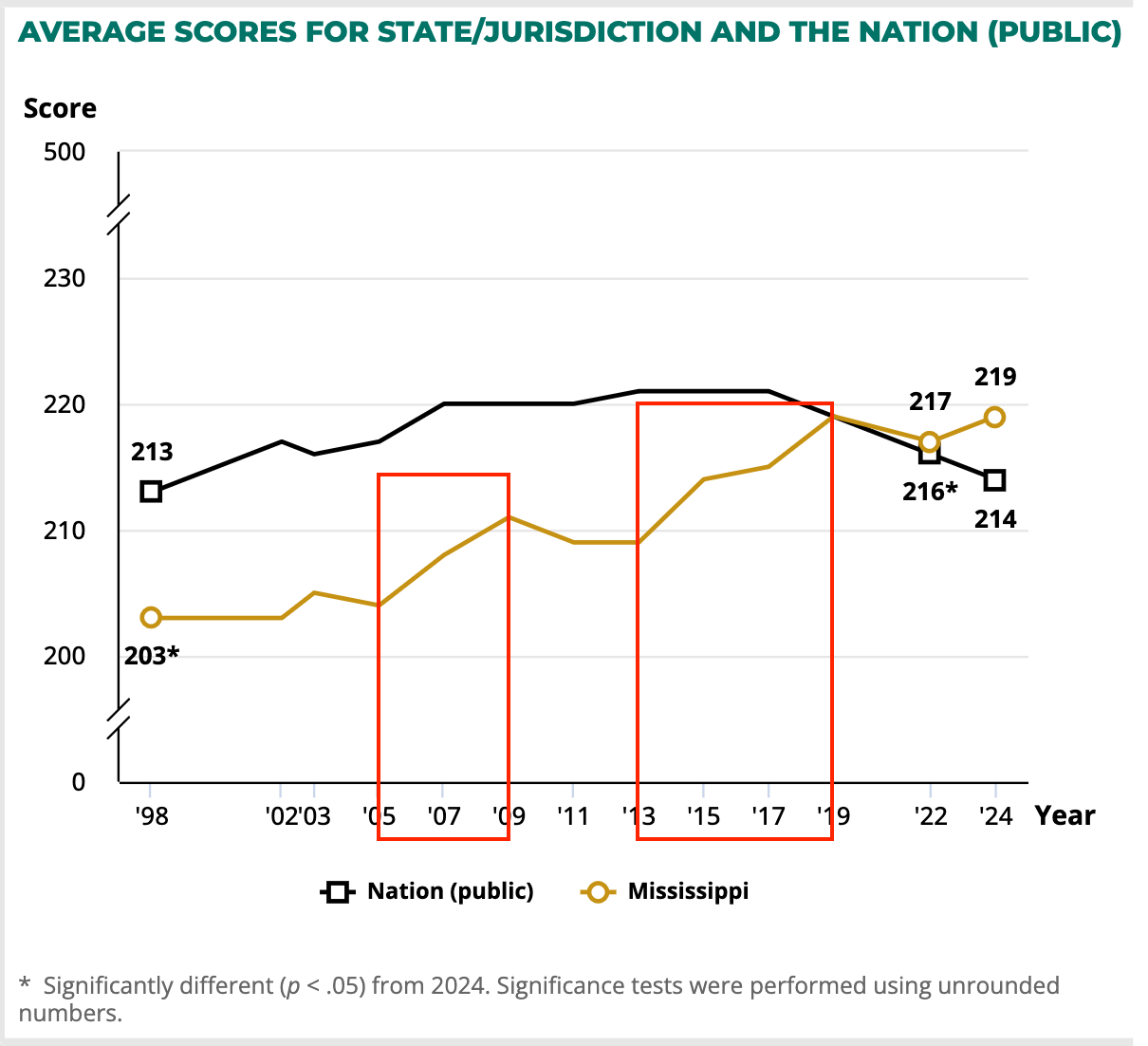
A bigger lesson, however, is taking greater care when deciding if reforms work as well as what causes that success. Related, as well, is assuring that the data used to decide success or failure represents learning.
Here the Mississippi story is much different that the media “miracle” or Cantor’s argument that high-stakes accountability has worked in the state.
Several questions must be answered.
If Mississippi’s reform has worked, why does the state have the same wealth and race gaps as in 1998?
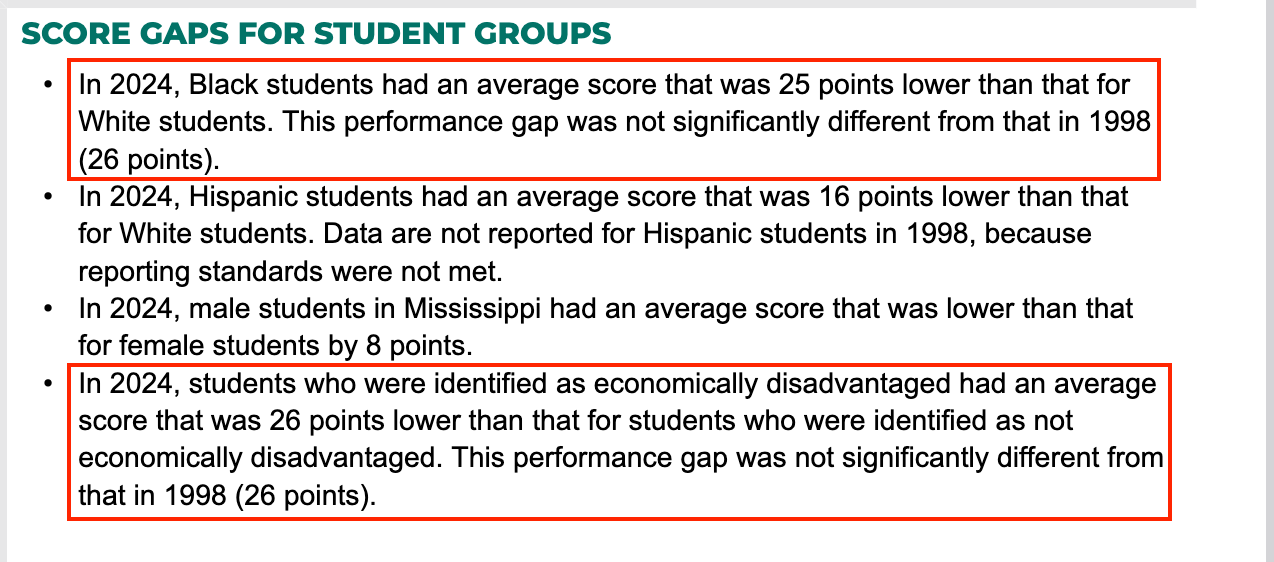
If Mississippi’s reform has worked, why does the state continue to retain about 9000 K-3 students per year?
- 2014-2015 – 3064 (grade 3) – 12,224 K-3 retained/ 32.2% proficiency
- 2015-2016 – 2307 (grade 3) – 11,310 K-3 retained/ 32.3% proficiency
- 2016-2017 – 1505 (grade 3) – 9834 K-3 retained / 36.1 % proficiency
- 2017-2018 – 1285 (grade 3) – 8902 K-3 retained / 44.7% proficiency
- 2018-2019 – 3379 (grade 3) – 11,034 K-3 retained / 48.3% proficiency
- 2021-2022 – 2958 (grade 3) – 10,388 K-3 retained / 46.4% proficiency
- 2022-2023 – 2287 (grade 3) – 9,525 K-3 retained/ 51.6% proficiency
- 2023-2024 – 2033 (grade 3) – 9,121 K-3 retained/ 57.7% proficiency
- 2024-2025 – 2132 (grade 3) – 9250 K-3 retained/ 49.4% proficiency
And most significantly, if Mississippi reform has worked, do the test score increases in grade 4 represent greater student learning?
There is little scientific evidence on this important question, but the evidence is suggesting a principle by Gerald Bracey: “Rising test scores do not necessarily mean rising achievement.”
First, an analysis of reading reform and a statistical analysis of Mississippi test score increases suggest that those increases are statistical manipulations caused by grade retention and not student learning.
When grade 8 data are compared to grade 4, those analyses seem accurate since states behind Mississippi in grade 4 catch and pass by grade 8 (include the subgroup of Black students):
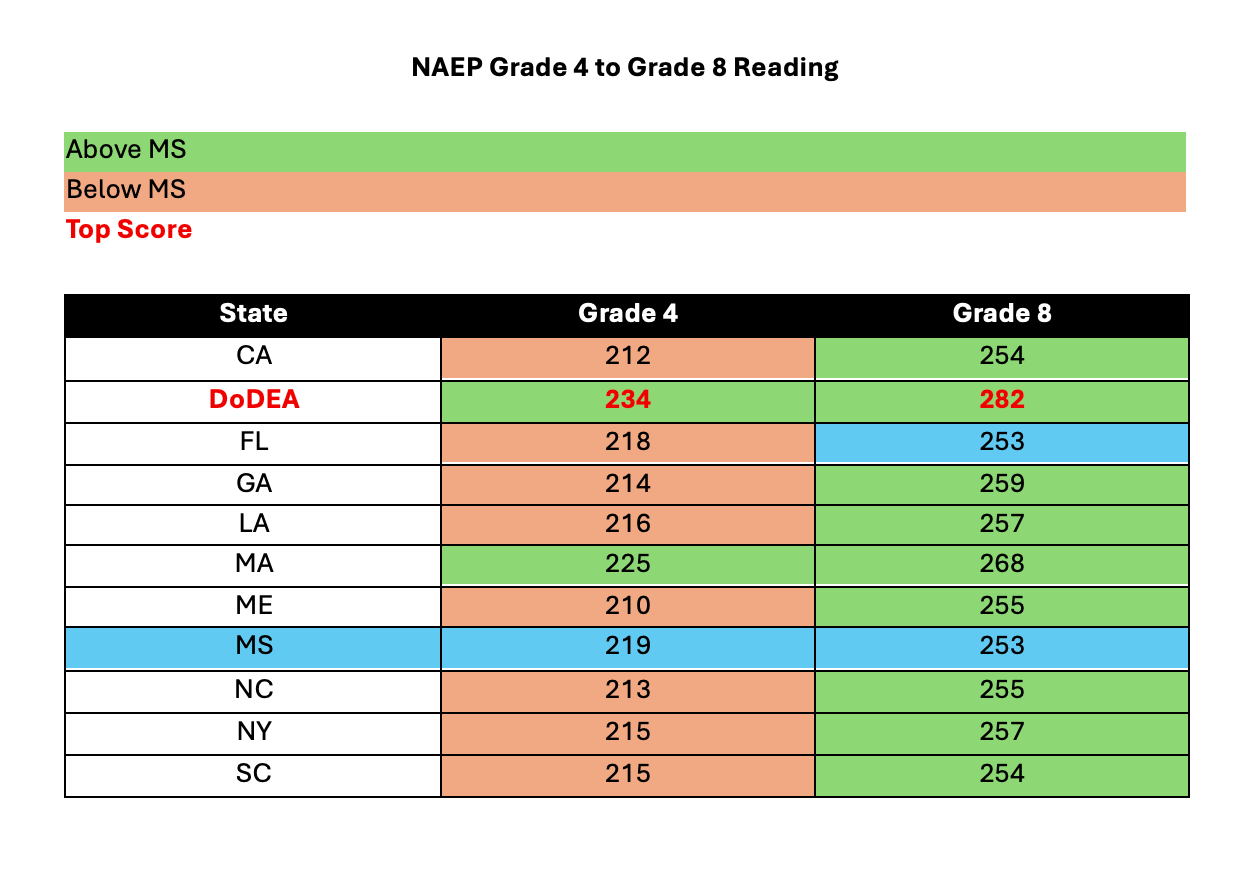
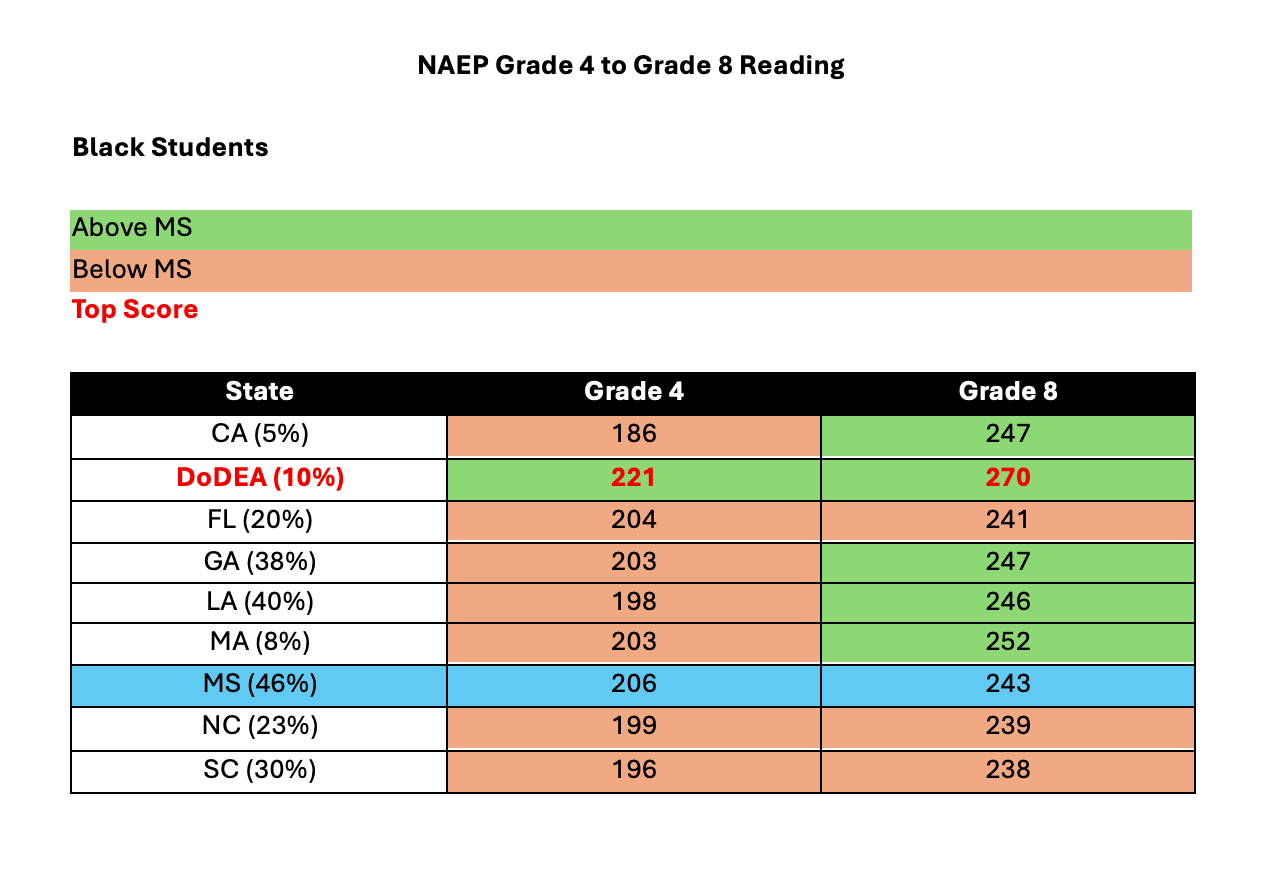
The irony here is that in 2019 when Hanford declared Mississippi reading reform a “miracle,” many uncritically jumped on that bandwagon.
The Atlantic article is receiving the same uncritical and effusive response—although it is no more credible.
Canter offers just a different compelling but ultimately misleading story.
As of 2026, there simply is no empirical evidence Mississippi’s reading reform has worked.
There remains no “science” in the multiverse of “science of reading” stories.
[1] One frustrating aspect of the “science of reading” movement has been the demand for “science” while advocates tend to use anecdotes, cherry pick evidence, and ignore research counter to their stories. Note the expectations, often ignored, for “scientific” by The Reading League:
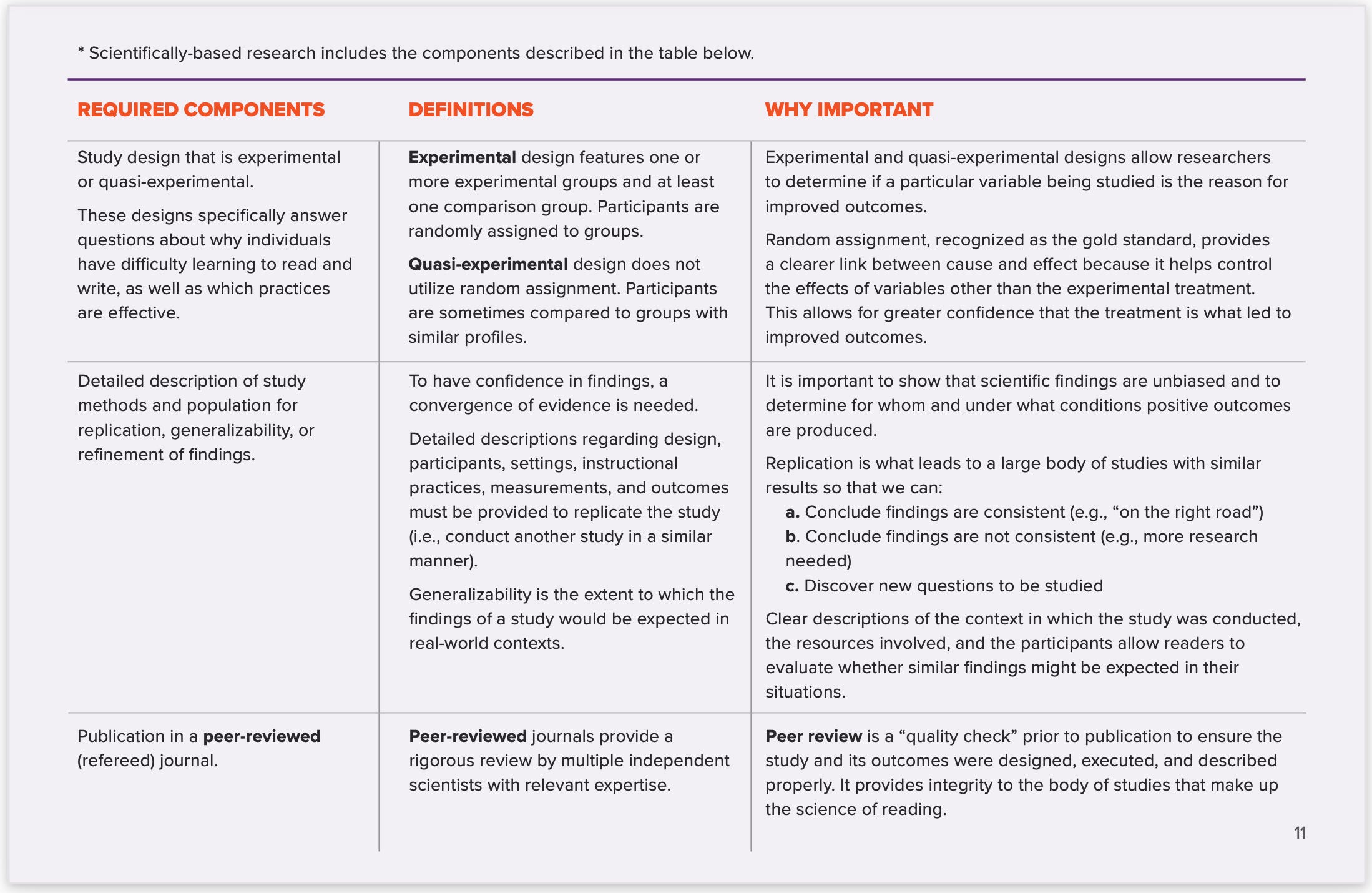
[2] I have four open-access articles in English Journal, documenting with research that the media stories (specifically by Emily Hanford) are misleading and inaccurate.
If you want to help with the costs of keeping my public work open access and free, please DONATE.
Subscribe to Paul Thomas
Launched 4 months ago
P.L. Thomas, Professor of Education (Furman University, Greenville SC), is the poetry editor for English Journal. NCTE named Thomas the 2013 George Orwell Award winner. Follow his work @plthomasEdD.


The so-called science of reading is another high profile political campaign to try to standardize reading instruction. There is no need for a national policy to dictate how reading is taught since curriculum is the responsibility of the states, not the federal government. The so-called miracle is simply a manipulation via the retention third grade students, and there is no actual miracle. SOR is another disruptive scheme that is backed by media campaign that will ultimately fall on its face because phonics, which is essential, is merely one aspect of reading. Comprehension or understanding is the actual goal, and it is much harder to achieve in areas with systemic, rampant poverty.
In another Thomas article he explains the “over promise and under deliver” potential of SOR compared to so many other ill conceived campaigns to improve academics with very little actual investment. He writes:
“The “science of reading” movement is deja vu all over again since the movement looks essentially like many other education reform patterns that have all failed (as many of us said they would) because they misunderstand the problem and grasp for silver-bullet solutions — all wrapped in a media and political frenzy that is almost impossible to stop. The trash heap of failure includes Teach for America, charter schools, accountability driven by standards and high-stakes testing, the NRP and Reading First, value-added methods of teacher evaluation and merit pay, and many others.”https://plthomasedd.medium.com/dismantling-the-science-of-reading-and-the-harmful-reading-policies-in-its-wake-d15d9fe6d8e0
LikeLiked by 1 person
I learned from you many years ago that every “miracle” schools story will turn out to be hogwash.
LikeLike
If it’s too good to be true, it probably ain’t.
LikeLiked by 1 person
Why, thank you, FLERP!
LikeLiked by 1 person
Test scores are decoupled from reflection of improvement due to the faulty logic of testing. People who give tests seem to think they can plumb the depths of understanding with a few questions. Wrong again, Mr Watson.
Consider music. I was listening to Beethoven’s Ode to Joy in his ninth symphony, and realized that I reacted to the music the same way I react to a fiddle tune called Forked Deer (back in the day, Senator Harry Byrd could play that tune on the fiddle). For any musical folks here, they both emphasize a part of the music by hanging around and in the dominant key before returning to the tonic to end the phrase.
If I asked children to know that bit of musical trivia, it would indicate almost nothing about their understanding of music. It would be a ridiculous test question, the answer to which would take us nowhere with regards to student understanding. Not even about music. I would have answered such a question “correctly” and received whatever accolades accompanied a correct answer, but it would not be meaningful.
this is the problem with miracles in education: they depend on little more than looking for particular answers to questions that someone thinks plumb the drops of student understanding. Test makers talk about Norming the question, seeing how many takers get it right. So what.
LikeLike
In addition to Paul’s good work, there’s another debunking of the so-called science of reading by Rachael Gabriel at the education media project which I help manage at The Progressive magazine. Here’s an excerpt:
“Unlike previous reading legislation, science of reading policies do not mandate or empower schools to use evidence-based practices. Instead, they focus on using products such as reading programs, assessments, and professional development. Often, these products come from for-profit companies that have lobbied state legislators to require public school classrooms to use their materials. Some products, such as Language Essentials for Teachers of Reading and Spelling (LETRS) trainings, are written directly into state laws, while others appear on lists of state-approved options to which districts must transition with tight timelines for compliance.”
And the link: https://progressive.org/public-schools-advocate/whats-behind-the-push-to-make-schools-adopt-the-science-of-reading-gabriel-20260417/
LikeLike
Thanks, Jeff.
The momentum for the “science of reading” is driven by publishers selling product.
LikeLike
Thomas provides a chart showing a substantial increase in test scores between 2005 and 2009 and writes: ‘One lesson ignored in the Mississippi story is that it suffers from “the moment” syndrome. I have been asking since the start of the “miracle” narrative: Why haven’t we looked at the historical increase in grade 4 NAEP reading scores, including an ignored spike well before the 2019 christening of “miracle”?:’ Not sure whom he asked without receiving a response. But if he were to type his question into a search bar, he might get an answer. Perhaps something like this, which I just received from Google:
===================================The 8-point jump in Mississippi’s 4th-grade NAEP reading scores between 2005 and 2009 was rooted in a foundational shift that began years before the 2013 Literacy-Based Promotion Act. These improvements were driven by private-public partnerships, new curriculum standards, and a targeted focus on teacher quality. 1. The Barksdale Reading Institute (BRI) Established in 2000 through a $100 million gift from Jim Barksdale (former CEO of Netscape), the Barksdale Reading Institute provided the “blueprint” for the state’s literacy gains. Scientific Approach: BRI partnered with the Mississippi Department of Education to implement the “Science of Reading”—focusing on phonics, fluency, and vocabulary—years before it became a national trend. School Coaching: It funded literacy coaches to work directly in high-poverty schools, providing hands-on training for teachers that the state was not yet funding. 2. Adoption of More Rigorous Standards Mississippi significantly updated its curriculum expectations to better align with national benchmarks. 2006 Curriculum Frameworks: In 2006, the state introduced more rigorous Language Arts and Math frameworks. These standards required students to master more complex texts and critical thinking skills at earlier grades. Accountability: The state began assigning letter grades (A–F) to schools, creating a culture where progress toward proficiency—not just a single test score—was measured and publicized. 3. Increased Professional Standards for Teachers To support the more rigorous standards, the state overhauled how it trained and supported its educators. Targeted Professional Development: Mississippi increased its investment in teacher training workshops specifically focused on the newly adopted standards. Universal Screening: By the mid-2000s, schools began using statewide screening tools three times a year (K–3) to identify struggling readers early, allowing teachers to adjust their instruction in real-time. 4. Other Contributing Factors Low Initial Baseline: In 2005, only 18% of Mississippi 4th graders were proficient in reading. The sheer volume of room for growth meant that even basic improvements in instructional consistency yielded large “miracle” gains on paper. Post-Katrina Resilience: Some research suggests that the massive influx of federal aid and the intense focus on “returning to normalcy” following Hurricane Katrina in 2005 inadvertently prioritized core academic stability in the following years.======================================With careful prompting, it might additionally detail the failure of his other charts up there to effectively buttress his general argument.Might even perhaps provide a link here:https://www.urban.org/research/publication/states-demographically-adjusted-performance-2024-national-assessment
LikeLike
Your assessment of Thomas’ shortcomings are right on target. Also, did you know that, despite Thomas’ assertions, in 2024 Mississippi did start to show improvements in NAEP Grade 8 Reading?
Because NAEP is a sampled assessment, a good way to consider performances is looking at statistically significant results. Back in 2013, when the reform act passed, Mississippi’s white 8th graders were statistically significantly outscored by whites in 43 other states on NAEP Reading. Flash forward to 2024 and only white students in just 7 states could make the same claim.
For Black students, the changes in NAEP Grade 8 Reading were equally notable. In 2013, Black students in 27 of the 42 states that got NAEP Grade 8 Reading scores outscored those in Mississippi by a statistically significant amount. By 2024, only those Black students in Colorado and Massachusetts could make the same claim.
One other point, between 2013 and 2024 the white minus Black achievement gap on Grade 8 NAEP was decreased by 6 NAEP Scale Score points, and the NAEP Data Explorer indicates that change was statistically significant, too.
LikeLike
But why do these improvements lead in post-8th grade? The ACT scores are marginally changed. Educational outcomes depend on investment in children’s lives and their families and communities.
LikeLike
It’s simply too soon to expect ACT to show results like those that started to really appear in Grade 4 in 2019 and then just started to appear in Grade 8 in 2024. Let’s see what happens with ACT next year and a couple of years after.
LikeLike
No, it’s not too soon to see whether the children who increased their 4th grade scores retained their improved reading skills by 11th grade, when every student takes the ACT.
If there was “miracle,” the ACT scores of those who were part of the “reform”should go up by impressive numbers. They didn’t.
In 2018 Average ACT was 18.6
2019 Average ACT 18.4
2020 Average ACT 18.2
2021 Average ACT 18.1
First cohort for their “reform” hit 11th grade in 2022
Average ACT 2022 17.8 (https://www.act.org/content/dam/act/unsecured/documents/2022/2022-Average-ACT-Scores-by-State.pdf)
Average ACT 2023 17.6
Average ACT 2024 17.7 (https://www.act.org/content/act/en/products-and-services/the-act/scores/average-act-test-scores-by-state.html)
Average ACT 2025 17.7
The Mississippi ACT scores dropped from 2018-2025.
The kids who were part of the “miracle” cohort had lower scores that the classes before them.
LikeLike
Diane, do you really think legislation just passed in 2013 would miraculously result in improvement just a year or two later? That’s what you are claiming.
In fact, it took the MS DOE 2 years just to start key programs like the instructional coaches. It took still more time for those coaches and other efforts to reach the field in appreciable numbers and start having impact.
That’s why what MS was doing didn’t get national attention until 2019 for Grade 4. Those 2019 4th graders didn’t hit Grade 8 until 2023, when there was no NAEP.
The next year after that, 2024, is when MS started to show improvements compared to other states, at least, in Grade 8 NAEP Reading (see my recent X post which has the supporting data for that statement: https://x.com/Innes434/status/2051455201790353722).
The very earliest we should expect to see any impacts in ACT, which MS tests in Grade 11, is 2026, and those scores won’t be available for many months.
As for the cohort that tested in Grade 8 in 2024, they won’t hit Grade 11 until 2027.
BTW, I don’t think MS is a miracle, either. But, as Rachel Canter discusses here: https://www.progressivepolicy.org/wp-content/uploads/2026/04/PPI_Mississippi-Marathon.pdf, things have been going on there for a while, but it takes a lot of time to make real change.
I suggest a bit more reasonable patience.
LikeLike
Richard,
The Mississippi story is being used to make diverse claims: that poverty doesn’t matter; that what happens outside school to children doesn’t matter. Social science does not agree. As I suggested in the post, read Richard Rothstein’s CLASS AND SCHOOLS.
Furthermore the “miracle” has been used to promote state laws telling teachers HOW to teach, which is absurd.
It would indeed be a miracle if our politicians ensured that every child had access to good medical care, good nutrition, and basic economic security. Instead, they prefer to mandate one way to teach and to ban other ways.
Nothing in my post suggested that dramatic results would be produced “a year or two” after the reforms were introduced in 2013.
I never claimed a miracle. I don’t believe in miracles. What I did say was pay attention to ACT scores from 2022-2025.
Five years from now, we will look back and say we were “sold a story.”
LikeLike
Diane,
Mississippi isn’t the only place where teachers have been given better instruction and tools to teach reading and produced amazing results despite high poverty.
I write about another example found in Kentucky here: https://web.archive.org/web/20240529213640/https://www.bipps.org/_files/
ugd/7833d4_5617781b9cf24ad68a0cafaff3c08a97.pdf.
Regarding your position on poverty, I think you might be confusing correlation with causation. Any decent Freshman 101 statistics course teaches that you cannot establish causation with a correlation. It’s an extremely common error on the part of educators. Refusing out of hand to accept growing evidence that schools, given the right tools and training, can make notable progress despite poverty could be an example of this.
I think there already is good evidence that something of importance is happening in Mississippi. Figuring out what exactly in their multi-pronged approach is most important is complicated work, however. It might be all the elements are needed. And, more work might be required for higher grades, as well.
I agree that we will see all of this more clearly as time goes on, possibly in less than 5 more years. Of course, Mississippi could step back from what it is doing (how many reforms have failed for lack of patience?), but I am hopeful that won’t happen.
LikeLike
Hi Diane,
How would you compare the decline in Mississippi ACT scores with those of other states during and after Covid?
Do you think that skill in reading is necessarily tightly correlated with ACT scores?
If not, do you see value in reading skills apart from the skills reflected by ACT scores?
(I confess that the responses I received from Gemini to the first two of those questions seemed quite reasonable to me, but I remain open to any contrary view. I didn’t prompt Gemini with the third. My own response would be a, likely more concise: “yes of course”).
LikeLike
I thought it was a fair comparison to compare one standardized test (NAEP) to another (ACT), especially since one showed very impressive results.
I am not a fan of standardized tests for reasons I have repeatedly stated. I am not advocating for the ACT or College Board.
If a reading “miracle” has happened in Mississippi, scores should be higher as students advance in grades.
100% of students in Mississippi take the ACT. If there had been a “miracle” in reading, ACT scores should rise. They didn’t.
The much earlier evaluation of NCLB’s Reading First program (a $6 billion reading program based on the “science of reading”) reached a similar conclusion. The students were better at all the parts of the reading program, but there was no improvement in comprehension.
Isn’t comprehension the reason for reading?
LikeLike
Diane, once again, it is too early to expect a reform aimed at K to Grade 3 to already impact Mississippi’s ACT scores.
Impacts of the reform really started to show in Grade 4 NAEP in 2019. That could have shown in a 2023 NAEP, but the NAEP was cancelled that year due to COVID. The next NAEP was given in 2024, and despite claims from some, compared to other states Mississippi started to show improvements in Grade 8 NAEP Reading in 2024.
You can see that for yourself if you use the NAEP Data Explorer to examine NAEP Grade 8 Reading scores by race for white and Black students in all states in 2013 and 2024. For white students, in 2013 Mississippi’s 8th graders were statistically significantly outperformed by white students in 43 other states. In 2024, only white students in 7 states could make the same claim. For Black students, Mississippi’s were statistically significantly outscored by those in 27 other states in 2013. By 2024, only Black students in Colorado and Massachusetts could make the same claim.
Mississippi does statewide ACT testing in Grade 11. Even the 8th graders from 2023 didn’t enter that test pool until 2026, and we have not seen those results and won’t for many months.
Also keep in mind that Mississippi continued to improve in Grade 4 NAEP Reading after 2019, and it will be even longer before they hit Grade 11. So, let’s see what happens in a couple of more years and stop trying to kill something before it even has a reasonable chance to prove itself.
LikeLike
“ACT scores should rise. They didn’t.”
Are you taking Covid fully into consideration, Diane?
Gemini’s response included:
“1. The Stagnation vs. The National Slide
While many states saw a dramatic “COVID cliff” in ACT scores that they are still struggling to climb back from, Mississippi’s scores have remained relatively flat.”
I can’t confirm that is true. Do you believe otherwise?
And now I just prompted Gemini with this:
“It seems possible to me that decoding ability better facilitates depth of understanding of subjects that are of interest to the particular reader rather breadth of understanding in subjects that are not. And reading comprehension tests may necessarily better measure the latter?”
I received an answer that seemed well-informed and reasonable. Might you try offering a similar prompt? Or are you disinclined to engage with such reservoirs?
LikeLike
Stephen,
COVID was finished in mid-2023.
Why would it depress 11th grade ACT scores but not 4th grade scores.
If a miracle doesn’t have lasting effects, it’s not a miracle.
LikeLike
Diane just doesn’t seem to understand that a reform aimed at K to 3 can’t be expected to change ACT testing in Grade 11 for many years. See my earlier comments which for unknown reasons were identified as from “zestful523fa13eac.” Richard Innes
LikeLike
“Why would it depress 11th grade ACT scores but not 4th grade scores.”
Covid did. of course, dramatically depress 4th grade NAEP scores throughout most of the country.
You wonder why Mississippi scores were uncommonly resilient? Not a miracle, we can agree.
Per Gemini:
====
1. The Early Return
While many large school districts in the Northeast and West Coast remained fully virtual or hybrid well into 2021, Mississippi pushed for a “traditional” return much sooner.
By the end of the 2020-21 school year, data showed that 65% of Mississippi students had spent the year primarily in-person. In contrast, many peer states and large urban centers were still hovering at 20–30% in-person.
2. High-Dose Exposure to Literacy Because Mississippi had already implemented a very structured, “Science of Reading” curriculum (as we discussed), being in person allowed teachers to execute that high-intensity coaching and phonics “drill” that is notoriously difficult to do over Zoom.
The “Double Whammy”: Mississippi had a superior system (structured literacy) and superior access (in-person days). The Result: 4th graders in Mississippi received more hours of direct, face-to-face instruction in the “mechanics” of reading during the critical 2020–2022 window than their peers in states like California or New York.
3. Comparing the “In-Person” Impact The Harvard Center for Education Policy Research conducted a study on the 2022 NAEP scores and found a direct correlation between remote learning and score declines:
2020-2021 Reading Loss
Primarily in person -1 to -2 (NAEP points)
Primarily remote -6 to -8
==========
LikeLike
Good 4th grade scores. No lasting effect.
LikeLike
“Good 4th grade scores. No lasting effect.”
You are not favorably impressed by demographically adjusted scoring that shows Mississippi having thus far achieved fourth place nationally in respect to 8th grade scores?
LikeLike
A lasting effect would persist through high school, don’t you think?
LikeLike
“A lasting effect would persist through high school, don’t you think?”
It would. And I have yet to see any convincing evidence that it does not in respect to MS reading improvements.
Instead, when I seek to learn “Overall how closely do ACT scores compare state to state relative to NAEP scores?” I am informed that, “The correlation is generally higher in Math (roughly 0.81–0.91) than in Reading (0.72–0.74).”
More importantly, in our consideration of ACT scores, have we perhaps been missing the significance of graduation rates?
When I inquire: “How have Mississippi graduation rates changed over the past decade?” the response is startling. I would encourage you to inquire similarly. The response I received includes:
=========
Mississippi’s high school graduation rate has seen a dramatic upward trend over the last decade, rising from one of the lowest in the country to exceeding the national average.As of the 2024-25 school year, Mississippi reached a historic high graduation rate of 90.8%, a significant climb from 74.5% in the 2013-14 school year.
Key Improvements by Subgroup
The Mississippi Department of Education (MDE) highlights that several subgroups have seen even more dramatic gains over this period:
Students with Disabilities: The graduation rate for this group nearly tripled, rising from 23.2% in 2014 to 71.1% in 2025.
Race-Based Gap: The graduation gap between Black and White students has narrowed significantly since 2014, when it was 7.4 percentage points.
CTE Completers: Students completing Career and Technical Education (CTE) programs achieved an exceptionally high graduation rate of 99.5% in recent accountability years.
========================
Would you agree that all that, if true, would entirely deflate the ACT score critique advanced by skeptics?
I continue to anticipate that the hugely important gains in capacity measured by MS NAEP reading tests in Mississippi do persist throughout High School.
LikeLike
Let’s revisit the question in 5-10 years.
Mississippi is still one of the poorest states in the nation and one of the most racist.
After the latest Supreme Court decision on VRA, Mississippi may or may not have even one Black member of Congress.
Changing those conditions would be a miracle.
LikeLike