Paul L. Thomas of Furman University has been a persistent critic of the narrative about the “Mississippi Miracle.” The story gained great traction when New York Times‘ columnist Nicholas Kristof took it national on September 1, 2023, in an article titled: “America Has a Reading Problem. Mississippi Has a Solution.” The “miracle” supposedly was accomplished without doing anything to improve the lives of children and their families, without even raising teachers’ salaries. The “science of reading” did the trick; that, plus holding back third graders who didn’t pass the final reading test.
Many articles have been written since then recycling the claim that the “science of reading” was largely responsible for the impressive growth in Mississippi’s fourth grade reading scores on NAEP (the National Assessment of Educational Progress), which is administered every two years. If only states forced teachers to teach the “science of reading,” there would be no failure in reading (except, of course, for the students who were retained in third grade and not participants in the fourth grade testing.)
The “Mississippi Miracle” allegedly occurred within the context of a “Southern Surge,” where low-spending, non-union states like Alabama and Louisiana also participated in a miraculous increase in reading scores. These professors complexified that claim recently.
The most recent article confirming the “miracle” appeared in The Atlantic and was written by Rachel Canter, who participated in the Mississsippi reforms as leader of Mississippi First and is now at the Progressive Policy Institute in Washington, D.C.
Paul Thomas writes on his Substack blog:
“No story has caught the imagination of education reformers this decade quite like the ‘Mississippi miracle,’” Rachel Canter asserts in The Atlantic, adding:
Other states are now trying to emulate what Mississippi did. Those efforts largely revolve around adopting what’s known as the “science of reading”— a set of principles and teaching techniques, including phonics, that are grounded in decades of empirical research.
Canter, the Director of Education Policy at the Progressive Policy Institute, released as well a report on Mississippi reading and education reform, noting:
I personally spent 17 years helping state leaders run that race. As the head of Mississippi First, a nonprofit I founded in 2008, I played a hand in, and sometimes led, many of the state’s key education policy conversations with the legislature while also working with the Mississippi Department of Education to implement the reform agenda. This is my insider’s view of what policymakers, philanthropists, and pundits should know about what really happened.
Both Canter’s article and her report are lessons themselves in how education reform in the US works, specifically during this cycle driven by the “science of reading” and “science of learning.”
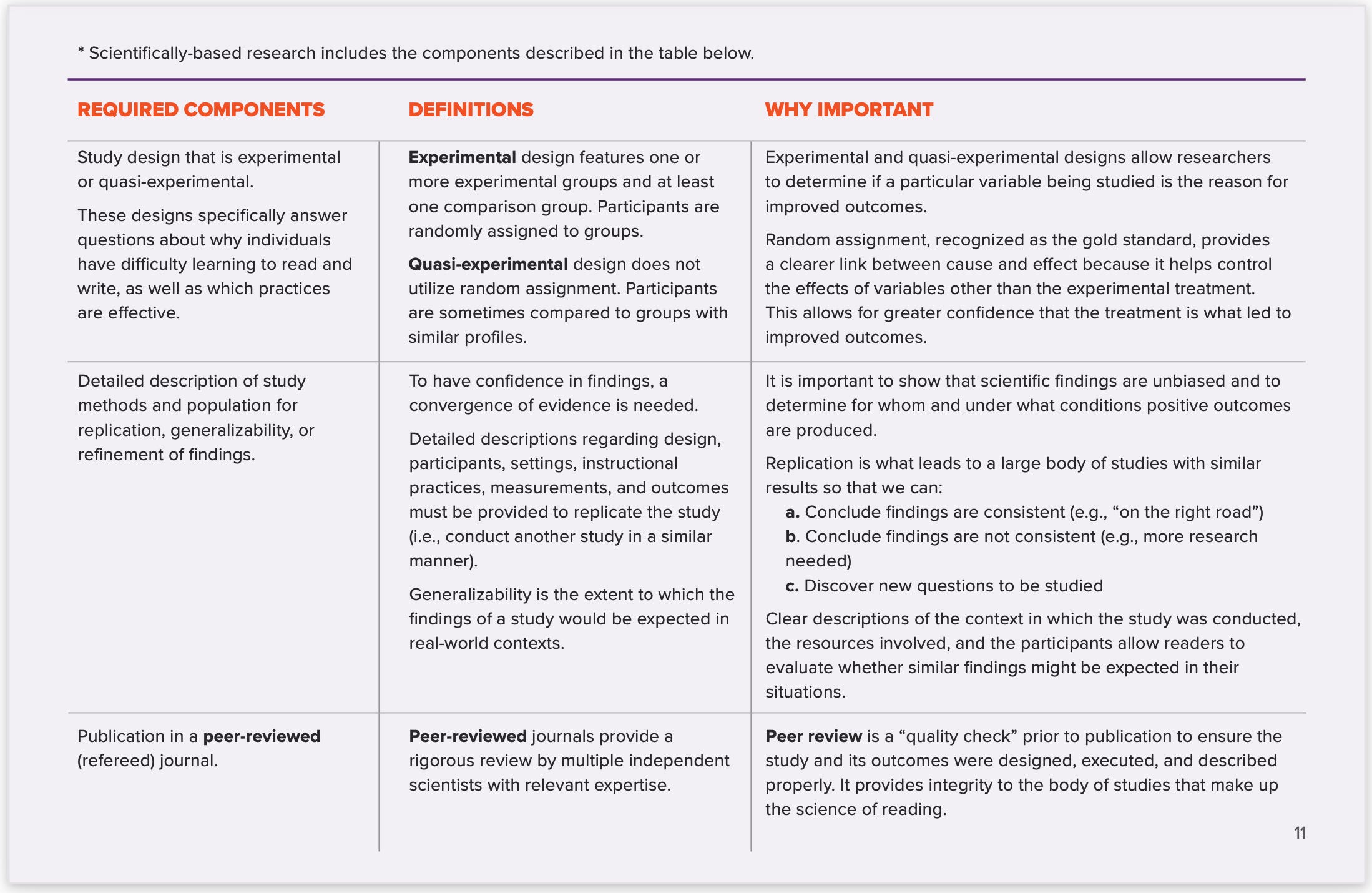
Notably, Canter mentions “empirical research,” yet neither a magazine article nor a think tank report meet the standards of “scientific” championed by “science of” reformers—experimental/quasi-experimental research published in peer-reviewed journals [1].
Also, Canter’s article introduces on a larger scale one of the many multiverses of the “science of reading” existing currently.
The article and report express what Mississippi officials have been arguing for a while: Mississippi reform is not a miracle; it is many years of hard and complex work.
Canter, in fact, seems to double-down on Mississippi reform is effective due to high-stakes accountability (the core of education reform since Reagan, reform that has never worked but perpetuated a permanent cycle of crisis and reform in the US).
I will return to Canter’s argument about Mississippi’s reform success, but I think the criticism of overly simplistic stories about the Mississippi “miracle” are valid and many are beginning to acknowledge that news articles and podcasts have driven reductive and misguided reading reform, policy, and classroom practice [2].
In short, a lesson we should learn, finally, is to reject “miracle” narratives in education.
Lessons Ignored (And Questions Unanswered)
The problem with Canter’s article and report (beyond that they lack experimental rigor) is that her claims are just as misleading and often just as incomplete as the media stories being sold.
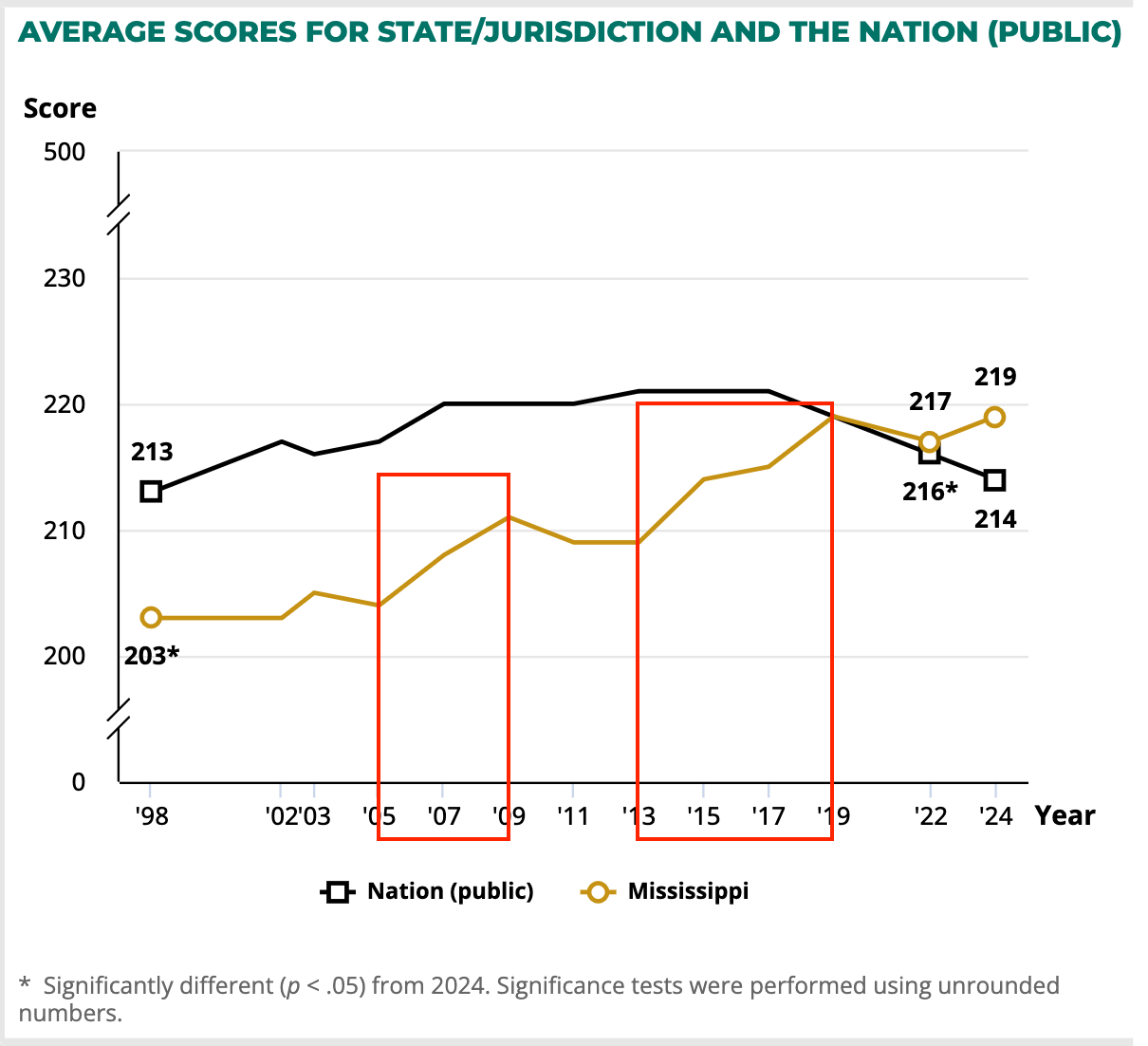
One lesson ignored in the Mississippi story is that it suffers from “the moment” syndrome. I have been asking since the start of the “miracle” narrative: Why haven’t we looked at the historical increase in grade 4 NAEP reading scores, including an ignored spike well before the 2019 christening of “miracle”?:
A bigger lesson, however, is taking greater care when deciding if reforms work as well as what causes that success. Related, as well, is assuring that the data used to decide success or failure represents learning.
Here the Mississippi story is much different that the media “miracle” or Cantor’s argument that high-stakes accountability has worked in the state.
Several questions must be answered.
If Mississippi’s reform has worked, why does the state have the same wealth and race gaps as in 1998?
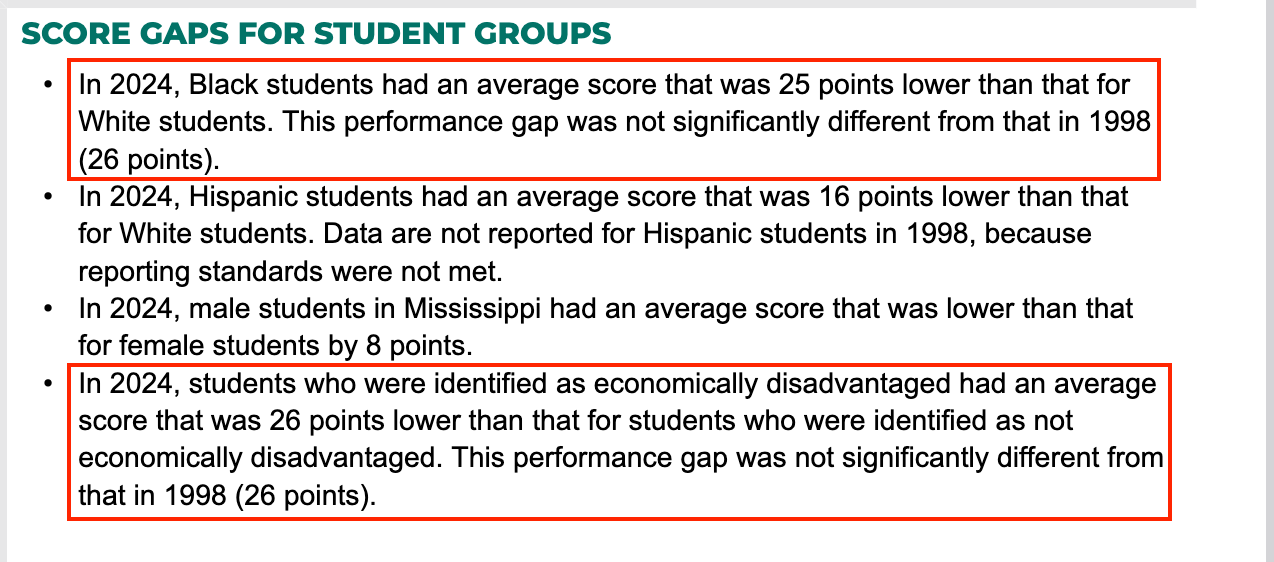
If Mississippi’s reform has worked, why does the state continue to retain about 9000 K-3 students per year?
- 2014-2015 – 3064 (grade 3) – 12,224 K-3 retained/ 32.2% proficiency
- 2015-2016 – 2307 (grade 3) – 11,310 K-3 retained/ 32.3% proficiency
- 2016-2017 – 1505 (grade 3) – 9834 K-3 retained / 36.1 % proficiency
- 2017-2018 – 1285 (grade 3) – 8902 K-3 retained / 44.7% proficiency
- 2018-2019 – 3379 (grade 3) – 11,034 K-3 retained / 48.3% proficiency
- 2021-2022 – 2958 (grade 3) – 10,388 K-3 retained / 46.4% proficiency
- 2022-2023 – 2287 (grade 3) – 9,525 K-3 retained/ 51.6% proficiency
- 2023-2024 – 2033 (grade 3) – 9,121 K-3 retained/ 57.7% proficiency
- 2024-2025 – 2132 (grade 3) – 9250 K-3 retained/ 49.4% proficiency
And most significantly, if Mississippi reform has worked, do the test score increases in grade 4 represent greater student learning?
There is little scientific evidence on this important question, but the evidence is suggesting a principle by Gerald Bracey: “Rising test scores do not necessarily mean rising achievement.”
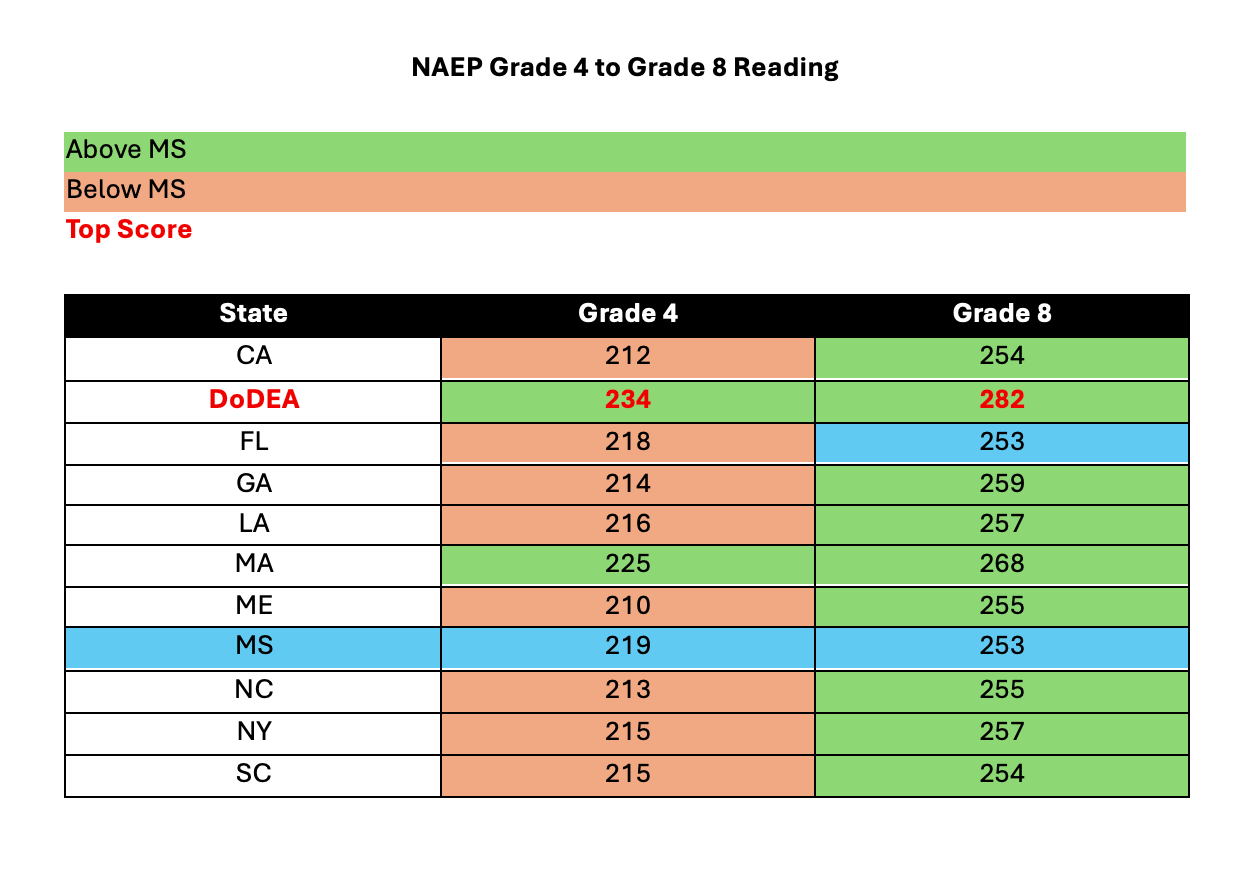
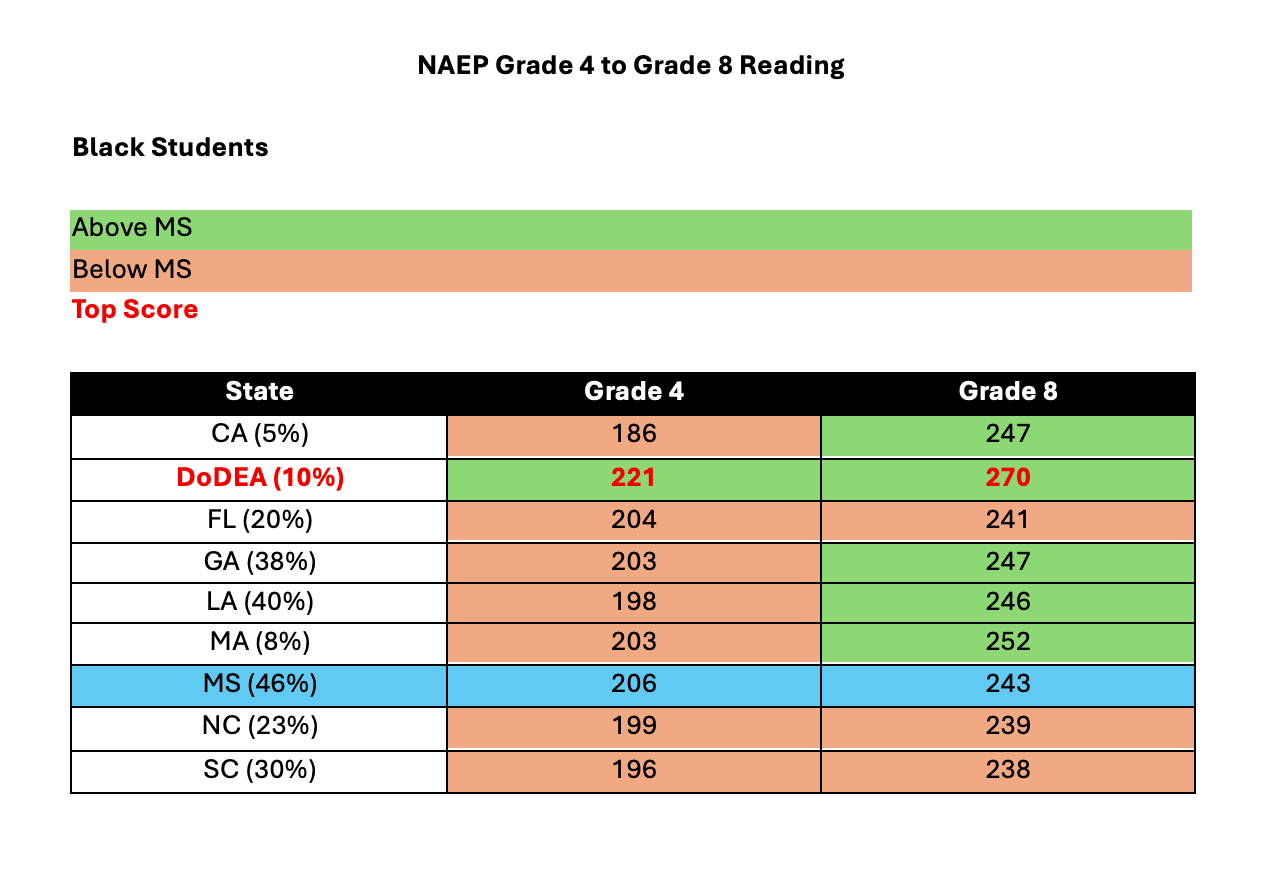
First, an analysis of reading reform and a statistical analysis of Mississippi test score increases suggest that those increases are statistical manipulations caused by grade retention and not student learning.
When grade 8 data are compared to grade 4, those analyses seem accurate since states behind Mississippi in grade 4 catch and pass by grade 8 (include the subgroup of Black students):
The irony here is that in 2019 when Hanford declared Mississippi reading reform a “miracle,” many uncritically jumped on that bandwagon.
The Atlantic article is receiving the same uncritical and effusive response—although it is no more credible.
Canter offers just a different compelling but ultimately misleading story.
As of 2026, there simply is no empirical evidence Mississippi’s reading reform has worked.
There remains no “science” in the multiverse of “science of reading” stories.
[1] One frustrating aspect of the “science of reading” movement has been the demand for “science” while advocates tend to use anecdotes, cherry pick evidence, and ignore research counter to their stories. Note the expectations, often ignored, for “scientific” by The Reading League:
[2] I have four open-access articles in English Journal, documenting with research that the media stories (specifically by Emily Hanford) are misleading and inaccurate.
If you want to help with the costs of keeping my public work open access and free, please DONATE.
Subscribe to Paul Thomas
Launched 4 months ago
P.L. Thomas, Professor of Education (Furman University, Greenville SC), is the poetry editor for English Journal. NCTE named Thomas the 2013 George Orwell Award winner. Follow his work @plthomasEdD.

 Diane Ravitch's blog
The so-called science of reading is another high profile political campaign to try to standardize reading instruction. There is no need for a national policy to dictate how reading is taught since curriculum is the responsibility of the states, not the federal government. The so-called miracle is simply a manipulation via the retention third grade students, and there is no actual miracle. SOR is another disruptive scheme that is backed by media campaign that will ultimately fall on its face because phonics, which is essential, is merely one aspect of reading. Comprehension or understanding is the actual goal, and it is much harder to achieve in areas with systemic, rampant poverty.
In another Thomas article he explains the “over promise and under deliver” potential of SOR compared to so many other ill conceived campaigns to improve academics with very little actual investment. He writes:
“The “science of reading” movement is deja vu all over again since the movement looks essentially like many other education reform patterns that have all failed (as many of us said they would) because they misunderstand the problem and grasp for silver-bullet solutions — all wrapped in a media and political frenzy that is almost impossible to stop. The trash heap of failure includes Teach for America, charter schools, accountability driven by standards and high-stakes testing, the NRP and Reading First, value-added methods of teacher evaluation and merit pay, and many others.”https://plthomasedd.medium.com/dismantling-the-science-of-reading-and-the-harmful-reading-policies-in-its-wake-d15d9fe6d8e0
LikeLike
I learned from you many years ago that every “miracle” schools story will turn out to be hogwash.
LikeLike
If it’s too good to be true, it probably ain’t.
LikeLiked by 1 person
Why, thank you, FLERP!
LikeLiked by 1 person
Test scores are decoupled from reflection of improvement due to the faulty logic of testing. People who give tests seem to think they can plumb the depths of understanding with a few questions. Wrong again, Mr Watson.
Consider music. I was listening to Beethoven’s Ode to Joy in his ninth symphony, and realized that I reacted to the music the same way I react to a fiddle tune called Forked Deer (back in the day, Senator Harry Byrd could play that tune on the fiddle). For any musical folks here, they both emphasize a part of the music by hanging around and in the dominant key before returning to the tonic to end the phrase.
If I asked children to know that bit of musical trivia, it would indicate almost nothing about their understanding of music. It would be a ridiculous test question, the answer to which would take us nowhere with regards to student understanding. Not even about music. I would have answered such a question “correctly” and received whatever accolades accompanied a correct answer, but it would not be meaningful.
this is the problem with miracles in education: they depend on little more than looking for particular answers to questions that someone thinks plumb the drops of student understanding. Test makers talk about Norming the question, seeing how many takers get it right. So what.
LikeLike
In addition to Paul’s good work, there’s another debunking of the so-called science of reading by Rachael Gabriel at the education media project which I help manage at The Progressive magazine. Here’s an excerpt:
“Unlike previous reading legislation, science of reading policies do not mandate or empower schools to use evidence-based practices. Instead, they focus on using products such as reading programs, assessments, and professional development. Often, these products come from for-profit companies that have lobbied state legislators to require public school classrooms to use their materials. Some products, such as Language Essentials for Teachers of Reading and Spelling (LETRS) trainings, are written directly into state laws, while others appear on lists of state-approved options to which districts must transition with tight timelines for compliance.”
And the link: https://progressive.org/public-schools-advocate/whats-behind-the-push-to-make-schools-adopt-the-science-of-reading-gabriel-20260417/
LikeLike
Thanks, Jeff.
The momentum for the “science of reading” is driven by publishers selling product.
LikeLike
Thomas provides a chart showing a substantial increase in test scores between 2005 and 2009 and writes: ‘One lesson ignored in the Mississippi story is that it suffers from “the moment” syndrome. I have been asking since the start of the “miracle” narrative: Why haven’t we looked at the historical increase in grade 4 NAEP reading scores, including an ignored spike well before the 2019 christening of “miracle”?:’ Not sure whom he asked without receiving a response. But if he were to type his question into a search bar, he might get an answer. Perhaps something like this, which I just received from Google:
===================================The 8-point jump in Mississippi’s 4th-grade NAEP reading scores between 2005 and 2009 was rooted in a foundational shift that began years before the 2013 Literacy-Based Promotion Act. These improvements were driven by private-public partnerships, new curriculum standards, and a targeted focus on teacher quality. 1. The Barksdale Reading Institute (BRI) Established in 2000 through a $100 million gift from Jim Barksdale (former CEO of Netscape), the Barksdale Reading Institute provided the “blueprint” for the state’s literacy gains. Scientific Approach: BRI partnered with the Mississippi Department of Education to implement the “Science of Reading”—focusing on phonics, fluency, and vocabulary—years before it became a national trend. School Coaching: It funded literacy coaches to work directly in high-poverty schools, providing hands-on training for teachers that the state was not yet funding. 2. Adoption of More Rigorous Standards Mississippi significantly updated its curriculum expectations to better align with national benchmarks. 2006 Curriculum Frameworks: In 2006, the state introduced more rigorous Language Arts and Math frameworks. These standards required students to master more complex texts and critical thinking skills at earlier grades. Accountability: The state began assigning letter grades (A–F) to schools, creating a culture where progress toward proficiency—not just a single test score—was measured and publicized. 3. Increased Professional Standards for Teachers To support the more rigorous standards, the state overhauled how it trained and supported its educators. Targeted Professional Development: Mississippi increased its investment in teacher training workshops specifically focused on the newly adopted standards. Universal Screening: By the mid-2000s, schools began using statewide screening tools three times a year (K–3) to identify struggling readers early, allowing teachers to adjust their instruction in real-time. 4. Other Contributing Factors Low Initial Baseline: In 2005, only 18% of Mississippi 4th graders were proficient in reading. The sheer volume of room for growth meant that even basic improvements in instructional consistency yielded large “miracle” gains on paper. Post-Katrina Resilience: Some research suggests that the massive influx of federal aid and the intense focus on “returning to normalcy” following Hurricane Katrina in 2005 inadvertently prioritized core academic stability in the following years.======================================With careful prompting, it might additionally detail the failure of his other charts up there to effectively buttress his general argument.Might even perhaps provide a link here:https://www.urban.org/research/publication/states-demographically-adjusted-performance-2024-national-assessment
LikeLike
Your assessment of Thomas’ shortcomings are right on target. Also, did you know that, despite Thomas’ assertions, in 2024 Mississippi did start to show improvements in NAEP Grade 8 Reading?
Because NAEP is a sampled assessment, a good way to consider performances is looking at statistically significant results. Back in 2013, when the reform act passed, Mississippi’s white 8th graders were statistically significantly outscored by whites in 43 other states on NAEP Reading. Flash forward to 2024 and only white students in just 7 states could make the same claim.
For Black students, the changes in NAEP Grade 8 Reading were equally notable. In 2013, Black students in 27 of the 42 states that got NAEP Grade 8 Reading scores outscored those in Mississippi by a statistically significant amount. By 2024, only those Black students in Colorado and Massachusetts could make the same claim.
One other point, between 2013 and 2024 the white minus Black achievement gap on Grade 8 NAEP was decreased by 6 NAEP Scale Score points, and the NAEP Data Explorer indicates that change was statistically significant, too.
LikeLike
But why do these improvements lead in post-8th grade? The ACT scores are marginally changed. Educational outcomes depend on investment in children’s lives and their families and communities.
LikeLike