I am a proud alumna of Wellesley College, class of 1960. Wellesley literally changed my life. My best friends today are classmates; we meet monthly on Zoom to compare notes. We confess our deepest hopes and fears and stand by one another. I have returned for Reunion every five years since graduation. I love the campus and the memories.
I have supported an annual lecture series at Wellesley that has brought terrific thinkers to the campus.
Not long ago, my sons endowed a Professorship in my name, the first endowed chair in the education department. It is called The Diane Silvers Ravitch ’60 Chair in Public Education and the Common Good. The first person to hold the chair is a brilliant young scholar named Soo Hong.
Last night, after midnight, one of my dear classmates sent this review, just published. It made me very happy.
About-Face
Books and media by the Wellesley community
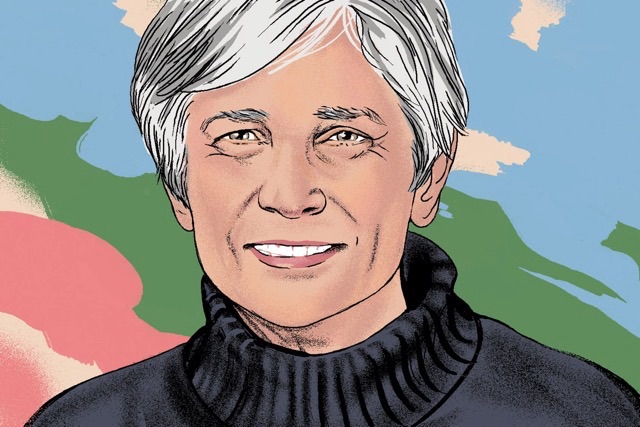
Image credit: Agata Nowicka
AUTHOR Catherine O’Neill Grace
PUBLISHED ON February 24, 2026
ISSUE WINTER 2026
“I was wrong” is one of the most difficult things for a human being to say. Imagine saying it when you have been a conservative public intellectual and expert on public education for decades. Yet that is exactly what Diane Silvers Ravitch ’60 does in her engaging new memoir, An Education: How I Changed My Mind About Schools and Almost Everything Else.
The author of numerous books about the history of American education and education policy, Ravitch turns to the personal in this volume, describing in depth her childhood in Houston, her experience at a segregated public high school, and her journey to Wellesley College in the fall of 1956.
At Wellesley, Ravitch learned not what to think, but how. She arrived on campus feeling, by her own account, like a “fish out of water.” But the College provided her with brilliant peers, gifted teachers, lively debate, and enriching friendships—including with “Maddy,” Madeleine Korbel Albright ’59. She recounts the hilarity of writing the junior show, Call It Red, and the excitement of seeing Fidel Castro speak at Harvard while she was working as a reporter for the Wellesley News.
A political science major at Wellesley, Ravitch went on to earn a Ph.D. in history from Columbia. As her memoir unfolds, she writes openly of loss—the anguish of the death of her 2-year-old son from leukemia, the painful dissolution of her first marriage. And she writes of love—at an education conference in 1984, she met teacher Mary Butz, who became her wife.
She also writes about intellectual transformation. As an education reformer, Ravitch believed deeply in standards, accountability, high-stakes testing, and school choice. Woven through the book is an account of her transition from outspoken supporter of conservative, market-driven policies in public education to one of their most forceful critics. Like many policymakers of the late 20th century, she saw competition, data, and pressure as levers that could fix public education. Serving in senior government roles, including assistant secretary of education during the George H. W. Bush administration, she helped advance reforms rooted in these assumptions, convinced they would raise achievement and close gaps.
But watching these policies unfold in real schools forced her to confront their consequences. High-stakes testing narrowed curricula and hamstrung teachers. Charter expansion and privatization failed to deliver promised gains while draining critical resources from public systems. Most troubling, education reformers increasingly blamed educators for failures that Ravitch now sees as driven by poverty and inequality. Children—especially poor children—were being left behind.
By the end of An Education, Ravitch emerges as a committed advocate for public schools, professional teachers, and democratic accountability. She followed the facts where they led and changed her mind. In this open-hearted, expansive memoir, she explains why.
A former classroom teacher, Grace is senior associate editor of this magazine
Diane Silvers Ravitch ’60
An Education: How I Changed My Mind About Schools and Almost Everything Else
Columbia University Press, 248 pages, $24.95

 Diane Ravitch's blog
I have all of her books and have just read this one. It was touching to hear how thoughtfully she addressed her life, experiences, and the metamorphosis that transformed her into one of the most powerful advocates for education, children, and democracy. I highly recommend everyone read it, share it, and understand the courage it takes to “change your mind”.
Thank you, Diane!
LikeLike
Thank you, Susan.
LikeLike
Diane — As I have said before, it is an honor knowing you. You welcomed me in to your blog, let me share, and it is a blessing for me because I have always loved to write. But, for the longest time guarded my words for fear of retribution. My friend and I collaborated on a book about educational reform “Get Over it” by Caren Black. I did the illustrations for her concepts yet we talked about it every day until it was published. One of the concepts was the “living system.” We keep the good and throw out the bad (but learn from it). One of the things I do recall about public education is the bureaucracy. I was never one to wear “rose colored glasses,” but rather to inspect and delve into building a better system. And, there were plenty of things that I thought I knew only later to change my mind. Again, and again. All I know, is when I could tell a student, “See this book? Well, I actually have had discussions with the author.” The kids eyes lighted up. I told them if they liked something to express their feelings to the author. I started doing that and oh the feeling I got when someone actually internalized my thoughts and responded. I existed. I have done that with many artists. But like I said, to look at a book, and that book becomes a living thing — priceless. Last word, you should check out the “Buy Now” documentary on Netflix. There is the CEO of Adidas who completely changed his entire philosophy on the shoe/apparel world — changed his mind after believing wholeheartedly one way. And, just for grins, check out this artist (I think you will enjoy her work) http://www.sayakaganz.com You have accomplished so much and agree with the reviews knowing who you are as a person. Congratulations!
LikeLike
Thanks, Rick. I value your voice.
LikeLike
I wrote my MA thesis on Nietzsche’s influence in Silver Age Russian Philosophy in 2002. In all my reading of him, here is a quote from Nietzsche that has stuck with me over the years:
“A very popular error: having the courage of one’s convictions; rather, it is a matter of having the courage for an attack on one’s convictions.”
Thanks for your courage, Diane. It couldn’t have been easy (or at least it wouldn’t have been for me).
LikeLike
Thank you, Mark.
LikeLiked by 1 person
Such a beautiful, moving book. I HIGHLY recommend this. If you have not read it yet, treat yourself!
LikeLike
I agree 100%! I wrote a comment a few weeks ago about how amazing the book was.
I also noticed that Diane gives you a lovely shout out in the end acknowledgements! So thank you, too, for your contribution to the final manuscript! (And what a wonderful compliment to you!)
LikeLike
“I am a proud alumnae of Wellesley College, class of 1960.” –– You should write alumna (singular), not alumnae (reads as plural here).
LikeLike
You are right!
LikeLike
I have made the correction. I embarassed my alma mater with that Latin error. But I don’t blame Wellesley. I took Latin in ninth and tenth grades. All my fault!
LikeLike