What a great story!
Michael Burry, a woodworking teacher at a private trade school in Boston, had the thrill of working on the restoration of Notre Dame. The Roth Bennett Street School was founded in 1881 to teach immigrants the skills they needed to get gainful employment. Today, it operates as a school to teach hand crafts like violin making, bookbinding, and furniture making.
How did an American earn the great privilege of working on the restoration of Notre Dame? Read on.
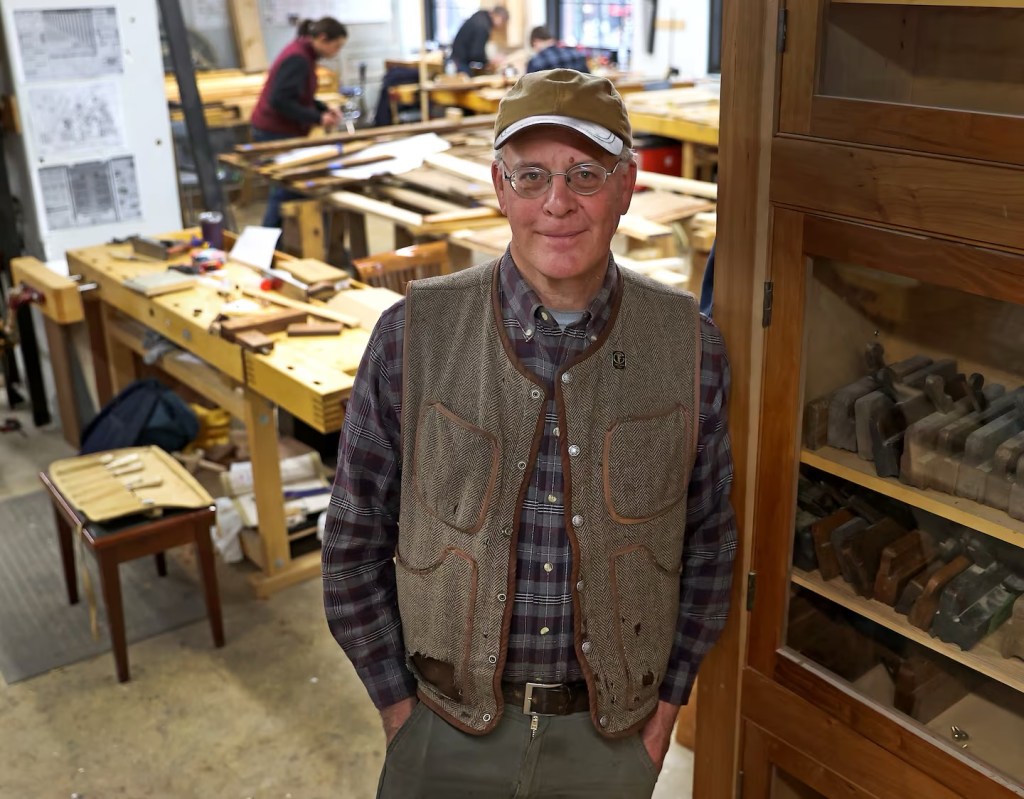
Michael Burrey, a teacher at North Bennet Street School, recently worked on the restoration of Notre Dame in Paris. DAVID L. RYAN/GLOBE STAFF
Billy Baker of The Boston Globe reported:
In 2019, as Notre Dame Cathedral in Paris was burning, Michael Burrey was 3,000 miles away, in the North End of Boston, watching the television coverage with his students and asking himself a question: What can we do to help?
It’s a thought many people had. Ultimately, hundreds of thousands of individual donors would contribute toward the cathedral’s reconstruction. But Burrey was in a unique position — he’s an expert in medieval carpentry who spent 11 years as an interpretive artisan at what was formerly called Plimoth Plantation, and he is currently a teacher at the North Bennet Street School, one of the country’s leading traditional trade schools.

The spire of the Notre Dame Cathedral collapsed as the landmark was engulfed in flames in central Paris on April 15, 2019.AFP VIA GETTY IMAGES
Soon Burrey would begin a journey that would end with him becoming one of just a handful of American artisans to work on the French team that completed a stunning reconstruction of one of the world’s great cultural artifacts.
“It’s the pinnacle of my career,” Burrey said recently, following the grand reopening of the cathedral on Dec. 8. “I have such great appreciation for being able to be a part of the group effort that demonstrated that the traditional trades that built Notre Dame 800 years ago are still here, still viable and teachable and learnable for people today.”
His work on the project was made possible by Handshouse Studio, a nonprofit based in Norwell that focuses on building large historical objects as educational projects. In the past, the studio has recreated a Revolutionary War-era wooden submarine as well as a 17th century Polish synagogue.
Burrey has been collaborating with Handshouse for a quarter century, and they, too, were looking for ways to help Notre Dame. Thus, the Handshouse Studio Notre Dame Project was born.
The first thing they did, both as an educational exercise and out of a show of solidarity with the French, was build a full-scale model of one of the wooden trusses that supported the roof of Notre Dame. These were the hidden structures inside the massive cathedral where the devastating fire started.
Burrey brought a team of students from his restoration carpentry class at North Bennet Street to Washington, D.C., in 2021. For two weeks they worked with skilled traditional craftsmen from the Timber Framers Guild to build the massive wooden structure, known as Choir Truss #6, working all the way from white oak logs hewed with broad axes to the finished product.
“It was a way for us to say that building something as it was originally made is not only possible but also important,” said Marie Brown, executive director of Handshouse Studios. The original hope, she said, was that they might donate the truss to the French for inclusion in the cathedral. But something else happened, something even cooler.
The build was so successful that the two architects overseeing the reconstruction of Notre Dame, Rémi Fromont and Philippe Villeneuve, traveled to the United States to see the structure. As a result, they invited two American timber framers to join the reconstruction team in France. One invitation went to Michael Burrey. The other went to Jackson Dubois, a Washington state man who is president of the Timber Framers Guild.
For three months in the summer of 2023, Burrey and Dubois joined 18 carpenters from a French company called Asselin working on the wooden components of the Notre Dame spire. They operated out of the medieval town of Thouars in western France, about three hours from Paris, and Burrey worked on the decorative elements of the spire — the quatrefoils, trefoils, railings, and dormers. There were language barriers, Burrey said, but the one thing they had in common was that they all spoke carpentry.
“[Burrey] called me a couple times from France and was telling me about what he was working on, where he was sitting, what he was seeing in this medieval town,” said Claire Fruitman, the provost and interim president of North Bennet Street School.
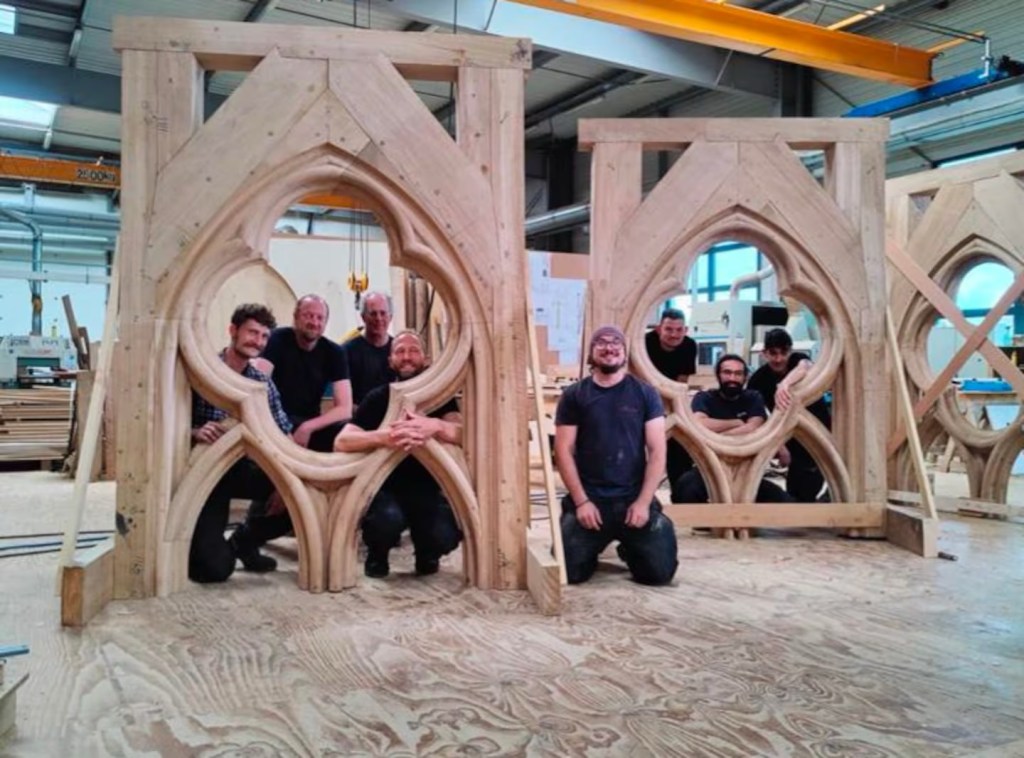
Burrey (third from left) joined French carpenters for a picture. The French carpenters built the quatrefoils for the nave of Notre Dame cathedral. MICHAEL BURREY
“No one ever wants any sort of heritage to have something go wrong,” she added. “But when it does it’s amazing to say we have people who can fix it and bring it back to life, and the lessons he learned over there are things he’s brought back into the classroom for the next generation of preservationists.”
Burrey, who lives in Plymouth, was not the only local craftsperson to work on the project. Hank Silver, who owns Ironwood Timberworks in Hatfield, worked as lead carpenter for the nave, the central, large space of the cathedral that accommodates the congregation during religious services. Silver declined an interview request, but told Elle Décor that “for someone like me, being able to work on this building, which is the birthplace of this technique, is particularly meaningful. When I look at Notre Dame, I will be able to say, ‘I built that.’”
Burrey, meanwhile, has not been to the cathedral since it reopened, but he said he has marveled at the photos of the completed work.
“There’s nothing but a smile on my face, and a feeling of deep appreciation for being part of a group effort, when I think of everybody coming together to get things back the way they should be,” he said.

 Diane Ravitch's blog
Thanks for this fascinating story that warms the heart of this Francophile. Who said Americans are lazy, stupid and uneducated? Americans are some of the most productive and creative people in the world. Of course, we also have some stupid and uneducated people, many of whom voted for Ramaswamy’s boss.
LikeLike
Retired,
Whenever someone tweets at me about how terrible public schools are, I reply that they are insulting the American people, since 90% of us went to public schools. Since these folks are usually Trumpers, they hate the implication that they are unpatriotic.
LikeLike
I have had the privilege of going to Notre Dame twice: Once as a 16 year old and then as an adult with my own sixteen year old son in tow. I cried as I watched the cathedral burn on TV. It is a magnificent structure of religious, global, and mythological consequence. When I entered the nave with my son he looked up at the vaulted ceiling and simply said, “Wow.” I must say that I smiled at that spontaneous response. As an artist and admirer of medieval architecture I was almost jealous as I read of the opportunities provided for the artisans lucky enough to work on the project. I can’t wait to get back and get lost in that wonder of human ingenuity once again.
LikeLike
“It is a magnificent structure of religious, global, and mythological consequence.”
Religious. . . mythological. . . but thou does repeat thyself.
LikeLike
In 2010, my family was able to visit Notre Dame on Christmas Eve, as my daughter was teaching in neighboring Andorra on a Fulbright. Something about the scale of human endeavor, community, and perseverance needed to build an object of such beauty is universally appealing.
LikeLike
Europeans have produced skilled craftsmen through their guild system. My husband’s grandfather was a Danish baker. When I first met him, he commented that I had gone to college for four years, but he had spent seven years in an apprenticeship program in the Danish Bakers’ Guild in order to master his craft. The Europeans invest in craftsmanship. Some of the unions here have training programs in the trades, but the training is not as thorough as the European apprenticeships.
LikeLike
As a Bostonian with a passing familiarity with the North Bennett Street school, I’d say it’s more an echo of European guilds than the usual apprenticeships.
LikeLike