Archives for the month of: June, 2022

Governor Bill Lee of Tennessee is working overtime to destroy public schools in his state with charters and vouchers.

Pastors for Tennessee Children has stood up to him and the legislature, mobilizing public opinion against privatization.

PTC needs our help!

It’s a tumultuous time for public education in Tennessee. There are currently over 130 school privatization lobbyists working the legislature. Their intent is to replace public schools with charters, vouchers and homeschools. The Tennessee Public Education Coalition and Pastors for Tennessee Children have been actively working together to protect our students and teachers. These organizations blocked dangerous legislation including bills to expand vouchers, to allow charter schools to buy publicly owned properties for only one dollar, and to allow the mayoral takeover of elected school boards.

Pastors for Tennessee Children filed an amicus brief in the voucher lawsuit, which is still pending. They have shared our message in op-eds that have run in newspapers statewide and in live news interviews. They met with legislators and became active on social media. In short, They have done outsized work for an organization composed of a small number of committed volunteers who care about our public schools.

They cannot continue without your help.

Please make a donation here.

Or send a check to the following address:

Pastors for Tennessee Children to 7237 Riverfront Drive, Nashville, TN 37221

Mike Deshotels is a retired educator in Louisiana, who blogs at “Louisiana Educator.” He wrote the following post about the now well-established all-charter district.

The state of Louisiana took over most public schools in New Orleans after the devastation caused by Hurricane Katrina in 2005. It turned them over to charter operators, who were expected to get better academic results than the underfunded public schools. The city’s experienced teachers, mostly African-American, like their students, were fired and replaced by inexperienced Teach for America recruits. Philanthropies and the federal government poured billions into the district to help privatization succeed.

Other states, impressed by the promises of privatization, pushed for more charter schools, and some for vouchers, like Arizona, North Carolina, Florida, and Ohio. Michigan created the Education Achievement Authority (which failed), Tennessee created the Achievement School District, which boldly promised dramatic increases in test scores. It failed too. Still others, like Oklahoma, Nevada, and Texas, encouraged privatization and rapid expansion of charter schools.

Billionaires like Michael Bloomberg, Bill Gates, Charles Koch, Betsy DeVos, and the Waltons continue to fund the charter idea, as does the federal government, whose Charter Schools Program doles out $440 million annually to open or expand charter schools (many of which will fail or never open).

For the billionaires and the charter lobby, New Orleans was the shining star of the corporate reform movement, promising huge academic gains by firing teachers, closing public schools, and privatizing low-performing schools. New Orleans is the foundational myth of the charter movement.

Mike Deshotels shows here that the New Orleans “miracle” was and is a vast mirage. Fully a decade ago, in a dissent to a report by the Council on Foreign Relations that endorsed privatization of public schools, Linda Darling-Hammond wrote that “New Orleans remains the lowest-ranked district in the low-performing state of Louisiana.” Billions of dollars later, New Orleans continues to be the lowest performing school district in the lowest performing state.

Here is an excerpt from Mike Deshotels’ post:

This recently released report by the Louisiana Pelican Policy Institute, a business funded “good government” group has produced a dashboard that compares the most recent data on all public-school systems in Louisiana. It provides a way for us to compare expenditures and results in public schools. We can now get a good idea about whether the school reforms in New Orleans have lived up to their promises.

It is important to note that not all public schools in New Orleans at the time of takeover had been deemed to be failures. Even though the Orleans public school system, as a whole, fell into the bottom quartile of public school systems in the state based on academic achievement, there was a group of public schools in New Orleans that were performing well, even before 2006. Several highly selective schools had been producing high academic achievement and great college prep results. So approximately one-fourth of the Orleans schools were left intact because of acceptable results. Those schools, even though now converted into charters, continue to be selective in the students they serve and continue to produce exemplary results. But there is still a major problem with the state test scores of the other three-fourths – the reformed takeover schools.

The recent study shows that taken as a whole, the New Orleans all charter system is still ranking in the bottom quartile of all public-school systems in the state. This is in a state that performs near the bottom of all states on national testing and college preparedness. For example, the new dashboard reveals that for the four academic subjects of math, reading, science and social studies, only 18% of all New Orleans public school students are now rated proficient or better. (I averaged the results of the 4 academic subjects)

In the key subjects of math and reading, Orleans performs at the 24th percentile compared to all other state school systems. This is approximately the same as the Orleans school system performed before Katrina!

What about efficiency in the use of per pupil dollars? Has the new business-oriented model resulted in more efficient use of tax and grant dollars?

One thing that the all-charter system has been successful in doing is attracting a generous flow of charitable foundation money to these new experimental schools. A sizable portion of per pupil dollars in the reformed Orleans public system come from charitable and foundation grants. So the reformed all charter school system is certainly well funded.

The Pelican Policy Institute study has provided a rough measure of how the school money in Orleans is now allocated. Total per pupil funding of the New Orleans system now adds up to $24,434 per student. For Louisiana, this is lavish funding by any measure. The state average per pupil funding is now $11,755, less than half the per pupil amount for New Orleans. How do the New Orleans schools allocate their per pupil funding compared to all other public schools? According to the Pelican Policy dashboard, New Orleans now spends 23% of all its funding on administration and 36% on classroom instruction. (Salaries of the Charter managers are not published as far as I know) The state average for other systems in Louisiana is 8% for administration and 56% for the classrooms. (All non-charter public-school administrators and teacher salary schedules are public records)

Did the increased funding allow the reformed Orleans school system to hire a better quality of teachers? The state auditor recently found that more than half of the Orleans teachers are not certified as teachers. In addition, most of the teachers now employed in Orleans are Caucasian while 90% of the students are African American. This ignores studies that show that children learn better from real role models of their own ethnic type. So much for the new business approach.

Finally, on average, the other school systems in the state have 31% of students achieving proficiency in the 4 basic subjects tested. This compares to 18% achieving proficiency in the new reformed Orleans system.


Dean Obeidallah, a regular contributor to CNN, describes the Texas GOP’s defiant rejection of democracy. In an earlier post, I pointed out that the state convention booed Senator Jon Cornyn for daring to negotiate a bipartisan gun control deal (which did not include any of President Biden’s demands). That was the mildest of their actions.

He writes:

CNN) – Disturbing video from the Texas Republican Convention this weekend shows convention-goers mocking GOP Rep. Dan Crenshaw — a Navy SEAL veteran who lost his right eye to a bomb in Afghanistan — with the term “eye patch McCain.”

Fox News’ Tucker Carlson coined the derisive nickname after the Texas lawmaker dared to express support for beleaguered Ukraine following Russia’s barbaric attack on it.

But apparently even more heinous in the eyes of some attendees is that Crenshaw rejected former President Donald Trump’s claims that the 2020 election was stolen. One man wearing a red “Make America Great Again” hat can be seen yelling in an online video, “Dan Crenshaw is a traitor!” and “He needs to be hung for treason!”

As despicable as the behavior toward Crenshaw was, even more alarming were the actions taken by the Texas GOP and the convention’s 5,000-plus delegates.

The gathering rejected the outcome of a democratic election, supported bigotry toward the LGBTQ community and imposed far-right religious beliefs on others by seeking to have them enshrined into law. And that wasn’t half of it.

In fact, the convention showed us one thing: Texas Republicans are no longer hiding their extremism. Instead, they are openly embracing it.

Even before the opening gavel, they gave us a glimpse of the party’s extremism in the Lone Star State by banning the Log Cabin Republicans from setting up a booth at the convention.

Texas Republican Party Chairman Matt Rinaldi cast the deciding vote on the move to bar the group that has advocated for LGBTQ Republicans for decades. “I think it’s inappropriate given the state of our nation right now for us to play sexual identity politics,” Rinaldi told the Fort Worth Star-Telegram.

Once it formally got underway, the convention took a number of appalling and un-American actions. First, delegates approved a measure declaring that President Joe Biden “was not legitimately elected.” In short, the Texas GOP — like Trump himself — is embracing a lie because it’s unhappy with the election results. Put more bluntly, the Texas GOP voted to reject American democracy.

Republican delegates also booed John Cornyn, the senior US senator from Texas, at the convention Friday because of the Republican lawmaker’s role leading negotiations to reach a Senate deal on a bill to stem gun violence. Those legislative efforts follow last month’s horrific shooting that claimed the lives of 19 schoolchildren and two teachers in Uvalde, Texas.

The platform approved at the convention called for repealing or nullifying gun laws already in place, such as the Gun Control Act of 1968, which prevents felons and other dangerous people from being able to purchase a gun legally. Apparently, the Texas GOP believes that even dangerous people should have a constitutionally protected right to buy a gun.

The Texas GOP platform also embraced ramping up anti-abortion rhetoric in public schools. For example, the platform states that “Texas students should learn about the Humanity of the Preborn Child, including … that life begins at fertilization.” It even seeks to force students to watch “a live ultrasound” and for high-schoolers to read an anti-abortion booklet that critics say “includes scientifically unsupported claims and shames women seeking abortion care,” according to The Texas Tribune.

It sounds like the curriculum that you might find in a theocratic government such as the Taliban — not one in the United States funded by taxpayer dollars. But the GOP in large swaths of this country is no longer hesitant to support laws to impose its religious beliefs — as we see with measures some Republicans champion that would totally ban abortion. The GOP convention’s document additionally urges officials “not to infringe on Texas school students’ and staffs’ rights to pray and engage in religious speech.”

The Texas GOP platform also does its best to demonize those in the transgender community. It describes transgender people as suffering from “a genuine and extremely rare mental health condition.” And it sees sexual reassignment surgery as a form of medical malpractice.

The platform takes aim at gay Americans as well with the statement that homosexuality is “an abnormal lifestyle choice.” Instructively, the Texas GOP platform did not include such language in 2018 and 2020.

This platform gives us a glimpse into the views of the Republican base on key issues that in turn will pressure GOP elected officials in Texas — and possibly beyond the state — to adopt similarly extreme positions or run the risk of a primary challenge from an even more extreme Republican.

What caused this move to the far right? Brandon Rottinghaus, a political scientist at the University of Houston, told The Texas Tribune about the state GOP’s new extreme platform, “Donald Trump radicalized the party and accelerated the demands from the base.” He added alarmingly, “There simply aren’t limits now on what the base might ask for.”

I agree — in part. I don’t think Trump radicalized the base — rather he simply gave people permission to be who they always wanted to be.

But I agree with Rottinghaus that there are now no limits for what the GOP base might seek — be it rejecting election results it doesn’t agree with to enacting more laws based on extreme religious beliefs. And that should deeply alarm every American who wants to live in a democratic republic.

The convention also issued a call to repeal the 1965 Voting Rights Act, which guaranteed the right to vote for every citizen of voting age.

The only thing the Texas GOP neglected to do was pass a resolution congratulating the shooter at Uvalde for exercising his “God-given right” to use his AR15 as he saw fit.

Talk about cheesy! Talk about hypocrisy! Talk about weasels! Talk about betrayal of the public! Talk about disdain for democracy!

The people of Arizona voted overwhelmingly against vouchers, but the Koch-controlled GOP majority in the legislature is promoting a dramatic expansion of vouchers. Voters be damned!

To buy the support of public school parents, the legislators added a big increase in public school funding, but the new funding is available only if the vouchers are enacted.

Arizona has 1.1 million students, but only 11,775 have used vouchers to leave public schools. Now the Republicans want to fund vouchers for every student in the state. Does it matter that multiple academic studies have found that vouchers do not improve education? Of course not.

Do you think these guys know how repellent they are?

Four years after voters rejected a similar move, Republican lawmakers are pushing ahead with a plan to let any of the 1.1 million students in public schools get vouchers to attend private and parochial schools.

And they are holding a plan to boost aid to public schools hostage until they get what they want.

HB 2853, approved Wednesday by the House Ways and Means Committee on a 6-4 party-line vote, would remove all restrictions on who can get what are called Empowerment Scholarship Accounts. Backers say this ensures that parents get to decide what is the best option for their youngsters.

That assertion was disputed by Beth Lewis, executive director of Save Our Schools.

She said that unlike public schools, private schools can pick and choose who they want to accept. Lewis said those schools, many of which are for-profit corporations, accept those who will cost them the least, meaning the highest achievers and students who do not have special needs.

Republicans said they are not ignoring the needs of public schools, voting Wednesday for HB 2854, which would increase state aid to schools by $400 million, above another $250 million additional already planned.

But there’s less there than meets the eye.

First, only half of that additional cash is permanent. And it is weighted so the districts with the most students in financial need would get more.

Beyond that, schools would have to wait until the 2023-24 school year for the one-time $200 million infusion.

And there’s something else.

House Majority Leader Ben Toma, R-Peoria, who crafted both measures, included a “poison pill” of sorts: It says that if the vouchers do not become law, the public schools don’t get any of that $400 million.

That is designed to deter the education community from doing to HB 2853 what they did to a similar voucher expansion measure approved by GOP lawmakers in 2017.

They collected sufficient signatures to put the expansion on the 2018 ballot. And voters overruled the legislation by a margin of close to 2 to 1…

And Lewis told Capitol Media Services that supporters of public education won’t be deterred, vowing to go to the ballot once again if the Republican-controlled legislature approves universal vouchers. She said while that would mean the loss of $400 million — or, really, $200 million of ongoing funds — that is nowhere near the amount that public schools need in Arizona.

She pointed out that voters in 2020 approved Proposition 208 to infuse another nearly $1 billion into public education. That was sidelined after the Arizona Supreme Court ruled the tax could not be levied because it bumped up against a constitutional limit on education spending.

Lewis, the education community and their Democratic allies are not alone in saying schools need more than HB 2854 is offering.

Sen. Paul Boyer, R-Glendale, said he is holding out for an amount close to that $1 billion figure. And with only 16 Republicans in the 30-member Senate, the plan cannot get final approval without his vote.

Wednesday’s votes come as school districts won a significant legal victory, with a judge saying they are entitled to pursue claims that the legislature shorted them billions of dollars.

Jitu Brown, civil rights leader and director of Journey for Justice, joins here with Randi Weingarten, president of the American Federation of Teachers, to support the Biden administration’s modest proposals to reform the federal Charter Schools Program. The charter lobby has vigorously opposed any reform of the program. Their article appeared in Education Week.

Charter schools have been part of the fabric of public education in the United States for decades. Like a patchwork quilt, there is a great deal of variation among them. Some have a history of improvements to student achievement, while others have been ineffective or even harmful. Some charter operators are fiscally responsible, while others have been deemed incompetent or fraudulent.

As with every public school, and every expenditure of taxpayer funds, reasonable oversight enhances the quality and accountability of charter schools. This is the goal of the Biden administration’s proposed modest changes to the federal Charter Schools Program. But some charter school proponents have responded to the proposed changes with a fierce and well-funded opposition campaign.

The charter lobby is pushing back with big TV ad buys and op-ed campaigns, claiming that the proposed regulations would “halt innovation in its tracks,” “gut the federal Charter Schools Program,” and impose a “needlessly restrictive regulatory scheme.”

In fact, President Joe Biden’s fiscal 2023 budget proposes a $440 million investment in the federal grant program for charter schools. The Biden administration is right to seek more oversight of this program. As with all federal funding, there are rules to ensure proper use of the money. One study from the advocacy group Network for Public Education found that between 2006 and 2014, $45.5 million was handed out to charter schools that never even opened.

The charter lobby is chafing at one provision in particular—the requirement for applicants for Charter Schools Program startup funds to provide a community-impact statement. For the first time, the program requires charter operators to state how their new school would impact the surrounding community. The intent is to ensure that the applicant has engaged with residents in planning for the school, that there is a need for a new charter school in the community, and that the school won’t promote racial segregation…

Every school system in America, when it considers where to build a new school, considers the proposed school’s impact on the surrounding community from which it will draw students. Charter schools should not be islands unto themselves, nor should they thrust themselves onto communities that do not want them there.

Charters that function as centers for innovation and best practices for public schools should be welcome in every community. A charter industry that advocates and benefits from the closing of traditional public schools is not welcome.

Take the example of Detroit, where between 1995 and 2016, 152 charter schools opened, contributing to the closure of 195 traditional public schools in a city that already had a declining student population. This left some neighborhoods with no public schools—traditional or charter

Responding to parents’ and communities’ needs is what many charter school operators say they are all about. Yet, this responsiveness happens less than it should. In 2017, students at Hirsch Metropolitan High School on the South Side of Chicago held a walkout protesting a proposed charter school that would be sited at their building. Parents of students at the high school complained about a lack of community engagement from the proposed charter operator. The charter school eventually found a new, nearby location and promptly obtained $840,000 in grant money from the U.S. Department of Education.

We are lifelong advocates of high-quality public schools for all students, whether those schools are charters or traditional. Schools that aspire to serve our children and communities should embrace their accountability to the public. Schools are community institutions and should not seek to destabilize other institutions in our communities. One must wonder why those seeking to open charter schools are afraid of or resistant to this reasonable transparency and engagement proposal. The proposed rules would give more students access to high-quality schools, which is what we all—charter boosters and traditional public school champions—really want for America’s children.

Donald Trump, a man without any religious faith or moral principle, addressed an evangelical religious convocation called “Faith and Freedom” in Tennessee. He used the occasion to ridicule the Republicans who did not support his attempt to demolish the rule of law and the Constitution so he could have a second term in office. He is a very sore loser.

NASHVILLE — Former president Donald Trump used an evangelical conference here to ridicule former vice president Mike Pence for upholding the Constitution on Jan. 6, 2021, choosing an audience that represents Pence’s political base as a venue to attempt to undermine him.


“Mike Pence had a chance to be great. He had a chance to be historic,” Trump said in his first remarks about his onetime governing partner amid Jan. 6 committee hearings revealing the intense pressure Pence withstood in deciding to go forward with his constitutional role certifying the election.

“Mike did not have the courage to act.” He added: “Mike was afraid of whatever he was afraid of.”
Trump also referred to Pence, who did not attend the conference, as a “human conveyor belt” for his role in moving the election process forward, saying that he had considered labeling him as a “robot.”

Trump’s own aides have testified they told the president it would not be constitutional for Pence to move to overturn the election.

Trump also attacked Adam Kinzinger, calling him a crybaby. Kinzinger responded far too generously on Twitter.

As we watched the January 6 Commission and its interviews, we have seen the connecting of the dots in the most audacious effort in our history to overturn the results of a free and fair election. We have seen overwhelming evidence of a conspiracy to destroy our democracy and our Constitution. 2020 was not a close election. Trump could not bear the thought, the reality that he lost. He lost. He is a loser.

Among the many devious, dishonest plots to stop the certification of Joe Biden’s election, the following story may be the worst, in my judgment, although there are surely other contenders.

Michael Kranish of The Washington Post told the story of Trump’s attempt to appoint a new Attorney General in early January 2021 who would send letters to several states informing them that their electors should be withdrawn due to serious concerns about election fraud. Trump met with an official, Jeffrey Clark, in the Justice Department who wanted to be appointed Attorney General and stop the certification of Biden. Clark’s superiors said he was totally unqualified and threatened to resign en masse if Trump elevated him. Faced with the threat of a mass resignation of the top officials at the Justice Department, his own appointees, Trump backed down.

Three days before Congress was slated to certify the 2020 presidential election, a little-known Justice Department official named Jeffrey Clark rushed to meet President Donald Trump in the Oval Office to discuss a last-ditch attempt to reverse the results.


Clark, an environmental lawyer by trade, had outlined a plan in a letter he wanted to send to the leaders of key states Joe Biden won. It said that the Justice Department had “identified significant concerns” about the vote and that the states should consider sending “a separate slate of electors supporting Donald J. Trump” for Congress to approve.


In fact, Clark’s bosses had warned there was not evidence to overturn the election and had rejected his letter days earlier. Now they learned Clark was about to meet with Trump. Acting attorney general Jeffrey Rosen tracked down his deputy, Richard Donoghue, who had been walking on the Mall in muddy jeans and an Army T-shirt. There was no time to change. They raced to the Oval Office.

As Rosen and Donoghue listened, Clark told Trump that he would send the letter if the president named him attorney general.


“History is calling,” Clark told the president, according to a deposition from Donoghue excerpted in a recent court filing. “This is our opportunity. We can get this done.”

Donoghue urged Trump not to put Clark in charge, calling him “not competent” and warning of “mass resignations” by Justice Department officials if he became the nation’s top law enforcement official, according to Donoghue’s account.

“What happens if, within 48 hours, we have hundreds of resignations from your Justice Department because of your actions?” Donoghue said he asked Trump. “What does that say about your leadership?”


Clark’s letter and his Oval Office meeting set off one of the tensest chapters during Trump’s effort to overturn the election, which culminated three days later with rioters storming the U.S. Capitol. His plan could have decapitated the Justice Department leadership and could have overturned the election.


Clark’s actions have been the focus of a Senate Judiciary Committee investigation and an ongoing probe by the Justice Department’s inspector general, and now are expected to be closely examined during June hearings by the House committee investigating the insurrection of Jan. 6, 2021.


After the New York Times reported in January 2021 about Clark’s actions, he said he engaged in a “candid discussion of options and pros and cons with the president,” denied that he had a plan to oust Rosen, and criticized others in the meeting for talking publicly and “distorting” the discussion.
Now, however, key witnesses have provided Congress with a fuller account of Clark’s actions, including new details about the confrontation that took place in the Jan. 3 Oval Office meeting, which lasted nearly three hours.


A reconstruction of the events by The Washington Post, based on the court filings, depositions, Senate and House reports, previously undisclosed emails, and interviews with knowledgeable government officials, shows how close the country came to crisis three days before the insurrection.

The evidence, which fills in crucial details about Clark’s efforts, includes an email showing he was sent a draft of a letter outlining a plan to try to overturn the election by a just-arrived Justice Department official who had once written a book claiming President Barack Obama planned to “subvert the Constitution.”

But larger mysteries could still be solved at an upcoming Jan. 6 committee hearing slated to examine Clark’s actions, including the crucial question of whether Clark and his allies were acting on their own initiative — or whether they were one piece of a larger, well-planned effort to keep Trump in power. That question gets to the heart of the committee’s professed mission: proving there was a “coordinated, multi-step effort to overturn the 2020 presidential election.”
Clark, 55, and his lawyer, Harry MacDougald, declined to comment.


The House committee unanimously voted to hold Clark in contempt of Congress after he declined in December to answer most questions on grounds that his interactions with Trump were privileged. But Clark later appeared before the committee and asserted his Fifth Amendment right against self-incrimination, CNN reported; his testimony from that appearance has not been released.


Sen. Sheldon Whitehouse (D-R.I.), who participated in the Judiciary Committee’s investigation, said investigators should key in on whether Clark was working on behalf of others not yet identified.
“It certainly could be a symptom of a much larger and more coherent plan than has currently been disclosed,” Whitehouse said. Clark “does not appear to have elections expertise or experience, which raises the question, did he really sit down at his computer and type it out or does somebody produce it for him?
…”

Trump met in the White House with Clark and the top officials in the Justice Department, including Jeffrey Rosen and Richard Donoghue. Trump told them of his plan to make Clark the Attorney General. They were outraged.

Trump repeatedly went after Rosen and Donoghue, saying they hadn’t pursued voter fraud allegations.


“You two,” Trump said, pointing to the two top Justice Department officials. “You two haven’t done anything. You two don’t care. You haven’t taken appropriate actions. Everyone tells me I should fire you.”


Trump continually circled back to the idea of replacing Rosen with Clark.


“What do I have to lose?” the president asked, according to Donoghue.


“Mr. President, you have a great deal to lose,” Donoghue said he responded. “Is this really how you want your administration to end? You’re going to hurt the country, you’re going to hurt the department, you’re going to hurt yourself, with people grasping at straws on these desperate theories about election fraud, and is this really in anyone’s best interest?”


Donoghue warned Trump that putting Clark in charge would be likely to lead to mass resignations at the Justice Department.


“Well, suppose I do this,” Trump said to Donoghue. “Suppose I replace [Rosen] with [Clark], what would you do?”


“Sir, I would resign immediately,” Donoghue said he responded. “There’s no way I’m serving under this guy [Clark].”


Trump then turned to Steve Engel, the Justice Department’s assistant attorney general for the Office of Legal Counsel, whom Trump reportedly had considered for a seat on the Supreme Court.
“Steve, you wouldn’t resign, would you?” Trump asked.

“Absolutely I would, Mr. President. You’d leave me no choice,” Engel responded, according to Donoghue’s account. Engel declined to comment.

“And we’re not the only ones,” Donoghue said he told Trump. “You should understand that your entire department leadership will resign. Every [assistant attorney general] will resign. … Mr. President, these aren’t bureaucratic leftovers from another administration. You picked them. This is your leadership team. You sent every one of them to the Senate; you got them confirmed. What is that going to say about you, when we all walk out at the same time?”

Donoghue then told Trump that Clark had no qualification to be attorney general: “He’s never been a criminal attorney. He’s never conducted a criminal investigation in his life. He’s never been in front of a grand jury, much less a trial jury.”
Clark objected.

“Well, I’ve done a lot of very complicated appeals and civil litigation, environmental litigation, and things like that,” Clark said, according to Donoghue’s deposition.

“That’s right,” Donoghue said he responded. “You’re an environmental lawyer. How about you go back to your office, and we’ll call you when there’s an oil spill.”


Pat Cipollone, the White House counsel, told Trump that Clark’s proposed letter was “a murder-suicide pact,” according to Donoghue’s deposition. “It’s going to damage everyone who touches it. And we should have nothing to do with that letter. I don’t ever want to see that letter again.” Cipollone declined to comment.

Read the rest of the story if it is not behind a paywall.

The account goes on, filling in details about Clark’s effort to be named Attorney General of the United States and overturn the election. It is a shocking story. Had Trump appointed Clark, some Republican-led states might have recalled their electors. The Constitutional process, the orderly transition of power, would have been halted. The nation would have endured an unprecedented crisis. Trump would have been in control of the military and the levers of government.

No one knows what would have happened next.

My favorite part of the story:

“That’s right,” Donoghue said he responded. “You’re an environmental lawyer. How about you go back to your office, and we’ll call you when there’s an oil spill.”
North Carolina has a problem. The public consistently chooses to put its children in public schools, but the Tea Party-dominated General Assembly (legislature) favors privatization. No matter how poorly the charter schools and voucher schools perform, the General Assembly wants more of them. I wonder why? Is is campaign contributions or just hostility to anything public?

Tripster Travels

publicschoolsfirstnc.org

June 18, 2022

Time to Reconsider Virtual 

Charter Schools? 

After strong criticism of remote learning during the pandemic by the NC General Assembly and repeated legislative efforts to encourage districts to return to in-class instruction, it would be natural to think that the NC virtual charter schools, which are 100% remote, should come under increased scrutiny. 

Instead, the opposite happened. Last week, SB671, Edition 3 (Virtual Educ./Remote Acad./Virtual Charters) was introduced, which if passed into law, would allow NC’s two virtual charter schools to be upgraded to full charter status with NO REVIEW. The bill passed through the House with little discussion. As part of SB671, the “two pilot virtual charter schools…shall be deemed to be approved as charter schools by the State Board of Education.” In addition, they are allowed to increase enrollment by 20% each year based on their 2021-22 enrollment for the next five years, when their charter may be renewed for 10 more years.

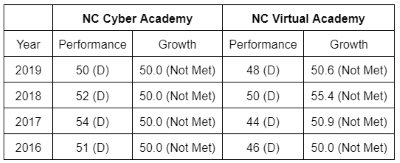
In the 2017-18 SY, two virtual charter schools, North Carolina Cyber Academy (formerly NC Connections Academy) and NC Virtual Academy opened as pilot projects. Because similar virtual charter schools had seen poor outcomes in other states, NC did not want to grant full charter status until the schools had proven themselves. The experiment has not gone well. In the years for which there is performance data (see NC School Report Cards), neither school achieved above a D performance grade or higher than 55 in growth. The NC Cyber Academy earned the lowest possible growth score (50) all four years. 

In addition, both schools currently serve a lower percentage of economically disadvantaged students than the state overall and have much lower four-year graduation rates.

2020-21 Economically Disadvantaged Students

  • State: 38.9% 
  • NC Cyber Academy: 31.5%
  • NC Virtual Academy: 32.4%

2020-21 Four-Year Graduation Rate

  • State: 87.0%
  • NC Cyber Academy: 54.9%
  • NC Virtual Academy: 77.5%

In a classic example of the privatization of public education, The NC Virtual Academy is powered by Stride K-12, an online learning company traded on the NY stock exchange. While the company’s investors may be getting good returns on their investment, the NC taxpayers are not. 

SB671 also introduces an option for public school districts to apply to the State Board of Education for approval to operate small virtual academies enrolling no more than 15% of their students. The bill lists seven required elements for a district’s plan including (#3) Hardware, software, and learning mgmt. platforms that support online learning, (#5) The professional development that will be provided to those teaching in the remote academy related to the pedagogy of providing remote instruction, and (#6) The identified characteristics for successful remote learning…. In addition, clear evaluation guidelines are set out to ensure that the remote academies do not provide a sub-standard education. These and other elements of SB671 are steps that could allow public schools flexibility to meet the needs of their students.

When SB671 went to the Senate for a vote this week, members found too many differences between their original version of SB671 – Edition 2 (Changes to the K-12 Scholarship Programs) and the House’s Edition 3. On a vote of 0-42, members sent the bill to a Conference Committee to iron out the differences. This delay provides an opportunity for NC citizens to reach out to committee members to voice their opinion on the various elements of the bill and what to keep or remove. House members have not yet been identified. The Senate members are 

The past few years have given NC educators, students, and parents plenty of opportunities to see the positive and negative aspects of virtual instruction. Implementing lessons learned and evaluating results as we move forward are critical next steps. SB671 does the NC virtual charter schools a disservice by excluding them from an evaluation of their pilot stage performance

A former Republican State Senator and the former State Auditor, a Democrat, wrote to argue on behalf of reforming the charter school law.

Bernie O’Neill (R-29, Bucks) is a former special education teacher for more than 25 years and a 16-year former member of the Pennsylvania House of Representatives.

Eugene DePasquale is former Auditor General of Pennsylvania and former member of the state General Assembly, (D-95, York). He presently serves as a Resident for the Keystone Center for Charter Change at the Pennsylvania School Boards Association.

They wrote:

Our roles as former elected officials from both of the major political parties have given us unique perspectives into not only Pennsylvania’s political process, but also its public education system, particularly charter schools.

Charter schools in the state have grown tremendously in the 24+ years in which they have existed. It is estimated that nearly 170,000 children will attend a brick and mortar or cyber charter school in the current school year and that Pennsylvania taxpayers will spend an estimated $3 billion to fund charter schools.

Despite being in operation for more than two decades, Pennsylvania’s Charter School Law (CSL) has never undergone any significant revision, other than allowing the creation of cyber charter schools in 2002, even though there are numerous glaring problems with the law. That’s not because the General Assembly hasn’t studied and introduced a myriad of legislative proposals each year to enact meaningful reforms. However, the state’s legislative body seems to be unwilling or unable to fix the problems.

Reforming the CSL should be a bipartisan issue. At its core, charter school reform would 1) ensure that public education funds are spent efficiently and appropriately; 2) that charter schools are as accountable and transparent as other public schools; and 3) preserve and strengthen educational choice by bolstering the law to ensure only quality charter school options are available to students and families.

Choice in public education is well-established in Pennsylvania. However, the status quo results in taxpayers sending hundreds of millions of public education dollars more than what charter schools need to provide an education. This is especially true for cyber charter schools, which do not maintain a physical school building and for all charter schools when it comes to well-documented overpayments for special education services. There’s a word for this type of spending – wasteful. And residents across the state feel the impact of these overpayments when their local school districts are forced to raise property taxes because of these costs.

Charter schools are supposed to be public schools. However, the boards that operate charter schools are not elected and are not required to include any representation from the community which they serve. Further, charter schools can contract with for-profit companies to run virtually all operations of the school. Once a charter school enters into one of these contracts, the public loses the ability to see how their money is being spent.

For years, proficiency on state assessments and graduations rates at charter schools have, on average, been substantially lower than those of traditional local public schools. While there are many high-performing charter schools, the current CSL makes it very difficult to close poor performers. Look no further than the fact that every cyber charter school has been identified by the state Department of Education as being in need of improvement for many years.

The bottom line is this: we owe it to our children and to the taxpayers to make sure that we are doing everything possible so that students are getting the best education available and that we are getting the best return on investment for our tax dollars. That’s something that all legislators should be able to support no matter which side of the aisle they’re on.

It is time to end the paralysis in Harrisburg, stop the practice of passing off charter school expansion proposals that fail to address serious funding flaws and contain little accountability as real reform, and finally work in a bipartisan manner to fix the law.

Texas Senator Jon Cornyn returned to Texas, after leading bipartisan talks on a weak gun control bill, only to discover that his fellow Republicans were furious at him for participating in any deal

WASHINGTON — U.S. Sen. John Cornyn was back in Texas Friday without a final bipartisan gun bill and set to address a state GOP party whose members are furious with him for working with Democrats on reforms they say will violate their “God given rights.”

Cornyn left D.C. on Thursday evening, telling reporters that “it’s fish or cut bait at this point” on the legislation after he and other negotiators spent days ironing out details behind the scenes. But they were unable to reach a final agreement as they ran up against a self-imposed deadline to get the bill written this week.

“Indecision and delay jeopardize the likelihood of a bill because you can’t write what is undecided and without a bill there is nothing to vote on,” Cornyn tweeted. “We are still talking and the clock is ticking…”

Meanwhile, committee members hashing out the Texas GOP platform at its biennialconvention in Houston advanced a resolutionThursday night rejecting the gun deal in its current form and rebuking 10 Republicans who have publicly supported it.

“All gun control is a violation of the Second Amendment,” the resolution says.

When it came Senator Cornyn’s turn to speak at the state GOP convention, he was booed repeatedly, amid shouts of “no gun control.”

Clearly, the Texas GOP wants no limits whatever on the right of any individual to buy a gun of any kind, any size, any caliber, no matter whether they are deranged or have a criminal background or are terrorists.