There has never been an election in the United States like this one.
Donald Trump continues to insist that the election was stolen and that he is the rightful winner, even though his opponent Joe Biden has 6-7 million votes more than Trump does and even though Biden will register 306 votes in the Electoral College today, the same as Trump called “a landslide” when he won in 2016. In every presidential election in recent memory, the loser conceded defeat before the Electoral College met. Not Trump. He vows to continue his fight. Some commentators think that he is “fighting” because he is collecting millions of dollars from small donors, which he may use to pay his legal fees after leaving the White House or to pay off bank loans.
About three-quarters of Trump voters believe what he says, despite the Trump campaign’s failure to win in any consequential court, despite 50 losses in state courts, and two rejections by the U.S. Supreme Court.
Michigan’s 16 electors will convene at 2 p.m. Eastern inside a heavily guarded state capitol in Lansing to cast their ballots for Joe Biden to become president and Kamala Harris to become vice president.
A spokeswoman for Senate Majority Leader Mike Shirkey (R) said in a statement overnight that the entire capitol complex will be closed to the public based on “recommendations from law enforcement” amid “credible threats of violence.” Police will escort each of the electors from their cars amid what’s expected to be a large “Stop the Steal” protest outside.
This certainly sounds like the prudent call, but it is nevertheless lamentable that the closures – combined with coronavirus precautions – will strip some of the pomp and circumstance from a sacred American tradition that is typically pro forma.
Ugly events this weekend – from Washington, D.C., to Washington state and Minnesota to Kentucky – showed that violence is not hypothetical. This is an especially dangerous development in a democracy that depends upon losers accepting the results of free and fair elections.
Police in Olympia, Wash., arrested an armed right-wing protester and charged him with shooting a counterdemonstrator during protests on Saturday night.
In the nation’s capital, at least four people were stabbed, including someone who is now in critical condition, and 33 more were arrested, after rallies supporting President Trump descended into chaos fueled by white nationalists. D.C. Police Chief Peter Newsham estimates that as many as 700 Proud Boys and their confederates roamed downtown streets looking to start fights, clashing with about 200 anti-Trump protesters.
Many photographs show the Proud Boys carrying Confederate flags. If they want to secede from the Union, let them go. It is never too late.
Are they Confederates or fascists or both?
Can Trump be impeached retroactively for betraying his oath of office? For attacking the Constitution? For sedition?
Essayist Joseph Epstein wrote an opinion piece in the Wall Street Journal insisting that Dr. Jill Biden should stop calling herself “Dr.” He objected to the use of the term “Dr.” for anyone who is not an M.D.
His essay set off a furor in the media. The topic “trended” on Twitter (meaning it was one of the most widely cited of the day), and it was written up in major newspapers.
Epstein wrote:
Madame First Lady—Mrs. Biden—Jill—kiddo: a bit of advice on what may seem like a small but I think is a not unimportant matter. Any chance you might drop the “Dr.” before your name? “Dr. Jill Biden” sounds and feels fraudulent, not to say a touch comic. Your degree is, I believe, an Ed.D., a doctor of education, earned at the University of Delaware through a dissertation with the unpromising title “Student Retention at the Community College Level: Meeting Students’ Needs.” A wise man once said that no one should call himself “Dr.” unless he has delivered a child. Think about it, Dr. Jill, and forthwith drop the doc.
I taught at Northwestern University for 30 years without a doctorate or any advanced degree. I have only a B.A. in absentia from the University of Chicago—in absentia because I took my final examination on a pool table at Headquarters Company, Fort Hood, Texas, while serving in the peacetime Army in the late 1950s. I do have an honorary doctorate, though I have to report that the president of the school that awarded it was fired the year after I received it, not, I hope, for allowing my honorary doctorate. During my years as a university teacher I was sometimes addressed, usually on the phone, as “Dr. Epstein.” On such occasions it was all I could do not to reply, “Read two chapters of Henry James and get into bed. I’ll be right over.”
I was also often addressed as Dr. during the years I was editor of the American Scholar, the quarterly magazine of Phi Beta Kappa. Let me quickly insert that I am also not a member of Phi Beta Kappa, except by marriage. Many of those who so addressed me, I noted, were scientists. I also received a fair amount of correspondence from people who appended the initials Ph.D. to their names atop their letterheads, and have twice seen PHD on vanity license plates, which struck me as pathetic. In contemporary universities, in the social sciences and humanities, calling oneself Dr. is thought bush league.
Many years ago–back in the early 1960s–I worked alongside Joseph Epstein at a small magazine called The New Leader. He had a wicked sense of humor and was fast with a snappy wisecrack. Over the years, we lost touch, but I still remember the fun we had writing jazzy headlines for dull articles (“Five Minutes to Midnight in _____” [insert name of country].
I disagree with his putdown of Jill Biden. If people have earned a doctorate, they can call themselves Dr. What’s the point of working for years to earn a doctorate if you can’t use the title? As for his reference to her dissertation topic, I feel certain that he never read it and cannot judge whether it was or was not valuable. His words show how little he thinks of community colleges and their students and faculty.
Dr. Biden is not a good target for ridicule. She is a woman who radiates integrity, empathy, and intelligence. She has earned the right to call herself Dr. Biden.
The best comment I have seen on this flap appeared on Fred Klonsky’s blog, quoting Glen Brown. The gist: 70% of instructors in higher education are adjuncts, not paid a living wage. That’s a true scandal.
The board is supposed to advise the director of the Institute for Education Sciences, but Trump’s eight nominees are unqualified to offer much advice.
Science magazine reports:
One month before his term expires, President Donald Trump has revived a moribund federal education research advisory panel by appointing eight members who appear to have no expertise in the subject area.
The National Board for Education Sciences (NBES) provides guidance to the director of the Institute for Education Science (IES), the research arm of the U.S. Department of Education. But the lack of a quorum on the 15-member presidentially appointed board has prevented it from meeting since the waning days of the Obama administration.
That lengthy presidential snub of the panel was part of a broader effort by the Trump administration to shrink government that resulted in a reduced flow of scientific advice to various federal agencies. That effort has had a particularly dramatic impact at regulatory agencies such as the Environmental Protection Agency, where the administration dismantled or dramatically reshaped several science advisory panels. For education researchers, a mothballed NBES deprived them of a high-level conduit for using their methodological expertise to help shape federal policies meant to improve education outcomes for all students...
The member with arguably the highest public profile is John Yoo, a law professor at the University of California, Berkeley. He served in the Department of Justice under President George W. Bush, and authored the so-called “torture memos” that provided the legal justification for the war on terror waged in the aftermath of the September 2001 attacks. Yoo has also been vocal in defending Trump’s action during his impeachment and in his attempts to overturn the results of the 2020 presidential election.
Two other appointees–Michael Anton and Larry Schweikart—have also stridently defended Trump against what they see as existential threats to national security posed by liberal politicians. Anton spent a year at the National Security Council before becoming a regular presence on social media, and Schweikart, who retired in 2016 after 30 years as a history professor at the University of Dayton, is the author of “48 Liberal Lies about American History” and “A Patriot’s History of the United States.”
Some of the others have backgrounds in banking or finance.
Having worked in the first Bush administration in the research area, let me say that I take exception to the use of “science” in the large and diffuse field of education. Much of what is appropriately studied is qualitative, not quantitative. The effort during the second Bush administration to turn the Office of Educational Research into the Institute of Educational Sciences was pretentious, in my view.
Be that as it may, the advisory board to the National Center for Education Statistics included many of the best qualified education researchers in the nation. The director could justly turn to the board for sound advice about education policy and the needs of the field.
My hunch is that these eight people appointed by Trump think they will have an important role in deciding the nation’s education policies. They won’t. They will sit through sessions that are technical in nature and listen to presentations about research priorities. These presentations, for the uninitiated, are likely to bore them. I suspect that many will quit before their terms expire.
Mike Klonsky writes that his blood began to boil when he saw the pictures of thugs and fascists marauding in the streets of the nation’s Capitol, expressing the allegiance to their defeated leader, who happens to be the President of the United States. This is what fascism looks like. What’s worse than Trump, as Mike Klonsky notes, is the cowardice and complicity of the majority of Republicans, who cower before this would-be dictator, this man intent on destroying our democracy. Trump has lost 50 cases filed in state courts, and has lost twice in the Supreme Court. Yet he vows to continue his fight to overturn an election that he lost by overwhelming margins. He could not even persuade the federal judges he appointed to accept his claims of fraud. This man belongs either in a mental institution or in prison as an inciter of sedition.
Klonsky begins:
My blood is boiling after seeing news and videos of violent American fascists (“Proud Boys) being turned loose on mask wearers and counter-protesters in D.C. yesterday.
This follows by days 126 Republican congressmen and 17 red-state attorneys general signing on to the Texas lawsuit aimed at disenfranchising millions of voters, especially voters of color. As expected, the Supreme Court on Friday rejected the suit — with only wingnut justices Alito and Thomas mumbling their dissent — but not before more than 60% of House Republicans had signed onto the effort. This group of election deniers reached beyond Trump’s staunchest allies and included powerful figures such as the chamber’s top two officials and the leaders of influential committees, all of whom put their official stamp on this fascist measure.
GregB. is one of our best-read commenters. He is well-informed and wise.
He writes:
I’ve posted this a few times over the years of commenting here, so I figure this is a good place to do it again. It’s a summation of my opinion of my favorite book on science, Carl Sagan’s The Demon-Haunted World: Science as a Candle in the Dark:
In this valedictory statement of scientific philosophy, Sagan elevates the idea and relevance of the scientific method in our daily and public lives. It is not something to “believe in,” it is a way of looking at the world with healthy skepticism and pragmatic attention to systematic, verified observation. “Science invites us to let the facts in, even when they don’t conform to our preconceptions.” (We don’t “believe in,” for example, climate change; we make decisions to accept the validity about the prevailing scientific research and interpretation of its findings.) Sagan uses examples in history including UFOs, superstitions, dragons and other mythical monsters, and a variety of other topics to explain how science has demonstrated these things do not exist and why we should not live in fear of them. He tackles those who promote anti-science such as fake approaches to treating and “curing” diseases, how to engage in the “The Fine Art of Baloney Detection,” and how public figures use these things to distort public dialogues about policy.
But the one thing that makes this book so special to me is Sagan’s connection of science to the civic education and engagement that is required of citizens in the modern world, which are essential if we are to be free. I think it worth quoting the final paragraph of this, the last book he wrote in his life, something he wrote when he knew had, at best, a few short months to live. These are quite literally the last public words of the greatest scientific communicator who has ever lived:
“Education on the value of free speech and the other freedoms reserved by the Bill of Rights, about what happens when you don’t have them, and about how to exercise and protect them, should be an essential prerequisite for being an American citizen—or indeed a citizen of any nation, the more so to the degree that such rights remain unprotected. If we can’t think for ourselves, if we’re unwilling to question authority, then we’re just putty in the hands of those in power. But if the citizens are educated and form their own opinions, then those in power work for us. In every country, we should be teaching our children the scientific method and the reasons for a Bill of Rights. With it comes a certain decency, humility and community spirit. In the demon-haunted world that we inhabit by virtue of being human, this may be all that stands between us and the enveloping darkness. (emphasis added)”
What follows is an alarming story about a young man who hoaxed thousands of people on Twitter, including Trump. The real shocker is not this particular story—which is so absurd that it’s funny— but the fact that it is so easy to set up fake accounts, collect money for fake causes, and impersonate others. This is a cautionary story for our times.
Jack Nicas wrote:
Last month, between tweets disputing his election loss, President Trump posted an article from a conservative website that said his sister Elizabeth Trump Grau had just joined Twitter to publicly back her brother’s fight to overturn the vote.
“Thank you Elizabeth,” Mr. Trump wrote on Twitter. “LOVE!”
But the Twitter account that prompted the article was not his sister’s. It was a fake profile run by Josh Hall, a 21-year-old food-delivery driver in Mechanicsburg, Pa.
“I was like, ‘Oh, my goodness. He actually thinks it’s his sister,’” Mr. Hall, a fervent Trump supporter, said in an interview last week.
It was a surreal coda to nearly a year of deception for Mr. Hall. Since February, he had posed as political figures and their families on Twitter, including five of the president’s relatives. He had pretended to be Robert Trump, the president’s brother; Barron Trump, the president’s 14-year-old son; and Dr. Deborah L. Birx, the White House coronavirus response coordinator. The accounts collectively amassed more than 160,000 followers.
Using their identities, he gained attention by mixing off-color political commentary with wild conspiracy theories, including one that the government wanted to implant Americans with microchips, and another that John F. Kennedy Jr., who died in a plane crash in 1999, was alive and about to replace Mike Pence as vice president.
“There was no nefarious intention behind it,” Mr. Hall said. “I was just trying to rally up MAGA supporters and have fun.”
Many of those “Make America Great Again” followers appeared to believe the posts. Records also show that some accounts served another purpose: directing people to give Mr. Hall money. They promoted a fund-raiser for a political group Mr. Hall created called “Gay Voices for Trump.” In an interview, he admitted that the group didn’t exist. The fund-raiser brought in more than $7,300.
Mr. Hall’s Twitter spree seems to be a case of mischief spun out of control, illustrating how a person simply needs a phone and some knowledge of the internet to start trouble that gets the attention of hundreds of thousands of people.
Mr. Hall was hardly the first self-professed Trump fan to try to profit off fellow Trump backers. Federal prosecutors, for example, said in August that Steve Bannon, President Trump’s former adviser, and three others had solicited donations to build a border wall and then pocketed more than $1 million.
Beware of salesmen in plaid jackets selling snake oil.
And he was hardly the first person to create a fake online persona. Fake accounts have been instrumental in the spread of conspiracy theories, and scammers have repeatedly posed as celebrities, soldiers and even Mark Zuckerberg to defraud people on Facebook, Twitter and Instagram.
Those companies said they remove millions of fake profiles each year. Yet Mr. Hall showed that it was still fairly simple to impersonate key White House officials and the president’s family, including his teenage son, and amass tens of thousands of followers before Twitter took notice.
Millions of people have been lured down dark internet rabbit holes like QAnon, a pro-Trump conspiracy theory that claims satanic Democrats abuse and eat children and is fueled by someone posing as a government official. By comparison, Mr. Hall was a small-timer. His escapades in the alternate reality universe might have gone unnoticed — until Mr. Trump’s mistaken tweet elevated him to the big time of MAGA misinformation.
The New York Times identified Mr. Hall as the person behind the fake Trump accounts, which have now all been taken down by Twitter, and constructed a recap of his deception via screenshots of some of his tweets and an archive of many others collected by Ian Kennedy and Melinda Haughey, University of Washington researchers who use software to save millions of tweets about the election and pandemic. The Times also interviewed Mr. Hall, people close to him and people he misled online.
Mr. Hall said he became interested in politics in 2016 when he was a teenager, energized by Mr. Trump. “I kind of thought he was like a clown at first,” he said. “But the more I heard him talk, I realized: Yeah, he says kind of off-the-wall things, but I do agree with what he’s saying.”
He dreamed of becoming a conservative talk-radio host, he said, so he opted against college and decided to instead build a persona online. He sparred with liberals on Twitter; created a “public figure” page on Facebook; and self-published a 49-page e-book on Amazon called “Hall Nation” that detailed his “38 essential rules to live life in order to be happy and successful.” (The first rule? “Insults are a good thing.”)
Offline, he was not so successful. He struggled to hold a job, he said, including stints as a hotel clerk and sandwich maker. Most recently, he delivered food for DoorDash.
But online, he started to develop a small following. In January, he asked followers to help him pay for a lawyer, saying “a Planned Parenthood loving radical leftist” whom he used to date had accused him of harassment. He also began selling T-shirts that said “Josh Hall did nothing wrong.” He raised $815 on GoFundMe. Court documents indicate he is using a public defender. A hearing in the case is scheduled for later this month.
Mr. Hall said that around that time Twitter suspended his account without explanation. “Once I got banned from Twitter, my attitude was kind of like, ‘What the hell, I’m just going to have fun now,’” he said. (A Twitter spokesman said the company suspended his original account because he had created multiple accounts under different identities.)
So he started a new account under a different name: Rod Blagojevich, the former Democratic governor of Illinois best known for trying to sell a U.S. Senate seat. Mr. Blagojevich’s prison sentence had just been commuted by President Trump, making him a sudden ally in the eyes of some conservatives.
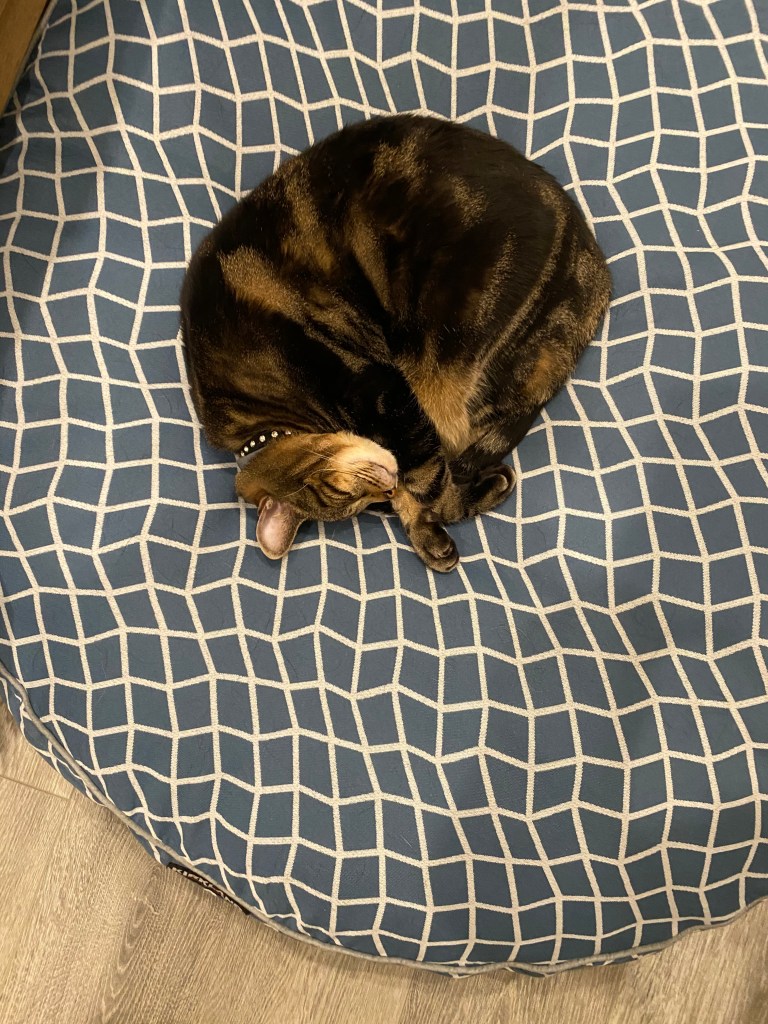
Our cat Dandelion (Dandy) resting on Mitzi’s bed. Mitzi was unhappy about this.
“OBAMA STARTED THE CORONAVIRUS,” Mr. Hall wrote on Feb. 27 under Mr. Blagojevich’s photo and a profile named @GovBlago. It was typical fare for the account, which eventually drew more than 26,000 followers. For much of the time it was active, the profile included a disclaimer in its bio that it was a parody account, which Twitter allows under some conditions.
The rest of Mr. Hall’s impostor accounts did not include such disclaimers.
Twitter eventually removed the @GovBlago account, prompting Mr. Hall to impersonate someone else in the headlines: Dr. Birx, the White House official working on the pandemic. “The media is lying to you about this virus,” he wrote as @DoctorBirx on April 22. The pandemic was “plotted by the powers that be to crash our economy in hopes that Trump will pay for it in November.”
Mitzi, a wonderful 100-lb certified purebred mutt, at rest on her bed.
“Uncle Rob runs Gay Voices For Trump with @TheBiTrumpGuy, although I am very much a heterosexual male. It’s the Trump genes – we love women,” Mr. Hall wrote as Robert Trump in July. “But we are trying to reach out to LGBT and other minority voters. Josh is doing great work so please give him a follow and support him!” The tweets brought Mr. Hall’s real profile thousands of new followers.Tracking Disinformation ›
Not long after, Mr. Hall started messaging Trump supporters as Robert Trump, asking them to donate to a fund-raiser for his group, according to screenshots posted online by two people who received the messages.
“Hey patriot. Would really appreciate if you have a couple of bucks to spare to organization,” he wrote, according to one screenshot.
Mr. Hall denied he sent such messages and suggested that the screenshots had been fabricated. “I would tell you if I did,” he said. “I should have used better judgment and stuff. But I didn’t deliberately try and dupe people out of money.”
His fund-raiser on the website GoFundMe called his group “a grass-roots coalition of LGBT Americans” and said all donations would go to “field organizing, events and merchandise.” He brought in $7,384.
Mr. Hall admitted last week that the group didn’t exist. He didn’t do more than register about 100 people to vote. “I didn’t end up ever really doing anything with the Gay Voices for Trump,” he said. “So I never got the funds from it.” He said the money was still with GoFundMe.
A GoFundMe spokeswoman said that the organizer behind the fund-raiser — an account named Josh H. — had withdrawn the money. She said GoFundMe was now investigating how the funds were used and that the company would give refunds to any donors who requested one.
Mr. Hall didn’t respond to follow-up questions about the fund-raiser.
Moonrise over harbor in Greenport, New Tork
Josiah Bruns, an engineer from Goffstown, N.H., donated $100. With his donation, he left a comment: “Uncle Rob Trump asked me too.”
Mr. Bruns said in an interview that a QAnon message board had led him to the Robert Trump account, which also promoted the conspiracy theory. “We’re trained on the Q research board to always question everything,” he said, adding that he used those lessons to scrutinize the Robert Trump account. “I’m probably 65 percent sure that it was real.”
After The Times told Mr. Bruns that he had been deceived, he said he didn’t mind. In the future, he said, he would apply more research techniques he had learned from the QAnon movement to decipher what was real on the internet. The web is a minefield of lies, he said, “especially if it’s something you want to believe, because those are the easiest lies to fall for.”
In August, Robert Trump died. The news drew scrutiny to the fake Robert Trump account, and some of its followers began to suspect that Mr. Hall was behind it, given the pattern of tweets between the profiles. In response, Mr. Hall said on Twitter that the fake account was run by “a close political friend of mine” who “did not know about Mr. Trump’s serious condition.”
He began impersonating different Trump relatives, including Fred Trump III, the president’s nephew; Maryanne Trump Barry, the president’s sister and a federal judge; and Barron Trump, the president’s teenage son.
“COVID is a scam,” he wrote on Aug. 23 as Barron Trump, a fake account that attracted more than 34,000 followers in eight days. On Aug. 25, the account posted: “Q is real. The more the media delegitimizes it, the more it shows that they’re scared.”
The Trump Organization, which has spoken on behalf of the Trump family members in the past, did not respond to requests for comment. The White House declined to comment.
The Twitter spokesman said the company eventually took down all of Mr. Hall’s accounts for violating its rules on impersonation and evading a previous ban from the site. In response to questions about why someone could create accounts impersonating the president’s teenage son and a White House official, the spokesman said in an email, “We’re committed to protecting the integrity of the conversation on Twitter, and we’re working hard to ensure that violations of our rules against impersonation, particularly when people are attempting to spread misinformation, are addressed quickly and consistently.”
A review on Saturday showed nearly 100 fake Barron Trump accounts were still active on Twitter, not counting those that identified as parodies.
Without a Twitter account, Mr. Hall felt left out after the election, as many fellow Trump supporters convened on Twitter to claim that the vote was rigged. “Why not make a comeback?” he recalled thinking. “I’m going to do something to spice things up.”
On the afternoon of Wednesday, Nov. 18, he created a new impostor, this time posing as the father of Kamala Harris, the vice president-elect. “My daughter is not who she portrays herself to be. She is dangerous for our democracy,” he posted.
The tweet got little attention, so he abandoned that fake for another Trump sibling. The final living sibling he hadn’t tried was Ms. Trump Grau, the president’s older sister, who is in her late 70s, lives in Florida and has hardly said anything public since her brother was elected.
Mr. Hall changed the name, photos and bio of the Mr. Harris account and erased the old posts. Then he started with a new message: “This election inspired me to break my silence,” he wrote under a photo of Ms. Trump Grau and the username @TheBettyTrump. “My brother Don won this election.”
He went viral again, collecting about 20,000 followers in 24 hours. Mr. Hall delighted many of his followers with dozens more juvenile and bizarre tweets, including claims that President-elect Biden is a pathological liar, Ms. Harris is a communist and Michelle Obama is a man.
Mr. Hall collected over $7,000 with his fake “Gay Voices for Trump” Twitter account. Photo by Ben Mack on Pexels.com
On Nov. 20, Mr. Hall said, he woke up and checked the president’s Twitter account, as he did most mornings. “I was like shellshocked,” he said.
He quickly began bragging on Snapchat that President Trump had tweeted about his fake account. “My friend was joking, ‘Maybe he’s not close with his sister, and you just brought him and his sister a lot closer,’” he said. “So I kind of felt good about that.”
Within hours, the account was outed as a fake.
Mr. Hall argued that his accounts were clear parodies, if anyone just looked at what they posted. As Ms. Trump Grau, for instance, he called the CNN anchor Anderson Cooper “Anderson Pooper” and said he would cover the legal fees of anyone who poured gravy down the pants of Chris Wallace, the Fox News anchor.
“I’m a big Trump supporter, but I’m thinking, ‘He’s got to know that that’s a parody,’” he said. “How does he not know?”
Arthur Camins has had a fruitful career as a teacher, science educator, and technology expert. He writes here about the kind of education he hopes his grandchildren will have.
He begins:
Persistent inequity and underfunding, especially after decades of emphasis on test-based accountability and privatization, largely unopposed increases in racial and socioeconomic segregation, and four years of leadership by an active opponent of public education bring us to a moment of choice for K-12 public education in the United States: Change or give up on the needs of most of America’s children.
I usually write what I hope are persuasive essays about education policy and other social justice issues. However, the divisiveness of the last election demonstrates that we can’t argue or campaign our way to lasting fundamental change through presidential elections. The change we need begins with building relationships through shared multiracial conversation and struggle.
Today, I offer my hopes for my two grandchildren and the rest of the children with whom they will grow up and live as adults. Maybe these can be conversation starters with others about their own hopes. That is what I think we need to do so that we can work together to push for our hopes for America’s children in the coming years no matter who serves as America’s chief education officer.
The Pfizer vaccine was developed not by Pfizer but by a German company called BioNTech. There is an amazing story behind BioNTech, which was founded by a married couple, both of whom are children of Turkish immigrants to Germany. Thanks to the success of their vaccine, they are now billionaires but they don’t own a car. They are the kind of people that Trump’s strict bans on immigration would keep out of our country. The Washington Post profiled the couple.
BERLIN — At 8 p.m. Sunday evening, the phone rang with the call Ugur Sahin, chief executive of the German medical start-up BioNTech, had been anxiously awaiting. “Are you sitting down?” Pfizer chief Albert Bourla asked him.
The news that followed was better than Sahin had hoped: Preliminary analysis from Phase 3 trials of his company’s coronavirus vaccine showed 90 percent protection.
“I was more than excited,” said Sahin, speaking to The Washington Post on a video call from his home in the western German city of Mainz.
The interim results put the 55-year-old and his co-founder wife, Ozlem Tureci, in the front of the pack racing for a safe and effective vaccine. Global markets rallied, and stock soared for BioNTech — a small-by-pharma-industry-standards company that has yet to see a vaccine using its technology brought to market. For the corona-weary masses, it was a much-needed glimpse of a potential end in sight...
The husband-and-wife team behind one of the world’s top coronavirus vaccine candidates are the sort of people who don’t own a car and who took the morning off for their wedding day in 2002 before returning to the lab. Half a day was “sufficient,” Tureci explained.
Sahin and Tureci, both children of Turkish immigrants to Germany, met while working on an oncology ward in the southwestern city of Homburg. They found they shared an interest in getting the body’s immune system to fight cancer. Sahin was born in the Mediterranean city of Iskenderun and moved to Germany when he was 4. His father was a “Gastarbeiter,” or guest worker, at a Ford factory in Cologne.
Tureci’s family moved to Germany from Turkey before she was born, after her father finished medical school. “He schlepped me everywhere when I was young,” she said, “to the hospital and to see patients and such.” In her studies, Tureci was surprised by the gap between advances in medical technology and what was available to doctors and patients. She and Sahin decided the best way to close that gap was to launch their own company.
Founded in 2008, BioNTech’s work focused primarily on cancer vaccines using what is known as messenger RNA technology. While traditional vaccines require labor-intensive production of viral proteins, mRNA vaccines deploy a piece of genetic code that instructs a person’s immune system to produce the proteins itself.
Sahin said he hadn’t closely followed the science of the novel coronavirus spreading in China, but on Jan. 24 he received a scientific paper that rang alarm bells. It described both serious cases and an asymptomatic carrier. He Googled “Wuhan” and saw it was a well-connected megacity with an international airport.
“That’s the full pattern you need for a pandemic virus,” he said. It took a few days to talk others at the company into putting their resources behind a coronavirus vaccine, he said, as some experts were still dismissing the potential for a pandemic as hype. “In a company, it’s a matter of convincing people that they need to install a lot of energy,” he said. Energy is something Sahin exudes as he talks excitedly about the vaccine’s prospects.
It was a “snowball effect,” Tureci said. “He was very convincing that this kind of pandemic could develop.”
Within four weeks, the first wave of the epidemic in Europe was in full swing, and BioNTech had 20 vaccine candidates as part of what it dubbed project “Lightspeed” (no connection to the U.S. government’s “Operation Warp Speed”). With a team of more than 1,000 people in Mainz working “24-7,” Sahin said, the company narrowed its most promising candidates down to four. But it didn’t have the resources to conduct large-scale clinical trials or the production and distribution that would be necessary.
BioNTech approached Pfizer, with whom they had an existing relationship, working on influenza vaccines. “The answer came immediately and was a yes,” said Tureci. In April, Pfizer invested an initial $185 million toward the vaccine development and said it would release up to $563 million more based on milestones in the development. When the interim Phase 3 results came in, Tureci said, they took her by surprise. “As a scientist, I’m very cautious and tend to be a bit pessimistic,” she said.
Sahin said the news was “extremely relieving.” The United States had already ordered 100 million doses, with an option for 500 million more. The European Union on Wednesday agreed on an order for an initial 200 million. Amid the whirlwind of publicity, tweets from President Trump have brought some bemusement. “Complete nonsense” is how Sahin describes the accusation that the companies sat on the results until after the election. And as for Trump’s claims of credit: “I’m not sure where the U.S. government would have had input in this,” Tureci said...
Sahin and Tureci are now a billionaire couple, numbering among the 100 richest Germans, according to the German paper Welt am Sonntag. Sahin said he can’t avoid watching the stock price go up — “but it doesn’t really matter that much.” He’s more concerned about getting his first product to the market. “I don’t have a car. I’m not going to buy a plane,” said Sahin, who cycles to work every day. “What’s life-changing is to be able to impact something in the medical field.”
I always have this problem in early December: What shall I give to the children in my life?
This year I did something I have wanted to do for a long time. I got a gift catalog from Heifer.com and I ordered animals that will be given to a family that needs them to have a better life. I purchased a sheep ($120) on behalf of one child and a goat on behalf of another. I could have bought shares in either animal for $10. I will buy honeybees ($20) and chicks ($20) for other children in my life. The children will have the pleasure in knowing that they helped others.
If you go online, you will see many opportunities to give meaningful gifts. For $275, you can pay for a girl to attend school in India. For the more expensive animals, like alpacas or heifers or water buffalo, you can buy a share.
These are gifts that keep on giving.
Alternatively, you can support charities in the United States that are providing food and shelter for needy children and families. It is truly shameful that millions of people are hungry and homeless in this country, one of the richest in the world. The pandemic has widened inequality, by plunging millions of people into poverty while enriching billionaires.
Bob Shepherd returned to teaching after many years in the education publishing industry, where he developed curriculum and assessments. He writes about what changed while he was away. Thanks to State and federal mandates, he found himself ensnared by stand
I taught at the beginning of my career, had a successful career in educational publishing, and then returned to teaching at the end of my career. What a difference these years made!!!!
At the beginning of my career, I had English Department Chairpeople who were highly experienced teachers. The general attitude of administrators was that English teachers were the experts on English, History teachers the experts on History and the teaching of History, etc., and they pretty much stayed out of stuff that wasn’t their business. We in the English Department would hold regular meetings and discuss what was and wasn’t working in our classes, choose curricula, share tips and lesson plans and materials (many of which we had developed), and set policies and procedures. Once a year, the English Department chairperson would do evaluations of the teachers in his or her department. We made our own tests. There was enormous opportunity for innovation because we could actually discuss with one another various pedagogical approaches and curricular materials and make our own decisions. Our discussions/debates about pedagogy and curricula were vigorous and spirited. Many of the teachers were older women who had been doing the job for years. They were, almost to a person, scholarly and highly knowledgeable. The kids learned a lot.
I loved teaching. The only reason I left was that the pay wasn’t great. I started a family, and the year I left, I almost tripled my salary.
Flash forward 25 years. When I returned to teaching, everything was micromanaged. We still had department meetings, but these had devolved into sessions in which the Department chairperson read to us the latest mandates from our administration or from the state. Curriculum materials were chosen for us and were HORRIBLE, test-preppy crap. We were expected to follow a day-by-day script from the state. Formal evaluations were done four times a year by APs or the Principal, using mandated checklists, and in addition, there were four other informal evaluations and a system of demerits for not completing an enormous list of requirements (if, for example, an AP came into one’s classroom and the standard, bellwork, essential question, daily vocabulary, and homework for the hour’s lesson weren’t posted on the board; if one’s Data Wall or lesson plan book (each class had to have a two-page lesson plan in a folder) were not completed and up to date; and so on (there were hundreds of such requirements–far too many for anyone to keep track of them). In short, the Department Chairperson and the teachers had lost all autonomy. We were expected to do enormous amounts of test prep because what mattered–to the evaluations of the students, of us, of the administrators, and the school–were the scores on the invalid, sloppy, ridiculous state tests. My pay depended upon the school’s state rating based upon those demonstrably invalid tests.
And the teachers had changed. They were mostly young. They were not scholarly and not knowledgeable. “What’s a gerund?” the 26-year-old English Department Chairperson asked me, looking at the month’s required grammar topics. “Oh, what’s that book?” a fellow English teacher asked me about a volume I was carrying. Never heard of this guy. YEETS?”
“Yeats,” I said. “His collected poems.”
“Oh, I don’t read poetry,” she said.
The Reading Coordinator informed us that our 9th graders had to read ALL of the Odyssey, in her words, “the ENTIRE NOVEL.” She freaking thought that The Odyssey was a novel!!! When we met to discuss a classical literature unit, she had no idea that the term referred to the literature of ancient Greece and Rome.
And there was enormous churn. Between a quarter and a third of the teaching staff every year.
To teach at all sanely, I had to pretend to be following the rules while secretly making my own curricular materials in the form of handouts.
I spent most of my time carrying out required tasks that were of ZERO value to my students, most of the related, in one way or another, to supposed “accountability.”
The profession had been utterly ruined in the name of “reform.”





 Diane Ravitch's blog