Archives for the month of: April, 2020

Until recently, the World Bank has been a vocal supporter of for-profit privatized education such as that offered by Bridge International, which had been expanding rapidly in Africa.

Thanks in large part to the work of Education International, a world confederation of teachers’ unions, the World Bank has changed its policy.

In a sudden and far-reaching policy shift, World Bank President David Malpass has agreed to major reforms that include officially freezing any direct or indirect investments in private for-profit pre-primary, primary and secondary schools. This has been a critical issue for Education International for many years and has been the key focus of our interactions with the Bank.

It has also been a major thrust of our Global Response campaign, where member organisations, regions and the EI secretariat have worked together to research and expose the activities of private, for-profit firms. Examples of that work include Uganda and Kenya, where illegal operations took place or labour standards and regulations were violated by Bridge International Academies.

Given that the World Bank is the largest funder of education in the developing world, EI has been keeping a close eye on their work. We have repeatedly and publicly challenged them for promoting privatisation, attacking teachers and undermining quality education systems and have tried to engage in dialogue – in meetings, including with EI officers and through letters, reports, and other methods. Not only did policy and financial support for private, for-profit, education operators like Bridge International Academies continue, but it increased. Some national foreign assistance agencies, including the UKs Dfid and USAID as well as private funders joined the parade. It was an ideological and profit-driven attack on public education.

Two things altered the situation. First, a pro-labour majority was elected in the US House of Representatives in the 2018 mid-term elections. That shifted leadership of key committees to members who were friendlier to trade union views. Second, the COVID-19 crisis required a broad consensus among the House, the Senate, and the White House to adopt a 2-trillion-dollar relief package. The positions of the World Bank evolved in discussions between the House Financial Services Committee chaired by Maxine Waters (D-California), and US Treasury Secretary Steven Mnuchin.

These actions built on growing global recognition of the damage done by private, for-profit education. That increasing concern includes a decision by the European Parliament and an agreement by the Board of the Global Partnership for Education (GPE).

World Bank polices and advice to many countries have long supported private delivery of education and other public services. Although it has officially committed to support the Sustainable Development Goals, much of its policy and actions run counter to that global consensus.

Financial support for private, for-profit education firms came largely from the World Bank Group’s International Finance Corporation (IFC), which is charged with making loans to the private sector. Under the agreement with the US, the IFC will freeze all support to private, for profit schools, including through direct investment, indirect investment and advisory services

EI continues to pressure the Workd Bank to adopt progressive policies that recognize workers’ rights and the need to regulate businesses practices.

Patrick O’Donnell is one of the best education journalists in the nation. He has covered charter and cyber charter scandals in Cleveland and in Ohio without fear or favor. Ohio, as you may have noticed, is awash in charter corruption.

O’Donnell worked for the Cleveland Plain-Dealer until last weekend, when the newspaper pushed out its leading journalists and told them they could cover far-flung areas if they want to stay employed. The order from on high essentially fired union journalists and gutted the newspaper’s coverage of Cleveland.

The Plain-Dealer is part of Advance Publications, which is owned by the billionaire Newhouse family. Advance is engaged in cost-cutting that will destroy local journalism. It’s all about the Almighty Dollar.

Wisconsin long ago scheduled its primaries for April 7. When the dimensions of the public health crisis became apparent, Governor Tony Evers tried to postpone the election and to encourage voting by mail. Evers’s order to postpone the election was overturned by the state court, and its ruling was sustained by the U.S. Supreme Court, voting along partisan lines. Hundreds of thousands of people were disenfranchised.

To understand the fiasco, read this article by Stephen Rosenfeld:

The Republican Party affirmed with startling clarity on Monday that preserving political power was a higher priority than protecting public health or enabling voters to cast ballots that will be counted in the COVID-19 era.

The stage for this stunning partisan display embracing voter suppression was a constitutional crisis that erupted in Wisconsin, a day before scheduled statewide elections on April 7 for its 2020 presidential primary, a state Supreme Court seat, and contests for hundreds of local offices.

The election will continue on April 7, but the reverberations from Monday rulings by Wisconsin’s Supreme Court and the U.S. Supreme Court later in the day in a related lawsuit have set down markers that suggest that securing voting rights in a pandemic is anything but assured—especially if anti-participatory state laws and voting procedures will be upheld by majorities on the highest courts.

Efforts by Democrats to postpone in-person voting and extend voting by mail due to the pandemic were rejected by conservative majorities on the Wisconsin Supreme Court and on the U.S. Supreme Court. In separate rulings, both courts sided with the Republican National Committee and Wisconsin Republicans.

“The Court’s order, I fear, will result in massive disenfranchisement,” Supreme Court Justice Ruth Bader Ginsburg wrote
in a dissent signed by the court’s three other liberal justices. “A voter cannot deliver for postmarking a ballot she has not received. Yet tens of thousands of voters who timely requested ballots are unlikely to receive them by April 7, the Court’s postmark deadline [to return ballots].”

While this ideological split may not be new in electoral politics, especially in voting right cases where conservatives seek strict laws limiting participation and liberals seek flexibility to enfranchise voters, it was a “bad sign” for the climate heading into elections in the fall, said Rick Hasen, ElectionLawBlog.org founder and a nationally known constitutional scholar.

“It is a very bad sign for November that the Court could not come together and find some form of compromise here in the midst of a global pandemic unlike anything we have seen in our lifetimes,” he wrote. “Like the Wisconsin Supreme Court, the U.S. Supreme Court divided along partisan and ideological lines.”

The courts’ rulings capped a day of high drama and a state constitutional crisis.

On Monday afternoon, Wisconsin’s Democratic Gov. Tony Evers issued an executive order to postpone in-person voting and extend the deadline for absentee ballots to be mailed in, citing the pandemic. But the state’s Republican majority legislature challenged Evers’ order before the conservative-led Wisconsin Supreme Court. The GOP legislative leadership issued a statement telling local officials to keep planning for Tuesday’s election, creating great tension and uncertainty as the Democratic governor and Republican legislature headed into court.

By a 4-2 vote later in the day, the Wisconsin Supreme Court nullified Evers’ executive order, forcing the in-person voting to continue on April 7 and restoring the deadline for absentee ballots to be returned by the same day for them to count. Meanwhile, hundreds of polling places were not going to open after poll workers withdrew due to the pandemic. For example, only five of Milwaukee’s 180 polls would be opened in that non-white epicenter, ElectionLawBlog.org noted.

“The April 7 Spring Election and Presidential Preference Primary is occurring as scheduled,” a headline on the Wisconsin Elections Commission (WEC) website said after the state Supreme Court ruling.

In addition to in-person voting, the WEC website said that 1,275,254 absentee ballots had been requested by voters and that 724,777 had been returned by April 6. Other reports by academics citing WEC data said that local officials had yet to mail out 10,000 ballots. Meanwhile, half-a-million ballots had yet to be returned.

The Wisconsin Supreme Court’s decision was not entirely unexpected, because in 2016 outgoing Republican Gov. Scott Walker and the GOP-led legislature stripped many authorities from the incoming Democratic governor. Democrats had fought those laws, enacted after the 2016 election in a lame-duck session, but lost.

“This is a real constitutional showdown,” said Kevin Kennedy, the ex-executive director of Wisconsin’s Government Accountability Board, which oversaw the elections for decades until Walker and GOP legislators dismantled the board.

“When I was there I thought the governor had the power to do something [like postpone an election in a crisis], but in 2016 the Legislature severely restricted the governor’s power,” Kennedy said. “He [Walker] signed all of these laws that he would never have tolerated as restrictions on his power. Even the Attorney General can’t settle a lawsuit without approval from the legislature.”

However, shortly after the Wisconsin Supreme Court ruled on Monday, the U.S. Supreme Court weighed in—responding to another lawsuit filed late on Friday by the Republican National Committee and Wisconsin’s GOP-led legislature. (Its Republican majority was created by gerrymandering after the 2010 census.)

The U.S. Supreme Court decision followed a tortuous path that began with lower court orders that sought to help voters but ended with its ruling withdrawing that help.

Earlier on Friday, April 3, a federal district court with a judge appointed by President Obama extended the Wisconsin election’s mail-in balloting deadline by a week and said that absentee voters did not have to find a witness to sign their ballots. The witness requirement was a pre-existing state law.

That pro-voter ruling was appealed by Republicans to a federal circuit court, which reinstated the witness requirement but kept the week-long extension for absentee ballots to be returned. The RNC then appealed the extension to the U.S. Supreme Court, arguing that some Wisconsin voters would be voting after Election Day.

The Republicans argued that no special exceptions should be made, even though the pandemic had led local officials to send out six times as many vote-by-mail ballots as in the 2018 election—and by late Monday more than 500,000 hadn’t been returned, according to the WEC.

The Supreme Court’s conservative bloc agreed with the Republican litigants, issuing a ruling that drew harsh criticism by the court’s liberal minority.

“The Court’s [majority] suggestion that the current situation is not ‘substantially different’ from ‘an ordinary election’ boggles the mind,” Justice Ginsburg’s dissent said. “Some 150,000 requests for absentee ballots have been processed since Thursday, state records indicate. The surge in absentee-ballot requests has overwhelmed election officials, who face a huge backlog in sending ballots.”

“It is among the most cynical decisions I have read from this Court—devoid of even the pretense of engaging with the reality that this decision will mean one of two things for many WI voters: either they will risk their health & lives to vote, or they will be disenfranchised,” tweeted Sherrilyn Ifill, president and lead counsel of the NAACP Legal Defense and Educational Fund.

A Troubling Precedent

In the coming days, it will become clear how many thousands of voters will see their absentee ballots rejected because they arrived too late to be returned by April 7. But Monday’s high court rulings—by a state supreme court and federal Supreme Court—will resonate in other 2020 swing states that are wrestling with expanding absentee balloting in response to the pandemic.

The partisan divide that led to Wisconsin’s constitutional crisis, where a Democratic executive branch and a Republican-led legislature could not agree on voting reforms, is not unusual—although the Wisconsin governor’s weakened authority is somewhat unique. The 2020 swing states of Michigan, Pennsylvania and North Carolina all have different parties controlling their executive and legislative branches. These states are already seeing clashes over expanding absentee voting in response to the pandemic.

Analysts in Wisconsin, including conservatives such as Charlie Sykes, said that no one should doubt that the Wisconsin GOP was putting partisan power before the public interest. Sykes noted that Republicans believe they can win a state Supreme Court seat if the April 7 election continued and other voting options were curtailed.

“In Wisconsin, the GOP would rather endanger people’s lives and have a clusterf—-k election, so long as it gives them a chance at clinging to a piece of government power,” he wrote Monday on TheBulwark.com, which Sykes founded and where he is an editor at large. “Don’t be confused about any [of] the motivations here: [The] GOP position is about power, not ideology.”

[Please read the rest of the article by opening the link.]
Professor Les Perelman, who taught writing at MIT, recently was honored by the New South Wales Teachers Federation for his successful effort to stop the “robo-grading” of tests in Australia. He demonstrated how easy it was to deceive the machines grading thousands of tests in only seconds.

Perelman speaks here about the importance of public education, critical thinking, and the dangers posed by edubusiness to both of the former.

Perelman is notable as the inventor of the Babel Generator, in which he and his students showed that the “robo-graders” used by ETS and other manufacturers of standardized tests could be easily fooled by gibberish. These automated grading machines would give high scores to papers that were nonsense if the sentences were long enough and contained pretentious words.

If you open the Babel Generator, insert any three words and it will immediately produce an essay that can fool the robot grading machine and get a high score even though it is totally nonsensical.

I wrote about Perelman in SLAYING GOLIATH.

G.F. Brandenburg wonders where the $2 trillion is going.

A retired math teacher, he did the numbers. If every American gets $1,200, that’s $400 billion. That’s 20%.

Who gets the other 80%?

Politico reported on April 8 that Trump insists that there be no oversight of the $2 trillion.

Apparently he thinks it was appropriated by Congress solely for him to dispense as he wishes.

WATCHMEN — As the Trump administration begins pumping trillions of taxpayer dollars into the economy, none of the built-in oversight mechanisms are even close to functional, Congress reporter Kyle Cheney writes. Congressional leaders have appointed just one of five members to a commission meant to serve as lawmakers’ eyes on Trump administration decisions for a $500 billion fund for distressed industries. An inspector general nominated by Trump intended to provide a second check has already generated controversy among Democrats, and the president’s sidelining of the chairman of a third independent overseer set back the one mechanism that appeared on track.

Friends? Family? Cronies? Campaign donors?

The potential for massive corruption is worse than you can imagine under a president with a long history of bankruptcies, tax evasion, stiffing creditors, and bending the rules to benefit himself, his family, and his company—and Republican Senators are his willing accomplices.

This was in Politico yesterday:

THE CORONAVIRUS crisis has brought to the fore two trends that, when put together, are a tad alarming.

GOVERNMENT IS GROWING, and becoming far more crucial in our everyday lives.

— JARED KUSHNER is in the middle of discussing a plan to track what health care we are receiving. … THE TREASURY is doling out checks to families and individuals. … THE SBA is giving grants to businesses to help them cover payroll. … THE GOVERNMENT has the ability to take a significant equity stake in one or more of the nation’s airlines.

YET, GOVERNMENT OVERSIGHT is shrinking.

— THE PRESIDENT has fired two inspectors general, and, if you believe reports, is planning on firing more. … THE ADMINISTRATION has routinely flouted subpoenas for appearances and documents. … SENATE REPUBLICANS have shrunk from checking the president.

THE KIND OF INTERVENTION into the economy that we are seeing right now typically requires stringent oversight over many years. KYLE CHENEY writes that “none of the built-in oversight mechanisms are even close to functional.” ANDREW DESIDERIO reports on a bipartisan group of senators asking Trump for answers about the intelligence community IG firing.

— AND NOW THIS: “Recovery bill allows the Fed to spend billions without keeping records,” by Maggie Severns and Victoria Guida: “Tucked into the recent recovery bill was a provision granting the Federal Reserve the right to set up a $450 billion bailout plan without following key provisions of the federal open meetings law, including announcing its meetings or keeping most records about them, according to a POLITICO review of the legislation.

“The provision, the existence of which has not been previously reported, further calls into question the transparency and oversight for the biggest bailout law ever passed by Congress. President Donald Trump has indicated he does not plan to comply with another part of the new law intended to boost Congress’ oversight powers of the bailout funds. …

“The changes at the central bank – which appear to have been inserted into the 880-page bill by sympathetic senators during the scramble to get it approved — would address a complaint that the Fed faced during the 2008 financial crisis, when board members couldn’t easily hold group conversations to address the fast-moving economic turmoil.”

Here is a constructed response question:

Why does the Trump administration want little oversight as it dispenses $2 trillion in aid? Why are Senate Republicans agreeable to Trump’s removal of independent monitors in government agencies?

Read the new ending to this post. Trump tweeted a response.

The Wall Street Journal offered some useful advice to Trump. Given his ego and vanity, he is unlikely to heed the editorial, even though it comes from his cheering section. His narcissism shields him from any criticism. He thinks that his base loves his attacks on the press. It is always surprising to see any member of the press defend this hater of the free press.

Trump’s Wasted Briefings
The sessions have become a boring show of President vs. the press.

By The Editorial Board
April 9, 2020, Page A16

A friend of ours who voted for President Trump sent us a note recently saying that she had stopped watching the daily White House briefings of the coronavirus task force. Why? Because they have become less about defeating the virus and more about the many feuds of Donald J. Trump.

The briefings began as a good idea to educate the public about the dangers of the virus, how Americans should change their behavior, and what the government is doing to combat it. They showed seriousness of purpose, action to mobilize public and private resources, and a sense of optimism. Mr. Trump benefitted in the polls not because he was the center of attention but because he showed he had put together a team of experts working to overcome a national health crisis.

But sometime in the last three weeks Mr. Trump seems to have concluded that the briefings could be a showcase for him. Perhaps they substitute in his mind for the campaign rallies he can no longer hold because of the risks. Perhaps he resented the media adulation that New York Gov. Andrew Cuomo has been receiving for his daily show. Whatever the reason, the briefings are now all about the President.

They last for 90 minutes or more, and Mr. Trump dominates the stage. His first-rate health experts have become supporting actors, and sometimes barely that, ushered on stage to answer a technical question or two. Vice President Mike Pence, who leads the task force, doesn’t get on stage until the last 15 minutes or so. That becomes the most informative part of the session, since Mr. Pence understandably knows details the President doesn’t.

Mr. Trump opens each briefing by running through a blizzard of facts and numbers showing what the government is doing—this many tests, that many masks, so many ventilators going from here to there, and what a great job he’s doing. Then Mr. Trump opens the door for questions, and the session deteriorates into a dispiriting brawl between the President and his antagonists in the White House press corps.

One of the ironies of this Presidency is that Mr. Trump claims to despise the press yet so eagerly plays its game. Every reporter knows the way to get a TV moment, and get a pat on the back from newsroom pals, is to bait Mr. Trump with a question about his previous statements or about criticism that someone has leveled against him. Mr. Trump always takes the bait.

On Tuesday Mr. Trump was asked, in a typically tendentious question, why he had compared the coronavirus to the flu. Instead of saying he had been hoping for the best but was wrong when he’d said that, he got into a fight over the severity of the flu. This sort of exchange usually devolves into a useless squabble that helps Mr. Trump’s critics and contributes little to public understanding.

The President’s outbursts against his political critics are also notably off key at this moment. This isn’t impeachment, and Covid-19 isn’t shifty Schiff. It’s a once-a-century threat to American life and livelihood.

The public doesn’t care who among the governors likes Mr. Trump, or whether the Obama Administration filled the national pandemic stockpile. There will be time for recriminations. What the public wants to know now is what Mr. Trump and his government is doing to prevent the deaths of their loved ones or help the family breadwinner stay employed.

If Mr. Trump thinks these daily sessions will help him defeat Joe Biden, he’s wrong. This election is now about one issue: how well the public thinks the President has done in defeating the virus and restarting the economy. If Americans conclude he succeeded in a crisis, they will forgive him for reacting more slowly than he and many others might have in January. But on that score, voters will be persuaded by what they see in their lives and communities come the autumn. They will judge Mr. Trump by the results, not by how well he says he did.

If Mr. Trump wants to make his briefings more helpful to the country, here’s our advice. Make them no more than 45 minutes, except on rare occasions. Let Mr. Pence lead them each day, focusing on one issue or problem. Mr. Pence can take the questions, and Mr. Trump can show up twice a week to reinforce the message. Maybe then our friend who was a Trump voter might start watching again.
###
—————-
Who will tell the president?

President Trump should thank The Wall Street Journal’s Editorial Board for good advice,
(Trump’s Wasted Briefings,” Review & Outlook, April 9).
The Journal provides advice that the president would certainly not get from his 2020
Re-election Campaign staff or from his loyal followers. Who among them would speak
truth to power for fear of the president’s wrath upon being criticized?
How could anyone in the president’s orbit possibly question a campaign tactic that
serves as a free-of-charge substitute for his expensive political rallies and where the
president stars in a well-staged, daily show with high ratings?
The Journal’s editors were able to tell their readers why the Trump-led briefings are wasted.
Now who will tell the president?

Frank G. Splitt
Mount Prospect, Ill.

Trump responded to the WSJ in a tweet at 3:59 pm today:

“The Wall Street Journal always “forgets” to mention that the ratings for the White House Press Briefings are “through the roof” (Monday Night Football, Bachelor Finale, according to @nytimes) & is only way for me to escape the Fake News & get my views across. WSJ is Fake News!”

The $2 trillion appropriated by Congress as coronavirus relief funds will benefit for-profit colleges with poor records, according to Marketwatch. They are likely to collect $1 billion. DeVos has been an investor in for-profit colleges, so don’t expect her to care. Democratic Senators have complained to DeVos but got no response this far.,

Dozens of for-profit colleges that are among those most likely to benefit from stimulus funding face thousands of claims from students demanding their money back because they say they were defrauded, according to analysis prepared for MarketWatch.

Some of the schools eligible for bailout funds also face federal scrutiny for mismanaged funds, while others have been dubbed “failed” under a federal standard requiring them to provide an education adequate for repaying loans, the analysis shows. Some schools eligible for bailout funds have settled lawsuits with the U.S. Justice Department following allegations of fraud and misuse of federal student aid…

The analysis found that of the top estimated 100 for-profit schools eligible for coronavirus crisis subsidies, 79 had students who demanded their loans be forgiven under a federal program meant to provide relief to students who alleged they had been defrauded. From these top 100 for-profit schools, 12,000 students had filed federal complaints alleging they were victims of fraud. Twenty-three of the top 100 for-profit schools most likely to receive funding were previously characterized by federal regulators as “failed” under a requirement that students go on to find jobs good enough to repay loans. DeVos last year rescinded the requirement that schools meet this standard as a condition for benefiting from federal subsidies.

Twelve of the top 100 for-profit schools eligible for stimulus funds also faced some form of legal action as of 2017 for alleged fraud involving recruitment and misuse of federal student aid programs, according to the analysis. Thirteen, meanwhile, were under “heightened cash monitoring,” an extra level of scrutiny under U.S. Department of Education rules meant to serve as a caution to students that can indicate problems with finances or accreditation.

“Colleges like these with a predatory history and thousands of prior students who are still awaiting compensation for deceptive practices should not be getting a federal bailout,” said Bob Shireman, deputy undersecretary of education under President Obama who now oversees higher education programs at The Century Foundation, a liberal think tank.

As the rushed effort to dispense $2 trillion in stimulus funds unfolds, experts are questioning how the government more broadly will guard against fraud, waste and abuse, and whether the public can trust whether tax dollars will be used to achieve the program’s goals.

Expect waste, fraud, and abuse, and a big payday for some of the worst actors in higher education, as well as a payday for the charter industry, which lobbied to be included in the fund for struggling small businesses, although they have not lost a dime.

While enthusiasts for online learning predict a boom after the pandemic, as students and teachers get used to learning at home online, the reality is different on the ground. Stress, loneliness, and boredom are typical reactions.

A team of reporters in Los Angeles reports on student reactions to the loss of face-to-face instruction.

A senior at John C. Fremont High School in South L.A., Emilio Hernandez has a class load that is about as rigorous as it gets: AP calculus, physics, design, English, engineering and government. He loves talking to his peers in English class, who make all the readings thought-provoking. He often turns to his math teacher, who has a way of drawing the graphs and walking him through derivatives and complex formulas.

Now, with a borrowed laptop from school and family crowded in the living room, he’s struggling to make school feel like, well, school. He has trouble falling asleep and finds himself going to bed later and later — sometimes as late as 3 a.m.

“Assignments that would normally take me two hours or 30 minutes are now taking me days to complete. I just … can’t focus,” he said. “I don’t have anyone giving me direction. It’s just me reading and having to give myself the incentive to do the work.”

It’s been three weeks since school districts across the state have closed their campuses as the novel coronavirus continues to sweep its way across California — sending more than 6 million students home to navigate online, or distance, learning. What started as an emergency scramble to provide laptops and meals for a few weeks has dramatically shifted to a longer-haul transformation of public education.

“The kids are not going back to their classrooms” this academic year, said Gov. Gavin Newsom, who acknowledged the burden on households with the entire state under his stay-at-home order.

For those who look to school for learning and social structure, the new reality is sinking in: There will be no school as we know it after spring break. No prom. No year-end field trips. No projects to present inside a familiar classroom. Navigating the three months left in the school year, leaders said, calls for patience and dedication from educators, self-motivation from already stressed-out students and swift actions from school districts typically mired in bureaucratic obstacles.

“These aren’t normal circumstances. It’s the most uncharted territory that we’ve been in,” said State Supt. of Public Instruction Tony Thurmond. “We’re stronger together and we can help all of our kids as we work together.”

Many are already rising to the challenge. Yet each step forward means moving past bureaucratic hurdles and cost constraints and taking on persistent problems of student poverty and stubborn achievement gaps…

Overwhelmed. Unmotivated. Stressed. Stressed. Stressed.

These were the words that popped up over and over again on social media and in conversations among students across Los Angeles during a recent virtual town hall with a Times reporter and Heart of Los Angeles, a nonprofit organization in MacArthur Park that provides free after-school programming for underserved youth. About two dozen students shared just how complicated distance learning can be.

Many said that their homes were crowded enough already, and that school and after-school programs were their sanctuaries — a place to escape. Others worried not only about their grades but about the well-being of their families. Some students have been using their own savings to get food for themselves and younger siblings to avoid stressing out family members.

Among the nations of the world, only one is fully prepared for an emergency like the current pandemic: Finland. While the rest of us have lived like grasshoppers, not worrying about possible disasters, the Finns are like ants: storing what is needed for whatever might happen. They long ago decided not to be dependent on the global supply chain for essential equipment.

The New York Times published this story:

STOCKHOLM — As some nations scramble to find protective gear to fight the coronavirus pandemic, Finland is sitting on an enviable stockpile of personal protective equipment like surgical masks, putting it ahead of less-prepared Nordic neighbors.

The stockpile, considered one of Europe’s best and built up over years, includes not only medical supplies, but also oil, grains, agricultural tools and raw materials to make ammunition. Norway, Sweden and Denmark had also amassed large stockpiles of medical and military equipment, fuel and food during the Cold War era. Later, most all but abandoned those stockpiles.

But not Finland. Its preparedness has cast a spotlight on national stockpiles and exposed the vulnerability of other Nordic nations.

When the coronavirus hit, the Finnish government tapped into its supply of medical equipment for the first time since World War II.

“Finland is the prepper nation of the Nordics, always ready for a major catastrophe or a World War III,” said Magnus Hakenstad, a scholar at the Norwegian Institute for Defence Studies.

Though year after year Finland has ranked high on the list of happiest nations, its location and historical lessons have taught the nation of 5.5 million to prepare for the worst, Tomi Lounema, the chief executive of Finland’s National Emergency Supply Agency, said on Saturday.

“It’s in the Finnish people’s DNA to be prepared,” Mr. Lounema said, referring to his country’s proximity to Russia, its eastern neighbor. (Finland fought off a Soviet invasion in 1939.)

In addition, most of its trade goes through the Baltic Sea. That, Mr. Lounema said, is considered a vulnerability because, unlike Sweden, which has direct access to the North Sea on its west coast, Finland has to rely on the security conditions and the running of maritime traffic in the Baltic.

“If there is some kind of crisis, there might be some disturbance” in the supply chain, he explained.

Two weeks ago, as the country’s coronavirus cases ticked up — by Sunday, the country had recorded more than 1,880 cases and 25 deaths — the Ministry of Social Affairs and Health ordered that stored masks be sent to hospitals around the country.

“The masks are old — but they are still functioning,” Mr. Lounema said by phone.

There is little publicly available information on the number of masks and other supplies that Finland has or where exactly they are stored.

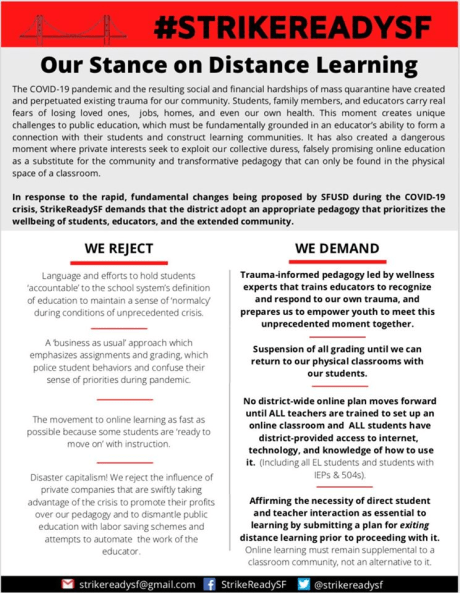
Parents, educators, and community activists in San Francisco formed an organization to protest the inequities in over reliance on distance learning. They call themselves StrikeReadySF. This is their manifesto.

distancelearning