Archives for the month of: February, 2020

About 30 public schools in Broward County may close due to loss of students to charter schools.

The original purpose of charter schools was to collaborate with public schools, not to destroy them. Unfortunately, the charter industry is so well represented in the legislature that they have a distinctive edge over real public schools. The wife of the State Commissiomer of Educatuon Richard Corcoran runs a charter school.

About 30 Broward schools could close, combine with other schools or convert into a new type of facility as the school district looks for ways to deal with nearly half-empty campuses.

Many of these schools are in the southern part of the county, from Hollywood to Pembroke Pines, where thousands of students have left for charter schools. Others are in the Fort Lauderdale area and have struggled with factors such as low student performance, outdated facilities and aging neighborhoods…

Enrollment has dropped about 30,000 in the past 15 years, due mostly to charter schools and to a smaller degree private school vouchers. The demographics also have changed in Broward, where most growth is among adults without school-aged kids….

Broward considers a school to have insufficient enrollment if it has 70% percent or fewer students than it was built to serve. Many of these schools aren’t able to afford an art, music or physical education teacher or a media specialist to run the library. Several didn’t get musical instruments through the $800 million bond because they can’t afford to teach music.

Nearby charter schools are eagerly eying the buildings that might become available.


From Politico today:

Of all the Democratic candidates, Michael Bloomberg has the worst record on education. His education policies mirrored George W. Bush’s No Child Left Behind. He was fully invested in high-stakes testing, data-based decision-making, closing schools with low scores instead of helping them, opening new schools and then closing those schools, creating selective schools that chose students based on test scores, and opening scores of charter schools. He had sole control of the “Panel on Education Policy,” and warned its members that if they disagreed with him, they would be fired. When some disagreed about his blanket prohibition of “social promotion,” he summarily fired them. He hired three non-educators as chancellor to lead the system (one of them last 95 days). He tried and failed to hire business people and people from other other fields as principals. He stands for testing and privatization of public education. He has funded pro-privatization candidates in local and state school board races around the country.

SCOOP … MIKE BLOOMBERG is airing another national TV ad tying himself to closely BARACK OBAMA. This one is a 30-second spot entitled “Difference,” and it’s chock-full of imagery of BLOOMBERGand OBAMA. The timing of this ad is quite interesting, as it comes in the middle of a massive intraparty squabble between BLOOMBERGand Sen. BERNIE SANDERS (more about that in a second). BLOOMBERG has found plenty of ways to tie himself to OBAMA, the most popular Democrat in America. The 30-second ad

— SCRIPT: “[NARRATOR]: A great president and an effective mayor. Leadership that makes a difference. [OBAMA SPEAKING]: He’s been a leader throughout the country for the past 12 years, Mr. Michael Bloomberg is here. [NARRATOR]: Together they worked to combat gun violence, and again to improve education for every child. [OBAMA]: And I want to thank the mayor of this great city, Mayor Bloomberg, for his extraordinary leadership. And I share your determination to bring this country together to finally make progress for the American people.”

BLOOMBERG also has a new 30-second spot with Judge Judy. …

— LAT WITH THE NUMBERS: “Democratic presidential candidate Michael R. Bloomberg has spent more than $124 million on advertising in the 14 Super Tuesday states, well over 10 times what his top rivals have put into the contests that yield the biggest trove of delegates in a single day. The only other candidate to advertise across most of those states so far is Vermont Sen. Bernie Sanders, who has spent just under $10 million on ads for the March 3 primaries.”

NEWS: BLOOMBERG has qualified for the NBC/MSNBC/Nevada Independent debate Wednesday night in Las Vegas. He’s indicated that he’ll do it, and a brand-new poll suggests that his advertising and publicity blitz has vaulted him into second place nationally.

THE POLL: SANDERS, 31 … BLOOMBERG, 19 … JOE BIDEN, 15 … ELIZABETH WARREN, 12 … AMY KLOBUCHAR, 9 … PETE BUTTIGIEG, 8. NPR/PBS NewsHour/Marist Poll

— BLOOMBERG’S DEBATE PREP, via Chris Cadelago and Sally Goldenberg: “Howard Wolfson, the veteran Democratic strategist who joined Bloomberg’s orbit in 2009 after working on Hillary Clinton’s 2008 presidential race, is playing the role of Bernie Sanders; Julie Wood, Bloomberg’s national press secretary, is depicting Elizabeth Warren; and senior advisers Marc La Vorgna and Marcia Hale are stand-ins for Pete Buttigieg and Amy Klobuchar, respectively. …

“Bloomberg is trying to hone a crisp and energetic appeal to voters that will contrast with Biden — another white, male septuagenarian on stage, according to advisers.”

THE BRAWL right now between BLOOMBERG and SANDERS seems to be the rare internecine fight that benefits everyone involved. It goes something like this: BLOOMBERG whacks BERNIE, delighting the Democratic Party’s large anti-Bernie wing. BERNIE then blasts out a fundraising email to his list of millions. He reminds his supporters that BLOOMBERG is a billionaire who palled around with TRUMP,and the left goes wild, but so do BLOOMBERG supporters, who say only a deep-pocketed billionaire willing to punch can take on the president.

Oklahoma has just experienced a fraud involving an online charter school called EPIC, which was accused of collecting money for ghost students and billing for excessive administrative overhead. It’s amazing how many of the big scandals in charter land involve the highly profitable online charters.

Now parents in Oklahoma are outraged that a new virtual charter obtained the names and addresses of their children. The charter is aligned to the Gulen movement.

State Superintendent Joy Hofmeister has promised get to the bottom of this breach of student privacy.

Alex Pareene, staff writer at the New Republic, reminds us of Michael Bloomberg’s intolerance of dissent abd his casual disdain of civil liberties. He writes here about the mass arrests of people suspected of wanting to protest the Republican National Convention in New York City in 2004. He mentions in passing the Occupy Wall Street protest, in which a ragtag group of protestors occupied a small private park near Wall Street, carried protest signs, gave speeches, and built their own library. For two months in 2011, the protest was peaceful but very visible. It contributed the phrase “the 99%” to our vocabulary, referring to vast wealth inequality. One evening, Bloomberg sent in riot police to sweep away Occupy Wall Street, arrest anyone who resisted, and throw their”library” of 5,500 books into a dumpster. One of my books was in that library, thrown into the trash;P, left to rot in the rain.

Pareene recalls Mayor Mike’s authoritarianism.

Over the course of the 2004 Republican National Convention in New York City, the New York Police Department arrested nearly 2,000 people at protests. The mass arrests were indiscriminate. Bystanders and journalists were among those hauled to a filthy bus depot terminal that served as a makeshift holding pen.

Hundreds of people were charged with minor crimes so that they could be kept in jail for the duration of the convention. A judge held the city in contempt of court for failing to abide by a state policy that gives people in jail the right to see a judge or be released within 24 hours. And the city lied about how long it took to process the fingerprints of its detainees. In the end, no serious charges were brought against anyone, because the entire point was to keep people off the streets while Bush and his friends enjoyed their parties, and to dissuade others from attempting any further disruption.

Even then, it was clear that the arrests were illegal. They were, as the civil rights attorney Norman Siegel put it at the time, “preventative detention.” The cops knew it, the city’s lawyers knew it even as they denied it, and the mayor knew it. I remember all this because I was there. I probably avoided arrest out of happenstance more than anything else. But most of the people who would go on to elect Michael Bloomberg to another two terms as mayor of New York City have probably forgotten the entire episode, because, like the mayor, they never really cared.

It took 10 years for the city to settle what the New York Civil Liberties Union described as “the largest protest settlement in history.” Bloomberg had been out of office for a few weeks when the settlement was announced. In his final term, he had used similar tactics against Occupy Wall Street.

Occupy and the 2004 RNC were special events, which, to Bloomberg and his defenders, justified the bulldozing of civil liberties. But his entire mayoralty was defined less by these mass displays of authoritarian force than by the everyday abuses his police committed against millions of New Yorkers of color as part of his police department’s stop-and-frisk policy. The NYCLU reports that the NYPD made more than five million “stops” during Bloomberg’s 12 years in office. The overwhelming majority of those targeted were black or Latino.

When a federal judge finally ruled the NYPD’s tactics unconstitutional, Bloomberg essentially threw a tantrum, accusing her of being anti-cop and insinuating that she would have blood on her hands once the murder rate crawled back up. (The bad old days will return if we ever take our foot off the necks of black New Yorkers is a common refrain in New York politics, and it’s one Bloomberg was happy to endorse while campaigning for his third term alongside his predecessor, one Rudy Giuliani.)…

Earlier this week, when audio resurfaced of Bloomberg defending racial profiling by police and lamenting that police “disproportionately stop whites too much and minorities too little,” his comments were treated as newly uncovered bombshells. But he said these things all the time—on the radio, on television, to newspaper reporters—for years.

Bloomberg said and did all these things because he is an authoritarian. He has explicitly argued that “our interpretation of the Constitution” will have to change to give citizens less privacy and the police more power to search and spy on them. In fact, he does not seem to believe that certain people have innate civil rights that the state must respect. If the NYPD wanted to spy on Muslims, even if they lived outside New York City, solely because of their religion or ethnicity, Michael Bloomberg thought it was a great idea. And as Jack Shafer recently pointed out, his dedication to ensuring submission began before he was an elected official—when he was the boss at a company notorious for its tyrannical treatment of employees.

Bloomberg’s three victorious mayoral election campaigns are depressing evidence that a substantial number of Americans are amenable to authoritarian politics and uninterested in protecting civil liberties. So long as the person overseeing the police state claimed to be surveilling people for their own good, it was easy to turn a blind eye, especially if the surveillance was concentrated in certain neighborhoods.


Vanessa Williamson of the Brookings Institution wrote one of the most insightful columns that I have read about the candidacy of Michael Bloomberg.

Bloomberg’s net worth is more than $50 billion. He has given generously to many charitable causes. But he has also used his charitable donations to advance his political ambitions.

In recent years, he has given millions of dollars to mayors across the nation, ostensibly to aid them as they shaped a political agenda that was anti-gun, anti-smoking, and other good causes.

But now Bloomberg is collecting on some of those gifts. He already has the endorsement of the mayor of the District of Columbia, who received a Bloomberg gift of $4 million.

Williamson writes:

In his quest for the Democratic presidential nomination, former New York City Mayor Michael Bloomberg has already spent nearly a quarter of a billion dollars, more than that of the major Democratic candidates combined. But, ironically, focusing on his immense campaign budget underrates the impact of Bloomberg’s money on his chances. Just as important is the political force of his charitable giving.

Traditionally, presidential nominations have been decided more by political insiders than by grassroots mobilization. Bloomberg may be able to gin up some public support through campaign ads and Tammany Hall-style politics, but in the inside game, it would seem he is at a disadvantage. He has never run for national office, has supported Republican candidates, and was himself a Republican.

But politics in America is increasingly organized around institutions reliant on big-donor philanthropy. Candidates, local and state parties, advocacy organizations, think tanks, and many foundations are in a constant scramble for money. Few leaders of these organizations will want to offend a man whose personal wealth makes their entire operating budgets look like a negligible rounding error.

And in case Bloomberg’s potential support had escaped the attention of any would-be grantees, he ramped up his giving in advance of his presidential bid. Bloomberg outspent every other billionaire philanthropist last year, giving away $3.3 billion dollars, nearly five times more than he did in 2017. This spending has had little impact on his overall wealth; the 77-year-old Bloomberg remains the eighth-richest man in the world, with more than $50 billion dollars.

His tactical philanthropy gives Bloomberg the unique capacity to influence the decision-making of the institutions that are traditional power brokers and opinion makers in Democratic politics. As Bloomberg knows well from his stint as mayor, big-money “charity” is an imposition of the giver’s political will. While he is best known for his work on the crucial issue of gun control, Bloomberg has also deployed his wealth to bully and sideline potential opponents. “When church groups or community organizations threatened to get noisy in opposition to him or his programs, he wrote checks that tended to quiet them down,” writes Edward-Isaac Dovere in his analysis of Bloomberg’s mayoralty. Bloomberg can run pork-barrel politics out of his own pocket. And, of course, the political effects of Bloomberg’s philanthropy are not limited to New York.

Charity tends to get a free pass when it comes to its political effects. Liberal concern about “money in politics” is usually limited to direct electoral engagement. Charitable endeavors are seen as sacrosanct; witness the opposition President Barack Obama faced upon attempting to limit the charitable deduction. (The tax implications of Bloomberg’s run are interesting in themselves—assuming the billionaire gets a tax write-off for his charity, and that those contributions meaningfully contribute to his presidential chances, he is the only major candidate whose campaign is publicly subsidized.)

Big-dollar philanthropy deserves vastly more criticism than it receives; when wealth is highly concentrated, charity comes at enormous cost to the public good. The Democratic presidential primary has already seen multiple experienced public servants drop from contention for lack of funds, including, not coincidentally, every single non-white person who was a serious contender for the nomination. If Bloomberg can buy his way out of the public scrutiny that a campaign is supposed to afford—if he can purchase, rather than persuade, the party faithful—it represents yet another fissure in our decaying political process.

In essence, Bloomberg is engaging in a very old form of politics that has long been recognized as at odds with the function of representative institutions. As political theorist Emma Saunders-Hastings explains, philanthropy in ancient Rome was “not only comparable to campaign finance”—it was campaign finance. To assure their political base, those wishing to accrue power gave generously to the poor. Machiavelli, whose analyses made his name synonymous with the pursuit of power, recognized that philanthropy was a form of political domination. “Many times works that appear merciful,” he wrote, “are very dangerous for a republic.”

Machiavelli would easily have recognized the implications of Bloomberg’s philanthropy for his position in the Democratic primary. No matter his intentions, the Bloomberg campaign’s reliance on his personal wealth threatens America’s democratic institutions at a time when those institutions are already profoundly weakened. His charitable contributions exacerbate the risks posed by his self-funded campaign. Money is power, even when it is donated.

In addition to his strategic philanthropy, Bloomberg used his vast wealth to buy opinion leaders. He selected a number of experts in various fields, people known for writing opinion pieces and speaking out on issues, and invited them to be on his “personal payroll,” not on the government payroll. It was impossible to know which experts supported his policies because they agreed with them or because he had hired them. No one knew who was on his “personal payroll.”


Are Zillow and Realtors Contributing

to School Segregation?

:

\\\\

How do renters or buyers judge the quality of the schools zoned to their prospective homes?

Often it starts not with schools or teachers or students, but with the real estate industry.

Two recent pieces of investigative journalism call attention to a prominent flaw with this system: Realtors and real estate websites alike share assessments that downgrade schools that serve higher percentages of low-income and minority students, while also serving to maintain segregated housing patterns by steering Whites away from districts that serve students of color.

For a series of articles published earlier this month, the Newsday newspaper in Long Island paired testers of different ethnicities and races and had them seek similar homes from the same realtors.

The newspaper found that realtors repeatedly steered White buyers away from school districts enrolling higher percentages of minoritized residents, typically using veiled language. For example, they told White buyers that one community was an area to avoid “school district-wise” or “based on statistics.” Yet that district’s 90 percent Black and Hispanic high school boasted a 96 percent four-year graduation rate and above-average performance compared to the rest of the county.

In a study of the areas investigated by Newsday, NEPC Fellow Amy Stuart Wells, a professor of sociology and education at Teachers College, Columbia University found that a one percent increase in Black/Hispanic enrollment corresponded with a 0.3 percent decrease in home values. In other words, a home worth $415,000 at the time of the study in 2010 would cost $50,000 more in a 30 percent Hispanic/Black district as compared to a 70 percent Hispanic/Black district.

Wells and her team compared two districts with similar housing stocks and socioeconomic backgrounds but different percentages of Black, Hispanic, and White residents. Although Wells said realtors discounted the quality of the schools of the majority Black/Hispanic area, her team found few differences when they actually visited and studied the district.

“There didn’t seem to be a huge difference at all in the curriculum and the quality of the teachers,” she told the newspaper. “So, they [real estate agents] do play an important role in steering people away from certain districts that are becoming more racially, ethnically diverse and less White, in particular.”

An internet-era wrinkle to these longstanding practices was documented and described last week in an article published in the education-focused news site Chalkbeat. The site’s analysis found that school ratings featured on popular real estate sites like Zillow and Realtor.com—ratings assigned by the non-profit corporation called GreatSchools—nudged buyers toward schools with higher percentages of White students by assigning lower ratings to schools with higher percentages of Black and Hispanic students. This happened even when GreatSchools’ own evidence showed that these schools were doing a good job growing the scores of their students.

Specifically, although student’s test score growth is also considered, it’s worth a much smaller share of a school’s “grade” than proficiency, a factor that greatly penalizes schools serving students with fewer opportunities to learn due to societal inequalities outside the realm of the school.

More than that, the GreatSchools algorithm is overwhelmingly about these test scores, largely ignoring other factors of school quality. Rather than assessing the degree to which all students are provided opportunities to learn, test results tabulate outcomes that are profoundly influenced by the unequal opportunities and resources offered to White students versus students of color.

Alternative approaches are available, but they require us to truly and deeply learn about the school. Superficial measures like those used by GreatSchools and its real estate customers must be set aside. One example of such an alternative approach is NEPC’s Schools of Opportunityrecognition program for high schools, which uses a holistic assessment of school quality. The application and evaluation processes consider how these schools are broadening and enriching learning opportunities, creating and maintaining a healthy school culture, and implementing a variety of research-based approaches that close opportunity gaps.

Yet it is the GreatSchools ratings that are viewed by 150 million users of real estate software per year. And there’s evidence that it’s having an effect: A recent study found that property values in areas with a high GreatSchools rating increased by nearly $7,000 over three years, furthering the discriminatory real estate cycle that has always existed in the United States.

This newsletter is made possible in part by support provided by the Great Lakes Center for Education Research and Practice: http://www.greatlakescenter.org

The National Education Policy Center (NEPC), a university research center housed at the University of Colorado Boulder School of Education, produces and disseminates high-quality, peer-reviewed research to inform education policy discussions. Visit us at: http://nepc.colorado.edu

Copyright 2019 National Education Policy Center. All rights reserved.

This is an astonishing report about the destruction and privatization of public schools in Oakland, California, and the billionaires who facilitated the looting of that city. The article by Eugene Stovall appeared in “Black Agenda Report.” The audacity of this attack on public education is astonishing. The mechanism for the destroyers were graduates of the Broad Academy, known as Broadies. Since billionaire Eli Broad gave Yale University $100 million to take charge of his program, someone should warn Yale about its record.

Read it all. It will take your breath away.

Stovall writes:

Eli Broad (rhymes with “toad”) conconcted a scheme to privatize Oakland’s public schools and produce a revenue stream for his billionaire cronies.

Operating unethically and illegally, Broad managers used their training to cripple and plunder Oakland’s schools.”

Eli Broad is a liberal Democrat. He opposes Trump’s Muslim ban, immigration policies and withdrawal from the climate change treaty. In fact, like Democratic billionaires Tom Steyer and Michael Blloomberg, Broad opposes Trump’s entire right wing agenda. However, just as the Trump Foundation created the Trump University scam, the Eli Broad Foundation created the Broad Superintendent Academy, an educational enterprise that has become so successful that it is now associated with the home of the Skull and Bones Society, Yale University. But despite its aura of respectability, the Broad Superintendent Academy is no less a scam than Trump University.

Billionaires Want More

Eli Broad created two Fortune 500  companies, Kaufmann-Broad Homes and SunAmerica Bank. With an estimated net worth of $6.7 billion, Eli Broad ranks as Forbes  Magazine’s 78th wealthiest man in the United States. But like many billionaires who create mechanisms to increase their wealth, Broad created a “non-profit” academy as his entré into the private education market. The Broad Superintendent Academy attracts applicants who willingly pay exorbitant tuition fees for the chance to get placed in a top management public education position. Broad academy applicants do not need educational degrees or teaching certificates. Neither are they experienced teachers or successful school administrators. The Broad academy is uninterested in strategies for improving student achievement and does not teach its students about fundamental educational issues, pedagogies and methodologies. The Broad academy only indoctrinates and commits its students to the privatization of public education and the generation of revenues for private corporations. Broad Academy attendees are taught the disruptive management tactics needed to ignore “best educational practices.” They are taught how to overcome objections when mandating school closures and school property sell offs to the billionaire-owners of private schools. When Broad placed his academy graduates in management positions at the Oakland Unified School District, they left a trail of fiscal mismanagement, budget overruns and demoralized staff, students and teachers. Operating unethically and illegally, Broad managers used their training to cripple and plunder Oakland’s schools.

The Broadies Who Plundered Oakland’s Schools

In 1998, Eli Broad recruited Jerry Brown, the former Governor of California and a former presidential contender, to become mayor of Oakland. Broad needed someone with Brown’s political clout with the Democratic Party to implement his plan to privatize Oakland’s schools. Broad had been a close personal friend of Jerry Brown’s father, Pat Brown, and had financed all of Jerry Brown’s political campaigns. Now Broad realized California’s top Democrat and his control over the statewide Democratic Party machine gave him a unique opportunity to make money from private education.

Broad’s scheme to privatize Oakland’s public education resources required the support of other billionaires capitalizing on the private education market. Netflix founder, Reed Hastings, a Bay Area resident with a net worth of $3.7 billion, was associated with the multi-million dollar Rocketship Charter Schools. The late founder of The Gap, Don Fisher, with a net worth of $3.3 billion, was associated with the Knowledge is Power Program (KIPP), one of the largest chains of charter schools in the country. With a net worth of $3.5 billion, John Doerr, partner in the investment firm, Kleiner, Perkins, Caufield & Byers, the firm that brought Google and Amazon to the market, cofounded the New Schools Venture Fund which sucks public school resources into for-profit K-12 corporations. Another critical partner in Broad’s clique of billionaires was the bishop of Oakland’s catholic diocese, a representative of the multi-billion dollar, worldwide Vatican empire. With its profound interest in co-opting public funds and real estate for its own network of parochial schools, Oakland’s catholic bishop gave Broad’s unholy coalition a solid block of votes that not only put Jerry Brown in City Hall, but changed Oakland’s charter into the ‘strong mayor” form of government, that gave “Boss” Brown the power function as Eli Broad’s “bag man.” In return for its electoral support, the diocese of Oakland received a multi-million dollar cathedral on the downtown shore of Lake Merritt.

Once “Boss” Brown controlled City Hall, Reed Hastings went into action. Hastings funded another charter amendment that gave the mayor the authority to pack the school board with his own unelected appointees. Greasing the wheels of the Democratic machine, Hastings financed the passage of a State Assembly bill that permitted charter schools to operate without  accreditation and to hire teachers without  teaching credentials. Then Hastings funded the Proposition 39 campaign to force local school districts to share revenues with charter schools. “Boss” Brown’s buddy, Democratic Governor Gray Davis, who later was recalled on corruption charges, put Reed Hastings on the State Board of Education. In the meantime, Don Fisher gave Jerry Brown’s wife, Gust Brown, the position of CEO over The Gap Corporation.

Getting Control Of The Schools … And The Money

In 2001, the Oakland Unified School District had a $37 million budget deficit. The district’s fiscal managers decided to resolve the shortfall by borrowing from its construction fund, a practice other California school districts in similar situations routinely used. But Brown and Broad saw the school deficit as an opportunity to advance their scheme.

Brown contacted Tom Henry, CEO of the Fiscal Crisis and Management Team (FCMAT), a firm located in Sacramento and staffed by lobbyists and political hacks. Brown used Henry’s services, on occasion, when he was governor. FCMAT did “hit” jobs for anyone willing to pay. Brown paid Tom Henry to prevent Oakland from solving its fiscal problem. FCMAT lobbied the State Attorney General, Bill Lockyer, the former Democratic Assemblyman from Alameda, to rule that Oakland’s plan to borrow construction funds was a violation of state and local law. Then Henry worked with Don Perata, the State Senator for Alameda County, to lobby a bill through the state legislature that forced the Oakland school district to accept a $100 million loan to cover its $37 million shortfall. In addition, the bill put the Oakland school district under the control of a state administrator to be appointed by Jack O’Connell, the State Superintendent of Public Education. When Jack O’Connell campaigned for state superintendent, he received financial support from Eli Broad’s billionaire cabal. Reed Hastings contributed $250,000, John Doerr $205,000 and Eli Broad, himself, contributed $100,000 to O’Connell’s campaign. With the state takeover of Oakland’s schools, O’Connell agreed to appoint anyone “Boss” Brown wanted. Thus Eli Broad and his cronies got complete control over the $63 million slush fund  forced on the Alameda County tax payers. Jerry Brown described the state takeover as a “total win” for Oakland’s schools. In reality, the state takeover was a total win for Eli Broad and his billionaire cronies. For the tax payers forced to repay the loan and for the Oakland school children whose schools were plundered by malicious billionaires, the state takeover was a disaster.

The Table Was Set And The Feasting Began

The Democratic state superintendent of education, Jack O’Connell, appointed Randolph Ward, a graduate of Broad’s superintendent academy, as Oakland’s state administrator. Ward appointed Arnold Carter, another Broad academy graduate, to serve as his chief of staff. Both state administrators appointed a bevy of Broadies  to fill the Oakland school district’s top management positions. Then Ward implemented Broad’s privatization agenda. He closed public schools and opened charter schools. He created additional management positions for Broad academy graduates and issued multi-million dollar consultation and construction contracts to private corporations. Randolph Ward gave Broad’s billionaire cronies complete access to the $63 million slush fund created by top Democrats, Jerry Brown, Bill Lockyer, Don Perata, Jack O’Connell, Tom Henry as well as other members of “Boss” Brown’s Democratic machine.

When the state took over the Oakland schools in 2002, Randolph Ward fired the superintendent, Dennis Chaconas. When Ward resigned in 2006, Broadie Kimberly Statham replaced him. A year later, Statham left and her chief of staff, Vincent Matthews, another Broadie, took her place.

In 2008, Oakland Assemblyman Sandre Swanson broke with “Boss” Brown and introduced a bill to force the state to relinquish its control over Oakland schools. Eli Broad gave a Sacramento lobbyist $350,000 to oppose Swanson’s legislation, but Swanson’s bill passed and local control was returned to the Oakland School Board. In July 2009, the school board hired Anthony “Tony” Smith as the district’s superintendent.

Smith was not associated with Eli Broad. However, even though local school board resumed control over the schools, Eli Broad was not finished, He funded a front group, Greater Oakland [GO], which financed the election of five Broadies to the Oakland school board. In 2014, the Broadie school board forced school superintendent Tony Smith to resign and appointed another graduate from Broad’s academy, Antwan Wilson , Oakland’s next school superintendent, resuming Broad’s decade-long privatization scheme.

A Decade of Corruption

Under Randolph Ward, Oakland Schools struggled with the overwhelming debt imposed by the Democratic Party machine. When Ward left Oakland, millions of dollars went missing with him. Though FCMAT received a multi-year contract to help manage the debt, Tom Henry provided little substantive support, financial or operational. In 2007, Jerry Brown left Oakland for his cattle ranch in Northern California. In its 2007-08 report, an Alameda County grand jury investigation found that the Oakland Unified School District had been looted.

Between 2003 and 2006, Ward shut down 14 public schools and opened 13 charter schools. He increased the district’s shortfall by nearly $15 million. Ward’s successor, Kimberly Statham, another Broadie, opened 4 charter schools and Broadie Vincent Matthews, who followed Stratham as state administrator, opened 9 charter schools. Under state control, the district’s debt ballooned from $37 million to $89 million while school enrollment, the district’s primary source of funding, dropped from 55,000 in 2002 to 38,000 in 2009. When Assemblyman Sandré Swanson forced the state to return local control, Oakland’s schools had $5.6 million less than what was reported and a total of $9 million unaccounted for and completely missing. But with the return of local control, the district’s fiscal mismanagement problems only worsened. Eli Broad now directed his Broadie school board to support his schemes. 

Antwan Wilson: The Most Corrupt Broadie Of Them All 

When the Broadie school board replaced Tony Smith with Antwan Wilson, it hired a thoroughly corrupt, incompetent and morally reprehensible superintendent to run the Oakland Unified School District. Ignoring all budgetary, ethical and legal constraints, Wilson zealously implemented Broad’sprivatization plan. Wilson overspent the school district budget by overpaying Broadie administrators and conniving with Broadie consultants. In 2015, though the school board authorized only $10.4 million, Wilson paid consultants $22.6 million. The board approved only $7.1 million for administrators and supervisors, but Wilson spent $22.3 million. From July 2014 to January 2015, Wilson spent $22.3 million on district office managers while Smith spent only $13.1 million the entire previous year. From 2013-2014, Tony Smith spent $10 million on classified managers, but in 2015-2016, Antwan Wilson spent $22.3 million. Under Wilson, the number of students shrunk, but spending for administrators and supervisors with teaching certificates grew from $13.9 million in 2013-2014 to $20 million in 2015-2016. Wilson increased spending on outside consultants from $22.7 million in 2013-2014 to $28.3 million in 2016-2017. In Wilson’s last year with Oakland schools, he exceeded the budget for consultants by 32 percent.

These revelations galvanized Tom Henry’s FCMAT into action. Henry immediately lobbied for another state take over even as he collaborated with the Broadie school board to close even more schools and make even more valuable real estate available to billionaire-owned charter schools. But without Boss Brown’s backing, Henry was unsuccessful in getting Governor Gavin Newson’s support for another state takeover.

Open the article and read the ending. It doesn’t get better for the students of Oakland. Eli Broad, Jerry Brown, and their allies used Oakland as their Petri dish. Oakland was raided and looted. Antwan Wilson left Oakland to become chancellor of the D.C.schools, where he was booted out after seeking preferential treatment for his own child. Upon Wilson’s abrupt departure, the mayor of D.C. replaced him with Lewis Ferebee, superintendent of Indianapolis, who is also a graduate of the Broad Academy.

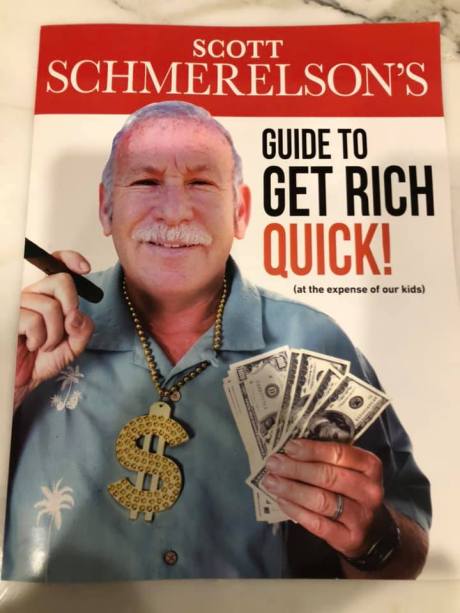
A front group for the California Charter Schools lobby, which calls itself “Families and Teachers United,” released a flyer that attacked school board member Scott Schmerelson, a pro-public school member of the LAUSD school board and well-qualified educator. Schmerelson has been endorsed by every Democratic club in Los Angeles.

The scurrilous flyer accuses him of investing in mutual funds that include products that are harmful to children (tobacco). Anyone whose pension is invested in large mutual funds knows that individual shareholders do not choose the stocks in the fund’s portfolio. My own pension fund includes companies I find abhorrent and there’s nothing I can do about it.

The flyer accuses Schmerelson of “double dipping” because he collects a pension for his decades of service as an educator in the LAUSD schools and a salary as a board member, like other board members.The flyer does not mention that board salaries were increased in 2017 based on the recommendation of an independent commission.

Should he give up his well-earned pension? Of course not! Should he refuse to take the same salary as other board members? Of course not!

Who paid for this vile, lying, unethical anti-Semitic ad?

Ad paid for by Families and Teachers United, sponsored by California Charter Schools Association Advocates. Committee major funding from
Charter Public Schools PAC
Not authorized by a candidate or a committee controlled by a candidate.
Funding details at http://www.fppc.ca.gov.

This may be the most expensive school board election in LA history, even though the billionaires have no ideas other than charter schools. None.

Who are they? Blogger Sara Roos names names. 

How about full public disclosure of the income and investments of the billionaires who fund the CCSSA?

Sara declined to reproduce the flyer, so as not to give more visibility to this trash.

Methinks the charter billionaires  are angry at Scott for telling the public that more than 80% of LA’s charters have empty seats.

Schmerelson, a man of unblemished integrity, responded to the anti-Semitic flyer with a statement denouncing the depths to which the charter lobby is willing to sink. He notes that the group that produced the flyers by the billionaire Waltons and Reed Hastings.

The election is March 3 but early  voting has started.  VOTE  FOR SCOTT SCHMERELSON!

86390772_10157937802082866_79698186238689280_n

We have a problem in this society. We have many problems. One of them is the role of private equity in destroying products and services that were once household names.

Here is an example: One of the stores that many New Yorkers love is Fairway Markets. It started as one store on the Upper West Side. It was the place to go for an amazing selection of cheeses and fresh produce and dozens of varieties of olive oil and more.

But it started to grow, and it turned to equity investors for new capital to expand. The investors had big plans. They paid themselves big salaries. They loaded up the company with debt. They went public and took on more debt. And before long this once-successful chain was doomed.

This article appeared at Bloomberg News by Joe Nocera.

There is more. This article in Slate describes how private equity investors have pillaged well-known retail operations. Jordan Weisman wrote:

The list of retailers that have been bought and wrecked by private equity firms keeps on growing. This week, the beloved New York grocery chain Fairway filed for its second bankruptcy in less than four years and announced plans to sell off its stores, thanks to a disastrous run of mismanagement by a series of buyout shops. It’s on a list of casualties that now includes Toys R Us, Payless ShoeSource, and Sports Authority, among many others. That’s on top of financially troubled names like Neiman Marcus that have managed to avoid Chapter 11 or liquidation (so far).

Last year, a group of progressive nonprofits reported that of the 14 largest retail bankruptcies since 2012, 10 had involved companies owned by private equity. The thud of corporate failures has become so constant that it’s essentially become a meme in the financial press.

This is the marketplace that choice advocates favor as the future of schooling.

Scott Maxwell, a columnist at the Orlando Sentinel, tweeted a few days ago:

”Berate public schools all you want. There will never be a day when you take your child to aPublic school only to find it’s gone out of business.”