Archives for the month of: December, 2019

Andrea Gabor writes here about the importance of an accurate Census in apportioning Congressional representatives and federal resources. She shows that California leads the way in relying on schools to make sure there is an accurate head count of those who live in the state. 

Fears are running high that the 2020 U.S. census could result in a costly undercount in a number of states and communities. Politicians and policy makers in the parts of the country with large hard-to-count immigrant and minority populations are particularly worried.

They should be. This will be the first time that the census, carried out every 10 years, is conducted online. Court battles and funding cuts have delayed the production of backup paper forms and shortened the time for testing online portals and rural surveys. Although the courts blocked the administration’s efforts to include a citizenship question, President Donald Trump’s anti-immigrant rhetoric and orders to round up undocumented residents may discourage many from taking part in the census.

California is especially aware of these challenges. With both vast rural areas and a large immigrant population, the nation’s most populous state faces an undercount that is projected to be as high as 2%, close to double the national average. That could cost the state a seat in the House of Representatives during the next reapportionment process, as well as federal funding for everything from schools to infrastructure.

The U.S. Census Bureau estimated that in the 1990 survey, California missed more people than any other state — about 2.7% of its population. The undercount cost the state one House seat and an estimated $2 billion in federal funding during the 1990s.

To ensure an accurate count in 2020, California has developed an aggressive strategy that includes enlisting help from the public schools, including teachers, parents and students. It’s an example other states and localities with similar populations should follow, especially because children are among the groups at greatest risk of being undercounted.

Federal law makes it a serious crime to share information provided by individuals to the Census Bureau, but noncitizens still need assurance that participating in the survey won’t bring immigration enforcement agents to their doors.

Neighborhood schools are ideally positioned to tackle the census challenges, because local residents are more likely to trust them than they are other government entities. Schools can also provide the computers and internet connections that hard-to-count areas often lack, a resource that will be particularly important next year.

California has spent at least $100 million since 2017 to ensure an accurate count, and much of that money is going to schools. Thirty-two county offices are funding school-based efforts to reach the targeted populations.

Los Angeles County alone — identified as the nation’s “hardest to count” county — will get $2 million for a range of activities, from training parents and administrators about the importance of the census to setting up kiosks where families can fill out survey forms.

Neighboring Orange County has allocated funds to a school district in Anaheim, which has a large Latino and Asian population, to train parents to operate school-based centers where families can get information and help in filling out the online surveys. Student groups are involved, and there is curriculum training for teachers who want to do census-related units in their classes.

As an example of these grass-roots efforts, the superintendent of the Anaheim Union High School District, Michael Matsuda, last spring enlisted the help of the leader of the Vietnamese students’ association at one school. Anika Nguyenkhoa, 17, developed a Ted talk-like speech that she has presented to hundreds of parents and county educators. She is teaming up with the heads of Vietnamese groups at other Anaheim high schools for two news conferences in February, one for the general public and the other targeting Vietnamese students.

The school district has also enlisted the Anaheim Bros, a civic fraternity founded, initially, to give young Latinos an alternative to gangs. By connecting the census to political representation and to local funding, Anaheim’s push is part of a district-wide civics-awareness effort that Matsuda sees as essential for engaging immigrant students and their families.

Owning a charter chain is very lucrative, especially when it is one of Betsy DeVos’s favorites. Just this year, she gave the Texas-based IDEA chain $116 million from the federal Charter Schools Program to expand in Texas and Louisiana.*

Feeling flush, the IDEA board of directors approved a plan to lease a private jet and pilot at a cost of $160,000 a month for eight years, nearly $2 million a year, for a total of $15.3 million.

The pushback from Texas AFT, the attention from Texas newspapers, and the heavy ridicule on Twitter led to a quick reversal of the decision. IDEA’s well-compensates executives will have to fly commercial, to their great disappointment!

The Houston Chronicle reported:

Texas’ largest charter school network abruptly grounded its plan to spend millions of dollars leasing and operating a private jet Monday, hours after the Houston Chronicle and a state teachers union raised questions about the arrangement.

IDEA Public Schools officials reversed course Monday evening, saying the organization will not sign an eight-year lease on an eight-passenger aircraft, an agreement unanimously approved earlier this month by the charter’s governing board. District leaders said they planned to use the jet to fuel the organization’s rapid expansion across the southern United States, with private donors footing a bill expected to approach $15 million over the life of the lease.

Tom Torkelson, CEO of IDEA, called the lease plan “a prudent decision,” although it does prove that IDEA is a private chain, not an operator of public schools. Have you ever heard of a public school or even a state superintendent with a private jet?

Life is unfair! If your corporation is taking in millions, why shouldn’t its top brass have a private jet? You know, like other private corporations?

*The federal CSP was launched by President Clinton in 1994 to grow start-ups but it has morphed into a slush fund for corporate charter chains, which DeVos uses as her personal slush fund. This is the program where nearly 40% of the schools funded either never open or close soon after opening.


Amy Goodman, host of “Democracy Now,” interviews Carol Burris, Keron Blair, and Jitu Brown about the Public Education Forum and the fight for equity and justice.

We are educating the public about the importance of changing the status quo.

Ahead of the last Democratic presidential debate of the year this Thursday, seven candidates appeared Saturday at the historic Democratic Presidential Forum on Public Education in Pittsburgh, an event organized by public education organizations, unions, civil rights organizations and community groups. We play highlights from the forum and get response from Keron Blair, director of the Alliance to Reclaim Our Schools in Atlanta; Jitu Brown, national director of the Journey for Justice Alliance; and Carol Burris, executive director of the Network for Public Education Action. She recently authored a report titled “Still Asleep at the Wheel: How the Federal Charter Schools Program Results in a Pileup of Fraud and Waste.”

The Washington Post reported this evening that moderate Democrats who voted to impeach Trump are the targets of a GOP ad campaign to oust them. Every one of them knew they were putting their future at risk.


GOP-tied group to spend $2.5 million against moderate Democrats

An advocacy group with GOP ties said Wednesday it will spend $2.5 million in the immediate aftermath of the House impeachment vote to attack supportive Democratic lawmakers in running next year in districts President cTrump previously won.

The new American Action Network spending is in addition to the $8.5 million the group has already spent in the lead-up to Wednesday’s vote — a campaign that has spooked many vulnerable Democrats but failed to convince them to oppose impeachment.

A total of 29 members will be targeted by digital ads. Nine of those will see cable and broadcast television ads run in their districts: Democratic Reps. Jared Golden (Maine), Elissa Slotkin (Mich.), Xochitl Torres Small (N.M.), Susie Lee (Nev.), Max Rose (N.Y.), Anthony Brindisi (N.Y), Kendra Horn (Okla.), Joe Cunningham (S.C.) and Elaine Luria (Va.).

Dana Milbank in the Washington Post captures the strange upside-down distortion of facts and evidence that characterized the Republican side of the debate. Not a single Republican was willing to question Trump’s efforts to entice a foreign nation to dig up dirt on a political rival. None thought it was unsavory, atrocious, intolerable. What if Obama has done the same thing? They would have been howling for his impeachment. Instead, all spoke of Trump as if he were a deity who walks among us.

Looking at the complete subjugation of the a Republican Party, Milbank declares a victory for Trumpism. I disagree. Trump has totally subjugated the Republican Party to his will, but the American people will decide next November whether he has won. A victory for Trump in November is a victory for racism, misogyny, xenophobia, climate change denial, greed, and isolationism. It could happen. But we must work to make sure that it doesn’t.


Milbank wrote:

For only the third time in history, the House of Representatives on Wednesday night dealt a president the greatest punishment in its constitutional arsenal. The stain of impeachment will follow Donald Trump to his grave and be noted long after he’s gone.

But in one sense, Trump won.

Wednesday’s 10-hour impeachment debate on the House floor and the party-line vote that followed proved that Trump’s multiyear campaign against the truth — 15,000 lies and counting — has succeeded. Republicans, united, didn’t spend much time defending Trump on the (unfavorable) merits. Instead, in an appalling spectacle of mass projection, they took turns accusing Democrats of the very offenses Trump committed — with Trumpian language and disregard for reality.

Democrats are the ones, Rep. Tom McClintock (R-Calif.) said, who committed a “stunning abuse of power.” Democrats are the ones, Rep. Tom Rice (R-S.C.) said, who “colluded with Russia and Ukraine.” Democrats are the ones, Rep. Steve King (R-Iowa) said, who engaged in “the largest and most massive coverup of such a list of crimes against our country.” Democrats are the ones, Rep. Peter King (R-N.Y.) said, who committed an “assault on the Constitution.” Democrats are the ones, Rep. Tim Walberg (R-Mich.) said, who are “interfering in America’s election.” Democrats are the ones, Rep. Roger Marshall (R-Kan.) said, who “have dangerously shattered precedents.”

It was as though Alex Jones and Tucker Carlson had taken over the House floor. Even during the most solemn constitutional ritual, Republicans were auditioning for an audience of one — and outbidding each other with conspiracy theories in hopes of scoring a favorable tweet from the boss.

Republicans on the floor applauded.

Rep. Louie Gohmert (R-Tex.) accused Democrats of pursuing impeachment to conceal “Ukraine’s interference into the U.S. election in 2016” — earning Gohmert a rebukefrom Rep. Jerrold Nadler (D-N.Y.) for spouting this false Russian propaganda.

It was all a triumph for alternative facts, for Russian dezinformatsiya, for Fox News and for social media toxicity.

The losers aren’t the Democrats — the public remains as split as before — but democracy. Just as after the Mueller report, Trump will only grow more emboldened in breaking the legal constraints on his presidency.

Trump, and Republicans, succeeded in making impeachment just another political fight. (“They don’t just hate Donald Trump, they hate the 63 million Americans who voted for this president.”) As such, Wednesday felt oddly routine at the Capitol. Only a few dozen lawmakers watched most of the debate. Outside, a few hundred rallied for impeachment; a lone figure dressed as Santa Claus rallied against. There was little of the fire that greeted Obamacare’s passage in 2010.

To look down from the gallery was to see a House divided: almost all white men on the Republican side, a mosaic of color and gender on the Democratic side. Rep. Justin Amash (I-Mich.), forced to leave the GOP because he supported impeachment, sat with the Democrats; Rep. Jeff Van Drew (N.J.), about to leave the Democratic Party because he opposes impeachment, hobnobbed on the Republican side with new colleague Steve King.

The Rev. Patrick Conroy, the House chaplain, prayed for “wisdom and discernment.” But it wasn’t to be found. Rep. Barry Loudermilk (R-Ga.) compared Democrats unfavorably to Pontius Pilate. Rep. Fred Keller (R-Pa.) likened Democrats to those who killed Jesus (“they know not what they do”). Rep. Mike Kelly (R-Pa.) likened impeachment to the attack on Pearl Harbor. Rep. Doug Collins (R-Ga.) repeated the same misquote of House Speaker Nancy Pelosi — three times.

Democrats, in response, kept repeating the evidence. “The president withheld congressionally approved military aid to a country under siege to extract a personal political favor. That’s a cold hard fact,” said Rep. Jim McGovern (Mass.).

But Republicans met hard facts with protests (they began by forcing a vote to adjourn and ended by refusing to use their electronic voting cards), intermittent and then frequent heckling, booing and jeering, maligning of Democrats’ motives, demands for Adam Schiff’s indictment and Pelosi’s expulsion, and hours of Trumpian insults directed at Democrats: Phony. Fraudulent. Socialist. Stalinist. McCarthy(ism). Sham. Witch-hunt. Coup. Kangaroo court. Joke. Rigged. Hoax. Charade. Circus. Stunt. Lies. Corruption. Swamp creatures. Star chamber. Illegal. Illegitimate. Hit job. Delusional. Elitists. Total Schiff show! READ THE TRANSCRIPT!!!

And Trump chimed in on Twitter with more of the same — “ATROCIOUS LIES . . . ASSAULT ON AMERICA” — before heading to a campaign rally.

History will note that at 8:42 Wednesday evening, the People’s House impeached Trump for high crimes and misdemeanors. The punishment was necessary and just. But though Trump stands rebuked, the Republicans’ ugly defense of an unrepentant offender shows that Trumpism has prevailed 

Peter Greene writes here about the budget approved by Congress for the Department of Education.

There is good news and bad news. Peter Greene thinks it’s mostly good news. I’d say there is both.

Congress did not appropriate a penny for Betsy DeVos’s top priority, her $5 billion request for vouchers (aka “education freedom scholarships”). Sorry, Betsy, nada. Even Republican Congressmen and Senators represent public school parents.

But Congress appropriated $440 million for Betsy’s charter school slush fund, otherwise known as the federal Charter Schools Program. The CSP is a swamp of fraud, waste, and abuse, as the Network for Public Education demonstrated in its “Asleep at the Wheel” and “Still Asleep at the Wheel” reports, which showed that more than $1 billion in federal funds were wasted on charters that either never opened or closed not long after opening. The House (controlled by Democrats) wanted to cut CSP to $400 million (which is $400 million too much), but the Senate (controlled by Republicans) negotiated it back to level funding. The CSP was created by the Clinton administration in 1994 to help start-ups, mom-and-pop or teacher-led charters that needed some extra funding. Betsy has turned it into a big fat plum for corporate charter chains like KIPP and IDEA, which are not start-ups and which are already richly endowed with funding from billionaires, most of them right-wingers. At present, the federal government is the single biggest funded of charter schools in the nation, even in states that don’t want them or need them, like New Hampshire, where Betsy gave the state $46 million to double the number of charters, but the state legislative fiscal commission rejected the money. Congress showed its lack of concern for accountability; that’s for the little people.

Peter Greene writes:

Trump asked for a 10% cut to the department and the elimination of twenty-nine programs. That didn’t happen (though it’s worth noting that many Trump appointees like DeVos have figured out that you can cut spending in your department by simply letting positions stand empty).

There is more money for Title I. It’s about a 3% increase, while Democratic candidates are calling for increases of 200% to 300%.

The Charter Schools Program– the fund that has wasted a billion dollars on charter school waste and fraud– will stay art current levels, with neither the boost the GOP wanted nor the cut that Democrats called for.

And special ed funding will once again not be increased to its full, required level. This makes forever years for Congress to stiff the states on the granddaddy of all unfunded mandates. Thanks a lot, Congress.

Audrey Amrein Beardsley is one of the leading experts in the nation in the field of value-added assessment and also one of the nation’s leading skeptics of the claim that teacher “effectiveness” can be measured by the test scores of their students.

Recently, a study was published by economists that purported to measure the effect of teachers’ on their students’ height. The study was a blatant lampoon of VAM (value-added modeling or measurement).

It turns out that I was one of about 25 people who promptly forwarded it to Amrein-Beardsley.

She reviewed the study here. 

Beardsley reminds us of a paper written by economist Jesse Rothstein nearly a decade ago in which he lacerated VAM by showing that it could be twisted to show the effect of teachers on students’ past achievement, a feat that is clearly absurd.

When a policy idea like VAM becomes the target of satire, you know that it is well and truly dead. Now, if only someone would tell the state legislatures that.

Ed Johnson, a close observer and frequent critic of the Atlanta public schools, writes here about the superintendent’s plans to adopt models developed by Eli Broad and the Waltons to transform the public schools into a business.

Johnson is a believer in the collaborative philosophy of W. Edwards Deming.


December 2019

Journey of Transformation: Atlanta schools to “buy” teachers by “price tag”

  • “Thinking about human beings as interchangeable commodities for sale, or abstract units of labor power, would lead merchants and planters to see human capital in much the same way that they saw animals.  And, by the time a young apprentice became a partner, he would feel ‘no more remorse in fitting out a ship for the purpose of trading in human flesh, than he would have done in sending her to catch whales or seals.’”
  • —Caitlin Rosenthal. Accounting for Slavery: Masters and Management. Kindle Edition, location 1153.
Last month, Atlanta superintendent Meria Carstarphen, Ed.D., gave a presentation to the Atlanta Board of Education Budget Commission on FY 2021 budgeting for what she calls “Student Success Funding,” or SSF.  The Budget Commission is a standing committee of the Board that meets monthly.

At one point during the presentation, Dr. Carstarphen invited the Chief Financial Officer (CFO) of the Atlanta Public Schools system (APS) to more adequately explain a matter that see, Dr. Carstarphen, suggested to enquiring commission members she had already explained well enough (my insertions):

  • (50:30-51:00) “… the way the schools purchase back their positions … we allocate the dollars and they buy their teachers back.  The price tag we put on those teachers is an average salary … and all schools buy back [teachers] at that rate.  What we know, what we’ve seen is that the schools that have the highest needs … have teachers that have either less experience or they don’t have the high degrees and, for whatever reason, they are ‘cheaper.’  … So what we would like to propose is … allowing those schools to buy their positions back at the actual average [value of the price tags we put on teachers] for their school.”
Despite the Board’s decision to non-renew her employment contract beyond the current school year, Carstarphen, by her presentation, makes clear she continues to advance her Journey of Transformation of APS.

When finished—and it can be finished, we must now understand—the journey will have brought APS to a permanent state of being “run like a business” and, in that state,  destroyed as the democratically governed public good is it supposed to be.

Thus the word “finish” must now be understood as signifying something real and consequential.  To continue thinking the word means something rhetorical or non-specific poses a grave risk to ever reclaiming and restoring APS as the public good it is supposed to be.

Entangled actors

In their joint report, The Strategic CFO: A Guide for School Districts, billionaire Eli Broad’s The Broad Center and Education Resource Strategies (ERS) lay out the essence of the matter as related to SSF.

So, too, does the partnership of ERS and APS, in the joint presentation, Student Success Funding: [APS] A District in Transformation.

Moreover, the APS CFO talks about student-based budgeting in the ERS Q&A, Student-Based Budgeting Takes Root in Atlanta.

ERS is a consultancy that says it helps clients to maximize—operative word, “maximize”—usage of capital resources, including “human capital.”  But as the Taguchi Loss Function teaches, maximal usage of a resource that is a system rapidly drives down the value and usefulness of the resource to point of it becoming a great source of waste.  In what follows, remain mindful that an individual “human capital” (e.g., an individual teacher) is a system.

And then there is the Walton Family Foundation’s 2017 grant of $350,000 to APS “To support research related to student[-]based budgeting” (my emphasis).  Research?  For what purpose, as related to student-based budgeting?  Maybe to establish the effectiveness of student-based budgeting and to use APS as a guinea pig in experiments to do that?  Was not the effectiveness of student-based budgeting a given?  Again, the APS CFO talks about student-based budgeting in the ERS Q&A noted above.

Thus we have Eli Broad, a private actor, in partnership with ERS, a private actor.  And we have ERS, a private actor, in partnership with APS Leadership, a public actor.  And we have APS Leadership, a public actor, in partnership with the Waltons and Eli Broad, both private actors.  This then means the public cannot know and trust the motives and behavior of any of the actors independently of each other; the actors are entangled.

Innately born systems thinking children learning to picture entanglement

So, how might we model and think about APS Leadership, ERS, Eli Broad, and the Waltons being entangled on the matter of student-based budgeting or, more relevantly, what Carstarphen calls Student Success Funding, or SSF?

Well, on a recent tour of Beecher Hills Elementary School, an Atlanta public school, goosebumps popped up when I noticed on a wall a display showing children were learning to “Organize our thinking using Venn Diagrams.”  (I regret I failed to take a snapshot.)

So let’s take the children’s lead, here, and make and use a simple Venn diagram to organize seeing and thinking about SSF being a common motive of the entangled actors as well as to represent a “finish”-able end to the superintendent’s Journey of Transformation of APS.
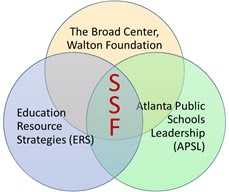
We might also recognize that thinking about SSF begs also thinking about a situation like that of Carstarphen having been superintendent in Austin, Texas, but all over again here in Atlanta.

Fortunately, a seemingly democracy-practiced Hispanic citizenry of Austin lead putting an end to her machinations and operating in cahoots with Eli Broad and the charter schools industry, soon enough.

In contrast, however, an apparent consumer-craving Black Atlanta citizenry, intersecting, Venn diagram-wise, with a paternalistic White Atlanta citizenry, is demanding destruction of APS as a public good, both actively and passively, as by silence.  Such Black and White behaviors continue to intersect as Atlanta elites’ old fashioned but still functioning Atlanta Compromise, which lets Eli Broad, et al., know Atlanta is an easy mark, I suggest.

  • “The leading figures in the actual Civil Rights Movement explicitly challenged the idea that the free market could deliver Black people from racism.” (p. 82) …
  • “Corporate education reform favors privatization and ‘free market’ solutions to school governance (‘running schools like a business’ and so on) and is, therefore, necessarily antithetical to the ethos of trade unions and of collective bargaining.” (p. 83)
  • –Brian Jones, Keys to the Schoolhouse: Black Teachers, Privatization, and the Future of Teacher Unions, Academia; accessed 4 Dec 2019.
Similarly, persons that preach a selfish, free market, “by any means necessary” ideology of education for children labeled Black–for example, as do the people of the Black organization known as BOOK (Better Options for OUR Kids), with funding by the Walton Family Foundation, support by the United Negro College Fund (UNCF), and now propaganda distribution by The 74–are so horribly racially insular as to pose a real and present existential threat to the human development and dignity of the very children they so loudly profess to care about.

But then such racially insular people show it’s not the human development of the children they care that much about.  Rather, such racially insular people show they care mostly about the children developing as a race, a race to forever believe and perpetuate it is oppressed, and a race to forever believe and perpetuate “white supremacy” is something real.  Such racially insular people show they care about developing the children just as Eli Broad and the Waltons and similar others would have it.

Anticipating intended effects

Whether the matter is framed to be about student-based budgeting or Carstarphen’s euphemistically named Student Success Funding, or SSF, some essential effects to anticipate from the superintendent’s Journey of Transformation of APS are:
  • schools turned into and managed as free market performance centers
  • principals turned into and managed as free market schoolhouse CEOs and marketers
  • teachers turned into and managed as free market fungibles to be bought and sold, as needed
  • schools and school facilities opened, closed, and sold off, as needed, to maximize usage of capital; alternatively, the portfolio model by the marketing name, “Excellent Schools”
Thus we might now understand Carstarphen’s response to non-renewal of her employment contract that she has yet to “finish the work” she was hired to do.  We might now understand her Journey of Transformation of APS can indeed reach the state of being “finished,” taking a total of about 15 years, she now says.  And when finished, all schools—public, partner, charter—will be running not just like an ordinary business but running like a conglomerate of businesses on the style of Warren Buffet’s Berkshire Hathaway conglomerate, for example, capable to generate its own internal market.

APS central office will function as the conglomerate business controlling all other businesses and each individual school will have the ballyhooed “freedom and autonomy in exchange for accountability” to function like a specialized business or branch (i.e., theme school, academy, whatever).  Still, each specialized business (i.e., each school) will be subject to certain common business management practices (think again about the Beecher Hills kids learning to make and use Venn diagrams) that originate with the controlling business (i.e., APS central office) for maximizing performance at that level.

For example, individual businesses (i.e., schools) will be subject to being opened, closed, and sold off, as needed, so as to continually maximize any or all of their financial performance, customer traffic (i.e., school enrollment), consumer satisfaction (i.e., illusory parental school choice), and other matters.  Teachers will be reduced to fungible commodities to be bought and sold at the cheapest, competitive price the internal market will pay, so different specialized businesses (i.e., schools) can also continually work at maximizing usage of the human capital they have bought—all the while generating enormous amounts of squander as well as waste of human potential.

Good, effective business marketing (i.e., lying) required

What the Walton Family Foundation calls “student-based budgeting” is also know by other conceptually accurate names, including student-based allocation, weighted student funding, and fair student funding.  But now comes Carstarphen’s marketing name, Student Success Funding, which gives no conceptual clue about the reality of the matter.

Naming the matter “Student Success Funding” makes for good business marketing.  The nature of such business marketing—and all that such business marketing implies, including manipulating consumers to believe they need something when they don’t, to consume something when they shouldn’t, to not consume something when they should, etc.—keeps with Atlanta school board chairman Jason Esteves marketing The City Fund’s truthfully named “portfolio model” by the catchy name, “Excellent Schools.”

Carstarphen’s apparent jovial easiness with business marketing leaves no doubt of it harkening back to even when “human capital” was sold at auction based on the financial accounting value, or “price tag,” owners and managers of the human capital had recorded in their “price lists.”  Carstarphen has been repeatedly advised, in public Board meetings, to let go the “human capital” language and remove it from strategic planning.  But she refuses to do that, and now we might see that the entangled SSF actors suggest why she refuses: they all stand to benefit from destroying APS as a public good.

It is also obvious that the superintendent’s carefree morals and ethics about marketing allow her to effectively be okay with the management of schools as free market performance centers, to be okay with teachers as buyable and sellable commodities, to be okay with students as customers, and to be okay with parents as consumers of schools they would choose as if choosing a Happy Meal from a McDonald’s menu price list.

And, most disturbingly, to be okay with continuing to manipulate children into marketing the “APS brand” as entrants in the Superintendent’s Annual Winter Card Contest.  Why any parents would allow their child to be used in this way is puzzling.

Similarly, perhaps following Carstarphen’s lead or command, some Atlanta public school principals have taken to talking about their school as a competitive “brand,” as if doing that is necessary to compete with the KIPP brand, the Kindezi brand, the Atlanta Neighborhood Charter School brand, etc.

  • “Two years ago I realized ANCS was a direct competition.  I had to figure out how to make parents see my school as a viable option for parents.  I don’t want it to be a competition about which is better but what fits best for my kid.  How can we make sure that Parkside is a viable neighborhood school of choice?”
  • —Principal, Parkside Elementary School, 29 Aug 2019

Funding Atlanta public schools to improve

However, funding APS as the public good it is supposed to be and budgeting for that is immaterial to the entangled SSF actors—APS Leadership, ERS, Eli Broad, the Waltons.  And let’s not forget Bill Gates.  “What about Bill Gates?,” Carstarphen once asked me in a meeting in the midst of my trying to help her understand the golden opportunity her becoming Atlanta superintendent held for her to not do in Atlanta as she had tried to do in Austin.  To understand that APS needs, has always needed, and always will need, improvement, not one-off turnaround.  Fool’s errand on my part because, obviously, Eli Broad, et al., came to Atlanta with her.

The Austin Chronicle put it this way about Austin’s citizenry seeing her to the exit door:

“[Carstarphen] never understood or cared for the public mood.”
The table below lists and gives a short description of so-called “ERS Principles” the APS Leadership have apparently adopted, as given.  However, not one reference so far discovered even suggests that any ERS Principle represents a fundamental truth or proposition based in reality.  Rather, each principle inscribes, arguably, a statement of belief about free market ideology suitable for marketing SSF.
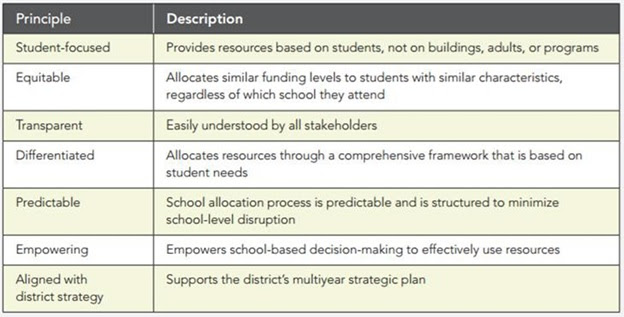
References about SSF, variously named, warn:
  • SSF is complex (e.g., this by ERS, itself)
  • SSF is fraught with implementation challenges (e.g., this)
  • SSF lacks research-based evidence that it works (e.g., this, which references APS)
  • SSF reproduces racial inequality that undermines funding equity (e.g., this and this)
  • SSF requires principals to be competently burdened “school CEOs” more so than knowledgeable leaders of educational practice and improvement

Open a window onto morals and ethics of SSF

To bring clarity and transparency to SSF in a way that exposes it for what it is, Carstarphen might engage her Accountability and Information Technology Division to model SSF as either or both a data model, so as to expose, as MLK Jr put it, the “interrelated structure of reality” SSF portends; and, a process model, possibly dynamic, so as to expose the interrelated behaviors SSF portends and to have a basis for predicting those behaviors, over time.

Structure and behavior are like opposite sides of the same coin; there cannot be one side without the other side.  An essential component of an SSF Model will be unambiguous and hype- and marketing-free definitions of things and relationships between things modeled.

(My post, Lexical Conventions for Enterprise Data Modeling, is freely available to the superintendent and her administration to draw from, as have some folk at major corporations even in faraway places such as the U.K.  So is my article, Enterprise Modeling: Checking with Reality, as published by Business Process Trends.)

Then, with either or both SSF Models in hand, people might be helped to see the complexity, inequality, absurdity, and various kinds of squander to come from implementing SSF, and then decide to reject SSF before it can be implemented and the damage done.

Even so, and essentially without expense, moral and ethical concerns alone should give pause and reason enough to reject Student Success Funding and instead commit to funding the Atlanta Public Schools system with the aim of starting the system off on a never-ending, unfinishable Journey of Continual Improvement and, along the way, detoxify APS of accumulated charter school industry squander, so the system can get back to being the wholly public good it is supposed to be.

My insertion, original emphasis:
  • “Planters strove for rationalization, standardization, and fungibility when it served their interests. Their ownership of capital [including human capital] gave them the power to commodify as they chose.”
  • —Caitlin Rosenthal, Accounting for Slavery: Masters and Management. Kindle Edition, Location 3511.

Ed Johnson
Advocate for Quality in Public Education
Atlanta GA | (404) 505-8176 | edwjohnson@aol.com

Owen Davis writes here about the enrichment of the testing industry by No Child Left Behind and Race to the Top.

The testing and accountability craze started before No Child Left Behind, but that federal law turned it into a bonanza for Pearson and other companies and led to a consolidation of the testing industry.

We now know, almost 20 years after NCLB was signed into law on January 8, 2002, that it has had very little effect on student test scores, on closing achievement gaps, or on any of the other wild promises made first by George W. Bush, echoed by Rod Paige and Margaret Spellings, and reiterated again by Arne Duncan and John King.

Who in Congress or the federal government will have the courage to call a halt to this insane investment of billions of dollars into the testing industry?

Davis writes:

Three days after taking office, George W. Bush unveiled his signature domestic policy, No Child Left Behind. The bill would triple the number of exams the federal government required of students, while dangling stiff penalties over struggling schools. For many educators it felt like a depth charge.

The mood was different at Pearson Education, a division of the London-based conglomerate Pearson PLC. As the education community was still absorbing the shock in February 2001, Pearson Education chief executive Peter Jovanovich spoke to a group of Wall Street investment analysts. He pointed them to the proposed annual testing requirements and school report cards. “This,” Jovanovich said, “almost reads like our business plan.”

Pearson Education was a relative newcomer to the education market. Three years earlier, Pearson PLC had paid $4.6 billion to buy the textbook wing of publishing house Simon & Schuster. In 2000, the company acquired a leading standardized test provider. Now Pearson’s stars had aligned.

“Content has been king,” Marjorie Scardino, Pearson’s top executive, said at the time. “But now we’ll have the ability to put content and applications together and that will really allow us to be king.” With a hand in both delivering curriculum and testing students over that curriculum, Pearson would capitalize on America’s newfound school accountability kick.

Pearson Education’s profits increased 175 percent in the decade following No Child Left Behind. The company, whose properties included Penguin Books and the Financial Times, soon derived most of its profits from American education. Test sales jumped fivefold between 2000 and 2006. “Our assessment businesses are in the sweet spot of education policy,” Scardino told investors in 2005 – a year when more than 60 percent of American school kids lived in states giving Pearson tests.

Since 2000, the testing market has roughly tripled in size, to nearly $4 billion a year, with annual achievement tests spawning a range of more frequent tracking assessments. As testing has flourished, more and more functions of the school publishing industry the have fallen into fewer and fewer hands. In 1988, ten publishers shared 70 percent of the textbook market. Today, the “Big Three” —McGraw-Hill, Houghton Mifflin Harcourt and the juggernaut Pearson—control at least 85 percent of the market. These lucky few have since expanded their offerings; Pearson hawks everything from student data trackers to online credit-recovery courses to ADHD diagnostic kits.

But along the way the American public grew wary of the companies’ influence in education. Parent groups on both the left and right have cast testing mandates as political favors to test makers, a notion that has helped spark a recent nationwide pushback against accountability policies. Hundreds of thousands of parents across the country have opted their children out of mandatory tests last year, and entire schools have held test boycotts.

The sense that students are over-tested is no illusion. A 2013 study from the Organization for Economic Cooperation and Development found the stakes attached to testing in the U.S. to be the highest in the developed world. One study of the 66 largest urban school districts found the average student took 112 standardized tests from kindergarten to graduation, spending an average 22 hours a year just taking the exams, let alone preparing for them.

The efforts of testing companies to secure and expand their business have helped pushed American schools toward an overbearing focus on assessment – one that has failed to achieve its desired result of dramatically improving student and school performance. Here’s the story of how we got to this point.

It is a sad story, an awful story, that involves lobbyists, business plans, and billions of dollars. Nothing good there for students or teachers.

Thomas Ultican, the chronicler of the Destroy Public Education movement, writes here about the calculated destruction of the Oakland Public School District, which has suffered at the hands and by the wallets of billionaires.

In 2003, the district had a deficit of $37 million.

The state forced the district to take out a loan of $100 million.

In return, the state took control of the district.

After six years of state control, the district’s deficit increased from $37 million to $89 million.

Unfortunately for Oakland, the billionaire Eli Broad decided to turn the district into his petri dish.

Oakland Mayor Jerry Brown welcomed the state takeover.

The Broadies romped.

A California central coast politician named Jack O’Connell was elected California’s Superintendent of Public Instruction in 2002. He selected Randolph Ward, a Broad Academy graduate, to be Oakland’s state administrator. When O’Connell ran for state superintendent, his largest campaign donors had been Netflix CEO Reed Hastings ($250,000), venture capitalist John Doerr ($205,000), and Eli Broad ($100,000). Brown described the state takeover as a “total win” for Oakland.

The Broadies of Oakland

2003-2017 Broad Academy Graduates and Superintendents of OUSD

Broad Academy graduates are often disparagingly called Broadies.

The OUSD information officer in 2003 was Ken Epstein. He recounts a little of what it was like when Ward became the administrator:

“I remember a school board meeting where Ward and the board were on stage. Each item on the agenda was read aloud, and Ward would say, “passed.” Then the next item was read. In less than an hour, the agenda was completed. At that point, Ward said, “Meeting adjourned” and walked out of the board room and turned out the lights, leaving board members sitting in the dark.”

When Ward arrived in Oakland, the district was in the midst of implementing the Bill Gates sponsored small school initiative which is still causing problems. The recently closed Roots that caused so much discontent in January was one of the Gates small schools. Ward opened 24 of them (250-500 students) which in practice meant taking an existing facility and dividing it into two to five schools. He closed fourteen regularly sized schools.

When Ward arrived in Oakland there were 15 charter schools and when he left for San Diego three years later there were 28 charter schools…

Kimberly Statham, who was a classmate of Ward’s at the Broad Academy, took his place in 2006. The following year a third Broad Graduate, Vincent Mathews took her place.

After a short period of no Broadie in the superintendent’s seat, Antwan Wilson was hired in 2014. Shortly after that, the New York Times reported that the Broad Foundation had granted the district $6 million for staff development and other programs over the last decade. The Broad Center also subsidized the salaries of at least 10 ex-business managers who moved into administrative jobs at the district office.

Kyla Johnson-Trammell, an Oakland resident who and educator with OUSD, was named to replace Antwan Wilson in 2017. When he left to lead the Washington DC’s schools, he left a mess in Oakland. Mother Jones magazine says Wilson saddled the district with a $30 million deficit. They continue, “A state financial risk report from August 2017 concluded that Oakland Unified, under Wilson, had ‘lost control of its spending, allowing school sites and departments to ignore and override board policies by spending beyond their budgets.”’

The preponderance of the problems in OUSD are related to the state takeover, FCMAT and the leadership provided by Broad Academy graduates.

The usual billionaires have selected several of the OUSD board members and showered them with donations from out-of-district and out-of-state.

The fundamental problem is Oakland has a dual education system with 37,000 students in public schools and 15,000 in charter schools. It costs more to operate two systems. Every school district in California that has more than 10% of their students in charter schools has severe financial problems. Oakland has the largest percentage of charter school students in the state with 29% so financial issues are the expectation.

This is an education crisis that was manufactured by the super wealthy and implemented by neoliberal politicians.