Sixteen-year-old climate activist Greta Thunberg spoke at the UN Climate Conference today. Trump skipped the meeting to attend a discussion of religious freedom. Last Friday, Thunberg inspired millions of students around the world to demonstrate on behalf of action to address the climate crisis.
She said today:
“This is all wrong. I shouldn’t be standing here. I should be back in school on the other side of the ocean.
Yet you all come to me for hope? How dare you.
You have stolen my dreams and my childhood with your empty words. And yet I’m one of the lucky ones. People are suffering. People are dying. Entire ecosystems are collapsing. We are in the beginning of a mass extinction. And all you can talk about is money and fairy tales of eternal economic growth.
How dare you.
For more than 30 years the science has been crystal clear. How dare you continue to look away, and come here saying that you are doing enough, when the politics and solutions needed are still nowhere in sight.
You say you ‘hear’ us and that you understand the urgency. But no matter how sad and angry I am, I don’t want to believe that. Because if you fully understood the situation and still kept on failing to act, then you would be evil. And I refuse to believe that.
To have a 67% chance of staying below a 1.5C global temperature rise – the best odds given by the Intergovernmental Panel on Climate Change – the world had 420 gigatonnes of carbon dioxide left to emit back on January 1st, 2018. Today that figure is already down to less than 350 gigatonnes. How dare you pretend that this can be solved with business-as-usual and some technical solutions. With today’s emissions levels, that remaining CO2 budget will be entirely gone in less than eight and a half years.
There will not be any solutions or plans presented in line with these figures today. Because these numbers are too uncomfortable. And you are still not mature enough to tell it like it is.
You are failing us. But the young people are starting to understand your betrayal. The eyes of all future generations are upon you. And if you choose to fail us I say we will never forgive you. We will not let you get away with this.
Right here, right now is where we draw the line. The world is waking up. And change is coming, whether you like it or not.”
DeVos vigorously defended charter schools, especially in Detroit, even though most Detroit charters underperform Detroit public schools and are run as profit-making businesses.
DeVos opened Saturday’s program at the Mackinac Republican Leadership Conference by celebrating her mission to spread education freedom across the country. The Michigan native slammed teacher unions and Democratic primary candidates for offering a vision for the education system that will produce worse outcomes for students and cost taxpayers trillions of dollars.
DeVos said she is solely focused on doing what’s best for students, though she has been a frequent target of Democrats running to oppose President Donald Trump in 2020. She said Democrats who criticize the proliferation of charter schools ignores their results and falsely claim they are the “enemy of the people.”
“You’ll hear repeatedly that public charter schools are bad,” DeVos told Republicans Saturday. “The truth is they are the best thing to ever happen to Detroit students.”
If you have been sick of watching the takeover of American education by entrepreneurs, professional managers, management consultants, and Wall Street, you will see parallels between the managerial culture at Boeing and the management culture that has permeated large sectors of American educators. At Boeing, crucial decisions were made by managers, not engineers; in education, crucial decisions are made by managers from the business world, not educators. The results in both cases are disastrous, but especially so in aviation where people were killed by bad decisions.
In this stunning, gripping, frightening article, Maureen Tkacik explains how Boeing was ruined by financial decision makers, which ultimately led to two crashes of its new 737 MAX jets.
She begins:
Nearly two decades before Boeing’s MCAS system crashed two of the plane-maker’s brand-new 737 MAX jets, Stan Sorscher knew his company’s increasingly toxic mode of operating would create a disaster of some kind. A long and proud “safety culture” was rapidly being replaced, he argued, with “a culture of financial bullshit, a culture of groupthink.”
Sorscher, a physicist who’d worked at Boeing more than two decades and had led negotiations there for the engineers’ union, had become obsessed with management culture. He said he didn’t previously imagine Boeing’s brave new managerial caste creating a problem as dumb and glaringly obvious as MCAS (or the Maneuvering Characteristics Augmentation System, as a handful of software wizards had dubbed it). Mostly he worried about shriveling market share driving sales and head count into the ground, the things that keep post-industrial American labor leaders up at night. On some level, though, he saw it all coming; he even demonstrated how the costs of a grounded plane would dwarf the short-term savings achieved from the latest outsourcing binge in one of his reports that no one read back in 2002.*
Sorscher had spent the early aughts campaigning to preserve the company’s estimable engineering legacy. He had mountains of evidence to support his position, mostly acquired via Boeing’s 1997 acquisition of McDonnell Douglas, a dysfunctional firm with a dilapidated aircraft plant in Long Beach and a CEO who liked to use what he called the “Hollywood model” for dealing with engineers: Hire them for a few months when project deadlines are nigh, fire them when you need to make numbers. In 2000, Boeing’s engineers staged a 40-day strike over the McDonnell deal’s fallout; while they won major material concessions from management, they lost the culture war. They also inherited a notoriously dysfunctional product line from the corner-cutting market gurus at McDonnell.
And while Boeing’s engineers toiled to get McDonnell’s lemon planes into the sky, their own hopes of designing a new plane to compete with Airbus, Boeing’s only global market rival, were shriveling. Under the sway of all the naysayers who had called out the folly of the McDonnell deal, the board had adopted a hard-line “never again” posture toward ambitious new planes. Boeing’s leaders began crying “crocodile tears,” Sorscher claimed, about the development costs of 1995’s 777, even though some industry insiders estimate that it became the most profitable plane of all time. The premise behind this complaining was silly, Sorscher contended in PowerPoint presentations and a Harvard Business School-style case study on the topic. A return to the “problem-solving” culture and managerial structure of yore, he explained over and over again to anyone who would listen, was the only sensible way to generate shareholder value. But when he brought that message on the road, he rarely elicited much more than an eye roll. “I’m not buying it,” was a common response. Occasionally, though, someone in the audience was outright mean, like the Wall Street analyst who cut him off mid-sentence:
“Look, I get it. What you’re telling me is that your business isdifferent.That you’respecial.Well, listen:Everybody thinks his business is different,becauseeverybody is the same. Nobody. Is. Different.”
And indeed, that would appear to be the real moral of this story: Airplane manufacturing is no different from mortgage lending or insulin distribution or make-believe blood analyzing software—another cash cow for the one percent, bound inexorably for the slaughterhouse. In the now infamous debacle of the Boeing 737 MAX, the company produced a plane outfitted with a half-assed bit of software programmed to override all pilot input and nosedive when a little vane on the side of the fuselage told it the nose was pitching up. The vane was also not terribly reliable, possibly due to assembly line lapses reported by a whistle-blower, and when the plane processed the bad data it received, it promptly dove into the sea.
Boeing’s defenders blamed the pilots for the crashes. They said that the pilots needed more training. But the engineers knew otherwise.
The article ends like this:
No one who knew anything about anything thought it was a good idea to slash research and development spending, lay off half the engineers, or subcontract whole chunks of a plane without designing it first. It hardly mattered. “It was two camps of managers, the Boeing Boy Scouts and the ‘hunter killer assassins,’” remembered Cynthia Cole, a former Boeing engineer who led the Society of Professional Engineering Employees in Aerospace (SPEEA) during the 787 saga. “How do you merge those two management philosophies? The hunter killer assassins will destroy the Boy Scouts. That’s what happens.”
That’s what happened on an exponentially more ruinous scale in mortgage lending and pharmaceutical sales and at General Electric, which over the past decade has spent more than $50 billion buying back its own stock even as its staggering insurance business losses threaten to bankrupt the company. (And none of this has diminished GE’s zeal for deindustrialization, which has disemboweled places like Fort Wayne and Erie and Schenectady and put tens of thousands of people out of work, both permanently and on furlough.) It’s what happens to every well-intentioned half-measure to mitigate the catastrophic effects of climate change.
None of these things had to be ideological wars, said Cole, a lifelong conservative who now chairs the King County Republican Party in Washington state and first joined the union—membership in SPEEA had been voluntary when she joined—because not a few months into her first engineering job she had watched a space shuttle land in a control room full of engineers who had built the shuttle. The shuttle bounced, there was a massive collective intake of air, and one of her colleagues let it slip that the landing gear wasn’t strong enough to withstand certain weather conditions, and that if she wanted to keep her job she’d keep her mouth shut about it; she was laid off a few months later. “I thought to myself, oh my gosh! This happens in the movies.”
She had no idea then how sick she would get of watching the same movie.
But a month later, back in the same room on a biblically hot day, a son of Kenyan farmers restored a bit of moral clarity to proceedings: “As an investment professional, allow me to inform Congress as to how Boeing has viewed this whole crisis.” Noting that the stock had surged from $140 four years earlier to $446 right before the crash that had killed his wife, and his son, four-year-old daughter, nine-month-old daughter, and mother-in-law, Paul Njoroge laid out the sequence of 737 MAX orders, ten-figure stock buybacks, and dividend hikes that had dealt out this horrible fate to his family.
“Could that be the reason Boeing did not feel obliged to ground the MAX even after the second crash of the Boeing 737 MAX?” he asked. “Back to my very essential question, why wasn’t the MAX 8 grounded in November after the first crash in the Java Sea? One hundred and eighty-nine lives were lost, and executives at Boeing cared more about its stock price than preventing such a tragedy from occurring again,” and so had begun “a pattern of behavior blaming innocent pilots.”
“I am empty,” he told the committee. “My life has no meaning.” He had met his wife studying finance at the University of Nairobi. The family had been spread across Bermuda, where Paul worked as an investment manager at Butterfield Bank, and Ontario, where his wife and children were settling down. Paul was expected to join them later. The distance had been hell, and he had never even had a girlfriend before her; his family was literally everything, he explained, and every single one of them was gone. “I have nightmares about how they must have clung to their mother, crying, seeing the fright in their eyes as they sat there helplessly. It is difficult for me to think of anything but the horror they must have felt.”
After his testimony, a dead-eyed Njoroge stood in the hallway for nearly three hours, granting interviews to the dozens of journalists who needed exclusive footage to anchor their packages. He told me he wasn’t surprised that Boeing’s stock hadn’t suffered more since the company had killed his family. He would never buy it himself, of course, but even now it would be hard to justify leaving it out of a client’s portfolio.
If you read one article today or this week, read this one. It is fascinating, horrifying, and an indictment of the managerial culture that treats all problems as the same–whether it is building an airplane, educating children, or developing new medicines. A management problem, where professionals don’t matter.
One premise of the book is that the fundamental secret to Success Academy’s amazing standardized test scores, mentioned throughout the work is the filtering of the right families. On page 266 he writes “The common criticism leveled at Moskowitz and her schools is that they cherry pick students, attracting bright children and shedding the poorly behaved and hardest to teach This misses the mark entirely. Success Academy is cherry-picking parents.” Parents must go through a series of tests and hoops to jump through for their children to get into and to stay in a Success Academy school. First there is, of course, the lottery. But winning the lottery is just the first step. Described in great — and frightening — detail in chapter 20 “The Lottery”, lottery winners have to attend a mandatory informational session where they are told how much work it is to be a parent of a child at the school — how lateness is not tolerated and there is a 7:30 AM start time. How there is no transportation provided. How every Wednesday is a half day and there is no after school program. How absences require a doctor’s note. Many prospective lottery winners give up after that meeting. Then there are several other steps like extensive paperwork and uniform fittings and a dress rehearsal. Even Pondiscio is shocked to watch how a student who is deep on the waitlist eventually get admitted to the school. But having families who are this willing and able to comply with the demands made by Success Academy leads, predictably, to high standardized test scores. He doesn’t say this so bluntly, but let’s face it — this is a kind of cheating.
But if you look at the back of the book, you see that it was well reviewed by various reformers including former NYC schools Chancellor Joel Klein. How can this be? Well even though Pondiscio says the test scores need to be seen in the context of the family selection process, he also argues, several times throughout the book, that it is OK that they do this. The argument is that wealthy families use their resources to get their child into a school that is a good fit for them so why shouldn’t poor families who have the resource of being highly functional use that to get their child into a school that is a good fit for them too?…
My first response to this would be that only 16 out of the inaugural 73 students even endured to graduate Success Academy. If a higher percentage were actually served by Success Academy, then this argument of ‘shouldn’t they also get to choose a school that is good for them?’ would be more compelling. Since for the vast majority, they did not choose a school that was good for them, even after going through all those steps, and they did ultimately choose to leave, so what kind of choice did they really get? For the small number of families and children that turn out to be a good fit after all, there are at least double that number who regretted that choice and surely feel duped by the false promise that Success Academy actually cares about their children.
Maybe an analogy will make this more clear: On airplanes, only wealthy people have the choice of flying first class while people who can’t afford that must fly in coach. So now Success Airlines comes along and they have something they give people the choice of flying in something like first class except the seats are outside the plane on the wings and you have to get to the seats on your own and there’s a 2/3 chance that you’re going to be jettisoned from that seat before the flight is over anyway. Should we say that having a choice like that is something that poor people deserve to have?
If Pondiscio is making the case here that Success Academy should have the right to exist, I’ve never said that they shouldn’t exist. But their existence should not be to just benefit the few that are a good fit at the expense of not only the students at the neighboring schools but also the students who left Success Academy before graduating. To do this, I think that they need more oversight and regulations and transparency about what goes on inside their schools. And I’m glad that this book does a nice job about showing the sorts of abuse that occur in the school which I’ll get to next.
If you are a charter bigwig or spouse, you can fly first class, a privilege not available to public school employees.
Charter executives are exempt from the rules that apply to public schools. Yet they deign to call themselves “public schools” without surrendering their perks.
Miller writes:
“It’s a treat to fly at the front of the plane, where seats are bigger and fares are roughly double the cost of a coach seat. But for the state’s most prolific charter school operator, first-class air travel is allowed. In addition, the company will pay for the travel of employee spouses, family members and “companions” of executives as well.
“That’s just one of many illustrations of the different rules that apply to charter schools in Texas compared to public schools, where funding for even the most basic needs always seems in short supply.
“IDEA Public Schools, based in Weslaco, has allowed the first-class travel perk for six years. That includes footing the bill for the commute of chief financial officer Wyatt Truscheit, who moved from Mission, Texas, to the Los Angeles area in 2013 and comes to Texas every other week, according to tax records. IDEA also pays for Truscheit’s housing while he works in South Texas.
“IDEA received $319 million in state funding and $71 million in federal money in 2018 to operate its 61 campuses around the state. With its schools in Louisiana, IDEA runs 96 locations in all.
“As a 501c3 nonprofit corporation, IDEA is also allowed to make loans to employees and board members and to do business with relatives of employees.
“In 2015, IDEA bought property from board member and developer Mike Rhodes for $1.7 million. Board member David Earl also received money for serving as counsel for Rhodes in the land deal.”
The charters can engage in business with board members and their families. They do not have to hold open meetings. They are private schools that get public money but operate like private enterprises. Some gig.
As I have mentioned here, I am Jewish. Be that as it may, I regularly read the publication “Commonweal,” which is edited by lay Catholics (not Jesuits, as I originally sad) and often vigorously agree with its writers. Read this one by John Chryssavgis.
At the latest G7 summit in Biarritz, U.S. President Donald Trump reassured the world that “our economy is creating jobs and helping the poor.” A similar confidence was expressed in a recent op-ed published by the Wall Street Journal. It was titled “Making Money is a Patriotic Act” (August 13, 2019). Signed by Bernie Marcus, a cofounder of Home Depot, and the New York City supermarket magnate John Catsimatidis, the op-ed opened with a striking, quasi-religious claim: “The two of us are quite rich. We have earned more money than we could have imagined and more than we can spend on ourselves, our children and grandchildren. These days getting rich off a profitable business is regarded as almost sinister. But we have nothing to apologize for and we don’t think the government should have more of our profits.” The fact that the latter is a prominent member in, and generous donor to, the Greek Orthodox Church in America (as well as to the Roman Catholic Archdiocese of New York) prompted me to reflect again on the age-old question of wealth and poverty in Christian thought. This is a question where Orthodox and Roman Catholic teaching are very similar, if not the same.
Of course, the connection or correspondence between prosperity and philanthropy has long concerned economists, political theorists, and moral philosophers, as well as theologians. Economic resources are indispensable to the church, but the church has an obligation to husband its resources in a way that includes the less fortunate. When it comes to wealth, the focus for Christians should be beneficent compassion (the law of love) rather than brutal competition (the law of survival of the fittest). Proclaiming that greed is neither sinister nor sinful and claiming that the government should not impose higher taxes on the wealthy is at odds with the Christian responsibility to recognize the dignity and parity of the least of our brothers and sisters (Matthew 25:40).
The authors boast of creating employment (albeit at often degradingly low salaries) and supporting charities (while benefiting from generous tax deductions for charitable giving), but they’re also proud of having risen from meager origins to achieve the American Dream. This up-by-the-bootstraps success narrative may be convenient for the Christian right, but it is inconsistent with both Orthodoxy and Roman Catholic social teaching.
Before contemplating the spiritual message, however, let’s consider the economic argument. Fiscal conservatives have long insisted that private charity is better than government handouts; helping hands, they say, should be inspired by a heart of compassion rather than compelled by law. But to suggest that wealthy donors can replace government programs is both arrogant and dangerously irresponsible. Private philanthropy falls off during economic downturns, when poverty rises. In other words, philanthropy tends to be cyclical, whereas public programs are designed to be counter-cyclical, helping the most when there’s the greatest need for help. The idea that faith-based or privately organized charity is more efficient or more effective than government relief has not been true since the industrial revolution. It is especially untrue during a recession.
But much of secular philanthropy is less about providing relief to the poor than about stockpiling tax deductions and/or getting one’s name emblazoned on the front of a new cultural or religious institution. No matter how dizzying the donations of the wealthy, they are in fact a minuscule fraction—economists estimate it’s less than 0.031 percent—of current social needs. It would be wonderful if more of society’s most fortunate members would respond to the needs of the less fortunate. But it is a fantasy to believe that voluntary organizations, including religious ones, could adequately replace the array of government health and social programs that help the most vulnerable.
Take some examples from my own church, which is also the church of John Catsimatidis. How troubled are Orthodox leaders that the tens of millions of dollars worth of donations raised for a church at Ground Zero in New York City—all of which doubtless qualify for tax deductions as charitable gifts—will in no way benefit the underprivileged, in a city where there is visible evidence of material want on every street corner? How often do Orthodox Christians and perhaps especially Orthodox clergy stop to examine their lifestyle in light of their vocation to close rather than widen the gap between rich and poor? And when wealthy Orthodox Christians give, how much do they focus their generosity on impoverished fellow Christians—or, indeed, on impoverished non-Christians?
Recently, at a traffic stop in Lewiston, Maine, I observed a refugee woman cross the road in order to offer money to a beggar. I was instantly reminded of the episode in Luke’s Gospel “when Jesus looked up and saw the rich putting their gifts into the treasury. He also saw a poor widow put in two mites. And he said, ‘Truly I tell you, this poor widow has put in more than all of them; for they all contributed out of their abundance, but she out of her poverty put in all the livelihood that she had’” (Luke 21:1–4). I carry a mite with the cross that I wear—a reminder that the cross entails sacrifice and that my social obligations are central to any spiritual aspiration. This is true for everyone of course, not only the rich; and “rich” is a relative term. But there is no relativizing away the special duty of those who have much more than they need to help provide for those who have less than they need. Complaints about high taxes signal that one thinks of this duty as merely an option.
Even the subtler, seemingly softer mercantilism proposed by the recent Business Roundtable in its August 2019 “Statement on the Purpose of a Corporation,” which seems to reverse course on the priority of maximizing shareholder value, and to soft-pedal the exploitation of offshore labor and ecological despoliation, is not really a confession of guilt but rather an admission that big business now has a public-relations problem.
Saints and mystics have always understood the connection between ascesis and communion: those who are unable to control their appetites—to say “enough” when their own needs have been met—are less likely to notice and respond when their neighbor does not have enough. Luxury is the enemy of solidarity. The tragedy is not just that the rich may never make it to heaven, but also that they may never understand why heaven is beyond their reach.
It may be “easier for a camel to go through the eye of a needle than for a rich person to enter the kingdom of God…but what is impossible for mortals is possible for God” (Luke 18:24–26). In the larger picture of God’s beneficence, there is always ample room for forgiveness and redemption. Almsgiving allows us to confront our inner brokenness and spiritual poverty by reaching out to others, to the least and lowest in our community until, as Abba John wrote in sixth-century Gaza, “we reach the point of regarding the poor as our equal and as our neighbor” (Letter 636). But to recognize the poor as our equals is to understand that they cannot be left at the mercy of a philanthropist’s whim, and the satisfaction of their needs is not another charitable option, like the construction of a new opera house or university gym. Rightwing philanthropists need to get over their aversion to public-assistance programs and their resentment of the taxes that fund them. And before they write op-eds congratulating themselves for their own munificence or disparaging government programs they dismiss as “handouts,” they would do well to remember another famous passage from Scripture: “Let not your left hand know what your right hand is doing” (Matthew 6:3).
Once again, we are reminded that charter schools are a Republican cause, and their champion is Betsy DeVos.
Mike Turzai, Republican Speaker of the House in Pennsylvania, was on his way to a meeting with Betsy DeVos when he encountered some public school teachers, who were picketing with signs saying they loved their public schools.
Turzai found this deeply offensive, and he proceeded to lambaste the teachers as a “special interest group” defending a “monopoly.”
In the video, Turzai praised charter schools, which receive government funding but operate independently of the public school system, saying that in charter schools. “you have to care about each child, not about the monopoly.” He then claimed that the public school advocates were part of a monopoly
“What you care about is a monopoly and special interests,” said Turzai, whosedistrict encompasses the North Hills municipalities of McCandless, Pine, Marshall, Bradford Woods, and Franklin Park.
One of the advocates then said, “I am little offended from that,” to which Turzai responded, pointing to the posters they were holding, “Oh, I am offended by your posters.”
One poster read “I love public schools.” The other read “Public Money for Public Schools.”
Bill Phillis of the Ohio Coalition for Equity and Adequacy points out the obvious: State-issued school grades punish schools and districts for enrolling too many poor kids.
Ohio’s school report card grades predict median household income, child poverty rate, level of education attainment of adults
An “F” rating on Ohio’s school report card is guaranteed in districts with lowest median household income, highest child poverty rates and lowest level of education attainment by adults.
Rich Exner of the Cleveland Plain Dealerdid the numbers. “A” districts on average have the highest median household income and “F” districts have the lowest. Low poverty rates and high education attainment rates are found in “A” rated districts; and high poverty rates and low education attainment rates are found in “F” rated districts.
That Ohio’s report card measures demographics and not the aptitude and competence of the board of education and its personnel is obvious; however, state officials blame low report card grades on school district leaders and personnel. Therefore, state officials want to have the state takeover “F” rated school districts. Totally illogical.
The state takeovers in Youngstown and Lorain have failed to produce positive results; however, some members of the Senate Education Committee want to continue down the path of this failed strategy. How asinine.
The Bill & Melinda Gates Foundation issued an annual report called the “Goalskeepers Report 2019,” signed by Bill & Melinda Gates.
The theme is “Examining Inequality.”
It is a useful compilation of data about inequality from around the world, focused mainly on Africa.
There are two things that really bother me, however.
First of all, Bill Gates has never admitted or apologized for the damage he has done to American education by his munificent support for high-stakes testing, evaluating teachers by test scores, Common Core, and charter schools. His initiatives have wreaked havoc, demoralized teachers, harmed schools and communities, and he never says “I was wrong.”
The second thing that bothers me is that I do not believe that Bill & Melinda Gates wrote the report to which they affixed their names. It is unethical to claim authorship of something you did not write yourself.
Jennifer Berkshire presents here a podcast in which she interviews Quinn Strassel, the Ann Arbor high school teacher who wrote the musical “Betsy DeVos: The Musical.”
The podcast includes both an interview and some of the songs.
Suffice it to say that DeVos has been a one-woman wrecking crew in Michigan who is now doing her best to dumb down the entire nation with her wacky, failed ideas about vouchers and charters.
I can’t wait until the show reaches Broadway or off-Broadway or off-off-Broadway.

 our teachers.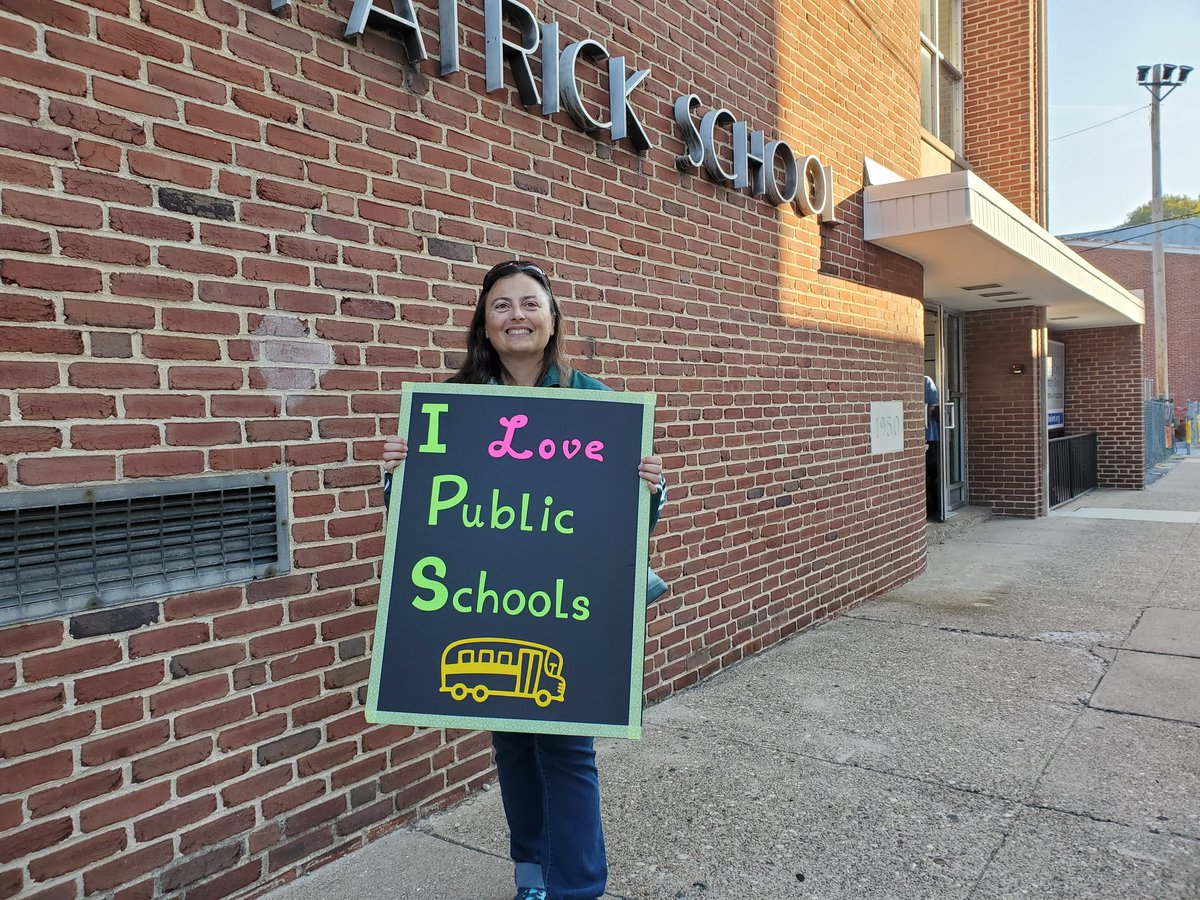

 Diane Ravitch's blog