Archives for the month of: March, 2019

I posted earlier that there are no teachers on the task force appointed by Governor Gavin Newsom and State Superintendent Tony Thurmond to study charter law in California, but that’s not quite right. The task force is meeting regularly and it would likely be impossible for a working teacher to leave her or his classroom on a weekly basis to attend task force meetings.

However, there are at least two members of the task force who were active teachers: Erika Jones of the California Teachers Association and Cindy Marten, superintendent of the San Diego Unified School District.

I don’t understand why the task force has so  many representatives of the charter industry on a committee to study charter law, when only 10 percent of students in California schools are enrolled in charters. The charter industry is infamous for protecting its turf and fighting any regulation or accountability. This is like asking representatives of Big Tobacco to participate in a discussion of whether to regulate cigarette sales.

Charter law in the state is notoriously lax. A district with a tiny enrollment can open a charter in a district 500 miles away and collect a commission on the students who enroll. If a charter asks a district for permission to open or for a renewal, and the district rejects the application, the charter can appeal to the county board. If the county board says that its application or its record is deficient, the charter can appeal to the state board. Under Governor Jerry Brown, the state board rubberstamped applications despite rejections from the affected district and county. Under current law, the state need not consider the fiscal impact of charters on nearby public schools, a factor which has severely damaged Oakland, Inglewood, and other districts. Under current law, charters are parasites on the districts that are forced to host them, draining away students and resources and leaving “stranded costs” (fixed costs).

California has had a large number of scandals in the charter sector. The most recent occurred when the CEO of the Celerity Charter chain pled guilty to using the schools’ credit card to charge luxury items, including designer clothing, fancy hotels, haute cuisine and limousine service, as well as to fund her Ohio charter school.

These are issues the task force will consider. Will the large bloc of charter supporters on the task force acknowledge the fiscal problems caused by charters for the public schools that enroll most students? Or will they fight stubbornly to maintain the charters’ freedom from accountability? Why did the California Charter School Association get two members of the task force but the California Teachers Association get only one? If charter schools undermine public schools, it is a net loss for the children of the state. If failing charters are allowed to be renewed again and again, it is a disgrace.

Here is the complete task force:

The task force members are:

  • Cristina de Jesus, president and chief executive officer, Green Dot Public Schools California (charter chain);
  • Dolores Duran, California School Employees Association;
  • Margaret Fortune, California Charter Schools Association board chair; Fortune School of Education, president & CEO;
  • Lester Garcia, political director, SEIU Local 99 (Local 99 took $100,000 from Eli Broad to oppose Jackie Goldberg);
  • Alia Griffing, political director, American Federation of State, County and Municipal Employees (AFSCME) Council 57;
  • Beth Hunkapiller, educator and administrator, Aspire Public Schools (charter chain);
  • Erika Jones, board of directors, California Teachers Association;
  • Ed Manansala, superintendent, El Dorado County; board president, California County Superintendents Educational Services Association; 
  • Cindy Marten,  superintendent, San Diego Unified School District;
  • Gina Plate, vice president of special education, California Charter Schools Association (charter lobby);
  • Edgar Zazueta, senior director, policy & governmental relations, Association of California School Administrators (ACSA endorsed Marshall Tuck against Tony Thurmond). 

Recommended readings:

Gordon Lafer on the fiscal impact of charters on California public schools.

Carol Burris on the travesty of the state’s charter law. 
 

Carol Burris did a thorough analysis of the abuses committed by the charter industry in California.

Please read this report and send a copy to Tony Thurmond, who just appointed a task force to study charter schools and stacked it with charter allies.

Last November, there was a bitter contest for the position of Superintendent of Public Instruction in California.

The charter lobby pumped millions of dollars into the campaign of Marshall Tuck, former CEO of Green Dot charter schools. The charters spent twice as much as the California Teachers Association, which backed Tony Thurmond.

In a tight race, Thurmond won.

In two recent teachers’ strikes, in Los Angeles and Oakland, teachers demanded a moratorium on new charters until the fiscal impact of charters on public schools was thoroughly studied.

In response, Governor Gavin Newsom asked State Superintendent Tony Thurmond to set up a task force to examine the issues that charters raise and consider any needed revisions in the law.

Thurmond appointed an 11-member panel. Not a single one of the 11 is a teacher, even though teachers raised the questions in their strikes.

Worse, a possible majority of the panel represent the charter lobby that fought so hard to defeat Thurmond, smeared him with negative ads, and lost.

Here are some of the members:

  • Cristina de Jesus, president and chief executive officer, Green Dot Public Schools California;
  • Margaret Fortune, California Charter Schools Association board chair; Fortune School of Education, president & CEO;
  • Lester Garcia, political director, SEIU Local 99; (Charter against Jackie 100K Broad IE)
  • Beth Hunkapiller, educator and administrator, Aspire Public Schools
  • Ed Manansala, superintendent, El Dorado County; board president, California County Superintendents Educational Services Association; (El Dorado Charter Officers. President. Marcy Guthrie … Ed Manansala, Ed.D., County Superintendent El Dorado Co. Office of Education
    Rite of Passage Charter High School – El Dorado County Office of Education …
  • Gina Plate, vice president of special education, California Charter Schools Association;
  • Edgar Zazueta, senior director, policy & governmental relations, Association of California School Administrators. (LED Endorsement of Marshall Tuck)

It appears that seven of the 11 task force members are in the tank for charter schools.

This is by no means a balanced or open-minded committee.

How likely are they to propose tighter regulation of charter schools?

How likely are they to propose that districts should not be allowed to open charter schools in other districts, a policy that has led to financial abuses?

How likely are they to curb the waste, fraud, and abuse that allow fly-by-night charter schools to open in strip malls, collect money, then disappear?

Tony Thurmond, what happened?

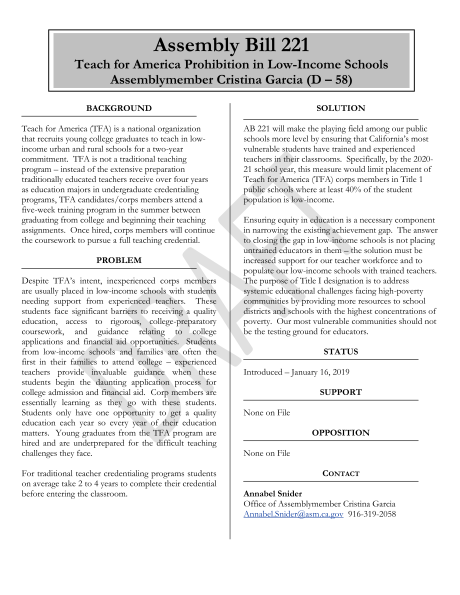
In this brief radio interview, Professor Julian Vasquez Heilig of California State University in Sacramento explains the rationale behind Assembly Bill 221, which would ban TFA teachers from teaching in schools with high numbers of impoverished students. He says that the neediest students need well-prepared, experienced teachers, not novices.

A description of the bill is here.

tfa factsheet png


State Superintendent of Instruction Tony Thurmond appointed an 11-member task force to study the fiscal impact of charter schools on public schools.

He did so at the request of Governor Newsom.

Four members of the task force are part of the charter industry.

Thurmond is amazingly evenhanded. In the race for the office last fall, the charter industry outspent him 2-1 and smeared him with negative advertising.

Ten percent of the state’s students are in charter schools.

The task force should be sure to read University of Oregon Professor Gordon Lafer’s Study of the fiscal impact of charters on three districts, called “Breaking Point.”

In the two recent teachers’ strikes, in Los Angeles and Oakland, teachers called for a moratorium on new charters until such a study was completed. Governor Newsom has been noncommittal on that demand.

The charter sector has operated with minimal or no oversight. To see how bad things are, read “Charters and Consequences.” There are storefront charters where students meet their teacher only once every three weeks. There are charters with graduation rates under 10%. Charters are allowed to open wherever they want. Charters can appeal a district rejection to the county, then appeal the county rejection to the state, where they usually got a rubber stamp. Charters may be run like chain stores, without oversight, just to make money. Until Newsom signed a bill recently, there were no laws profiting conflicts of interest or nepotism. The charter industry vigorously opposed any regulation or accountability.

One charter executive called the ban on conflicts and nepotism a “scorched earth policy.”


Ohio charter schools are very low-performing. They have also had numerous scandals.

And then there is the story of the Richard Allen Charter Schools.

The Dayton Daily News conducted an investigation and found that the charters “are still being run by a person who was sued by the state attorney general 18 months ago for her role in misspending $2.2 million in school money.”

The school leased a Maserati, two Mercedes, and a Jaguar for its leaders. Nothing but the best with public money! I mean, really, would you expect them to drive a Ford or a Toyota or a Chevy?

The investigation “also found that the schools are operating in buildings that have a bankruptcy case hanging over them, and Richard Allen has had no state financial audits released for the past three school years.”

Can you believe this?

Superintendent Michelle Thomas faces pending legal action, as does the Institute of Management and Resources (IMR), which ran the school for years and listed a leased Maserati and Jaguar in its bankruptcy filing.

Asked last week about Thomas’ role running Richard Allen schools, a state attorney general’s spokesman claimed, “The schools are no longer under Ms. Thomas’ control.”

But both the schools’ website and Ohio Department of Education documents confirm that she is the superintendent, and it was Thomas who responded to questions about the schools after a reporter visited the Talbott Tower office for the schools’ management company.

Asked about the contradiction, attorney general’s spokesman Dominic Binkley said he would have to recheck information provided by the AG’s education division that Thomas was no longer running the schools.

Ohio Senate Education Committee Chair Peggy Lehner, who has led charter school reform efforts in recent years, said state officials will investigate.

“I find this information extremely troubling, and I, along with a number of other entities within the state, will continue to look into this,” Lehner said.

Thomas declined an interview request, sending short emails instead.

“Richard Allen Schools has nothing to do with IMR,” Thomas wrote, adding, “The schools are working hard to respect its leases and to secure the property outside of the bankruptcy. The audits are proceeding and it is my understanding that they should be released soon.”

Until summer 2017, the three Richard Allen schools in Dayton and one in Hamilton were run by The Institute of Management and Resources, a company started by Thomas and her mother, Richard Allen Schools founder Jeanette Harris.

Earlier this decade, the state auditor’s office ruled that IMR misspent $2.2 million in public money running Richard Allen. The company denied wrongdoing and appealed in court, but lost in 2015.

Lingering issues

IMR filed for bankruptcy protection in March 2018. The Daily News pored through hundreds of pages of court records, state audits and school records, finding several lingering issues:

** The state attorney general’s office sued IMR, Harris, Thomas and others in late 2017, seeking to turn those $2.2 million in audit findings into collectible court judgments. The case was stayed when IMR filed for bankruptcy protection months later.

“(In addition to IMR), we also sued Jeannette Harris, her daughter Michelle Thomas, and the schools’ former treasurer (Felix O’Aku),” Binkley said. “We seek to hold those individuals strictly liable for the improper payments that resulted in the findings for recovery…

** IMR’s March 2018 bankruptcy filing says that at the time, the company was leasing four cars that were being paid for by IMR officials — a 2015 Maserati Ghibli for which Thomas is listed as co-lessee, a 2016 Mercedes C300 with deputy superintendent Aleta Benson listed as “guarantor,” and both a 2016 Jaguar XJL and a 2016 Mercedes GL 450 SUV with Harris listed as “guarantor.”.”

Ohio spends a billion dollars annually on its failing charter sector, which is now lobbying for an increase of 22% in state aid.


Jan Resseger explains here why Ohio should not give more money to charter schools and their sponsors (in Ohio, the authorizers of charter schools get a 3% commission for every student enrolled in their charters). Charter authorizers have a financial incentive to keep their charters open, regardless of their performance.

One reason to reject the increase is the charters’ poor performance.

But the most important and persuasive reason to say no is that their funding is money deducted from the public schools, which serve far more students and serve them better than charters.

“Usually arguments about the quality of public investment in charters are about whether charters do a good job as measured by test scores.  Proponents of charter schools typically want the public to evaluate charter schools and traditional public schools by comparing their test scores—despite considerable research over the years demonstrating that the results are, at best, relatively comparable.  Steve Dyer uses the test score yardstick in a recent blog post: “Not only have Ohio charter schools not gotten appreciably better on the report card since… 2015, but since the 2012-2013 school year, charter schools overall have received more Fs than all other grades combined on state report cards.” Dyer doesn’t think these schools are performing well enough to deserve additional tax support….

“Here is an example—this time from Sunday’s Cleveland Plain Dealer—of how reporting on charter school accountability and funding often goes.   As he describes the request for more money from the legislature, reporter Patrick O’Donnell considers the academic record of Ohio charter schools and whether state regulation has improved enough.  O’Donnell begins: “Charter schools in Ohio have long wanted more money from the state, but a history of well-publicized scandals, mismanagement and poor report card grades have made it hard to justify giving them any more tax dollars.  Have they cleaned up their act enough now?”

“Charter schools in Ohio actually want a lot more money per-pupil in the next state budget. O’Donnell reports: “Some charter officials are pressing the state for another $2,000 per student a year for most charter schools in the upcoming state budget. Leading the charge are the Breakthrough Schools, the Cleveland based chain that has the strongest results out of all charters in Ohio. Joining them are the growing Accel Schools chain, which has grown to 40 schools in the state over the last three years.”  Accel Schools is the charter network run by former K-12 Inc., CEO Ron Packard, who expanded his Accel network by buying up Cleveland’s I Can charters along with many of the schools formerly operated by David Brennan, who died last autumn.

“How should Ohio’s policy makers evaluate whether spending tax dollars on charter schools is a good investment?  And particularly in these times when charter schools are asking for a huge bump of $2,000 extra per-pupil? Measured by test scores, and evaluated by their record of conflicts of interest, fraud. and outlandish financial mismanagement, Ohio should not increase public funding for its charter school sector.  But I believe there is a more important—and usually ignored—reason for denying more funding to the privatized charter school sector in our state. Policy makers must begin examining charter schools’ enormous, persistent drain on local school district budgets.

“In Ohio, California, and many other states, charter schools get their funding through a “school district deduction.” Here is how the Ohio Department of Education describes the process of funding (When you read the following language, remember that charter schools in Ohio are formally called “community schools” instead of charter schools.): “Payments to community schools take the form of deductions from the state foundation funding of the school districts in which the community school students are entitled to attend school. Community schools students are counted as part of the enrollment base of the resident school district to generate funding.” The amount taken from the school district budget by every Ohio student who leaves for a charter school is $6,020.  This is known as a “district deduction” system of funding.”

Charter schools want more money but no accountability. They want to harm public schools.

The Ohio legislature should just say no.


Another for-profit chain of colleges has gone into bankruptcy and its students ar3 left holding the bag, loaded with debt and worthless degrees. Policing these institutions is the job of the Education Department. For years, the for-profit colllege Industry has hiredlobbyists from both parties to protect them.


The New York Times reports:

“When the Education Department approved a proposal by Dream Center, a Christian nonprofit with no experience in higher education, to buy a troubled chain of for-profit colleges, skeptics warned that the charity was unlikely to pull off the turnaround it promised.

“What they didn’t foresee was just how quickly and catastrophically it would fail.

“Barely a year after the takeover, dozens of Dream Center campuses are nearly out of money and may close as soon as Friday. More than a dozen others have been sold in the hope they can survive.

“The affected schools — Argosy University, South University and the Art Institutes — have about 26,000 students in programs spanning associate degrees in dental hygiene and doctoral programs in law and psychology. Fourteen campuses, mostly Art Institute locations, have a new owner after a hastily arranged transfer involving private equity executives. More than 40 others are under the control of a court-appointed receiver who has accused school officials of trying to keep the doors open by taking millions of dollars earmarked for students.

“The problems, arising amid the Trump administration’s broad efforts to deregulate the for-profit college industry, began almost immediately after Dream Center acquired the schools in 2017. The charity, started 25 years ago and affiliated with a Pentecostal megachurch in Los Angeles, has a nationwide network of outreach programs for problems like homelessness and domestic violence and said it planned to use the schools to fund its expansion.

“Now its students — many with credits that cannot be easily transferred — are stuck in a meltdown. On Wednesday, members of the faculty at Argosy’s Chicago and Northern Virginia campuses told students that they had been fired and instructed to remove their belongings. In Phoenix, an unpaid landlord locked students out of their classrooms. In California, a dean advised students two months away from graduation not to invite family to attend from out of town.

“In less than a month, everything I have worked for the past three years has been taken from me,” said Jayne Kenney, who is pursuing her doctorate in clinical psychology at Argosy’s Chicago campus. “I am also conscious of the fact that what seems like the swift fall of an ax in less than one month has in reality been festering for years.”

“The fall accelerated last week when the Education Department cut off federal student loan funds to Argosy after the court-appointed receiver said school officials had taken about $13 million owed to students at 22 campuses and used it for expenses like payroll. The students, who had borrowed extra money to cover things like rent and groceries, were forced to use food banks or skip classes for lack of bus fare.

“Lauren Jackson, a single mother seeking a doctorate at the Illinois School of Professional Psychology, an Argosy school in Chicago, did not receive the roughly $10,000 she was due in January. She has been paying expenses for her and her 6-year-old daughter with borrowed money and GoFundMe donations.

“On Tuesday, after three months of not paying her rent, she received an eviction notice.

“I didn’t want to go home and tell my baby that Mommy may not be a doctor,” said Ms. Jackson, whose school could close Friday. “Now I don’t want to go home and tell her that we don’t have a home.”

‘Bad for Everyone’

“Led by Secretary Betsy DeVos, the Education Department has reversed an Obama-era crackdown on troubled vocational and career schools and allowed new and less experienced entrants into the field.

“The industry was on its heels, but they’ve been given new life by the department under DeVos,” said Eileen Connor, the director of litigation at Harvard Law School’s Project on Predatory Student Lending.

“Ms. DeVos, who invested in companies with ties to for-profit colleges before taking office, has made it an agency priority to unfetter for-profit schools by eliminating restrictions on them. She also allowed several for-profit schools to evade even those loosened rules by converting to nonprofits.

“That’s what Dream Center wanted to do when it asked to buy the remains of Education Management Corporation.

“Education Management, once the nation’s second-largest for-profit college operator, was struggling for survival after an investigation into its recruiting tactics resulted in a $200 million settlement in 2015. Despite those troubles, it had 65,000 students, and some of its schools maintained strong reputations.

“Dream Center is connected to Angelus Temple, which was founded by Aimee Semple McPherson, a charismatic evangelist once portrayed by Faye Dunaway in a TV movie, “The Disappearance of Aimee.” It is affiliated with the Foursquare Church, an evangelical denomination with outposts in 146 countries.

“Buying a chain of schools “aligns perfectly with our mission, which views education as a primary means of life transformation,” Randall Barton, the foundation’s managing director, said when Dream Center announced its plan.

“But Dream Center had never run colleges. It hired a team including Brent Richardson, who worked on the conversion of Grand Canyon University to a nonprofit as its chairman, to lead the schools’ corporate parent, Dream Center Education Holdings. He stepped down in January.

“Alarms were ringing from the moment the takeover was proposed. Dream Center’s effort to buy the failing ITT Technical Institutes schools had fallen apart after resistance from the Obama administration. When it asked to buy Education Management’s schools, consumer groups, members of Congress and some regional accreditors raised concerns.

“But in late 2017, Ms. DeVos’s agency gave preliminary approval to Dream Center’s plan.

“Almost immediately, the organization discovered the schools were in worse shape than expected, with aging facilities and outdated technology. The universities “were, on the whole, failing without hope for redemption,” the receiver wrote in a court filing last month.

“Dream Center had anticipated a $30 million profit in its first year, Mr. Barton wrote in a recent legal filing. Instead, it was facing a $38 million loss.

“And Dream Center showed little inclination to curb the tactics that got Education Management in trouble, like misleading students about their employment prospects. The executives it installed cultivated a high-pressure culture in which profit surpassed all other concerns, according to a report filed last year by Thomas J. Perrelli, the court-appointed monitor overseeing the schools’ compliance with their state settlements.

“By the end of 2018, Dream Center was facing eviction on at least nine campuses and owed creditors more than $40 million, and Education Department officials scrambled to plan for what looked like an imminent implosion.

“We know all too well that precipitous school closures are bad for everyone involved and leave too many students high and dry,” said Liz Hill, an agency spokeswoman. “Teams of people at the department have been working tirelessly on behalf of students — caught up in this situation through no fault of their own — with the singular goal in mind to ensure as many students as possible had options to complete their education.”“The way they presented the receivership was that it would be beneficial to the students, but it’s actually been detrimental,” said Marina Awed, a student at an Argosy school in California, Western State College of Law, who was scheduled to graduate in two months. “It shouldn’t be this easy to defraud the Department of Education.”

Disgraceful.

This story in today’s Washington Post moved me. If I had been in the room, I would have jumped up and applauded Senator Flowers.


Debate on gun legislation reached a crescendo at the Arkansas State Capitol on Wednesday when a senator fervently denounced a bill that would make it easier to use lethal force in the name of self-defense.

The bill, sponsored by three Republican state senators, would remove a clause from the current law that required a “duty to retreat” in self-defense cases. Previous efforts to push similar “stand your ground” laws in the state, under both Democratic and Republican legislatures, have all failed within the past decade, the Arkansas Democrat-Gazette reports.

On Wednesday, Sen. Stephanie Flowers (D) spoke up when some members of the state’s Judiciary Committee tried to limit debate time on the issue — delivering an ardent monologue to explain why “stand your ground” laws are dangerous, particularly for people and communities of color.

“I am the only person here of color. I am a mother, too, and I have a son,” Flowers said. “And I care as much for my son as y’all care for yours. But my son doesn’t walk the same path as yours does. So this debate deserves more time.”

Addressing gun rights supporters in the room, Flowers said it was “crazy” to limit debate on such a sensitive issue. The senator again invoked her 27-year-old son, adding she was glad he no longer lives in Arkansas.

“You don’t have to worry about your children. . . . I have to worry about my son, and I worry about other little black boys and girls,” she said. “And people coming into my neighborhood, into my city, saying they have open-carry rights walking down in front of my doggone office in front of the courthouse. That’s a bully!”

Flowers said she was “scared” and “threatened” by the notion, and cited instances in which people had entered the legislature while carrying guns under their coats, adding, “You can see the damn print!”

Before she could continue, Flowers was interrupted by the committee chairman, Sen. Alan Clark (R).

“Senator, you need to stop talking,” he whispered.

“No, I don’t!” Flowers lashed back.

“Yes, you do,” Clark replied.

“No, I don’t,” Flowers said. “What the hell you going to do, shoot me?”

“Senator …” Clark said, in an apparent effort to quiet her.

“Senator s—. Go to hell. I’m telling you, this deserves more attention.”

Flowers walked out of the committee room before returning to hear other groups speak out against the bill, including the Arkansas Association of Chiefs of Police and the Arkansas Sheriffs’ Association, according to the Arkansas Democrat-Gazette. The measure was narrowly defeated in a 4-to-3 vote, with one Republican joining the opposing group.

Video of Flowers’s unrelenting defense was shared widely Friday, drawing praise from those inspired by her fearlessness. Some found the timing of the video to be fitting, as Friday marked International Women’s Day.

The bill’s primary sponsor will attempt to reintroduce the bill Monday to get one more “yes” vote, local NBC affiliate KARKreported.

Lisa Haver, a pro-public school activist in Philadelphia wrote to tell me that “It’s a new day in Philadelphia!”

The old School Reform Commission, appointed by the governor and mayor, routinely approved charter school applications, no matter what the charter operator’s performance or record.

Last week, the new school board turned down three charter applications.

She wrote:

Hi Diane,
The new Board, which replaced the state-imposed School Reform Commission last year, voted last night to deny all three of this year’s charter applications.
The decisions, with the exception of a few abstentions due to conflicts, were unanimous.
There was not a single yes vote for any of the three applicants.
Board members gave several reasons why they rejected the applications.
The SRC would approve applications for clearly inadequate applicants, mostly for political reasons.
These schools would have cost the District over $161 million over 5 years, including stranded costs.  Now we can use that money to hire more support staff and fix our older buildings.
Best,
Lisa
Here is the story.

“In a series of historic votes, Philadelphia’s Board of Education denied all three new charter school applications at its meeting Thursday, amid calls for a full moratorium on charters. After protest from charter advocates and a group of students, the votes reversed the dominant reasoning of the former School Reform Commission, which the board seemed to uphold in December when it voted to renew the charter of Richard Allen Preparatory Charter School in an attempt to avoid legal fees that could result from a lengthy appeals process.

“This time, board members denied the three applications to expand the operators’ charter school networks, citing struggling academics at the applicants’ other schools and a difficulty serving diverse and vulnerable students. Members also mentioned that applicants have other charter schools that are operating under expired charters, without signing the conditions offered by the board, which would require the schools to meet various standards.

“City Councilwoman Blondell Reynolds Brown spoke in favor of String Theory’s proposed new charter school, the Joan Myers Brown Academy, named after the founder of the Philadelphia Dance Company. It was envisioned as a performance arts charter school in West Philadelphia with a focus on dance.

“The vote took place after outraged testimony from Joseph Corosanite, the co-founder of String Theory Schools.

“It’s challenging for me to see an evaluation of us that is deeply flawed and biased,” Corosanite said, referring to the evaluation of String Theory’s application by the District’s Charter Schools Office. “I understand that there still may be some question, but there is not part of our application that can’t be worked through if you choose to approve us.”

Corosanite said the school should be approved because the neighborhood schools in West Philadelphia are “some of the worst in the city from an academic standpoint, as well as from a facilities standpoint.

“People don’t know how we do this because they’ve never done it before.”

“Board members explained their thoughts after the votes were taken.

“I did not come to the board with the perspective that all schools were bad. I certainly did not come with the perspective that charters are better,” said member Leticia Egea Hinton. “I’m sometimes confused by the perspective that charters, no matter how low-performing, are better and that public schools, no matter how great, are still bad.

“Our challenge is: How do we create a system that provides a quality education for all, that reflects high standards and expectations for all children, no matter where they live and who they are?”

Chris McGinley, who was also a member of the former School Reform Commission, thought back to the 1990s, when charters first appeared in Philadelphia.

“During the charter school movement in Philadelphia, it was an era where schools were supposed to become more like businesses … a quick fix, mostly for urban school districts,” he said. “We all know that promise has not been realized.”

“ said he would vote to approve only the highest-quality charter schools, “with consistency towards a Pennsylvania charter school law that is big on promise and low on accountability.”

“He added: “Even if we accept the premise that school districts should operate more like businesses, there were valid reasons not to approve. We have unsigned contracts with three of the applicants. No business would accept new bids or new work with providers who refuse to sign current contracts.”

”City Councilwoman Helen Gym, who helped found a charter school when she was a community organizer but became a critic of the state’s charter law, celebrated the votes as a victory for local control — referring to the nearly 20-year struggle of organizers and advocates to abolish the state-controlled SRC, which Mayor Kenney replaced with an appointed school board last summer.

“For years, a state takeover body sold the idea that our public schools’ most basic needs and rights had to be sacrificed in favor or reckless and massive charter expansion — no matter the quality of the charter or the impact on the school district,” Gym said in a statement after the vote. “The needs of our public schools are dire. We need immediate investments to address staffing and curricular vacancies that are robbing our children of their right to a ‘thorough and efficient’ education.” She was referring to a phrase in Pennsylvania’s constitution.

“We need meaningful investments in our school facilities so that they don’t fall apart or continue to put the health of children and school staff at risk,” Gym’s statement continued.”