Archives for the month of: March, 2018

I invited Leonie Haimson, executive director of ClassSizeMatters, to write about the unfortunate decision by the New York City Department of Education to close P.S. 25 in Bedford-Stuyvesant, Brooklyn. It is one of the most successful schools in the city. It is under enrolled, but the authorities could easily change that by advertising its success or placing additional programs in the building. If and when the school closes, the empty building would then be available for Eva Moskowitz’s charter chain, and the children in the area would no longer have a zoned public school. Did Mayor DeBlasio forget that he campaigned on the promise to support public schools against the voracious expansion of charter schools?


Leonie writes:

On Tuesday, a lawsuit was filed to block the closing of PS 25 Eubie Blake, a small school in the Bed Stuy section of Brooklyn, which by all accounts is a school that is excelling and exceeding expectations, especially given the high-needs students it serves.

Last month, the Panel for Educational Policy voted to approve the closure of ten city schools, most of them struggling schools on the Renewal list.  Lost in the media shuffle was the fact that one of these schools, PS 25, wasn’t a low-performing school; far from it.

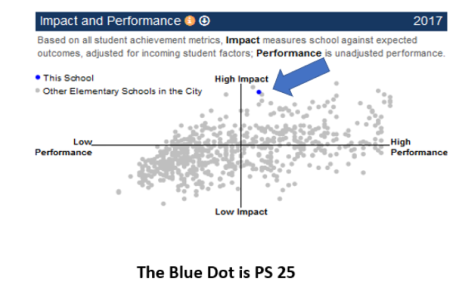
According to the DOE’s School Performance Dashboard, (according to Chancellor Farina, the “the most advanced tool of its kind,” PS 25 has the fourth highest positive impact of any public elementary school in the city and the second best in the entire borough of Brooklyn, when the need level of its incoming students is taken into account.
Picture1

According to this metric, the positive impact of PS 25 also exceeds that of any charter school in the city, except for Success Academy Bronx 2, given the fact that most of its students are economically disadvantaged, have disabilities and/or are homeless.

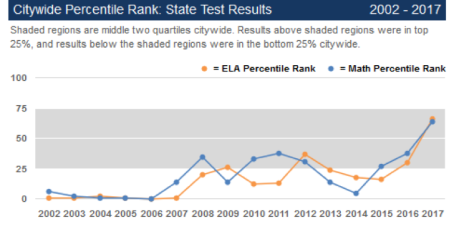
The test scores from PS 25 on the state exams show a sharp upward trajectory, with its students now exceeding the city average in both ELA and math.
Picture2

In fact, controlling for background and need, the students at PS 25 now outperform similar students by 21 percentage points in both subjects.

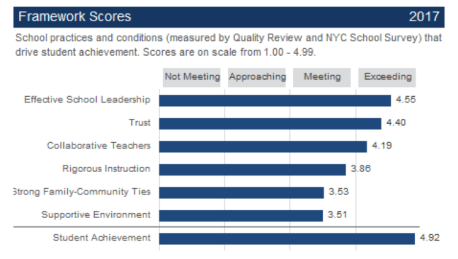
Now for those who say test scores aren’t everything, the school also excels according to all other methods the DOE uses to evaluate schools.  It exceeds or meets standards in “Effective School Leadership”, “Trust”, “Collaborative Teachers”, “Rigorous Instruction”, “Strong Family-Community Ties” and “Supportive Environment,” according to the school’s Quality Review as well as parent and teacher surveys.
Picture3

The fact that the DOE is closing a school which is delivering such great results for its students should not have been ignored.

Also unreported by any media outlet were two other salient facts: if PS 25 is closed, the entire city-owned building will be left to a charter school – Success Academy Bed Stuy 3, the first time this has happened in NYC, to my knowledge.

Also ignored was that the Community Education Council District 16 never voted to close this zoned school. State law requires that before this can occur, the CEC must authorize this, as any changes in zoning lines can only happen with their approval. The is one of the main responsibilities of CECs and some would argue their sole veto power over the unilateral and often arbitrary decision-making of the Mayor and the Chancellor.

So why does the Chancellor say PS 25 should be closed?  Chancellor Farina argues that the school is under-enrolled.  Yet at least five other schools have smaller enrollments than PS 25 and are not being closed.  Moreover, DOE has never publicized the fact that this school outperforms nearly every other school in the city.  If they had celebrated this school’s accomplishments, surely more parents would apply.  The sad reality is that many public schools in D16 have lost enrollment because of the supersaturation of charter schools in the district –  a drain on space, funding and resources which will only worsen if this school is closed.

According to the DOE’s controversial school capacity formula, PS 25’s “underenrollment” also means there is sufficient space in the building for its small class sizes of 10 to 18 – which provide ideal learning environments and are likely a major reason for its students’ success.  The DOE could also place another preK or a 3K class in the building if they wanted its enrollment to grow.

Currently, PS 25 parents are being shown a list of other schools to apply to, most outside the district and a few schools within — but none will have the same small classes and positive impact on learning, and none of them will their children have the right to attend.

Given how difficult many of these families’ lives are already, with nearly one quarter of the students homeless, this will be yet another terrible disruption, though in this case, wholly preventable. One can only hope the DOE changes course and withdraws the proposal to close PS 25 immediately.

Below is the press release about the lawsuit, which describes a 2009 legal precedent when then-Chancellor Joel Klein withdrew a proposal to close three zoned schools in Harlem and Brooklyn after being sued.  He then signed an agreement that the DOE would never do this again without a vote of the CECs.  The legal complaint to block PS 25’s closure with more data about the school and facts about the law is posted here.


For Immediate Release: Tuesday, March 27, 2018

Contact: Leonie Haimson, 917-435-9329; leoniehaimson@gmail.com


Lawsuit filed to stop the closure of PS 25, the 4th best public elementary school in NYC according to the DOE


Today a lawsuit was filed in the Brooklyn State Supreme Court against the proposed closure of P.S. 25 Eubie Blake in District 16, Brooklyn, a zoned neighborhood school, which Chancellor Carmen Farina and the Board of Education are attempting to close without the prior approval of the Community Education Council.

Last month, on February 28, the Panel on Educational Policy voted to close the school which will require students to seek enrollment in other schools, with no assurance of admission.  Not only is it a violation of NY State Education law 2590-e to close the only zoned school in the neighborhood without the district CEC’s prior approval, but P.S. 25 is also the fourth best public elementary school in NYC in the estimation of the Department of Education, and the second best in the borough of Brooklyn, when the need level of its students is taken into account.

According to the DOE’s School Performance Dashboard, which according to Chancellor Fariña is ““the most advanced tool of its kind,” the positive impact of P.S. 25 is greater than all but three of the city’s 661 public elementary schools, and its closure would leave the entire city-owned building to Success Academy Bed Stuy 3, a charter school. [1]

Achievement levels of P.S. 25 students have steadily climbed over the last three years, and the school now exceeds the city average in state test scores, despite the fact that a large percentage of students are homeless, economically disadvantaged, and/or have disabilities. According to DOE’s figures, the school’s students outperform similar students by 21 percentage points in ELA and math.  The achievement of the more than thirty percent of students with disabilities is also exceptionally high.

The school also meets or exceeds standards in all the following areas:  Effective School Leadership, Trust, Collaborative Teachers, Rigorous Instruction, Strong Family-Community Ties, and Supportive Environment.

Plaintiff Crystal Williams, a parent of two children at P.S. 25, said: “The school has seen a big improvement in recent years.  The teachers are excellent.  They give students close support, and my kids are learning.  The teachers take their time in part because they have small classes, and I don’t believe my children would be provided with the same quality of education at whatever other schools they are forced to attend.”

“PS 25 should be honored and replicated, not closed,” said Mark Cannizzaro, President of the Council for School Supervisors and Administrators, the principals’ union. “The school has been on a clear, upward trajectory: Dedicated school leaders and teachers have helped boost English and math test scores ever higher compared to the district and the city as a whole. All the while, PS 25 has made great strides in addressing students’ social and emotional needs, and has offered them a vibrant curriculum with art, music, library skills, coding and STEM classes. We continue to oppose this decision. The students, families and educators of PS 25 deserve better.”

Said Shakema Armstead, a plaintiff who has a third grader at PS 25, “My son, who has an I.E.P, loves the school.  It gives him and other students with a sense of community and stability that allow them to thrive.  There is no reason for them to be thrown into another school where they would have to re-adjust to an entirely new environment, especially as P.S. 25 is doing so well.”

There is a precedent for this lawsuit. In 2009, a lawsuit was filed against Chancellor Joel Klein on behalf of parents at three neighborhood zoned schools, in Harlem and Ocean Hill-Brownsville area, to prevent the closure of these schools without a vote of the relevant CECs.  The lawsuit was joined by Randi Weingarten, then President of the UFT, and NYC Public Advocate Betsy Gotbaum. Within weeks, Chancellor Klein withdrew the closure proposals.[2]  He subsequently signed the following settlement agreement:

The [plaintiffs and the DOE] agree with regard to the three schools identified in the Complaint and any other traditional public school that, for those grades that are within the province of school attendance zones, [the DOE] will not close, phase-out, remove, alter or engage in conduct designed to effect the closure of any such school in a way that deprives residents of the right to send a qualifying child to his or her zoned traditional school, without either (1) obtaining, pursuant to 2590-e(11) of the Education Law, the approval of the relevant Community Education Council as to such change or (2) timely replacing such school with another zoned school within the same attendance zone.

In this case, DOE has no plans to create another zoned school for these children, and yet no vote of Community Education Council 16 has occurred.  The DOE claims that the school is being closed because it is under-enrolled, but this ignores several important factors:  Parents have not been told of the exceedingly high quality of the school according to the DOE’s own metrics, and if they had been informed of this, more of them would likely enroll their children in the school.  The DOE could also install another preK or a 3K program in the school.   The availability of space has also allowed for very small classes, which in turn have provided PS 25 students with an exceptional opportunity to learn.

Said Leonie Haimson, Executive Director of Class Size Matters, “It would be tragic if the second best elementary school in Brooklyn were closed.  PS 25 has very small classes of 10 to 18 students, which are ideal for such high-poverty students.  Given how the DOE refuses to align the school capacity formula with smaller classes, that alone makes the school appear underutilized.  It would be extremely disruptive if this closure occurs, especially for the large number of homeless children at PS 25, because the school is a sanctuary of stability in their lives. Instead of closing PS 25, the DOE should celebrate, emulate and expand it—and give more NYC children the same chance to succeed.”

A copy of the lawsuit is posted here: https://tinyurl.com/y6wjocsu

###

[1] https://tools.nycenet.edu/dashboard/#dbn=16K025&report_type=EMS&view=City

[2] https://www.nyclu.org/en/press-releases/response-nycluuft-lawsuit-doe-announces-it-will-keep-schools-open


Betsy DeVos may be mocked by the media and parents, but she has a friend in Mike Petrilli at the Thomas B. Fordham Institute. 

Is TBF angling for a federal grant? Mike was an original member of the “NeverTrump” movement, but now he is very impressed by Betsy DeVos. He is star struck, in fact.

Congress has handled her budget requests unsympathetically. She asked for deep cuts in the ED Department’s budget, but Congress increased spending on the programs she wanted to eliminate. The ED budget is actually larger, not smaller.

Betsy wanted $1 billion for school choice, but Congress killed that.

The only win she got was an increase in the funding of charter schools, which now goes up to $400 million a year.

This is a big win for ALEC, the Koch brothers, the DeVos family, and all the Red State governors who want to privatize public education. Make no mistake, it is a win for Donald Trump.

The big push to eliminate public schools in urban districts will resume, thanks to Congress.

This surely makes Corey Booker, one of DeVos’s strongest supporters, happy, along with Andrew Cuomo (NY), Dannel Malloy (CT), and Jerry Brown (CA).

Democrats who say they oppose the DeVos agenda of privatization (like Senator Patty Murray of Washington State) got rolled by DeVos.

New funding for charters, despite the scandals and frauds association with them, will be at least $600 million from the federal government, with its $400 million a year, and the Walton family’s $200 million a year.

If charters were really saving lives, as Petrilli claims, why are Detroit, Milwaukee, and D.C. still among the lowest performing districts in the nation, even though they are all charter-heavy?

When public money goes to private entrepreneurs without accountability, that is an invitation to fraud. And there are plenty of fraudsters lined up to take the money and run.


Three parents at PS 25 in Bedford Stuyvesant, Brooklyn, are suing to stop the closure of one of the city’s highest performing elementary schools. The Department of Education said the school was too small.

“The lawsuit hinges on a state law that gives local education councils the authority to approve any changes to school zones. Since P.S. 25 is the only zoned elementary school for a swath of Bedford-Stuyvesant, the department’s plans would leave some families with no zoned elementary school dedicated to educating them, forcing students to attend other district schools or enter the admissions lottery for charter schools.”

Question: Why didn’t DOE and local superintendent recruit additional students to 25?

Next question: will the building be emptied and handed over to another charter?

Next question: Why are charter operators focused on killing public schools in black communities, leaving them with no choice but a charter?


Gary Rubinstein wishes the Wall Street Journal would stop writing puff pieces about Success Academy. He wishes the reporter Leslie Brody would ask questions. 

Given that Success Academy is the darling of Wall Street, that’s not likely to happen.

The most important question, I think, is why anyone thinks Success Academy is a model for public schools when it picks its students, gets rid of those it doesn’t want, and doesn’t accept new enrollments after third grade? What public school operates like this, with a strict winnowing process and high attrition rates as the norm? It’s a business plan, not a model for public schools, which are required by law to accept all students, without regard to their disability or language skills or likely test scores. While it is true that some public schools admit students on the basis of test scores, they do not present themselves as models for the nation or as typical. Even if a student is rejected by a school with selective admissions, the district is required to find a school for the student. Not so the charters. If a student doesn’t make the cut, they are bounced out.

Success Academy improbably claims that its attrition rate is no worse than nearby district schools, but only 17 of the 73 who started in SA survive to graduate.

Gary writes:

”Part of their ‘success’ depends on their decision to not ‘backfill’ when students leave the school. This is quite an advantage for a school seeking to keep its test scores up. What would happen if all schools had this luxury?

“Reformers are known for saying that every child should have the opportunity to a great education regardless of zip code. By not backfilling beyond 3rd grade, Success Academy denies the right to transfer into this school for kids over 10 years old, which is definitely discriminatory. Also this means that any child who moves to New York after 3rd grade and didn’t have the opportunity to ever apply for the Success Academy lottery will never attend a Success Academy.”

He also notes the high teacher turnover, which Success Academy is known for:

“The second article is about some of the problems Success Academy had had in their high schools. According to the article, there was a student protest where 100 out of the 345 students participated. Then later in the article it says about the principal:

Mr. Malone also has had to grapple with high staff turnover. He said almost one third of about 50 teachers last year left, in some cases due to the exhausting nature of the job.

“So a school with 345 students had 50 teachers? If these two numbers are accurate, that is quite the 7 to 1 student teacher ratio.”

I deactivated my two Facebook accounts last week. I am not alone.

This happened today:

Key Takeaway: Facebook’s benefits are overwhelmed by problems inherent in its business model, its failure to safeguard personal information, and its lack of transparency and accountability.

Find Documents:
Press Release: http://nepc.info/node/9115

Contact:
Kevin Welner: (303) 492-8370, kevin.welner@colorado.edu
Alex Molnar: (480) 797-7261, nepc.molnar@gmail.com

Learn More:
NEPC Resources on School Commercialism

BOULDER, CO (March 27, 2018) – The National Education Policy Center (NEPC) will delete its Facebook account on Wednesday March 28. We have already removed social sharing via Facebook from the NEPC website and our other communication tools.

While Facebook has many benefits, we feel compelled to disassociate ourselves from the invasive data mining and the third-party targeting of users inherent in its business model. The goal of the NEPC is to provide high-quality information in support of democratic deliberation. Deceitful micro-targeted propaganda is made possible by Facebook data and undermines democracy. Our reading of the evidence and record tells us that neither Facebook nor any other opaque, unregulated, and unaccountable private entity should have control over the private data of billions of people. Whatever services are provided by the Facebook platform are overwhelmed by Facebook’s business model, its lack of transparency, its failure to safeguard the personal information of its users, and its lack of accountability.

NEPC annual reports on Schoolhouse Commercialism have highlighted the intensifying surveillance culture and other dangers to student privacy in the digital age, and Facebook has emerged as a primary culprit. It would be disingenuous for us to use Facebook to promote those reports and other NEPC work.

We don’t pretend that this was an easy step. Communication of research lies at the heart of NEPC’s mission, and social media are a big part of communications—with Facebook positioned as a dominant social media platform. Last month, NEPC’s “Schools of Opportunity” project benefited hugely from a short video that went viral on Facebook, garnering over a million views.

Yet the more we learned about Facebook’s data gathering , and in particular the Cambridge Analytica scandal , the more we couldn’t avoid the conclusion that Facebook’s benefits are far outweighed by its dangers. Facebook is designed in ways that are inherently troubling. As Facebook’s first president warned, “God only knows what it’s doing to our children’s brains .” He disclosed that Facebook was designed to create a “social validation feedback loop” that we now know does indeed alter brain chemistry by triggering dopamine hits each time a posting is liked. And marketers are taking full advantage .

Consider also this passage from a recent article in The Guardian (internal links included):

That Silicon Valley parents use the money they earn from tech to send their children to tech-free schools is no secret. But such qualms have not stopped the tech companies themselves from continuing to push their products on to other people’s children, both through partnerships with school districts and special apps for children as young as six.

In January 2018, the Campaign for a Commercial-Free Childhood sent Mark Zuckerberg a letter , signed by over 100 child advocates, educators, and experts in child development, requesting that Facebook discontinue its Messenger Kids app for children. A growing body of research demonstrates that excessive use of digital devices and social media is harmful to children and teens, making it likely that this new app—designed to encourage greater use of digital devices and social media among children—will undermine children’s healthy development. Facebook continues to promote Messenger Kids.

This problem is much larger than Facebook, but we cannot use that fact to justify inaction. We cannot, in good conscience, continue to lend tacit support to Facebook. NEPC has concluded that encouraging our readers to provide information that will be used by Facebook and its clients to tailor and limit information to which our readers will then be exposed contradicts our defined organizational mission, which is to support democratic deliberation about education policy.

We at NEPC encourage other education organizations to consider whether they too should delete their Facebook accounts, and we call upon policy makers to develop policies that provide strict public oversight of social media platforms.

Schools and Digital Platforms

NEPC’s own publications describe how digital platforms work through schools to pull children into the surveillance economy—an unregulated economy that these platforms have worked to construct and from which they benefit financially. “Students are offered no choice,” explains Faith Boninger, co-author with Alex Molnar of NEPC’s commercialism reports. As one student told Boninger and Molnar, “I can’t delete my Facebook account. My school activities have Facebook groups that I have to access. Maybe I can delete my account when I graduate.”

Molnar, who is NEPC’s Publications Director, warns that “students are tied to Facebook by their school-related activities, and they unwillingly and usually unwittingly provide Facebook with information that is used to limit what they are exposed to on-line and funnel them to worldviews that will reward Facebook’s clients.”

Boninger and Molnar add that their research has shown that digital platforms being promoted for school use are neither well understood by educators nor adequately regulated by existing policy and law. Says Molnar, “the kind of abuses inherent in Facebook’s business model, management structure, and lack of transparency are, without question, also occurring in schools and classrooms every day via social networks and digital platforms.”

Learn more about NEPC research on digital marketing and data gathering in schools at http://nepc.colorado.edu/ceru-home.

The following organizations also have resources on data gathering from children and in schools: Campaign for Commercial-Free Childhood , Center for Digital Democracy , Electronic Frontier Foundation , Electronic Privacy Information Center , and the Parent Coalition for Student Privacy .

We encourage people to distribute this announcement as widely as possible and to continue to share the work of the National Education Policy Center with others.


The Washington Post reports that the Alt-Right conspiracy theorists have created fake portraits and videos to attack student leader Emma Gonzalez. The most infamous is a doctored video allegedly showing her tearing up the Constitution, changing the original, in which she ripped an NRA target.

Disgraceful. There is no limit to how low the far right will go.

So how did those teenagers from Marjory Stoneman Douglas High School become so well informed?

Thank their teachers!

Emma Gonzales’ teacher in AP government is Jeff Foster. 

If all our high school students were as poised, well-informed, and ready for political action as Emma, this would be a dangerous world for crackpots and conspiracy theorists.

This might be a reason that red-state legislatures work so hard to defund the schools and demoralize teachers. A good education is a dangerous thing!

After she delivered her speech, González was so confident in front of news cameras that conspiracy theorists quickly accused her of being a crisis actor. Critics questioned how a high school senior could have such tight talking points. Rumors spread on YouTube and Twitter that the Stoneman Douglas students like her who were making repeat appearances on cable news networks were actually 30-year-old pawns of gun-control advocates. Others, like, CNN anchor Dana Bash, praised the students for their “amazing ability to have presence of mind and to be able to speak truth to power in a way that a lot of adults can’t do.”

But it turns out the Stoneman Douglas students being scrutinized are just teens with really good teachers at a school with resources. They are a testament to what public schools can produce if students have support at home and in well-funded schools.

Many of the high-profile Stoneman Douglas seniors are in the same AP United States Government and Politics program this year, helmed by Jeff Foster, who helped create the AP government curriculum for the entire Broward County Public Schools system.

Foster is going on 20 years teaching AP government classes. He worked in finance for a few years before his mother suggested he try substitute teaching. He fell in love with it and went on to get his masters in education.

Just one of the remarkable teachers in a well funded public school.


Matthew Kraft, an assistant professor of education and economics at Brown University, asks the question in the title of this post. He weighs the pros and cons. The cons are overwhelming. The pros are dubious. Peter Greene assesses Kraft’s balancing act. He finds the pro side of the balance curiously vacuous. Yet Kraft steps back and concludes that the nation is better off for the millions or hundreds of millions or billions spent to evaluate teachers by dubious measures.

Greene is not buying it.

The rush to evaluate demoralized teachers, created perverse incentives, and created a teacher shortage, with no evidence of success. Not much of a positive scorecard. (By the way, whatever happened to Raj Chetty and his Nobel-worthy research demonstrating that your fourth grade teacher determines your lifetime income and whether you [if female] get pregnant before marriage?)

He writes:

“Previous sucky evaluation systems may not have provided useful information about teachers (or depended on being used by good principals to generate good data). But at least those previous systems did not incentivize bad behavior. Modern reform evaluation systems add powerful motivation for schools to center themselves not on teachers or students or even standards, but on test results. And test-centered schools run upside down– instead of meeting the students’ needs, the test-centered school sees the students as adversaries who must be cajoled, coached, trained and even forced to cough up the scores that the school needs. The Madeline Hunter checklist may have been bunk, but at least it didn’t encourage me to conduct regular malpractice in my classroom.

“So yes– everyone would be better off if the last round of evaluation “reforms” had never happened.

“Kraft also asks if “the rushed and contentious rollout of teacher evaluation reforms poison the well for getting evaluation right.”

“Hmmm. First, I’ll challenge his assumption that rushed rollout is the problem. This is the old “Program X would have been great if it had been implemented properly,” but it’s almost never the implementation, stupid. There’s no good way to implement a bad program. Bad is bad, whether it’s rushed or not.

“Second, that particular well has never been a source of sparkling pure water, but yes, the current system made things worse. The problems could be reversed. The solution here is the same as the solution to many reform-created education problems– scrap test-centered schooling. Scrap the BS Test. Scrap the use of a BS Test to evaluate schools or teachers or students. Strip the BS Test of all significant consequences; make it a no-stakes test. That would remove a huge source of poison from the education well.”

Dorothy Siegel, a member of the Working Families Party and longtime activist, explains why Cynthia Nixon has what it takes to beat Cuomo.

She writes:

“Teachout never had a chance of becoming governor, unfortunately. Cuomo controlled ALL the levers of power. Anyone who didn’t support him got their hands chopped off. Teachout couldn’t raise money because people/players feared what Cuomo would do to them when he found out. She only raised around $500,000, compared to Cuomo’s $24 million.

“Yet, such was the simmering hatred of Democratic voters for Cuomo in upstate NY that Teachout won almost every upstate county — on a shoestring, and with the active opposition of the Democratic Party establishment that Cuomo controls. That hatred will not change. Nixon will win big upstate — bigger than Zephyr, in part because she will have more money and will have twice as much time (six months vs three months) to introduce herself to voters.She also has the ability to garner lots of free media because of her celebrity, which will be enough to counterbalance Cuomo’s millions, at least upstate.

“In 2014, NYC and the suburbs (2/3 of the vote) went pretty strongly for Cuomo, in large part because most voters hadn’t heard much about Teachout. And most city and suburban Democrats had a hazy “he’s ok” opinion of Cuomo. Now that Cuomo has an acid-tongued, smart and well-funded opponent — and assuming he will continue to put his foot in his mouth — THE TRUTH about Cuomo will finally come out, ESPECIALLY his anti-public school actions of the past eight years. Recall, if you will, that Cuomo was the major promoter of uber-testing and using tests to evaluate teachers. Once voters are reminded of that evil work, Cuomo will be ESPECIALLY unpopular in the NYC suburbs, where Opt Out was a powerful force.

“I am cautiously optimistic that Nixon — and the rest of us pro-public school folks — will help people see Cuomo as the school-privatizing Trump Democrat he is.

“My friends, I see a path to victory. I believe Nixon CAN win, if everything falls into place in this Very Angry at Corporate Democrats political year, In any event, she will do “surprisingly” well against Cuomo. Mark my words.”


David Berliner, one of the nation’s most eminent education researchers, says teachers across the nation should walk out on May 1, to protest low wages, legislative attacks on their profession, and a hostile environment,ent for teachers.

“Enough! Enough B.S! Enough excuses! This must all end now. It is time to ensure the dignity of all who teach! May 1st would be a good day for teachers all over our great nation to walk out of schools and demand better from their legislators. May Day reminds us of two things. One, it is the day to commemorate the Haymarket massacre, where workers were striking for an 8-hour day, and many of them lost their lives. Workers are rarely given their dignity peacefully!”

Time to resist! Time for solidarity!

He writes: MAY DAY!

MARCHING FOR DIGNITY ON MAY DAY

When I was about 8 or 9 I overheard my mother crying, and begging my very gentle and dutiful father to cross the picket lines, since we had run out of food and could not pay the rent. He said he couldn’t do that. He had to fight for what was right. He had to stand with his fellow workers. I was scared, but even then, I remember being impressed by his resolve.

As I grew, strikes occurred a few more times. But when he retired after 30+ years from his clerks’ job in a drug store chain, he received time and a half when he had to work weekends; he earned two weeks off every year; he had a basic medical plan which was once used to save his life; and, when he retired, he had a small pension to accompany his social security. Most of all, what he had was his dignity.

He took his job in 1930, lucky to have any work at all during the great depression. And because jobs were scarce at that time, the chain store for whom he worked casually exploited its workers. But as 1930 gave way to the 1940s, the workers unionized and demanded (often through strikes) better working conditions. Pay and benefits were, of course, front and center—but what my father and his fellow workers were actually fighting for was their dignity. The pursuit of fair wages and benefits for their labor was, in large part, so that they and their families had a chance to lead a stable, decent enough, working-class family life.

Because of my history I am sure that were I a public-school teacher in West Virginia I would have marched for increased salary and benefits. But, just as importantly, I would have marched to maintain my sense of self-worth, my self-esteem, my self-respect, my dignity! I know I cannot be the role model I’d like to be for the children I have raised, or the youth that I teach, if my work is considered less worthy than that of many others by my governor and state legislators.

Do legislators and our governor here in Arizona know that some student teachers at Arizona State University asked not to be placed at a particular high school that serves the students of wealthy families? Was that because of violence at the school? No! Inadequate facilities? No! Inadequate tech support or training? No! Poor role models among our cooperating teachers? No—just the opposite!

The shunning of this school by our student teachers was because the students there called our student teachers “chumps”! The students at this public high school gloated that they had better cars, more stylish clothes, went to better places on vacations, had nicer houses to live in, and so forth. Their teachers, clearly, were chumps!
When our teachers are so denigrated by the offspring of the rich because they cannot afford even a middle-class life style for themselves and their families, it is way past time to worry a lot about our country. It was teachers who personified the middle class in so many of our towns and cities, throughout so much of our history. Firmly middle class was OK. Everyone who taught came to grips with that. All of knew that we weren’t going to get rich teaching.

But now, too many teachers are using food banks to help feed their families (I found this in New Mexico recently). Too many teachers are couch-surfing, and a few must occasionally live in cars because they cannot afford decent housing (go ahead: google homeless teachers!).

Enough! Enough B.S! Enough excuses! This must all end now. It is time to ensure the dignity of all who teach! May 1st would be a good day for teachers all over our great nation to walk out of schools and demand better from their legislators. May Day reminds us of two things. One, it is the day to commemorate the Haymarket massacre, where workers were striking for an 8-hour day, and many of them lost their lives. Workers are rarely given their dignity peacefully!

But the second reason to pick May 1st is that it is called May Day. We all know that May Day/May Day, is the internationally recognized call for help. Our American public education system needs help. May Day! May Day!

In my state of Arizona, in Oklahoma, and elsewhere, I would be proud to march with our teachers on May 1st or any other day chosen. I believe that parents across the nation would be supportive as well, despite the disruption to their lives that such a walkout would engender. We citizens need to stand in solidarity with our teachers and remember that they walk for their dignity, not merely for salary, benefits, and pension protection. The last thing Americans should ever want is for our children to be educated by beaten down public-school professionals, having trouble buying homes, and food, and day care for their own kids, as we ask them to educate the rest of America’s children. I cannot help but believe that if we support the teachers as they walk out, just as we supported the kids of Parkland this past weekend, something wonderful will happen: On May 1st I suspect that the ghosts of Woody Guthrie, Tom Joad, and my father, will march with teachers across the nation. If we stand in solidarity with our teachers we can help them regain the respect they deserve, and the pride they might again feel for the profession they have chosen.

David C. Berliner
Regents’ Professor Emeritus
Mary Lou Fulton Teachers College
Arizona State University