All week, there were dire warnings that Trump would force a government shutdown by refusing to approve a federal budget unless it included funding for his border wall. Democrats, of course, were adamantly opposed to funding the Wall, and some Republicans objected because of the cost With four days to go, Trump backed down and said he will wait until September to start again on demanding the funding. Some voters may recall that Mexico was going to pay for the Wall. That great, beautiful Wall stretching from sea to shining sea.
Archives for the month of: April, 2017
In a surprising move, New York Governor Andrew Cuomo hired New Jersey Governor Chris Christie’s chief political strategist as his chief of staff.
Governor Christie is term-limited and will soon leave office. His popularity rating is at a historic low, about 20%. His presidential campaign blew up after the scandal called Bridgegate, in which his staff coordinated the closing of a major bridge (the George Washington Bridge) between New York and New Jersey to punish the Democratic mayor of Fort Lee (where the bridge is based in New Jersey) for not supporting Christie’s re-election bid.
Christie has been a disaster for public schools. Although New Jersey has one of the best records in the nation for public school performance, Christie treats the public schools with disdain and favors charters and vouchers. He put a salary cap on administrators, causing many to retire or relocate. He has fought publicly with the teachers union and disparaged its leadership. He never had a good word to say about public schools, even though New Jersey schools consistently rank either 2nd or 3rd in the nation on NAEP tests.
Let’s hope that Governor Cuomo’s new chief of staff does not share Governor Christie’s hostility to public schools.
An urgent appeal from parent leaders at Public Schools First North Carolina. The General Assembly is about to pass a budget that includes no funding for teachers of art, music, and physical education. The unfunded mandate for reduced class size in the early grades will cause massive layoffs and program cuts. ACT NOW!
ACTION ALERT……..ACTION ALERT ACTION ALERT……..ACTION ALERT ACTION ALERT……..ACTION ALERT
PUBLIC SCHOOL ADVOCATES MUST CONTACT LEGISLATORS NOW!
Senators are planning to vote on the HB13 Amended Bill THIS AFTERNOON, Tuesday April 25th at their 4pm session.
PLEASE STOP what you are doing right now and CALL, E-MAIL, or TWEET North Carolina Senators FIRST and then call every HOUSE Member and ask them to add an amendment to put money for SPECIALS in the new two-year budget! The current bill has NO funds to pay for specials teachers next year! PLEASE DO IT NOW!
This may be our only chance to get this bill FIXED to avoid headaches with funding for our specials teachers next year. Let’s avoid having our teachers worry for another year about having their jobs. Let’s avoid potential layoffs next year by getting the money appropriated this year. Ask Senators to AMEND HB13 on the SENATE floor today! If this is their intention, then putting it into the bill this year should be no problem, right?
Ask Senators to amend the bill to add a guarantee of funding for specials teachers for next year in the two-year budget they are working on right now. ASK THEM TO PUT A GUARANTEE OF MONEY IN THE BUDGET to give school districts the planning time they need to keep their teachers in the classroom!
If HB13 is not amended to add money, this will NOT be addressed until the NEXT legislative session, the short session that starts in May 2018 — this is later in districts’ budgeting process than right now! May 2018 will be TOO LATE for many school districts whose teachers will have moved on to find other jobs or will have been dismissed due to lack of funding.
IF THE SENATORS DO NOT ADD THE FUNDING GUARANTEE NOW before the bill returns to the HOUSE for a final vote, OUR TEACHERS AND PARENTS will be left to worry and fret for another 12 months. This is not the way to run our public schools – ACT TODAY!! ASK NOW!!! This is the critical moment in this fight for funding.
Senators have the DATA needed! All of the information needed for the reports that Senator Barefoot wants to so he and other Senators can ALLOCATE money for K-3 teachers and for SPECIALS is in PowerSchool (NCDPI database) right now. This means that all of the Senators have this data NOW and can use it to make all assumptions needed NOW to figure out exactly what appropriations are needed to FUND Specials in 2018-19.
Senators promised to add this language in the Amendment last night and at the last moment they excluded the language leaving the HB13 fix ONLY half done.
BOTTOM LINE: The data needed to make the appropriation in the NEW two-year budget is in PowerSchool database and in the hands of our legislators at this time. The request is simple: put money in the budget now by amending HB13 now to include appropriation for Specials in 2018-19 school year.
To be clear, legislators are to be praised for advocating for smaller class sizes! All public education advocates are for smaller class sizes but not supportive of unfunded mandates or unrealistic implementation plans. The unintended consequences must be dealt with if our goal is to have great public schools that offer the best learning experiences for our youngest children.
Here is a WIN-WIN proposal: Encourage legislators to provide the money for teachers and SPECIALS NOW! And give local school districts time – 3 to 5 years – to find local funds for new classroom space; time to build and create additional space! Give school districts time to find new teachers or reassign/retrain some of their current staff. The alternative is crowded schools, classes in supply closets or lunchrooms, higher local taxes, lack of teaches or teachers with little or no experiences, and extreme over crowding in the upper grades to accommodate space and teachers for K-3. Right now, class sizes in the grades 4 to 12 are too large in many school districts — we have 35 or more kids in many classes!
Recently, Betsy DeVos visited the public schools of Van Wert, Ohio, with Randi Weingarten. Randi picked the district to show DeVos public schools that are the heart of their rural community, which is in Trump country. DeVos talked school choice, but encountered the reality of a community with high poverty and no interest in vouchers or charters.
In this article, Indianan Jill Long THOMPSON explains why vouchers would be a disaster for rural schools.
Jill Long Thompson is a former member of Congress and former USDA Under Secretary for Rural Development. She was board chair and CEO of the Farm Credit Administration and is now an associate professor at the Kelley School of Business and the School of Public and Environmental Affairs at Indiana University. She lives on a farm in northern Indiana.
Jill Long Thompson is a former member of Congress from Indiana. She is also a former USDA Undersecretary for Rural Development. She is a visiting associate professor at the Kelley School of Business and the School of Public and Environmental Affairs at Indiana University Bloomington.
Public schools are a cornerstone of communities, and they are a very important component of the rural infrastructure….
For rural communities, in particular, voucher programs create a business model that simply will not work. Running a rural school is very challenging because the resources are always limited, and oftentimes scarce.
Vouchers encourage the creation of small private schools. But, we don’t need more schools in rural communities; we need more resources to strengthen the schools we have. Increasing the number of schools means increasing the overhead, which is why vouchers dilute resources even further.
A school voucher program is the education policy equivalent of a county highway program that would give residents money to build little private roads anywhere they want.
That would not only be costly and inefficient; it would not serve the community’s transportation needs.
One must look no further than our own state, with its aggressive voucher program, to see the problems it causes for small rural school systems.
Since 2011, Indiana has shifted $520 million into the state voucher program.
Unfortunately, many of the schools receiving the vouchers have not performed as well as the public schools that lost funding because of the vouchers.
A voucher program is not the solution to the challenges facing public education.
According to the Penn Wharton Public Policy Initiative at the University of Pennsylvania, “Studies of the federally funded (Washington, D.C.) voucher program found that there was no conclusive evidence that vouchers affected student achievement. In fact, children who were given the school voucher performed no better in math and reading than the children who weren’t given vouchers.”
Additionally, “Similar studies of the longest-running school voucher program in the country in Milwaukee actually found that public school students outperformed voucher students at every grade level on the statewide reading and math tests.”
My husband and I are products of rural public schools. We live on a farm in the same district where my husband completed his elementary and high school education, and where he and his father both served on the local school board.
I know firsthand what the public school means to a rural community. Our school is not just a place to educate our children, but also a vehicle for bringing people together. Our local school is a big part of our identity.
I can think of nothing more important to the rural infrastructure than schools. President Trump’s voucher policies would cause irreparable harm to communities across rural America.
Kathleen Oporeza, executive director of Fund Education Now in Florida, urges all Florida citizens to contact their legislators–by email, by telephone, in person–and urge them to vote against any legislation that refers to “Schools of Hope,” which is a blatant effort to hand public schools over to charter entrepreneurs.
Urge the House & Senate to oppose any bill containing “Schools of Hope/HIgh Impact Charters” language
This dangerous concept has worked its way into at least a dozen bills, making it intentionally harder to track. All of this activity feeds the goal of making it easier to slip this bad public policy into one of several massive “train” bills far removed from public view.
Take action now. Tell our Senators and Representatives to oppose all bills, including HB 5105, SB 796, and SB 1552, that contain “Schools of Hope/High Impact Charter Networks” language.
“Schools of Hope”/“High Impact Charter Networks” create two separate, unequal publicly funded school systems – one under the control of duly elected school boards and the other controlled by outside private corporations under the direction of the appointed State Board of Education.
The deck is stacked. The BOE picks and chooses which district turnaround plans are accepted or rejected while at the same time exercising oversight authority over competing High Impact Charter Networks.
Because the BOE determines cut scores on state assessments and the calculation of school grades which can be manipulated to increase the number of D and F district schools this language will clearly drive the expansion of “Schools of Hope/High Impact Charter Networks.”
Use your voice now! One click easy. Please do not let “Schools of Hope/High Impact Charter Networks” trigger the immediate transfer of 115 “D & F” public schools and their 77K students into private, for-profit hands.
This isn’t about helping our most vulnerable students; it’s about promoting unmitigated charter school growth in an effort to erode district schools.
The Charter “Schools of Hope/High Impact Charter Networks” exponentially expand the effort to allow for-profit charters to keep grabbing tax dollars and tapping new markets to beef up the annual reports of corporate charter chains. None of this has been proven to help students or improve education.
Please tell the Florida Legislature to vote no on the “Schools of Hope/High Impact Charter Networks” language, SB 796, SB 1552 and HB 5105 with its $200M slush fund and block its inclusion in the Senate Budget and prevent it from being slipped by either chamber into a “train” bill.
Your voice has power. Our children are depending on us
After Checker Finn called for an end to teacher tenure, Mercedes Schneider became interested in the Thomas B. Fordham Institute. First she reviewed its financial reports to the IRS.
Now she scrutinizes the performance of the charter schools that TBF sponsors in Ohio. Since TBF lectures the nation about the virtues of school choice, it is useful to know how it’s own schools are doing. It is not a pretty picture.
Stan Karp writes here that high school exit exams are useless and discriminatory. They should be abolished.
http://www.rethinkingschools.org/archive/31_03/31-3_karp.shtml
I’m inclined to agree. If a student has accumulated the credits she needs andpassedall the required courses, what is the point of an exit exam? If the exam is a standardized test, normedon a bell curve, the design of the tests condemns many students to fail, no matter what their high school record is. The failures will consist mainly of students with special needs, English language learners, and students who live in poverty.
Why not base graduation on performance in high school,rather than a standardized test that may have no relation to the curriculum?
Karp writes:
“In the last few years, 10 states have repealed or delayed high school exit exams. California, Georgia, South Carolina, and Arizona even decided to issue diplomas retroactively to thousands of students denied them due to scores on discontinued tests. Although 13 states still use exit testing for diplomas and policies are in flux in several others, the number is down from a high of 27 states during the testing craze promoted by No Child Left Behind (NCLB).
“There are several reasons for this retreat, including the research on exit testing, which clearly shows that exit tests don’t help the students who pass and hurt the students who don’t. They increase dropout rates and incarceration rates without improving college participation, college completion levels, or economic prospects for graduates in states that have them.”
Karp offers the horrible example of New Jersey, which is on track to make PARCC its high-school graduation exam, although it was not designed for that purpose and is certain to leave many students without diplomas.
He writes:
“Contrary to popular impression, there is no federal mandate requiring high school exit testing. Since No Child Left Behind was passed in 2001, federal law has required testing once during grades 9–12 in math, English language arts, and science. The Every Student Succeeds Act retains this mandate. But the decision to tie diplomas to the results of those tests is totally a state decision.
“There are real issues of inadequate preparation for many students leaving high school. But they are issues that standardized testing has helped create instead of solve. Test-based reform has undermined good education practice in numerous ways, narrowed curriculum, and wasted scarce resources.
“When I went to college many years ago, “college for all” meant demands for open admissions, free tuition, and race, class, and gender studies. Today it refers to bootstrap notions of individual preparation validated by test scores. Putting an end to high school exit testing would be a step toward expanding opportunity for young people and putting the focus back on the resources and supports needed to provide it.”
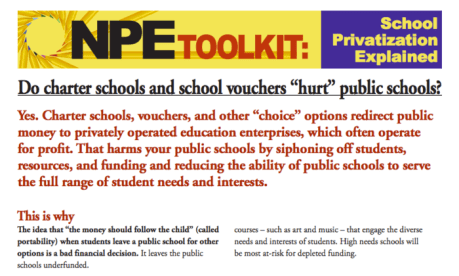
The Network for Public Education has created a toolkit to equip you to fight privatization of our public schools. In it, you will find concise summaries of important issues, with links to research, and ways that you can join with your colleagues , friends, and neighbors to block the Trump-DeVos agenda.
For the full report click here.
I am delighted to share with you that Helen Gym won the Emily’s List “Rising Star” contest.
Helen has fought for the children and public schools of Philadelphia, first as a parent leader, now as a member of the City Council.
Helen is smart, fearless, eloquent, and dedicated. She is a tireless fighter for justice and the common good.
This was part of the Emily’s List description of Helen:
“Helen is a progressive champion for the people of Philadelphia,” said Stephanie Schriock, president of EMILY’s List. “Her support for quality public education, immigrant rights, and sustainable investments in neighborhoods shows her deep commitment to improving the overall quality of life in her city. EMILY’s List is proud to recognize Helen’s dedication to public service as the EMILY’s List community nominates her for the Gabrielle Giffords Rising Star Award.”
Elected in 2015, Helen Gym became Philadelphia’s first Asian American woman elected to city council. She won her at-large seat after 20 years of grassroots organizing on behalf of Philadelphia’s public education system and immigrant communities. In her first year, she won historic investments toward universal pre-K and youth homelessness, and expanded resources for public schools. Helen is now leading the charge nationally around sanctuary cities and immigrant rights – and becoming a leading voice for cities resisting and winning with a progressive agenda.
Thanks to all who voted for this wonderful, courageous leader.
Congratulations, Helen!
I am adding Helen to the Honor Roll of this blog!
Mike Klonsky, Chicago activist, had a dream that was actually a nightmare.
It involved Arne Duncan running for mayor, Rahm running for president.
A nightmare.

 Diane Ravitch's blog