Archives for the month of: January, 2017

The Leadership Conference on Civil Rights issued a strong statement in opposition to the nomination of Betsy DeVos for Secretary of Education. While the so-called “reformers” like to claim that they are fighting for minority kids and civil rights, the actual civil rights organizations know that DeVos and Trump want to weaken and destroy public schools, which are open to all students. They also are aware that the origins of school choice were in the racial segregation movement of the 1950s, when the most racist governors and senators in the South rallied around the idea of school choice to protect the status quo.


The Leadership Conference issued this statement:


Dear Senator,


On behalf of The Leadership Conference on Civil and Human Rights, a coalition of more than 200 national organizations committed to promote and protect the civil and human rights of all persons in the United States, we are writing to express our strong opposition to the confirmation of Betsy DeVos to be the next U.S. Secretary of Education. All parents and students in this country – a majority of whom are of color or are low-income[i] – want the best education, support and dignity for their own children. We stand with them and cannot support a nominee who has demonstrated that she seeks to undermine bedrock American principles of equal opportunity, nondiscrimination and public education itself.


DeVos argues her opposition to public education serves students, especially students who are the most vulnerable.[ii] We reject the notion that children are well served by the dismantling of a public school system that serves 90 percent of all American students[iii] or by the elimination of civil rights protections that require the federal government to intervene when students are discriminated against.[iv]. The civil rights community has served as agitator and critic of schools and school systems that failed to meet the needs of students of color and low income students since long before Thurgood Marshall successfully argued the Brown v. Board of Education decision.


Opportunity and achievement gaps that demonstrate longstanding bias against students of color, English learners, Native Americans, girls, students with disabilities, low-income students and other marginalized students are indefensible and unacceptable and we have fought at the federal, state, local and classroom level to ensure every student the quality education to which they are entitled by law and birth. Rather than joining with us in support of accountability, oversight and intervention, DeVos instead argues for an unaccountable education system which serves only to exacerbate inequality of opportunity.[v]


While parent frustration with schools failing to meet their child’s need is real and parents have waited far too long for meaningful action by policymakers, the result of anti-public education agendas such as DeVos’ has often, as in Louisiana[vi], been worse outcomes for vulnerable students. The Michigan example, where DeVos’ impact on education policy and the proliferation of unregulated and for-profit charter schools is considerable, demonstrates clearly that this agenda does not result in the improved outcomes students, parents and communities deserve.[vii]


Equal access to education is a cornerstone of the civil rights movement. The Secretary of Education’s role as the enforcer of education and civil rights laws[viii] is central to advancing our shared vision of an inclusive and diverse system of high-quality public education that enables every student to live up to their potential. DeVos has demonstrated no previous commitment to ensuring equal educational opportunity in schools.


While she is entitled to her personal views as a private citizen, government officials are charged with enforcing our laws equally. DeVos’ connections to anti-LGBTQ organizations including those that promote dangerous and discredited ’conversion therapy,’[ix] groups that seek to limit a woman’s right to health care[x] and civil rights protections for survivors of violence,[xi] and her opposition to affirmative action policies[xii] demonstrate a lack of respect and appreciation for the diversity of our nation’s classrooms and fail to recognize a long and pernicious history of discrimination against groups of students. While we have heard little of DeVos’ record with regard to the rights and interests of English learners, immigrant students, students with disabilities and religious minorities, we are deeply troubled by the unacceptable rhetoric of the President-elect during his campaign and the absence of a record of DeVos’ support for these students.


When compared with Secretaries of Education through the history of the department, DeVos’ lack of experience stands out.[xiii] She has never been an educator or worked directly with children and families in public schools. She has never led a school, district or state agency tasked with educating students. She has never been a public school parent or a public school student. This lack of experience makes her uniquely unfamiliar with the challenges and opportunities facing the nation’s students, families, educators and schools.


The U.S. Department of Education is responsible for implementing and enforcing laws protecting students from discrimination on the basis of race, color, national origin, sex and disability and those laws that provide for educational opportunity from early childhood through graduate school. The person responsible for leading that department must absolutely be committed to respecting, valuing and protecting every single student in this country – without regard to LGBTQI status, family income, race, home language, gender, religion, disability or immigration status. Our nation’s laws, economy, future and children deserve no less.


Sincerely,


Wade Henderson
President & CEO


Nancy Zirkin
Executive Vice President


[i] See: http://www.southerneducation.org/Our-Strategies/Research-and-Publications/New-Majority-Diverse-Majority-Report-Series/A-New-Majority-2015-Update-Low-Income-Students-Now

[ii] See: http://www.federationforchildren.org/wp-content/uploads/2015/03/Betsy-SXSWedu-speech-final-remarks.pdf?e40fe9

[iii] See: https://nces.ed.gov/fastfacts/display.asp?id=372

[iv] See: http://c.ymcdn.com/sites/www.copaa.org/resource/resmgr/2016_Conference/COPAA_Voucher_paper_final_R6.pdf

[v] See: http://www.politico.com/story/2016/12/betsy-devos-michigan-school-experiment-232399

[vi] See: http://www.nber.org/papers/w21839

[vii] See: http://bridgemi.com/2016/12/betsy-devoss-michigan-legacy/

[viii] Department of Education Organization Act (Public Law 96-88)

[ix] See: http://www.politico.com/story/2016/11/betsy-devos-education-secretary-civil-rights-gay-transgender-students-231837

[x] See: https://rewire.news/article/2016/03/21/devos-family-promoting-christian-orthodoxy-political-donations/

[xi] See: https://www.insidehighered.com/news/2016/11/28/betsy-devos-trumps-choice-education-secretary-has-unclear-higher-ed-priorities

[xii] See: http://www.insidephilanthropy.com/home/2016/3/1/school-choice-but-much-more-making-sense-of-devos-family-phi.html

[xiii] See: http://blogs.edweek.org/edweek/campaign-k-12/2016/12/betsy_devos_would_be_first_ed_.html
Jon Schwartz writes for The Intercept.


In this post, he gives a list of (mostly) practical ways that we can organize to survive the next four years and beat back the white nationalism that Trump used to get elected.


Earlier I posted about the dramatic decline in the number of librarians in the Philadelphia public schools: only 8 librarians in 220 schools!


This librarian replied:


Thank you for bringing attention to this sad trend in education, Diane. School librarians in Indiana are also becoming extinct. Indiana school guidelines only require one licensed school librarian per district. This means in lean times the librarian is the first to get cut. As a result, many Indiana school districts only have one high school librarian.


While it is true that high school students do more research and definitely need a librarian, I could argue that librarians are almost MORE important in the lower grades. Elementary school librarians are crucial in helping to develop a love of reading in children through story times and activities. They have extensive training on selecting and maintaining a quality library collection and as licensed teachers, they educate both student and staff on the effective use of these collections. Studies indicate that younger students (and many older ones as well) need to cut back on screen time. Therefore, it is important that schools continue to have physical books available.


As students move into middle school and wish to use alternatives, they will know that they can turn to their librarian for instruction on how to find and use digital resources. Elementary and middle school librarians are crucial in teaching our children the information literacy skills they will need to become well-informed adults. They teach our youth how to responsibly use the power of the Internet and navigate the massive amount of information that’s on it. They are on the front lines when it comes to battling the current “fake news” epidemic. If anything, we need school librarians now more than ever!


The Center for American Progress has researched the many DeVos political action committees and discovered that they have given campaign cash to 10 of the 12 Republicans on the Senate Health,  Education, Labor and Pensions Committee. This is the Committee that will pass judgment on her fitness to be US Secretary of a Education.


“A number of media outlets and researchers have described the hundreds of millions of dollars the DeVos family has poured into right-wing causes for many years. A few have noted their pattern of giving to members of the Senate. But none have revealed a complete and up-to-date tally of her financial sway over the Senate that will consider her nomination.

 
“DeVos has taken this pay-for-play approach before. Just consider the impact she had in her home state of Michigan last year. As a reward for passing a no-accountability charter school law in the state, the DeVos family once gave state Republicans $1.45 million in a seven-week period. That’s about an average of $25,000 a day. “A filthy, moneyed kiss” is how the Detroit Free Press’ editorial page editor described the lobbying effort.”


The Senate hearings should be a love fest, with senators scrambling to praise her long experience as a friend of private and religious schools and lobbyist for vouchers.


Our reader Greg B offers the following history lesson:


Republicans should revise Cato’s admonition “Carthago delenda est” (Carthage must be destroyed) to “Obama delenda est” and make it their party’s motto. Two points, one aside, and one comment:
My family has been self-insured for the past 18 years and our annual premiums went down by more than $18,000 in the first year of the Affordable Care Act and we got better insurance. In my experience, its most virulent opponents know nothing about it. I’ve also found that some who get their insurance through the ACA don’t realize that it IS Obamacare. Yesterday I saw a post on the Crooks and Liars website listing some tweets confirming this including: “I’m not on Obamacare. My health insurance is through the ACA (Affordable Care Act), which was what they had to come up with after Obamacare crashed and burned as bad as it did. So I’m gonna be fine.”


(As an aside, I think the President’s decision to embrace the term “Obamacare”—I do not use this term at all—was a great strategic blunder. It unnecessarily personalized and politicized a seminal public policy issue. Consider, as David McCullough describes in his biography of Harry Truman, that Truman expressly wanted his idea to be called the Marshall Plan. He knew that attaching his name to it could be politically toxic and therefore convinced George Marshall, whose reputation among Republicans and Democrats alike was impeccable, to allow his name to be used for the policy. Or, think about who much more difficult, in the early days, it would have been to institutionalize Social Security had it been called Roosevelt Social Insurance.)
Secondly, I suspect, especially after Donald’s (we should no longer refer to him by his last name, it drives him crazy) “presser” yesterday when he said “repeal and replace” of the ACA would take place simultaneously, that his endgame strategy is one of rebranding, not reforming or changing. Just as he licenses his name to make most of his money, he will, I strongly believe, do all he can to do the same with public policy. Much has been written about the coming age of kleptocracy he will bring. The most valuable asset he can bequeath his children is his name with the added value of the cachet of the presidency. In order to increase its value, Donald will unconsciously (because I’m sure he has no idea who Cato or what Carthage was) follow Cato’s dictum with respect to the Obama legacy. Much like the Stalin-esque practice of scrubbing history of facts, his rewriting of history will focus on eliminating as many traces of anything that goes counter to his desired narrative and rewrite past history to inform the future.


When I was a government teacher in the 1980s, the Cold War guided foreign policy and our greatest fear was nuclear war with the Soviet Union, I spent time teaching about Stalin, using Orwell’s “Animal Farm” as a text to explain to students that the scrubbing of history and desecration of language of was just as great a threat as the Soviet bloc military threats posed. For the final exam, I used the opening page of Milan Kundera’s novel “The Book of Laughter and Forgetting” to ask the students to write an essay comparing the passage with what we had learned over the past semester. I share it here because I think it speaks to a central tenet of Trumpism, which, sadly has many echoes in the dark ages of Stalin:


“In February 1948, Communist leader Klement Gottwald stepped out on the balcony of a Baroque palace in Prague to address the hundreds and thousands of his fellow citizens packed into Old Town Square. It was a crucial moment in Czech history—a fateful moment of the kind that occurs once or twice in a millennium.


“Gottwald was flanked by his comrades, with Clementis standing next to him. There were snow flurries, it was cold, and Gottwald was bareheaded. The solicitous Clemintis took off his own fur cap and set it on Gottwald’s head.


“The Party propaganda section put out hundreds of thousands of copies of a photograph of that balcony with Gottwald, a fur cap on his head and comrades at his side, speaking to the nation. On that balcony the history of Communist Czechoslovakia was born. Every child knew the photograph from posters, schoolbooks, and museums.


“Four years later,” however, “Clementis was charged with treason and hanged. The propaganda section immediately airbrushed him out of history and, obviously, out of all the photographs as well. Ever since, Gottwald has stood on that balcony alone. Where Clementis once stood, there is only a bare palace wall. All that remains of Clementis is the cap on Gottwald’s head.”


It is chilling to think that a relic of history in 1948 is as relevant today, in 2017, as it was then. The fate of the Affordable Care Act is about more than health care.

Betsy DeVos is a huge reformer. She has used her gold to clear the way for hundreds of charters in Michigan, 80% of them for-profit, and she has opposed any regulation or supervision of them.


So, why, wonders Peter Greene, are some charter cheerleaders expressing doubts about the heiress as Secretary of Education?


For one thing, they worry that letting anyone open a charter school might tarnish the brand. But there is a deeper concern: they don’t want to compete with voucher schools. They are content to be the only sector sucking money out of public schools. Why encourage yet a third sector? With all their praise of competition, they would prefer to limit the field.

The conservative media has mobilized to defend Betsy DeVos against the emerging portrait of her as a voucher-loving, out-of-touch billionaire who wants to privatize public funding and replace public schools with charter schools and religious schools.


Mercedes Schneider describes some of the rehabilitation attempts. One of them appears in the current issue of EdNext, whose editors are affiliated with the conservative Hoover Institution (disclosure: I was once on the editorial board of EdNext).


Having a sharp eye, Schneider scrutinized the photograph of DeVos that accompanied the article. She made a discovery: DeVos is looking at carpet samples! This is a strange way to portray a woman who is trying to establish her credentials as an “educator” or a serious person who cares about issues. Carpet samples? Was she redecorating the drawing room?

Stuart Egan is a high school teacher in North Carolina. When he read Mitt Romney’s endorsement of Betsy DeVos, he was enraged. In this post, he reviews Romney’s ignorant, out-of-touch claims on behalf of DeVos. Detroit as a model? Charters in Michigan as a success story? DeVos as a successful businesswoman, when she was born to billionaires and married a billionaire?


Facts matter. History matters. Evidence matters. Not to Romney.


Mitt Romney’s Very Misguided Op-ed Endorsing Betsy DeVos

John Kuhn was the superintendent of the small Perrin-Whitt school district in Texas and was recently named superintendent of schools in Mineral Wells, Texas. He is also one of the best informed, most eloquent critics of corporate reform in the nation. He was a lead speaker at the 2011 Save Our Schools March on Washington, where he electrified the crowd. He has recently published two books: Fear and Learning in America and Test and Punish: How the Texas Education Model Gave America Accountability Without Equity. Kuhn says that the Texas A-F school grading system sets up schools that enroll poor kids to fail; A stands for “Affluent.”


Kuhn writes:


Texas Education Agency Releases A-F Grades for School Districts the Same Day It Dismisses Its Own A-F Grade on the National “Quality Counts” Report Card


On January 5, the Austin American-Statesman published the Texas Education Agency’s A-F grades for Texas school districts and campuses. The law establishing this system called for official A-F grades to come out in 2018, so these are “what if” grades, intended to provide to legislators a preview of what the “real” grading system will look like when grades come out officially. In a statement, TEA commissioner Mike Morath cautioned that no “inferences about official district or campus performance in the 2015– 16 school year should be drawn from these ratings.” That didn’t keep public school critics from immediately proclaiming that the A-F grades “transparently and comprehensively represent the performance of districts and campuses statewide.” No surprise there; A-F is seen by many as a tool designed specifically to give anti-public education forces ammunition to aim at the public school system.


In releasing the “work-in-progress” A-F grades to the public (as they were obligated to do), TEA officials ensured that these unofficial scores will become the de facto rating system for Texas schools for the remainder of the year, even though an actual rating system is already in place. This is despite commissioner Morath stating clearly and repeatedly that the grade report “is very much a work-in progress,” that the bases and assumptions behind the grades may change, and that the TEA didn’t take into account local community ratings of districts (statute requires that this local stakeholder input be included as 10% of schools’ final A-F grades). We now have a confusing situation in which the TEA homepage notes in a headline article that 94% of Texas school districts “Met Standard” while public school critics giddily point to another article on the same homepage announcing the release of A-F grades that often label formerly successful schools as sudden failures. In fact, several high-performing schools around the state received D’s and F’s. The Dallas Morning News listed 11 local school districts that received F’s but that were only recently considered as having “Met Standard.” “That’s amazing
when you consider that they all met the standard two weeks ago and the scores, the data, haven’t changed,” Mesquite Superintendent David Vroonland said.


School district officials have called the new A-F system “a big mistake,” “NOT an accurate reflection of quality education,” and “an unfair game,” and have noted that a similar A-F system was rescinded in Virginia after failing spectacularly, and that, since an A-F rollout in Oklahoma, student performance has declined significantly–despite the fact that A-F systems are sold to legislators as a means to improve student performance by holding districts accountable. It is difficult not to conclude that this system is for the most part arbitrary and capricious. In one respect it is very reliable, as it actually very consistently punishes those Texas schools that serve the most economically- and socially-challenged families and students. District A-F grades appear to align exceptionally closely with the percentage of economically-disadvantaged students on school district rosters, a factor that is obviously outside the ability of schools to affect.


As a means of assessing the impact of non-school factors on districts’ A-F grades, I sorted every school district in the state by the percentage of their student bodies made up of economically disadvantaged students, and then I listed their A-F grades out to the side. I took the ten districts with the lowest percentage of economically disadvantaged students that received grades in all four categories and compared them to the ten districts with the highest percentage of economically disadvantaged students. Here are the results:


The 10 Schools Serving the Lowest Proportions of Poor Kids in Texas

A – 20

B – 7

C – 9

D – 2

F – 2

Overall average – B

On the other hand:


The 10 Schools Serving the Greatest Proportions of Poor Kids in Texas:

A – 6

B – 8

C – 11

D – 6

F – 9

Overall average – D+


As you can see, there is a strong and verifiable correlation between districts’ A-F grades and the prevalence of poverty among their students. Meanwhile, there is no verifiable correlation between districts’ A-F grades and the quality of their teachers, which is supposed to be the purpose behind A-F grades even existing. They are supposed communicate to the public which schools are better, not which schools are poorer. We don’t need a measure that communicates which schools have the greatest concentrations of poor kids—we already have that measure (the economically disadvantaged numbers). The A-F system exists to differentiate good schools from bad, not poor schools from rich, and it can’t do it! Major fail.


That latter assertion—that A-F can tell us which schools are better and which schools are worse—was never really anything more than a blind assumption built on ideology and political posturing, rather than on science. This A-F system, despite what the anti-public education lobby will say, is not in the least transparent, not in the least fair, not in the least accurate, and does not serve the need of Texas parents and taxpayers to be informed about the quality of teachers and schools. In fact, if anything, it misinforms them. It amounts to fake news. These are fake grades, non-representative of what they purport to reflect. If your passing school in Texas is suddenly failing today, it’s probably because it educates the wrong kinds of kids: poor ones. The A-F system is carefully-crafted disinformation likely to adversely effect on public support for public education.


If I had time, I would do a similar bit of sorting of districts by residential home values, ratios of students served in special education, ratios of students with limited English, ratios of at-risk students, average teacher salary levels, and school finance revenue levels (because, in case you don’t know, Texas schools are funded at wildly different levels). I predict that each of those exercises would result in a strong correlation with these A-F grades (that, again, purportedly reflect teaching quality and supposedly do NOT merely reflect non-school factors outside the control of the educators being smeared by these grades). I challenge any statisticians worth their salt to examine this system in an independent review and let Texas education stakeholders know what these grades really show.


Commissioner Morath had to release these grades by law, so I don’t blame him for releasing it. However, he badly let down local teachers and administrators by over-promising transparency in the lead-up to A-F and under-delivering with its rollout. In a meeting of school leaders from the Dallas-Fort Worth area in December, Mr. Morath confidently assured school leaders that, out of a sense of fairness, since schools in Texas are funded so inequitably, he would ensure that anywhere the TEA published A-F ratings for schools, the Agency would also publish information related to each school’s relative funding level—so that users of the information would have the full picture, as it is unfair to expect schools with fewer resources to outperform schools that are funded more generously. Having promised that, however, Mr. Morath somehow failed to ensure that the information published by the Austin newspaper included the funding-levels context. As of this writing, I haven’t seen the promised relative funding levels information published anywhere by TEA. As many of us feared, the assurance that appropriate context would be included alongside the published results of the A-F accountability system appears to have been little more than a bait-and-switch. As with every school accountability system in the history of the state of Texas, this system purports to communicate to Texas parents that it represents a fair ranking of schools that are competing on an even playing field. In reality once again, by funding some schools at double and triple the level of others and keeping hush-hush about which schools are flush and which are kept on a shoestring budget, Texas is picking winners and losers and concealing the fact in school accountability system after school accountability system. This A-F system, like all the others, occludes more than it reveals.


In the end, A-F appears to exist primarily as a political tool, designed not to inform but to misinform parents and taxpayers across Texas. The A-F rating system has not been independently assessed for validity. No third party has done an in-depth analysis to establish whether A-F grades for schools tend to significantly correlate with factors outside of schools’ control, such as poverty levels of students, discrepant funding levels, and the like. Until it is established that the system accurately reflects educational quality more than it reflects social realities that schools operate within and cannot control, the system should be considered incapable of serving its stated purpose. No educational quality conclusions should be drawn absent this independent validation.


One last sidebar:


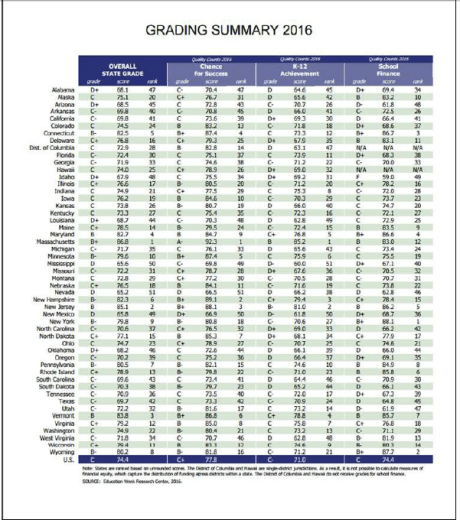
Ironically, on the same day that the TEA released grades for local campuses, it received its own A-F grade from Education Week’s “Quality Counts” report on the education systems in all 50 states and the District of Columbia. The Texas Education Agency received an overall grade of C- on the national report and wasn’t happy. TEA immediately dismissed the validity of the report, stating that it is “difficult to effectively evaluate the state’s performance from a national report where no state made the highest grade, no state made the lowest grade, and the majority of states were all lumped into the same grade category.”


On the chart below (from www.edweek.org/media/qualitycounts2016_release.pdf), you will see that on the “Quality Counts” ranking, Texas ranked 45th in the nation in school finance. In other words, Texas schools are low-funded compared to other states. However, on the achievement of students, Texas was ranked 24th. To this educator, that means Texas teachers are picking up the slack that lawmakers are leaving. Additionally, on a third measure called “Chance of Success”—which includes circumstances faced by students including family income, parent education, parent employment, steady employment, etc.—Texas ranked 42nd. So, despite long odds and little meaningful help from policymakers, Texas teachers are doing an outstanding job overcoming obstacles placed in front of them and helping our students to learn.

screen-shot-2017-01-08-at-9-45-25-am

Despite the systemic obstacles like inadequate school funding and insufficient outside-of-school supports available to Texas children, the TEA nonetheless released this grading report labeling 30% or so of Texas schools—as demanded by the bell curve they built the system on—as “D” and “F” schools. Perhaps most incredible of all is the fact that these grades are based almost exclusively on STAAR standardized test results, an exam fraught with problems, about which the Texas Lieutenant Governor Dan Patrick once said “we don’t trust this test.”


Despite misgivings about the quality and ability of the test to reflect student learning, and despite the TEA’s own tepid reaction to its A-F grade from Education Week, and despite the prior existence of a school accountability system proclaiming 94% of Texas schools to be satisfactory performers, and despite the fact that the A-F system reflects poverty better than it reflects teaching quality, ultimately, when it comes to A-F grades, the Texas Education Agency apparently believes it is better to give than to receive.


Note:  Spreadsheets with the Texas data can be found here and here.

Phil Cullen, an educator in Australia who writes a blog called Treehorn Express, wrote the following about “Kleinism” in Australia.


http://treehornexpress.wordpress.com

 
KLEINISM IN AUSTRALIA. WILL IT GO AWAY?


A REVIEW

 
The summer holidays are over ‘down under’, and Australia will commence the new school year under the most peculiar circumstances. We’d like to start a new year of school learning with high levels of confidence in our pupils’ abilities to do as well as they can and with our own usual high level of teacher zest for teaching young people how to go about it. In the long run, we’d like to see Australia at the top of the pole for schooling excellence and our country amongst the leaders of commercial enterprise because of our business expertise in fundamentals and our ability to solve problems, innovate productively and enjoy challenges. Sadly, these fundamental characteristics of a successful schooling system have to be held on hold for some years; replaced by a testing regime invented by a New York curriculum incompetent, teacher-hater, ex-lawyer; once in charge of a school district there.

 
We aren’t allowed to start the school year down under with high hopes and positive attitudes. We are obliged to maintain the ridiculous; to start as early as possible with heavy preparation and intense practice for our annual standardized blanket testing program called NAPLAN, held each May. Its clone is called NCLB in the US. As educators at the chalk-face, we have no option, no choice, no say. Our system is controlled by testucators, disciples of Kleinism….a fear based system of schooling that was imported in 2008 by Julia Gillard, later our Prime Minister; then federal minister for education. It was one of the biggest mistakes a government representative ever made.

 
Following the 2007 federal elections, she was charged by her senior colleague Kevin Rudd, new to the job as PM, to reform the Australian education system almost immediately, because his fellow neo-cons were telling him that teachers were making a mess of it and that most Australian children couldn’t spell or calculate. He used serious threatening language in his instructions to the teaching force and to her, to find something better than what we had. The Business Council of Australia and the ‘Four Pillars of Australian Banking’, both organisations of neo-liberal persuasion, roundly approved, despite both politicians being known within their temples of wisdom, as ‘lefties’. It was a peculiar liaison….and became a weird time in our history. Dutifully, she booked her flight to find a place somewhere in the world that had a reputation. Actually, Australia had a reputation itself for being amongst the world’s best at the time, but anti-school fanatics were the preferred mouthpieces of the local press – especially the Murdoch press. No. She didn’t select Finland, South Korea or nearby New Zealand whose schooling achievements were beyond the ordinary. Her first stop was New York. As macabre as the scenario appears, on her first day, she visited Rupert Murdoch, a requirement of all Australian leaders when they travel overseas….. to get their riding instructions. He arranged for her to attend a cocktail party being organized by the Rockefeller Foundation where she was introduced to Joel Klein, a fellow lawyer who, as strange as it seemed to Australians, was in executive charge of a large school district in New York. His system had a reputation. Indeed. It had a really big reputation – not for learning or teaching or anything to do with the realities of schooling, but for threatening learners and teachers and principals and schools to do as they were told and, if they didn’t measure up to his requirements, they were out of a job or the school was closed. He sweet-talked our Julia into the effectiveness of this sort of approach to school leadership and,…..within minutes…..Australia had a new system.
She didn’t request a study of the effects of high stakes testing on schooling, nor check the credentials of the New York operators. She was conned, big time. Rupert and Joel Klein rubbed their hands with glee, because they were in the publishing, programming business, worth billions.

 
Not long later, Klein openly boasted to the world that his test-based scheme was well established in Australia. He was correct. Although it is based on fear and deceit and child abuse, Australia still has it. The big boys, of the kind that were at the cocktail party, will not allow our government to have any other kind. Their colleagues in the BCA and banking fraternity keep vigilant. That’s clear. Julia felt that she had found the ultimate touchstone of school control, and was able to persuade the Australian banking community to pay the cost of a visit by her ‘pin-up boy’, as she called co-lawyer Klein, to speak to them in their own fortresses in Sydney, Melbourne and Canberra. Despite some ethical uncertainties which she later modified by capturing the ‘approval’ of the principals of all Australian schools with a very swift, cunning and deceitful maneuver. They had to carry the can for professional ethics, once they pronounced their approval of kleinist naplan. Indeed, they dutifully suspended their professional ethics and still do….adopting an attitude that disappoints proud principals of the present and past wondering how this happened to organisations that were once stalwart and proud of their protection of children’s rights. Federal and state education bodies, once citadels of wholesome schooling, succumbed to the use of fear and the abuse of mental health of children for whom they are supposed to be responsible…..and….as Aussies say: “She was in with Flynn”. No blood on her hands.

 
She established a special unit called the Australian Curriculum Assessment and Reporting Authority a sort of third level of government power, a sort of bundestag that now completely controls schooling; and she made sure that it was staffed with expert measurers whose experience in schooling and teaching and learning was severely limited. This incongruous mis-match between knowledge of testing and knowledge of learning between people running the show, has had profound consequences. After all, whoever controls the schooling system, controls the country’s future. The outcomes of constructing testing devices that contain inbuilt pupil dislike and distaste for particular school subjects and for school itself …and doing so in a most rigid manner….has had effects that run counter to the faith that she and ‘pin-up’ Klein had in improvement of PISA and NAPLAN raw scores. They flopped, failed, flunked all neo-con expectations as schools are doing in countries that are overdoing the fear base; and, it must be noted, run counter to the expectations of parents for schoolies to do the right thing. Despites their attitude to childhood, they’d like their kids to do well. Australia, after eight years of kleinism is heading downhill fast.

 
The last few years in the US and in Australia have clearly demonstrated that no schooling system can progress while its most outstanding features at the chalk-face, each capable of gynormous damage, include


Fear of failing


Deceit


Abuse of mental health.
all deliberately imposed by forces beyond the classroom. Office-based testucators of known kleinish measurement calibre have no idea of what happens in the classroom. They just mass-produce tests, send them to schools, gather the data, pat themselves on the back, blame teachers when things don’t go so well.

 
But, hold! Now, a breath of fresh air. A hopeful start has been made in the US education circles, our major mentors, in December 2016, by reducing the ponderous effects of centralised control. Releasing states from their fearful obligations is a small step, but it is a step in the right direction. Maybe, one day, control of the learning act will seep down through the numerous know-it-all hierarchies to the real learning centres in all countries where the teaching/learning experts reside, now being wrecked by the corrupting influences of kleinism – fear, deceit and abuse.
Down under, we’re notoriously slow to examine the effects of imports from up over. The big boys there and here do not like it, when educators reveal the truth….that the problem lies within the testing itself. We can’t expect any improvement to learning in our schools in 2017. Both places have a devil-may-care attitude towards children and their schooling; and basic timidity prevents us from sticking up for kids.

 
___________________________________________________