Archives for the year of: 2013

This post was written by Ohio teacher Brian Page @FinEdChat


The curriculum ladder


As teachers, we are all feeling the squeeze of tough economic times. States have cut education funding for a number of reasons. We are taking the cuts personally because we live a profession that strikes at the core of our values. Every child deserves a fair shot, regardless of the zip code where they were born. Our system should serve as the ladder to provide every child in the country a tool to climb to whatever heights they aspire to reach. Yet we continue to cut away one step after another.


Developing across the country are programs and legislation that prioritize cost-cutting measures rather than put kids first. The world’s most respected educational minds stress the importance of art, music, foreign languages, and gifted instruction opportunities, especially in the elementary grades. Yet these subjects are experiencing deep cuts in all grades, and in some cases disappearing all together. So while we are fighting just to keep every step in the ladder, we are losing sight of the additional steps we need to add to keep pace with the adult demands of modern society. Mastering financial literacy is a necessary step out of poverty for some and into adulthood for everyone.


Did you know…


• We are asking our children to make one of the biggest debt choices of their lives while still in high school, student debt. Student debt has now surpassed credit card debt – – it is $1 trillion. Yet in 46 states kids are unlikely to be introduced to resources like this one and this one to help them make an informed college choice.


• Lots of high school students have jobs and pay taxes, but they don’t know how to fill out basic tax forms or file for themselves. It is time we begin integrating resources like this one so they understand their taxes.


• According to this research, the biggest mistake low-moderate income (LMI) Americans make is they do not have any emergency savings. They do not use any basic banking services such as a direct deposit or a saving account. It baffles me that we do not teach our kids the importance of savings, or the power of compound interest using resources like this one.


• Many high school students are purchasing cars on their own, without any direction or understanding of the total financial obligation. We owe it to them to provide resources like this so they can make informed choices.


• Of those who carry a balance on their credit card from one billing cycle to the next, the average credit debt is $15,418. When our high school students turn 18, they are eligible for a credit card (with a co-signer), and if used wisely, it can be a great tool for them to build their credit score. If used inappropriately, it can ruin their lives. It is time we start to teach kids to understand credit card solicitations and their credit bills using resources like this one.


• A lot of our high school students have trouble figuring out what career field would be a good fit for them. Resources like this one are very helpful, and we owe it to them to expose them to this information.


Each resource makes up the framework for an important step in the education ladder missing in 46 states. Yet the research is clear that there is a direct link between inequality and financial literacy. Equally as clear is a message from our parents. A resounding 93% of parents wish to see financial literacy courses taught in high school.


I want our children first introduced to complicated financial concepts and contracts by teachers who love them and who are trying to help them, not by someone trying to trick them. Relying on the school of hard knocks should not be an option anymore. It is time a step is added in the ladder to empower future generations to make wise and informed financial choices. Personal Finance should be integrated into every child’s K-12 educational experience, and a course in Personal Finance should be a semester-long high school graduation requirement.
This is a personal message from actor Matt Damon and early childhood educator Nancy Carlsson-Paige, addressed to the teachers of Garfield High:

We are writing to support all of the teachers at Garfield High School.  We admire your strong and unified stand against the district mandated standardized test. Teachers, students, and parents do not have to accept practices that are harmful to them and to the whole meaning and purpose of education. We know it takes courage to risk your jobs in order to stand for what you know is right.  But your example holds the promise of inspiring teachers in school districts all over the country to take similar action.  Thank you for your strength and courage.  We admire you and are behind you all the way.

Hey, Garfield teachers, Matt and Nancy think you are great!


Nancy Carlsson-Paige and Matt Damon

Members of the Philadelphia Student Union performed a Zombie flash dance in front of school district headquarters to protest school closings. The district leadership insists it needs to save money by closing schools. The students don’t believe it.

The students are right.

The district will open privately managed charters to replace the closed public schools.

John Merrow is still trying to get to the bottom of the DC cheating scandal.

During his investigation, he discovered that Michelle Rhee hired a data coach who lives in California to advise her at $85 an hour or $1500 a day when he visited DC. This data expert reported to Rhee’s assessment director.

Merrow heard from confidential sources that the data expert had written a four-page memo expressing his concerns about possible cheating. Merrow spent months trying to track down the memo. He knows that it exists but no one will let him see it. Rhee’s former assessment director won’t answer Merrow’s many calls.

What is in the memo? No one will say and Merrow can’t get his hands on it. But he makes the reasonable assumption that if the memo said “don’t worry, all is well,” the memo would be promptly released. It seems reasonable that someone has something to hide.

Note that Rhee is represented in this matter by a prominent criminal attorney in Washington, D.C.

Why?

Here is the latest from Mississippi, which is considering charter legislation.

Running through the comments of advocates for charters is the claim that charters will improve achievement for the lowest performing students.

They need to know three things:

1. There is no evidence that charter schools know how to improve student achievement.

2. If the governor and the legislature truly believe that deregulation improves achievement, why not deregulate all the schools?

3. When they create a charter system to compete with public schools, they risk creating a dual school system. Researchers consistently find that charters are more segregated than district schools. Is Mississippi okay with restoring another dual school system?

The St. Louis Post-Dispatch tore apart Rhee’s shoddy report card, recognizing tat it is nothing more than an effort to foist her personal political preferences on the nation’s schools.

Unfortunately the newspaper admires some of her bad ideas–like evaluating teachers by test scores–and is unaware that her IMPACT program in DC hasn’t made a difference. And it accepts her mistaken notion that teachers are the problem, not poverty, not inequitable resource, not overcrowded classes, not bad policies like the ones she is pushing.

The good news is that her act is wearing thin, even with a paper that is inclined to agree with her.

They write: “…issuing arbitrary report cards followed by back-slapping news releases from politicians who have — or will shortly — receive campaign donations is a cynical way to go about standing up for children.”

In the Frontline documentary, John Merrow confronted Michelle Rhee with statistics from certain schools showing dramatic increases in test scores followed by equally dramatic declines. And they had this exchange:

JOHN MERROW: What’s your reaction to those numbers? That the gains are phony.

MICHELLE RHEE

Yeah. I mean, I—again, I—I feel like when you look at a situation like that does it call things into question? Absolutely. And should those things be investigated? A hundred percent. No—there’s no doubt about it. // But I can point to, you know, dozens and dozens of schools where, you know, they saw very steady gains over the course of the—the years that we were there, or even saw some dramatic gains that were maintained. So I think, in isolated places—could something have happened? Maybe.

Retired D.C. teacher and blogger extraordinaire G.F. Brandenburg has started an investigation of the “dozens and dozens of schools” that allegedly saw “steady” or “even some dramatic gains” when Rhee was chancellor.

He will continue his search for the “dozens and dozens” of schools in future posts.

See how great it is to be a math teacher?

Here on this blog we have math teacher Gary Rubinstein correcting the mistakes of the Gates Foundation’s $50 million MET project and now math teacher Brandenburg fact-checking the most divisive figure in American education today.

A teacher in New Orleans sent this letter to me. My promise to him or her: we will all use whatever tools are at our command to stop the destruction of public education and the exploitation of students to benefit corporate interests. We will not give up.

I wanted to bring to your attention the trailer for the upcoming Oprah network series about John McDonogh high school here in New Orleans.

http://www.oprah.com/common/omplayer_embed.html?article_id=41375.

It is a vicious misrepresentation of what is going on at the school- merely propaganda for the brand new charter management organization that makes our students out to be thug primitives who need taming by clean cut out of towners.

Last night, a meeting was held by a coalition of concerned citizens and organizations to discuss the stripping away of the public from our public schools and some important action steps to re-frame the narrative of New Orleans schools. Parents mentioned this very video and will be protesting a screening at the school tonight.

Meanwhile, this series plans to do exactly what the corporate reformers here have been doing all along and what those folks last night are contending with- an extreme narrative that is completely out of touch with the truth, and has troubling privatization and profit motives.

In the wake of these reforms, our schools have shut out holistic learning, critical pedagogies, whole child concerns, etc. and have become militaristic nightmares- the opposite of the safe spaces schools should provide, especially for students in the impoverished situations many of the students depicted in this program come from.

Our students feel the walls closing in on them as young white teachers (I am one of them) stand in front of their classroom telling them all they need to do to get to college is work harder so the students can be successful just like them! To put them on camera in that experience is the grossest form of exploitation I can think of.

The propaganda this show is prepared to deliver across the country is both predictable and terrifying. Narratives are powerful and the allies of privatization are winning.

We need to start an information campaign to discredit this work, as happened with “Won’t Back Down.” Your voice in that movement is of course key, and I look forward to your input and feedback.

Sincerely,

A concerned young educator in New Orleans

Abby Rappaport is one of our best education journalists, and she is mostly covering Texas politics these days.

In this article, she explains the escalating revolt against testing in Texas, where it all started.

The bottom line: Texas has been obsessed with testing for the past two decades, and people are just plain sick of it. The last legislature cut $5.4 billion from the schools’ budget, but managed to find $500 million for Pearson. Abby estimates that in the next few years, Pearson will collect over $1 billion from Texas taxpayers.

That’s a lot of money by anyone’s reckoning.

The school boards are sick of it. More than 80% have passed resolutions against high-stakes testing.

Parents are sick of it. Legislatures are getting complaints in the grocery store and wherever they run into parents in their district.

Happily, Texas Republicans are sick of all the testing. Many come from small towns and rural areas and their constituents are button-holing them. They don’t want to tear up their local public school and close it down because of test scores.

Last September 30, I spoke to a joint meeting of the Texas Association of School Administrators and the Texas School Boards Association. I got a wonderful, wild, Texas-size reception. They don’t like what’s going on. They talk to their legislators. Nobody had a good word for the reign of Pearson.

So, please, all eyes on Texas. Let’s all cheer for the testing revolt that’s growing there by the hour.


Jeannie Kaplan is an elected member of the Denver Board of Education. She has been critical of corporate-style reform and of the heavily-funded effort to persuade the public that it is successful. When she heard that Jonah Edelman of Stand for Children told an audience in Tulsa recently that Denver was a national model of success, she decided to review the score card for the district. (Stand for Children boasts of its civil rights credentials but supported a slate of Republican candidates for the state legislature in 2012, as part of its campaign for corporate reform).

Kaplan wrote for this blog:

So Much Reform. So Little Success

Denver, Colorado is a poster child for much of what reformers like to see: standardized testing, teacher accountability, charter schools, choice, co-location, and oh, did I mention testing? Denver Public Schools is trying or has tried almost all of them. Why, even Jonah Edelman, founder of one of the most well-funded, prominent reform organizations, Stand for Children, just today, January 10, 2013, pointed to Denver as a leader in reform because of its “portfolio” of school choice led by its charter schools. So, how is reform really working in Denver?

Let’s start by focusing on achievement, meaning test scores, since that is the focus of all things reform. (This post will have a lot of data since reform and data go hand in hand these days, especially data that can be spun). Denver Public Schools have been rated by the Colorado Department of Education as “Accredited with Priority Improvement Plan,” for the last three years. Out of five grades this is the second to the bottom. To be fair, DPS is inching toward the next category, “Accredited with Improvement plan.” The cut point is 52% of eligible points; Denver is at 51.7%. I am not sure how meaningful this data point is, since the GROWTH points count for 35 points out of 100 and ACADEMIC ACHIEVEMENT, meaning proficiency, counts for only 15.

Colorado now places enormous emphasis on “the growth model.” While no one would contest you need to have growth to get to proficiency, I believe this model masks what is really happening, and so the data I am citing is all about proficiency. To further emphasize how growth can mask proficiency, allow me to quote from one of Denver’s most ardent reformers, Alexander Ooms, who said on in a commentary on EdNewsColorado:

“Denver can celebrate academic growth for years to come without making much progress in the exit-level proficiency of students. And that is simply not the right direction. Growth is means, not end.”http://www.ednewscolorado.org/2012/05/23/38581-commentary-our-unhealthy-obsession-with-growth to read his entire commentary.

I could not have said it better. The data I cite are proficiency numbers, not growth numbers.

In 2005, when reform was in its infancy, Denver Public Schools hired its first non-educator superintendent: Michael Bennet, former businessman/lawyer, former mayoral chief of staff . Mr. Bennet’s childhood friend and fellow businessman, Tom Boasberg, was hired to replace him when Bennett became a Senator. Denver has been experimenting with reform since then. Oh, and BTW, Jonah Edelman grew up as Tom Boasberg’s neighbor in Washingon, D.C.

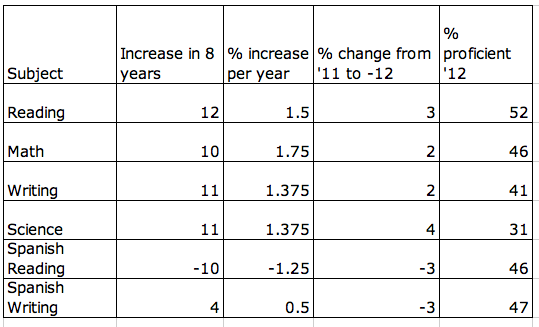
After 8 years, what academic changes has reform produced?

The following data is from 2005 through 2012, according to Colorado standardized tests. Here is the website for a deeper delve into the data

http://www.schoolview.org/performance.asp

ACHIEVEMENT:

Screen shot 2013-01-12 at 4.32.48 PM
We can’t leave achievement without looking at the State of the Union shout-out school, Bruce Randolph. Bruce Randolph Middle School in 3 years of state tracked data shows a gain of 2% in reading to 28%, stayed at 19% in math, increased by 3% in writing to 17%, and increased 7% in science to 17%. It is tied for last in proficiency – 52nd – for all of Denver’s middle schools.

Bruce Randolph High School has declined 10% to 33% in reading, declined 3% in math to 10%, declined 2% in writing to 14% increased 1% to 12% in science. Bruce Randolph is 24th out of 27 high schools in academic achievement.

ACHIEVEMENT GAP increases based on 7 years of CSAPs/TCAPs

Elementary School

Reading 4.17
Writing 5.78
Math 6.46

Middle School

Reading 3.23
Writing 4.71
Math 6.72

High School

Reading 3.01
Writing 5.82
Math 6.30

According to DPS data, the gap between FRL and paid-lunch students has widened by 9% since 2005. In 2005, percent proficient for FRL was 29%, paid was 58%. In 2012 the numbers were 41% for FRL, 79% for paid. The gap has grown to 38%.

ACT RESULTS: (A composite score of 21 is generally accepted as a college readiness benchmark)

From a DPS presentation of September 2012​

2005 17
2012. ​17.6

GRADUATION for 2011 – we are still waiting state numbers for 2012 but the number of students graduating increased from 2,642 in 2005 to 3,414 in 2012, for a total of 772 more graduates in 8 years…or an average of 96.5 more graduates each year.

Here is how Denver Public Schools compares with the state:

State​​ 73.9%
Denver ​ 56.1%

REMEDIATION (from Fall of 2010)

From the Fall of 2007, when this data was first available to the Fall of 2010 (the latest data available, remediation numbers have increased from 57.1% to 59.7%. The state of Colorado is at 31.8%.

This is the achievement for 8 years of reform.

Need I say more?