Archives for the month of: February, 2013

This essay by Leon Wieseltier appeared in a recent issue of “The New Republic”:

WHEN I LOOK BACK at my education, I am struck not by how much I learned but by how much I was taught. I am the progeny of teachers; I swoon over teachers. Even what I learned on my own I owed to them, because they guided me in my sense of what is significant. The only form of knowledge that can be adequately acquired without the help of a teacher, and without the humility of a student, is information, which is the lowest form of knowledge. (And in these nightmarishly data-glutted days, the winnowing of information may also require the masterly hand of someone who knows more and better.)

Yet the prestige of teachers in America keeps sinking. In the debate about the reform of the public schools, the virulent denigration of teachers is regarded as advanced opinion. The new interest in homeschooling—the demented idea that children can be competently taught by people whose only qualifications for teaching them are love and a desire to keep them from the world—constitutes another insult to the great profession of pedagogy.

And now there is the fashion in “unschooling,” which I take from a forthcoming book by Dale J. Stephens, the gloating founder of UnCollege. His deeply unfortunate book is called Hacking Your Education: Ditch the Lectures, Save Tens of Thousands, and Learn More Than Your Peers Ever Will. It is a call for young people to reject college and become “self-directed learners.” One wonders about the preparedness of this untutored “self” for this unknown “direction.” Such pristinity! Rousseau with a MacBook!

Yet the “hackademic,” as Stephens calls his ideal, is a new sort of drop-out. His head is not in the clouds. His head is in the cloud. Instead of spending money on college, he is making money on apps. In place of an education, he has entrepreneurship. This preference often comes with the assurance that entrepreneurship is itself an education. “Here in Silicon Valley, it’s almost a badge of honor [to have dropped out],” a boy genius who left Princeton and started Undrip (beats me) told The New York Times. After all, Jobs, Gates, Zuckerberg, and Dell dropped out—as if their lack of a college education was the cause of their creativity, and as if there will ever be a generation, or a nation, of Jobses, Gateses, Zuckerbergs, and Dells. Stephens’s book, and the larger Web-inebriated movement to abandon study for wealth, is another document of the unreality of Silicon Valley, of its snobbery (tell the aspiring kids in Oakland to give up on college!), of its confusion of itself with the universe.

To be sure, all learning cannot be renounced in the search for success. Technological innovation demands scientific and engineering knowledge, even if it begins in intuition: the technical must follow the visionary. So the movement against college is not a campaign against all study. It is a campaign against allegedly useless study—the latest eruption of the utilitarian temper in the American view of life. And what study is allegedly useless? The study of the humanities, of course.

THE MOST EGREGIOUS of the many errors in this repudiation of college is its economicist approach to the understanding of education. We have been here before. Not long ago Rick Santorum, if you’ll pardon the expression, delivered himself of this tirade: “I was so outraged by the president of the United States for standing up and saying every child in America should go to college. … Who are you to say that every child in America go? I, you know, there is—I have seven kids. Maybe they’ll all go to college. But if one of my kids wants to go and be an auto-mechanic, good for him. That’s a good paying job.” He was responding wildly to Barack Obama’s proposal that “every American … commit to at least one year of higher education or career training. This can be community college or a four-year school; vocational training or an apprenticeship.” Obama was not forcing Flaubert down a single blue-collared throat.

Indeed, Obama and Santorum were regarding education from the same stunted standpoint: the cash nexus, or the problem of American “competitiveness.”

A few months later, the Council on Foreign Relations published another instrumentalist analysis, equally uncomprehending about the horizons of the classroom, called “U.S. Education Reform and National Security,” which proposed, among other things, that the liberal arts curriculum be revised to give priority to “strategic” languages and “informational” texts. As Robert Alter acerbically remarked, in a devastating issue of the Forum of the Association of Literary Scholars, Critics, and Writers, this is “Gradgrinding American education”: “there is no place whatever in this purview for Greek and Latin, because you can’t cut a deal with a multinational in the language of Homer or Virgil.”

THE PRESIDENT IS RIGHT that we should “out-educate” other countries, but he is wrong that we should do so only, or mainly, to “out-compete.” Surely the primary objectives of education are the formation of the self and the formation of the citizen.

A political order based on the expression of opinion imposes an intellectual obligation upon the individual, who cannot acquit himself of his democratic duty without an ability to reason, a familiarity with argument, a historical memory. An ignorant citizen is a traitor to an open society.

The demagoguery of the media, which is covertly structural when it is not overtly ideological, demands a countervailing force of knowledgeable reflection. (There are certainly too many unemployed young people in America, but not because they have read too many books.) And the schooling of inwardness matters even more in the lives of parents and children, husbands and wives, friends and lovers, where meanings are often ambiguous and interpretations determine fates.

The equation of virtue with wealth, of enlightenment with success, is no less repulsive in a t-shirt than in a suit. How much about human existence can be inferred from a start-up? Shakespeare or Undrip: I should have thought that the choice was easy.

Entrepreneurship is not a full human education, and living is never just succeeding, and the humanities are always pertinent. In pain or in sorrow, who needs a quant? There are enormities of experience, horrors, crimes, disasters, tragedies, which revive the appetite for wisdom, and for the old sources, however imprecise, of wisdom—a massacre of schoolchildren, for example.


Robin Alexander writes here about the collateral damage inflicted by the testing-and-accountability regime in the U.K.

His analysis will be familiar to American readers. As we all seek to be “world class” and to compete with one another, our governments are imposing a dreary conformity on every school and draining them of the spontaneity and joy that is the life blood of teaching and learning.

Philadelphia’s Broad-trained Superintendent William Hite offered the district’s employees an insulting contract: pay cuts up to 13%, benefit cuts, longer school days, and no pay increases until 2017. After 2017, any increases would be “performance-based,” dependent on the principal’s recommendation. Seniority would be abolished, as well as any payment for advanced degrees. See here and here

In addition, schools with more than 1,000 students would not be required to have libraries or librarians. No more counselors. No limits on class size. The district would no longer be required to provide teachers lounges, water fountains, etc.

This is the most insulting, most demeaning contract ever offered in any school district to my knowledge. The terms seem more appropriate to a prison than to a school, although it seems that both teachers and students are treated as wards of a cruel, harsh state. Who would want to teach in such a district that cared so little for students and teachers?

Is this what Dr. Hite learned at the Broad Superintendents Academy? Crush the workforce?

Didn’t anyone ever tell him that teachers’ working conditions are students’ learning conditions?

Leaders of the Philadelphia Federation of Teachers said his members would never accept such demeaning terms and predicted many would leave for districts where they were treated with dignity.

District officials defended their proposal:

“Deputy Superintendent Paul Kihn said he could not comment on ongoing labor talks, but said that the school system “actually values teachers as the most important resource in our district. We are committed to providing teachers with a set of working conditions…that will actually in the long run make Philadelphia a place that people will want to come and work.”

“Under the district’s opening proposal, issued Friday, the PFT’s 15,000 members — 10,000 teachers, plus nurses, counselors, secretaries, aides and others — would take pay cuts ranging from 5 percent for those who make under $25,000 to 13 percent for those who make over $55,000.”

Who will want to teach in a district that offers less pay, fewer befits, longer hours, no libraries, no counselors, no place to sit and rest between classes?

There was no discussion of reducing the pay of the superintendent, William Hite, who is paid $300,000 yearly and is surrounded by a coterie of six-figure assistants, including Deputy Superintendent Kihn ($210,000),

On another topic, Superintendent Hite plans to close 29 schools. A new study shows that the receiving schools perform no better than the closing schools. The closings do nothing to improve education for the students. Are they intended to save money or to make room for more charters (even though many of the charters in Philadelphia are low-performing or are under investigation for financial irregularities)?

With this contract and the proposed closings, the School Reform Commission and Superintendent make clear that their goal is to end public education in Philadelphia.

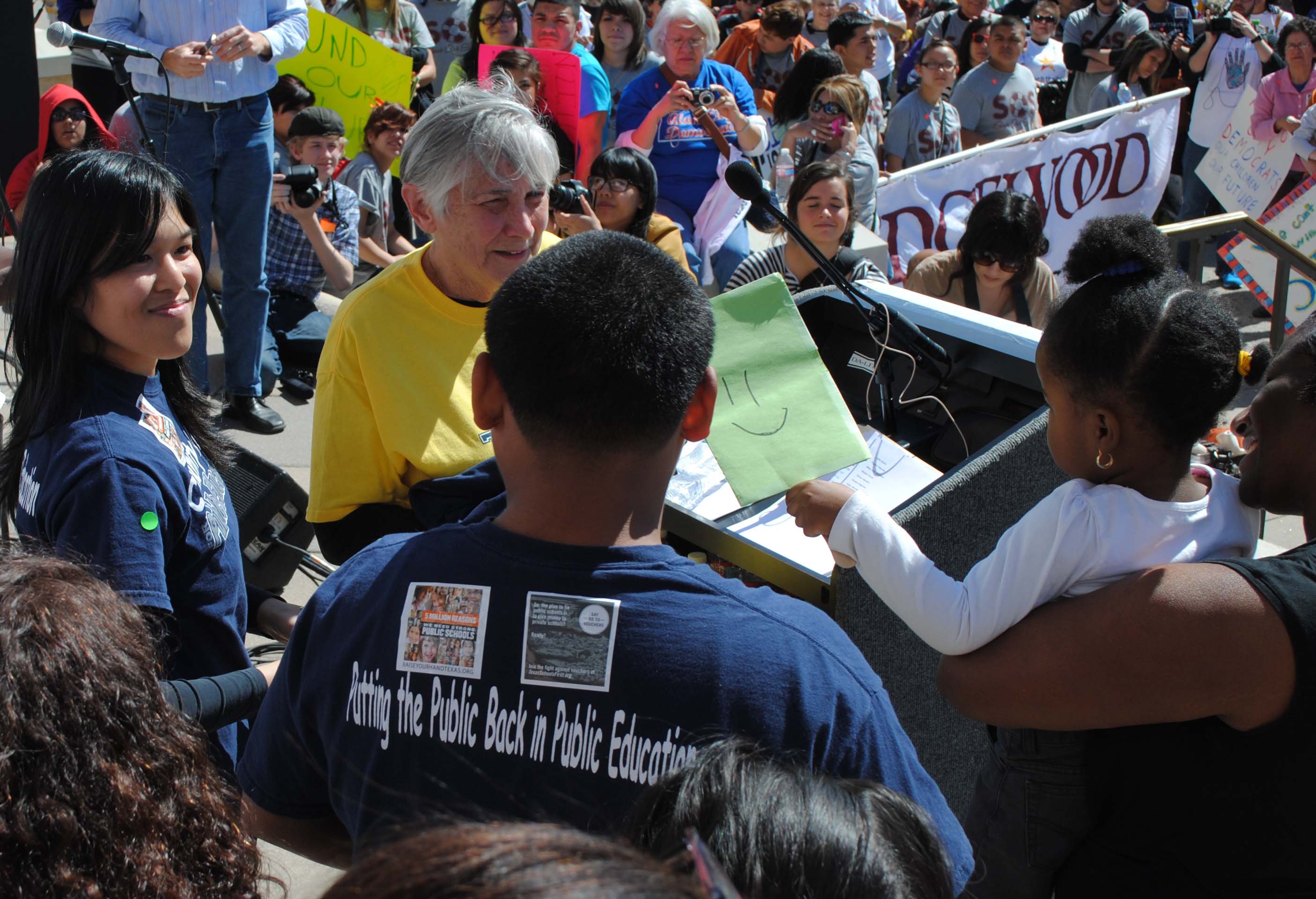
these photos were taken by retired Texas teacher Steve Coyle.

download5

download6

download7

download8

In this terrific article, you can see the beginnings of a popular uprising against the testing obsession and the rush to put public dollars into private hands.

In Texas, Republicans are paying attention, even threatening to pull the plug on testing. Rural Republicans seem set to ally with Democrats to stop the voucher movement and protect their community public schools.

Will the national Democratic Party pay attention to its base? It’s base is working people, not Wall Street. Educators, not the 1%.

As readers know, I often post comments that I find interesting. Sometimes I agree with them, sometimes I disagree, sometimes they raise questions that are sure to provoke discussion, which is healthy. I like this comment. One of the reasons I like it is that the writer recognizes that American education is not in crisis, that the overwhelming majority of public schools are successful, and that we must be temperate in grabbing at quick fixes or sweeping changes.

The reader writes:

Well, I must admit I did not read all the posts [about the Common Core]. I lost interest when I felt the conversation was becoming a list of advocates for their favorite methodology. To go back to Doctor Ravitch’s initial post, I see the issue as implementing an untested curriculum across many different environments with many different needs and various levels of teacher skills. Experience and research tell me that there is no single, best practice for education. Districts, schools, teachers, and most importantly children are each unique. What works in Ann Arbor, Michigan may not be successful 50 miles away in Detroit. Add to this the lack of fidelity when implementing initiatives and you must question anyone’s hope for a “program” or a “curriculum” that will “fix” public education.

I can not even agree that public education needs to be “fixed”. We have significant issues addressing the needs of large subgroups, but I still have faith that the majority of our children today are receiving a quality education. Millions of children are doing amazing things in our public schools. Thousands of educators are working effectively and in many cases heroically. However, we still have far too many children not being given the instruction and support they need. For these children the Common Core may not be the answer and in fact may be an additional barrier to their success. For these children Montessori classrooms may not be enough. For these children additional testing has definitely not led to improvement.

I do not know the answer for all the challenges facing education, but I believe it rests somewhere withing the affective domain. I think we need to focus less on finger-pointing and more support. Teachers and students must have HOPE. They must believe that what they do is important, valued work. We need to stop allowing public school educators to be convenient whipping boys for any politician looking for a platform or business looking to sell a commodity or service.

Education remains our best hope for the future not in the collection and recitation of facts. The future of our world depends on an education that instills hope, a sense of purpose, a willingness to take risks, the belief that one’s efforts and perseverance lead to success.

Corporate reformers are taking no chances.

They have raised more than $3 million to make sure that they control the Los Angeles school board.

The school board president Monica Garcia will have $1 million, more or less, to fight off education activist Robert Skeels, who has raised $20,000, more or less.

Inexperienced Kate Anderson, the corporate favorite, will have $1 million, more or less, to battle incumbent Steve Zimmer, an experienced teacher. Zimmer will be outspent many times over.

The money continues to pour in from out of state donors, zeal Street, equity investors, and others who think it would be fun to buy a school board of a major city.

Meanwhile, back in New York City, Mayor Bloomberg has announced the closing of another 26 years. This, after 11 years of mayoral control with no dissent permitted. The closing schools are, as usual, disproportionately black, Hispanic, poor, and enrolling large numbers of students with disabilities. Too bad he can’t run for a fourth and fifth and sixth term so he can finish the job of reforming the city’s schools.

Mayor Bloomberg wants Los Angeles to follow his lead. He has contributed $1 million to the corporate campaign fund.

John Kuhn is a superintendent of a small district in Texas. He is also one of the most eloquent champions of students, teachers, and public education. With him on our side, we can’t lose.

Why doesn’t the media give him equal time with Michelle Rhee? He actually educates children. He changes lives. He is an educator.

This was his speech at the Save Texas Schools rally on 2/23/13:

http://www.texasisd.com/article_135671.shtml
John Kuhn’s Rally Speech
By John Kuhn – Supt
Feb 27, 2013, 08:39

Are there any teachers in this crowd?

I want to say something to teachers that our lawmakers should have said long ago: Thank You! Thank you for keeping our children safe. Thank you for drying their tears when they scrape their knees, for cheering on our junior high basketball players, for going up to your room on Sundays to get ready to teach my kids on Monday. Gracias por cuidarlos! As a dad, I thank you.

Coaches, thank you for fixing little girls’ softball swings and for showing our boys how to tie their ties. Thank you for getting our children safely home on the yellow dog after late ballgames, marching contests, and one-act plays.

Thank you for buying all those raffle tickets, hams, pies, discount cards, Girl Scout cookies, insulated mugs and pumpkin rolls, for buying more playoff shirts than any one person could possibly need and on top of all that spending your own money on pencils and prizes and supplies for your classroom.

There are those poor deluded souls who say you take more than you give, and I disagree with them with everything I am. Don’t let them get you down. They wouldn’t last a day in your classroom. You are NOT a drain on this economy; you are a bubbling spring of tomorrow’s prosperity. You’re a fountain of opportunity for other people’s children. As educational attainment goes up, crime, teen pregnancy, unemployment, and prison rates all go down. Squalor and ignorance retreat. Social wounds begin to heal. Our state progresses; our tomorrow brightens. What you do, teacher, is priceless. You don’t create jobs. You create job creators.

Some people don’t understand why you do what you do. They think merit pay will make you work harder, as if you’re holding back. They don’t understand what motivates you. They think the threat of being labeled “unacceptable” will inspire you to care about the quality of your instruction, as if the knowledge that you hold the future in your hands on a daily basis is not incentive enough.

Maybe these sticks and carrots work for bad teachers, but they only demoralize the great ones, and there are thousands and thousands and thousands of great teachers in our public school classrooms today.

Some people have forgotten that good teachers actually exist. They spend so much time and effort weeding out the bad ones that they’ve forgotten to take care of the good ones. This bitter accountability pesticide is over-spraying the weeds and wilting the entire garden.

You stand on the front lines of poverty and plenty, on the front lines of our social stratification. You are the people who shove their fingers into gushing wounds of inequality that our leaders won’t even talk about, and you aren’t afraid. You’re the last of the Good Samaritans, and you aren’t afraid, even as they condemn you for trying but failing to save every last kid in your classroom. You aren’t afraid, and you keep trying, and you haven’t faltered. You deserve to be saluted, not despised. You deserve to be acclaimed. You deserve so much more than the ugly scapegoating that privatizers peddle in the media and our halls of government.

Teacher, bus driver, coach, lunch lady, custodian, maintenance man, business manager, aide, secretary, principal, and, yes, even you superintendents out there trying to hold it all together—you serve your state with skill and honor and dignity, and I’m sorry that no one in power has the guts to say that these days. History will recognize that the epithets they applied to your schools said more about leaders who refused to confront child poverty than the teachers who tried valiantly to overcome it. History will recognize that teachers in these bleak years stood in desperate need of public policy help that never came. Advocacy for hurting children was ripped from our lips with a shush of “no excuses.” These hateful labels should be hung around the necks of those who have allowed inequitable school funding to persist for decades, those who refuse to tend to the basic needs of our poorest children so that they may come to school ready to learn.

They say 100,000 kids are on a waiting list for charter schools. Let me tell you about another waiting list. There are 5 million kids waiting for this Legislature to keep our forefathers’ promises. There are 5 million children, and three of them live with me, and they’re all waiting for somebody in Austin, Texas, to stand up for them and uphold the constitution. There’s a waiting list of 5 million kids and this government says they can just keep waiting. How long must they wait?

If you support public schools I want to tell you about a new website. Go to texaskidswaiting.com and add your child’s name to the public school waiting list, the list of kids waiting for this government to provide adequate school funding. That’s Texaskidswaiting.com.

Our forefathers’ promises must be kept. We want fair and adequate resources in our kids’ schools. We want leaders who don’t have to be dragged to court to do right by our children.

It’s not okay to default on constitutional promises. It’s not okay to neglect schools until they break, to deliberately undermine our public school. These traditional institutions have honorably served their communities for generations. It’s not okay to privatize a public school system that strong and generous people built and left to us; it’s not okay for Austin to confiscate buildings built by local taxpayers and give them away to cronies and speculators.

These buildings aren’t just schools, they’re touchstones. They’re testaments to our local values. The Friday night lights that have illuminated our skies for decades, the school gyms that have echoed with play since the Greatest Generation was young—these aren’t monuments to sports. They’re monuments to community. They’re beacons of our local control, of the togetherness we cherish in our hometowns and city neighborhoods. We don’t want education fads imposed on us by Austin or, even worse, out-of-state billionaires.

What we want is simple, tried, and true. We want what this state promised in 1876. And to those who want to take away that promise, I know some moms and trustees and local businesspeople who will say what brave Texans have said before: “Come and take it.”

Two years ago I asked state leaders to come to our aid; they responded by cutting school funding by billions. But help did come: it came from you. The people of Texas are the cavalry that will save Texas schools. Two years ago may have been the Alamo; but this year may well be our San Jacinto.

I will end by saying this to the advocates who are bravely defending public education: thank you. And one more thing: do not go gently into that good night. Stand and fight, and save our schools.

Thank you.

NBCTs, nationwide: I’m gathering signatures for this letter of support.

You name, school, district, city , state to my email at the bottom. Thanks!

An Open letter to the Seattle Educational Community

Teachers, parents, students, school board members and the administration of Seattle Public Schools owe Garfield High School teachers their gratitude for first speaking the truth about the MAP test. Any reprimand of or negative consequences imposed by Seattle Public Schools on the truth-telling teachers of Garfield, and the teachers at many other sites who have joined them, would be unjust. These teachers should be given public commendations for rightly raising their professional concerns and specific critique of our district’s choice and misuse of the Measures of Academic Progress® [MAP] testing.

An unspoken truth is that most all Seattle Public School stakeholders already knew that the MAP test was expensive and of little practical use in supporting our students’ learning, or in evaluating their classroom teachers, before the Garfield High School teachers spoke up publicly. This view is supported by research elsewhere, and we are disappointed that those who continue to uphold using the MAP test discount this research in favor of anecdotal evidence of its efficacy.

Effective teaching and learning must utilize multiple, meaningful measures to evaluate what a student knows and can do. These measures are also critical to improve teaching practice, reflect on curriculum, and evaluate school and district-wide policies. Students who are struggling and those who have mastered skills and content should be identified and offered meaningful support to succeed and excel. But the advent of the expensive MAP test precisely coincided with a shrinking of actual classroom resources to help address whatever deficits the MAP might have helped identify. Our classroom teachers need resources (instructional assistants, special education help, supply budgets) more than they need this test.

Teachers who are struggling in the classroom should be offered useful critique and professional support. If, after due process, these teachers are unable to meet the high standards to which we hold ourselves as educators, these individuals should be removed from their teaching positions. We wish to continue to improve our district, which is already rated as one of the best in the state and nation, in its ability to serve our students. To quote Garfield High School teachers, “The MAP test is not the way to do any of these things.”

Some might argue that if MAP testing for this school year is already paid for, we should finish the year’s planned MAP testing days. Since the MAP has not proven to be useful or reliable in its given tasks, we ask Superintendent Banda to reconsider his call to wait until the end of the year for a general evaluation of all Seattle Public Schools assessments. Seattle Public Schools’ annual “operating budget” for delivering 180 days of instruction to our students this year is around $566 million; it costs over $3 million per day to operate our schools. If we end MAP testing now, millions of dollars of this year’s operating budget will be spent on school days of teaching and learning instead of on days of ineffective MAP testing.

We also believe that the process employed by Seattle Public Schools administration in accepting this testing regime was flawed. An administrative and public review of the procedures related to these kinds of important adoptions needs to be established that engages all stakeholders to help prevent unworthy, expensive, MAP-like mistakes in the future.

Sincerely,

Sooz Stahl, Ballard High School
Eric Muhs, Ballard High School
Janet Woodward, Garfield High School
Heather Snookal, Garfield High School
Mark Lovre, Garfield High School
Gerardine Carroll, Center School
Kit McCormick, Garfield High School
Taryn Coe, Ballard High School
Paul Franklin-Bihary, Ingraham High School
Alison Bishop, Sacajawea Elementary
Mary E. Bannister, Whittier Elementary
Lisa DeBurle, Pathfinder K-8

Seattle Public Schools National Board Certified Teachers

Jacob Crouch, Bothell High School, Bothell, WA
Peggy McNabb, Evergreen High School, Vancouver,WA
Diane Ball, Deer Park School District, Washington
Patricia J Smith, NBCT, Chimacum S.D., Washington
Judi Goldman, Everett School District, Everett, WA
Linda Myrick, NBCT, Bellevue
Gerald Bopp, Mt Si HS, Snoqualmie, WA
Anna Nordstrom, not currently teaching, partly because of ridiculous testing requirements, Seattle, WA

Washington State NBCTs

Kathy M Xiong, Milwaukee Public Schools
Kelly Sul, NBCT-Literacy, Delano Elementary, Chicago Public Schools, Chicago, IL
Jacqueline Smith – Family School 32 – Yonkers Public Schools, Yonkers, NY
Kathy McCullen, NBCT Parkwood Elementary, Durham Public Schools, Durham, NC
Theo Bullock, Genesee Valley Central School, Belmont, NY
April Stockley, NBCT, West Ouachita High School, West Monroe, LA
John Minnick, Staley High School Kansas City, Missouri
Judy Bjorke, Minneapolis Public Schools, Mpls, MN
John Phillips, NBCT, Tarkington School, Chicago Public Schools
Nonie Kouneski, Minneapolis Public Schools, Mpls. Mn
Jocelyn Alexander Shaw, NBCT, Dr. King College Preparatory, Chicago, District 299
Sarada Weber, King College Prep, Chicago, Il
Amy Hirsbrunner, NBCT-Reading and Language Arts, United Arab Emirates
David Strom, NBCT, Chicago Public Schools
Mendy Heaps, Elizabeth Middle School, Elizabeth School District, Elizabeth, CO
Debbie Anderson, Hawaii State Department of Education, Hilo, Hawaii.
Aeriale N. Johnson,NBCT North Slope Borough School District, Kaktovik, AK
Beth Strong, NBCT Allen-Field School Milwaukee public schools Milwaukee, WI
Matt Prestbury East Baltimore Community School Baltimore,MD
Betsy Waters, NBCT, Calvary Baptist Church Preschool Director Lexington KY
Susan L. Adkins, NBCT (MC-Gen), Mi
Kate Lunz, Monarch High School, Louisville, CO

Eric Muhs
ericmuhs@comcast.net

Michael Weston got fed up with being bullied.

So he did what he had to do: he is running for the school board.

Good luck, Michael!

We will be rooting for you.

Hi Diane. I am the Hillsborough County, Florida, teacher you featured in your post “Vote for this man for School Board”. Many thanks for that! I want to let you, and any others interested in our fight against Bill Gates, know that my Campaign website, http://michaelweston.org/ is now up and running. There is a volunteer page for an locals wishing to help out, and of course a donate page for anyone, anywhere, who wishes to help us kick Gates our of our school system.

This will be my second run, we had a fantastic showing, but missed the runoff by only 1700 votes out of 100,000 cast. We were outspent by over 7 to 1. We will be outspent this round as well, but will make up for it with feet on the ground!

We also have a Facebook page,
http://www.facebook.com/MichaelWestonforschoolboard7

Many thanks for what you do!