On November 26, the New York Times published an article that had this headline: ‘Minority Voters Chafe As Democratic Candidates Abandon Charter Schools.’

The point of the article was that many black and Latino families are very disappointed that all the Democratic candidates have turned their backs on charter schools, excepting Cory Booker, currently polling around 1-2%. The article was especially critical of Senators Bernie Sanders and Elizabeth Warren, who have, as the article put it, “vowed to curb charter school growth.”

The article implied that the shift was due to the candidates’ pursuit of the support of the teachers’ unions, and charter schools are mostly non-union. Thus, if you want the union vote, you oppose non-union charters. (In my experience, neither the AFT nor the NEA is anti-charter, since they seek to organize charters to join their unions and have had some modest success; still, about 90% of charters are non-union.)

The article was prompted by an organized disruption of a speech in Atlanta by Elizabeth Warren, who was talking about a washerwomen’s strike in Atlanta in 1881, led by black women. The disruption was led by Howard Fuller, who, as the article notes, has received many millions from rightwing foundations, not only the Waltons but the Bradley Foundation in Milwaukee, to sell vouchers and charters to black families.

Not until paragraph 25 does the article mention that the national NAACP, the nation’s largest organization representing black families, called for a charter moratorium in 2016. That fact alone should raise the question of how representative the protestors are.

I wrote this post about the article. The gist of my complaint was that the Times’ article gave the impression that black and Latino families are clamoring for more charters, when in reality there are many cities in which black and Hispanic families are protesting the destruction of their public schools and the loss of democratic control of their schools.

I questioned why the article relied on a five-year-old press release from the National Alliance for Public Charter Schools as evidence for its claim that the “wait list” for charter schools was in the “hundreds of thousands.” Actually, the 2014 press release from the charter advocacy group said the “wait list” topped one million students. My comment was that “wait lists” have never been audited or verified and that a claim by a lobbying group is not evidence.

I added to my post a commentary by Robert Kuttner, the editor of the American Prospect,  who was also critical of the article.

Both Kuttner and I heard from a reporter from the New York Times. In the response posted below, he acknowledges he made an error in citing poll data in the article, without reading the underlying poll.

I heard from one of the writers of the Times article. She said my post had many inaccuracies. I invited her to write a response and promised I would post it in full. I pleaded with her to identify any inaccuracies in my post and said I would issue a correction. She did not send a response that I could post nor a list of my “inaccuracies.”

The Times posted an article last July about the growing backlash against charter schools. But I do not think the Times has exhausted the question of why the charter “movement” is in decline.  It would surely be interesting if the Times wrote a story about why the NAACP took a strong stand against charter expansion, despite the funding behind charters. Or why Black Lives Matter opposes privatization and supports democratic control of schools. Or why black families in Little Rock, Chicago, Houston, and other cities are fighting charter expansion. None of those families are funded by the Waltons, Bill Gates, Eli Broad, Charles Koch, or Michael Bloomberg, so they don’t organize buses to take hundreds or thousands of people to demonstrations.

The Times should take note of the fact that white Southern Republicans have made the charter issue their own, and they are using it to recreate segregated schools. Indeed, the Republican party has made charter schools and vouchers the centerpiece of their education agenda, and Democrats in most state legislatures have resisted that agenda and support public schools. There is also the fact that DeVos and Trump are pushing charters and school choice even as they dismantle civil rights protections.

I wish the Times had noticed a court decision in Mississippi a few months ago that upheld the right of the state to take tax money away from the predominantly black public schools of Jackson, Mississippi (which are 96-97% black), and give it to charter schools authorized by the state, not the district. They might note that the sole black justice on the Mississippi Supreme Court, Justice Leslie King, dissented from that decision. The district, under black leadership, fought that decision and lost. The black parents of Jackson, Mississippi, are fighting for adequate funding of their public schools, while the white Republicans in state government are imposing charter schools.

In Justice Leslie King’s dissenting opinion, which Justice James Kitchens joined, he wrote “This Court should not be a rubber stamp for Legislative policies it agrees with when those policies are unconstitutional.”

Public school districts in Mississippi receive local funding from ad valorem tax receipts. When a student enrolls in a charter school, which is a free public school, money that would have gone to the district follows the student to the charter school instead.

My view is that we need a great public school in every neighborhood, with experienced teachers, a full curriculum, a vibrant arts program, a nurse, and all the resources they need for the students they enroll. I think that charter schools should be authorized by districts to meet their needs and supervised by district officials to be sure that there is full transparency and accountability for the academic program, the discipline policies, and the finances. Charter schools should complement public schools, not compete with them or supplant them.

Here is Robert Kuttner’s second commentary on the article:

americanprospect


DECEMBER 2, 2019

Kuttner on TAP

Charter Schools and the Times: a Correction and Further Reflections. I made an error in my On Tap post last week on the New York Times feature piece on black public opinion and charter schools.

My post criticized the Times for publishing a page-one story with an exaggerated headline, “Minority Voters Feel Betrayed Over Schools.”

The Times piece cited a poll showing black support for charter schools at 47 percent. My mistake was to infer from this figure that black support and opposition were about equally divided. As one of the story’s authors pointed out in an email, the actual poll showed support at 47 percent, opposition at 29 percent, and no opinion or similar for the rest.

That 29 percent opposed figure was not mentioned in the Times piece. Nonetheless, I should have pursued the underlying poll and reported it, and not just made assumptions. I regret the error.

That said, polling results vary widely depending on the wording and framing of the question, the sponsor of the poll, and the context. For instance, a poll by the Public Policy Institute of California, in a state that has more charters than any other, reverses the finding of the Education Next poll cited by the Times. In California, blacks, with just 36 percent support, were far less likely to support charters than whites.

One of the two polls that the Times linked to used the phrase “public charter schools.” Most charter schools are public only in their taxpayer funding; their actual accountability to public systems varies widely. Many are for-profit, or nominally nonprofit but managed by for-profit management companies.

Another poll, which my post cited, by Peter Hart Associates (for the American Federation of Teachers), finds that black parents are strongly opposed to the idea of reducing funds for public schools and redirecting them to charters, which is often the practical impact of increased spending on charters. As this study shows, the practical effect of charters, in a climate of fiscal scarcity, is often precisely to divert funds from public schools.

I owe our readers a much deeper look at the charter school controversy, as well as error-free reading of polls. Both will be forthcoming. ~ ROBERT KUTTNER

Robert Kuttner’s new book is The Stakes: 2020 and the Survival of American Democracy.
Follow Robert Kuttner on Twitter

Indiana legislators have rewritten state laws to favor privatization of public assets. If a public school is considered unutilized, a charter operator can claim it for only $1. When the West Lafayette school district sued to challenge the law, a judge sided with the legislators. Give the public school away to a private operator, even though it belongs to the public who paid for it!

Karen Francisco, the brilliant editor of the Fort Wayne Journal Gazette, writes here that the state’s political leadership is conspiring against the public interest by giving away public property to entrepreneurs. More than once, the  public has been fleeced by shady charter operators in search of profit.

The “real estate racket” that the legislature endorsed on behalf of charter entrepreneurs is draining millions of dollars away from taxpayers in Indiana and other states.

It would take an accountant to disentangle the tangled web of real estate deals that allow charter operators to rip off the public.

Francisco tries to explain it here:

A decade ago, The Journal Gazette reported a local charter school, Imagine MASTer Academy, was using state tax dollars to pay a for-profit landowner nearly triple in rent what it could have paid to own its building outright.

No one – not the governor, attorney general or any lawmaker – stepped up to protect taxpayers from that poor deal. None showed interest in the growing number of national headlines about charter school real estate scams. In announcing last week it was getting out of the charter school business, the former property owner of Imagine MASTer Academy illustrated why West Lafayette and other public school districts must challenge Indiana law.

Admittedly, the complex shell game is tough to follow, but no one should doubt who is prospering when an out-of-state real estate investment company boasts of 10.5% returns on a charter school portfolio that just sold for $454 million. Is it any wonder Indiana teacher salaries weren’t growing?

EPR Properties of Kansas City, Missouri, bought Imagine’s North Wells Street campus in 2008 from Schoolhouse Finance, the real estate arm of Imagine Schools Inc., a management group hired by businessman Don Willis and other area residents to operate the local charter school. The sales price was $5.5 million. Two years earlier, Schoolhouse had bought the campus from the YWCA. EPR, a real estate investment trust, sold it back to Schoolhouse eight years later for nearly $7.4 million. Just two years later, it was sold to Wallen Baptist Church for $3.25 million.

In the interim, Indiana taxpayers made rent payments of nearly $2 million in a three-year period alone. Under a triple net lease, the public was also on the hook for the for-profit company’s property taxes, insurance and maintenance. When the charter school faced closure because of poor academic performance in 2013, Imagine was converted to Horizon Christian School. State officials, under another charter-friendly law, forgave $3.6 million in loans to Imagine.

We don’t know how much Horizon Christian School paid in rent during its six years at the Wells Street site.Although the school, now at3301 E. Coliseum Blvd., is supported almost entirely by taxpayer-funded vouchers, its financial affairs are not subject to public access laws.

The entrepreneurs are betting that the public won’t be able to follow the trail of bread crumbs that transfers millions of dollars from taxpayers to the bank accounts of private corporations.


The PISA results were released, and they put the test-and-punish reforms of the past two decades in a harsh light. Billions have been spent on testing and spurious teacher evaluations.

Dana Goldstein writes in the New York Times:

The performance of American teenagers in reading and math has been stagnant since 2000, according to the latest results of a rigorous international exam, despite a decades-long effort to raise standards and help students compete with peers across the globe.

And the achievement gap in reading between high and low performers is widening. Although the top quarter of American students have improved their performance on the exam since 2012, the bottom 10th percentile lost ground, according to an analysis by the National Center for Education Statistics, a federal agency.

If you recall, the Disrupters claimed that their method would both “Race to the Top” and “close achievement gaps.”

Their strategies did neither. Time for a change.

Can this be true?

Anand Giriharadas, author of Winner Take All, writes in TIME that the elites lost their grip in 2019.

Let’s hope it is true.

Democracy is a great idea, worth fighting for.


The Network for Public Education is fortunate to have the leadership and energy of Marla Kilfoyle, former national director of BATS.

She has developed connections with dozens of organizations fighting to protect and improve public schools.

Read her latest report here.

The report includes a call to action to protect student privacy. The deadline for taking action is December 8. Please open the link and join thousands of allies in speaking out against unwanted invasion of student privacy.

The NPE Grassroots Education Network is a network of over 145 grassroots organizations nationwide who have joined together to preserve, promote, improve, and strengthen our public schools. If you know of a group that would like to join this powerful network, please go here to sign on. 

If you have any questions about the NPE Grassroots Education Network please contact Marla Kilfoyle, NPE Grassroots Education Network Liaison at marlakilfoyle@networkforpubliceducation.org

Notes from Marla

CALL TO ACTION FOR ALL ORGANIZATIONS!

Dear NPE Grassroots Education Network – this is a specific call to action that needs to be completed BEFORE December 8th.  The Network for Public Education is sending a letter to the FTC as part of a formal public comment process in which the Commission has asked for input about the potential change in the regulations for COPPA, the Children’s Online Protection Act, originally passed by Congress in 1998. 

 We are urging the FTC NOT to weaken this important privacy law through regulation, as the law wisely provides for parent consent before the online collection of personal data directly from children younger than 13.  Instead, the FTC appears intent on allowing schools and/or teachers to consent on the part of parents when collecting student personal data directly from children. 

 Please read our (brief) letter and if you would like to sign it on behalf of your organization, please enter your contact info and that of your organization on this google form.

 The deadline for signing onto our letter is Dec. 8, as all comments are due to be submitted to the FTC no later than Dec. 9.  You are also encouraged to add your own comments online. You can do so at this link. 

 For more background on this issue, you can check out the blog post and comments submitted by the Parent Coalition for Student Privacy.

There is also pertinent information about how you can register for the national conference of the Network for Public Education Action in Philadelphia  in 2020.

You will enjoy meeting your friends and allies there.

Registration is open for the NPE Action 6th National Conference to be held in Philadelphia, March 28-29. Seats are limited this year to 500, so DO NOT delay your registration. Go hereto register and book your hotel! Please do not delay, reserve your seat today!  

And there is much, much more from our allies across the nation:

Public Schools Week will be held from February 24th-28th. Start planning NOW by doing the following:

  • Begin to ask your Governor, state and federal lawmakers, Mayor, City Council, or Board of Education to adopt a resolution in support of Public Education. Begin to do this now. You can adopt, edit, or modify this resolution from The School Superintendents Association. If you get a resolution please send it to Marla Kilfoyle at marlakilfoyle@networkforpubliceducation.org and we will forward it along.
  • National organizations please cut a three-minute video that encourages your members to participate in Public Schools Week. Here are the instructions for the video. To see sample videos please go here.  
  • Please share and ask your members to take the pledge in support of Public Schools week. You can do that here.
  • Please consider hosting an event. Starting planning NOW and register your event here  
  • To learn more about Public Schools Week, messaging for 2020 and the #PublicSchoolProud campaign please go here and the toolkit has all kinds of amazing things you can do to support the week on social media.

Jennifer Hall Lee lives in Pasadena, California. Her child is now enrolled in the high school, but Lee continues to volunteer and raise money for the middle school, where she is needed. In a note to me, she said that 45% of the students in Pasadena are attending private schools, charter schools, or home schooled. The public schools are suffering because of this splintering of civic energy.

She explained why she cares about the middle school:

The annual fund committee raises money throughout the year to help Eliot pay for teacher salaries, supplies, programs, technology and more–all of which keeps Eliot an arts magnet school. Annual funds, once the staple of private schools, are now necessary for many public schools. Pasadena Unified doesn’t receive money from a parcel tax and California ranks very low in per-pupil spending. Let me explain that by referring to the words of Pasadena School Board Member Pat Cahalan as he explains the funding disparity well: “Wisconsin funds public education at about $2,000 more per student. If California funded PUSD at that rate, the district would have over $30 million more every year.”

Eliot is a Title 1 school, which means that our student body is over 50% socio-economically disadvantaged. Moreover, we have to deal with reality: low statewide spending on students, no parcel tax, and misperceptions about PUSD. When the annual fund committee meets to discuss fundraising ideas, we have to deal with those three realities. They are in the room with us, underscoring our ideas as we decide which events to hold and what monies we can reasonably expect to raise. It’s difficult, but also joyful.

During the first year of the Eliot annual fund, we reached the goal of $50k; believe me, it was a huge lift. It took 12 months, but we succeeded, and I have to say this: we couldn’t have done it without everyone, including community members who had no children in Eliot but who participated, reached out to us, donated, and encouraged us. We are so grateful.

In today’s political climate we need everyone’s generosity and interest in our school to help us succeed. Children need to know that everyone in their community cares about them.


During the 2016 campaign, Donald Trump spoke of his commitment to protect the rights of LGBT people.

He lied.

ProPublica released a report documenting the Trump administration’s step-by-step dismantling of federal protections of LGBT persons–in the military, in public housing, in schools, in health care, and in enforcement of civil rights in the courts.

The celebrated Boston charter City on a Hill is closing one of its schools and imposing budget cuts at another due to falling enrollments.

Once a shining star in the Boston charter school world, City on a Hill Charter School is facing a massive financial crisis, prompting trustees on Monday to enact a series of dramatic budget cuts: It will lay off 23 teachers, administrators, and other staffers at its Roxbury and New Bedford campuses and will close the New Bedford campus in June.

“This is a really difficult decision and we don’t take it lightly,” said Cara Stillings-Candal, chair of the trustees in an interview following their Monday morning board meeting. “We wouldn’t have made these decisions if it wasn’t in the best interest of families and students.”

The sweeping budget cuts represent the latest turbulent turn for the nearly 25-year-old charter school, which has been struggling with high leadership turnover, lackluster academic performance, and financial woes. Earlier this year, state officials placed the New Bedford campus on probation, and a year earlier teachers at all three sites unionized, a rarity for independent charter schools, which place a premium on operational autonomy.

The severity of this fall’s financial crisis emerged after headcounts at the three campuses revealed enrollment had dropped for a second year in a row. That, in turn, will lead to a loss of hundreds of thousands of dollars in per-student aid from the state and federal governments. The three campuses operate as independent schools overseen by a single board of trustees and an executive team.

Just 570 students are currently enrolled in grades 9-12 across City on a Hill’s three campuses, leaving 270 seats empty. The Boston campuses receive about $20,000 per student in state aid and the New Bedford site gets about $15,000 per student. Last year’s enrollment drop resulted in an $842,000 loss in state and federal aid.

The decline in charter enrollments mirrors a trend seen in a few states, like Michigan, where charters have lost their luster.

Politico Morning Education reports that the Trump administration has joined a court case on the side of a Christian school in Maryland that was removed from the state’s voucher program because it discriminates against LGBT students and teachers.

This is not surprising. The DeVos family has funded anti-gay organizations and state referenda for many years. The Trump administration takes the view that if religious organizations discriminate, that is no one’s business, even though they are receiving public funds. Thus, DeVos and Trump carve an exemption in civil rights law. It is okay to discriminate against persons if your discrimination actions stem from sincere religious beliefs. Where will this end? Gay students and teachers today, black students and women tomorrow. The civil rights protections that have been a sturdy bulwark against bigotry since 1964 are being picked apart, one group at a time. The federal government has embarked on a religious campaign to eviscerate civil rights protections, and this campaign begins with the least numerous, least popular group: Gays. So long as a school sincerely believes that gay students and teachers are loathsome, the state and federal government will not stand in the way of their discriminatory acts.

TRUMP ADMINISTRATION BACKS CHRISTIAN SCHOOL’S LAWSUIT OVER VOUCHERS: The departments of Justice and Education on Tuesday sided with a private Christian school that’s fighting Maryland’s decision to kick it out of a state voucher program over its anti-LGBTQ views. The Trump administration filed a “statement of interest ” backing the federal lawsuit filed by Bethel Christian Academy, which accuses Maryland education officials of unconstitutionally discriminating against the school based on its religious beliefs.

— Eric Dreiband, the assistant attorney general for the civil rights division, said in a statement that the Constitution protects religious schools from being forced “to choose between abandoning or betraying their faith and participating in public programs.”

— Robert S. Eitel, a top adviser to Secretary Betsy DeVos, said in a statement that “Americans do not give up their religious liberty protections simply because they may participate in a government program or interact with a state government.” He added that the Education Department “cannot sit on its hands as the First Amendment rights of Bethel Christian Academy are violated.”

— Maryland education officials have previously said they were trying to prevent taxpayer money from flowing to institutions that discriminate against students on the basis of sexual orientation, which is prohibited under the rules of the voucher program.

— A main point of contention is whether the language in the school’s handbook that doesn’t accept same-sex marriage or opposes transgender people complies with the state’s nondiscrimination requirement. The school says it doesn’t consider sexual orientation in its admissions process.

— A federal judge ruled earlier this month that the lawsuit, which is being brought by the Alliance Defending Freedom, could move forward. The judge ruled the school had presented a “plausible” case that the state had “unjustly conflated the school’s religious beliefs with discriminatory behavior.”

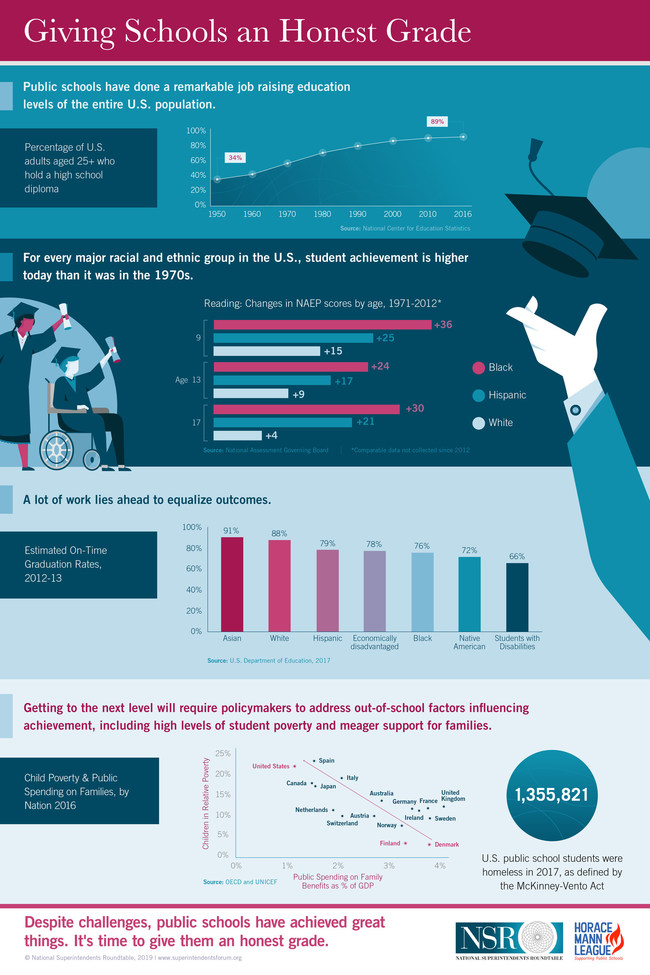
The National Superintendents Roundtable has a message for the public: be fair when judging our public schools. Schools today are far better than they were 40 or 50 years ago, by all conventional measures. what they might have added was that schools made steady progress until about 2007 or so, when No Child Left Behind took hold, then things were made worse by Race to the Top and Common Core. The proliferation of choice has flattened the progress made from 1970 to 2007.