It being New Year’s Eve, it is not a time for serious thinking.
Thus, I take this opportunity to offer my suggestions for good things to watch on television. Or, to put it another way, things that I really liked watching.
My favorite was the Belgian crime series called “Professor T.” on PBS. Do not mistakenly watch the British version. Professor T. is a highly intelligent, neurotic criminologist who solves difficult crimes. The series is urbane, witty, provocative, and sometimes zany. I enjoyed watching Professor T. think, and I liked his taste in music (mostly Bach.)
The best film I have seen lately is Don’t Look Up. It is a terrifying, sometimes hilarious metaphor for our times. It has a star-filled cast (Merryl Streep as a Trump-like President), Leonardo DiCaprio as a scientist at Michigan State, Jennifer Lawrence as a graduate student at MSU). And many more big names (Tyler Perry, Cate Blanchett, Jonah Hill, Ariana Grande).
The story, in brief, is that a grad student observes a giant comet headed directly for earth. A direct hit will extinguish all life on earth in a bit more than six months. She tells her professor and they contact federal authorities,who bring them to D.C. to meet with officials at NASA, the military, and the White House. The White House decides the story should be buried because it might have a negative effect on the midterm elections. They go to the media. The nation’s biggest talk show treats them as less important than a story about a singing star breaking up with her boyfriend. They get low ratings, and the news media decides their story is not interesting; it won’t sell papers. Basically, their warnings are discredited, and no one takes them seriously.
But the President calls them back, says their calculations have been verified by the scientific community, and she deploys plans to destroy the comet with massive strikes of nuclear missiles.
Then the plot changes as a tech genius convinces the President that the comet can be stopped without destroying it, and its minerals are worth trillions. The profit motive brings a sharp change of plans. I won’t tell you how it ends. You should see it. It captures the essence of our celebrity-driven, superficial mass culture, where power and greed outweigh common sense and integrity.
Michael Hiltzik, a superb columnist for the Los Angeles Times, says farewell to “the stupidest year in American history. “ (Again, I violate copyright law by posting this column. I appeal to the good graces of the wonderful L.A. Times. If they object, I will delete the post.)
My one criticism of his incisive critique is that he nearly ignores the astonishing, unprecedented attack on the U.S. Capitol by insurrectionists on January 6, 2021, a day that will live in infamy, a day that a sitting President urged his supporters to overturn the election he lost, a day that the Capitol was breached and ransacked by hundreds or thousands of Trump supporters, who proceeded to attack scores of law officers defending the Constitutional transfer of power and hundreds of legislators. Hundreds of those legislators—all Republicans—soon became defenders and apologists for the insurrectionists who besieged them. It doesn’t get stupider than that.
Hiltzik writes:
One year ago, we were looking forward to a safer and sounder 2021.
The Food and Drug Administration had granted emergency authorization to the Pfizer-BioNTech and Moderna vaccines against COVID-19.
A new presidential administration was poised to take office in the next month, armed with a commitment to bring together a nation cleaved by four years of divisive policymaking.
Instead of unity and immunity, this year has brought us stupidity and insanity on an unimaginable scale. In the categories of public health, education policy, fiscal policy and investment options, we appear to have taken leave of our collective senses.
Certainly there are other years or periods in which stupidity or heedlessness brought civilization in general close to eradication.
Consider 1914, when most of Europe dived hellbent to war for no discernible reason. (Read Barbara Tuchman’s book “The Guns of August” for the full horrific picture.) The Dark Ages were a period benighted by scientific ignorance.
Some individual countries and national leaders stand out for tempting fate, to their and their citizens’ misfortune. Britain in 1938 under Neville Chamberlain. Russia’s warmongering with Japan in 1904-1905. Louis Napoleon poking a stick into the Prussian bear’s cage in 1870-1871. Saddam Hussein invading Kuwait in 1990.
The perpetrators of some of these errors might assert in their defense that they were brought low by circumstances they didn’t know at the time.
But America in 2021 can’t plead that it didn’t know. Didn’t know that vaccines representing stupendous scientific achievements were the solution to the COVID-19 pandemic?
It was not to be.
Didn’t know that Donald Trump wasn’t joking when he demanded that government officials overturn a fair presidential election? Didn’t know that bitcoin, NFTs, SPACs and meme stocks were destined, even designed, to take unwary investors to the cleaners?
Of course we knew, and know. We don’t seem to care.
In reviewing the most intellectually demoralizing events of 2021, I’ll leave aside a few discrete outbursts of asininity.
Or the shameful behavior of congressional Republicans, who cowered in safety during the Jan. 6 insurrection, pleading with Trump to help quell the riot, only to claim ever since that the violence of the crowd was no big deal.
Or the posting of Christmas cards by politicians showing their families hoisting assault weapons, as Rep. Thomas Massie (R-Ky.) did just four days after a gunman killed four students at a Michigan high school. He was followed by Rep. Lauren Boebert (R-Colo.).
The pandemic is surely the focus of the most obtuse and ignorant public reactions and state and local policy responses to any crisis in American history. It’s as if the grown-ups have all been beamed up, and we are left in the hands of people like Florida Gov. Ron DeSantis. (I am paraphrasing a line from the great pandemic movie “Together.”)
In any rational world, the refusal or failure by some 50 million adult Americans to take a vaccine of known efficacy against a deadly disease would be inexplicable. But this is not a rational world, and the situation is even worse.
Vaccine refusal is seen in many benighted corners of the United States not merely as the exercise of personal choice for personal reasons but as a means of showing moral superiority over the vaccinated.
A conservative critic of anti-pandemic measures writing from rural southwest Michigan for the Atlantic bragged absurdly and selfishly, “I am now closer to most of my fellow Americans than the people, almost absurdly overrepresented in media and elite institutions, who are still genuinely concerned about this virus.”
The author may think he’s remote from virus concerns, but that’s not the case at a hospital visited by CNN in Lansing, Mich., which can’t be much more than 100 miles from his location and where “the latest COVID-19 surge is as bad as healthcare workers there have seen.”
How did it come to pass that Americans, who almost uniformly are inoculated against at least a half-dozen serious diseases in childhood, chose this moment to refuse a spectacularly effective shot against one of the most dangerous diseases to arise in their lifetimes, out of pure ignorance?
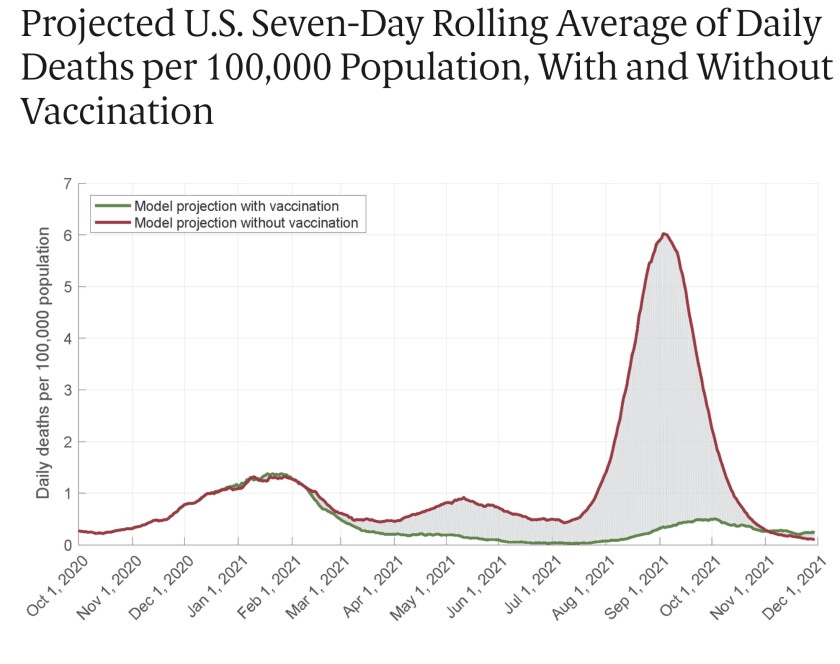
Its effectiveness is scarcely disputable: The Commonwealth Fund estimates that the vaccine averted about 1.1 million American deaths from COVID-19 and more than 10.3 million hospitalizations this year.
The Commonwealth Fund estimates that the U.S. would have experienced more than 1.1 million additional deaths from COVID-19 if not for the vaccines.(Commonwealth Fund)
The answer lies in politics.
Trump drew the line first, dismissing social distancing steps and refusing to speak up for vaccination. He established these steps as partisan choices, and his political acolytes followed him over the cliff.
DeSantis has been a leader in this descent into the Inferno. He’s chosen to make Dr. Anthony Fauci, head of the National Institute of Allergy and Infectious Diseases and America’s most respected authority on the pandemic, a target of partisan calumny. He’s appointed a vaccine doubter as his state’s top public health official.
What is the outcome? Florida currently ranks eighth-worst among states in its COVID-19 death rate, with more than 62,000 Floridians having perished from the virus. Of the seven states with worse records, six are red states like Florida.
Corporate America has not showered itself in glory. On Dec. 18, Boeing announced that it was dropping its requirement that all U.S. employees be vaccinated. Its explanation was that a federal judge had blocked the enforcement of a federal executive order that employees of government contractors be vaccinated.
This is absurd. Nothing in the ruling required Boeing to drop its requirement. The company announced its step back just as the Omicron variant was about to produce a surge in infections. The pusillanimity of American corporations on this subject continues to astound. (The Times, which is owned by a physician and biomedical entrepreneur, is requiring all employees to be fully vaccinated by Jan. 31.)
To its credit, on Dec. 17 the Biden White House issued an uncompromising warning about the dangers of remaining unvaccinated.
“For the unvaccinated, you’re looking at a winter of severe illness and death for yourselves, your families and the hospitals you may soon overwhelm,” White House Chief of Staff Ron Klain said. “So, our message to every American is clear…. Wear a mask in public indoor settings. Get vaccinated, get your kids vaccinated, and get a booster shot when you’re eligible.”
Investment follies
In May, I asked whether we were experiencing a peak in investment absurdity. The examples then were bitcoin, dogecoin and nonfungible tokens (NFTs), as well as meme stocks, the prices of which were not tied to sober reflections about their issuers’ business prospects but to internet-fueled speculation.
Assets like these, which are priced in accordance with the “greater fool” theory (they have no intrinsic value beyond what you can cadge from a bigger fool than yourself), have only proliferated since then. Or perhaps it’s only the absurdity that has ballooned.
NFTs, for instance, are tradable digital files that confer no ownership to anything but the digital file, which may be an image of an object that is actually owned by someone else. Someone has parodied the NFT market by purporting to sell NFTs of images of individual Olive Garden restaurants, but it’s the kind of parody that gets at the essential truth of the target.
You don’t get to own the restaurant or the photo. You don’t get a discount on menu items or a guarantee that the photo is even accurate. You supposedly get to own something on the Non-fungible Olive Garden Metaverse, whatever that is, and you can try to find a greater fool to sell it to.
NFTs generally don’t confer ownership of the underlying asset or even the digital representation of the asset. The market doesn’t exist for any reason except to produce activity to suck in greater fools.
The best clue that there’s something hinky about these markets is that the Trump family is going all in. A purported media company started by Donald Trump, for instance, is merging with a special purpose acquisition company, or SPAC.
As I reported, the deal promptly came under the scrutiny of financial regulators. In any case, no discernible business plan of any substance has emerged for the Trump company. People appear to have invested because of his name.
Now Melania Trump has gotten into the act, hawking NFTs of paintings of her eyes—”an amulet to inspire,” the pitch says, though obviously you don’t get to own the eyes or even the original watercolor.
Software developer Stephen Diehl, an established skeptic of these things, writes that we are entering upon “a hustler’s paradise … where the market now provides a financial token game for every meme, every celebrity, every political movement, and every bit of art and culture.” The old saw applies about how if you’re looking around the poker table and can’t identify the mark, it’s you.
Inflation and Build Back Better
Republicans and conservatives have never cottoned to spending on programs that assist the middle and working class. President Biden’s Build Back Better program was destined to get their backs up.
How could they attack a program that provides for universal prekindergarten education, assistance with child care, caps on the price of drugs such as insulin and better access to healthcare? Simple: Raise the old bugaboo of inflation.
That’s been the approach of Sen. Joe Manchin III (D-W.Va.), who recently announced — via Fox News, of course — that he couldn’t support the plan in any way. He’s since backed off a bit from his adamantine opposition, but the core of his position was concern that the measure would add to inflation.
As we’ve reported, that’s just wrong. Not even former Treasury Secretary Lawrence Summers, who sounded an inflation alarm about the pandemic relief package enacted this year, thinks it applies to this measure. The provisions of Build Back Better are paid for and represent investments in the economy, so they’re anything but inflationary.
Indeed, Wall Street views Manchin’s resistance as an economic negative. According to MarketWatch, Goldman Sachs cut its growth forecast for the first quarter of next year to 2% from 3%, for the second quarter to 3% from 3.5% and for the third quarter to 2.75% from 3%.
That’s not counting the direct impact of Build Back Better on Manchin’s own state, which is among the poorest in the nation and one in which government programs are crucial. That’s well understood on the ground: The United Mine Workers union publicly urged Manchin to reconsider his opposition to a program that would have “a meaningful impact on our members, their families, and their communities.”
Much more happened in 2021 that prompts one to hold head in hands. To be fair, however, there were also glimmers of hope.
Biden on Dec. 21 announced steps to strengthen the country’s response to the Omicron variant, including mobilizing troops to help staff overwhelmed hospitals, opening thousands of vaccine sites and sending 500 million free testing kits to households. The Build Back Better plan is not entirely dead, and a revival effort will start in January.
Whether 2022 will be less stupid and insane than 2021 won’t be known until we can view it in a rearview mirror 12 months from now. We can only hope.
Andy Borowitz is a humorist who writes for The New Yorker. His jokes get their bite by being so close to reality that they are almost plausible. The magazine now labels them as humor because apparently so many people apparently believed they were true. He recently posted his best jokes of the year. Here are my favorites.
AUSTIN (The Borowitz Report)—A new bill moving swiftly through the Republican-controlled Texas legislature would institute a strict statewide dress code for women.
Governor Greg Abbott, a vehement supporter of the bill, said that the dress code would benefit women because “it will give them one less thing to think about when they get up in the morning.”
“I believe in the sanctity of human life, and the best way to protect that life, in the case of a woman, is to free her from the stress of having to choose what to wear,” Abbott said.
Abbott summarized the new dress code, which bars women from wearing skirts above the knee, sleeveless blouses, and most varieties of pants.
“Slacks are fine as long as they have cuffs,” he said. “However, if a woman is caught wearing jeans or dungarees, she will be sent home.”
Abbott dismissed comparisons between the state’s proposed dress code and that imposed by the Taliban, which has required women to wear burqas. “We are strongly opposed to masks of any kind,” he said.
Recently the daughter of one of our regular readers (Roy Turrentine) posted a comment.
She wrote in response to the reports of politician
Bob Shepherd was delighted by her writing, and he offered her a reading list of some of his favorites (unlikely that these are on the Common Core reading list, since CCSS privileges “informational text” over fiction).
Bob wrote:
Have you read Siddhartha, by Herman Hesse, yet? I fell head over heels in love with that book when I was your age. And take a crack at 1984, by Orwell, which may be the most important book to be read at this time in history. And here, a few suggestions for short fiction:
MY CANDIDATES FOR THE BEST SHORT STORIES EVER WRITTEN
Asimov, Isaac. “The Last Question” Atwood, Margaret. “Bread” Benet, Stephen Vincent. “By the Waters of Babylon” Bierce, Ambrose. “Chickamauga” Bierce, Ambrose. “Occurrence at Owl Creek Bridge” Borges, Jorge Luis, “The Library of Babel” Bostrom, Nick. “The Dragon Tyrant” Bradbury Ray. “The Veldt” Bradbury, Ray. “The End of the World” Bradbury,. Ray. “There Will Come Soft Rains” Chiang, Ted. “Stories of Our Lives” Chopin, Kate. “Story of an Hour” Crane, Stephen. “A Mystery of Heroism” Du Maurier, Daphne. “The Birds” Faulkner, William. “The Bear” Gallico, Paul. “The Snowgoose” Goldstein, Rebecca. “The Legacy of Raizel Kaidish” Hawthorne, Nathaniel. “Rappaccini’s Daughter” Hathorne, Nathaniel. “Young Goodman Brown” Hemingway, Ernest. “Hills Like White Elephants” Hemingway, Ernest. “A Clean, Well-Lighted Place” Hemingway, Ernest. “The Long Wait” Liu, Ken. “An Advanced Readers’ Picture Book of Comparative Cognition” Jackson, Shirley. “The Lottery” Marquez, Gabriel Garcia. “A Very Old Man with Enormous Wings” O’Conner, Flannery. “A Good Man Is Hard to Find” Roth, Phillip. “The Conversion of the Jews” Thurber, James. “The Secret Life of Walter Mitty” Tolstoy, Leo. “The Life and Death of Ivan Illych” Updike, John. “A & P” Updike, John. “The Music School” Vonnegut, Kurt. “Who Am I This Time?” Walker, Alice. “Everyday Use”
The Washington Post reports a concerted effort by Trump faithful to increase their base in the House of Representatives by challenging moderate Republicans. As a result of tedictricting, the number of highly concentrated conservative districts has increased. Joe Kent, running in Washington State, believes that the insurrectionists who stormed the Capitol on January 6, 2021, are “patriots.”
The defiant far-right acolytes of former president Trump in the House Republican caucus have embarked on a targeted campaign ahead of the midterm elections to expand their ranks — and extend their power — on Capitol Hill.
The effort, backed by Trump and guided by House members such as Marjorie Taylor Greene (R-Ga.) and Madison Cawthorn (R-N.C.), is part of a broader push by followers of the “Make America Great Again” movement to purge the GOP of those not deemed loyal to the former president and his false claims that the 2020 election was rigged in favor of Joe Biden.
Former Army Green Beret Joe Kent is running for a U.S. House seat in Washington state held by another Republican, Rep. Jaime Herrera Beutler, who voted to impeach Trump over his role in the events of Jan. 6 at the Capitol.
Kent said he has little interest in fighting with Democrats if he makes it to Congress. Instead, he wants to force Republicans into tough votes, starting with articles of impeachment against President Biden and a full congressional inquiry into the 2020 presidential election, which he says was stolen from Trump.
“A lot of it will be shaming Republicans,” Kent said. “I need to be going after the people in the Republican Party who want to go back to go-along-to-get-along. It’s put up or shut up.”
The goal, organizers of the effort say, is to supersize the MAGA group in the House from its current loose membership of about a half dozen — and give it the heft that, combined with its close alliance with Trump, would put it in a position to wield significant influence should Republicans win the House majority.
Key to the strategy is to coalesce MAGA-movement support around certain candidates running in Republican primaries in heavily pro-Trump congressional districts where the primary victor is all but assured to win the seat in November. That effort is being bolstered by redistricting, as state lawmakers draw districts even more partisan than the current lines.
In 2020, Trump won 45 districts by more than 15 percentage points. Under new maps already finalized in more than a dozen states, he would have won 78 districts by that margin, according to a Post analysis.
“We should be gaining MAGA seats,” Boris Epshteyn, a Trump ally, said on a recent episode of the radio show hosted by former Trump strategist Stephen K. Bannon. “It’s not just about ‘let’s add some Republican seats,’ it’s about ‘let’s add MAGA strongholds.’ ”
Trump critics warn that a stronger MAGA wing in Congress threatens democracy.
“We’re looking at a nihilistic Mad Max hellscape. It will be all about the show of 2024 to bring Donald Trump back into power. … They will impeach Biden, they will impeach Harris, they will kill everything,” said Rick Wilson, a longtime Republican strategist who is sharply critical of Trump.
If the MAGA crowd succeeds, one of our two major political parties will be controlled by unscrupulous, cynical, anti-democratic forces whose goals are power and greed, fueled by racism, xenophobia, anti-Semitism, and fear of the other.
Mercedes Schneider digs into the background of Virginia’s new Secretary of Education. She is a data collector, not an educator. On the good side, she is conservative but apparently not an anti-CRT warrior:
On December 20, 2021, Virginia Governor-elect Glenn Youngkin announced that his choice for state education secretary is “education consultant” Aimee Guidera. In the ABC8News in which I read Youngkin’s choice, political analyst Rich Meagher commented, “We don’t know a lot about this nominee just yet in part because she is not a political operative. She is a data scientist.”
We don’t know much about this nominee, but let’s unequivocally label her a *data scientist* and not just a data collector.
The ABC8News article does identify Guidera as “founder and former chief executive of the Data Quality Campaign (DQC), a leading voice advocating for improving the use of data to increase student achievement,” a statement that reads more like the pro-data-collection sales pitch than perhaps the article author realizes.
Guidera holds no degree in data collection and analysis or statistics and research. According to her Linkedin bio, Guidera’s bachelors of arts is from Princeton’s Woodrow Wilson School of Public and International Affairs (public policy), and her masters is in public policy from Harvard’s John F. Kennedy School of Government. Nevertheless, since she founded and operated a data collection organization, Guidera is cloaked in presumed credibility as a student data expert.
For those who are sketchy about founder Guidera and her DQC, allow me to offer information from several posts I have published between 2013 and 2017 concerning DQC, DQC’s controlling nonprofit, Education Trust, and her connection to Common Core and ubiqitous Gates funding, among other market-based, ed-reform connections. Then, readers can decide whether they believe “education consultant” Guidera to be more “data scientist” or just a well-funded, well-positioned data collector.
As for me, I’m going with “well-funded, well-positioned data collector.”
In the rest of the post, Mercedes (who has a doctorate in statistics, unlike Guidera) reviews the Data Quality Campaign. Open the link and read all about it.
Davyon Johnson, a sixth-grader in the MuskogeePublic Schools saved two lives in one day. In the morning, he performed the Heimlich maneuver on a classmate who was choking on a bottle cap (he says he learned it on YouTube). Later the same day, he pulled a woman from a burning building.
If he is in any sense representative of the children of America, our future is in good hands.
An 11-year-old boy from Oklahoma is being honored for his heroism after he saved a choking classmate and rescued a woman from a house fire in one day.
Davyon Johnson was named an honorary member of both the sheriff’s office and the police force and was recognized by the board of education in his hometown of Muskogee, a city about 50 miles southeast of Tulsa.
“Davyon performed the Heimlich maneuver on a classmate on December 9 and that evening helped a woman from her house that was on fire,” the Muskogee County Sheriff’s Office wrote on Facebook last week.
Adults used to say that the young today are “going to hell in a hand basket,” and “why can’t they be like us?” (From the musical Bye Bye, Birdie: “Why can’t they be like we were, perfect in every way/What’s the matter with kids today?”)
Now we have to worry about the adults, many of whom are behaving stupidly and dangerously, undermining democracy and fighting common sense public health measures, while the kids are all right. Maybe the grownups need to find role models like Davyon Johnson.
Ever since Republicans in North Carolina took control of the General Assembly (legislature) in 2010, they have tried to diminish the state’s responsibility for the common good or to extinguish it altogether. No institution has suffered as much by their hostility as the public schools.
NC Policy Watch is an outstanding source of information about the state. It recently reported about the General Assembly’s refusal to obey a court order to rectify the unconstitutional funding of the public schools, which is grossly inequitable. The historic ruling was the Leandro case, and Republicans have offered charters and vouchers instead of equitable and adequate funding. Now they are rumbling about impeaching the judge who told them to fix the funding.
Despite multiple judicial determinations that the state’s K-12 schools are unconstitutionally deficient, the Republican politicians – including, last week, a pair of appellate court judges – say that no court can order the legislature to actually fix the problem.
According to the judges in question, state courts have “no authority to order the appropriation of monies to satisfy any execution of [the Leandro] judgment.”
In effect, they argue, 25-plus years of trials, expert witness testimony, findings, rulings, appeals and remedy planning were all just a meaningless exercise in pushing paper. When it gets right down to it, the power to decide whether to make our K-12 schools constitutional remains right where it’s always been – at the whim of state legislative leaders who are the chief authors of the current failed system.
And just in case anyone had any doubts about the complete power they claim to wield (or had any inkling to question it), GOP lawmakers are firing some unmistakable warning shots designed to intimidate naysayers.
In concert with right-wing allies, lawmakers have sent the clear and appalling message in recent days (see item #8 of the recently adopted adjournment resolution) that they are considering the extraordinary (and deeply treacherous) step of impeaching Superior Court Judge David Lee – the visionary and courageous jurist who has been seeking to enforce the Leandro ruling and make it real.
At the beginning of December, Jan Resseger wrote about why President Biden’s Build Back Better agenda is so important. At the moment, it’s prospects are dim,due to theintransigenceofSenator Joe Manchin of West Virginia. Senator Manchin drives a Maserati and owns a yacht, but his state is very poor and needs the help that Build Back Better offers.
Jan Resseger describes the hoary English tradition—which we inherited—of expecting the poor to pull themselves up by their own bootstraps. This is apparently what Senator Manchin believes in, as he fears that the poor will become “spoiled” by too much government help.
She writes:
Right now, the U.S. House of Representatives has passed the Build Back Better Bill which represents a radically different philosophy: President Biden’s commitment to helping children whose families live in poverty instead of punishing their parents. The U.S. Senate is negotiating its version, which many hope to see passed by the end of 2021.
The Center on Budget and Policy Priorities explains why a single reform in the Child Tax Credit—making it fully refundable for families with very low income—is for America’s children the most important element in Build Back Better: “Making the full Child Tax Credit available for families with low or no earnings in a year, often called making it ‘fully refundable,’ is expected to generate historic reductions in child poverty compared to what it would have been otherwise. Before the Rescue Plan made the full Child Tax credit fully available in 2021, 27 million children in families with low or no income in a year received less than the full credit or no credit at all.” In the American Rescue relief bill last spring, Congress made three significant changes in the Child Tax Credit: raising the maximum Child Tax Credit from $2,000 to $3,600 per child through age 5, and $3,000 for children age 6-17; allowing families to receive a Child Tax Credit for 17-year-olds; and making the Child Tax Credit fully refundable for the year 2021. The House version of the Build Back Better Bill extends the first two provisions only through 2022, but the House version permanently makes the Child Tax Credit fully refundable:
“In the absence of the full refundability provision, the first two of those changes would lift an estimated 543,000 children above the poverty line, reducing the child poverty rate by 5 percent… But the two changes plus full refundability stand to raise 4.1 million children above the poverty line and cut the child poverty rate by more than 40 percent. In other words, the full refundability feature makes the expansion nearly eight times as effective in reducing child poverty.” “Until last spring’s COVID relief bill, many children had been excluded because “their families’ incomes were too low. That included roughly half of all Black and Latino children and half of children who live in rural communities… This upside-down policy gave less help to the children who needed it most. The (COVID) Rescue Plan temporarily fixed this policy by making the tax credit fully refundable for 2021. Build Back Better, in one of its signature achievements, would make this policy advance permanent.” (emphasis in the original)
In a new report last Friday, the Center on Budget and Policy Priorities warnsabout what we can expect if the U.S. Senate fails to pass the Build Back Better Bill by the end of December, 2021 and allows to expire the reforms instituted temporarily for this year alone in last spring’s American Rescue Plan: “If Build Back Better isn’t enacted, the Child Tax Credit would revert to providing the least help to the children who need it most — and some 27 million children would once again get a partial credit or none at all because their families’ incomes are too low.”
The First Focus for Children Campaign outlines other urgently needed reforms included in the House version of the Build Back Better Bill: “The Children’s Health Insurance Program, CHIP, which covers roughly 10 million children would be made permanent, sparing it from serial expiration every few years.” The bill would also require states to make children’s eligibility continuous over all 12 months for CHIP and Medicaid; would guarantee 12 months (instead of 60-days) of postpartum coverage for mothers on Medicaid; and would provide 4-weeks of paid leave for new parents and expand family leave. Build Back Better would significantly expand access to quality child care and phase in universal pre-K for 3- and 4-year-olds. For young adults aging out of foster care, the law would lower the age of eligibility for the Earned Income Tax Credit from 25 to 18. The bill would also address hunger among children by making meals available during the summer months when school is not in session.
None of these programs directly invests in public education, but together they will improve educational opportunity. Why? We know that a family’s economic circumstances affect children’s opportunity at school. Recently this blog covered a new report that 101,000 students in the New York City Public Schools—10 percent of the district’s students—were homeless in the past year. Decades of research show that such challenges directly affect such students’ experiences at school.
Maury Harris was a top economist in the U.S. When he retired, he went back to graduate school to study criminology. This is his first publication. (Full disclosure: He is the brother-in-law of my late younger sister).
An important excerpt:
The extremely low 2020 homicide levels in Canada, the United Kingdom and Germany relative to the US undoubtedly reflect exceptionally high gun ownership in the US with 1.20 guns for every resident in 2019. In contrast, guns per resident were 0.35 in Canada, 0.20 in Germany and 0.06 in the United Kingdom. It gets worse. For 2020, the FBI reports that US firearm background checks—a proxy for legal domestic gun sales–jumped by 40% to a record 39.7 million.