David Gamberg recently retired as Superintendent of two contiguous school districts on the North Fork of Long Island: the Southold district and the Greenport district. He first was appointed in Southold, where he was beloved for his devotion to the students; he is a child-centered educator, who encouraged the arts, developed a student-run garden (whose produce was used in the school cafeteria), and strengthened the school’s theatre program. When the Greenport schools needed a new superintendent, they invited Gamberg to split his time between the two districts.

Gamberg writes his story:

When I was young I never fully knew what my father did for a living. Eventually learning that he was a truck driver did not dissuade me from following in his footsteps. I never did pursue that line of work. Nor did I ultimately learn about the industry that he worked in throughout his entire life. Therefore I am not one to opine on how the supply chain and the trucking industry’s role in our economy is a major feature of what we are now experiencing in our country and throughout the world.


I was fortunate to grow up in the America of my youth. My father was a truck driver who did not go to college. I consider myself so fortunate. My mom worked as an aide in a nursing home. They worked hard, but I was also the beneficiary of a system that recognized a need to level the playing field for those among us who may not have been born into a privileged position in society.


It never occurred to me that my K-12 public education was ineffective or insufficient to prepare me to lead a fulfilling life. I didn’t go to private school, and the racially diverse schools that I attended were of great benefit to my understanding of the world around me. I resent the attacks on public schools that are playing out today.


At 59 years old I can remember a time when the United States government helped me to get a leg up in life. I went to Head Start, a pre-kindergarten program for children set up for the common good, to give opportunities for young people like me who did not come from wealth, or status in society that paved the way forward. I don’t know where I would have traveled in life if not for this early support, and therefore I can’t imagine why good early childhood education is not something that every American of any political persuasion should support. This was not the only benefit I received as a young citizen of our country.


Yes, I went to college, a public state university, paid in part because of the benefits I derived from my father’s lifelong contributions to the Social Security system. He was of age to receive social security when I went to school in the early 1980s. As a result of the structure of the Social Security benefit program at the time, as long as I was in college I would receive some measure of support to offset the cost of going to school. This and other safety net benefits including state and federal grants afforded me the opportunity for a good education, without having vast amounts of student debt hanging over my head upon graduation.

I raise these issues in the context of my childhood view of work and school, and my growing awareness over the years about the role that good government programs and support played in my life. It is not a matter of government entitlements. Rather, it is about the public trust that we place in our government to support fellow citizens. It is about the importance of a civil society, and how our governing polity should work.

The opportunities that should be afforded to every young American to have the ability to go to post secondary school to pursue their purpose in life if they choose to do so, or to dream of a career and living a life to the fullest should be the norm, and a common reality for all. This should not be dependent upon your station in life, where you were born, or your family situation.
This article by Ed Montini in the Arizona Republic explains the childish behavior of Republican leaders, who engage in taunts instead of reasoned discourse about their agenda. They don’t want to expand Medicare. They don’t want universal pre-K. They don’t support efforts to combat climate change. They oppose paid family leave for families in need after surgery or childhood. They are against a federal guarantee of two years tuition-free community college. They oppose higher taxes on billionaires. They don’t care about voting rights. They don’t want to expand opportunity. They don’t want to reduce inequality. They don’t invest in the future.

What are they for? Tax breaks for the rich.

Since they have no agenda, their goal is to make sure Biden can’t succeed. After blocking everything he proposes (with the help of Senator Manchin of West Virginia and Senator Krysten Sinema), they have nothing to offer other than the schoolyard chant.

Ed Mancini was walking his dog early one morning, and he saw two other dog owners engage in conversation, a man and a woman. As they part ways, the man says to the woman, “Let’s go, Brandon!” then turning away.

The woman is puzzled and asks Montini if he knows what that phrase means.

So, first thing in the morning I am called upon to explain this recent cultural phenomenon to one of the few American grown-ups who has managed to remain a fully functioning adult, while most of the rest of us have been transformed by social media into crude, smart-alecky 8-year-olds.

There’s that Southwest Airlines pilot

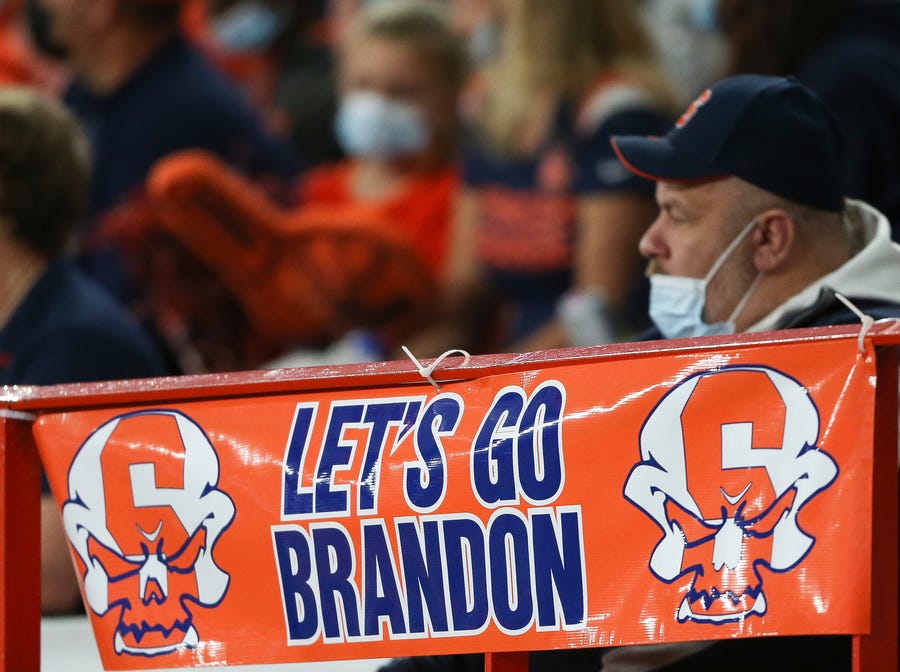
This particular sign was a the Boston College-Syracuse football game Oct. 30. A fan’s juvenile jab at President Joe Biden.Joshua Bessex

For instance, the woman had not heard about the Southwest Airlines pilot who recently signed off on a flight, telling passengers, “Let’s go, Brandon.”

Or about how the whole thing began when a race car driver named Brandon Brown won a NASCAR race and, while being interviewed on TV, the crowd started chanting, “F–k Joe Biden.” The flummoxed interviewer suggested they might be saying, “Let’s go, Brandon.”

After that, the phrase became a way for grown-up 8-year-olds to say the f-word about Biden without actually using it.

Really.

Elected Republican politicians in Washington, D.C., started using the phrase.

Donald Trump began selling “Let’s go Brandon” T-shirts through his Save America PAC for $45, and grown-up 8-year-olds in America actually purchased them.

$45.

There are adults who channel their 8-year-old selves by bringing signs saying, “Let’s go, Brandon” to public events, as well as some who scribble the message in paint on the rear window of their automobiles….

How to answer someone who says such a thing

Of course, we all learned as children that infantile behavior tends to draw some type of backlash….

After I explain the whole “Let’s go, Brandon” thing to the woman who’d been walking her dog she says, “That seems incredibly childish. How are you supposed to answer someone who says such a thing?”

I tell her that, as a grown-up, she would be best served simply ignoring it.

As for the rest of us, suffering as we do from social-media-induced age regression, I’d respond, “I’m rubber and you’re glue …”

Reach Montini at ed.montini@arizonarepublic.com.

Problem viewing email? View in browser

Mercedes Schneider is an experienced high school teacher in Louisiana. She wants to help her students overcome what they may has lost during the pandemic.

She knows what it will take. How likely is it that the district or the state will give her what she needs?

https://deutsch29.wordpress.com/2021/11/07/what-it-would-take-for-me-to-seriously-confront-pandemic-learning-loss/

Many of the nation’s public schools are in poor physical condition. Since the Great Recession of 2008, states stopped or cut the funding necessary repairs and upgrades. President Biden’s infrastructure plan included $100 billion to upgrade the physical conditions of America’s schools. In the last hours of haggling before the bill was passed, this provision was cut, then eliminated.

In a major blow that left educators, school leaders and advocates stunned, Democrats pared back – and then eliminated – $100 billion that Joe Biden earmarked for school modernization in his spending bill.

The story details the woeful conditions of Philadelphia’s schools. Helen Gym, an education activist who was elected to the city council, has been outspoken about the need to invest in rebuilding obsolete schools.

“Our children deal with lead, asbestos and mold,” Gym says of the School District of Philadelphia, where schools are on average 70 years old. “We had to start school weeks later than schools in the suburbs because we don’t have air conditioning and classrooms can reach 90 degrees or higher on our hottest days, which are becoming more and more frequent.”

Gym, a potential 2023 mayoral contender and longtime education activist, had been arrested weeks prior to the rally for banging on the doors of the Senate gallery inside the state Capitol in Harrisburg to protest the way the state funds the city’s public school system – a longstanding issue that goes on trial in the commonwealth court next week.

“We have windows that don’t open fully,” she says. “Even now we struggle with the basics of functioning cafeterias, bathrooms that don’t flood and roofs that don’t cave in.”

Five years ago, when Philadelphia performed a cursory assessment of its buildings, it estimated that basic repairs to bring schools up to code would cost roughly $4.5 billion, to say nothing of long-standing larger renovation needs or modernizing its K-12 system top-to-bottom. In 2019, the school district took out a $500 million bond for routine capital projects to begin facilities improvements.

States need federal aid to upgrade their schools. We put our money into those things we care most about. Providing healthy and attractive buildings where children learn is not at the top of the list.

Veteran journalist Jennifer Berkshire speculated on Twitter about why Democrats failed to defend public schools against extremists. The answer is that they swerved into the politics of neoliberalism 25 years ago and promoted privately-run charter schools. They allied with reactionary forces like the Waltons in their fruitless quest for “innovative” schools. Her handle is @@BisforBerkshire.

She wrote with crystal clarity:

Lots of takes on the Dem’s public education problem. But party’s utter inability to articulate why public education matters may be the biggest.

The Democrats’ favorite policy shop in D.C. is the Center for American Progress, which has been the party’s leading advocate of charter schools. The question that CAP can’t answer is: Why does public education matter?

Nancy Bailey addressed the same problem on her blog. She said bluntly that Democrats are not the education party, as they want the public to believe. They abandoned public schools and teachers by their promotion of school choice and evaluating teachers by their students’ test scores.

The eight years of Obama’s Race to the Too was a nightmare for teachers, who were constantly scapegoated. Arne Duncan fell in love with Common Core and Teach for America and used every opportunities to bash teachers and real public schools.

Democrats cannot be the education party when they support charter schools, Common Core, and fast-track teachers like Teach for America. They haven’t stood up for public education despite all the teacher union hoopla.

Where have they been on the discussion of special education? They’ve worked along with Republicans to deny children individualization, smaller class sizes.

Democrats can become the “education party” again when they walk away from the billionaires like Bill Gates, who likes to play with other people’s lives.

Harold Meyerson, one of my favorite commentators on current events, says that we should stop calling Joe Manchin and Kyrsten Sinema “moderates.” How can one man and one woman block every proposal that would help improve the lives of millions of Americans, including their constituents? Nor should we use that term to describe the handful of Democrats in the House who are blocking reasonable and popular programs, like lowering drug prices. I note that I allow Meyerson to use a word that is not permitted on this blog…but he wrote it.

He writes:

Memo to Media: Stop Calling Manchin et al. ‘Moderates’
Being more swayed by big-money contributions and an anti-mother bias are far better descriptors. 
“Moderates Hinder Efforts to Negotiate Drug Prices,” says a front-page headline in today’s Washington Post. Certain Democrats are indeed blocking those efforts, but is the media right to characterize them as moderates? How much of the fight between the overwhelming majority of both the House and Senate Democratic caucuses and the Manchin-Sinema-Gottheimer-Peters gang can accurately be described as left-vs.-center or liberal-vs.-moderate, which are the autopilot descriptions that the media applies to them?

Consider, for instance, that a number of these battles are being waged over policies that would win over swing voters and, indeed, are popular across the political spectrum. In a recent Kaiser Family Foundation poll, fully 83 percent of Americans, including 76 percent of Republicans, favored allowing the federal government to negotiate with drug companies to bring down the prescription drug prices for Medicare recipients and people with private insurance. Which is why, on Sunday, 15 House Democrats in frontline districts—genuine moderates—signed a letter to the congressional leaders saying that bringing down drug prices was key to their survival in next year’s midterm elections (and, by extension, to the Democrats’ ability to hold a majority in the next Congress).

There are similar majorities in support of other initiatives that the so-called moderates have blocked, like paid sick leave (73 percent in a recent CBS News poll) and extending Medicare coverage to vision and dental care (84 percent in the same poll).

So, is “moderate” an accurate characterization of the Manchin Gang? Is it moderation that dictates their stances?

Even a cursory look at the campaign contributions to those gang members suggests other factors besides “moderation” are in play. In the House, two of the three Democrats who blocked the relatively comprehensive drug price negotiation provision—California’s Scott Peters and Oregon’s Kurt Schrader—are among the largest recipients of drug company campaign contributions. The nay-saying duo of Schrader and Peters have received a combined $1.5 million in pharma contributions in the course of their congressional careers. The one Democrat who blocked that provision in the Senate, Arizona’s Kyrsten Sinema, raised a record $1.1 million from July through September, as her opposition to reducing drug prices became clear. A good chunk came directly from Big Pharma executives, even as a paltry 10 percent came from actual Arizonans. With ratios like that, it would not be a stretch to conclude that Sinema, who’s not up for re-election until 2024, may be more motivated by a high-paying job in a high-paying industry than she is by winning the votes of her constituents, moderate and otherwise, should she seek re-election.

We should note that the other Democratic senator from Arizona—former astronaut Mark Kelly—met with fellow moderate Amy Klobuchar and genuine leftists Bernie Sanders and Elizabeth Warren last Thursday to discuss how to get a drug price reduction into the reconciliation bill. Does that make Kelly a liberal and Sinema a moderate? I think not.

So, what do we call these non-moderate moderates who for reasons of their own have broken ranks with their fellow Democrats and President Biden? How about OMT Democrats—Only Money Talks Democrats?

That works for most of them; I’m not sure it does justice, though, to Joe Manchin, who increasingly seems a character of Dostoevskian perversity. With each passing (or blocking) day, Manchin comes across as a creature of steadily mounting rage against fellow legislators who don’t pay him sufficient obeisance, who fail to recognize that this is really all about him. On one issue—paid family leave—he has positioned himself as the sole but sufficient bulwark against making sure that Americans in need, most particularly mothers of newborns and sick children, must choose between work and parenting.

There’s a term for this that is far more accurate than “moderate.” The mot juste for Manchin is “motherfucker.” 

As everyone knows, Texas passed a law banning abortions after six weeks of pregnancy, well before women know they are pregnant. There are no exceptions, not even for cases of rape and incest. Governor Gregg Abbott says the exemptions are unneeded because he will “eliminate” rape in Texas. Since he has already passed legislation to remove gun control, women can defend themselves, presumably, by shooting rapists dead. The Governor didn’t explain what to do if a woman is the victim of incest.

Many people think that the current Supreme Court will overturn Roe v. Wade, abolishing women’s right to an abortion.

But this entire discussion may soon be moot, if it’s not already. Currently women can order pills online that are inexpensive and easy to obtain. States like Texas will try to ban these pills but they can’t control the mail.

In the United States, where the abortifacients misoprostol and mifepristone have been approved by the Food and Drug Administration, abortions by pill made up more than a third of all abortions in 2017.

“It’s really a revolution that’s happened in the last 20 years for women,” said Rebecca Gomperts, a doctor in Austria who founded the online medical abortion service Women on Web in 2005.

Providers and analysts say interest in these pills has spiked in the United States since Texas passed a law banning most abortions in the nation’s second-most-populous state.

No matter what the Supreme Court does, no matter what red-state legislatures do, access to abortion will be easy.

After the election, I posted an article from the Charlotte News-Observer/AP that suggested that attacks on critical race theory was not a decisive factor in many local school board races.

But since there are thousands of local school boards, no one knows for sure whether the issue changed minds and votes.

Axios reports that the anti-CRT crowd made many gains in their effort to win school board races.

Mike Allen writes:

A new PAC focused on electing conservative candidates to public school boards — by raising fears about how racism is taught — won three-fourths of its 58 races across seven states on Tuesday.

Why it matters: Those wins for the 1776 Project PAC, and Glenn Youngkin’s gubernatorial victory in Virginia, underscore the political potency of culture wars and COVID-related issues in schools this year — and how GOP candidates are seeking to ride the trend to new majorities.

  • Founder Ryan Girdusky told Axios: “My PAC is campaigning on behalf of everyday moms and dads who want to have better access to their children’s education.”

But, but, but: School officials are concerned there’s been intense hype and misinformation around the U.S. about what’s actually being taught in most schools.

  • They also worry politicization of school boards is sometimes translating to violence against teachers, and poorly informed decision-making.

By the numbers: Thirteen Pennsylvania school board candidates backed by the group won their races, along with 11 in Colorado, nine in Kansas, four in New Jersey, three in Virginia and two each in Ohio and Minnesota.

  • They’re not just winning in Republican areas; several candidates won in solid blue counties: Montgomery County, Pennsylvania; Passaic County, New Jersey; and Johnson County, Kansas.

Between the lines: Critical race theory is an academic movement focused on systemic racism, especially in U.S. law. It’s largely remained in graduate school settings as opposed to public secondary schools.

  • But “CRT” has become a potent political buzzword among conservative politicians and parents upset about schools introducing new lessons about racism and the history of slavery in the U.S.

What to watch: Expect more Republican candidates up and down the ballot to pick up CRT along with the rest of Youngkin’s political playbook.

  • The education issue “seems to be trending in our direction, whether it’s school lockdowns, curriculum or critical race theory,” one national GOP strategist told Axios.

If the attacks on CRT continue to stir animosity and spread lies about teaching history, this will cause teachers to self-censor whatever they teach about race and racism. This chilling effect will hamper efforts to think critically and honestly about some of the most important issues in American history. The attacks have also targeted any efforts to promote diversity, equity, and inclusion. The anti-CRT crusaders say they want to restore “patriotic education.” That is, an education built on lies.

The heated debate over “critical race theory,” “indoctrination” and “socialism” in the schools, and attacks on teachers for teaching books like Beloved has unleashed the native fascism that usually hides under a rock.

We saw it in Virginia, where the Republican winner in the election played on these issues in his campaign and vowed that he would pass a law to allow parents to opt their children out of reading stuff that made them “uncomfortable.”

A Texas legislator aims to be on the front lines of book banning. Rep. Matt Krause assembled a list of 850 books that he thinks should be removed from the schools. The books must go “because they might cause students to feel “discomfort.”The list is heavily weighted towards titles about gender, sexuality, racism, and other topics that he thinks should not be taught or read about in school. He probably would ban them for college too if he could.

My guess is that these books were chosen simply by their title, not because Rep. Krause read them.

Here is the list of 850 books that he wants to eliminate from the schools. Krause has no idea whether any of them are taught in the schools.

In the age of the Internet, when teens can see anything and everything mentioned in these books, this crude censorship is ridiculous.

I can’t tell whether the odor in the air is the burning of books or is the stench of McCarthyism.

What do you think?

Boston has had mayoral control of the schools since 1992. On November 2, the voters went to the polls and overwhelmingly supported the return of an elected school board. Mayoral control was sold as a “reform” panacea that would lead to higher achievement. It didn’t. Boston joins Chicago as cities where the public wants to abandon autocratic rule of the schools. The vote in Boston to restore an elected board went 4-1 in favor.

The newly elected mayor, Michelle Wu, said before the election that she would be open to a board in which a majority of members were elected, and some were appointed by the mayor.

The Boston Globe wrote:

The Question 3 ballot measure, which passed with 78.7 percent of the vote, was nonbinding, meaning it doesn’t carry legal weight. But councilors say it will prompt them to push for changes that will democratize school decision-making and empower communities of colorwho have long felt ignored by the appointed committee.