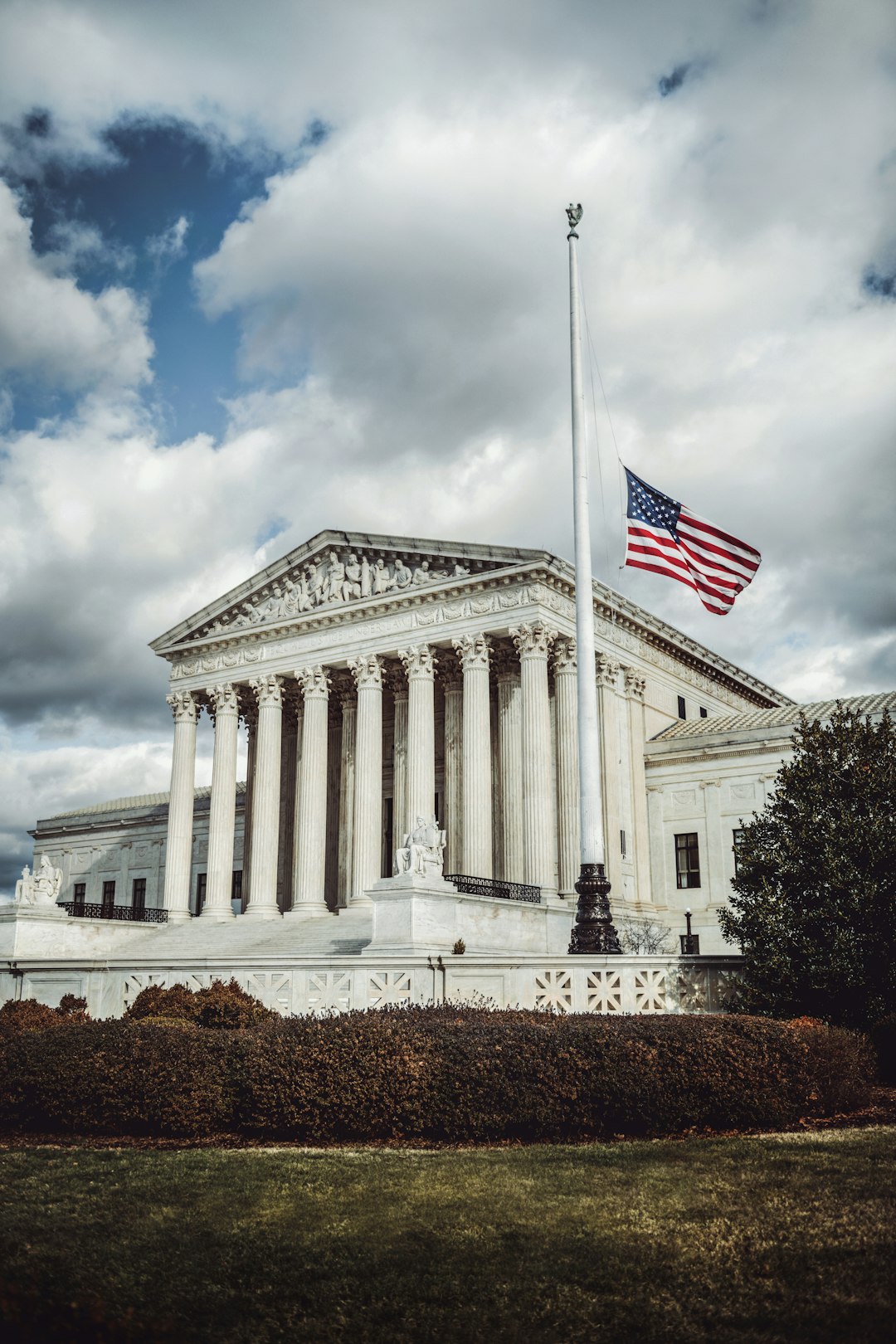
Two states, Colorado and Maine, have ruled that Donald Trump is disqualified to appear on their state ballot for President because of Section Three of the 14th Amendment.

That section, written after the Civil War, says:

Section 3 Disqualification from Holding Office

No person shall be a Senator or Representative in Congress, or elector of President and Vice-President, or hold any office, civil or military, under the United States, or under any State, who, having previously taken an oath, as a member of Congress, or as an officer of the United States, or as a member of any State legislature, or as an executive or judicial officer of any State, to support the Constitution of the United States, shall have engaged in insurrection or rebellion against the same, or given aid or comfort to the enemies thereof. But Congress may by a vote of two-thirds of each House, remove such disability.

Trump did take an oath “to support the Constitution of the United States” and he did incite and encourage a mob to invade the U.S. Capitol to disrupt the counting of the electoral votes and thereby “engaged in insurrection or rebellion” against the Constitution. In addition, he spent months trying to block the orderly transition of power from himself to Joseph Biden, who won the Presidential election of 2020.

His speech on January 6 was incendiary. Just as bad were his efforts to pressure state officials to change the results in their states and to create slates of fake electors. All of his actions were aimed at remaining in power despite the fact that he lost both the popular vote and the vote of the electoral college. Because he is a SORE LOSER, he summoned a mob to Washington, D.C. on January 6 and urged them to “fight like hell” to overturn the election and to march on the Capitol and prevent the peaceful transfer of power.

Nothing like this happened before in the history of the United States.

All of these facts, including the video footage of the horrific events of January 6, are evidence that he should be disqualified from the ballot.

The Supreme Court is dominated by conservative jurists who claim to be Originalists, who read the Constitution in light of its original intent. The original intent of Section Three of the 14th Amendment is unambiguous. Trump disqualified himself.

Somehow, I expect, the Court will find a way to avoid ruling against Trump. They might say that the case involves politics and is not in the judicial realm, as some state courts have ruled. That is an evasion, of course, but it may suffice to get them off the hook. How many judges want death threats, a frequent tactic of the Trump mob?

But I disagree. I want Trump on the ballot.

My reason for wanting Trump ON the ballot has nothing to do with the Constitution. I believe that his role in the insurrection is indisputable. The Biden campaign should run ads featuring the mob overrunning the Capitol and attacking police officers again and again. They should remind the public that Trump did nothing for three hours while the seat of our government was ransacked.

I want him to be defeated by vote of the American people. I believe he will lose in 2024. I can’t be certain. But if he is taken off the ballot, a significant part of the population will believe that he was removed for partisan reasons.

For the rest of his life, he will rail about the “rigged” election and how he was cheated.

I want him to be beaten fair and square as he was in 2020.

I do not believe that the American people will again vote into the presidency a man of no character, a man facing multiple indictments, a man whose motive for running is to pardon himself of federal crimes and to wreak vengeance on his critics, , a man who has no respect for the Constitution, a man who can’t be trusted to leave office ever.

He lost the popular vote by almost three million in 2016. He lost it by 7 million votes in 2024, along with a decisive defeat in the Electoral College. His behavior since he lost in 2020 has been undignified and loathsome. I predict he will lose by 10 million votes in 2024.

Let him run.

Timothy Snyder, professor of history at Yale University, explains why Trump cannot run for President. Doing so violates the clear language of the Constitution.

He writes:

If you pick up your copy of the Constitution, as I have just done, you can see that its plain language forbids Donald Trump from running for office. Section Three of the Fourteenth Amendment is as clear as can be on this point. Anyone who has taken an oath as an officer of government, and then taken part in an insurrection, may not hold any office thereafter.


I have been travelling in places where Trump has support, reading letters to the editor and editorials in local newspapers, and listening to what people have to say. The three arguments that I hear seem to be pretty much the same ones made by lawyers and in the broader media. I just can’t find any argument that would incline me to ignore what the Constitution clearly states.


The first move people make is to change the subject. It is not the Constitution. It is “the Democrats” who are just trying to keep Trump off the ballot.

The very best text I have read on the topic of Trump’s eligibility for office, the one that initiated this discussion at a level no one else has yet attained, was written by the legal scholars William Baude and Michael Stokes Paulsen. Though I do not know them, I will say with some confidence that these men are not registered Democrats.

This is only worthy of mention, though, because it affirms the hopeful proposition that people who hold various political views can agree about the fundamentals of the Constitution and about the desirability of constitutional rule.

We are all subject to the Constitution and we can all claim rights under it, regardless of those political commitments. To say that we can discard the Constitution because “the Democrats” or “the Republicans” or any other group appeal to it is to defy the document itself and to ignore what it means to have constitutional rule.

The second thing I hear is that in a democracy everyone can run for president.

Certainly one can have a debate about who should be able to run for office. In our constitutional system, however, a candidate for president must be a U.S. citizen, born in the United States, of a certain age, who has resided in the U.S. for a certain period, and who has not previously been an officer of government and taken part in an insurrection (directly or by giving aid and comfort).

Of those five limitations (citizenship, place of birth, age, residence, lack of insurrectionary past), surely the last is the least constricting. The citizenship requirement rules out more than 95% of the people in the world. Place of birth seems a bit unfair. It is not something that people choose. And it excludes people who have actually chosen America by becoming citizens. There are foreign-born citizens who want to run for president, and who would be strong candidates. Age might or might not be reasonable as a limitation — should we really exclude people under 35? And if we do, perhaps we should also exclude people over a certain age?

Compared to these limitations, the ban on insurrectionists seems the least debatable. It involves very few people, has to do with choices they themselves have made, and is motivated more clearly than the other limitations by the protection of constitutional rule as such.

The prior three paragraphs are me debating the merits of what the Constitution says. We can all do this. And perhaps the Constitution should be altered. What we all have to acknowledge, though, is that in our system, not everyone can run for the office of president.

The third point people make is that Trump is not an insurrectionist because he has not been convicted as such in court. I don’t think that this is an argument made in good faith. Trump himself does not contest the facts. Indeed, his purported campaign for president right now is based precisely on his participation in an insurrection, which he advertises in public appearances and in social media.

There are deeper points to be made, though. To read the Constitution in this way, as not executing itself, is to deny it of its basic dignity and purpose. There is also some political common sense to be applied here. When a high officer of the United States takes part in an insurrection, it would be expected that he (in this case it is “he”) would then try to alter lower-court decisions (as Trump in fact has).

In the specific case of section three of the Fourteenth Amendment, the insurrection clause that we are discussing here, it is quite clear that the purpose was to establish a qualification for running for office, not to define a criminal offense. An insurrectionist might or might not also be a convict at the time of an election; either way, he is not eligible to run.

If we believe in the Constitution and in constitutional rule, the issue is clear. Donald Trump cannot run for any federal or state office. We might have strong feelings about this; but the reason we have a Constitution in the first place (and the rule of law in general) is to avoid government by strong feelings.

a large building with a flag on top of it

Our Supreme Court is dominated now by justices who claim to care about the plain reading of the Constitution, or the intent of the people who wrote its provisions. This should make this case particularly easy for them.

It is possible, of course, that these justices are simply politicians who espouse their textualism and originalism only when it suits them, in the service of supporting other politicians. Should this prove to be the case, their own office, and indeed the Constitution itself, would be in grave danger (a subject for another article).

We are about to find out.

The document that launched four decades of disastrous education policies was titled “A Nation at Risk.” It was a document produced by a commission appointed by Ronald Reagan’s Secretary of Education, Terrell Bell.

Reagan wanted to abolish the U.S. Department of Education, which was created in the last year of President Jimmy Carter’s term in office. Secretary Bell wanted to save the Department so he persuaded the President to let him appoint the National Commission on Excellence in Education. This Commission released its report, “A Nation at Risk,” in 1983.

The report was a dire description of the failings of American education. It painted a picture of falling test scores and mediocrity that were causing terrible damage to the national economy.

Thomas Ultican, retired teacher of advanced math and physics in California, noted that the conservative Hoover Institution released a book praising “A Nation at Risk” on its 40th birthday.

Ultican had done his research on the report and concluded that it was a hit job, asham, a pack of lies. He recently heard James Harvey, who served on the staff of the commission that wrote the report; Harvey confirmed that the commission had literally cooked the books. It began its work determined to slime America’s public schools, and it cherry-picked data to make its case.

As he shows in his review of that 1983 bombshell, it was not only filled with statistics sl lies, but it launched forty years of destructive “reforms.”

“A Nation at Risk” was misleading, dishonest, and deeply corrupt in both its intentions and its effects.

Inform yourselves: read this slashing critique of a “landmark” publication that has harmed generations of students and educators.

Sam Wineburg is the Margaret Jacks Professor Emeritus of Education at Stanford University. This essay is based on his latest book, with co-author Mike Caulfield, Verified: How to Think Straight, Get Duped Less, and Make Better Decisions about What to Believe Online (University of Chicago Press, 2023). Here, he highlights the ways that corporations deceive students with advertising that looks like news.

Our Kids Are Being Sold to and They Don’t Know It–

And Neither Do We

A recent California bill mandating the teaching of media literacy cites a Stanford University study showing that “82 percent of middle school pupils struggled to distinguish advertisements from news stories.” Along with my Stanford colleagues, I was the author of that study.

Between 2015-2016 our research team collected nearly 8,000 student responses. In one exercise, we asked middle school students to examine the home page of Slate, the online news magazine. The site was organized as a series of tiles, each with a headline, the name of the author, and an illustration. However, some tiles were author-less, such as “The Real Reasons Women Don’t Go into Tech,” which was accompanied by the words sponsored content. This label notwithstanding, the vast majority of middle schoolers believed that “The Real Reasons Women Don’t Go into Tech” was news.


If only the solution to students’ confusion were as simple as teaching what “sponsored content” means.  In the past few years, a dizzying array of terms—“in association with,” “partner content,” “presented by,” “crafted with,” “hosted by,” “brought to you by,” or, simply—and enigmatically—“with”—have been concocted to satisfy the Federal Trade Commission requirement that ads be labeled. As we describe in our new book, Verified: How to Think Straight, Get Duped Less, and Make Better Choices What to Believe Onlineit’s not only middle school students who are getting hoodwinked by this farrago of terms. We all are. 


Researchers at Boston University and the University of Georgia surveyed people across age levels and backgrounds after they had read a 515-word article, “America’s Smartphone Obsession Extends to Online Banking.” The article came with a label saying that it was created for the Bank of America. But the disclosure was overshadowed by the masthead of The New York Times and the article’s headline. Only one in ten respondents identified the article as an ad. The marketing firm Contently found similar results: 80% of respondents mistook an ad in the Wall Street Journal for a news article. The study’s author, an advertising insider with reasons to downplay the obvious, admitted: “There’s little doubt that consumers are confused by native ads.” 


Native ads, so-called because they’re designed to fade into the surrounding “native” content, use the same fonts, color schemes, and style as regular news stories. An article may look like news, written by an independent and trustworthy journalist, but in reality, it’s tainted by the agenda of the company that paid for it. You think you’re being informed only to find out—if you do find out—that you’re being swindled. In 2018 native advertising raked in $32.9 billion, eclipsing all other forms of digital advertising and growing at astronomical rates.


At first, it was only scrappy upstarts like BuzzFeed (masters of clickbaity stories like “Ten Important Life Lessons You Can Learn from Cats”) that pioneered this new form of advertising. But as ad income plummeted in places like The New York Times, the Wall Street Journal, and the BBC, they, too, got in on the game. Initially, the price didn’t seem too steep: sacrifice a modicum of integrity to stay afloat. But the slope downward was slippery. If the long-standing commitment of journalism was to erect a wall of separation between the news side and the business, native advertising dissolved the mortar in the wall. The resulting seepage blurred the boundaries beyond recognition. Publishers tried to convince themselves they weren’t doing anything wrong. But in their heart of hearts, they knew they were engaging in journalistic hanky-panky. “When I explain what I do to friends outside the publishing industry,” wrote one publishing insider, “the first response is always ‘so you are basically tricking users into clicking on ads.’ ”


In 2019, after a stream of headlines bemoaning the confusion caused by misinformation, we undertook a second study. This time our sample matched the demographic make-up of high school students across the country. Over 3,000 students with access to a live internet connection participated. One exercise asked them to evaluate items appearing on the website of The Atlantic.  The first, entitled “Why Solving Climate Change Will Be Like Mobilizing for War,” was written by Venkatesh Rao; the second, “The Great Transition,” featured an infographic about energy usage along with the statement, “saving the world from climate change is all about altering the energy mix.” The logo of The Atlantic appeared in the upper left corner next to a hyperlink with the words “Sponsor Content What’s this?”, next a small yellow shell. Two-thirds of high school students failed to identify the infographic as an ad from Shell Oil.


Why should we be concerned?  To start, if students are to become informed citizens, they need to understand that multi-national companies are not in the business of helping humanity or adopting stray animals. Their goal is to please shareholders by increasing profits. Fossil fuel companies, especially, may want us to think they’re on the right side of history when it comes to climate change. But actions speak louder than ads. Clean energy investments by big oil companies (“renewable resources” as the Shell ad calls them) represent a mere sliver, one percent, of their yearly capital expenditures, a pittance compared to what they spend exploring and discovering new ways to dredge fossil fuels from the earth and sea. Shell might not be outright lying in its infographic but we can be sure of one thing: they’re not going to pay for something that casts them in a negative light. The whole point of native advertising is to burnish a company’s image. Instead of having us view Shell as the enemy of climate change, its ads are designed to soften us up, to plant a seed of doubt. “OK, they may be an oil company,” we’re supposed to think, “but maybe—just maybe—they’re really trying.” 


We can sum up why we should teach students to be skeptical of Shell’s infographic in three words: conflict of interest. It goes against the company’s interest to be forthright about the harmful effects of fossil fuels. Big oil, writes Harvard professor Naomi Oreskes and author of Why Trust Science, “may be a reliable source of information on oil and gas extraction,” but they are “unlikely to be a reliable source of information on climate change.” Why? For one simple reason: “The former is its business and the latter threatens it.”


It’s not just big oil who’ve gotten in on the native ad game. With China and Russia leading the pack, foreign governments spend millions of dollars to place “news” stories in leading digital publications like the Washington Post, the Wall Street Journal, and the Chicago Tribune. In the twelve months from November 2019 to October 2020, the China Daily Distribution Corporation funneled over nine million dollars to influence American audiences. A favored venue was MSN, Microsoft’s web portal, which featured an upbeat story about how Tibet, the nation ravaged by China in a brutal 1950 takeover, had “broken free from the fetters of invading imperialism and embarked on a bright road of unity, progress and development.” Nowhere does the article say the story was paid. You only discern this if you recognize “Xinhua” as China’s state-run news agency.


Whether paid for by a multi-national corporation or a foreign government, the goal of native advertising is the same: to persuade us when our guard is down. Sponsors know that if their message were plastered with the word “ad” in big red letters, we’d ignore it. At the same time, it’s important to understand that just because something’s an ad doesn’t necessarily mean it’s false. Big companies are wary of ads backfiring. They fear the consequences of being outed as liars. Persuasion can assume many forms in addition to outright lying. An ad can tell only part of the story. It can leave out the broader context. It can ignore evidence that goes against the story a company or foreign nation wants to tell. It can emphasize some facts and de-emphasize others. It can use examples that tug at our heartstrings, even when those examples misrepresent general trends. In fact, a partial truth is often more dangerous and harder to detect than a pack of lies. 


The internet is one giant marketing experiment and today’s students are the guinea pigs. Richly compensated PhDs work diligently figuring out how to deceive them without their noticing.  This deception is not an aberration or bug in the system—it’s how the game is played. Our students are part of a treacherous game. If we don’t teach them how it’s played, who will? 


Certainly not Shell Oil. 

————    

Sam Wineburg is the Margaret Jacks Professor Emeritus of Education at Stanford University. This essay is based on his latest book, with co-author Mike Caulfield, Verified: How to Think Straight, Get Duped Less, and Make Better Decisions about What to Believe Online (University of Chicago Press, 2023)

The following story was published by The Denver Post:

A man shot through a window and broke into the Colorado Supreme Court building early Tuesday morning and caused “significant and extensive” damage in several areas of the building before surrendering to police, according to the Colorado State Patrol.

The man was involved in a crash about 1:15 a.m. near 13th Avenue and Lincoln Street a short time before he forced his way into the Ralph L. Carr Colorado Judicial Center, which houses the Colorado Supreme Court, the Colorado Court of Appeals and several other state agencies, according to a Colorado State Patrol news release.

This comes two weeks to the day after the state Supreme Court ruled Donald Trump cannot appear on the state’s primary ballot based on his actions surrounding the Jan. 6, 2021, U.S. Capitol breach and riot by his supporters, Jacob Factor reports.

Steve Bailey, an opinion writer for the Charleston Post and Courier, wrote recently about the new charter school that will open in an affluent neighborhood in Charleston. It will use the Hillsdale College curriculum. The Moms predict it will be the highest performing school in the area. With the freedom to choose its students and to oust the ones who are problematic, it’s sure to get high gest scores.

He writes:

The leaders of Moms for Liberty, who have made a fine mess of the Charleston County School District, have a new project: starting a “classical” — read conservative — kindergarten through 12th grade charter school, preferably in Mount Pleasant. And the Moms’ kids will be at the front of the line for seats in their new school.

Ashley River Classical Academy has partnered with Hillsdale College, a tiny Michigan school that has become the go-to provider for conservatives like Donald Trump and Ron DeSantis looking to overhaul curriculums to counter “leftist academies.” The Christian college has helped open 23 charter schools in 14 states — and many more are on the way. Ashley River would be its first in South Carolina.

Hillsdale, with about 1,570 students, has expanded its influence by providing and helping implement a free, off-the-shelf product for conservatives. Its 1776 Curriculum focuses on Western civilization and American exceptionalism, phonics, Latin, classic literature and traditional teaching methods, not “shiny and new” technology and instruction. It emphasizes “moral character and civic virtue,” Ashley River said in its charter school application.

“ARA is poised to become one of the highest achieving schools in South Carolina,” it predicts.

The school started accepting pre-enrollment applications this month and is scheduled to begin kindergarten through fifth grade classes in August. The six-member board of directors includes Tara Wood, the chair of the Charleston Moms for Liberty chapter; Janine Nagrodsky, the treasurer; and Nicole McCarthy, who heads the Moms’ education committee. The all-white board has hired an African American principal, Alexandria Spry, who previously ran a Hillsdale school in Jacksonville, Fla.

The student body “will be diverse in every way,” the charter application promises. “We want all kids to come to the school,” says Spry.

Charter schools, which are publicly funded but privately run, are often promoted as offering parents an alternative to low-performing schools in urban areas. That hardly describes this school’s preferred home: affluent Mount Pleasant, where the town’s explosive growth has been fueled in part by some of the best public schools in the region. The $104 million Lucy Beckham High School opened there three years ago.

But that is where the founders would like to open Ashley River Classical Academy. Coincidentally or not, Mount Pleasant is also ground zero of the Charleston chapter of Moms for Liberty. Half the school’s board lives there. Their kids, and those of school employees, will get preference in admissions, according to the school website.

“The school is not a political project,” Spry tells me. “We are just trying to provide the best education we can.”

Finding a site has been a struggle. Ashley River Classical is looking for a 10-acre campus to build a 50,000-square-foot school that eventually could accommodate 690 students, kindergarten through 12th grade. The school originally looked at five sites in Mount Pleasant, none of which panned out. It’s now looking at a temporary site in North Charleston, near Daniel Island, with plans to eventually build in Mount Pleasant, according to the school’s website.

A location is expected to be announced this month, Spry said. But both she and Tom Drummond, the board chairman, declined to comment further on a site.

Ashley River is one of more than two dozen South Carolina charters sponsored by Erskine College, a small Christian school in Due West. Nashville-based American Classical Education Foundation has committed to help finance the school’s start-up costs.

It was just a year ago that Moms-backed candidates won a majority on the Charleston County School Board, kicking off a chaotic year that included the hiring and departure of a superintendent in a matter of months. Now the Moms and their like-minded supporters will have a chance to implement their own ideas in their own school for their own kids. Tuition-free, thanks to taxpayers.

The Network for Public Education has worked recently with “Documented,” an organization that defends democracy. Its executive director Nick Surgey led a panel at our 10th conference in D.C. in October. Nick and his colleagues described their very well documented work to expose the plot to destroy public education. As I left the room, David Berliner said to me, “That was a terrifying hour.”

Here is the video. Please take the time to watch.

Nick is an expert on the extremist Alliance Defending Freedom, which has led attacks on public schools and on abortion rights. The Speaker of the House Mike Johnson was a lawyer for ADF.

Please read the Documented brief describing their work.

It will open your eyes to a well-funded plot to destroy our public schools.

I wish you a happy and healthy New Year.

We in this nation face many challenges this year, especially with a Presidential election this November.

The country is polarized on many issues, and yet there is so much that binds us together. We should build on these commonalities and remember that we are all Americans, we are all human beings, we want the best for our country and for our children and grandchildren.

I read a news story last night that I wanted to share with you.

Rev. Dr. William Barber was involved in an unfortunate incident in Greenville, North Carolina last Tuesday. He went to the opening of the new film “The Color Purple” and brought his own chair, to accommodate his disability. The movie theater would not permit him to use his own chair, and he was evicted. Dr. Barber was the keynote speaker at the NPE conference a few years ago in Raleigh, North Carolina, and he inspired every one who heard him. He is a man of humility, faith, and courage.

After the news was reported, the AMC theater chain apologized profusely, and the chairman of the AMC chain asked to meet with Dr. Barber to apologize and to discuss how its movie theaters can make changes to meet the needs of people with disabilities.

At the end of the article, Dr. Barber said something that I would like to put up in lights:

Rev. William Barber: “There’s no way to follow Jesus without learning to pay attention to whoever is broken and vulnerable in society,” Barber said. “Because that’s where God shows up.”

Please remember this. Please share it with your friends.

Jan Resseger, warrior for children, wrote this post about the deceptive sales pitch for vouchers. For at least thirty years, we have heard again and again that vouchers will “save poor kids from failing public schools.” Maybe someone believed it, but now we know: Vouchers do not save poor kids from “failing” public schools.

As voucher researcher Joshua Cowen has explained, kids who use a voucher to leave public schools fall behind their public school peers academically. In addition, public funds are now flowing freely to schools that openly discriminate against kids on the basis of religion, LGBT status, special education status, or any grounds they choose. They also subsidize home schoolers and evangelical schools that openly indoctrinate their students.

Now we begin to understand who benefits most from vouchers: families whose children never attended public schools. Families whose kids are already enrolled in religious and private schools. Wealthy families.

Jan Resseger writes:

This year may go down as the year of the school voucher. Seven states passed new voucher programs and ten states expanded private school tuition vouchers in 2023. This year’s trend was marked by an especially disturbing development: many of the state legislatures turned school privatization into an entitlement for the children of the wealthy.

For POLITICO, Andrew Atterbury recently highlighted the explosion of private school vouchers across more than a dozen states this year, “fueled, in part, by groups like the American Federation for Children—founded by former Trump administration Education Secretary Betsy DeVos.” But while advocates used to promote vouchers as a way to expand opportunity for poor children, many of these states are making wealthy children eligible: “That dynamic—the wealthy benefiting from vouchers while the poor are stuck—appears to be playing out nationally. While school choice is especially popular for families with incoming kindergarteners, data shows students who are accessing thousands of dollars in taxpayer funds are often already enrolled in private schools. In Florida, 84,505, or 69 percent, of these new voucher recipients were already enrolled in private school. A much smaller group—16,096, or 13 percent of voucher students—left their public schools to enter the program. Another 22,294 students began kindergarten with a scholarship… More than half of the voucher funding in Arizona is going to students previously enrolled in private school, homeschooling or other non-public options… In a similar trend, nearly all students participating in the $32.5 million Arkansas voucher program—95 percent—were either entering kindergarten, or enrolled in a private school the previous year.”

And what about family income? “Nearly half of new enrollees to Florida’s expanded scholarship program—53,828 students—are above the previous income thresholds for scoring Florida’s scholarships…. In Arizona, 45 percent of scholarship applicants came from the wealthiest quarter of students in the state.”

When Ohio’s legislature expanded school vouchers as part of the state budget, the state did so by raising the income eligibility level—creating a government-funded entitlement for all families no matter how high their income.

NPR’s George Shillcock reports that, according to November 29, 2023 data, while, “the Ohio Legislative Services Commission initially estimated the EdChoice Voucher program would cost $397 million this fiscal year for the new vouchers… the numbers are now out and show over 66,000 families applied to the new program costing $412 million this year alone. In total, over 90,000 families applied to the school voucher program… including renewals from previous years and the Cleveland Scholarship Program, costing more than $580 million.”

Blogger and former member of the Ohio House of Representatives, Steve Dyer examines which families are benefiting from Ohio’s 2023 school voucher entitlement: “According to state data, more new EdChoice Expansion Voucher high school recipients come from families making more than $150,000 a year than families making less than $120,000 a year… There are more new vouchers flowing to subsidize private high school students whose families make as much as $250,000 a year… than there are flowing to subsidize private high school students whose families make less than 1/2 that much. An astounding $1.3 million of your tax dollars went to subsidize the private school tuition of families who make more than $250,000 a year!” Data is not available to document how many of Ohio’s new vouchers are being awarded to simply cover tuition for children already enrolled in private schools.

No state has established a new tax to pay for its new voucher program. States expanding their investment in vouchers will pay for the private school vouchers at the expense of their public schools, thereby dismantling the one public institution with the capacity to serve the educational needs and protect the rights of all children. Private schools, on the other hand, may select their students and push out those whose test scores lag or who struggle with behavior problems; may charge tuition above the value of the voucher; may neglect to provide school transportation or free school lunch for children who cannot afford the school’s lunch; and in many states are not required to hire certified teachers. Public schools serve children everywhere, including the rural counties and small towns with too few school-aged children to have any private schools where students might use a voucher.

The Ohio Education Association’s president Scott DeMauro reminds taxpayers what only a strong system of public schools can accomplish: “The reason that it is so important to have a strong, fully funded public school system is because only public schools have the responsibility and the duty to serve all students, regardless of their race, their gender, their family income, regardless of who they are or their abilities.” While public schools are far from perfect, dogged educators and advocates have achieved progress over the past half century improving racial equity, equalizing school funding across communities, developing programming for English language learners, and developing the capacity for public schools to serve children with specific disabilities.

At the same time many states are enacting voucher expansions that serve comfortable and wealthy families, funding for federal programs that support poor children seems unusually fragile in Congress. In 2021, as part of COVID relief, Congress expanded the Child Tax Credit and made it fully available to America’s poorest families, but child poverty doubled at the end of 2022, when Congress cancelled those reforms.

Congress avoided a government shutdown in early December by passing a continuing budget resolution to protect existing funding into the New Year. But after the holidays, a severely divided Congress must pass the federal budget for the current fiscal year. Here are merely some of the programs to protect poor children that are at risk:

  • Federal COVID-era support for child care providers expired in September. Despite President Biden’s October 25th request to Congress for $16 billion in supplemental funding to keep vulnerable child care centers operational, the request awaits action in Congress after the new year.
  • The Center on Budget and Policy Priorities describes threats to funding the Special Supplemental Nutrition Program for Women, Infants, and Children: “Unfortunately, WIC is facing a funding shortfall for the first time in decades due to higher-than-expected participation and food costs, jeopardizing access to this highly effective program and risking disproportionate harm for Black and Hispanic families… With a shortfall looming and no assurance that additional funding is coming, states may soon take steps to try to slow enrollment and reduce spending.”
  • The controversial education budget proposed in the Republican dominated U.S. House Education Committee (but never voted on by the full House of Representatives) included an 80 percent cut in funding for Title I, the massive program dating back to the War on Poverty, that provides additional funding for school districts serving concentrations of children living in poverty. The level of funding for Title I will be determined when Congress acts on the 2024 budget.

The expansion of school vouchers across Red state legislatures is a symptom of a much larger problem. Perhaps, however, the shocking explosion of this government entitlement for the wealthy will force us to ask ourselves what kind of society forgets its obligation to to its most vulnerable children.

The authors of The School Voucher Illusion: Exposing the Pretense of Equity encapsulate the meaning of this year’s school voucher expansion: “As currently structured, voucher policies in the United States are unlikely to help the students they claim to support. Instead, these policies have often served as a facade for the far less popular reality of funding relatively advantaged (and largely White) families, many of whom already attended—or would attend—private schools without subsidies. Although vouchers are presented as helping parents choose schools, often the arrangements permit the private schools to do the choosing… Advocacy that began with a focus on equity must not become a justification for increasing inequity. Today’s voucher policies have, by design, created growing financial commitments of taxpayer money to serve a constituency of the relatively advantaged that is redefining their subsidies as rights—often in jurisdictions where neighborhood public schools do not have the resources they need.” (The School Voucher Illusion: Exposing the Pretense of Equity, p. 290)

The MAGA faction of the Republican Party has made clear that it does not want to defend Ukraine. It does not see the point of helping Ukraine resist a Russian takeover. As foreign policy expert and national security specialist Rep. Marjorie Taylor Greene has said, “Ukraine is not our 51st state.” Like Trump, the “Freedom Caucus” does not want to pay to repel Putin’s unprovoked invasion of Ukraine. Trump thinks that Putin might be our ally if only we give him whatever he wants. (He has said he wants to restore the USSR.). You need only look at any photo of Trump and Putin together to see how Trump looks at Putin with a deferential and adoring expression.

Timothy Snyder, Professor of History at Yale University, published this powerful article in the Kyiv Post. He should have published it in The Washington Post.

He writes:

Imagine that freedom was in decline around the world. Imagine that things had gotten so bad that a dictatorship actually invaded a democracy with the express goal of destroying its freedoms and its people. And yet… imagine that this people fought back. Imagine that their leaders stayed in the country. Imagine that this people got themselves together, supported and joined their armed forces, held back an invasion of what seemed like overwhelming force. Imagine that their resistance is a bright moment in the history of democracy this whole century. We don’t have to imagine: that attack came from Russia and those people are the Ukrainians. Would you sell them out?

Americans have an alliance in North America and Europe which has existed for more than seventy years, with the goal of preventing an attack from the Soviet Union and then from Russia. Imagine that, when the Russian attack came, the hammer fell on a country excluded from that alliance. Ukraine indeed took the entire brunt of the invasion, resisted, and turned the tide: a task assigned to countries whose economies, taken together, are two hundred fifty times larger than Ukraine’s. In so doing, Ukraine destroyed so much Russian equipment that a Russian attack on NATO became highly improbable. With the blood of tens of thousands of its soldiers, Ukrainians defended every member of that alliance, making it far less likely that Americans would have to go to war in Europe. Would you sell them out?

(If there is anyone out there who still thinks that NATO had anything to do with Russia’s invasion of Ukraine, consider this: invading Ukraine made Russia far more vulnerable. If Russia actually feared NATO, invading Ukraine would be the last thing it would do. Russian leaders are perfectly aware that NATO will not invade Russia, which is why they can pull troops away from the borders of NATO members Norway and Finland and send them to kill Ukrainians.)

For this whole century, American politicians and strategists of all political orientations have agreed that the greatest threat for a global war comes from China. The scenario for this dreadful conflict, in which hundreds of thousands of American soldiers could fight and die, is a Chinese offensive against Taiwan. And now imagine that this can defused at no cost and with no risk. The offensive operation the Chinese leadership is watching right now is that of Russia against Ukraine. Ukrainian resistance has demonstrated how difficult a Chinese offensive operation in the Pacific would be. The best China policy is a good Ukraine policy. Will we toss away the tremendous and unanticipated geopolitical gain that has been handed to us by Ukraine? There is nothing that we could have done on our own to so effectively deter China as what the Ukrainians are doing, and what the Ukrainians are doing is in no way hostile towards China. Ukrainians are keeping us safe in this as in other ways. Would you sell them out?

Imagine, because it’s true, that the whole world is watching the war in Ukraine. From everyone else’s point of view, whether they like us, hate us, or don’t care about us, Ukraine seems like an obvious ally and an easy win for the United States. Anyone around the world, regardless of their own ideology, knows that Ukraine is a democracy and America is supposed to support democracies. Anyone around the world, regardless of the state of their own economy, knows that our economy is enormous, far larger than Russia’s, and that economic strength wins wars. Anyone around the world can easily see that Americans are not at risk in Ukraine, and that Americans draw extraordinary moral and geopolitical gains from Ukrainian resistance. From the point of view of all observers, in other words, defunding Ukraine would demonstrate enormous American weakness. Is that the face we want to show the world? Do we want to tell everyone that we are unreliable and unaware of our own interests? Ukrainians, with American help, make Americans look sensible and strong. Would you sell them out?

Imagine that this is a winnable war, because it is. Russia’s main strategic objective, the seizure of Kyiv, was not achieved. Ukraine won the Battle of Kyiv. Russia was forced to retreat from Kyiv and Chernihiv and Sumy oblasts. Imagine the Russia’s campaign to take Kharkiv failed. Ukraine won the Battle of Kharkiv. Imagine that Kherson, the one regional capital Russia has taken in this war, was taken back by Ukraine. Ukraine won the Battle of Kherson. Snake Island, lost early in the war, has been taken back by Ukraine. Ukraine has taken back more than half of the territory seized by Russia in this invasion. Knowing that all is this is true, imagine that Putin knows it too. Russia’s main offensive instrument, the paramilitary Wagner Group, staged a coup against Putin and that Putin had to kill its leader. Imagine that Putin knows he cannot really take much more Ukrainian land — not without American help, anyway. Ukraine has a theory of victory that involves gains on the battlefield. Putin has a theory of victory that involves votes in the US Congress. Putin thinks that he has a better chance in the Capitol than he has in Kyiv. Should we prove him right?

Imagine a world food system with Ukraine as a major node. In normal times Ukraine can feed four hundred million people, and usually the UN World Food Program depends upon Ukraine. Ukrainian exports feed some of the most sensitive parts of the Middle East and Africa. Much of the instability in those regions is related to shortages of food. Russia has destroyed a major dam to destroy Ukrainian farmland. And mined Ukrainian farms on a huge scale. Russia targets ports and grain storage facilities with its missiles, and claims the piratical right to stop all shipping on the Black Sea with its navy. And yet… Imagine that Ukrainians resist here as well. Ukrainians farmers are hard at work. Ukraine still supplies food to the World Food Program. Ukrainians, through their own innovative weapons and clever tactics, managed to intimidate the Black Sea Fleet and open a lane for commercial shipping. That they are feeding the people who needed to be fed. Would you sell them out?

Imagine that we were a country that cared about war crimes. And imagine that there was a law, an international genocide convention, that defined five actions that constitute genocide, and that Russians have committed every one of these crimes in Ukraine. I cannot keep on writing about “imagining” when I have seen some of the death pits myself. I cannot say “imagine” when writers I know have been murdered because they represent Ukrainian culture. I cannot stay with my device when I read that the Russian state boasts of having taken 700,000 Ukrainian children to be russified, when every day Russian propagandists make clear that Russian war aims are exterminationist. And yet Ukrainians resist and persist. This is a genocide that can be stopped, that is being stopped. We are living within the scenario, the one we say that we have been waiting for, when American actions can stop a genocide, simply by helping the people who have been targeted, simply by paying their taxes. Whenever the Ukrainians take back land, they rescue people. This is how they think of their liberated territories: as places where no more children will be kidnaped, no more civilians will tortured, no more local leaders will be murdered. Would you sell out a people to a genocidal occupation? A people that has done nothing but good for you?

I have heard the excuse that Americans are “fatigued.” I have been in Ukraine three times since the war began. I have been in the capital and in the provinces. I have seen almost no Americans, fatigued or otherwise, in the country. And that is for the simple reason that we are not in Ukraine. How can we be fatigued by a war we are not fighting? When we are not even present? This makes no sense. It causes no fatigue to give money to the right cause, which is all that we are doing. It feels good to help other people help themselves in a good cause.

If we stop supporting Ukraine, then everything gets worse, all of a sudden, and no one will be talking about “fatigue” because we will all be talking about disaster: across all of these dimensions: food supply, war crimes, international instability, expanding war, collapsing democracies. Everything that the Ukrainians are doing for us can be reversed if we give up. Why would lawmakers even contemplate doing so?

If you happened to know lots of Ukrainians, as I do, you would know people who have been wounded or who have been killed. You would know people who get through their days with dark circles around their eyes, because everyone has dark circles around their eyes. You would know people who have lost someone, because everyone has lost someone. You would know people who are grieving and yet who are nevertheless doing what they can do. You would not know anyone in Ukraine who believes that fatigue is a reason to give up. Would you sell such people out?

I have heard the other excuse: that we need to audit the weapons we send to Ukraine. The expenses are minimal and the gains are great: a nickel on our defense dollar, achieving what we cannot ourselves do with all the rest. And here’s the thing: the weapons we send to Ukraine are the only ones in our stockpiles that are being audited. They are being audited not by accountants in suits and ties but by men and women in camouflage. They are being used and used well by people whose lives are at stake and whose country’s future is at stake. Ukrainians have used American air defense more effectively than anyone knew that it could be used.

Ukrainians are using American missiles that we consider outdated to destroy the most advanced Russian assets. Ukrainians are taking American weapons built in the last century and using them to defend themselves and the rest of us in this one. In large measure they are literally using arms that we would otherwise be paying to disassemble because we regard them as obsolete.

If that battlefield audit done by the Ukrainian army is not good enough: well, then, by all means, American lawmakers, come and visit Ukraine and see for yourself. You and your staffers would be very welcome. Ukrainians want you to come. It would be a very good thing if more of us visited Ukraine.

I will tell you what I witnessed in Ukraine: when Ukrainians see American weapons systems, they applaud. Would you sell them out?

Reprinted from @tashecon blog. See the original here.