We now have a U.S. Supreme Court that is hypocritical. On one hand, it claims to interpret cases in alignment with the original language of the Constitution and the original intent of the authors of that document. But it ignores that principle when it conflicts with their personal beliefs. This is certainly true with the Court’s treatment of relations between Church and State. For more than 200 years, the Court respected the separation of Church and State, with only minor exceptions. The present Court, however, has taken a sledgehammer to the “wall of separation,” especially in relation to funding religious schools.
Our reader who uses the name of “Quikwrit” wrote the following:
Freedom FROM Religion
The constitutional principle of a “wall of separation” between government and religion in America goes back even far further than our 1797 Constitution: Already back in 1635, Roger Williams, founder of the Rhode Island Colony, declared that a “wall of separation” must forever separate American government from any religion. In Thomas Jefferson’s famous 1802 letter to the Connecticut Baptist Convention, Jefferson quoted Williams’ “wall of separation” phrase to explain the meaning of The First Amendment’s Establishment Clause.
Jefferson, author of our Declaration of Independence, also compiled his own version of the Bible, known as The Jefferson Bible, that basically treated Jesus as an admirable philosopher, but not divine. Jefferson’s non-Christian edition of the Bible became widely popular in the new United States, and for decades every new member of Congress was given a copy of The Jefferson Bible when sworn in to Congress.
Our Founding Fathers’ insistence on separating government from any and all religion came about because England had imposed mandatory Anglican church membership in the colonies for anyone who wanted to participate in government; so, although many of our Founding Fathers were Deists, not Christians, they were compelled to join the official British government’s Christian Anglican religion in order to be able to vote or take any part in government.
James Madison, whom we honor with the title “Father of our Constitution” because so many of our Constitution’s key principles are derived from his ideas, wrote that “the purpose of the separation of church and state is to keep forever from our shores the ceaseless strife that has soaked the soil of Europe in blood for centuries”.
That bloody “ceaseless strife” of religious war in Europe was well known to Madison and to our nation’s other Founding Fathers because they had recent ancestors who had suffered and been killed because of the endless warfare between Christian religions throughout Europe during the 16th, 17th, and 18th centuries. Those centuries of bloodshed and misery followed the Protestant Reformation which led to the establishment of dozens of warring Protestant religions, none of which agreed with each other in their dogma, and all of which disagreed with the Catholic church.
Thousands and countless thousands of people died as each Christian religion tried to force their version of religious beliefs on the others.
George Washington, whom we honor with the title “Father of our Nation”, was in complete agreement with the Establishment Clause and wrote that “the United States government is not in any sense founded on the Christian religion.” He was compelled to attend Anglican church services but never took Communion because he refused to be hypocritical.
Today, some who argue against the separation of church and state claim that when the First Amendment’s Establishment Clause says that government shall make no law “respecting the establishment of religion” it means only that the government shall not establish a religion and that government is free to provide all manner of support for existing religions. However, in the grammatical syntax of the time in which the First Amendment was written, the phrase “the establishment of religion” refers to “established religions”, not to establishing a government religion. Written in the grammatical syntax of our current times, the First Amendment would state that the government shall make no law “respecting established religions”.
Correctly read, and knowing the intent of Our Founding Fathers which they clearly expressed, the First Amendment provides Americans with freedom FROM religion.
And yet, today, self-righteous religious zealots — some of whom are even on the U.S. Supreme Court — are driving our nation toward a time of bloody religious warfare in America; warfare that will divide and weaken our nation and allow our enemies abroad to destroy us. That destructive division is already on the stage with the demands that The Ten Commandments be posted in schools and public places and that public schools must teach the Bible: The coming conflict looms with the question of whose version of the Ten Commandments will be displayed and whose version of the Bible will be taught.
Protestants and Catholics each have their own version of the Ten Commandments and their own version of the Bible. Whose version of the Commandments and whose version of the Bible would be posted and taught in public schools?
In the Protestant version of the Commandments, the Second Commandment says that it is sinful to make “graven images”, such as statues — the Catholic version of the Commandments says nothing about graven images, so Catholic churches are filled with statues of Mary and the saints. Will Catholic children in public schools be shamed by their classmates as sinful because Catholic churches contain statues of Mary and the saints?
If America doesn’t remain true to the constitutional rule established by Our Founding Fathers that our government must be separated from all religion by a solid wall, bloody conflict will ultimately follow…and a weakened America will then be conquered by its international enemies.
President Biden is battening down the hatches before Trump returns to the White House. Today he extended protection to nearly one million immigrants currently in this country.
The Biden administration on Friday extended temporary humanitarian protections for nearly 1 million immigrants living in the United States, announcing the move days before the start of a possible deportation campaign by the incoming Trump administration.
Immigrants from Venezuela, El Salvador, Ukraine and Sudan who have a form of provision residency known as temporary protected status will be eligible to renew their permits for 18 months, the Department of Homeland Security said.
Lawmakers and immigrant advocates had been urging the department to extend the protected designation for these nationalities and others under a 1990 law that shields immigrants from being deported to countries engulfed in conflict or natural disasters.
Angela Kelley, a former Biden official who is now an adviser to the American Immigration Lawyers Association, said the extension was “right over home plate” because it met DHS’s legal requirement to assess conditions in beneficiaries’ home nations. “These countries merit it,” Kelley said, “and these people are already here.”
Mr. Trump has derided the program and vowed to end it, at least for certain countries. Immigrant advocates had been urging the Biden administration to extend it for many of those countries before he takes office.
In his first term, Mr. Trump terminated the status for about 400,000 people from El Salvador and other countries, and then faced legal challenges.
According to the Congressional Research Service, more than a million migrants from countries in Latin America, the Caribbean, Africa and the Middle East had Temporary Protected Status as of 2024.
The move makes it legally difficult for Mr. Trump to roll back the protections for citizens of the four countries, at least until they expire some time in 2026.
“Because President Biden has extended protection for the nationals of all these countries, President Trump will be unable to deport these individuals any time soon, “ said Steve Yale-Loehr, an immigration scholar at Cornell Law School.
”Trump can’t ignore what Congress wrote into law in 1990,” he said.
About 600,000 Venezuelans who currently have the protection will be allowed to renew and remain in the United States until October 2026, and approximately 232,000 immigrants from El Salvador will be able to do so. More than 100,000 Ukrainians will be able to remain in the United States until August 2026. Some 1,900 people from Sudan will also be allowed to renew their status.
The program was signed into law by President George H.W. Bush to ensure that foreign citizens already in the United States can remain in the country if it is not safe for them to return to their home country because of a natural disaster, armed conflict or other upheaval.
Jeff Tiedrich’s blog on Substack is called “Everyone Is Entitled to My Own Opinion.” He uses language that I ban from this site. But he’s so exceptional in his insights, his humor, and his ability to weave incidents into a narrative that I have to post him despite his flagrant use of the F word.
The judge who presided over Trump’s criminal trial, Juan Merchan, issued a sentence of “unconditional discharge”, meaning the president-elect will be released without fine, imprisonment or probation supervision for his conviction on 34 felony counts of falsifying business records. While the sentence makes Trump a convicted felon, he will face no penalty other than this legal designation.
in the end, A Very Special Boy received the slightest possible punishment, being told in effect to go think about what a bad boy you’ve been. but at least Donny will go down in history as America’s only convicted felon president. you know the big grievance-baby is never going to stop letting it gnaw away at his insides — and for that, ha fucking ha. sucks to you be you, Donny.
Donny had tried like hell to put off his sentencing until how about never, running first to the New York Court of Appeals and then to the New York State Supreme Court, insisting that the imaginary doctrine of “pre-presidential immunity” meant that he couldn’t be sentenced for any crimes at all.
both courts told Donny to get stuffed — and so he went scampering off to his besties on the Supreme Court. late last night, the Supremes surprisingly did the right thing, and ruled 5-4 that Donny could eat an entire bag of dicks.
three of the four dissenters were Luxury Vacation Clarence, Fishin’ Trip Sammy, and Blackout Brett — the bought-and-paid-for Federalist Society hacks who vote the way their oligarch overlords tell them. the fourth was Nihilist Neil, whose own motivation is that he hates government and just wants to see everything burn.
wrap your mind around that. there are four Supreme Court Justices willing to go beyond the already-corrupt concept of ‘presidential immunity’ and insist that Donny is A Super-Duper Extra-Special Boy who can do all the crimes he wants, any time, for any reason, with no accountability at all, ever.
one vote is how close Donny came to escaping even the limited form of justice that was meted out this morning.
“if you noticed yesterday, the hydrants were empty. they didn’t have any water, any of them. they said twenty percent but now I just heard fifty percent and now none of them have water and that fire’s still raging. when he turned that down, I was going to give him unlimited water, it would come down, it really comes down from the north, way up north, including parts of Canada, it’s so much water that they wouldn’t know what to do with. just the opposite would have happened. but and uh, that’s the reason that this happened. he wouldn’t do what we wanna— and we’re gonna force that upon him now, but it’s very late.”
where do you even begin with this nonsense?
Donny somehow believes that Gavin Newsom rejected an imaginary offer of water that apparently comes from some mysterious source “way up north.” (Donny stopped short of repeating his ‘big Canadian faucet’ fairy tale.)
“There was no ‘water restoration declaration’ for him to sign,” Jeffrey Mount, a senior fellow in the Water Policy Center at the Public Policy Institute of California think tank, said in a Wednesday interview.
“There was never a ‘water restoration declaration’ in California that the Governor refused to sign,” Brent Haddad, an environmental studies professor at the University of California, Santa Cruz, said in a Wednesday email.
let’s go back to the clip.
“we’re gonna force that upon him now.”
he’s going to force water on Gavin Newsom? how does that work?
“Governor Newsom, there’s a delivery man here with a hundred million tons of water, he wants to know where to put it.”
Donny’s never been all that big on the concept of consent. remember when he promised to quote-unquote “protect women,” whether they like it or not?
“I said, ‘Well, I’m going to do it, whether the women like it or not,’” Trump said. “I’m going to protect them.”
how fucking creepy is that? “I’m doing this to protect you” is the kind of thing the serial killer says as he handcuffs you to the radiator.
Donny famously bragged about grabbing women by the pussy — because when you’re a star, they let you. now Donny’s going to hydrate California — because when you’re a president, they let you.
reporter: “what’s the price tag?” Donny: “well, maybe no price tag. y’know, look, we’re going to have to see what happens. because Denmark — we need this for national security. we need Greenland very badly. you look— the Russian ships, the China ships, they’re all over the place, they’re surrounding. now they have for a long time, that’s a lane. but uh, we need that for national security. so, I don’t know that Denmark has any right title and interest, so we’re going to find it— but I can tell you, you saw the clips that were released. the people of Greenland would love to become a state of the United States of America. I— we were greeted with tremendous love and affection and respect. the people would like to be a part of the United States. now Denmark maybe doesn’t like it, but then we can’t be too happy with Denmark, and maybe things have to happen with respect to Denmark having to do with tariffs. because they have to do this, I think, for the free world. we need that to protect the free world.
listening to Donny try to form coherent thoughts on the fly is like watching a chimpanzee play with a hand grenade. you know it’s going to end badly, but you can’t look away.
what is this nonsense? “I don’t know that Denmark has any right title and interest.” that Greenland is a territory of Denmark is not open to conjecture. there’s no maybe they and maybe they aren’t. it’s a fact, and facts are not malleable. Donny lives in a fantasy world of his own construction.
now, as to these people in Greenland who are so fucking psyched to become Americans — are they in the room with us right now? because when Cokey McSniffles Jr. and that weird little garden gnome Charlie Kirk did their failed Greenland photo op earlier this week, they had to bribe unhoused locals to wear MAGA hats and pretend to be supporters.
Danish public media organization DR News reports that many of the Trump supporters pictured dining with the president-elect’s son were unhoused and “socially disadvantaged” people asked to wear MAGA merch and offered a free dinner at Hotel Hans Egede in the town of Nuuk.
so yeah, that sounds like a groundswell of enthusiasm right there.
“also in California, you might have recalled a news story from last year. there was some interest in the fire departments and the firefighters in California. and the interest was that there were too many white men who were firefighters. and we need to have a program in California to make sure we don’t have enough white men as firefighters. we have DEI, we have budget cuts, and yet I’m wondering now if your house was burning down, how much do you care what color the firefighters are?”
Scott Jennings seems to care a lot what color the firefighters are. sounds to me that if Scott Jennings’ house were on fire and black firefighters showed up, he’d demand to know where the white firefighters are.
fuck this implication that black people aren’t up to the job of fighting fires, and that they’re being allowed to ride on the firetruck as some kind of unearned favor.
Tex. Rep Jasmine Crockett was having none of it.
“we are looking at qualifications. what diversity, equity, and inclusion has always been about is saying, you know what, open this up. don’t just look at the white men. open it up and recognize that other people can be qualified. if we have been good enough to build this country, we are good enough to serve and die overseas, we are good enough to serve in other ways.”
the Most Unwelcome Man in the World inflicted himself on Jimmy Carter’s memorial service yesterday, and there are two things you need to know.
first, the narcoleptic old dotard immediately drifted off into slumberland — and second, Melania apparently now does her shopping at the Pilgrim Warehouse.
but the real hero of the day was the photographer from the Carter Center, who positioned his camera so that Donny and Melly, who were sitting to the right of Obama, were blocked by a granite column.
As of now, Attorney General Merrick Garland says he will release the part of Jack Smith’s report about Trump’s actions on January 6, but will not release the report about Trump’s retention of documents.
The Trump team is in court trying to block even that partial, redacted part of Smith’s findings.
But doesn’t the public have the right to know the results of Smith’s investigations. Once Trump is in office, his Justice Department will suppress the report. It will never be released. It may be destroyed.
Biden should release the entire report, in the service of the public’s right to know. Biden would be criticized by Trump and his acolytes, but that’s nothing new.
As President, Biden has absolute immunity for any actions he takes in his official capacity.
Will Biden play by the new rules or continue to be a nice guy?
Last writes:
I want to talk about all of the Trump insanity. I want to talk about his insistence on “taking” Greenland. And the Panama Canal. And making Canada a U.S. state. And renaming the Gulf of Mexico the “Gulf of America.”
But guess what: Trump wants us to talk about this bs. He’s trying to dominate the news cycle, get attention, and keep the public talking about nonsense instead of the important story.1 So let’s not do that here?2
Instead, let’s talk about Jack Smith’s report. Because Democrats are poised to let Trump win again because they’re still playing by 2015 rules.
This week Trump’s legal team petitioned the attorney general not to release Smith’s report.
The chutzpah of these guys is off the charts. Because they aren’t saying, “The report should not be released.” At least that would be an argument.
No, Trump’s legal rationale is that the decision of whether or not to release the report should rest with . . . the next attorney general.
The icing on the cake is that they’re making this petition to Merrick Garland, who has some personal experience with Republicans denying a sitting Democratic administration the ability to execute governing decisions.
Fork. That. Noise.
Perhaps understanding how silly this petition is, Judge Aileen Cannon came off the bench (so to speak) to try to force Garland not to release the report. She issued an order forbidding the attorney general of the United States from publishing a report that federal regulations authorize him to publish when it’s “in the public interest.”
What authority does Judge Cannon have over the attorney general in this instance? Why is the publication of a government report in Washington under her purview in Florida, especially since, as Kim Wehle points out this morning, the case is no longer in her hands? And, most importantly, Smith’s report covers his twoprosecutions and Cannon was formerly overseeing only one of those cases—so on what basis is she enjoining a report that covers another judge’s case in another jurisdiction?
These are questions we don’t need to answer because Cannon has proven herself to be nothing more than a naked political actor. Her conduct has been so egregious that Ty Cobb referred to her yesterday as Trump’s “tool” and said, “He [Trump] gets the results he needs from her.”
Reminder: Ty Cobb is not a resistance lib; he does not have TDS. He’s a conservative Republican who served as Trump’s own White House counsel. When one of the most important Republican lawyers in the country thinks a judge is cartoonishly crooked, that’s saying something.
Now you understand why Trump dispatched his kid and Charlie Kirk to Greenland yesterday for photo ops? Better to focus on a stunt than on Trump’s total corruption of the justice system.
2. Fear
Why are Trump and Cannon so desperate to prevent the special counsel’s report from coming out? Trump won. He’s going to be president. They’ve gotten everything they wanted.
Perhaps because Trump’s lawyers recently reviewed the final draft of Smith’s report. They’ve seen what’s in it. If it were a nothingburger—or if it was TOTAL EXONERATION—they’d want it public.
Surely that means something?
Smith’s report should be public. As a matter of tradition (all previous special counsel reports were published) and also as a matter of morality. The country should have a permanent record of Trump’s once-allegedly-criminal actions.
But also as a matter of politics. Remember: 2025 is the year of maximum peril. Every day that can be chewed up forcing the administration to fight on a topic they fear is a day they lose in pursuit of their authoritarian agenda. You would not know it from their current posture, but the Democrats are actually the opposition party. They have a duty to oppose Trump, on all fronts, and inflict political pain wherever they can.
It is not clear that the Democratic party, as an organism, understands this reality. And so the final reason for making Smith’s report public by any means necessary is to force Democrats to come to terms with the new rules of American government.
Government officials are now bound by the law—and only the law. The Republican party has worked hard to create this new order and has spent the last eight years exploiting this dynamic while Democrats have operated under the political arrangements that existed from, roughly speaking, 1974 to 2015.
The law says that Aileen Cannon’s injunction can, at least temporarily, halt the transmission of Jack Smith’s report.
But the law also says that any action a president takes as part of his official duties is, prima facie, legal. This was not formerly the case, but it is now. So if President Biden were to publish the report this afternoon in violation of Judge Cannon’s order, he would do so with total immunity.
Or, if the attorney general were to publish the report, putting himself at risk of being held in contempt of court, he could be pardoned by President Biden. That would all be perfectly above-board.
Yet, amazingly, Biden and Garland seem to still be in 2015 mode.
This morning Garland made clear, in a Justice Department court filing, that he intends to publish the volume of Jack Smith’s report concerning the insurrection case, but will hold back on the volume relating to the classified documents.3
Which means that, unless President Biden acts, it is unlikely that the public will ever see the section of Smith’s report that pertains to the stolen documents case.4 Garland will not publish the volume related to that case. Which probably means that this second volume will never see the light of day.
Can you believe this? Can you believe that, in 2025, Biden and Garland are still operating under Queensberry rules, where nonbinding precedents are controlling and everyone stays hands-off the process? That they are willing to let Trump off the hook again?
Let’s be totally and completely clear: President Biden should publish both volumes of Smith’s report before leaving office. Doing so would serve the public interest and—most importantly—would be legal. Because, as an official action of a sitting president, it falls under the Supreme Court’s blanket of immunity.
Joe Biden didn’t make these rules; but like it or not, the country is now governed by them.
Unilateral disarmament is for suckers and hippies.
Judge Juan Merchan officiated at Trump’s formal sentencing this morning. He sentenced Trump on 34 counts, giving him an “unconditional discharge,” meaning no jail time. The charges stemmed from Trump’s payments to Stormy Daniels before the 2016 election to keep her quiet about their sexual encounter. The payments were disguised as legal fees. Trump fought in every possible legal avenue to avoid this confirmation of his status.
He was turned down by appellate courts, even, last night, by the U.S. Supreme Court.
During the hearing, he again denounced the judgment, the judge, and the proceedings.
He insisted that he was “totally innocent.”
The New York Times reported that Trump was using the sentencing as a fundraiser (of course):
Trump mounted a significant legal effort to stop today’s court proceeding. He failed but that has not stopped him from fund-raising off of it. “It’s truly unbelievable that they’re bringing this case today — all designed to bring chaos and disrupt the peaceful transfer of power during this crucial time,” he said in an email blast this morning soliciting donations from supporters.
The ironic claim that the sentencing disrupted “the peaceful transfer of power,” implicitly raising the comparison to 2021, when he summoned his mob to invade the U.S. Capitol to disrupt “the peaceful transfer of power.” The sentencing was in no way chaotic or disruptive, unlike January 6, 2021.
Steve Schmidt, veteran Republican operative turned Never-Trumper, is outraged by Trump’s belittling of Canada, our staunchest ally. There is no more durable alliance than ours with Canada. Trump’s absurd claim that he wants it as our “51st state” is insulting to our friends.
Why does he like to antagonize our closest allies? Why does he defer like a puppy dog to Putin? Someday we will have the answer. Not now. The easy answer is that he’s a sociopath. But there must be more to it than that.
Schmidt begins:
What Donald Trump is doing is foolish in the extreme and deeply immoral. He is the steward of a relationship between two nations that has been forged across centuries. It is sealed by blood sacrifice on freedom’s alter, marriage, commerce and shared values. His bullying is unseemly, shortsighted and a refutation of the combined wisdom of 14 presidents across 82 years.
Heed their words. Take them in to properly appreciate the astonishing stupidity of the venomous Chauncey Gardiner from Mar-a-Lago, who is cheered when he should be jeered, and bowed down to when he should be confronted.
Everywhere one looks these days a capitulant weakling is defenestrating and beclowning themselves.
The obeisance plays out in many forms. For example, the silence around Trump’s outrages towards Canada are a form of capitulation. Where is Hakeem Jeffries? Where is Chuck Schumer? Where is anyone?
Remember this when thinking about the Canadian nation. It was the country in which an American slave could breathe free air.
Trump will debase our nation in a thousand different ways, and while all should be opposed, there are some assaults that must be opposed by the American people.
Donald Trump is not king. He was not elected to harass, destabilize, assail, assault, disrespect or insult Canada….
Trump’s conduct is disgusting. For my part, as an American citizen, I repudiate the coming actions of the Trump administration towards Canada, our ally and friend. This is shameful and embarrassing, but not as much as the silence of all of Canada’s friends across America.
What is happening is no laughing matter. It is wrong, and sometimes that should be enough.
Schmidt goes on to post the speeches delivered to the Canadian Parliament by Presidents Franklin Delano Roosevelt, Harry S Truman, Dwight D. Eisenhower, John F. Kennedy, and Ronald Reagan. All were respectful and appreciative of our neighbors to the north.
Trump is like a dinner guest who blows his nose with his dinner napkin, spits in the common soup bowl, and tells the host that the food stinks. Never invite him.
Michael Waldman of the Brennan Center for Justice demonstrates that Republicans won control of the House thanks to gerrymandering. Legislatures in red states drew districts that were designed to favor members of their party.
In other words, they rigged the elections.
Democrats have also gerrymandered districts to win seats, but never as methodically or as systematically as Republicans.
He wrote:
Many things propelled Donald Trump’s election victory. Inflation. A worldwide anti-incumbent backlash. Anger at institutions. A swing to the right among working-class voters of all racial backgrounds. And more. Analysts are still chewing on all the data (and Democrats are chewing on each other).
As we sift through the results and look forward, Republican control of the House of Representatives will matter greatly. That control is very, very narrow. And it turns out to rest on a shaky foundation of gerrymandering and manipulated maps, all encouraged by the Supreme Court.
The last time a new president took office without a “trifecta” of House and Senate control was 35 years ago. But this will be the slimmest House majority on record. With yesterday’s announcement by Indiana Rep. Victoria Spartz that she will not participate in the Republican caucus, control may effectively come down to one vote.
And according to my colleague Michael Li in a new analysis, Republicans won a net 16-seat advantage due to manipulated maps drawn for party advantage. (Democrats garnered an edge in 7 seats through gerrymandering, but the GOP gained a total of 23 seats that way — hence, 16 seats.)
How did this skew happen? Simply, Republican legislators control the drawing of many more districts than Democrats do. In some states, nonpartisan commissions or state courts have actually produced fairer maps. But in most places, politicians are free to press for partisan advantage.
North Carolina is split relatively evenly between Republican and Democratic voters. This year, Trump won the state even as Democrat Josh Stein swept into the governor’s mansion. However, the heavily gerrymandered legislature drew congressional maps that produced 10 seats for Republicans and only 4 for Democrats. The state high court had blocked the gerrymander, a move upheld by the U.S. Supreme Court in Moore v. Harper. But then a judicial election shifted partisan control of the North Carolina court, which abruptly blessed the gerrymander it had previously banned. That judicial reversal alone gave the GOP an extra 3 seats in Washington — enough to control the House.
Today Republicans are strutting, but that swagger may not last long. Speaker Mike Johnson will have to manage a fractious majority that could be defeated by one or two defections. Individual members will be empowered to extort policy concessions, no matter how extreme.
In fact, what may matter even more than the gerrymandered seats is the collapse of electoral competition. Only 27 districts nationwide saw margins of less than 5 percent. Lawmakers will look more nervously at the prospect of primary challenges than at the risk of alienating the broad mass of persuadable voters.
It did not have to be this way. In 2013, the Supreme Court gutted the Voting Rights Act, which had prevented the most egregious gerrymanders along racial lines. Then in 2019, John Roberts led the justices to rule that federal courts could not police partisan gerrymandering at all.
Congress has the power to act, and in 2022 it tried — coming within two Senate votes of passing the Freedom to Vote Act and the John R. Lewis Voting Rights Advancement Act, which together would have barred gerrymandering for congressional seats nationwide. Both parties would have been forced to compete on a level field. (This legislation would also have undone other damage wrought by rulings such as Citizens United, which legalized the campaign system that saw Elon Musk spend a quarter of a billion dollars to help elect Trump.)
All this is a reminder that the rules of American politics, often arcane, often hidden, bear tremendous weight. It should caution us from drawing too many conclusions about any recent victor’s supposed “mandate.”
Voters are mad as hell about a government they feel does not deliver for them. Rigged rules are a big part of why Washington too frequently does not work. Partisans must do more than battle for inches of advantage. To truly reconnect the seats of power to a sullen electorate, real reform and real competition must be part of the answer.
Sherrilyn Ifill is a veteran civil rights litigator and one of the most thoughtful leaders of the democratic resistance to authoritarianism. She is a former President of the NAACP Legal Defense Fund.
In this post, she offers sound advice about how to survive until the next election (in 2026) and then in 2028). Never give up!
She writes:
Sherrilyn Ifill
In one of the most important and climatic scenes in the 2006 film Titanic, Rose and her beau Jack are holding on as they stand on tiptoe outside the rails of the upside down ship. As the ship begins its final, rapid descent into the dark, cold waters of the Atlantic, Jack tells Rose, “This is it.” They have received instructions from the ship’s architect on how they might survive once they are in the water. They are both clear about the goals: survive and stay together.
This feels like the moment this country faces as we approach Trump 2.0. In just a few short weeks Donald Trump will return to the White House, bringing with him a coterie of some of the most incompetent and vile miscreants to serve in some of the highest and most consequential civil positions in our government. Their intentions are clear. Their penchant for lies and targeting has already been on display. Their ham-fisted approach to governance is clumsy, cruel, and unethical, but that won’t stop it from being effective. They are prepared to fight battles small and large. With the wind of a conservative Supreme Court and Republican-controlled Congress at their backs, Trump and his team are feeling bold and unstoppable. The outcome seems clear.
But like Rose and Jack, we have goals as well. To survive personally and nationally, with the remnants of democracy still in place so that we have a platform on which to build a new, stronger, healthier democracy. Our other goal is to stay together. We can and must do both.
The greatest obstacle to our fight to survive as a democracy (even a deeply flawed one) and to hold together a semblance of unity among those who believe in the fight for equality and justice in this country, is the inclination to give up – to believe that Trump’s plans cannot be stopped. I agree that they cannot be stopped in total. But I do believe that they can be upended in part, and we must use what powers we have to thwart as many of his harmful policies and plans as we can. It’s also critical for us to play for the future and not just for the present moment. That means it matters that we make a record – a record of Trump’s excesses and lies, but also of police, prosecutor, and judicial misconduct, of corruption – documents and money exchanged, of quid pro quos, and of collaboration with foreign enemies.
Many of us are fighting powerful exhaustion and an ongoing measure of shock that this giant, seemingly unsinkable state-of-the-art democracy (however flawed) can really be about to sink. That exhaustion and disbelief can lead to paralysis, something we can ill afford. I’m reminded that the first thing Jack and Rose did was take deep breaths before holding one long breath as the ship descended. And we must do the same. First pulling in as oxygen those things that nourish us and keep us going. I have encouraged people to lean-in to art, and nature and family and spiritual practice. Establishing a regimen of these things that you will engage and absorb regularly over the next four years is critical. An exercise schedule, morning meditation or prayer, monthly museum visits or concerts, a book club, monthly family dinners, Netflix nights, leaning into your favorite sports team. All of this can help ensure that you are regularly oxygenated throughout what I can guarantee will be moments that will take our breath away in their cruelty and audacity.
Lastly, like Jack and Rose, hold hands. Stay connected to our cohort of democratic survivors. Those determined to make it to shore. There’s room on the floating door for more than one if we don’t panic and if we understand that our fate is inextricably linked to those who share our vision for democracy, justice and equality.
Generosity and encouragement will be key. Our hands may come apart from time to time, but we can still stay close. Fight those who are opposed to democracy, equality and justice. Not those who are your allies. You can disagree with your allies. Correct them, edify them, firmly push back against them when necessary. But try to reserve your fight for your opponents.
Once we’ve established our oxygen routine, we will have to focus. There will be many things competing for our attention. But we must decide what are the things or areas to which we’ve committed ourselves. We cannot exhaust ourselves. There are civil rights and civil liberties organizations ready to file suit. Support them. There are representatives in Congress who know the rules and are ready to resist the excesses of the Republicans. We don’t have to do their work – but we must support them.
But there is work for every citizen to do. When your friends or family members get tired, and start thinking we can’t survive this, give them the number to call their Senator or House member. Remind them that it matters. And remind yourself. Never make it easy for those in power to trample our rights. Make them hear your voices, no matter what. Speak, write, call, march. If we stop doing those things, it won’t be long before we no longer remember where the line is for decency, truth, justice and democracy.
There’s another reason it matters. Remember that the fear of losing their jobs is the prime motivator of most elected representatives, and they are in constant fear that they have lost sight of which way the wind is blowing. The 2022 midterms loom large, and Republicans remain in disarray. They too, are exhausted just from trying to keep up with what Trump, or Musk have ordered in their most recent tweets.
So when you call, leave messages, send texts and emails, send postcards and letters. Trust me – they worry, and they waver. And if you are blessed to have terrific representatives, then they need the encouragement and the reminder of who they are fighting for. We must call our our elected representatives when they do wrong, but we must also pat them on the back when they do right.
Get engaged locally. Go with a friend or family member to the next school board meeting. Showing up at city council meetings. Visit your library as a way of showing your community who you are, and that you care. Do not cede the space to your opponents. They win whenever we fail to show up. Our presence is powerful and destabilizes the sense that we are intimidated. This is especially important if you live in a blue state or district. We need to hold the spaces, cities and states we have.
When you reel your resolve flagging, look at your children, your young cousin, your niece, or nephew and ask yourself if you are too intimidated to protect their future. If the answer is no, then act like it. Enter the space that is yours. Decide that in 2025 you will be come an active citizen, not an observer.
For my friends in media, many of you are already failing this preliminary moment. Tighten up your language. Stop conceding the rationality of things that are fundamentally irrational and the legality of things that are illegal. Musk and Ramaswamy are leading at best a “project on government accountability.” Maybe and “ad hoc committee” or study group. It is not a “Department” which is a legal term for federal agencies. The creation of federal departments requires an Act of Congress, not the mere whim of a president-elect and his benefactor. Think “Department of Homeland Security.” There is no “Department of Government Efficiency.” And if giving legal imprimatur to this ad hoc initiative is not reason enough to refrain from referring to it as DOGE, engaging in cost-free advertising for Elon Musk’s cryptocurrency (called DOGE) should be reason enough.
Restore your obligation to help your readers understand what is out-of-the-ordinary and antidemocratic. Trump’s stated plans to seize the Panama Canal, to make Canada the 51st state, and to “buy” Greenland is not “Trump being Trump.” It is not a “policy plan.” And it is certainly not an “approach to diplomacy.” If you had 11th grade social studies you know that it reflects imperialist ambitions, that it is an act of hostility towards those nations, and that is destabilizing to those nations, their people, and their markets. Report on it as such. Trump is the President-elect. When he makes these kinds of threats they should be treated seriously and presented as the threat they constitute. This is not normal behavior. It could and may yet lead to trade wars or armed conflict.
It is also critical that the media compel elected representatives to stand with or against Trump’s most excessive plans. I would have expected a responsible press to be camped outside of Senator Marco Rubio’s house who, as Trump’s Secretary of State nominee, would be charged with handling the fallout from Trump’s intemperate and menacing threats against sovereign nations. What are his views about Trump’s stated plan to seize the Panama Canal? There is a pretty healthy Panamanian American population in Florida. What is Rubio saying to that community?
The Matt Gaetz ethics report was an explosive revelation. Seems long ago. He has moved on to prime-time show on OANN. That does not mean the press should move on. This is the man Trump wanted as Attorney General – to represent the United States and lead the largest law enforcement force in the world. His selection of Gaetz is, in and of itself, disqualifying. But he has yet to be pressed on the Gaetz report and what he knew about it. If he didn’t know then he didn’t do basic due diligence before selecting a nominee. If he did, well then, the Senate has no reason to give any Trump nominee the benefit of the doubt -something one might remind those Democratic senators who have announced their willingness to consider voting for RFK, Jr. as HHS Secretary.
The public doesn’t sustain its outrage because the news moves on to something else. Stop letting Trump set the news cycle. Your job is to keep the citizenry educated so that we can make good decisions. Trump’s election is evidence that this has failed. But it’s never too late to do better.
For all of us, even when the media fails, we are still obligated to stay informed. Start following the terrific lawyers, journalists, activists, and writers who have shown that they have the ability to meet the moment and who can share with you information you are unlikely to get other places.
Faith leaders who believe in democracy and justice? There’s work for you to do, and it is urgent. Now is the time to reach out to your local police precinct captains. Make sure they know who you are. Ask for a cell number where you can reach them. Invite them to your places of worship and let them know what you expect. When and if we see our neighbors being targeted, taken away by ICE or other law enforcement, faith leaders should be on-call for their communities, with a direct high level point of contact to find out where individuals have been taken and how they can be reached. Let your local police know that you expect humane treatment of arrestees and detainees.
Finally, we all end the year with a little less money than we would like but make a decision once your finances stabilize about which two or three public, non-profit sources of information or advocacy you will support. PBS? Democracy Now? Pro Publica? Wikipedia (now under threat from Elon)? Your library? Black press? Your town’s alternative weekly? Then do it. Do it now.
Begin printing out articles that contain important information and social media posts that shed important light on controversial issues. There’s a great deal of “scrubbing” happening on the internet right now and many of the most nefarious figures of this time that have stayed under the radar will reappear in the days of our future rebuilding, espousing brand-new positions and ideas.
I intend to use this space to shed light and do some deep dives on the meaning and context behind the anti-democratic plans and proposals that are unfolding, especially those that strike at the heart of our constitution’s guarantee of equality, so please tune in. As I always say, I don’t have all the answers. I’m only absolutely clear about the need to fight.
There’s all kinds of graft, both legal and illegal. The Trump family seems to have mastered the art of legal graft. Tech billionaires and others have fallen to their knees to kiss Trump’s ring and to humbly offer him $1 million to help pay for his inauguration ceremonies. So far, the inauguration fund has swelled to $170 million, probably the most in history.
The ABC network paid Trump $1 million for his inauguration and, for good measure, gave $15 million to Trump rather than fight a lawsuit defending George Stephanopoulos for saying on air that Trump had “raped” E. Jean Carroll. ABC might have won in court on First Amendment grounds, but it capitulated.
Amazon, owned by Jeff Bezos, was even more ingenious. It agreed to pay the Trumps $40 million to license a documentary about Melania. She will be the executive producer. Of course, Bezos had already paid his $1 million into the inauguration fund. He is the publisher of The Washington Post, the guy who prevented the publication of an editorial endorsing Kamala.
The documentary will surely be a glowing reprise of the life of Mrs. Trump, since she is in charge. But will it include her career as a nude model? The photos are all over the internet, and no kidding, she has a stunning body. But will they be in the documentary? Doubtful.
Remember that part of the Constitution called the “Emoluments Clause”? It has been generally understood to mean that the President should not take any gifts or compensation from anyone, presumably to avoid the appearance of a bribe.
However, Trump flouted that clause with the permission of the Supreme Court, which never found a conflict in Trump’s ownership of a hotel in close proximity to the White House, where foreign leaders rented elaborate suites.
Trump can accept major gifts now because he is not President yet. However, he sought to block his sentencing in a New York court in the grounds that the President-elect enjoyed the same immunity from criminal proceedings as a sitting President. Trump is ingenious.
Tom Ultican is a retired teacher of physics and advanced mathematics. He is now a tireless blogger who unearths the machinations of the elites and billionaires intent on privatizing public education. Tom has been a strong supporter of the Network for Public Education. He explains here why he will attend the next NPE conference in Columbus, April 5 and 6.
He writes:
I am going to Columbus, Ohio for the 2025 NPE conference the weekend of April 5 and 6. Since 2015, these conferences have been a forward looking delight for me. (I missed the 2014 conference in Austin, Texas.) It is a place to hear from heroes of human rights and amazing defenders of public education. It is here where we unite and organize to take on ruthless billionaires; out to end taxpayer funded free education for all. Meeting and hotel reservations are still available.
Chicago 2015
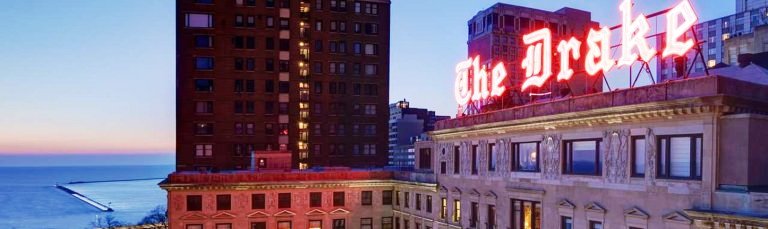
My first NPE conference, in 2015, was held in the historic Drake Hotel on the shore of Lake Michigan. I had been reading blogs by Diane Ravitch, Mercedes Schneider and Anthony Cody. They were all there. In fact, when I arrived the quite tall Cody was walking down a staircase to greet new arrivals. This got my conference off to a thrilling start. Yong Zhao, the keynote speaker, was amazing plus I personally met Deborah Meier and NEA president, Lily Eskelsen García. Always close to my heart will be the wonderful and all too short relationship I developed with our host, Karen Lewis.
Raleigh 2016
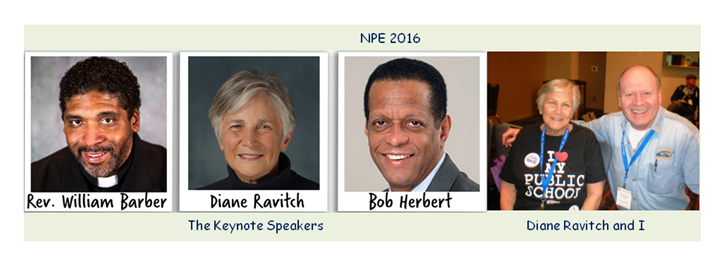
In Raleigh, I met Andrea Gabor, who was working on a book that was released in 2018, “After the Education Wars; How Smart Schools Upend the Business of Reform.” She had been an agnostic on charter schools until she went to New Orleans and discovered a mess. The amazing speaker, Rev. William Barber, gave the keynote address. This leader of the “poor people’s campaign” is a truly gifted speaker.
Oakland 2017
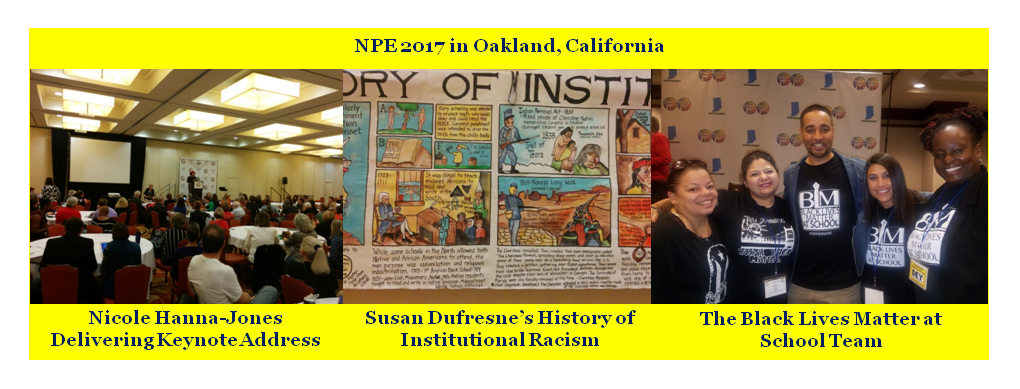
Nicole Hanna-Jones who had just won the MacArthur Foundation genius award and recently published “The 1619 Project” was our keynote speaker. Susan Dufresne lined the walls of the Oakland Marriot’s main conference room with her art depicting institutional racism that was published in book form 6-months later (The History of Institutional Racism in U.S. Public Schools). At a KPFA discussion featuring Diane Ravitch and Dyett High School hunger strike hero, Jitu Brown, I ran into Cindy Martin, then the Superintendent of San Diego Unified School District. She has been the number two at the Department of Education for most of the past four years. Too bad she was not the number one.
Indianapolis 2018
Diane Ravitch opened the conference declaring, “We are the resistance and we are winning!” Finnish educator, Pasi Sahlberg, coined the apt acronym for the worldwide school privatization phenomena by calling it the “Global Education Reform Movement (GERM).” In Indianapolis, we met many new leaders in the resistance like Jesse Hagopian from Seattle. In his introduction, Journey for Justice leader, Jitu Brown, declared, “Jesse is a freedom fighter who happens to be a teacher.” Jesse’s new book “Teach Truth; the Struggle for Antiracist Education” was just released.
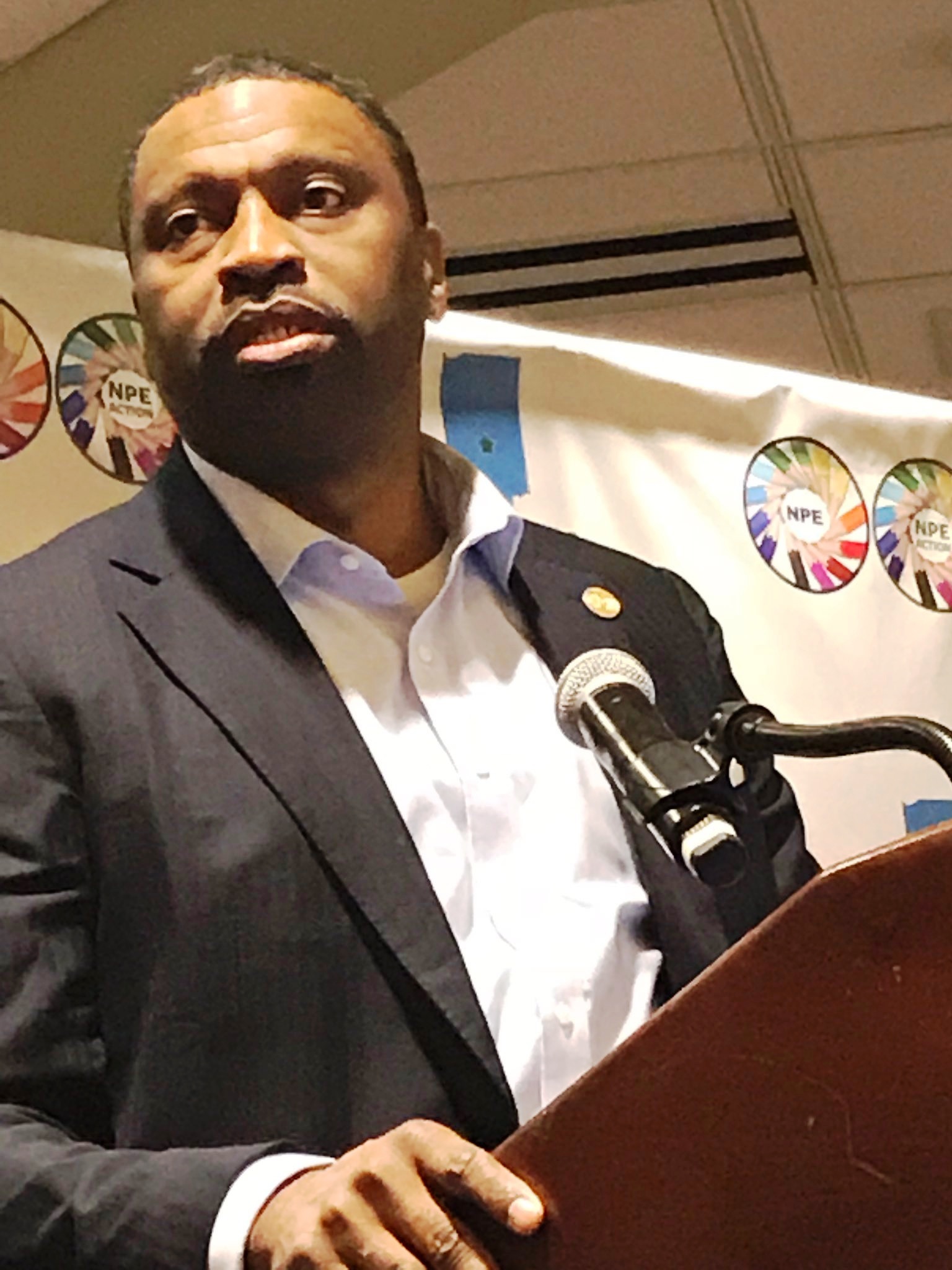
America’s leading civil rights fighter and president of the NAACP, Derrick Johnson, was our keynote speaker. He said the NAACP was not opposed to charter schools, but is calling for a moratorium until there is transparency in their operations and uniformity in terms of requirements is repaired. Derrick noted the NAACP had conducted an in depth national study of charter schools and found a wide range of problems that needed to be fixed before the experiment is continued.
Derrick Johnson, President of NAACP, Speaking at #NPE18Indy – Photo by Anthony Cody
Philadelphia 2022
Like the entire world, NPE activities were seriously interrupted by COVID-19. We were finally able to meet on Broad Street in Philadelphia March 19-20, 2022. This gathering was originally scheduled in 2020. My good friend Darcie Cimarusti, who worked for NPE, called me about joining her for a breakout session on The City Fund, the billionaire founded organization pushing the portfolio model of school management. By 2022, she was so weakened by cancer that I ended up leading the session. Sadly, Darcie passed a few months after the conference.
At the 2022 meeting, we also paid tribute to Phyllis Bush, an NPE founding board member and wonderful person. She was dealing with cancer at the Indianapolis conference and passed some time afterward.
The lunchtime conversation between Diane Ravitch and social activist, musician and actor, Stevie Van Zandt, was special. “Little Stevie” co-founded South Side Johnny and the Asbury Jukes, became a member of the E-Street band with Bruce Springsteen and starred on the Sopranos. It turned out that Diane and Stevie became friends when they were walking a picket line in support of LA teachers.
Ravitch posted afterwards, “I wish you had been in Philly to hear the wonderful “Little Stevie” (formerly the EST band and “The Sopranos”) talk about his love for music, kids, teachers, and arts in the schools at #npe2022philly. Everyone loved his enthusiasm and candor.”
Diane Ravitch and Steven Van Zandt at NPE Philadelphia
Washington DC 2023
October 28-29, 2023, brought the Washington DC NPE conference, a special event. Of particular interest to me was the preconference interview (October 27 evening) of James Harvey by Diane Ravitch. Harvey is known as the author of a “Nation at Risk.” There were so many more of us there than expected; the interview was moved to the old Hilton Hotel’s large conference room. After the change and everyone settled down, Harvey commented, “I remember being at a meeting in this room fifty years ago when we heard that Alexander Butterfield had just testified that there were tapes of the oval office.” There is nothing like being there with people who made and witnessed history.
James also shared that the two famous academics on the panel, Nobel Prize winner, Glen Seaborg, and physicist, Gerald Holton, were the driving forces for politicizing the report. Strangely these two scientists did not come to their anti-public school conclusions based on evidence and they were significant to the reports demeaning public schools using phony data.
Gloria Ladson-Billings from the University of Wisconsin Madison delivered the first Keynote address on Saturday morning. She claimed, “Choice is a synonym for privatization.” And also stated there is money in the public which wealthy elites do not think common people should have. She also noted, “We are in the business of citizen making.” Ladson-Billings indicated that we do not want to go back to normal because it was not that great.
Conclusion
From the beginning, NPE has not sought donations from wealthy elites. The organization is 100% grass roots supported mainly by educators. When it holds a conference, the information has one purpose and that is protecting public education. If you can break free on the first weekend in April and you regard saving public education important, I encourage joining us in Columbus, Ohio for the 2025 NPE conference.




 Diane Ravitch's blog