Archives for category: Vouchers

Ethan DeWitt of the New Hampshire Bulletin and NPR reported on the partisan divide surrounding vouchers. Republicans budgeted for 28 students but expect between 1,000-5,000 to enroll. Democrats worry that the cost of vouchers will spin out of control.

Both should worry that the evidence base for the efficacy of vouchers shows high attrition rates and meager or negative academic results. Furthermore, the voucher advocates repeat the big lie that a state grant of $5,000 will give poor kids the same opportunities as rich kids, whose families pay far more for private schools.

During a two-hour event sponsored by the conservative advocacy organization Club for Growth, DeVos and Pompeo applauded New Hampshire’s initiative. And they framed the effort to allow public money to help students attend private schools as essential to closing the country’s achievement gap when compared to other developed countries.

Here is a link to Pompeo’s speech.

“The same chance”? Not so. Saying it doesn’t make it so.

Representative Mel Myers, Democrat and ranking member of the NH House Education Committee, sent me the following comment:

You have to remember that this voucher policy was slipped into the budget with no public hearing on this bill version. Our House Education Committee heard a similar bill which was tabled after a rigorous challenge on the part of the Democratic members of the committee. During the remote hearing, over 1000 signed up and over 800 were in opposition. Our Governor Chris Sununu and Commissioner of Education Frank Edelblut continue their agenda to dismantle NH education which has always ranked in the top five in the nation.


Rep. Mel Myler

Ranking Dem

House Education Committee

Jeanne Diestch, a former Democratic state senator in New Hampshire, recently wrote about the attention showered on the state’s new voucher program by Republican conservatives like Mike Pompeo, a likely Presidential candidate, and Betsy DeVos. Republicans took control of the New Hampshire legislature until 2020; its Governor, Chris Sununu, is a Republican, and he appointed the state’s commissioner of education, Frank Edelblut, who homeschooled his children. Republicans wasted no time in passing a sweeping voucher bill.

US Conservatives Eyeing NH Vouchers

Diestch wrote in her newsletter:


Why the GOP hates the world’s top education models

When a former Secretary of Education and a future Presidential candidate come to New Hampshire for the rollout of a new state educational policy, you know something important is afoot. The candidate, Mike Pompeo, stated at the event that US schools are falling behind because we have a “public-school monopoly”; adopting NH’s “Education Freedom Accounts” [EFAs] would allow the “free market” to correct this problem. This change is so important to conservatives that the Koch-founded Americans for Prosperity is handing out supportive pamphlets door-to-door in Bedford. So let’s look at three questions:

  1. Why do conservatives want the free market to control education rather than local public-school districts?
  2. Why are so many outside the state so interested in a change inside New Hampshire?
  3. How will all this impact us, the people of the state?

WHY DO CONSERVATIVES WANT FREE-MARKET EDUCATION?
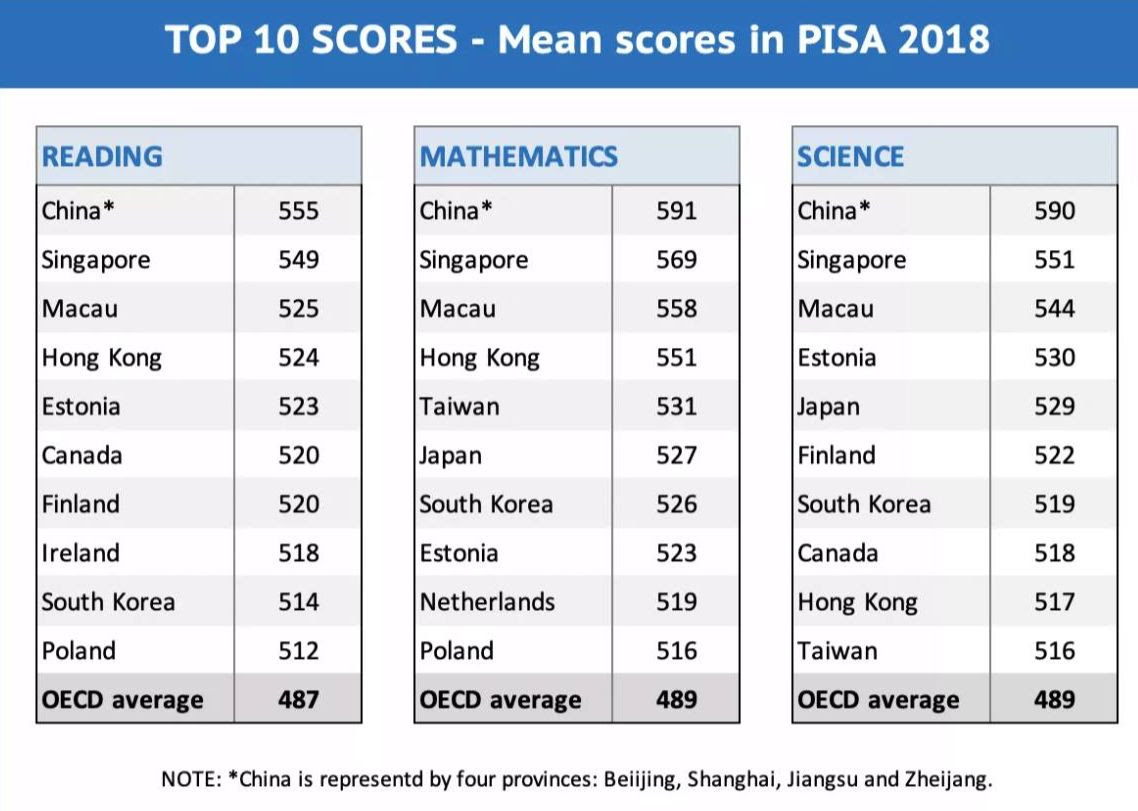
Nations with top education scores all rely on public schools. If the US followed their examples:

  • Teachers would be highly educated, well-paid and respected. In Finland, for example, acceptance for an education degree can be more competitive than medical school.
  • Schools would have shorter vacations, but also shorter school days. In China, elementary students take 90-minute lunch breaks. In Singapore, teachers use the additional time for planning lessons and collaborating on how to improve students’ performance.
  • After the regular school day, learning would continue at home or in tutoring sessions, especially for secondary students. Parents’ role in most successful nations is to ensure children do their three hours or so of assigned homework.

All these top-scoring countries rely on
public-education systems.

(Note that China is not really first; it only submits scores from 4 wealthy provinces.)Why don’t conservatives want to follow these successful models? More school days with highly qualified educators cost more. Companies want to sell high-margin educational software, supported by low-paid trainees, rather than pay education professionals’ salaries. New Hampshire’s EFAs potentially shift millions from public-school teachers and administrators to corporations seeking shareholder profits. In addition, church-based schools are seeking their share of EFAs. Then there is the fact that more-educated people tend to vote Democratic.

WHY SO MANY EYES ARE WATCHING NH EFAS
That is why so many outside New Hampshire are focused on EFAs here. National and international commercial and religious interests will be contributing to Mr. Pompeo and other conservative candidates. Donors hope that if a highly ranked state like New Hampshire can be convinced to hand their taxpayer dollars to unsupervised scholarship funds (see inset below), the rest of the nation will follow.EFAs hide spending detail from taxpayers

EFAs move millions in taxpayer funds from local school board oversight to an independent contractor. The contractor only has to report three things to the Department of Revenue
Administration: amount spent on administration, total number of scholarships, and average scholarship size. The state has no knowledge of who receives how much.
— NH RSA 77 G:5(g)HOW EFAS WILL CHANGE NH
EFAs impact far more than students. When EFAs substitute a $4600 payment for a year of public-school education, someone has to make up the difference. A religious school might charge only $2000 more per year in tuition, but how many low-income households can afford $2000 per child? The upshot is that poor neighborhoods will still need to rely on public schools, but those schools will have fewer per-student dollars to support them. Property taxpayers will have to make up the difference or close schools. The hit will be especially severe in Coos County, where thousands of educators comprise a significant segment of employees. When those schools are forced to close, most educators will move out, worsening Coos towns already dwindling populations and decreasing property values. Our most diverse populations in Manchester and Nashua are also more likely to suffer from the shift in funding caused by EFAs because they have lower incomes. In southern New Hampshire, the census showed that population did increase due to in-state migration. But what families will want to move into a state whose public schools are foundering? The answer is, those families for whom $4600 is enough to send their children to low-tuition religious schools, those families who can already afford expensive private school but would like taxpayers to subsidize them, and those families who want taxpayer funding for parent-guided home education programs. These differ from the workers attracted over the last decade to New Hampshire for its highly rated public schools. How will this affect companies struggling to find employees? No one knows, but the answer will certainly impact our economy.
EFAs will also impact New Hampshire society. Communities forced to close their schools will become less cohesive. Children educated only alongside others with similar backgrounds will have less understanding of the world and their place in it. They will be less able to succeed in the diverse demographics that will make up our nation’s future.
Perhaps conservatives have decided not to follow successful models for improving public education because they do not want the public to be educated. They would prefer people who let corporations and the wealthy take advantage of them, who have been taught to villainize a government that protects public interests.

Carol Burris, executive director of the Network for Public Education, reports the heartening news that support for school choice has declined in the latest poll by EdNext. EdNext is a pro-choice journal funded by the Hoover Institution and of there pro-choice organizations and individuals.

Support for Charters and Vouchers Has Dropped

Despite the myth that the pandemic resulted in an increased appetite for privatized alternatives to public schools, the opposite is true, according to a new poll just published by EdNext. Support for both charter schools and vouchers is down by substantial amounts. Only 33% of all Democrats now support charter schools–that’s an all-time low.  Less than half of all Americans (41%) now support them. Your constant advocacy for public schools and against privatized alternatives is paying off.

Democrats are beginning to see the pattern in the rug: Whatever is being pushed by Betsy DeVos, Charles Koch, the Walton family, and every rightwing foundation is not in the public interest.

Jeff Bryant is a journalist who specializes in education. In a recent issue of The Progressive, he details the many failures of what is falsely called “education reform.” The term for many has been a ruse for privatization via charter schools and vouchers. Instead of “reform,” it should be called disruption and destruction. Bryant leads the Progressive’s Public School Advocate project. This is a good-news story. Ed Reform has no successful strategies or ideas, but it’s billionaire funders and the U.S. Department of Education continue to fund its failed ideas.

He begins:

It was telling that few people noticed when Chicago’s Board of Education announced in late May that it was closing down its school turnaround program and folding the thirty-one campuses operated by a private management company back into the district.

The turnaround program had been a cornerstone of “Renaissance 2010,” the education reform policy led by former Chicago Public Schools Chief Executive Officer Arne Duncan, who became U.S. Secretary of Education during the Obama Administration. As the news outlet Catalyst Chicago reported, Duncan used the core principles of Renaissance 2010 as the basis for “Race to the Top,” his signature policy that he rolled out to the nation.

Race to the Top, a successor to former President George W. Bush’s “No Child Left Behind” program, included holding schools accountable for higher scores on standardized tests, inserting private management companies into district administration, and ramping up charter schools to compete with public schools.

Another news event affecting Chicago public schools that got very little national attention was the decision by the Illinois state legislature to rescind mayoral control of Chicago schools and bring back a democratically elected school board. The plan is backed by the state’s Democratic governor, J.B. Pritzker (and, predictably, opposed by Chicago mayor Lori Lightfoot). For years, prominent Democratic leaders—including New York Governor Andrew Cuomo and former Chicago mayor and previously Obama White House Chief of Staff Rahm Emanuel—touted mayoral control and a rejection of school board governance.

A third story from the Chicago education scene was that, in December, Noble Charter Network, the city’s largest charter school chain, disavowed its “no excuses” approach to educating Black and brown students because of the racist implications. Noble’s decision added to other reports of no-excuses charter chains dropping their harsh behavioral control and discipline policies during the past year.

These stories highlight the waning of three “school improvement” approaches: strict accountability with private management, mayoral control, and no-excuses charter schools. Each approach was among the pillars of “education reform” favored by previous presidential administrations and heartily endorsed by Washington, D.C., policy shops, such as the Center for American Progress.

Taken in unison, the three stories also contribute to the much larger narrative of how the once all-pervasive and generously funded policy movement known as education reform has ended—not with a bang, but a whimper.

Other policy directives of the reform movement that are also being relegated to the dustbin of history include state takeovers of low-performing schools, evaluating teachers based on student test scores, and flunking third-graders who score below a certain threshold on reading exams.

Please open the link and read on.

Some members of the Los Angeles school board are proposing a stealth voucher plan. Unsurprisingly, the United Teachers of Los Angeles opposes the plan.

DeVos-funded consultant pushes internal voucher scheme in LAUSD

This fall UTLA members will be building a vision for how to use the historic infusion of funding to transform education for our students. The privatizers have their own game plan to drive more public dollars to charter operators, and it involves an internal voucher-like scheme connected to Betsy DeVos. Under Trump, Devos’s office funded a grant for an outside consultant to push a competition-based system called Student-Centered Funding in LAUSD.

Basically, funding would move with each student instead of being allocated centrally for staff and programs. It sounds like a good idea when you first hear about it — but in cities like Chicago and Denver, these formulas have led to racially disparate negative consequences, including the loss of libraries and the arts, school closures, and the undermining of school stability, particularly in Black and Brown communities.

The funding scheme was sold in Chicago as a way to achieve greater equity for Black and Brown students, but it’s done the opposite.
Former student Styles Avant-Pinkston lived through a similar scheme — called student-based budgeting in Chicago — that led to under-resourced schools being starved of support and then often shut down. Avant-Pinkston was forced to travel across town to attend a school outside of his neighborhood.


“I shouldn’t have to take a 50-minute bus ride — I should just be able to walk to a good school,” Avant-Pinkston says. “These funding schemes are an attack on kids of color and minority communities. You never hear about schools in wealthy neighborhoods shutting down — they invest in those schools. Schools can be turned around if they see value in doing that — some people just don’t see the value in communities of color. The message is clear: Student-based funding schemes shut down neighborhood schools.”

The LAUSD School Board has yet to vote on the internal voucher scheme, but a decision could come as early as this month. With a highly paid consultant leading the way, the district has fast-tracked the plan, and families and educators have been left out of the discussions and development. Even some Board members have been given little information about this monumental shift in funding.

This internal voucher scheme has destabilized community schools wherever it’s been tried and has not proven to improve student outcomes. If implemented the negative effects would be:

Marketing Over Student Needs: Students would be turned into “backpacks full of cash” and schools forced to compete for market share. With every year a hustle to protect enrollment, school principals would have to prioritize marketing over student needs.

Downward Spiral: Schools that are already struggling with inadequate resources and that serve under-resourced communities would be hit hardest. Every time a student leaves, the school would have even fewer resources to support the students who remain, triggering cuts to staff and essential programs and pushing out other families.

School Closures: Drops in enrollment lead to the closure of neighborhood schools and the destabilization of communities, particularly in Black and Brown neighborhoods. LAUSD has already been targeting small schools like Trinity Elementary in South LA for permanent closure, citing dropping enrollment figures. Closed schools are then handed over to a chapter operator. That trend will accelerate under this internal voucher scheme

Veteran Educators Pushed Aside: The scheme creates incentives to hire lower-salary educators and other staff. That’s what happened in Chicago, where principals are prioritizing hiring less expensive inexperienced teachers over the overwhelmingly Black veteran teaching staff.

Privatization on steroids: LAUSD has told the Department of Education that they plan to allow dollars to follow students to independent charter operators, a further threat to neighborhood schools and the stability of the public school system. The operational funding shift also lays the groundwork for money to eventually follow students to private or religious schools. This is why market reformers from both political parties — from Arne Duncan and Betsy DeVos to ALEC — support the formula: It is an important step down the road to achieving their longtime goal of dismantling our nation’s historic commitment to public education and freeing those dollars for the private sector.

Readers of this blog have followed the advance of privatization of public school funding for nearly a decade. We know the big foundations and individuals that support privatization. We have followed their activities and watched as all of their strategies have failed to match their promises. The great puzzle, to me, is the indifference of the mainstream media. While they cover political scandals of every variety, they are just not interested in the sustained campaign to divert public money to schools there privately managed,to religious schools, to other private schools, and even to homeschooling. The media rightly criticized Betsy DeVos’s crusade for school choice, but as soon as she left office, they lost interest in the issue. Meanwhile, red states are rushing to open more charter schools and fund more vouchers.

Maurice Cunningham explored this issue in a recent post on the blog of the MassPoliticsProfs. He chastises the Boston Globe, but the same complaint could be directed to most mainstream media.

He begins:

Suppose WalMart swept into Boston and spent millions to acquire Market Basket. The town would go ballistic. It would be covered every day in every media outlet, front page of the Boston Globe. But the Walton Family Foundation of Arkansas—the exact same heartless* mercenaries—spends millions of dollars to take over public schools and it gets ignored. Why is that?

He discusses “Hidden Politics” and “the Politics of Pretending.” He has written frequently about astroturf groups and how they present themselves to a gullible media as authentic spokesmen for parents or for some other groups.

That’s the PR facade, he says. What really matters is: who is funding these groups? Why doesn’t the media care?

I always thought that if out-of-state billionaires could be proven to have entered the state using local fronts to change Massachusetts education policy that would be a great, great, great story. I’ve been proven wrong again, and again, and again. I still think it’s a great story, it’s just a great story that only gets told at a small political science blog. Why is that?

Why is that?

Peter Greene has written a powerful case against the argument of the school choice lobby, who insist that children should choose a school that affirms their parents’ values. The choice lobby says that it causes conflict when students go to school with others who don’t share their worldview and challenge their beliefs.

Greene refutes this assertion:

The argument here, pushed daily on Twitter by Cato’s Neal McClusky, is that “public schools leave people no choice but to be at each others’ throats” and that the system leaves no choice but to either ban or impose policies and ideas. Therefor, the argument goes, school choice offers a chance to make all the conflict go away. Folks over here can choose a school that actively pursues diversity and anti-racists policies, while folks over here can choose a school that actively blocks such policies. Allowing diverse school approaches will, the argument goes, somehow reduce the conflicts currently tearing at the social fabric of our country

So first we get a school that separates from the original public district so that it can keep out all sorts of diversity and anti-racist programs. But then that school splits over a conflict about whether or not to teach creationism. Then the creationism school splits over an argument about which books to ban from the school library, and then that school splits over policies regarding LGBTQ+ students. The continued spinning off of entities based on new policy disputes will be familiar to anyone who knows the Protestant church. Meanwhile, many parents will factor in location and student body demographics for their decisions, and of the many schools spun off to “settle” the various disputes, half will fold because they don’t make enough money. 

In the end, “Well, if they don’t like that policy, they’ll be able to choose a school with which they agree,” will turn out to be a false promise.

Some choices are not healthy.

We have seen the use of school choice to avoid conflict before. After Brown v. Board of Education, lots of folks decided they had a problem sending their white children to school with Black students, and they “solved” that conflict by creating schools that let them choose segregation. When it comes to the current CRT panic, there may well be some schools that have gone a step too far with their anti-racist work (though–plot twist–those schools keep turning out to be not public ones). But an awful lot of the panic is fueled by folks opportunistically whipping up some good old-fashioned white outrage over encroaching Blackness, and we’ve been here before.

Some choices are not good for the country. We do not benefit from having a bunch of white kids taught that slavery wasn’t so bad and the Civil War was just about state’s rights. We do not benefit from having students taught that science isn’t real. We do not benefit from having students taught that Trump is really still President and 1/6 was just some unruly tourists. And we so very much don’t benefit as a society from schools that segregate both students and content based on race. Not all possible choices should be available. 

Bubbles do not banish conflict.

I agree with the part of the premise that says, more or less, “Holy crap, but we are spending a lot of time arguing bitterly and separating ourselves into chasm-separated camps!” What I don’t get, at all, is how separating the children of these warring factions into their own separate education bubbles is going to help. How will having been immersed in nothing but the particular view of their parents’ camp prepare them to be workers, neighbors, and citizens in a society where other people with other views exist. 

Upon graduation, will they proceed to a college or trade school that is also designed to strictly fit with their parents’ beliefs? And then will they search, diploma in hand. for employers who also embrace only the world view that these well-bubbled citizens have been taught is the One True View? 

How does growing up in a bubble prepare you for life outside it–particularly if your bubble teaches things that are neither nuanced or accurate views. 

Greene has much more to say about why it’s wrong and unhealthy for society to encourage growing up in a bubble, where the only people you meet agree with you.

Open the link. Read on.

Chris Lubienski is a professor of education policy at Indiana University. He wrote recently with Amanda Potterton and Joe Malin about the deceptive rhetoric of school choice rhetoric. Thirty years ago, the school choice movement boasted that charters and vouchers would “save poor children from failing public schools.” They claimed that private schools outperform public schools. Now we know that school choice does not produce academic improvement for students; that many pick their students and discriminate against the children they don’t want. “Success” for school choice means expansion of charters and vouchers, not better education for students.

Last week, Forbes magazine published an article on how “School Choice Keeps Winning.” Interestingly, “winning” isn’t defined as helping kids learn. Indeed, the article avoids that issue because evidence indicates that school choice is actually failing on that front. Instead, Forbes uses the term to celebrate the expansion of choice programs in many GOP-led states.

The language used in the Forbes article reflects a rhetorical strategy that school choice advocates have adopted in recent years. We (Joe Malin, Amanda Potterton, and Chris Lubienski) analyzed how language favoring educational choice is increasingly shaping U.S. educational policy for a new article published in the journal, Kappa Delta Pi Record. Key features of some dominant narratives include shifting the focus away from academic results (where choice advocates had, for years, insisted there were great gains). Instead, in view of a slew of recent studies showing students in choice programs experience a relative decline in learning gains, choice advocates like Betsy DeVos and Donald Trump have been moving the goalposts to focus on personal narratives and claims of school choice as “liberty,” “freedom,” or a “civil right.” Public schooling is often framed as a “failing” enterprise, and thus a burden on the taxpayer and on poor families. This language often implies that education should be organized like a “business,” with families as “consumers” of the privatized benefits of schooling.

But we also note emergent, counter-narratives which support and envision a strong, broadly supported public education system. For example, in 2019 in Kentucky, superintendents joined together to oppose a bill that would create a scholarship tax-credit program for private schools. They engaged in urgent news press gatherings and via social media to highlight the importance of adequate funding for the state’s public schools. One superintendent said:

We’re all in this business to help students, we are in public education. And it’s a very simple fact that over the last ten years the percentage of funding from the state has continued to dwindle. The burden on local school districts has continued to increase. Teachers feel it the same that we feel it. Every one of our employees feels it. So, we feel very passionate and we’re all very united for this idea that we cannot continue to allow the state to siphon funds away from public education.

Another superintendent, illustrating real-time funding concerns they have, said:

You need to prepare and provide for all of our students, all of our learners, and 21st century learning is much more diverse than what it was 20 years ago. So to provide them specific needs at the expense of another funding mechanism or while we are losing specific funding streams has made it difficult. We are faced a choice: do we keep Read to Achieve or do we buy textbooks? Do we buy textbooks or do we offer in-house professional development? Those are difficult decisions, decisions that have been made, will continue to be made by myself and colleagues, to benefit our children. But it’s beginning to become very difficult, because you are getting to the meat of services to kids, and when that becomes a problem it inhibits their learning, it inhibits their opportunities, it disallows us to create additional avenues that they would be interested in pursuing, be it career choices or whatnot. So, it does become a very problematic scheme when you look at it in that way.

And this was all before the pandemic. So, now in 2021, we believe these concerns regarding public school funding are clearly still relevant.

The analysis finishes with talking about what lies ahead and why words matter in policy and practice amid continued, evolving efforts by some to further privatize public resources.

The recently published article is available here. If you can’t gain full access, a pre-print version is also available here — or, feel free to email Joe at malinjr@miamioh.edu

Citation

Malin, J. R., Potterton, A. U., & Lubienski, C. (2021). Language matters: K-12 choice-favoring and public-favoring stories. Kappa Delta Pi Record, 57(3), 104-109. https://doi.org/10.1080/00228958.2021.1935175
Bruce D. Baker is a school finance expert at Rutgers University. He writes here that the changing legal status of religious schools opens the door to taxing churches.

He begins:

On June 30th 2020, the U.S. Supreme Court determined that if a state has a program of providing public financing for private entities to provide educational services, that program cannot exclude from participation any institution simply because that institution is religious (see Espinoza v. Montana Department of Revenue). The decision involved a taxpayer financed tuition tax credit program providing vouchers for children to attend private schools, which under the state’s constitution (Blaine amendment), prohibited use of those vouchers at religious schools. This decision followed an earlier SCOTUS decision that prohibited Missouri from excluding religious institutions from access to a publicly financed program for playground refurbishing. These cases combined reverse a long history of state enforced Blaine Amendments which excluded the use of taxpayer dollars for religious institutions, even where taxpayer dollars were available to other private providers.

Of course, one difficulty with such provisions is having the government play any role in defining what is, or isn’t religion, when determining whether a tax benefit or public financing should be bestowed on an institution. Jedi? Religion! Church of the Flying Spaghetti Monster? Religion!

If a state cannot exclude from access to taxpayer resources institutions simply because they are religious, a state also cannot exclude from taxation, institutions simply because they are religious. Indeed, to the extent that properties on which private schools operate are exempt, then this exemption would also apply to properties on which private religious schools operate. But the exemption would not extend to the church itself, or for example, rectories, religious retreats or other lands and buildings used solely for “religious” activities, including worship. The state cannot define religious activity in-and-of-itself to qualify as public service because the state should not be in the business of defining “religion,” and bestowing differential benefits on that basis alone.

The voucher movement should be dead, in light of the numerous evaluations showing that voucher schools do not get better results than public schoools, and in many evaluations, voucher students lose ground compared to their peers in public schools.

The GOP is determined to siphon public dollars away from public schools and send them to religious schools.

Missouri Governor Parson just signed a voucher bill that will allow students to attend low-cost private and religious school while reducing the state’s revenues and reducing funding for public schools.

This is choice for the sake of choice, not for the benefit of students. This is the Betsy DeVos model.

The Associated Press reports:

Missouri students as soon as next year could have access to scholarships for private school through a new tax credit program signed Wednesday by Gov. Mike Parson.

Under the voucher-style program, private donors would give money to nonprofits that in turn would dole out the scholarships. The money could be used for private school tuition, transportation to school, extra tutoring and other education-related expenses.

Donors to the program would get state tax credits equal to the amount they give, an indirect way to divert state tax dollars to private education.

Parson’s signature represents a long-sought victory for primarily GOP advocates of so-called school choice legislation, which has struggled to gain traction with Missouri Republicans in rural areas where public schools likely would be students’ only option regardless of changes in state law.

“This legislation will empower students and parents with access to resources and educational opportunities that best meet the individual needs of their child,” Sen. Andrew Koenig, a suburban St. Louis Republican, said in a statement.

Critics of school voucher programs have said they funnel money away from public schools by drawing students out of those districts, leading to a drop in attendance and a subsequent drop in funding.

“Missouri is 49th in the country in average starting teachers’ salaries,” Melissa Randol, who heads the Missouri School Boards’ Association, said in a statement. “We need to invest in Missouri’s high quality teachers, rather than funnel money to institutions that have no accountability to taxpayers for how they spend taxpayers’ dollars or how they educate our children.”

Only K-12 students in the state’s largest cities — those with at least 30,000 residents — would be able to get the scholarships. That includes St. Louis, Kansas City and many of their suburbs. It also covers Springfield, Columbia, Cape Girardeau, Jefferson City, Joplin and St. Joseph.

https://www.newstribune.com/news/news/story/2021/jul/15/missouri-governor-signs-school-voucher-bill-into-law/879201/