Archives for category: Vouchers

Tennessee is the next target for voucher advocates.

The far-right American Federation For Children has poured $800,000 into an ad campaign for vouchers. This is the same organization that honored Governor Scott Walker and Michelle Rhee in 2011, the year that Walker went after the teacher unions in Wisconsin.

The voucher campaign has the support of the governor and the state commissioner of education, Kevin Huffman, who is one of the “leaders” produced by Teach for America. And also Rhee’s ex-husband.

It is useful every so often to review the list of organizations that are funded by the ultra-rightwing Walton Foundation. This past year, the foundation gave out $158 million for “education reform.” As you will see, almost all of that money went to support charter schools and vouchers and organizations that advocate for privatization.

Of course, this is the foundation’s list of grants, and it does not include the millions of dollars that the members of the Walton family have poured into privatization campaigns and elections in Georgia, Washington State, and elsewhere.

Last fall, a state court in Louisiana ruled that it was unconstitutional for the state to pay for vouchers by taking dollars from the Minimum Foundation Program. The state constitution says the money is for public schools only. Judge Tim Kelley, a Republican, ruled that private and religious schools are not “public schools.” He wrote: ““While the Court does not dispute the serious nature of these proceedings nor the impact and potential effects on Louisiana’s educational systems, vital public dollars raised and allocated for public schools through the MFP cannot be lawfully diverted to nonpublic schools or entities.”  

Governor Bobby Jindal and his faithful State Commissioner (ex-TFA) John White immediately sought a way to circumvent the court ruling.

Not willing to wait for a judge to rule on the state’s appeal, they now say that the public funding will go to districts, which will be expected to fund vouchers.

Nothing will slow Jindal and White’s efforts to privatize the state’s public schools, not the state constitution and not a court decision.

Mercedes Schneider nails it when she says this is nothing less than a “money-laundering scheme.” 

And the Louisiana School Boards Association denounced John White’s effort to circumvent the court’s ruling and the state constitution.

The Louisiana Federation of Teachers said that White’s proposal is “an attempted end run around the State Constitution.”

Steve Monaghan of the LFT said, “This is simply a dodge, but it isn’t artful,” he continued. “The simple fact is that if it is illegal for the state to spend MFP funds on private and religious schools, it would also be illegal for local school districts to do the same thing.”

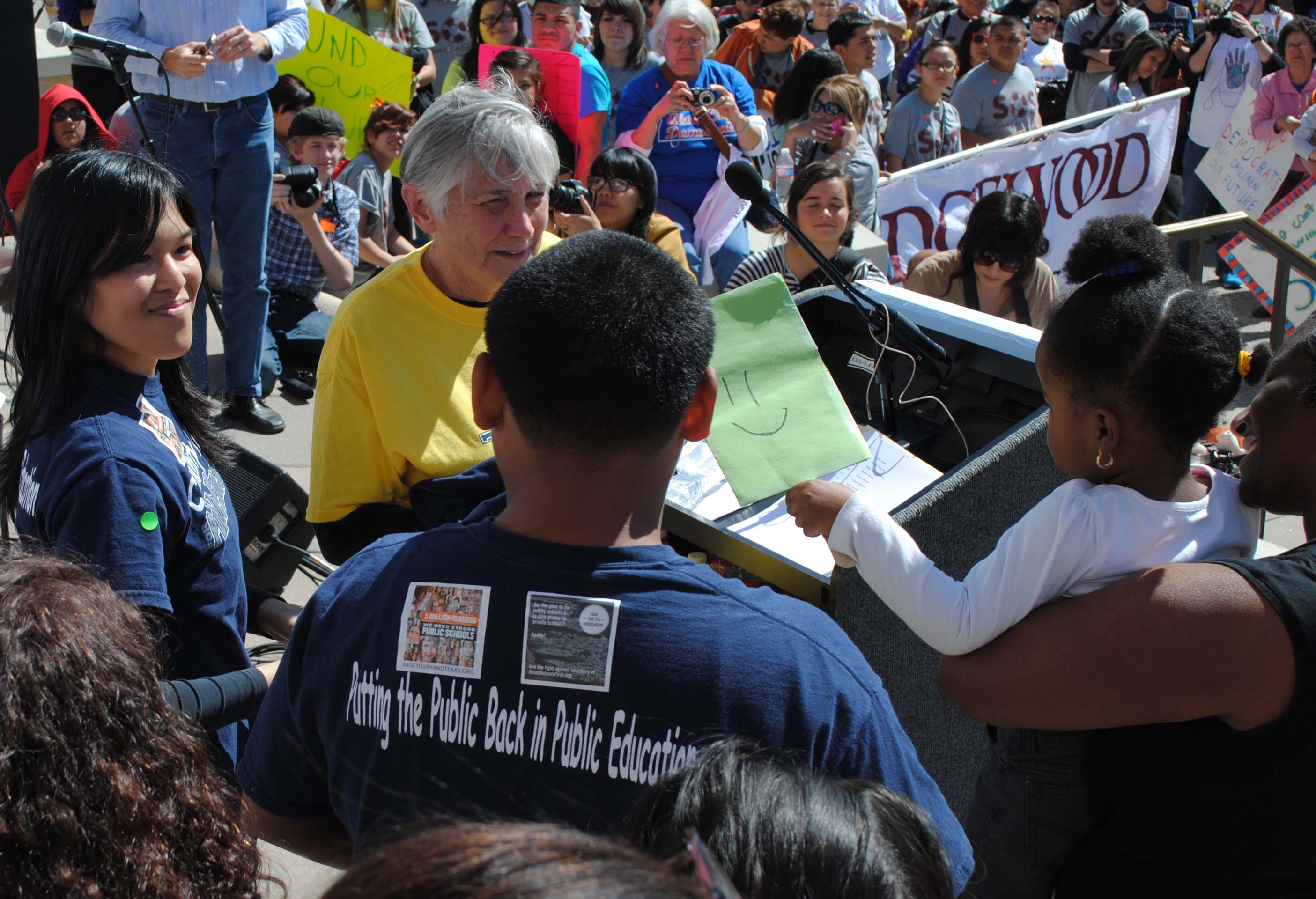
Kim Burkett went to Austin with her children to speak out for public schools and her community.

She noticed there were two different rallies. On one side of the building was a school choice rally, advocating for vouchers, attended by 30 people, including lobbyists.

On the other side were thousands of parents, students, grandparents, and educators.

Read her account. It gives a good portrait of the battle not only in Texas, but in many states.

When I was in Texas last week, several people–including state legislators–told me that they believe that rural Republicans will join Democrats in voting down vouchers. The rural Republicans know that vouchers would kill their local public schools, and they don’t believe that would be right.

Something similar may be happening in Wisconsin. Governor Scott Walker is eager to expand vouchers to new parts of the state, and Republican Senators are less than enthusiastic. Some say they want any voucher program to be subject to a local referendum, but Walker stoutly refuses. He must know that voters have never approved a voucher program. Other Republicans are undoubtedly concerned about how vouchers will affect their community schools. Of coure, Governor Walker wants vouchers for children with disabilities, which is an ALEC bill. The reality is that children with disabilities have better programs and more constitutional protections in public schools than in private and religious schools.

The fact that Republicans are pushing back against vouchers is good news.

these photos were taken by retired Texas teacher Steve Coyle.

download5

download6

download7

download8

Each year, the National Education Policy Center at the University of Colorado presents its annual Bunkum awards.

These are awards that acknowledge the very worst think tank reports of the year.

Be sure to review previous winners of this not exactly coveted dishonor.

Drum roll, please!

The “Three’s a Harm” award goes to…(open the envelope)…the Friedman Foundation!

Here is a quote from the ceremony itself:

“After being shut out of the 2010 and 2011 Bunkum Awards, four-time winner Friedman has returned in spectacular fashion. Seldom does a report hit the “trifecta:”

  • Erroneous information
  • Faulty reasoning
  • Inspired chutzpah

The problems begin with the report’s claims that test scores and dropouts have not shown any visible improvement between 1992 and 2009, during which time school staffing increased 2.3 times. Even setting aside problems with the staffing claim itself, our reviewer points out that the report’s fundamental premises asserting no improvements in test scores and an increase in the drop-out rate are flat wrong. In reality, there has been clear improvement in NAEP scores for all student subgroups, particularly students of color and younger students. And despite the change to a more stringent definition of drop-outs, graduation rates have increased, helping to raise college attendance to historic highs.

Soaring on the wings of flawed reasoning, with a strong updraft of chutzpah, the report’s author jumps from his platform of sham evidence to deliver three unsupported recommendations: a call for class size increases, a call for cuts in administrative and teaching staff and a call for increased school choice. As our reviewer points out, US public school class sizes are larger than those in our “competitor” OECD countries and are, in fact, larger than the idealized and attractive small classes in the private schools the Friedman Foundation touts. Small class sizes are apparently only bad and wasteful when they are in public schools. Similarly, there is the inconvenience that charter schools divert a higher proportion of their spending into administrative largesse.”

Accordingly, not only does the report’s call for increased school choice have no visible relation to the data, it undermines two other recommendations from the same report. It uses bogus information to draw ungrounded causal conclusions that in turn lead to an unsupported series of recommendations that are in conflict with one another. Our judges were amazed.”


The second Bunkum award is titled: “The ‘Trust Us, There’s a Pro-Voucher Result Hiding in Here Somewhere.”

Another drum roll! Among many contenders, the winner is: The Brookings Institution and Harvard University’s Program on Education Policy and Governance for “The Effects of School Vouchers on College Enrollment: Experimental Evidence from New York City.”

Again, to quote from the citation for the award:

“These authors wander aimlessly around a data wilderness, searching for positive evidence about school vouchers. Their report attempts to make the case that New York City partial vouchers of $1,400 per year to attend private elementary schools for three years had later positive impacts on college attendance, full-time college enrollment and attendance at selective colleges for African American students. It received lavish media attention, including a foot-stomping commentary by the report’s authors in the Wall Street Journal that scolds President Obama for what they regard as his outrageous failure to line up behind voucher policies.

To help understand the problems with this report, let’s all mentally travel to Sunnyside, Nevada, which hit a high temperature of only 14°F on January 17, 2012. Even while the world was experiencing record heat, Sunnyside posted a record cold for that date. If we wanted to distract attention from overall warming trends, we might lead with this and other cherry-picked data. It’s an old trick that often works, if nobody pays attention to the overall trends and if nobody questions the cherry-picking.

Yet this is essentially the approach used by the Bunkum-winning Brookings report, which finds positive college-related impacts for African American students (but not for other students) who had received vouchers back in elementary school. The researchers, of course, had no a priori reason to think that African Americans would benefit in this way from vouchers, when other students do not. They simply explored the data, found lots of results showing no voucher benefits and then found this one (akin to Sunnyside, Nevada) that helped support their advocacy of vouchers…Buried on p. 12 of the report is the statement that for the total sample, there was “a tiny insignificant impact.” As for the claims of a positive effect on college attendance of African Americans, there were no statistical differences between ethnic groups. Yet the authors chose to trumpet a positive effect for African Americans.”

The third award–the “Noblesse Oblige” award– went to the Public Agenda Foundation for its report “What’s Trust Got to Do With It?”

In this bizarre report, Public Agenda recognized that parents don’t like it when their local public schools are closed, but they need to be “educated” to what is best for them. Or as the award committee wrote:

“Reading this report, one learns about a problem that few of us knew existed. Apparently, there is a great deal of confusion in disadvantaged communities where wealthy strangers have arrived laden with school-turnaround gifts. The patrons of these communities are inexplicably and unjustifiably seen as patronizing—or even as destructive intruders. Fortunately, the Public Agenda Foundation has stepped up with this report which outlines ways to help members of these communities to get their minds right.

The report examines why citizens have proprietary attitudes toward their community school and why they resist external “change agents” who are intent on improving those schools for the citizens’ own good.

In the view of this report, these uninformed and parochial parent attitudes are obstacles to the re-making and improvement of community schools. According to its authors, “Many parents do not realize how brutally inadequate local schools are.” As a result of their ignorance, parents have raised irrational and unwise objections to firing teachers due to low test scores or to their school being closed, privatized, broken-up.”

The “Scary Black Straw Man” Award goes to: The Center of the American Experiment for “Our Immense Achievement Gap: Embracing Proven Remedies While Avoiding a Race-Based Recipe for Disaster.”

The Awards Committee wrote:

“The nature of this irredeemably awful report is betrayed in the title, which seeks to alert readers to the evidently toxic combination of policy ingredients that, in the fevered imagination of the authors, amounts to a “race-based recipe for disaster.” Moreover, the imagined carnage would not be confined to the kitchen. In the apocalyptic metaphorical landscape of this report, aspects of our transportation system are also at risk: A “train wreck” resulting in massive “liabilities” of “billions of dollars” is the likely result of state policymakers colluding, in their promotion of race-based school reform policies, with advocates for busing and school funding. Our judges quickly checked the acknowledgements section to see if Chicken Little was listed as an advisor.

This exercise in hysteria was precipitated by a Minnesota Department of Education report on concentrated poverty and segregation, along with three other reports published by equity-focused organizations. These reports suggest policies such as a continuation of existing pro-diversity efforts, establishment of state standards for when equity could be considered achieved, a sharper focus on existing programs, and the encouragement of voluntary fair housing and magnet school programs.”

There you have it, folks. More evidence of advocacy disguised as research.

My one disappointment in the awards ceremony was that I was hoping that the Brookings Institution would win special recognition for firing me last June because I was “inactive.” As it happened, on the same day I was fired, my latest book was #1 in social policy on amazon.com, a statistic that often shows a high level of activity.




Despite the fact that a Louisiana judge struck down the funding for the state’s voucher program, State Superintendent John White expressed confidence that the state would find a way to pay for it and that the numbers who leave public schools for religious schools with public funding will increase.

Although nearly half a million students were eligible this current year, only about 5,000 currently are using a voucher to attend a nonpublic school.

White did not address whether the state will continue to fund schools that do not teach accurate or modern science, mathematics or history.

Nor did he mention whether teachers in voucher schools will need to be certified, as they are not now.

John White is one of the national leaders that Teach for America produced.

He is determined to leave a legacy in Louisiana of vouchers, charters, and an impoverished public school system.

Some legacy.

Maybe his next job might be at ALEC or the Walton Foundation.

A reader who is a parent in Wisconsin notes that the far-right group American Federation for Children is reaching out to disability groups to get their support for vouchers. AFS is committed to privatization, and they know full well that vouchers for special education students is a first step. It is also high on ALEC’s agenda. It arises not from concern for the students, whose rights are protected by federal law in public schools, but out of concern for their own political agenda, which is anti-public education, anti-union, and anti-professionalism.

Writes the reader:

More about Wisconsin and vouchers — I and two other parents of students with disabilities have just had a column published in Wisconsin’s Capital Times:

http://host.madison.com/news/opinion/column/parents-why-we-must-stop-special-needs-vouchers/article_1d0779cc-151a-53d2-b575-62de8feadfbe.html

Amanda’s link above, about expanded vouchers expected to be part of the budget plan, also holds true for special needs vouchers, although the Walker administration has been silent on that aspect so far. Just this week, however, the national American Federation for Children lobby has begun contacting disability groups across Wisconsin, with a pitch for putting the vouchers INTO the budget.

This although no statewide disability group in Wisconsin is asking for these vouchers, and we particularly DON’T want them in the budget where they wouldn’t get a separate public hearing. Such a controversial statewide policy change, full of problems and pitfalls, must be debated and exposed and voted on separately!

Stop Special Needs Vouchers, a statewide grassroots group led by families of students with disabilities, is spreading the word: we need to keep special needs education strong in Wisconsin public schools. We’re on Facebook at https://www.facebook.com/StopSpecialNeedsVouchers — please join us!

Why do we have public schools? Would we be better off, as certain reformers now think, if everyone had school choice and went to a charter or used a voucher to go to a private or religious school?

Do we need public schools?

I asked Carol Burris, principal of South Side High School in Rockville Center, New York, how she would answer these questions.

How would you answer?

This is what Carol wrote:

“When I think of the purpose of public schooling I always think of Dewey’s famous phrase that is stenciled into the entrance wall of Teacher’s College ““Schools are the fundamental method of social progress and reform” (Dewey,1897). I believe that these words are as true today as when they were first included in John Dewey’s “Pedagogic Creed” .

“There is a compact that exists between a community and its public school. It is a promise that the school will teach every child that passes through its doors—poor children, affluent children, children with disabilities and children who show great academic promise. The common public school is required to teach the easy to teach and the difficult to teach. The common public school is there for the student with strong parent advocates and for the child who is, for all practical purposes, alone.

“Most important of all, it is where such children meet and sit side by side in classrooms, on bleachers and in cafeterias. They learn from each other as surely as they learn from their teacher. That social learning is also what gives rise to the promise of social progress and social reform.

“I attended a private high school where I met children who looked like me, thought like me and prayed liked me. It was a good school, but I did not have as rich an experience as the public school students who attend my school. There were no students with substantial learning disabilities in my high school. It was a test-in school so no one struggled with academics. Only two of the students who attended were Black, and none of the students were poor. There was learning that I missed during my teenage years. I am glad we sent our daughters to public school.

“Charters and privates are not designed to serve all students—they are designed to serve students who are more like each other than not. Although there may be some diversity, those who are truly different either never apply, are never accepted or are counseled out. . One has to only look at New York City Schools, which are becoming more segregated and stratified by income than ever before, to understand the outcome of charters, selection policies and choice.

“We can take the easy road that leads to improvement for some kids at the expense of others, or the more difficult road that will improve education for all kids. Without vibrant, supported public schools, the second option does not have a chance.”

Carol