Archives for category: Virtual Charter Schools

I have posted many times over the years about the giant fraud called the Electronic Classroom of Tomorrow in Ohio, or ECOT. Ohio doesn’t permit for-profit charters, yet ECOT was set up–like many “nonprofit charters”–to produce huge profits for its owner, William Lager, who owned companies with which ECOT contracted. Lager opened ECOT in 2001, and it was closed down in January of 2018 after collecting about $1 billion from the state. It was the largest school in the state. Lager gave generous contributions to politicians, mostly to Republicans, and in exchange, his school was never held accountable or audited. After a major expose in the New York Times showing that ECOT had the lowest graduation rate of any school in the nation and that Lager’s related companies were making large profits by providing goods and services to the school, Ohio officials began to take a closer look at ECOT. The major newspapers in Ohio began to criticize the cushy political deal that enriched Lager and delivered a subpar education to thousands of students.

When the State Auditor Dave Yost (who had received campaign gifts from Lager) conducted an audit, ECOT could not account for students it claimed. ECOT said in court that a student should be counted even if they didn’t get any instruction. The state tried to “claw back” $80 million for only the last two years of ECOT’s operation, ECOT chose to go bankrupt instead. Since 2001, ECOT has collected over $1 billion from the state of Ohio, all of it money that was subtracted from the state’s public schools, but ended up instead in the pockets of Lager and his friends in high political office.

What is striking is how little it cost to buy the Republicans! For a few thousand dollars in campaign contributions, they let this guy take hundreds of millions away from public schools.

Here are some examples of ECOT pay for protection from accountability:

see here.

Andrew Brenner, chair of the House Education Committee (who says public education is “socialism”) was a Lager favorite. He didn’t “take a dime” from ECOT, but he took lots of dimes from Lager.

Kasich has received over $30,000 for his campaigns from Lager, along with key legislative leaders. Kasich gave the ECOT commencement speech in 2011.

The state auditor got Lager cash and spoke three times at ECOT graduation ceremonies. Jeb Bush gave the commencement address to ECOT graduates in 2010.

Here is the most recent list of the candidates who received campaign gifts from Lager.

This is the background of the names on this list:

Looking at the list, here are the backgrounds of the top five individuals in the order that they appear.

1. Cheryl Grossman, former Ohio House Majority Whip
2. William Batchelder, former Ohio House Speaker who later became a lobbyist for Lager and other charters https://janresseger.wordpress.com/2015/02/27/ohios-term-limited-house-speaker-becomes-lobbyist-for-notorious-charter-operator/
3. Matt Huffman, currently Ohio state senator
4. Barbara Sears, former Ohio House Majority Floor Leader
5. Jim Buchy, former Ohio House member

Other noteworthy pols on the list include
Jon Husted, Secretary of State now running for Lieutenant Governor
Cliff Rosenberger, former Ohio House Speaker who went on an all-expense trip paid by the Niagara Foundation, part of the Gulen chain. His home was raided by the FBI just two months ago! https://www.daytondailynews.com/news/fbi-agents-are-rosenberger-house-and-storage-unit/u8X9Apyx9g3rs0u63n3mBL/
Josh Mandel, Ohio Treasurer
Andrew Brenner, Chair, House Education Committee currently running for Ohio Senate
Shannon Jones, former Ohio senator and author of the notorious SB5, which was designed to strip public employees of their collective bargaining rights. http://action.weareohio.com/page/content/sb5history/
Mike Dewine, currently Ohio Attorney General and candidate for Governor (running with Jon Husted – above)
Mary Taylor, currently Ohio Lieutenant Governor – defeated by DeWine in the Republican primary in May)
Dave Yost, currently Ohio Auditor of State now running for Attorney General. COULDN’T MAKE THIS ONE UP – Yost gave ECOT an Excellence in Bookeeping Award in 2016. He also was an ECOT commencement speaker: https://ohiodems.org/today-ohio-history-dave-yost-gives-ecot-third-award-bookkeeping-2016/
Troy Balderson, currently member of Ohio House and candidate for Congress.

Jan Resseger brings the story up to date in this post.

Here is how the Ohio Supreme Court hearing—five months ago today—concluded, according to the Columbus Dispatch‘s Jim Siegel: “As ECOT attorney Marion Little finished his arguments for why, under the law, the online school should get full funding for students even if they only log in once a month and do no work, Chief Justice Maureen O’Connor interjected. ‘How is that not absurd?’”

Now, you would think that by now the Ohio Supreme Court could have arrived at a decision on ECOT’s final appeal to stay in business—a case in which lower courts had found against ECOT at every level. But as citizens of Ohio, we await ECOT’s death without any kind of closure even though we all know that the school has already been shut down—totally. The school’s assets have been sold off in a widely publicized auction and it no longer provides services for students. The Supreme Court decision matters, because ECOT’s officials hope—if the Supreme Court finds for ECOT—the school wouldn’t be required to repay as many tax dollars and because the same officials say they hope to resurrect the school.

In just the past month, as we await the high court’s decision, and the state remains mired in the ECOT scandal: here are some things we’ve been learning.

For the Associated Press, Kantele Franko reports that 2,300 of ECOT’s supposed students are apparently unaccounted for. Nobody knows whether they have dropped out or left the state or perhaps re-enrolled someplace else. Franko explains that a thousand of the students were likely 18 years of age or older, but that 1,300 were school-age youngsters who ought to be considered truant if they are not re-enrolled. Franko quotes Peggy Lehner, chair of the Ohio Senate Education Committee: “I think this just illustrates the whole problem that we’ve had with ECOT… You not only can’t tell how long the students signed on, you can’t even tell for sure if they even exist, so I am not surprised that there are students that they can’t track.” So far, however, the Ohio Legislature hasn’t passed any new laws to better regulate attendance at Ohio’s e-schools.

Thousands of ECOT’s students, at least those who are actual people, have enrolled at another virtual school in the state.

The primary beneficiary of ECOT’s closure and of this new law is Ohio Virtual Academy, a for-profit online school that took in 4,000 ECOT students mid-year. That boosted its enrollment more than 40 percent, along with its income and potential profit. With 12,000 students, the school is now Ohio’s online giant, replacing the mammoth ECOT.” Ohio Virtual Academy is the state’s affiliate of the notorious K12, Inc., a national, for-profit, online-charter empire. The legislation to protect schools serving students abandoned when ECOT closed was added quietly as an amendment to another bill just before the Legislature adjourned for summer break, and was opposed by several prominent Democrats. O’Donnell quotes Toledo Representative Teresa Fedor, the ranking Democrat on the House Education Committee: “Children move in and out of schools because of choice every day. It’s outrageous that Ohio taxpayers have to foot more profits for e-schools and then give them safe harbor.”

To add to the comedy/tragedy, Ohio’s State Attorney General Mike DeWine has suddenly decided it is time to go after Lager and try to recover millions. DeWine is running for governor. The current Governor, John Kasich, protected ECOT for years, as did DeWine.

What everybody wonders is why DeWine, who has been Ohio Attorney General since 2011, only decided to go after ECOT now in the summer of 2018—as he, Ohio’s 2018 Republican candidate for governor, actively campaigns. DeWine claims to have waited until another case set a precedent for cracking down on such conflicts of interest involving a charter school—this time a smaller charter school in Cincinnati. Now, says Mike DeWine, he can be assured that as the State Attorney General he has standing to crack down on charter school fraud.

Clearly, the ECOT scandal has become hot potato for Republican candidates seeking state office in the November 2018 election. Democrats across the state, reminding the public of William Lager’s huge political investments in Republican campaigns over the years, are also reminding voters that key Republicans including Mike DeWine—currently attorney general and Ohio’s Republican gubernatorial candidate in November, and Dave Yost—currently state auditor and Ohio’s Republican candidate for attorney general in November, have been ignoring for years Lager’s compromised position as the founder and agent of nonprofit ECOT who is also making huge profits by steering business to his own for-profit contractors.

Will Ohio’s voters remember in November that the state Republican party enabled Lager to shift $1 billion from their public schools to ECOT?
A former certified public accountant who helped hide the tax evasion by the leader of Pennsylvania’s first cyber charter was sentenced to prison for a year and a day.

The founder of the Pennsylvania Cyber Charter School, Nicholas Trombetta, will be sentenced later this month.

Trombetta scammed $8 million and didn’t pay taxes. By some fluke in the law, he was not charged with theft of public’s money, but only with failing to pay taxes on the money he stole.

The school was the state’s first cyber charter. It had 10,000 students, each producing a revenue of $10,000 to the school. That’s $100 million, just lying around. What was Trombetta to do with all that dough?

Don’t you think the legislature might reconsider the need for regulation and oversight of these sweet deals? No accountability, no transparency, no supervision. Just lots of money.

Imagine if you can, an “online agricultural school” for grades 7-12, where students might occasionally visit a farm, but such visits are not mandatory.

The Fort Wayne Jounal-Gazette, one of Indiana’s best newspapers, wrote an editorial with this example of the wastefulness of school privatization. The editorial was prompted by the NPE-Schott Foundation National Report on privatization. Indiana received a well-deserved grade of F.

The editorial says:

“Indiana’s friendly environment for education privatizers is summed up nicely by an audacious attempt to open an online agriculture charter school for students in grades 7-12. Billing the model as a “real virtual school,” organizers initially said the statewide school would offer occasional farm visits, but they wouldn’t be mandatory.

“The idea of an agriculture program taught entirely online seems ludicrous only if you don’t see the profit potential. Virtual schools are eligible to collect 90 percent of the basic tuition grant for each student enrolled, so the Indiana Agriculture & Technology School – with 100 students now enrolled – was set to collect about $460,000 a year, with limited expenses for instruction, textbooks or equipment. Fortunately, scrutiny of another Indiana virtual school seems to have pushed the state to demand some classes be taught face-to-face. Monthly visits to a Morgan County farm and as little as four hours of computer instruction a day suggest the school won’t be any more successful than the four F-rated online schools now serving about 13,000 Hoosier students, however.

“Indiana’s dismal record for oversight of online charter schools is one reason it earned its own failing grade in a report evaluating the extent to which states divert money from traditional public schools to private schools and charter schools operated by for-profit management companies. The survey, by the Network for Public Education and the Schott Foundation, which might be easily dismissed as biased except that its findings are irrefutable, notes:

• Indiana has three separate programs designed to funnel tax dollars from public schools, at a conservative estimate of $171 million a year. “Indiana law has continued to morph over the years so that prior enrollment in a public school is no longer needed to receive a voucher for private school,” wrote Carol Burris, executive director of the Network for Public Education. “That means that taxpayers are now funding private school tuition previously paid for by parents.”

• Private schools receiving tax dollars are allowed to discriminate against students for whom English is not their first language by not providing services and can discriminate in enrollment on the basis of religion. “It is a system in which the school, not the parent, does the choosing.” Burris wrote in an email.

• Failing charter schools have been allowed to convert to voucher schools, so that they can “continue indefinitely,” Burris wrote.”

Read it all.

I wrote this article, which was posted just online by the Washington Post.

Charters are not “progressive.” They pave the way for vouchers. They divert funding from public schools, which enroll 85% of American students. They are more segregated than public schools. Ninety percent are non-union. The far-right Walton Foundation is spending $200 million a year on charters and Betsy DeVos is currently spending $400 million, which may soon increase to $500 million. The vaunted “high performance” charters have either higher attrition or cherry pick their students.

Our nation is evolving a new dual school system, with one system choosing its students and the other required to find a place for all who apply.

Pennsylvania has many cyber charters. They are all failing schools. The legislature doesn’t care. Two cyber charter operators were arrested and convicted for stealing millions of dollars. One of them–Nicholas Trombetta– is awaiting sentencing for tax evasion on the $8 million he stole from the cyber charter he founded (Pennsylvania Cyber Charter School), the other–June Brown, founder of two cyber charters–was convicted but not sent to jail because the judge accepted her plea that she was too old and frail to be incarcerated (she is younger than me). Trombetta committed a crime by evading taxes, but stealing $8 million from his cyber charter was not a crime under lax Pennsylvania law, according to the article cited here.

Greg Windle writes here about the failure of the Legislature to reign in cyber charter corruption, fraud, waste, and abuse of taxpayers’ dollars.

Even choice advocates are embarrassed by cyber charters, but they keep on going, collecting tax dollars for rotten services.

No cyber charter school in Pennsylvania have ever received a passing academic score from the state, and very few have come close, according to information recently highlighted in a report from the office of Democratic State Rep. James Roebuck of Philadelphia.

Roebuck and other House Democrats have assembled a package of bills that would further regulate charters by reforming how they use reserve funds, rules for leasing buildings, special education payments, contracting, the teacher evaluation system, disclosure in advertising, school building closures, and the transfer of school records. The package would not single out cybers, but other legislation has been introduced that would reduce their per-student reimbursement.

Pennsylvania has 13 cyber charters enrolling more than 34,000 students, or 10 percent of all the cyber students in the country.

These schools are authorized not by local districts, but by the Pennsylvania Department of Education. But districts must send per-pupil payments to cyber charters for each local student they enroll, and the payments are the same as for brick-and-mortar charters, even though cybers have fewer expenses.

This has proven frustrating not only to the districts and other proponents of traditional public schools, but to several groups that favor school choice and charters…

No cyber charter school in Pennsylvania have ever received a passing academic score from the state, and very few have come close, according to information recently highlighted in a report from the office of Democratic State Rep. James Roebuck of Philadelphia.

Roebuck and other House Democrats have assembled a package of bills that would further regulate charters by reforming how they use reserve funds, rules for leasing buildings, special education payments, contracting, the teacher evaluation system, disclosure in advertising, school building closures, and the transfer of school records. The package would not single out cybers, but other legislation has been introduced that would reduce their per-student reimbursement.

Pennsylvania has 13 cyber charters enrolling more than 34,000 students, or 10 percent of all the cyber students in the country.

These schools are authorized not by local districts, but by the Pennsylvania Department of Education. But districts must send per-pupil payments to cyber charters for each local student they enroll, and the payments are the same as for brick-and-mortar charters, even though cybers have fewer expenses.

This has proven frustrating not only to the districts and other proponents of traditional public schools, but to several groups that favor school choice and charters…

It’s been a difficult school year for many U.S. cybers. Ohio’s largest chain was forced to close mid-year, and others closed down in Georgia, Indiana, Nevada, and New Mexico. In the past, it has been rare for states to close cyber charters despite low achievement across the sector and several financial scandals…

Of the 43 states that allow charter schools, only 35 allow cyber charters. The eight that do not are Delaware, Maryland, Massachusetts, New Jersey, New York, Rhode Island, Tennessee, and Virginia. Only 23 of the states that allow cybers have actually authorized any, according to the report from the National Association of Charter School Authorizers. Those states plus Washington D.C. have a total of 135 full-time cyber charter schools.

Cybers make up just 2 percent of all charters in the country.

At its peak, Pennsylvania had 14 cyber charters, more than 10 percent of the nation’s total. However, Education Plus Cyber closed in December 2015 during the state budget crisis after its bank pulled the school’s line of credit. Some staff also alleged financial mismanagement…

Out of the 13 full-time cyber charters in Pennsylvania, educating over 34,000 students, only four have come close to receiving a passing grade of 70. The rest have received the lowest rating on the state’s academic rubric every year….

Larry Feinberg has his own frustrations with cyber charters and gw attributes them to a poorly written charter school law. Feinberg has been a school board member in Haverford Township for over 20 years, is on the board of the Pennsylvania School Board Association, and co-founded the Keystone State Education Coalition — a group that advocates for traditional public education, including stronger regulations on charters.

“Every month in school board meetings, I have to approve payments to cyber charters,” Feinberg said. “Our test scores are 30, 40, 50 points higher than theirs. We never authorized any of them. … They are all authorized by the Pennsylvania Department of Education. That allows them to reach in and take our tax dollars.

“There’s just no way it can cost as much money to educate them without a building and full-time staff. So there’s huge profits to be made.”

This is a refreshing development. Republican legislators in Indiana are asking whether it is time to pull the plug on failing virtual charter schools.

“As a group of state officials convene for the first time Tuesday to examine virtual charter schools, two prominent Indiana Republican lawmakers are calling for the state to intervene in the dismal performance of the schools.

““Whatever we’re doing is not working, because I don’t see where they’re improving,” said Ryan Mishler, chair of the Senate Appropriations Committee, adding, “With a virtual, if you’re failing so many years in a row, maybe we need to look at how long do we let them fail before we say you can’t operate.”

“Mishler and House education chair Bob Behning told Chalkbeat that the oversight of virtual charter schools needs to be addressed, whether through changes to state law or action by the Indiana State Board of Education.

“Indiana will have seven virtual charter schools at the start of the next school year, with three opening in the past year alone and one shutting down amid chronic bad grades. But their academic performance raises questions — four of the five schools graded by the state last year received F ratings.

“Even for students who need a more flexible alternative to traditional brick-and-mortar schools, Mishler said, “If they’re not doing well, if they’re not graduating, how good is it for them?””

Will wonders never cease?

Stephen Dyer, former legislator in Ohio, now a fellow at Innovation Ohio, notes that Ohio’s Republicans are scurrying to denounce ECOT, which is now a criminal investigation. Some are even returning campaigning contributions. How did ECOT manage to survive for nearly 20 years while providing a low-quality education and receiving $1 billion from the state?

Bill Phillis of the Ohio Equity and Adequacy Coalition said in a post today that the owner of for-profit ECOT was very generous in distributing campaign contributions to influential officials. He wrote: The ECOT Man really covered all the bases when doling out campaign funds-county prosecutor, legislators, party caucuses, governors, attorney generals, secretaries of state, state treasurers, supreme court justices and probably other office holders. The money doled out came from tax dollars that should have been used to educate students.

Some Republicans are trying to blame Democrats too, since there was a Democratic governor in 2009. But Dyer points out that Governor Ted Strickland tried to slash the appropriations for e-schools by 70%, and Republicans threatened to block the entire state budget unless the cut was restored.

It’s very simple. Gov. Strickland’s budget that year called for a 70 percent cut for Ohio eSchools. That’s right. If Gov. Strickland’s budget had passed unamended, ECOT funding would have been cut by 70 percent, effectively ending the school 10 years before it actually shut down, which would have saved Ohio taxpayers about $700 million that went to the school since then. Not to mention the lives of thousands of students ECOT failed to graduate.

By the way, of the 3,794 students who actually did graduate ECOT the first year of the 2009 budget, only 109 have college degrees today. Just by way of reference.

However, Ohio Republicans still controlled the Senate during the 2009 budget. I was in those budget negotiations and I can tell you that we were told in no uncertain terms that if the 70 percent cuts stayed in the budget, there would be no budget for the 2009 session — severely crippling Ohio’s potential economic recovery from the Great Recession.

When Dyer ran for re-election, he was targeted for defeat by a group that included ECOT.

The Republicans own this scandalous waste of taxpayer dollars. They should be held accountable.

Good riddance to bad rubbish!

Pennsylvania loves cybercharters even though study after study shows that they get terrible results.

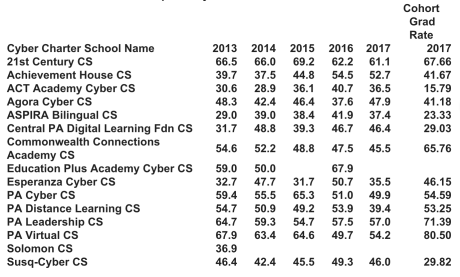
The Keystone State Coalition points out in its latest newsletter that state records demonstrate that none of the state’s 18 cybercharters meets state academic standards.

Do taxpayers care?

Not one of Pennsylvania’s cyber charters has achieved a passing SPP score of 70 in any of the five years that the SPP has been in effect. All 500 school districts are required to send taxpayer dollars to these cyber charters, even though none of them voted to authorize cyber charter schools and most districts have their own inhouse cyber or blended learning programs.
School Performance Profile Scores for PA Cyber Charters 2013-2017
Source: PA Department of Education website

http://www.paschoolperformance.org/

A score of 70 is considered passing.

Total cyber charter tuition paid by PA taxpayers from 500 school districts for 2013, 2014 and 2015 was over $1.2 billion; $393.5 million, $398.8 million and $436.1 million respectively.

Screen Shot 2018-05-23 at 9.09.06 PM


Bill Phillis of the Ohio Coalition for Equity and Adequacy is a steadfast critic of charter schools, which, he says, have absorbed $10 billion in funds that should have gone to Ohio public schools. Now that ECOT is in bankruptcy, the state is trying to claw a few million of the $1 billion that ECOT collected since 2000, when it was founded.

Phillis writes:

Auctions of charter school stuff-another manifestation of tax dollars squandered

The ECOT auction is just another going-out-of-business sale in the charter industry. About 250 charters have closed in Ohio and many have had auctions. These kinds of sales recover only pennies on the dollar.

The ECOT exposure has helped shed light on the waste, fraud and corruption in the industry. Previous charter closures and auctions usually had gone unnoticed by the general public.

Ohioans should assume that the ECOT auction ends the charter fiasco.

Of course, the charter fiasco will go on in Ohio even after ECOT is dead and buried and its stuff auctioned off.

The auction is today. You are not to late to pick something up if you bid online. Maybe a pencil engraved ECOT as a memento of a Teapot Dome type scandal in Ohio, a tribute to privatization and corporate reform. DeVos wants more of the same. Hold on to your wallet.

Goodbye ECOT: School auction begins today; key computers not included
Updated May 11, 2018

By Jeremy P. Kelley, Staff Writer Dayton Daily News

The Electronic Classroom of Tomorrow (ECOT) is auctioning its corporate headquarters building and most furnishings and business equipment beginning at 4 p.m. today, according to a news release from the auction firm Gryphon USA.

The auction includes everything from flat-screen TVs, tools and furniture to first-aid kits and pencils, according to Richard Kruse, president of Gryphon Auction Group and court-appointed deputy interim master for ECOT.

Kruse said the computer servers used by the school are not included in the auction. Auditors and prosecutors have suggested there could be evidence of criminal activity by ECOT on those servers.

“The media and government attention has been focused on the servers used by the school, but those are not included in the auction,” Kruse said in the news release. “Due to this, the auction is proceeding on schedule.”

ECOT was Ohio’s largest online school, at one point claiming more than 15,000 students, but the Ohio Department of Education said an enrollment review showed the school was not counting student participation correctly. The state began clawing back millions in funding that ODE said the school should not have received, eventually leading ECOT to close in January.

More than 2,000 students from southwest Ohio were listed as enrolled at ECOT in 2016-17, including 627 who lived in the Dayton school district, 168 in Hamilton, 94 in Springfield and dozens from suburbs ranging from Kettering to Troy.

ECOT’s headquarters building, a 138,000-square-foot facility originally built as Southland Mall, sits on 26.5 acres in south Columbus, near the intersection of U.S. 23 and Interstate 270.

The auction is viewable to the public online at http://www.ecotcre.com for the real estate, and http://www.ecotauction.com for the rest of the items. The online auction is open for bidding until June 12.

The largest virtual charter school in Ohio was the Electronic Classroom of Tomorrow (ECOT). Its for-profit owner William Lager collected over $1 billion in taxpayer dollars since it opened in 2000. He gave campaign contributions to state officials, and they looked the other way. They even spoke at his commencement ceremonies. When the state actually audited ECOT, it found inflated enrollments and went to court to collect money from Lager. ECOT lost its authorizer, and Lager declared bankruptcy.

Most of ECOT’s students have transferred to another online charter, the Ohio Virtual Academy, owned by Michael Milken’s for-profit K12 Inc.

K12 Inc. has asked the state to hold it harmless for the expected low academic performance of the transfer students from ECOT.

Will voters hold state officials accountable for allowing these frauds to continue collecting money from them?