Archives for category: Unions

Tony Evers was the Wisconsin Superintendent of Public Instruction when he first ran for Governor and was elected. His first election was a triumph, because he succeeded the rightwing extremist Scott Walker, who hated unions, public schools, and public higher education, three of the jewels in Wisconsin’s crown. The celebrated “Wisconsin Idea” was centered on those policies, policies that advanced opportunity and equity.

Evers brought that rightwing extremism in the governor’s office to a halt, but he still had to deal with a Republican legislature, intent on frustrating everything he hoped to do.

Despite Republicans’ smear campaign, Evers was re-elected by a margin of 51-47, while his Lt. Governor Mandela Barnes lost to Republican Senator Ron Johnson, a reprehensible Trumper, by 1%.

With the help of the teachers’ unions, the people of Ohio elected three new members of the state board of education who support public schools. This is great news because the politicians in the State House and the Legislature have been frantically diverting public funds to charter schools and vouchers, as well as endorsing extremist policies on race and gender. The state constitution explicitly authorizes a system of public schools and forbids public funding of religious schools. Ohio’s charter schools are among the lowest-performing in the nation and are lower performing than the state’s public schools. Half of those authorized by the state have closed.


Anti-culture war candidates win three seats on Ohio State Board of Education, with big boost from teachers’ unions

By Laura Hancock, cleveland.com

COLUMBUS, Ohio – Voters elected three candidates to the Ohio State Board of Education on Tuesday who oppose fights over LGBTQ students in bathrooms and attempts to control how American racism is discussed in social studies classes. The Ohio Federation of Teachers and the Ohio Education Association contributed tens of thousands of dollars to help the campaigns of former state senator Teresa Fedor of Toledo, Tom Jackson of Solon and Katie Hofmann of Cincinnati, who each won their races against more conservative candidates. Candidates the unions did not support, including one who ran unopposed, won races in two districts.

The unions were involved in recruiting the three candidates. Fedor and Hofmann are each former teachers and members of OFT. Jackson, a businessman, is a volunteer coach at Solon High School and serves on the Solon City Schools Strategic Planning Team. Their members volunteered to knock on doors and spread the word about the candidates.

They also gave their candidates a big fundraising boost. In addition to writing checks for each candidate’s campaign — OEA gave $13,700 to each candidate’s campaign and the OFT gave $12,000 to Fedor and Jackson and $13,700 to Hofmann — the unions spent at least $100,000 to get them elected through an independent super PAC called Educators for Ohio. The PAC is normally controlled by OEA, but OFT this year was also involved in it, said Melissa Cropper, president of the OFT.

The super PAC spent money only on the three state school board candidates, said Scott DiMauro, president of the OEA. “The three individuals who won those contested races are all strong advocates of public education, they have strong records on that,” DiMauro said. “I would anticipate they would work closely with other members of the state board who have been pushing back on some of those (culture wars) attacks. How everything is going to play out still remains to be seen, because you still have an extremist faction that is pushing some of those resolutions. Some of those members are still there.”

Fedor defeated Sarah McGervey, a Catholic school teacher who talked about parental rights against perceived liberal bias in education and keeping LGBTQ protections out of Title IX. Jackson defeated incumbent Tim Miller and Cierra Lynch Shehorn, who was ran further to the right of Miller. Hofmann defeated conservative incumbent Jenny Kilgore.

Hoffman, Jackson and Fedor vastly outraised their opponents. Kilgore individually raised $5,800 in 2022. Hofmann raised nearly $44,000. Jackson raised $53,000 this year, compared to Miller’s $7,600 and Lynch Shehorn’s $4,800.

Fedor’s and McGervey’s campaign finance reports are more complicated. McGervey ran for the Ohio House in August. After she lost that race she ran for the state board. Her total fundraising haul was $15,000. Fedor was a sitting senator in 2021, the beginning of the two-year funding cycle, and she raised $95,000 during the two-year period.

Other candidates who won but were not supported by the unions include incumbent member John P. Hagan, a conservative on the board, who beat a challenge from Robert R. Fulton. Neither candidate in that race received the unions’ endorsement. Ohio State Board of Education President Charlotte McGuire won reelection unopposed. Ohio Value Voters, a conservative Christian organization, backed the conservative slate of candidates, including Hagan.

As Ohio students fell academically behind from remote learning during the pandemic and Ohio has been without a permanent state superintendent for more than a year, conservatives on the state school board pressed to take on several controversial issues over the last year.

Last year, conservatives on the board successfully overturned an anti-racism resolution that the board had previously passed in the wake of George Floyd’s death. Two members of the state board who voted to overturn the anti-racism measure were defeated Tuesday night: Miller, of Akron, and Kilgore, of Hamilton County. A third supporter of the resolution, Kirsten Hill – who organized a bus from Lorain County to attend the “Stop the Steal” rally on Jan. 6 but said she never entered the U.S. Capitol – opted not to seek reelection.

More recently, conservatives on the board have been pushing a resolution that would urge local school districts to defy Title IX protections for LGBTQ students that are being proposed by President Joe Biden’s administration, potentially putting federal money for free and reduced lunch and special education in jeopardy. The resolution remains under consideration. Board members have spent 10 hours taking public testimony and discussing it since September.

Most of the state school board campaigning and fundraising took place in just the past two months, Cropper said.

“Remember, this election cycle, no one knew what the lines were going to be,” she said. Every 10 years, the boundaries for the Ohio State Board of Education shift when Ohio Senate boundaries are redrawn. Gov. Mike DeWine changed state school board boundaries Jan. 31, a move panned by critics as gerrymandering. DeWine didn’t change the school board map, even as state mapmakers shifted the Senate’s boundaries found to violate the Ohio Constitution, and on July 14, Ohio Secretary of State Frank LaRose notified county boards of election to use the Jan. 31 changes DeWine made. Candidates for the state school board, which are nonpartisan, had to file to run for the seats Aug. 10, which left just a few months to campaign.

“It really was a crunch in trying to get quality candidates to run,” Cropper said. “We had incumbents we know that were not pro-public education, who were in my opinion, pushing these culture war issues at the state board level. And it was just critical to us that we could get them out of there. So we definitely were looking for people who understand public education, who have been engaged in conversations about equity, social-emotional learning, the whole child approach, all the things that are really important to us.”

The whole child approach refers to the state board’s 2019-2024 strategic plan that says the state is concerned with the “whole child,” not just academics but stressors children experience at home that can influence learning. In 2019, the Ohio Department of Education unveiled social-emotional learning standards that aim to help children become successful in their interactions with others, to establish positive relationships, manage their emotions, and make healthy, drug-free choices in life.

“My estimation is that people rejected extremists and the extreme issues that they’re bringing to the table and children are caught in the middle,” Fedor said Wednesday. “I believe this is an overall rejection of using our children as political fodder.” Fedor had the most name recognition among the state school board candidates. In addition to her legislative career, she was on the Democratic gubernatorial ticket this spring with former Cincinnati Mayor John Cranley. Fedor said that as she campaigned, she talked about reducing the number of standardized tests kids have to take. She talked about her own time in the classroom, when she worked an additional part-time job at the Toledo Zoo to make money for classroom materials.

She said she learned that people were horrified that Hill led Ohioans to the Jan. 6 rally. “There was a flood of different ideas and thoughts about what’s going on,” she said. “And they did not support the extremists who are bringing the extreme issues forward. The culture wars in the classrooms have to end so we can get to the business of educating our children with quality public education.”

Billionaires have been pouring millions of dollars into state and local school board races for at least the last dozen years. These elections are often flooded with money from out-of-state billionaires who support expansion of charter schools and invalid ways of evaluating teachers.

It’s great to see the unions step up and support state school board members who care about public schools and teachers and care about issues that matter, rather than divisive conflicts that don’t help anyone. The amount of money spent by the unions was small compared to what the billionaires spend, but it made a difference.
One of the blogs I follow is that of Andrew Tobias, who writes about finance and politics. He recently posted the platform and goals of the 1956 Republican Party, when Dwight D. Eisenhower was running for re-election against Adlai Stevenson.

The Eisenhower Republicans were sane and deeply respectful of today’s Republicans, who are controlled by extremists and religious zealots.

Tobias posted this:

1956 REPUBLICAN PLATFORM

  1. Provide federal assistance to
    low-income communities
  2. Protect Social Security
  3. Provide asylum for refugees
  4. Extend minimum wage
  5. Improve unemployment benefit
    system so it covers more people
  6. Strengthen labor laws so
    workers can easily join a union
  7. Assure equal pay for equal work
    regardless of sex

Here is the full GOP platform of 1956.

SHARE IF YOU MISS THE GOOD OLD DAYS!

Carol Burris is the executive director of the Network for Public Education. She recently received a press release from Betsy DeVos’s organization, the ironically-named American Federation for Children, asserting that the drop in test scores during the pandemic was the fault of the unions. The purpose of the “American Federation for Children” is to promote vouchers, especially for religious schools, and it is always eager to criticize public schools and teachers’ unions. AFC much prefers religious schools where children are indoctrinated without apology and where discrimination against unwanted children is common. Maybe they should change their name to the American Federation for Some Children (who share our religious views).

Burris writes:


Walter Blanks, the Press Secretary of the American Federation for Children, got on the rickety old soapbox of Betsy De Vos to blame teacher unions for the recent drop in student performance on NAEP. Moms for Liberty then jumped on calling for parents to “fire teacher unions.”

Did children suffer a decline in learning progress during the pandemic? Of course.  Anyone who has ever taught in a school, unlike Mr. Blanks, could have predicted a drop.

As a former teacher and principal, I know that the relationship between a student and teacher and the relationship among students is critical for learning. And I also remember all those students who, without my cajoling and watchful eye, would have been content to put their heads down or look out the window instead of at their books. That’s kids. The warm smile directed at them, the subtle tap on the desk, you can’t do that over the internet.

But are unions the culprit for the NAEP score drop? There is no evidence of that. 

First, if union influence in keeping remote learning were to blame, we would expect to see a larger drop in city scores than suburban scores. Suburban schools, with or without unions, were far more likely to open. However, suburban scores dropped significantly more in Reading for both low and high achievers than for city students, whose scores barely budged. In Math, the point drop for high achievers was the same; suburban low achievers lost more ground than their counterparts in cities. 

Second, we would expect regional differences depending on the influence of unions.

But there is only one point difference in the scores’ drops between the union-heavy northeast and the right-to-work dominated south. And western states, where unions are prevalent in the most populous states, saw much smaller score drops than the south.  

Not content to blame unions in general, Walter Blanks singles out Randi Weingarten as a national villain. Ms. Weingarten, a woman and strong leader, married to Rabbi Sharon Kleinbaum, has become a prime target for the misogynist right. But the facts do not bear out his accusations. Even as Weingarten was listening to her members concerned with their own family and student health, she was quietly working behind the scenes to get schools safely opened.

As a New York City public school grandma, I know it. And I am thankful for those efforts. My granddaughter returned to in-person learning in the fall of 2020 as New York City public schools opened. There were bumps and starts, but they opened. Even so, the majority of NYC parents still kept their children remote. 

Will Mr. Blanks blame those parents and hundreds of thousands like them who were fearful of sending their children back to school? 

Covid 19 was a national tragedy. Over one million Americans died horrible deaths.  We will feel the pain and ramifications for years to come. And yes, our children deserve all our efforts to repair the academic and emotional damage of the pandemic. But using that tragedy to push an anti-union agenda does not help repair the damage. It continues to enflame the anger of parents still reeling from the pandemic themselves.

Blanks ends his essay by touting how school choice is the answer. I am scratching my head to reconcile that with the American Federation for Children’s stalwart support for low-quality online virtual schools and homeschools. You can’t blame learning loss on a lack of in-person learning and then support virtual learning solutions. Will AFC now advocate for the closure of online charters and homeschools? Don’t hold your breath. 

President Biden announced this morning that the rail industry and the workers’ unions had struck a tentative deal to avert a national rail strike. Such a strike would have crippled the economy and snarled supply chains.

Biden wanted to demonstrate that unions and management could work together, and they did.


“This agreement is validation of what I’ve always believed: Unions and management can work together, can work together, for the benefit of everyone,” he said in remarks in the Rose Garden.

Biden hosted the negotiators who brokered the railway labor agreement before his remarks.

“The negotiators here today. I don’t think they’ve been to bed yet,” Biden said.

The president called into the talks, which were being led by Labor Secretary Marty Walsh, around 9 p.m. Wednesday. Biden said on the call that a shutdown of railways was unacceptable, according to a White House official.

Biden, in his remarks, called the deal a win for America, as well as a win for rail workers and the dignity of work.“This agreement allows us to continue to rebuild a better America, with an economy that truly works for working people and their families. Today is a win, and I mean this sincerely, a win for America,” he said, thanking both business and labor for getting it done

Jacob Goodwin writes in The Progressive that the best solution to the teacher shortage is to strengthen teacher unions, assuring teachers of working conditions, job security, and benefits at a time when the teaching profession and public schools are under attack by rightwing nuts.

Goodwin writes:

In February, the National Education Association conducted a survey of its three million members and found that 90 percent of respondents felt that burnout was a “serious problem,” while more than half of members reported thinking about leaving the profession “earlier than planned.”

This immediate shortage of teachers is paired with long-term concerns, with the U.S. Bureau of Labor Statistics predicting that there will be an 8 percent increase in the number of high school teachers that are needed by 2030. But more immediately, the current teacher shortage is the product of an orchestrated attack on public spaces that, unfortunately, gained momentum during the COVID-19 pandemic.

I teach social studies to six graders at a public school in New Hampshire, which in July 2021 joined the ranks of at least five other states that have restricted classroom conversations about race and gender. Despite what their proponents claim, these laws are clear political ploys designed with the express purpose of stopping honest conversations about history in schools by intimidating teachers….

Teachers need to come together to revitalize associations from the ground up and push back on attacks on our public schools. Local teachers can find power by volunteering to participate in union actions and strengthening relationships across district boundaries. Educators who rise to this challenge will be following the work of generations past who fought to establish labor rights.

After all, unions are an iteration of the long American tradition of citizens coming together for a common civic purpose. As an essential part of each community, union members must demand democratic reforms internally as well. Challenging existing union leadership leads to increased ferment and dialogue within the union. The best ideas often bubble to the surface in spaces that embrace purposeful debate.

Unions also help to institutionalize civic norms and practices. To be leaders in the broader community, unions must demand democratic reforms internally. The practice of openness serves as a buttress against organizational rigor mortis. Creating an internal culture of openness and support will help empower members of diverse backgrounds and experiences and act as a safeguard against cliques and narrowness. This can be reinforced through adopting term limits for officers and establishing leadership development programs that increase the capacity of the next generation of labor leaders and local stewards.

Please open the link and read the rest of this excellent article.

Big business has been trying to get rid of unions since the first union was created. Corporations don’t want workers to have collective power. They prefer a workplace where they make all the decisions and don’t have to listen to workers’ voices. The share of unionized workers in the private sector is near an all-time low, but that may change. Recently there have been inklings of a rebirth of unionism. We see it in the growing number of Starbucks and Amazon workers who have voted to unionize. But their numbers remain small. Happily, public opinion is trending in favor of unions.

Someone recently asked me why there was so much hostility to teachers’ unions, and I answered, “Because they are the largest unions.” Teachers’ unions are blamed for whatever critics don’t like in schools, even though they fight for adequate school funding and decent working conditions. Those who have wanted to crush all unions focus their wrath on the NEA and the AFT, while overlooking the police union and the firefighters unions.

My view: if you want to reduce poverty and build a robust middle-class, support unions.

The Economic Policy Institute reports:

It’s been nearly 60 years since approval for unions in the U.S. has been this high.

More than 70% of Americans now approve of labor unions. Those are the findings of a Gallup poll released this morning, and they shouldn’t be surprising.

Why? U.S. workers see unions as critical to fixing our nation’s broken workplace—where most workers have little power or agency at work.

The pandemic revealed much about work in this country. We saw countless examples of workers performing essential jobs—such as health care and food service. They were forced to work without appropriate health and safety gear and certainly without pay commensurate with the critical nature of the work they were doing.

Those conditions, however, pre-dated the pandemic. The pandemic merely exposed these decades old anti-worker dynamics. Clearly, as the new poll and recent data on strikes and union organizing shows, workers today are rejecting these dynamics and awakening to the benefits of unions.

Nonunion workers are forced to take their jobs—accept their employer’s terms as is—or leave them. Unions enable workers to have a voice in those terms and set them through collective bargaining.

We know the powerful impact unions have on workers’ lives, and broader effects on communities and on our democracy.

Here’s a run-down based on the Economic Policy Institute’s extensive research on unions:

Pay and benefits 

  • Unionized workers (workers covered by a union contract) earn on average 10.2% more in wages than nonunionized peers (workers in the same industry and occupation with similar education and experience).
  • Unions don’t just help union workers—they help all of us. When union density is high, nonunion workers benefit, because unions effectively set broader standards—including higher wages.
  • Union workers are more likely to be covered by employer-provided health insurance. More than 9 in 10 workers covered by a union contract (95%) have access to employer-sponsored health benefits, compared with just 69% of nonunion workers.
  • Union workers have greater access to paid vacation days. 90% of workers covered by a union contract received paid holidays off compared to 78% of nonunion workers.
  • Union workers also have greater access to paid sick days. 9 in 10 workers covered by a union contract (92%) have access to paid sick days, compared with 77% of nonunion workers.

The 17 U.S. states with the highest union densities:

  • Have state minimum wages that are on average 19% higher than the national average and 40% higher than those in low-union-density states.
  • Have median annual incomes $6,000 higher than the national average.
  • Have higher-than-average unemployment insurance recipiency rates (that is, a higher share of those who are unemployed actually receive unemployment insurance).

Equity and Equality

  • Black and Hispanic workers get a larger boost from unionization. Black workers represented by a union are paid 13.1% more than their nonunionized peers. Hispanic workers represented by unions are paid 18.8% more than their nonunionized peers.
  • Unions help raise women’s pay. Hourly wages for women represented by a union are 4.7% higher on average than for nonunionized women with comparable characteristics.
  • Research shows that deunionization accounts for a sizable share of the growth in inequality between typical (median) workers and workers at the high end of the wage distribution in recent decades—on the order of 13–20% for women and 33–37% for men.

Democracy 

  • Significantly fewer restrictive voting laws have been passed in the 17 highest-union-density states than in the middle 17 states (including D.C.) and the 17 lowest-union-density states.
  • Over 70% of low-union-density states passed at least one voter suppression law between 2011 and 2019.

The growing approval of unions is playing out on the ground with more workers seeking to exercise their collective bargaining rights.

Data from the National Labor Relations Board recently analyzed by Bloomberg Law show the exponential increase in election petitions being filed. While the Gallup poll states that most nonunion workers do not respond that they want to join a union, clearly workers are petitioning for union election at elevated rates.

And workers have increasingly felt empowered to fight for what they want.

We were already seeing signs of workers being willing to strike to demand better wages and working conditions. Data from the Bureau of Labor Statistics showed an upsurge in major strike activity in 2018 and 2019, marking a 35-year high.

We are experiencing a labor enlightenment of sorts in this country, one in which workers are fed up with an economy and workplace that does not work for them. With approval for unions at the highest since 1965, there is a growing realization that unions can potentially make both work better for all.

Jesse Hagopian, who is a veteran high school teacher in Seattle, writes here about the Seattle teachers’ strike:

Members of the Seattle Education Association—the union that represents Seattle’s teachers, nurses, librarians, instructional assistants, office professionals and educational support staff—voted Tuesday, September 6 to authorize a strike, which was triggered when the Seattle Public Schools (SPS) did not meet the just demands of the union. After SPS failed to even show up to the bargaining table on Friday and Saturday, about 95% of SEA members voted to authorize the strike, with some 75% of the members voting.

Wednesday, September 7th was supposed to have been the first day of school for 50,000 students who attend Seattle Public Schools—but the strike will close all of the schools until a contract is reached. The last time SEA went on strike was in 2015 when the union’s work stoppage won a visionary set of demands including, expanded racial equity teams, more recess time for students, an end to the use of standardized tests scores being used in teacher evaluations, and small wage increases.

Again today, a rank-and-file upsurge spurred the union to vote to strike for, among other issues, maintaining “staffing ratios for special education and multilingual learners and that the district seeks more staff input as it aims to provide services for those students in general education classrooms.” In addition, the union is demanding more counselors, nurses, and to increasing the wages of classified staff—including instructional assistants—so that they can afford to live in Seattle, a city with one of the highest costs of living.

Open the link and read more.

For the first time in nearly half a century, teachers in Columbus, Ohio, have voted to go on strike.

The Columbus Education Association announced Sunday night that more than 94% of it members had voted to reject the Columbus City school board’s last final offer and go on strike for the first time since 1975….

The nearly 4,500-member union — which represents teachers, librarians, nurses, counselors, psychologists and other education professionals — met for more than three hours at the convention center to vote.

A spokesperson for the CEA said:

“…The school board has tried desperately to make this strike about teacher salary, teacher professional development, and teacher leaves,” she said. “Let me be clear. This strike is about our students who deserve a commitment to modern schools with heating and air conditioning, smaller class sizes, and a well-rounded curriculum that includes art, music and (physical education).”

The Economic Policy Institute is one of the very few think tanks in Washington, D.C. that cares about the status of working people. When one of its reports gets attention, critics are fast to point out that it is funded by unions. The same critics are silent when a think tank is funded by one or more billionaires, who like low taxes.


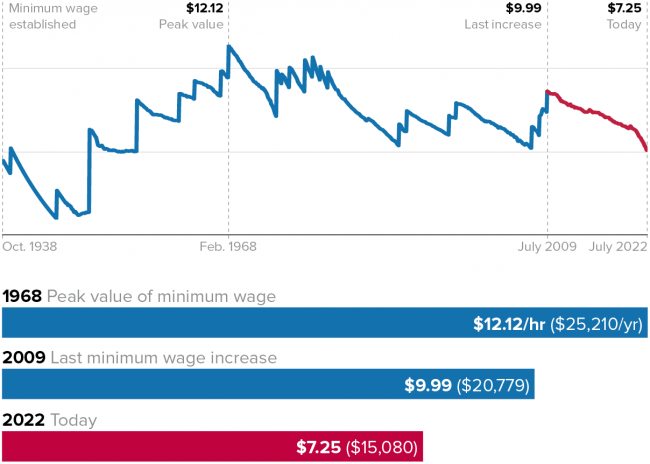
The value of the federal minimum wage has reached its lowest point in 66 years, according to an EPI analysis of recently released Consumer Price Index (CPI) data. Accounting for price increases in June, the current federal minimum wage of $7.25 per hour is now worth less than at any point since February 1956. At that time, the federal minimum wage was 75 cents per hour, or $7.19 in June 2022 dollars.

We are currently in the longest period without a minimum wage increase since Congress established the federal minimum wage in 1938.

As shown in the chart below, a worker paid the current $7.25 federal minimum wage earns 27.4% less in inflation-adjusted terms than what their counterpart was paid in July 2009 when the minimum wage was last increased. They earn 40.2% less than a minimum wage worker in February 1968, the historical high point of the minimum wage’s value.

After the longest period in history without an increase, the federal minimum wage today is worth 27% less than 13 years ago—and 40% less than in 1968

Real value of the minimum wage (adjusted for inflation)

Note: All values in June 2022 dollars, adjusted using the CPI-U in 2022 chained to the CPI-U-RS (1978–2021) and CPI-U-X1 (1967–1977) and CPI-U (1966 and before).

Source: Fair Labor Standards Act and amendments.

Economic Policy Institute