Archives for category: Unions

Carol Burris is the executive director of the Network for Public Education. She recently received a press release from Betsy DeVos’s organization, the ironically-named American Federation for Children, asserting that the drop in test scores during the pandemic was the fault of the unions. The purpose of the “American Federation for Children” is to promote vouchers, especially for religious schools, and it is always eager to criticize public schools and teachers’ unions. AFC much prefers religious schools where children are indoctrinated without apology and where discrimination against unwanted children is common. Maybe they should change their name to the American Federation for Some Children (who share our religious views).

Burris writes:


Walter Blanks, the Press Secretary of the American Federation for Children, got on the rickety old soapbox of Betsy De Vos to blame teacher unions for the recent drop in student performance on NAEP. Moms for Liberty then jumped on calling for parents to “fire teacher unions.”

Did children suffer a decline in learning progress during the pandemic? Of course.  Anyone who has ever taught in a school, unlike Mr. Blanks, could have predicted a drop.

As a former teacher and principal, I know that the relationship between a student and teacher and the relationship among students is critical for learning. And I also remember all those students who, without my cajoling and watchful eye, would have been content to put their heads down or look out the window instead of at their books. That’s kids. The warm smile directed at them, the subtle tap on the desk, you can’t do that over the internet.

But are unions the culprit for the NAEP score drop? There is no evidence of that. 

First, if union influence in keeping remote learning were to blame, we would expect to see a larger drop in city scores than suburban scores. Suburban schools, with or without unions, were far more likely to open. However, suburban scores dropped significantly more in Reading for both low and high achievers than for city students, whose scores barely budged. In Math, the point drop for high achievers was the same; suburban low achievers lost more ground than their counterparts in cities. 

Second, we would expect regional differences depending on the influence of unions.

But there is only one point difference in the scores’ drops between the union-heavy northeast and the right-to-work dominated south. And western states, where unions are prevalent in the most populous states, saw much smaller score drops than the south.  

Not content to blame unions in general, Walter Blanks singles out Randi Weingarten as a national villain. Ms. Weingarten, a woman and strong leader, married to Rabbi Sharon Kleinbaum, has become a prime target for the misogynist right. But the facts do not bear out his accusations. Even as Weingarten was listening to her members concerned with their own family and student health, she was quietly working behind the scenes to get schools safely opened.

As a New York City public school grandma, I know it. And I am thankful for those efforts. My granddaughter returned to in-person learning in the fall of 2020 as New York City public schools opened. There were bumps and starts, but they opened. Even so, the majority of NYC parents still kept their children remote. 

Will Mr. Blanks blame those parents and hundreds of thousands like them who were fearful of sending their children back to school? 

Covid 19 was a national tragedy. Over one million Americans died horrible deaths.  We will feel the pain and ramifications for years to come. And yes, our children deserve all our efforts to repair the academic and emotional damage of the pandemic. But using that tragedy to push an anti-union agenda does not help repair the damage. It continues to enflame the anger of parents still reeling from the pandemic themselves.

Blanks ends his essay by touting how school choice is the answer. I am scratching my head to reconcile that with the American Federation for Children’s stalwart support for low-quality online virtual schools and homeschools. You can’t blame learning loss on a lack of in-person learning and then support virtual learning solutions. Will AFC now advocate for the closure of online charters and homeschools? Don’t hold your breath. 

President Biden announced this morning that the rail industry and the workers’ unions had struck a tentative deal to avert a national rail strike. Such a strike would have crippled the economy and snarled supply chains.

Biden wanted to demonstrate that unions and management could work together, and they did.


“This agreement is validation of what I’ve always believed: Unions and management can work together, can work together, for the benefit of everyone,” he said in remarks in the Rose Garden.

Biden hosted the negotiators who brokered the railway labor agreement before his remarks.

“The negotiators here today. I don’t think they’ve been to bed yet,” Biden said.

The president called into the talks, which were being led by Labor Secretary Marty Walsh, around 9 p.m. Wednesday. Biden said on the call that a shutdown of railways was unacceptable, according to a White House official.

Biden, in his remarks, called the deal a win for America, as well as a win for rail workers and the dignity of work.“This agreement allows us to continue to rebuild a better America, with an economy that truly works for working people and their families. Today is a win, and I mean this sincerely, a win for America,” he said, thanking both business and labor for getting it done

Jacob Goodwin writes in The Progressive that the best solution to the teacher shortage is to strengthen teacher unions, assuring teachers of working conditions, job security, and benefits at a time when the teaching profession and public schools are under attack by rightwing nuts.

Goodwin writes:

In February, the National Education Association conducted a survey of its three million members and found that 90 percent of respondents felt that burnout was a “serious problem,” while more than half of members reported thinking about leaving the profession “earlier than planned.”

This immediate shortage of teachers is paired with long-term concerns, with the U.S. Bureau of Labor Statistics predicting that there will be an 8 percent increase in the number of high school teachers that are needed by 2030. But more immediately, the current teacher shortage is the product of an orchestrated attack on public spaces that, unfortunately, gained momentum during the COVID-19 pandemic.

I teach social studies to six graders at a public school in New Hampshire, which in July 2021 joined the ranks of at least five other states that have restricted classroom conversations about race and gender. Despite what their proponents claim, these laws are clear political ploys designed with the express purpose of stopping honest conversations about history in schools by intimidating teachers….

Teachers need to come together to revitalize associations from the ground up and push back on attacks on our public schools. Local teachers can find power by volunteering to participate in union actions and strengthening relationships across district boundaries. Educators who rise to this challenge will be following the work of generations past who fought to establish labor rights.

After all, unions are an iteration of the long American tradition of citizens coming together for a common civic purpose. As an essential part of each community, union members must demand democratic reforms internally as well. Challenging existing union leadership leads to increased ferment and dialogue within the union. The best ideas often bubble to the surface in spaces that embrace purposeful debate.

Unions also help to institutionalize civic norms and practices. To be leaders in the broader community, unions must demand democratic reforms internally. The practice of openness serves as a buttress against organizational rigor mortis. Creating an internal culture of openness and support will help empower members of diverse backgrounds and experiences and act as a safeguard against cliques and narrowness. This can be reinforced through adopting term limits for officers and establishing leadership development programs that increase the capacity of the next generation of labor leaders and local stewards.

Please open the link and read the rest of this excellent article.

Big business has been trying to get rid of unions since the first union was created. Corporations don’t want workers to have collective power. They prefer a workplace where they make all the decisions and don’t have to listen to workers’ voices. The share of unionized workers in the private sector is near an all-time low, but that may change. Recently there have been inklings of a rebirth of unionism. We see it in the growing number of Starbucks and Amazon workers who have voted to unionize. But their numbers remain small. Happily, public opinion is trending in favor of unions.

Someone recently asked me why there was so much hostility to teachers’ unions, and I answered, “Because they are the largest unions.” Teachers’ unions are blamed for whatever critics don’t like in schools, even though they fight for adequate school funding and decent working conditions. Those who have wanted to crush all unions focus their wrath on the NEA and the AFT, while overlooking the police union and the firefighters unions.

My view: if you want to reduce poverty and build a robust middle-class, support unions.

The Economic Policy Institute reports:

It’s been nearly 60 years since approval for unions in the U.S. has been this high.

More than 70% of Americans now approve of labor unions. Those are the findings of a Gallup poll released this morning, and they shouldn’t be surprising.

Why? U.S. workers see unions as critical to fixing our nation’s broken workplace—where most workers have little power or agency at work.

The pandemic revealed much about work in this country. We saw countless examples of workers performing essential jobs—such as health care and food service. They were forced to work without appropriate health and safety gear and certainly without pay commensurate with the critical nature of the work they were doing.

Those conditions, however, pre-dated the pandemic. The pandemic merely exposed these decades old anti-worker dynamics. Clearly, as the new poll and recent data on strikes and union organizing shows, workers today are rejecting these dynamics and awakening to the benefits of unions.

Nonunion workers are forced to take their jobs—accept their employer’s terms as is—or leave them. Unions enable workers to have a voice in those terms and set them through collective bargaining.

We know the powerful impact unions have on workers’ lives, and broader effects on communities and on our democracy.

Here’s a run-down based on the Economic Policy Institute’s extensive research on unions:

Pay and benefits 

  • Unionized workers (workers covered by a union contract) earn on average 10.2% more in wages than nonunionized peers (workers in the same industry and occupation with similar education and experience).
  • Unions don’t just help union workers—they help all of us. When union density is high, nonunion workers benefit, because unions effectively set broader standards—including higher wages.
  • Union workers are more likely to be covered by employer-provided health insurance. More than 9 in 10 workers covered by a union contract (95%) have access to employer-sponsored health benefits, compared with just 69% of nonunion workers.
  • Union workers have greater access to paid vacation days. 90% of workers covered by a union contract received paid holidays off compared to 78% of nonunion workers.
  • Union workers also have greater access to paid sick days. 9 in 10 workers covered by a union contract (92%) have access to paid sick days, compared with 77% of nonunion workers.

The 17 U.S. states with the highest union densities:

  • Have state minimum wages that are on average 19% higher than the national average and 40% higher than those in low-union-density states.
  • Have median annual incomes $6,000 higher than the national average.
  • Have higher-than-average unemployment insurance recipiency rates (that is, a higher share of those who are unemployed actually receive unemployment insurance).

Equity and Equality

  • Black and Hispanic workers get a larger boost from unionization. Black workers represented by a union are paid 13.1% more than their nonunionized peers. Hispanic workers represented by unions are paid 18.8% more than their nonunionized peers.
  • Unions help raise women’s pay. Hourly wages for women represented by a union are 4.7% higher on average than for nonunionized women with comparable characteristics.
  • Research shows that deunionization accounts for a sizable share of the growth in inequality between typical (median) workers and workers at the high end of the wage distribution in recent decades—on the order of 13–20% for women and 33–37% for men.

Democracy 

  • Significantly fewer restrictive voting laws have been passed in the 17 highest-union-density states than in the middle 17 states (including D.C.) and the 17 lowest-union-density states.
  • Over 70% of low-union-density states passed at least one voter suppression law between 2011 and 2019.

The growing approval of unions is playing out on the ground with more workers seeking to exercise their collective bargaining rights.

Data from the National Labor Relations Board recently analyzed by Bloomberg Law show the exponential increase in election petitions being filed. While the Gallup poll states that most nonunion workers do not respond that they want to join a union, clearly workers are petitioning for union election at elevated rates.

And workers have increasingly felt empowered to fight for what they want.

We were already seeing signs of workers being willing to strike to demand better wages and working conditions. Data from the Bureau of Labor Statistics showed an upsurge in major strike activity in 2018 and 2019, marking a 35-year high.

We are experiencing a labor enlightenment of sorts in this country, one in which workers are fed up with an economy and workplace that does not work for them. With approval for unions at the highest since 1965, there is a growing realization that unions can potentially make both work better for all.

Jesse Hagopian, who is a veteran high school teacher in Seattle, writes here about the Seattle teachers’ strike:

Members of the Seattle Education Association—the union that represents Seattle’s teachers, nurses, librarians, instructional assistants, office professionals and educational support staff—voted Tuesday, September 6 to authorize a strike, which was triggered when the Seattle Public Schools (SPS) did not meet the just demands of the union. After SPS failed to even show up to the bargaining table on Friday and Saturday, about 95% of SEA members voted to authorize the strike, with some 75% of the members voting.

Wednesday, September 7th was supposed to have been the first day of school for 50,000 students who attend Seattle Public Schools—but the strike will close all of the schools until a contract is reached. The last time SEA went on strike was in 2015 when the union’s work stoppage won a visionary set of demands including, expanded racial equity teams, more recess time for students, an end to the use of standardized tests scores being used in teacher evaluations, and small wage increases.

Again today, a rank-and-file upsurge spurred the union to vote to strike for, among other issues, maintaining “staffing ratios for special education and multilingual learners and that the district seeks more staff input as it aims to provide services for those students in general education classrooms.” In addition, the union is demanding more counselors, nurses, and to increasing the wages of classified staff—including instructional assistants—so that they can afford to live in Seattle, a city with one of the highest costs of living.

Open the link and read more.

For the first time in nearly half a century, teachers in Columbus, Ohio, have voted to go on strike.

The Columbus Education Association announced Sunday night that more than 94% of it members had voted to reject the Columbus City school board’s last final offer and go on strike for the first time since 1975….

The nearly 4,500-member union — which represents teachers, librarians, nurses, counselors, psychologists and other education professionals — met for more than three hours at the convention center to vote.

A spokesperson for the CEA said:

“…The school board has tried desperately to make this strike about teacher salary, teacher professional development, and teacher leaves,” she said. “Let me be clear. This strike is about our students who deserve a commitment to modern schools with heating and air conditioning, smaller class sizes, and a well-rounded curriculum that includes art, music and (physical education).”

The Economic Policy Institute is one of the very few think tanks in Washington, D.C. that cares about the status of working people. When one of its reports gets attention, critics are fast to point out that it is funded by unions. The same critics are silent when a think tank is funded by one or more billionaires, who like low taxes.


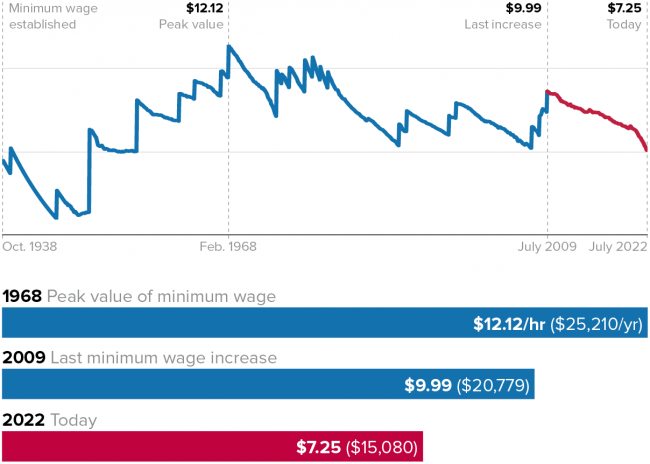
The value of the federal minimum wage has reached its lowest point in 66 years, according to an EPI analysis of recently released Consumer Price Index (CPI) data. Accounting for price increases in June, the current federal minimum wage of $7.25 per hour is now worth less than at any point since February 1956. At that time, the federal minimum wage was 75 cents per hour, or $7.19 in June 2022 dollars.

We are currently in the longest period without a minimum wage increase since Congress established the federal minimum wage in 1938.

As shown in the chart below, a worker paid the current $7.25 federal minimum wage earns 27.4% less in inflation-adjusted terms than what their counterpart was paid in July 2009 when the minimum wage was last increased. They earn 40.2% less than a minimum wage worker in February 1968, the historical high point of the minimum wage’s value.

After the longest period in history without an increase, the federal minimum wage today is worth 27% less than 13 years ago—and 40% less than in 1968

Real value of the minimum wage (adjusted for inflation)

Note: All values in June 2022 dollars, adjusted using the CPI-U in 2022 chained to the CPI-U-RS (1978–2021) and CPI-U-X1 (1967–1977) and CPI-U (1966 and before).

Source: Fair Labor Standards Act and amendments.

Economic Policy Institute

Steven Singer asks a reasonable question: Why is a Gates-Funded, anti-union, pro-charter advocacy group part of Pennsylvania’s effort to end the teacher shortage?

That would be TeachPlus.

Singer begins:

So Pennsylvania has unveiled a new plan to stop the exodus with the help of an organization pushing the same policies that made teaching undesirable in the first place.

The state’s Department of Education (PDE) announced its plan to stop the state’s teacher exodus today.

One of the four people introducing the plan at the Harrisburg press conference was Laura Boyce, Pennsylvania executive director of Teach Plus.

Why is this surprising?

Teach Plus is a national 501(c)(3) nonprofit organization that works to select and train teachers to push its political agenda.

What is that agenda?

Teach Plus has embraced the practice of widespread staff firings as a strategy for school improvement.

Teach Plus mandates that test scores be a significant part of teacher evaluation.

Teach Plus advocates against seniority and claims that unions stifle innovation.

Teach Plus has received more than $27 million from the Gates Foundation and substantial donations from the Walton Family Foundation.

How can an organization dedicated to the same ideas that prompted the exodus turn around and stop the evacuation!?

That’s like hiring a pyromaniac as a fire fighter!

Read on.

Michael Hiltzik of the Los Angeles Times writes here about the defeat of one of President Biden’s most important nominees for the U.S. Labor Department and why it is very bad news indeed for American workers.

David Weil withdrew his name as head of the Labor Department’s Wage and Hour Division on April 7 when it became clear that he would never be confirmed. He was nominated almost a year earlier. Every Republican and three Democratic Senators opposed him: Joe Manchin, Kyrsten Sinema, and Mark Kelly, perhaps hoping to placate conservative voters in Arizona before the November election.

Hiltzik writes:

Having earlier served in the job during the Obama administration, Weil came under ferocious attack by business interests and Republicans from the start, because they knew of his commitment to enforcing the labor laws on the books and the court rulings that have upheld them... 

Moreover, Weil’s loss was a blow for Biden, who is certainly the most pro-labor president in decades, perhaps ever. 

Weil was superbly qualified to resume leadership of the Wage and Hour Division. He’s an expert in labor law who has served as a professor and dean of the Heller School for Social Policy and Management at Brandeis University, with a sharp eye for the multitude of ways that employers can cheat and abuse their employees, especially lower-income workers… 

Weil’s 2014 book The Fissured Workplace examined the many ways that employers had been abandoning their responsibilities for workers.

As Weil explained to the Senate Committee on Health, Education, Labor and Pensions (HELP) during his July 15 confirmation hearing, his aim as administrator, as it was in 2014-2017, would be “strategic enforcement” of labor standards “to make sure we are targeting industries and employers who are really violating the law and who erode those kinds of standards,” while reaching out to employers to make sure they understand their responsibilities.

To Republicans and their patrons in the business community, however, any enforcement of labor law is too much.

They accused him of an “open bias against small business.”

Their evidence was his advocacy of such initiatives as the expansion of overtime rights to more than 4.2 million workers who had been treated as exempt from overtime pay and tightening the classification of employees as independent contractors — the key to the business model of gig firms such as Uber and Lyft.

Weil also expanded the definition of joint employers to impose responsibilities for workplace standards on big companies that sought to shed them through subcontracting and franchise arrangements. 

It should be clear that these regulations would all improve pay and working conditions for workers. But they would cost employers, so business painted Weil as the enemy. The posturing by Republican committee members sometimes sounded as though they had received their talking points intravenously from the International Franchise Assn., one of Weil’s principal critics….

As Weil observes, the labor market is one of unequal power in which employers dominate. This observation is not new, leftist or extremist. In the landmark 1937 Supreme Court case known as Parrish, Chief Justice Charles Evans Hughes (reaching back to an 1898 decision upholding safety rules for mine workers) noted that fear of being fired often forces workers to bow to working conditions they know to be unfair or detrimental to their health.

“The proprietors lay down the rules,” the earlier decision stated, “and the laborers are practically constrained to obey them.” Parrish, which upheld a Washington state minimum wage law, marked a sea change in the court’s approach to labor law. Hughes, by the way, had been placed on the Court by Herbert Hoover.

Weil traces an arc in government-protected worker rights beginning with enactment of the National Labor Relations Act in 1935 and especially the Fair Labor Standards Act in 1938. The latter installed an expansive definition of “employment,” and therefore of worker rights and employer responsibilities, at the heart of federal labor law. 

The FLSA made clear, he says, that “government plays a critical role saying, these are baseline rules of the game that can be built upon, whether through unionization or more progressive employers who understand the benefits of treating their workers well” — a foundation created by standards such as the minimum wage and an understanding on when the paid workday starts and stops.

Courts began to narrow the FLSA’s reach within a few years, followed by the Republican Congress, which enacted the anti-union Taft-Hartley Act of 1947 over a veto by Democratic President Harry Truman. 

The 1970s brought about more erosion in the basic understanding of worker rights and employer responsibilities.

“More and more workers were in situations where they were seeing daily violations of these basic rules, from being told you punch in for your time only after you’ve prepared your work station or you punch out before you do clean-up, and you get paid at straight time, not overtime, even after 40 hours” a week, Weil observes.

“If someone had the guts to stand up and say, ‘That’s not right,’ they were fired, in direct violation of the law,” Weil says. “The persistence of those practices create an environment where no one wants to raise their head up and talk about other problems that occur because they see these violations of the most basic rights that workers are supposed to have. Forget about the risk of saying you see a health and safety problem or discrimination, for decades the riskiest thing you could do in an American workplace is to say, ‘I want to have a union here.’

“To me,” he says, “those rights are not exercised if the basic rights are being systematically violated.”

In “The Fissured Workplace,” Weil tracked how employers had been offloading their employees to labor subcontractors, temp agencies and franchisees and redesignating one-time members of their payrolls as independent contractors. 

“In 1960,” he wrote, “most hotel employees worked for the brand that appeared over the hotel entrance. Today, more than 80% of staff are employed by hotel franchisees and supervised by separate management companies.”

Not long after his book appeared, the gig platforms such as Uber and Lyft emerged. Weil recognized them as new iterations of an old story.

“When the platform model came out with this whole false narrative that they were providing ‘flexibility’ without all that messy employment stuff, to me the platforms were just another form of fissuring,” Weil says. “Their idea was to control the brand, and completely divorce themselves from those responsibilities.” 

In a Los Angeles Times op-ed in 2019, when Uber and Lyft were fighting a California law that would designate their drivers as employees, Weil acknowledged that some companies operated in a gray area where their workers sometimes acted like employees and sometimes like independent contractors. 

“Uber and Lyft are not among those close, gray-area cases,” he wrote. “Their status as employers is really quite clear.” (Uber, Lyft and other gig companies spent immense sums to pass Proposition 22, which exempted them from the California law — though the law has been put on hold by a state judge.)

Weil’s position earned him the enmity of the gig companies. They opposed his confirmation through their now-defunct app-based Work Alliance, which tweeted during his Senate hearing that he supported “an outdated workforce model” that was shunned by gig workers who “love their flexibility and independence,” which the companies asserted Weil’s policies would “take away.”

In contrast to the gig firms’ efforts to create a hybrid employment standard that would only make permanent their abusive business models while denying workers basic employment protection, Weil has advocated extending workplace standards to beyond those who are classified as employees. 

In a 2020 paper, Weil and labor law expert Tanya Goldman proposed a framework of concentric circles in which basic protections such as freedom from discrimination and retaliation, and the guarantee of safe and healthful working conditions and a minimum wage would be linked to all work, rather than to legal definitions of employment.

Further protections, including the right to overtime pay, unionization and workers’ compensation and unemployment insurance, would belong to a second circle of workers who would be presumed to hold employment status unless their employers could make a hard-and-fast case that they were independent contractors. 

A third circle would encompass indisputably independent workers. They still would be entitled to unemployment and workers’ compensation, and could arrange on their own for other benefits such as retirement funding. 

The virtue of this concept is that it divorces essential protections from pettifogging debates over the definition of “employee.” Weil acknowledges that some of these changes would require congressional action. 

There lies the rub. Weil’s nomination foundered in large part on Senate procedure. The narrowness of the Democratic majority forced delays in a floor vote on his appointment that lasted into this year, when Biden was required to renominate him. By then, the business community had built up a head of steam against his confirmation. 

When it became clear that no Republican would vote for him, nor would three Democrats, Weil withdrew his nomination.

“The principal reason they didn’t want me in this role,” Weil says, “is that I had a record of enforcing the law.”
Michael Hiltzik, a columnist for the Los Angeles Times, reviews the context of the drive for unions at Starbucks. it’s CEO, billionaire Howard Schultz, wants to portray the far-flung coffee shop empire as worker-friendly, and he is flatly opposed to unions. He insists that the unions bring an adversarial edge and downplays the likelihood that unions would mean higher wages and benefits at the cost of profit margins.

Hiltzik writes:

Many American consumer companies, including Amazon and McDonalds, have been dealing with a surging interest in unionization by their employees, spurred in part by the pandemic-driven recognition that their employers have consistently undervalued their contributions to business success.

But few such union drives are as high-profile as the one at Starbucks. One reason may be the company’s warm and comforting image and its efforts to project a friendly relationship between customers and workers, who are designated in company parlance as “partners.” That’s very much at odds with the image of an employer so cold to the welfare of its workers that they’re spurred to organize.

Another may be the rapidity of the unionization drive’s expansion, which began with pro-union votes at three Buffalo-area stores. Workers United, an affiliate of the Service Employees International Union that is organizing union votes, says 223 Starbucks locations in 31 states have filed for votes with the NLRB.

That’s a fraction of the roughly 9,000 company-operated stores in the U.S., but reports of new successful votes are streaming in on virtually a daily basis. Five stores in the Richmond, Va., area voted for unions by overwhelming margins on April 19 alone, and workers at the company’s Seattle Reserve Roastery, a flagship tourist draw in Starbucks’ home city, announced a successful vote on April 21.

Workers United says 28 Starbucks stores have now voted to unionize, up from nine that had done so as of April 1.

“Because Starbucks is a front-facing company considered ‘essential,’” Workers United organizing chief Richard Minter says, “the pandemic exacerbated the employer-employee relationship. The partners were left in the crosshairs without the resources necessary to handle what was happening, without the right precautions and protocols that allowed them to feel safe.”

The company has mounted a fierce counterattack against the organizing drive. In videotaped town hall presentations, written communications to workers and managers, and in meetings with workers around the country, Schultz has repeatedly characterized unions as a menace to the company’s economics and future.

“Outside labor unions are attempting to sell a very different view of what Starbucks should be,” he wrote in an open letter posted on the company’s website April 10.

Employees “supporting unionization are colluding with outside union forces,” he wrote. “The critical point is that I do not believe conflict, division and dissension — which has been a focus of union organizing — benefits Starbucks or our partners…”

The union threat, Shultz said in a town hall meeting shortly after his reappointment as CEO, extends beyond Starbucks: “Companies throughout the country [are] being assaulted in many ways by the threat of unionization.”

Starbucks, in an anti-union FAQ posted on its website, warns that “unions get their revenue from dues, which could come out of your pay each week or month.” It says, “unions use dues to pay for their office overhead, staff salaries and other expenses,” though it doesn’t mention the expense of negotiating contracts and enforcing their provisions, which are of course the chief duties of unions.

The company also has hired the law firm of Littler Mendelson, which boasts of its skill at guiding companies “in developing and initiating strategies that lawfully avoid unions.” These include advising management on “precise and compliant messaging to employees … that may include informational signs and posters, home letters, meeting materials, testimonial videos, social media postings, handouts and campaign websites.”

Followers of labor-management relations will recognize that Schultz’s words come directly out of the canonical corporate anti-union playbook:

Paint the unions as “outsiders.” Imply that their only goal is to add members. Say they’ll disrupt the smooth working of the company or even drive it out of business. Say they’ll make it impossible for workers to deal directly with management. Talk about how much money workers will lose to dues…

Starbucks is plainly aware of the complaints about pay and working conditions that are fueling the organizing drive. The company has displayed on its website a poster it says reflects “issues we have been hearing from partners…”

Starbucks is not new to the arena of fraught labor relations. Its animosity toward unions dates back to Schultz’s 1987 acquisition of the company, then a local chain of coffee spots in Seattle. At that time, Starbucks employees were represented by the United Food and Commercial Workers Union. Former workers say Schultz promised to honor the UFCW contract but almost immediately tried to renegotiate it.

It’s conceivable that Schultz honestly sees himself as the hand that can improve Starbucks’ relationship with its workers, and that unions will only get in the way. He’s adept at projecting sincerity, as when he says in an employee video of the worker meetings that “it was difficult and emotional at times to hear the challenges and the issues that partners are facing.”

Unlike some other companies, Starbucks has not turned a cold shoulder to unions that have been voted in at its stores; Workers United says the company has begun to meet with union representatives at two of the Buffalo stores that touched off the organizing trend, though they have not reached contracts.

The real question is whether the company will draw the right lessons from the union organizing drive: that unions and management can be partners, not invariably adversaries, that demonizing unions won’t improve labor relations, and that workers’ interest in unionization doesn’t mean they hate the company.