Archives for category: Unions

Wow! Talk about a surprise! Teacher Glenn Sacks managed to get an article with the title of this post in the Wall Street Journal, the newspaper that regularly vilifies teachers’ unions and praises privatization of public funds.

Yes, Sacks–a teacher in Los Angeles–contends that teachers’ unions fight to get teachers the time and support staff they need to do their jobs, so they are necessary and valuable.

The link that Sacks provided is not behind a pay wall.

The article begins:

The rookie science teacher looks at me with the same “Am I understanding this job correctly or am I crazy?” look I’ve often seen in the eyes of new teachers.

“No, you understand,” I say. “You’ve been thrown into a situation that requires an enormous amount of work and a good amount of ability, and it’s sink or swim. You might naturally expect the system to help you, or at least acknowledge the position you’ve been put in. It won’t.”

Teachers have come under considerable scrutiny in recent decades, and everybody claims to have the silver-bullet reform that will fix education. No Child Left Behind, Race to the Top, Common Core, charter schools, raising the qualifications to become a teacher, limiting or abolishing tenure, and countless other measures have been taken up by Congress and state legislatures since I took my first teaching position in 1989.

Yet there is little public discussion about the education system’s central problem: Teachers don’t have enough time to do our jobs properly. Teachers unions understand this and fight to protect our ability to do our jobs.

He points out that some students can be assessed more accurately with an oral exam that with a written one, but teachers don’t have the time for that.

He writes:

Here are some ways to make teachers more effective:

  • Reduce class sizes, an issue in both the October teachers’ strike in Chicago and the Los Angeles teachers’ strike in January.
  • Provide teachers with support staff for clerical work.
  • Hire sufficient staff to eliminate extraneous chores.

Limiting class size and hiring sufficient staff would save teachers’ time from being squandered. That in turn would allow us to focus more on creating imaginative lessons and interacting with students.

Seeing Glenn Sacks’ article in the WSJ gives me hope that some people in the business world might read it and pay attention.

If they do, they will understand what real education reform looks like from the perspective of those who do the work, rather than those who sit in armchairs in think tanks.

 

Members of the Chicago Teachers Union adopted the agreement reached with the Mayor that provides significant new benefits for students. This is now known as “Bargaining for the Common Good.”

Chicago Teachers Union

STATEMENT:
For Immediate Release| ctulocal1.org

CONTACT: Chris Geovanis, 312-329-6250, 312-446-4939 (m), ChrisGeovanis@ctulocal1.org

CTU members vote overwhelmingly to accept tentative agreement

New contract includes historic language to cut class sizes, put nurse and social worker in every school.

CHICAGO, Nov. 15, 2019—Chicago Teachers Union members voted today to accept the tentative agreement they won in the wake of their historic eleven day strike.

With eighty percent of schools reporting, members have voted 81 percent yes to ratify the new contract with CPS.

The union won powerful gains for students and their school communities.

Those gains include mandatory class size caps and enforcement, language forcing CPS to comply with special education laws and regulations, sanctuary school protections for immigrant and refugee students, and supports for thousands of homeless students. While today most schools have a nurse barely one day a week, the contract will provide schools with a nurse and a social worker in every school every day. The union also won another freeze on charter expansion, and additional funding for staff that include librarians and counselors, who now must be allowed to serve only as counselors, not recess supervisors, test proctors or substitute teachers.

The contract will also, at last, lift up teaching assistants, school clerks and other paraprofessionals out of poverty.

“This contract is a powerful advance for our city and our movement for real equity and educational justice for our school communities and the children we serve,” said CTU President Jesse Sharkey. We live in one of the richest cities in the wealthiest nation in the world, and finally Chicago must start investing in the future of our city—our children.”

Moving forward, the union has put some of CPS’ most harmful and inequitable education policies squarely in its sights—including ending CPS’ discriminatory ‘student-based budgeting’ formula and the district’s racist school ranking system called SQRP. That includes the union’s effort to win passage in Springfield for an elected, representative school board, a bill that the House and Senate leadership have vowed to move this spring and the governor has promised to sign, restoring to Chicagoans the same democratic rights that voters in every other school district in the state possess. The union is also pushing legislation to restore CTU members’ bargaining rights, which were stripped away in 1995 with the imposition of mayoral control over CPS.

“Our contract fight was about the larger movement to shift values and priorities in Chicago,” said CTU Vice President Stacy Davis Gates. “Working class taxpayers in Chicago have paid for skyscrapers that most will never visit—but a school nurse is someone their child in need can see on any day. In a city with immense wealth, corporations have the ability to pay to support the common good.”

###

The Chicago Teachers Union represents nearly 25,000 teachers and educational support personnel working in schools funded by City of Chicago School District 299, and by extension, the nearly 400,000 students and families they serve. The CTU is an affiliate of the American Federation of Teachers and the Illinois Federation of Teachers and is the third-largest teachers local in the United States. For more information please visit the CTU website at www.ctunet.com.

The Florida Education Association rejected Governor Ron DeSantis’ bonus plan. Bonus plans have a long history of failure.


Nov. 14, 2019                                        CONTACT: Joni Branch, (850) 201-3223 or (850) 544-7055

FEA reacts to DeSantis bonus plan announcement

TALLAHASSEE — The Florida Education Association (FEA) was disappointed to learn Thursday that what Gov. Ron DeSantis envisions as a way to properly compensate experienced teachers is another bonus plan.

“Teachers and all school employees should be paid fair, competitive salaries,” said FEA President Fedrick Ingram. “Our educators do not want another bonus scheme, especially not one built on the back of a flawed school grading system. Bonuses don’t help you qualify for a mortgage; they can’t be counted on from year to year. We know that all too well here in Florida, where adjusting the current bonus plan is almost an annual event.”

The bonus plan announced Thursday and DeSantis’ minimum teacher salary proposal provide no benefit to many of the school employees who provide essential services to students. Despite the Marjory Stoneman Douglas High School Public Safety Commission’s call for more support in addressing mental health needs in our schools, the plans do not appear to account for guidance counselors, school psychologists, social workers and other mental health professionals. The plans as outlined also leave out thousands of other employees, including pre-K teachers, librarians, nurses, teacher’s aides, bus drivers, custodians, office personnel and food-service staff.

But the basic fact on bonuses is that they do not work. Merit pay and bonus structures for instructional personnel have been tried again and again both in this country and this state, for decades, without proven success. Florida has tried six bonus programs in the past 13 years. Meanwhile, we face a severe teacher shortage along with shortages of other school employees. Why do we continue to throw money at a failed concept? State dollars would be better spent on an effective strategy for recruiting and retaining educators — overall salary increases.

To overcome years of disinvestment in our public schools, the Florida Education Association is calling for a Decade of Progress, starting with a down-payment of $2.4 billion for public education in the next state budget. Florida currently ranks 43th nationally in funding for public education.

###

The Florida Education Association is the state’s largest association of professional employees, with more than 145,000 members. FEA represents pre K-12 teachers, higher education faculty, educational staff professionals, students at our colleges and universities preparing to become teachers and retired education employees.


FEA | 213 S. Adams St. Tallahassee, FL 32301 | 850.201.2800 | Fax 850.222.1840
Send an email to unsubscribe@floridaea.org to opt-out from receiving future messages. Only the individual sender is responsible for the content of the message, and the message does not necessarily reflect the position or policy of the Florida Education Association or its affiliates. This e-mail, including attachments, may contain information that is confidential, and is only intended for the use of the individual or entity to which it is addressed.


Tonight, the United Teachers of Los Angeles endorsed Senator Bernie Sanders for the Democratic nomination for president.

LOS ANGELES — United Teachers Los Angeles, the second-largest teachers’ local in the country, is proud to endorse Senator Bernie Sanders for US President in the 2020 Primary Election, making UTLA the first teachers’ union in the country to endorse a presidential candidate.

Tonight, the UTLA House of Representatives – the elected leadership body of the 34,000-member union — voted 80% in favor of endorsing Sen. Sanders, capping the most comprehensive member engagement process that UTLA has ever conducted for a political candidate.

vote

Thursday’s House vote followed a six-week discussion at school sites. Following that member engagement, on Wednesday at nine regional meetings, more than 500 elected site representatives voted 72.5% yes to the presidential endorsement of Sen. Bernie Sanders. Wednesday’s vote was opened up to allow any member who attended to vote alongside elected chapter leaders.

UTLA President Alex Caputo-Pearl said: “Why now, and why Bernie? Because we want him to win in the primary election and because we need an unapologetic, longstanding ally of progressive policies to make public education a priority in the White House. Sanders is the first viable major candidate in 25 years in the Democratic Party to stand up against privatization, the charter billionaires, and high-stakes testing and to stand up for a massive redistribution of wealth to schools and social services. Critically, like UTLA, Sen. Sanders believes in building a national movement for real, lasting change.”

Bernie Endorse

Teachers are the number one profession among his donors for a reason: Sanders has the most comprehensive, progressive plan for public education among the candidates. His platform calls for a salary floor for public school teachers, tripling Title I federal education funding, boosting funding for special education (IDEA), and placing a moratorium on charter school growth. For the last several decades the unregulated growth of corporate charter schools has siphoned money from public schools, with little protection against fraud and little attention paid to equity or quality when it comes to educating students.

In addition to education issues, Sanders’ platform aligns with our values on a range of issues, including rebuilding the US labor movement and winning Medicare for All.

Bernie spoke at UTLA’s Leadership Conference in July, and he brought down the house with his defiant message about leading a movement for fundamental political and social change, including a strong, fully funded public education system. Sen. Sanders also signed a pledge to support Schools and Communities First and Our New Deal for Public Schools. He was the first major US politician to publicly support our 2019 strike, and he pushed for donations to our strike fund, leading to a cascade of influential support and an increase in the fund of more than $100,000.

BSUTLA

LA educators are standing behind a candidate who has the electability to beat Trump. Sanders is leading in Democratic fundraising, is strong in swing states and among independent voters, beats Trump in head-to-head polls, and has major support in demographics that will vote heavily in 2020, including Latinx voters, Black women, and millennials. As the electorate becomes more diverse, defeating Trump will require a candidate who can motivate a diverse coalition of voters.

Sanders’ platform is not just a corrective to the destructive presidency of Donald Trump but also to failed policies of the past few decades that have starved public schools and left behind working-class and middle-class families while giving massive tax breaks to corporations and billionaires. Long-standing Democratic Party leaders have been a part of these problems.

“We must take the most anti-Trump stance that we can take,” said UTLA Vice President Gloria Martinez. “That includes endorsing Sen. Sanders. We see in Bernie the same fighting spirit that drove 60,000 people — teachers, students and parents — to the streets of LA in January during UTLA’s strike to invest in our students.”

The following is a timeline of UTLA’s endorsement.

  • Sept. 11 – UTLA Board of Directors votes 35-1 to begin exploring an endorsement process for Sen. Bernie Sanders.
  • Sept. 18 – UTLA House of Representatives votes 135-46 to confirm the process to explore endorsing Sanders.
  • Oct. 2 – School site leaders discuss and review endorsement materials.
  • Oct. 2-Nov. 12 — School site leaders engage members on consideration of a UTLA endorsement of Sen. Bernie Sanders.
  • Nov. 13— Membership advisory up or down vote at 9 regional area meetings. 72.5% of voters, representing more than 500 LAUSD schools, say yes to endorsing Sanders.
  • Nov. 14 — House of Representatives votes 80% to endorse Sen. Bernie Sanders.

###

Reader David Kristofferson recommended this documentary, which is streaming on Netflix. I regret putting any money in Reed Hastings’ coffers, but this is a very compelling program.

“American Factory” tells the story of a GM factory in Ohio that closed, putting thousands of workers out of work.

A few years after the closing, a large Chinese company named Fuyao arrives to revive the factory, dedicated now to producing glass for automobiles.  The CEO comes from China to show his dissatisfaction with the quality of American workers. The American workers are happy to have a job, but note that their pay of $12 an hour doesn’t compare with the $29 an hour they earned as GM employees.

The Chinese managers are so dissatisfied with the American workers that they bring a team of American managers to China to see how Chinese workers perform at the Fuyao factory. The Americans watch bug-eyed as workers describe their work habits: a 12-hour day; one or two days off each month. The workers line up to show their deference to the boss. They perform with precision at a company festival, praising their employer. They act like automatons.

Back home in Ohio, the American workers try to form a union. Some risk their livelihood, trying to organize as a UAW union.

I won’t tell you how the vote goes.

I will tell you that the Chinese owners fire the American managers.

There is a culture clash.

More than that, there is a depressing realization that America no longer leads the world in manufacturing.

And there is a frightening realization that the Chinese owners will eagerly replace human workers with machines to cut costs and increase efficiency.

This is a very different, very sobering view of the American future.

A possible subtitle: The Screwing of the American Working Class.


Grassroots Arkansas reports that the teachers of Little Rock will strike this Thursday. It will be a one-day strike. The State Board of Education (a wholly-owned subsidiary of the Walton family) stripped the local union of its collective bargaining rights and is trying to destroy and privatize public education in that city. For the billionaire Waltons, Little Rock is the petri dish that is near at hand. They have so many petri dishes, all of which have failed. Why don’t they leave this small but historic district alone? (Answer: Because the Waltons want everything; having $150 billions has made them willful and arrogant.) The state took control of the district in 2015 and has agreed to return limited control, with a powerless board still controlled by the state.

Little Rock educators have announced a strike this Thursday, November 14, to demand that the state stop its re-segregation plan, return democracy through full local control of the LRSD, and recognize the union’s bargaining rights. Our educators and students need all of us to stand up for them before unlicensed subs and private companies complete the destruction and further segregation of our public education system.

There are several ways that you can support students and teachers. If you are a caregiver, please do whatever you can to keep your students home on Thursday, or send them to one of the childcare sites to be announced soon. The money follows the students, and the only power we have is if the students stay home. If they go to school, they will be babysat by unlicensed subs. Other ways you can support include:

  • Donate and share the Bread for Ed campaign to feed kids while the schools are shut down.

  • Tuesday and Wednesday: Pass out flyers at schools during drop-off and pickup times. Go by the AEA building at 1500 W 4th Street or call them at (501)375-4611 to see which schools most need coverage.

  • Tuesday and Wednesday: 4:00-7:00 Sign making at the AEA building. 1500 W 4th St by the Capitol.

  • Thursday: Picketing at schools from 7-9:30. Picket the State Board of Education meeting at 11:00. Sign up here.

Together, we can reclaim democracy and a world-class education for ALL students!

STRIKE DATE SET IN ARKANSAS: The Little Rock Education Association is calling for one locally elected city school board with full decision-making authority following the state’s takeover of the district in January 2015. The union planned the strike for the day of the next state board of education meeting, when the district is on the agenda.

— The state board last month voted to stop recognizing the union as a bargaining agent for its members. The state board also voted to return control of Little Rock schools to a locally elected school board by 2020, but limited its authority.

— “They specifically stated that the school board, once elected, would not be able to reinstate our recognition, nor would they be able to hire or fire a superintendent and that the commissioner of education would still have veto power over any decisions that the state or that the school board makes,” Knapp Gordon said.

— The announcement said the union is working with #OneLRSD to stop Gov. Asa Hutchinson and his appointed state board from “segregating the city’s public schools.” The board last month backed away from a plan to divide the district under separate governing systems amid complaints that it would segregate the district. But Knapp Gordon said “by retaining control over the district, they still get to make those decisions that will lead to the resegregation of our school district.”

Jan Resseger is one of the keenest analysts of the assault on public education today.

In this post, she reviews Andrea Gabor’s excellent article in Harper’s magazine about the privatized district of New Orleans.

She begins:

When Hurricane Katrina struck New Orleans in September of 2005, I was serving in the Justice & Witness Ministries of the United Church of Christ, a mainline Protestant denomination, as the point person tracking and staffing work in UCC congregations to support justice in public education. My job was to help our churches support equal opportunity and access to quality education and to ensure that members of our congregations understood the importance of the First Amendment separation of church and state in public schools.

In the autumn and winter of 2005, our office worked with partners in New Orleans to advocate for policies that would protect New Orleans’ most vulnerable citizens during the hurricane recovery.  Early in the fall of 2005, it wasn’t apparent that the city’s public schools would be affected, but weeks later the state intervened to take over the majority of the schools under a Louisiana law that had been amended to permit the broad takeover. All of the school district’s teachers were put on disaster leave, and on March 24, 2006, all of the school district’s teachers were dismissed or forced to retire.

My job included writing a September, beginning-of-school resource for UCC congregations. Its purpose was to highlight primary challenges to justice in our nation’s public schools. To research the 2016-2017 Message on Public Education, I traveled for a week in July, 2006 to New Orleans to learn what was happening in the public schools of a devastated city. I talked with the Rev. Torin Sanders, a member of the Orleans Parish School Board, sidelined in the state takeover. I spoke for more than an hour with Brenda Mitchell, the president of the United Teachers of New Orleans, which had been rendered—by state fiat—incapable of protecting even long-serving, tenured teachers. I drove past the former Alcee Fortier High School—previously a public neighborhood high school with open admissions—now seized by the state and turned over to Tulane University to become the selective Lusher (charter) High School, which privileged admission for the children of the staff of Tulane and other universities. And I visited Benjamin Franklin High School, formerly a selective magnet high school, and now a selective charter high school.  While charter schools in the rest of the country were required to accept students through non-selective lotteries, in New Orleans, the emergency had created a rationale for exceptions that created a group of exclusive, selective charter schools.

What I learned during that week was that the majority of public schools in New Orleans—one of the poorest communities in the United States—had been deemed “failing” because of low test scores and that, due to that designation, the state and all sorts of players I did not understand were conducting a disruptive experiment with a new kind of school reform on a group of children whose lives had just been upended in every other possible way.  In October of 2006, Leigh Dingerson, for The Center for Community Change, published a profound resource exploring the same issues.  She called it Dismantling a Community. Later Kristen Buras published Pedagogy, Policy and the Privatized City and other research that helped explain, from the point of view of New Orleans’ teachers and students, what had happened.  But at that time none of us really had the language accurately to characterize what we had watched happening as public education was intentionally collapsed into some kind of experiment.

Naomi Klein helped with the definition in her 2007 book, The Shock Doctrine, in which she described the sudden takeover of the public schools in New Orleans as the defining metaphor for neoliberal economic reform: “In sharp contrast to the glacial pace with which the levees were repaired and the electricity grid was brought back online, the auctioning off of New Orleans’ school system took place with military speed and precision. Within nineteen months, with most of the city’s poor residents still in exile, New Orleans’ public school system had been almost completely replaced by privately run charter schools.  Before Hurricane Katrina, the school board had run 123 public schools; now it ran just 4… New Orleans teachers used to be represented by a strong union; now the union’s contract had been shredded, and its forty-seven hundred members had all been fired… New Orleans was now, according to the New York Times, ‘the nation’s preeminent laboratory for the widespread use of charter schools’…. I call these orchestrated raids on the public sphere in the wake of catastrophic events, combined with the treatment of disasters as exciting market opportunities, ‘disaster capitalism.’” (The Shock Doctrine, pp. 5-6)

From this perspective, she reviews Gabor’s recent article.

Candidates backed by teachers for local school boards in the Denver area (including Denver) won all but one race.

Candidates supported by the teachers’ unions swept school board elections in Denver, Aurora, Douglas County, Littleton, Adams County, Cherry Creek, and Jeffco. The only candidate to lose was in Jeffco.

The “reformers” bold experiment in teacher-bashing has come to an end, at least for now.

Now it is time for the Colorado legislature to eliminate former state senator Michael Johnston’s failed educator evaluation law, which bases 50% of evaluations on test scores. The law was declared a failure even by its supporters but remains on the books. It did not identify “bad” teachers and it did not produce “great teachers, great principals, or great schools,” as Johnston promised in 2010 when his law was passed.

Reformer Van Schoales wrote in Education Week two years ago:

Colorado Department of Education data released in February show that the distribution of teacher effectiveness in the state looks much as it did before passage of the bill. Eighty-eight percent of Colorado teachers were rated effective or highly effective, 4 percent were partially effective, 7.8 percent of teachers were not rated, and less than 1 percent were deemed ineffective. In other words, we leveraged everything we could and not only didn’t advance teacher effectiveness, we created a massive bureaucracy and alienated many in the field.

The problem, he said, was implementation. Every failed reform is dogged by poor implementation. That’s what they said about the Soviet Union and the Common Core.

When the Waltons paid for an analysis of their failure to pass a referendum to expand charter schools in Massachusetts in 2016, their advisors told them that teachers are trusted messengers. The public likes teachers and believes them. They are more credible than out of state billionaires. The Waltons, too, concluded that the problem with their message was poor implementation, not a rejection by the public, which values its public schools (I go into greater detail in my new book SLAYING GOLIATH, which will be published January 21.)


Jan Resseger explains the history and context of the truly historic teachers’ strike in Chicago that recently ended. She explains it with clarity, as only Jan can do.

This was not a strike for higher salaries. The mayor offered a 16% increase before the strike began, and that is what the Chicago Teachers Union accepted.

This was a strike for students. This was a strike to reverse a quarter-century of disinvestment by Mayors Richard Daley and Rahm Emanuel.

This was a strike against 25 years of austerity in a booming city that had billions for developers but nothing for students and schools.

This was a strike against corporate reform, which starved the public schools for the benefit of charter schools.

This was a historic strike. To understand why, read this post.


Tentative Agreement

Tonight’s Vote to Conditionally Suspend the Strike

CTU’s House of Delegates met tonight to consider a new tentative agreement. The terms of the tentative agreement can be downloaded from the MemberLink Portal. Delegates voted 364 to 242, with four abstentions, to accept the revised tentative agreement on the condition that Mayor Lightfoot agree to make up the days lost in the strike. The text of the resolution reads:

Be it resolved, that the Chicago Teachers Union House of Delegates will suspend the strike against the Chcago Public Schools immediately upon a CPS agreement with the CTU to restore with pay student instructional days lost during the strike. Per the CTU Constitution and By-laws, a referendum by the CTU’s entire CPS membership on contract ratification will be held within ten (10) days of suspending the strike.

So far, the mayor still insists that she will not schedule makeup days for students to regain class time and for us to recoup our lost workdays. Her hypocrisy, though, is clear to see. She and her bargaining team fanatically insisted that elementary teachers couldn’t have a 30-minute morning prep because it would “reduce instructional time.” Yet, now they have the opportunity to make up days of instruction. What reason, other than sheer vindictiveness, would they have for passing up this opportunity? That’s why we’ll still be on strike Thursday and until the mayor and CPS come to their senses and close this deal.

Tentative Agreement Highlights

Some major elements of the Tentative Agreement include:

  • A nurse in every school community every day.
  • A social worker in every school community every day.
  • Staffing Pipeline: $2.5 million in recruitment and training programs for clinicians, $2 million in tuition and licensure for nurses, increased investments in “grow your own” teacher pipeline programs and 50 percent tuition reimbursement for English Language and bilingual endorsement programs.
  • $35 million annually to reduce oversized K-12 classrooms across the district, prioritizing schools serving the most vulnerable students.
  • Unprecedented enforcement mechanisms for class size relief.
  • Sports Committee with an annual budget of $5 million (33 percent increase in annual funding) for increases to coaching stipends and new equipment/resources.
  • January 2019 0.8 percent increase in health care contribution rate rescinded as of 7/1/19; no plan changes to health insurance benefits and reductions in co-pays for mental health services and physical therapy.
  • Bank of sick days earned after July 1, 2012, increased from 40 to 244 days.
  • Development of special education Individual Education Plans (IEP) made solely by the IEP team; principals required to use substitutes or release time to provide adequate time for special education duties to the extent possible; common preparation periods with general education teachers where possible; special ed teachers last to be called to cover classes; $2.5 million annual fund to reduce workload.

Clarification on class size language

Many members have read the new language in Article 28 on Class Size and found the table and language confusing. We want to clarify how the new language improves on the class size language in our recently expired 2015-19 contract.

In that last contract, there were advisory class size limits for different grade levels. However, to relieve oversized classes only $6 million per year was allotted for the entire district. When a class was over the limit, the teacher would have to file for relief, a weak joint committee came and investigated. If there was money, and if there was will, the class might get a remedy.

In the tentative agreement, that protection still remains, but is strengthened. The same class size guidelines are maintained andthe pool of money to remedy oversized classes is increased more than five times, from $6 million to $35 million. The committee also has more power to award remedies.

The truly new part, however, is the automatically triggered hard cap on class sizes. Those classes that are over the limit by a set amount (differing based on grade level) will be immediately and automatically referred to the committee and relief for the those classes is mandated in the contract. There will be no need for a teacher to report their class and ask for help, the committee will automatically come out to relieve the problem.

Some have mistakenly read the higher numbers as eliminating the previous class size guidelines and raising them to allow even larger classes. That isn’t so. This language keeps the previous numbers and improves the enforcement mechanism quite a bit. Once the automatically triggered classes have been relieved, there is still a larger pool of money to relieve classes that may be over the existing guideline, but under the automatic trigger mark. Those classes will need to request relief, but will still have the stronger committee come to their aid and there will be more money available to solve their problems.

Day 11, Thursday

10:00am at City Hall

At 10:00 a.m. all members should meet at City Hall to demand Mayor Lightfoot agree to make up the strike days. Costumes are encouraged, especially if they’re red (no costume weaponry, though, please). We will not have pickets at school, but schools are encouraged to arrange breakfast or lunch meetings or conference calls to discuss the tentative agreement and our next steps as a union.

Day 10 Recap

Wednesday’s Actions

Our members maintained picket lines at every school today. At noon, in the cold and pouring rain, hundreds of CTU members met to protest “The 78” luxury real estate development. Like Lincoln Yards, The 78 got a huge TIF giveaway to develop already valuable land. The $700 million that Rahm and Lori gave them would have made a huge difference for our schools. We won’t stop reminding the public and the politicians that Chicago isn’t broke, the City’s priorities are.

New support from Springfield

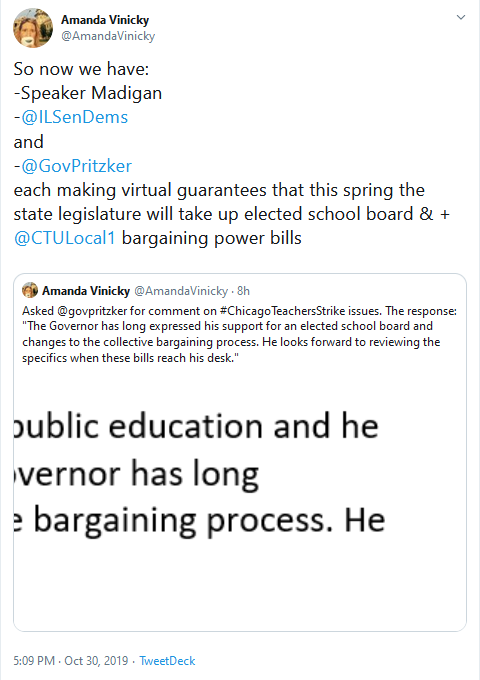
As the bargaining team finalized the deal, new information emerged from Springfield.

Tweet by Amanda Vinicky about Madigan and Cullerton pledging support to repeal IELRA Sec. 4.5

Looking ahead and building power

As you talk about the tentative agreement, it’s worth thinking about the conditions at your school. Whether or not this TA is ratified, we will eventually have a contract. It’s important that everyone build on the solidarity and momentum you’ve developed together on the picket line to enforce it. If the fight for good working and learning conditions were a war, the strike would be the “air war.” It can win a lot, but what ultimately determines day-to-day conditions is the “ground war”—the back-and-forth between administrators and staff in each school and workplace.

Read the TA (and the existing contract, for that matter) with an eye to the changes you want in your school. Try to come up with one change—big or small—that CTU members, together, want to see in your work environment. Then you can use our Campaign Planning Worksheet to brainstorm your campaign for when we return to work. When members at your school have agreed on a rough plan, check in with your organizer and/or field rep to talk through the details of putting it into action.

Union staff will continue to work hard in support of your rights. In your campaigns, they’ll help you refine your strategy and back you up. And they’ll always stand up for your rights in grievances and arbitration. If you organize well, you can make change without the long process of a grievance and help build your school’s solidarity and power.

Sent via ActionNetwork.org. To update your email address, change your name or address, or to stop receiving emails from Chicago Teachers Union, please click here.