Archives for category: Unions

This could be a historic moment for the American labor movement. Amazon workers in Staten Island, New York, voted to join a union.

NEW YORK — Workers voted Friday to unionize an Amazon Staten Island warehouse, a historic decision that marks the first successful U.S. effort at the e-commerce giant and a major victory for the domestic labor movement.


Amazon, the country’s second-largest private employer, has long fended off attempts to unionize workers at its warehouse — a highly prized target among traditional labor groups who have seen membership wane in recent years.

But a small, upstart independent union led by a former employee of the Staten Island warehouse mounted the first successful campaign to unionize Amazon workers, breaking many of the traditional organizing rules and relying on workers‘ momentum.

The vote could start a cascading effect on other Amazon warehouses in the country, labor experts say, encouraging others to consider unionizing. That could transform the way the e-commerce giant conducts business and prioritizes the treatment of workers.


The Amazon workers at the JFK8 warehouse on Staten Island will need to ratify a contract to become union members, the next step in an already lengthy process that former Amazon worker Chris Smalls began last year as leader of the Amazon Labor Union.

A separate union vote brought by the Retail, Wholesale and Department Store Union in Bessemer, Ala., was tallied Thursday. The union failed to secure the vote, but it was close enough that the number of contested ballots that are still pending could change the result. The final result won’t be decided for weeks or months.

Eric Blanc wrote a book about the teachers’ strikes titled Red State Revolt: The Teachers’ Strike Wave and Working-Class Politics.

He is in Minneapolis now covering the teachers’ strike that started last Tuesday.

He writes in The Nation:

Thousands of educators are on strike in Minneapolis, two years into a pandemic that has pushed public education to a breaking point across the country. With the future of education in unprecedented limbo, the stakes are high—and not just in the Twin Cities.

Public schools were in crisis well before Covid-19. Especially in predominantly non-white, working-class school districts like Minneapolis, decades of underfunding, privatization, high-stakes testing, and low educator pay made it increasingly difficult for teachers and support staff to provide the education their students deserve.

In the Twin Cities and beyond, the past two years have reversed Red for Ed’s political momentum and exacerbated structural stressors and inequities, resulting in increased educator outflows from the profession and increased familyoutflows from public schools. By late 2021, a quarter of teachers, and almost half of Black teachers, indicated in national surveys that they were considering leaving their jobs. Over the past 18 months, Minneapolis Public Schools have lost over 640 teachers and support professionals.

Schools have lacked basic resources necessary to address students’ mental distress in the face of pandemic conditions, the police murder of George Floyd, and subsequent social unrest. In line with a growing trend of progressive unions to “bargain for the common good,” one of the Minneapolis strike’s major demands is for every school to be provided with a social worker and counselor every day, as well as increased hiring of school psychologists. “As educators, we have been saying ‘What about the kids?’ for decades,” explains Greta Callahan, president of the teachers’ chapter of the Minneapolis Federation of Teachers. “And right now we’re at a place where we can no longer allow students to pay for the mistakes made by those at the top.”

Shortages of support staff, substitutes, and teachers in Minneapolis and St. Paul have deepened the difficulties of those educators who remain. This is especially the case for educational support professionals (ESPs), half of whom are people of color. “If we’re going to talk about racial justice, we have to talk about how we treat everybody in our system,” explains Shaun Laden, president of the educational support professionals’ chapter of Minneapolis Federation of Teachers. “The district doesn’t treat our members of color and our hourly workers with the dignity and respect that they deserve.” Faced with increased work burdens and a less-than-living wage—many ESPs make as low as $24,000 a year—it is not surprising that Sahan Journal found a 22 percent vacancy rate for Minneapolis ESPs, with many choosing instead to work at McDonalds or as FedEx delivery drivers. Unions are demanding that the starting pay for 90 percent of ESPs be bumped up to $35,000.

Of course, teachers are striking for higher pay but much more is involved. Open the link and read on.


For Immediate Release
March 7, 2022

Contact:
Natasha Dockter
Minneapolis Federation of Teachers and
Education Support Professionals
natasha.dockter@gmail.com
651-387-5681


Minneapolis educators to strike Tuesday for safe and stable schools

MINNEAPOLIS, March 7, 2022 – The educators of the Minneapolis Federation of Teachers and Education Support Professionals will go on strike Tuesday for the safe and stable schools students deserve. Despite days in public bargaining and mediations, including more than 65 hours in the last week, the district continues to refuse to work with MFT to create systemic change and remains entrenched in the unacceptable status quo. 
 
President Greta Callahan of the MFT teachers chapter, President Shaun Laden of the MFT ESP chapter and the presidents of Education Minnesota, the American Federation of Teachers and the National Education Association will attend a news conference at 7:30 a.m. Tuesdayoutside Justice Page Middle School, 1W. 49th S., Minneapolis.
 
The members of the MFT will begin picketing outside their schools and other worksites at 7:30 a.m. Tuesday. The membership will come together for a large rally at 12:15 p.m. at the Minneapolis Public Schools Nutrition Center, 812 Plymouth Avenue North, Minneapolis, before marching approximately 1 mile to the MPS Davis Center, 1250 W Broadway Ave, Minneapolis.
 
Logistics:
Picketing begins at schools and other worksites at 7:30 a.m. Tuesday
News conference with MFT presidents and state and national presidents 7:30 a.m. Tuesday at Justice Page Middle School, 1W. 49th S., Minneapolis
Rally starting at 12:15 p.m. Tuesday at Minneapolis Public Schools Nutrition Center, 812 Plymouth Avenue North, Minneapolis
Laden said:  “This bargaining campaign started with the very simple idea that for the education support professionals who are told every day that our schools can’t run without us, one job should be enough. We’re the most racially diverse group of educators in a district with administrators who say they care about racial equity. We have been demanding that the administrators at the bargaining table put their money where their mouth is and they have refused. Now is the time for the school board to intervene and settle a deal that pays ESP a starting wage of $35,000 a year.”
 
Callahan said: “For almost two years, we’ve been trying to reach agreements around safe and stable schools for students and those closest to them, but the administration has stubbornly defended an unacceptable status quo. We are the defenders of public education and we’re not going to slow down, or give up, until we make real progress addressing the mental health crisis in our schools, reducing class sizes and caseloads so students are receiving the individualized attention they need, and increasing educator compensation so that we don’t continue to lose staff, especially educators of color, to surrounding districts and other professions.”
 
Denise Specht, president of Education Minnesota, said: “Nearly 90,000 educators across Minnesota are standing with our union family in Minneapolis because what they’re fighting for is what we’re all fighting for: Schools that will give every student the chance to pursue their dreams. The same issues are being negotiated all over the state, from living wages for ESPs, to more mental health supports for students, to managing the crushing caseload for SpEd teachers, to recruiting and retaining more teachers of color,  to creating time for educators to give their students enough individual attention. We’re in a rich state with a $9.25 billion surplus. No educator should have to fight this hard for the schools our students deserve, but if that’s what it takes, we’re with you.”
 
Becky Pringle, president of the National Education Association, said: “With over $250 million in pandemic relief funds, the time is now to invest in the safe and stable schools that Minneapolis students need now more than ever. The three million members of the National Education Association are proud to stand with our siblings in Minneapolis. The last two years have demonstrated that the status quo is not good enough. Minneapolis students and their families have weathered a pandemic, continued police violence, and an economic system that has left students, their families, and educators behind. These students deserve class sizes small enough for one-to-one attention as well as investments in mental health services and social-emotional learning.  MPS must also invest in systematic changes that improve the recruitment and retention of educators of color as well as a living wage for education support professionals. Education support professionals represent a critical workforce in our schools providing essential supports students depend on. MPS has the resources to make these investments. The question is whether they value Minneapolis students as much as their educators do.”
 
Randi Weingarten, president of the American Federation of Teachers, said: “The federal government has provided an unprecedented amount of recovery funding to school districts to address problems related to the pandemic, including student recovery, staff shortages and school safety. There is no excuse for districts to make cuts in light of this historic infusion of funds. And the economy is showing real signs of growth. Indeed, Minnesota just announced a $9.25 billion surplus.
 
“Our kids, their families and educators have been through tremendous challenges in the last two years; they have done their share to navigate the rough seas together. Educators and students should be the priorities, and districts should provide the conditions and environment they need to succeed. School districts should respect their educators and ensure that students have the programs and services they need to thrive,” Weingarten said.
 
The union’s safe and stable schools agenda includes:

  • Paying a living wage for education support professionals to stabilize this critical workforce, because students need the stability of working with one paraprofessional throughout the school year. For ESPs, this means raising the starting salary from about $24,000 a year to $35,000 through increases in hours and rate of pay.
  • Making systemic changes to improve the recruitment and retention of educators of color, which benefits all of MPS.
  • Improving student-to-mental health professional ratios because students shouldn’t have to wait weeks for an appointment with a counselor or social worker.
  • Lowering class sizes because students learn best when their classrooms aren’t overcrowded and underfunded.
  • Paying competitive salaries for licensed staff to stop the exodus of teachers from MPS. State data show the average salary of Minneapolis teachers is ranked 28 out of 46 districts in the seven-county metro area.

###

Thanks for Donald Cohen of “In the Public Interest” for drawing my attention to this important victory in Virginia.

Members of AFSCME (American Federation of State, County, and Municipal Employees) mobilized to repeal an attack on their newly-won right to bargain collectively as a union. Unions offer a path to a secure middle-class existence. We need them now more than ever.

AFSCME members in Virginia are rejoicing in their success in protecting collective bargaining rights for local public employees across the commonwealth.

Their actions helped persuade the Virginia Senate to first defeat anti-worker bills filed in the Senate and, in February, to block House-passed anti-worker bills.

Members celebrated on Feb. 21 after the Senate Commerce and Labor Committee voted to defeat Del. Kathy Byron’s bill, which would have repealed a 2020 law that empowered localities to give their employees the freedom to collectively bargain for a contract.

Since taking effect last year, Del. Elizabeth Guzman’s HB 582 and Sen. Dick Saslow’s SB 939 have triggered a slew of collective bargaining ordinances. In Northern Virginia, AFSCME members began organizing during the pandemic and helped pass the first collective bargaining ordinance in April in the city of Alexandria. Arlington County soon followed suit in June.

Luis Velez Sr., an Arlington County construction management specialist and a member of AFSCME Local 3001, recounted the spring and summer he began organizing for collective bargaining rights.

“As a resident of Alexandria, I was proud to stand with Alexandria city employees as they won a strong collective bargaining ordinance. I was even more excited, a few months later, as an Arlington County employee when we passed our own collective bargaining ordinance,” he said. “We have a lot of work to do as our localities continue to recover from the pandemic and we are stronger when public employees are respected, have a voice on the job, and strong unions to advocate for the communities that we serve.”

The 2022 legislative session saw two versions of a total repeal of collective bargaining, and a series of bills introduced by Del. Nick Freitas that would have chipped away at collective bargaining and union rights. These bills sought to redefine a union election, eliminate automatic dues deductions and force employees to pay for any time and resources employees used while engaging in union work like representation during work hours. Freitas also wanted to dictate how and what localities could include in their collective bargaining ordinances and agreements.

Harlie White, a traffic and lights technician for the city of Alexandria, submitted written testimony twice.

“I stand in opposition to any bill that would repeal my collective bargaining rights and take away my freedom to join a union,” he said. “I am glad Senator Dick Saslow was willing to protect the 2020 law that empowers localities to give public service workers the freedom to join a union, and local municipalities the autonomy to enact union agreements as they see fit.”

The threat of losing collective bargaining mobilized AFSCME Virginia activists. Aside from testifying via Zoom and submitting written testimony, many sent letters and called their delegates and senators to make clear how important collective bargaining rights are for public employees, especially as cities and counties slowly recover from the pandemic.

Charlotte Malerich, an Arlington public library assistant, wanted Virginia elected officials to understand that chipping away at rights meant employees would lose their voice on the job.

“My co-workers and I need actual, concrete support: sick leave, child care, flexible schedules, teleworking for the things we can do at home …  and PPE for things we can’t do at home,” she said, referring to personal protective equipment. “And we need to have a voice at work to tell our managers what those needs are. Collective bargaining and union rights give us that freedom.”
After the inspiring teachers’ strike in 2019, which closed every public school in the state, the billionaire Governor Jim Justice of West Virginia promised to veto any charter school legislation. He lied. The legislation passed, and the Governor signed it.

The state established a state charter board, which proceeded to award seven charters, mostly to a for-profit charter corporation that manages low-performing charters in Ohio.

But a county judge stopped the clock by issuing an injunction to halt the new charter schools.

A Kanawha County judge has temporarily blocked five public charter schools from opening in West Virginia.

Circuit Judge Jennifer Bailey granted a preliminary injunction Monday sought by parents and education union members.

They filed a lawsuit against Gov. Jim Justice and leaders of the state Senate and House.

In the suit, the plaintiffs claim residents should be able to weigh in on any charter school established in their county.

They are challenging the authority of the Professional Charter Schools Board, a group that has its members appointed by the governor.

Last month, the board approved charter schools in Morgantown, Nitro and in Jefferson County, along with two online charter schools.

The judge outlined her logic in granting the temporary injunction.

“The plain language of Article 10, Section 12 of our state constitution provides that no independent school district or organization shall hereafter be created except with the consent of the school district or districts, out of which the same is created, expressed by a majority of the voters voting on the question,” Bailey said.

One of the arguments in the lawsuit was that the transfer of the student – and the tax money that goes with that student – is the same thing as creating an independent school district, and there is a specific prohibition against that in the state constitution – unless there is a public vote.

The two parents bringing suit are members of the American Federation of Teachers union.

“It is unconstitutional to create a new school system within our current school system and that’s what this bill seems to do,” AFT-WV President Fred Albert said.

After some county school boards voted no to approving a charter school in their areas, lawmakers created the Professional Charter Schools Board, which could OK charter schools without a county school board’s approval.

State Attorney General Patrick Morrisey said the injunction is wrong because acts of the Legislature are presumed to be constitutional and because the parents should have sued the charter school board not the governor and legislators. He said he will seek relief from the state Supreme Court.

Thanks to G.F. Brandenburg, who posted this very important report about The Battle of Blair Mountain, a largely forgotten milestone in the history of unionism.

Brandenburg opens his post by reminding us that the rich and powerful usually control history and write the narrative.

He adds this dramatic story of The Battle of Blair Mountain, which is unknown to most people and barely remembered in the state where it happpened. The famous but almost-forgotten battle pitted underpaid, impoverished miners against the coal industry’s hired and well-armed detectives and union-busters. After several days of fighting, federal troops were sent in to stop the combat.

The story was written by Irina Zhorov and appeared on PBS WHYY.

The site of the conflict is marked by an inconspicuous plaque. The land is inaccessible because its owned by a coal company.

Here is the lead-up to the Battle of Blair Mountain:

In early 20th-century Appalachia, miners in the southern West Virginia coal fields lived in company towns. They were dependent on their bosses for every necessity, including their homes and food. Pay was low. Living and working conditions were deplorable.

The United Mine Workers union attempted to organize miners in the region, but the coal companies fought back, often violently. In a series of clashes now called the Mine Wars, both union and company supporters were killed.

By 1921, tensions were coming to a head. Miners in Mingo County, south of Blair, had joined the union. In retaliation, the company had evicted them from their homes. The miners had been rounded up and were being kept in pens. State police had cut off food supplies, so families were starving.

Then private detectives who worked for the coal companies brazenly murdered a union sympathizer named Sid Hatfield, a hero to the miners. It was broad daylight, and Hatfield’s wife was by his side. Tensions boiled over.

One week after the murder, Frank Keeney, the leader of West Virginia’s United Mine Workers chapter — and Chuck Keeney’s great-grandfather — gave a series of speeches to rally miners in the coal fields.

Miners—10,000-15,000 of them—marched 50 miles to Blair Mountain to protest and fight.

Clearly, there are many people in West Virginia today whose parents or grandparents took up arms against the tyrannous coal companies. They know the history because it’s personal.

Yet this legacy of labor militancy does not seem to have any role in today’s politics. West Virginia is a red state with a Republican-controlled legislature. The Governor, Jim Justice, was a Republican who became a Democrat for his election in 2016. Seven months after his election, he reverted back to being a Republican, at a political rally with Trump by his side. Governor Justice is a billionaire who controls many businesses, mostly in agriculture and coal mining.

Why do West Virginians keep electing and re-electing Republicans who are hostile to the interests of poor and working-class people?

In this article, Marcus Baram of Capital & Main describes a surprising alliance between a veteran labor organizer and his chief nemesis, a man who was a master of union-busting.

He begins:

They were certainly an odd couple, the unlikeliest of allies: the union organizer and the notorious union buster. Bob Muehlenkamp, a stalwart of the modern-day labor movement, has coordinated hundreds of union organizing campaigns and was the organizing director of the Teamsters and SEIU 1199, the hospital workers union. Martin Jay Levitt, a master of corporate skulduggery, did everything he could as a consultant hired by hundreds of companies to intimidate workers into not joining a union. Once, during an organizing effort marked by threats of violence at one of the country’s biggest hospital systems, Muehlenkamp was handcuffed and arrested for trespassing, Levitt relishing another victory as employees voted not to join a union. They were on opposite sides, fighting tooth and nail, for close to 20 years.

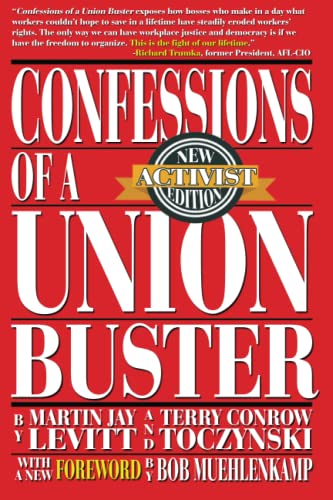
Until Levitt had a change of heart, and in the late 1980s reached out to Muehlenkamp about his desire to write a book exposing the dirty tricks of the union-busting industry. Levitt’s Confessions of a Union Buster was published in 1993 and immediately made waves, with Levitt appearing on 60 Minutesand giving lectures around the country to denounce his former colleagues and confess his sins. “Union-busting is a field populated by bullies and built on deceit,” he wrote. “The only way to bust a union is to lie, distort, manipulate, threaten and always, always attack.” He described how his former firm, Modern Management Methods, had developed a methodology for breaking down employee support for unions by using psychological tactics and turning managers into anti-union spokespersons.

His new career as a reformer earned him enemies on both sides — panicking his old colleagues in the union avoidance consulting industry and arousing skepticism among former nemeses in the labor movement, one of whom called him a “cheesy hustler.”

Levitt wrote about his insatiable greed, his alcoholism, a rap sheet that included forgeries, check fraud and arson, and multiple illegal activities on behalf of some of America’s biggest companies. Critics called him an opportunist, but some labor veterans, including Muehlenkamp, saw him as an important ally who could help them learn how to combat the union busters.

Levitt was a complicated penitent — just months after the book was published, he went to jail for obtaining credit by false pretenses — and he passed away in 2004 without having won over that many of his former antagonists.

https://e.infogram.com/047ec8bd-9d2b-43d6-9143-48a3cc2b5b73?parent_url=https%3A%2F%2Fcapitalandmain.com%2Finside-the-secretive-world-of-union-busting-the-story-of-an-unlikely-alliance&src=embed#async_embed

But his seminal book has served as a guide for union organizers and their allies. Levitt describes how his former industry benefited enormously from a 1950s-era loophole in labor law that allowed companies to hire anti-union consultants without disclosing those arrangements — one of the “enormous, gaping errors in the law that have left room for a sleazy billion-dollar industry to plod through,” Levitt wrote. That loophole was closed in 2016 by the Department of Labor, finally shedding light on an industry paid an estimated $340 million a year by companies. The labor victory was short-lived — just a few years later, the loophole was reopened by the Trump administration, and the Biden administration has yet to take action.

The book is being reprinted, with a new introduction and appendix by Muehlenkamp, who writes that “it documents the dirty underside of how U.S. corporations, who routinely bargain with unions in other countries, attacked and weakened American democracy. The question is, what can we do about it? We know how to have the best chance at beating the union busters. It starts with reading Levitt’s book. Know the enemy and take them as seriously as they take a union.”

Muehlenkamp talked to Capital & Main about his experiences in the movement, knowing Levitt as enemy and ally, and what he sees as the biggest challenges facing unions today.

Note: This interview has been edited for length and clarity.

To read the interview, open the link.

This part of Capital & Main’s examination of union busting reviews the targeting of academics who study labor by corporate critics. It was written by Jo Constantz.

Many scholars who study the history and economics of organized labor are sympathetic to the union cause. These academics often encounter threats, harassment, and defunding of their research.

It begins:

Throttled by both strong-arm tactics from anti-union interests and a chronic lack of support from universities, the field of labor studies has dwindled in the U.S. in recent years.

Researchers in the field have been the target of legal threats and lawsuits, onerous public records requests and misinformation campaigns from union avoidance consultants, business executives, corporate lawyers and conservative think tanks. It’s one aspect of the business lobby’s relentless war against unions in recent decades, which has seen companies spend more than $340 million a year on consultants to defeat organizing efforts by their employees and helped sink union membership.

Labor studies, an interdisciplinary field in academia that examines workplace issues and worker organizations, reveals working conditions that motivate people to want to join a union. Much of the scholarship has illuminated the central role that labor’s decline has played in exacerbating income inequality. In doing so, the field has aroused the ire of anti-union companies and their allies. The field has never been a major force in academia and many centers have been gradually shuttered due to lack of funding or merged with other departments. Only a handful of universities currently offer a major or minor in labor studies. Faculty are often untenured, vulnerable to layoffs and budget cuts, and they are often not replaced when they retire.

Open the link and read on.

This article in the Capital & Main series was written by Marcus Baram and is titled ”Inside the Secretive World of Union-Busting: Here’s How Much Corporations Pay to Bust Unions.” Subtitle: “U.S. companies spend hundreds of millions of dollars per year to ensure workers don’t organize.”

It begins:

A handful of workers at the Dollar General In the small Connecticut town of Barkhamsted had grown frustrated last September at being poorly treated by a district manager, amid allegations

The organizing effort involved just six workers (five after one said he was fired for his efforts to unionize) earning $13 an hour — so about $624 a day in total — but the company spent multiples of that to combat the union drive. Dollar General paid Labor Relations Institute, a firm known for its union avoidance consulting, a fee of $2,700 per day for each consultant it brought in, according to filings with the Department of Labor. LRI used five consultants, who reportedly held one-on-one meetings with workers and conducted group sessions to educate them on the risks of joining a union. In the end, the unionization effort failed and the company breathed a sigh of relief. The retail giant posted $33.7 billion in sales and $2.7 billion in profit in 2020, but remains convinced its future earnings might have been hurt if any of its 157,000 workers joined a union.

What do you say when a corporation cares more about profits than the lives of its workers?

In part one of its review of union busting, written by Jo Constantz, Capital & Main examines how employers use technology to defeat unions.

It begins:

During a Zoom call set up by union representatives and employees who had organized a worker organizing committee, “We noticed that managers of the company had busted into the meeting — they had crashed our Zoom call,” recalls Lorena Lopez, a director of organizing with UNITE HERE Local 11. “Workers started to get very nervous and shut down their cameras so they wouldn’t be recognized. I was running the meeting and asked everyone to ID themselves. But the company people refused.” During the meeting, a worker on the cleaning crew had volunteered to be the spokesperson for the group. According to Lopez, this worker was confronted by management the next day and pressured to quit.

“They were spying on us — and it was easy to do via Zoom,” she says. Under a settlement agreement with the NLRB, the company agreed to post flyersinforming employers of their right to unionize and pledged not to ask them about organizing efforts and not to surveil their Zoom meetings. A lawyer for the company did not return requests for comment.

Workplace surveillance, already widespread in the U.S., has become even more prevalent during the pandemic as employers try to enforce public health measures and monitor remote workers. According to research by Gartner, a market research firm, 60% of large employers use workplace monitoring tools, twice as many as before the pandemic. Coworker.org, a labor research nonprofit, recently compiled a database of over 550 of these commercially available products, which it dubs “little tech,” and published a study outlining potential harms and noting the industry’s general lack of regulation.

Open the link and keep reading.