Archives for category: Trump

Philip Bump of The Washington Post notes the hypocrisy of Republicans, especially James Comer, chairman of the House Oversight Committee, who searched and searched forevidence of President Biden’s corruption. He never found it but he never stopped looking and releasing press releases about the corruption he expected to find.

Now there is a genuine grifter in the White House, and Comer has lost interest in corruption, even when it’s detailed on the front pages of the daily press.

Yesterday, we learned that a fund in Abu Dhabi had invested $2 billion in the Trump family’s cryptocurrency business. Is this what we expect of our presidents? Will there be a Congressional investigation?

Bump writes:

One of the more striking aspects of Elon Musk’s rampage through the federal government has been that it is, at least in theory, redundant. There already exist congressional bodies and powers that are ostensibly focused on waste and corruption. The House Oversight Committee, for example, declares as its mission to “ensure the efficiency, effectiveness, and accountability of the federal government and all its agencies.” Why deal with Musk’s messiness when Republicans control how the House exercises that power?

We are not so naive that we cannot summon some answers to that question. One reason for this approach, for example, is that Musk was tasked with operating outside the system by design, pushing for sweeping cuts to congressionally appropriated spending specifically to get around the system of checks and balances.

A more important reason, though, is that the majority of members on the House Oversight Committee and, in particular, Chairman James Comer (R-Kentucky.) have a specific vision for how their power should be deployed. Their mission is not to work across the aisle to make government faster and cleaner. As has been made very clear in the two years since Republicans retook the majority, their mission instead is to generate allegations of impropriety by their political opponents while shielding their allies.

Nowhere is this more obvious than in the conflicting approach Comer and his committee have taken to allegations of self-enrichment by the nation’s chief executive.

Days after Republicans won their majority in November 2022, Comer held a news conference in which he sought to draw attention to claims — stoked in right-wing media and embraced by his party while in the minority — that President Joe Biden had benefited from his son Hunter Biden’s consulting work. He insisted that “the Biden family swindled investors of hundreds of thousands of dollars — all with Joe Biden’s participation and knowledge” and suggested that the sitting president (and presumed 2024 Democratic presidential nominee) might be “a national security risk” who was “compromised by foreign governments.”

What ensued over the next 16 months was far less “Law & Order” than “Keystone Kops.” Comer and other Republican leaders made little progress in tying Biden to his son’s business beyond the vaguest of connections, like that Hunter Biden would put his father on speakerphone during business meetings. Countervailing evidence for the idea that Joe Biden was entwined with Hunter’s foreign partners was ignored or spun away. One particular allegation hyped by Comer backfired spectacularly.

House Speaker Kevin McCarthy (R-California) was eventually pressured into announcing an impeachment probe targeting the president mostly centered on the same things Comer had been claiming since 2022. It went nowhere.
To put a fine point on it, two years of searching and subpoenas and depositions provided no concrete evidence (and very little circumstantial evidence!) that Joe Biden had used his position for his own personal benefit. Two seconds into Donald Trump’s second term in office, by contrast, there could have been any number of ripe targets for a similarly focused investigation.

Comer very obviously has no interest in doing so. When he inherited the Oversight Committee in 2023, in fact, he quietly ended an investigation into Trump’s finances, despite the committee having prevailed in a legal fight to obtain documentation from Trump’s accounting firm. Even with the former president pushing for the 2024 Republican presidential nomination, the various ways in which Comer’s allegations against Biden were much more obviously applicable to the Trumps attracted no interest from House Republicans.

Since the inauguration in January, viable avenues for investigation have become only more numerous.

On Tuesday, the New York Times published an exhaustive look at the Trumps’ creation of a crypto-centered investment structure called World Liberty Financial. It has explicit manifestations of nearly everything Comer was unable to prove about Biden and his family: exercising presidential power for the benefit of the company (and by extension himself and his sons), allowing partners to assume the trappings of the federal government for private financial discussions, foreign investors admitting that their interest is driven by the president’s participation.

The Washington Post recently detailed Trump’s rollout of a different cryptoworld product: a bespoke coin that serves as little more than a speculative vehicle — one from which Trump and his family can directly profit. Trump recently announced that top investors in the coin would be granted an audience with him. At around the same time he did so, the federal government registered the domain thetrilliondollardinner.gov.

“He’s actually selling access, personal access, to him and to the White House if people invest in this meme coin, which really has no intrinsic value,” Virginia Canter, the chief ethics counsel for the watchdog group State Democracy Defenders Action, told The Post. “If you are a foreign government burdened by tariffs, will you be enticed to invest? If you’re a criminal felon, will you maybe invest in hopes of they’ll give you an opportunity to make your case for a pardon?”
Oh, that reminds me: At least two investors in World Liberty Financial have already received presidential pardons.

Then there was the announcement last month that Donald Trump Jr. is the co-founder of a new private club in D.C. For a membership fee of $500,000, you can mingle with MAGAworld luminaries and — if the kickoff event is any indicator — members of the Trump administration. None of this rinky-dink “I’ll put my dad on speakerphone if he calls” stuff. Aptly enough, the club is called Executive Branch.

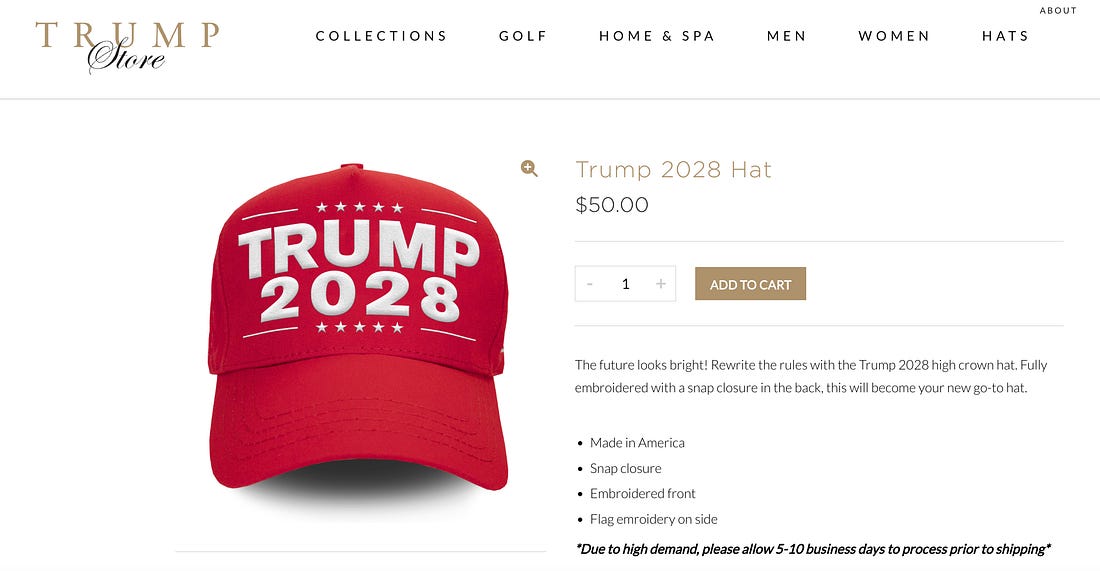
Those are just recent reports, mind you. The Trump Organization (which directly enriches the president) still operates private businesses around the world, at times in partnership with foreign governments. Trump himself has visited properties run by his private company on 42 of his 102 days in office, giving customers a decent shot at getting face-time with the president. Even when he isn’t at a Trump Organization property, he’s still selling pro-Trump merchandise (like a “Trump 2028” hat) both directly through the Trump Organization and through licensing deals.

Comer, meanwhile, has been focused not on investigating the obvious questions about Trump but, instead, on probing ActBlue — a fundraising system used by Democratic politicians. In an egregious break with the tradition of presidents avoiding interference in the Justice Department, Trump used the pretext of the House probe to demand that ActBlue face criminal investigation.

On Wednesday morning, Comer appeared on Fox Business to discuss Republican efforts to draft a budget bill. He began by asserting that his committee had identified billions in potential budgetary savings (which he later explained would come from targeting federal employee benefits, not from any robust investigation unearthing fraud or waste). Asked about articles of impeachment filed against Trump this week, he leveled a deeply ironic charge at his colleagues across the aisle.

“Harassing, obstructing — that’s all the Democrats know,” Comer said, while insisting that impeachment would go nowhere. “They don’t have any ideas or vision for the future.”

If there is one thing that can be said of Trump, it is that he has a vision for the future — in particular as it relates to the robustness of his own bank account. Comer and his colleagues in the House have proved to be more than happy to not stand in his way.
The second Trump administration may well go down in history as the most corrupt presidency in our history. We learned yesterday that the Trump family crytocurrency just received an investment of $2 billion from a fund in Abu Dhabi; this is a sure way to gain access to the patriarch in the White House. Not only is he enriching himself and his family, but has also allowed Elon Musk to violate every ethical rule in the federal government while shackling his competitors.

Steven Rattner, a columnist for The New York Times, details some of the ways that Trump enriches himself during his Presidency. We should not be surprised. Throughout his adult life, Trump has been a hustler, a con man, a performer, and a man who loves money.

He wrote:

No presidential administration is completely free from questionable ethics practices, but Donald Trump has pushed us to a new low. He has accomplished that by breaking every norm of good government, often while enriching himself, whether by pardoning a felon who, together with his wife, donated $1.8 million to the Trump campaign; promoting Teslas on the White House driveway; or holding a private dinner for speculators who purchase his new cryptocurrency.

Mr. Trump’s blatant transgressions have swamped those of any modern president and even those of his first term. Remember the outrage when he refused to divest his financial holdings or when he used a Washington hotel he owned as a kind of White House waiting room? Those moves seem quaint in comparison.

In his trampling of historically appropriate behavior, Mr. Trump appears to be pursuing several agendas. Personal enrichment stands out: Imagine any other president collecting a cut of sales from a cryptocurrency marketed with his likeness. There is the way he is expanding his powers: He has ignored or eliminated large swaths of rules that would have inhibited his freedom of action and his ability to put trusted acolytes in key roles. And then there’s rewarding donors, whether through pardons or favors for their clients.

I was working in the Washington bureau of The Times when Richard Nixon resigned, and even he — taken down by his efforts to cover up his misdeeds — did not engage in such a vast array of sordid practices.

The corruption of Trump 2.0 has not gotten the attention it deserves amid the barrage of news about Mr. Trump’s tariff wars, his attack on scientific research and his senior appointees’ Signal text chains. But self-dealing is such a defining theme of this administration that it needs to be called out. Like much that Mr. Trump has done in other areas, it announces to the world that America’s leaders can no longer be trusted to follow its laws and that influence is up for sale.

Just as in the post-Nixon era, when guardrails were established to prevent transgressions, the next president could decide to restore some of the sound government practices that Mr. Trump has trampled on. But the damage he has inflicted by, say, pardoning his donors or lining his own pockets is irreversible.

The below represents just a sampling of what’s transpired these past 100 days.

  • He turned a legitimate federal employee designation into a loophole. By giving senior officials such as Elon Musk the title “special government employee,” Mr. Trump avoided requirements that they publicly disclose their financial holdings and divest any that present conflicts before taking jobs in the administration.
  • He ended bans that stopped executive branch employees from accepting gifts from lobbyists or seeking lobbying jobs themselves for at least two years.
  • He loosened the enforcement of laws that curb foreign lobbying and bribery.
  • He dismissed the head of the office that polices conflicts of interest among senior officials.
  • He jettisoned the head of the office that, among other things, protects whistle-blowers and ensures political neutrality in federal workplaces.
  • He purged nearly 20 nonpartisan inspectors general who were entrusted with rooting out corruption within the government.

Rewarding donors is part of any presidential administration. Every president in my memory appointed supporters to ambassadorships. But again, Mr. Trump has gone much further.

  • Jared Isaacman, a billionaire with deep tentacles into SpaceX, gave $2 million to the inaugural committee and was nominated to head NASA — SpaceX’s largest customer.
  • The convicted felon Trevor Milton and his wife donated $1.8 million to the campaign and Mr. Milton received a pardon, which also spared him from paying restitution.
  • The lobbyist Brian Ballard raised over $50 million for Mr. Trump’s campaign, and Mr. Trump handed major victories to two Ballard clients. He delayed a U.S. ban on China-owned TikTok his first day in office and killed an effort to ban menthol cigarettes, a major priority of tobacco company R.J. Reynolds, on his second.

Mr. Musk, the Tesla and SpaceX billionaire who spent $277 million to back Mr. Trump and other Republican candidates, requires his own category.

As a special government employee, Mr. Musk is supposed to perform limited services to the government for no more than 130 days a year. By law, no government official — even a special government employee — can participate in any government matter that has a direct effect on his or her financial interests. That criminal statute hasn’t stopped Mr. Musk and his so-called Department of Government Efficiency from interacting with at least 10 of the agencies that oversee his business interests.

  • He installed a SpaceX engineer at the Federal Aviation Administration to review its air traffic control system. The F.A.A. is reportedly considering canceling Verizon’s $2.4 billion contract to update its aging telecommunications infrastructure in favor of a SpaceX’s Starlink product. (SpaceX has denied it is taking over the contract.)
  • SpaceX is a leading contender to secure a large share of Mr. Trump’s “Golden Dome” missile defense project, an effort that could involve billions of revenue for the winner.
  • X, Mr. Musk’s social media outlet, has become an official source of government news. The White House welcomed a reporter from the platform at a recent briefing, and at least a dozen government agencies started DOGE-focused X accounts.
  • As Mr. Musk’s political activities started to repel many potential customers of Tesla, his electric vehicle company, Mr. Trump lined Tesla vehicles up on the White House driveway and extolled their benefits. Then Commerce Secretary Howard Lutnick urged Fox News viewers to buy Tesla shares.
  • DOGE nearly halved the team at the National Highway Traffic Safety Administration that regulates autonomous vehicles. The agency has been investigating whether Tesla’s self-driving technology played a role in the death of a pedestrian in Arizona.

Critics of crypto argue that it has demonstrated little value beyond enabling criminal activity. Despite this, Mr. Trump has wasted no time eliminating regulatory oversight of the industry at the Securities and Exchange Commission and the Justice Department, even as his family grows ever more invested in it.

By enabling money to be delivered anonymously and without any bank participation, crypto offers the possibility for any individual or foreign state to funnel money to Mr. Trump and his family secretly. Moreover, Bloomberg News recently estimated that the Trump family crypto fortune is nearing $1 billion.

  • On the eve of his inauguration he released $TRUMP and $MELANIA memecoins — a type of crypto derived from internet jokes or mascots. Next, the S.E.C. announced it would not regulate memecoins. Then last week, Mr. Trump offered a private dinner at his golf club and a separate “Special VIP Tour” to the top 25 investors in $TRUMP, causing the price of the currency to surge and enriching the family. (That tour was initially advertised as being at the White House. Then the words “White House” disappeared, but the rest of that prize remained.)
  • The S.E.C. eliminated its crypto-enforcement program, ending or pausing nearly every crypto-related lawsuit, appeal and investigation. That includes the civil suit against Justin Sun, a crypto entrepreneur who had separately purchased $75 million worth of tokens tied to Mr. Trump’s family after the election.
  • The S.E.C. also suspended its civil fraud case against Binance, the huge crypto exchange that pleaded guilty to money-laundering violations and allowed terrorist financing, hacking and drug trafficking to proliferate on its platform. Soon after, the company met with Treasury officials to seek looser oversight while also negotiating a business deal with Mr. Trump’s family.
  • World Liberty Financial, a crypto company that Mr. Trump and his sons helped launch, said it had sold $550 million worth of digital coins. A business entity linked to him gets 75 percent of the sales.
  • The Trump family has said it will partner with the Singapore-based crypto exchange Crypto.com to introduce a series of funds comprising crypto and securities with a made-in-America focus.
  • The federal government’s “crypto czar,” David Sacks, Mr. Lutnick and Mr. Musk all have connections to the market. (Mr. Musk named DOGE after a memecoin.)
  • Mr. Trump is reportedly on his way to raising $500 million for his political action committees — highly unusual for a president who cannot run for re-election.
  • A new Trump Tower is underway in Jeddah, Saudi Arabia’s second largest city, with plans for two more projects for the kingdom announced after Mr. Trump’s November election victory, all in partnership with a Saudi company with close ties to the Saudi government.
  • Mr. Trump’s team asked about bringing the signature British Open golf tournament to his Turnberry resort in Scotland during a visit of the British prime minister, Keir Starmer, to the White House.
  • He posts news-making announcements on Truth Social, the company in which his family owns a significant stake.

It’s all a sorry and sordid picture, a president who had already set a new standard for egregious and potentially illegal behavior hitting new lows with metronomic regularity.

David Yaffe-Bellany of The New York Times reported on a startling development in Dubai that will enrich the Trump family by hundreds of millions of dollars. Is it a conflict of interest? Of course. Will it matter to the Republican leaders in Congress? No. Has there ever been a President who used his office for financial gain so brazenly? No. Trump is #1.

Gaffe-Bellamy writes:

Sitting in front of a packed auditorium in Dubai, a founder of the Trump family cryptocurrency business made a brief but monumental announcement on Thursday. A fund backed by Abu Dhabi, he said, would be making a $2 billion business deal using the Trump firm’s digital coins.

That transaction would be a major contribution by a foreign government to President Trump’s private venture — one that stands to generate hundreds of millions of dollars for the Trump family. And it is a public and vivid illustration of the ethical conflicts swirling around Mr. Trump’s cryptofirm, which has blurred the boundary between business and government.

Zach Witkoff, a founder of the Trump family crypto firm, World Liberty Financial, revealed that a so-called stable coin developed by the firm, would be used to complete the transaction between the state-backed Emirati investment firm MGX and Binance, the largest crypto exchange in the world.

Virtually every detail of Mr. Witkoff’s announcement, made during a conference panel with Mr. Trump’s second-eldest son, contained a conflict of interest.

MGX’s use of the World Liberty stablecoin, USD1, brings a Trump family company into business with a venture firm backed by a foreign government. The deal creates a formal link between World Liberty and Binance — a company that has been under U.S. government oversight since 2023, when it admitted to violating federal money-laundering laws.

And the splashy announcement served as an advertisement to crypto investors worldwide about the potential for forming a partnership with a company tied to President Trump, who is listed as World Liberty’s chief crypto advocate.

“We thank MGX and Binance for their trust in us,” said Mr. Witkoff, who is the son of the White House envoy to the Middle East, Steve Witkoff. “It’s only the beginning.”

Mr. Witkoff and Eric Trump were speaking on a panel at Token2049, a major crypto conference in the United Arab Emirates, where more than 10,000 digital currency enthusiasts have gathered for a week of networking. It was the latest stop in an international tour by Mr. Witkoff, who visited Pakistan last month with his business partners to meet the prime minister and other government officials. Eric Trump, who runs the family business, has spent the week in Dubai, where he announced plans to back a Trump-branded hotel and tower.

There is more.

This is a gift article so you should be able to read it in full even without a subscription.

Thom Hartmann sees the pattern on the rug. Trump and Musk are stifling democratic institutions and rushing headlong towards the tyranny they both admire. Trump thinks that he can make himself dictator for life, Like his buddies in Russia and North Korea. Will the public defend the Constitution?

He wrote:

When Harvard, one of America’s oldest and most revered institutions of higher learning, stands defiant as the federal government freezes billions in funding simply because it refuses to knuckle under to authoritarian demands — like gutting DEI programs and turning faculty into immigration informants — we’re no longer playing the usual game of politics.


This is the open throttling of academic freedom, part of a larger, deliberate campaign to silence dissent, centralize power, and erase democratic norms.


We’ve seen this playbook before in other countries — but now it’s being run right here, in the land that once proudly called itself the world’s beacon of liberty.


Democracy doesn’t die in darkness, as the saying goes; it suffocates in broad daylight.


Americans are witnessing an unprecedented assault on the very foundations of our democratic experiment, orchestrated with a precision that would make authoritarian strongmen worldwide nod in approval.


Senator Chris Murphy has raised alarm bells about what he describes as a methodical attack on American institutions that are supposed to keep government accountable to its citizens. By his account, the strategy isn’t dramatic coups or burning parliaments; that’s not how modern democracies perish. Instead, they’re slowly dismantled through the calculated erosion of accountability mechanisms.


History provides a disturbing playbook, and we’re watching it unfold right now here in America. Putin, Orbán, and Erdoğan didn’t need tanks in the streets. They understood that the process is multi-part but straightforward:


— Legitimize political violence,
— Capture the media,
— Intimidate lawyers,
— Install corrupt leaders within regulatory and police agencies,
— Disappear first minorities and later opposition leaders,
— Silence universities, and
— Starve opposition movements by denying their nonprofit status and funding.


Consider what we’re seeing unfold. The recent January 6 pardons sent an unmistakable message about the acceptability of political violence. When legislators openly express fears of “retaliation” — as Senator Lisa Murkowski just did — we’re already several steps down a dangerous path.


Meanwhile, the concentration of media power in the hands of billionaires who increasingly bend to political pressure isn’t accidental. Whether through ownership, lawsuits, or regulatory threats, the ability to speak truth to power is being systematically constrained.


Universities, traditionally bastions of free thought and youth activism, face unprecedented pressure to conform or lose federal support.

Legal professionals, our front-line defenders of constitutional rights, are being asked to choose between principles and practice.


The economic dimension of this strategy can’t be ignored. Targeted tariffs and funding cuts effectively create a corporate compliance regime where business survival depends on political loyalty. When small-dollar online giving platforms become targets, it’s clear this is about drying up resources for political opposition.


Senator Murphy’s warning carries particular weight: “I still believe we can stop it,” he says. His prescription includes institutional solidarity, mass mobilization, and political courage. These steps aren’t just wishful thinking: history shows they work when deployed with determination.


The challenges are clear, but so is the path forward. Democrats and defenders of democracy must recognize this isn’t politics as usual. The systematic undermining of accountability mechanisms isn’t merely partisan: it’s anti-democratic in the most fundamental sense.


It’s the first stages of outright tyranny, the first American dictatorship.


If conventional resistance proves insufficient, Murphy suggests civil disobedience may become necessary. That’s not a suggestion to be taken lightly, especially from a sitting US senator.

The coming months will test America’s democratic resolve. The institutions being targeted aren’t merely political; they’re the scaffolding of self-governance itself. As Murphy warns, “We still have the power, but we probably have less time than most think.”


For those wondering where the line exists between alarmism and appropriate warning, consider this: When elected officials speak openly about fear of retaliation, when media owners preemptively capitulate, when universities face unprecedented political pressure, and when legal professionals must toe ideological lines, we’re no longer discussing hypotheticals.


The American experiment has faced threats before, but, outside of the Confederacy, rarely have they been so comprehensively designed or so methodically executed.


Recognition of this reality isn’t partisan, it’s patriotic. The future of American democracy depends on understanding what’s at stake and acting accordingly.


The assault on Harvard is just one chapter in a larger story — one where the villains aren’t hiding in shadows, but are operating in full view with chilling precision.


The question isn’t whether this is happening. It’s whether enough Americans will recognize the danger in time to stop it.

In an investigative report, The New York Times demonstrated that Elon Musk failed to deliver on his claim that he could cut $2 trillion from the federal budget. Not only did he fall short, but his efforts were so reckless that they might cost money instead of saving it.

Having launched his so-called “Department of Government Efficiency” (which is not a department at all and was never authorized by Congress), Musk and his then-partner Vivek Ramaswamy promised to cut $2 trillion. Their goal dropped to $1 trillion, and Vivek left the team to run for Governor in Ohio.

Some of DOGE’s claims turned out be be inflated (one alleged saving of $8 billion turned out to be a saving of only $8 million.

Musk eventually reduced his saving claim to only $150 billion.

Since DOGE began, thousands of federal employees have been fired. Some have been rehired after courts decided their firing was illegal. Some have been fired, rehired, and fired again. Some career employees have taken buyout offers. Tens of thousands of federal employees have been laid off, without regard to their experience. There was no time for DOGE workers to evaluate each person they ousted, nor did DOGE have the competence to judge its victims.

The New York Times concluded that DOGE’s activities may actually save nothing at all. Firing workers is expensive when you do it the wrong way, the DOGE way.

Elizabeth Williamson of The New York Times wrote:

President Trump and Elon Musk promised taxpayers big savings, maybe even a “DOGE dividend” check in their mailboxes, when the Department of Government Efficiency was let loose on the federal government. Now, as he prepares to step back from his presidential assignment to cut bureaucratic fat, Mr. Musk has said without providing details that DOGE is likely to save taxpayers only $150 billion.

That is about 15 percent of the $1 trillion he pledged to save, less than 8 percent of the $2 trillion in savings he had originally promised and a fraction of the nearly $7 trillion the federal government spent in the 2024 fiscal year.

The Partnership for Public Service, a nonprofit organization that studies the federal work force, has used budget figures to produce a rough estimate that firings, re-hirings, lost productivity and paid leave of thousands of workers will cost upward of $135 billion this fiscal year. At the Internal Revenue Service, a DOGE-driven exodus of 22,000 employees would cost about $8.5 billion in revenue in 2026 alone, according to figures from the Budget Lab at Yale University. The total number of departures is expected to be as many as 32,000.

Neither of these estimates includes the cost to taxpayers of defending DOGE’s moves in court. Of about 200 lawsuits and appeals related to Mr. Trump’s agenda, at least 30 implicate the department.

The errors and obfuscations underlying DOGE’s claims of savings are well documented. Less known are the costs Mr. Musk incurred by taking what Mr. Trump called a “hatchet” to government and the resulting firings, agency lockouts and building seizures that mostly wound up in court.

“Not only is Musk vastly overinflating the money he has saved, he is not accounting for the exponentially larger waste that he is creating,” said Max Stier, the chief executive of the Partnership for Public Service. “He’s inflicted these costs on the American people, who will pay them for many years to come.”

Mr. Stier and other experts on the federal work force said it did not have to be this way. Federal law and previous government shutdowns offered Mr. Musk a legal playbook for reducing the federal work force, a goal that most Americans support. But Mr. Musk chose similar lightning-speed, blunt-force methods he used to drastically cut Twitter’s work force after he acquired the company in 2022.

“The law is clear,” said Jeri Buchholz, who over three decades in public service handled hiring and firing at seven federal agencies, including NASA and the Defense Intelligence Agency. “They can do all the things they are currently doing, but they can’t do them the way they’re doing them. They can either start over and do it right, or they can be in court for forever.”

Trump will leave no independent board untouched by his political venom, as he demonstrated by his hostile takeover of the Kennedy Center, where he removed every Biden appointee and replaced a bipartisan board with an all-Trump board. He also removed the nonpartisan director of the Kennedy Center and replaced her with a Trump loyalist. And he named himself President of the Kennedy Center.

Now he has removed all Biden appointees on the board of the Holocaust Museum, including Doug Emhoff, husband of former Vice-President Kamala Harris, who was in the first year of a five-year term. Emhoff is Jewish.

The New York Times reported:

The Trump administration has begun firing at least some of former President Joseph R. Biden Jr.’s appointees to the board that oversees the U.S. Holocaust Memorial Museum, including Douglas Emhoff, the husband of former Vice President Kamala Harris, and other senior Biden White House officials.

“Today, I was informed of my removal from the United States Holocaust Memorial Council,” Mr. Emhoff said in a statement on Tuesday. “Holocaust remembrance and education should never be politicized. To turn one of the worst atrocities in history into a wedge issue is dangerous — and it dishonors the memory of six million Jews murdered by Nazis that this museum was created to preserve.”

Mr. Emhoff is Jewish and an outspoken critic of the rise in antisemitism. His appointment to the council was announced in January; presidential appointments are typically five-year terms.

The other officials who were dismissed include Ron Klain, Mr. Biden’s first chief of staff; Tom Perez, the former labor secretary and senior adviser to Mr. Biden; Susan Rice, the national security adviser to former President Barack Obama and Mr. Biden’s top domestic policy adviser who led a major national strategic effort to counter antisemitism; and Anthony Bernal, a senior adviser to Jill Biden, the former first lady.

Please watch this wonderful, concise explanation by Fareed Zakaria of the harm that Trump is inflicting on our economy and our future by attacking science and basic research.

Since Trump invited Elon Musk and his DOGE team to cut the federal budget, the federal government has been subject to a bloodbath of firings, layoffs, and closed agencies. Some of the most shocking budget cuts have focused on scientific research. Reckless cuts have been imposed on the National Science Foundation and on every part of the Department of Health and Human Services, where the Secretary–conspiracy theorist Robert F. Kennedy Jr.–is crushing genuine research and prioritizing his obsession with vaccines as the cause of autism, which has been debunked.

Trump has blocked the payment of millions of dollars to universities that fund basic science research. He is using those blocks to force universities to stop DEI programs.

We can understand why Kennedy wants to destroy science: it has an annoying tendency to undercut his pet conspiracy theories. No matter what science says, he will continue to warn the public that vaccines are dangerous, that fluoridating water is dangerous, and anything that contradicts his ideology is fake, regardless of how many scientists disagree. WHO you gonna believe? The addled RFK Jr. or the world’s top scientists? Or Ghostbusters?

But we do not know why Trump put the nation’s public health agencies into the hands of a man who does not respect science.

Why does Trump want more children to die of measles? Why does he allow Elon Musk to shut down agencies like USAID that have saved millions of lives? Why he is cancelling grants to universities for basic scientific research? Why does he want to stop the work of scientists who are seeking cures for cancer, tuberculosis, AIDS, and other lethal diseases? I don’t know.

Frankly, the cuts are coming so fast that I can’t keep track of them all. I hope soon to find a comprehensive summary of the destruction of federally-funded scientific research.

In the meanwhile, this is the best overview I have seen.

Alan Burdick of the New York Times wrote this story about Trump’s rampage against scientific research:

Late yesterday, Sethuraman Panchanathan, whom President Trump hired to run the National Science Foundation five years ago, quit. He didn’t say why, but it was clear enough: Last weekend, Trump cut more than 400 active research awards from the N.S.F., and he is pressing Congress to halve the agency’s $9 billion budget.

The Trump administration has targeted the American scientific enterprise, an engine of research and innovation that has thrummed for decades. It has slashed or frozen budgets at the National Institutes of Health, the National Science Foundation, the Centers for Disease Control and Prevention and NASA. It has fired or defunded thousands of researchers.

The chaos is confusing: Isn’t science a force for good? Hasn’t it contained disease? Won’t it help us in the competition with China? Doesn’t it attract the kind of immigrants the president says he wants? In this edition of the newsletter, we break out our macroscope to make sense of the turmoil.

American research thrives under a patronage system that funnels congressionally approved dollars to universities, national labs and institutes. This knowledge factory employs tens of thousands of researchers, draws talent from around the world and generates scientific breakthroughs and Nobel Prizes.

It’s a slow-moving system, because science moves slowly. Discoveries are often indirect and iterative, involving collaboration among researchers who need years of subsidized education to become expert. Startups and corporations, which need quick returns on their investment, typically can’t wait as long or risk as much money.

Science is capital. By some measures, every dollar spent on research returns at least $5 to the economy.

President Trump is less patient. He has defunded university studies on AIDS, pediatric cancer and solar physics. (Two prominent researchers are compiling lists of lost N.I.H. grants and N.S.F. awards.) The administration has also laid off thousands of federal scientists, including meteorologists at the National Weather Service; pandemic-preparedness experts at the C.D.C.; black-lung researchers at the National Institute for Occupational Safety and Health. A next-generation space observatory, already built with $3.5 billion over a decade, awaits a launch that now may never happen.

Administration officials offer various reasons for the crackdown: cost-cutting, government efficiency, “defending women from gender ideology extremism.” Many grants were eliminated because they contain words, including climate, diversity, disability, trans or women. Some drew the administration’s ire because the applications included D.E.I. statements required by the previous administration.

It doesn’t take a telescope to see where this leads. American leaders have historically seen science as an investment in the future. Will this administration foreclose it? One-third of America’s Nobel Prize winners have been foreign-born, but an immigration crackdown has swept up scientists like Kseniia Petrova, a Russian who studied aging at Harvard and now sits in a Louisiana detention center. Australian academics have stopped attending conferences in the U.S. for fear of being detained, The Guardian has reported.

Now some American scientists are looking for the exits. France, Canada and other countries are courting our researchers. In a recent poll by the journal Nature, more than 1,200 American scientists said they were considering working abroad. The journal’s job-search platform saw 32 percent more applications for positions overseas between January and March 2025 than during the same period a year earlier.

These are mechanical threats to science — who gets money, what they work on. But there is a more existential worry. The Trump administration is trying to change what counts as science.

One effort aims at what science should show — and at achieving results agreeable to the administration. The health secretary, Robert F. Kennedy Jr., wants to reopen research into a long-debunked link between vaccines and autism. He doesn’t want to study vaccine hesitancy. The National Science Foundation says it will no longer fund “research with the goal of combating ‘misinformation,’ ‘disinformation,’ and ‘malinformation’ that could be used to infringe on the constitutionally protected speech rights of American citizens.” A Justice Department official has accused prominent medical journals of political bias for not airing “competing viewpoints.”

Another gambit is to suppress or avoid politically off-message results, even if the message isn’t yet clear. The government has expunged public data sets on air quality, earthquake intensity and seabed geology. Why cut the budget by erasing records? Perhaps the data would point toward efforts (pollution reduction? seabed mining limits?) that officials might one day need to undertake. We pursue knowledge in order to act: to prevent things, to improve things. But action is expensive, at a moment when the Trump administration wants the government to do as little as possible. Perhaps it’s best to not even know.

One sure way to shut down knowledge is to question who can gather it. The administration is painting scientists with the same liberal brush it has applied to academics more broadly — what Project 2025 describes as “the ‘enlightened,’ highly educated managerial elite.” The N.I.H. is controlled by “a small group of highly paid and unaccountable insiders,” the Project 2025 authors write. The regulatory work of the Environmental Protection Agency “should embrace so-called citizen science” and be left “for the public to identify scientific flaws and research misconduct.”

In science, as in a democracy, there’s plenty of room for skepticism and debate. That’s what makes it work. But at some point, calls for “further research” become disingenuous efforts to obscure inconvenient facts. It’s an old playbook, exploited in the 1960s by the tobacco industry and more recently by fossil-fuel companies.

Now it’s being weaponized by the government against science generally. Facts are elite, facts are fungible, facts are false. And once nothing is true, anything can be true.

Joyce Vance was the U.S. Attorney for the Northern District of Alabama. She writes a smart blog called Civil Discourse, in which she writes about court cases and the law, in language accessible to non-lawyers. In this post, she explains how massive protests can change the course of history.

She writes:

This coming Tuesday marks Donald Trump’s 100th day in office, a tenure that has led to a steady decline in the economy. If we use that measure, which many voters said led them to vote for Trump, these first 100 days have been a failure. Even as Trump has successfully seized power from Congress and some organizations have bent the knee to his every request, lawyers are winning in court, and some law firms, businesses, universities, and individuals are standing up to the president who would rather be a king. Trump may not have lost the first 100 days, but he hasn’t exactly won them either. Our democracy has been weakened, but it can still be saved.

Thursday is May Day, May 1st. There will be renewed protest marches across the country, many of them focused on Americans’ increasing awareness that the fundamentals of democracy, which we’ve taken for granted for so long, are in danger. It’s not just due process concerns, although that is an enormous part of it, as the deportations continue. Last week we learned that included some involved American citizen children and children with cancer, with Secretary Rubio offering a sorry rejoinder on Meet the Press this morning, blaming the mothers who took young children back to their countries of origin with them, rather than being forced to abandon them. There are plenty of reasons to march.

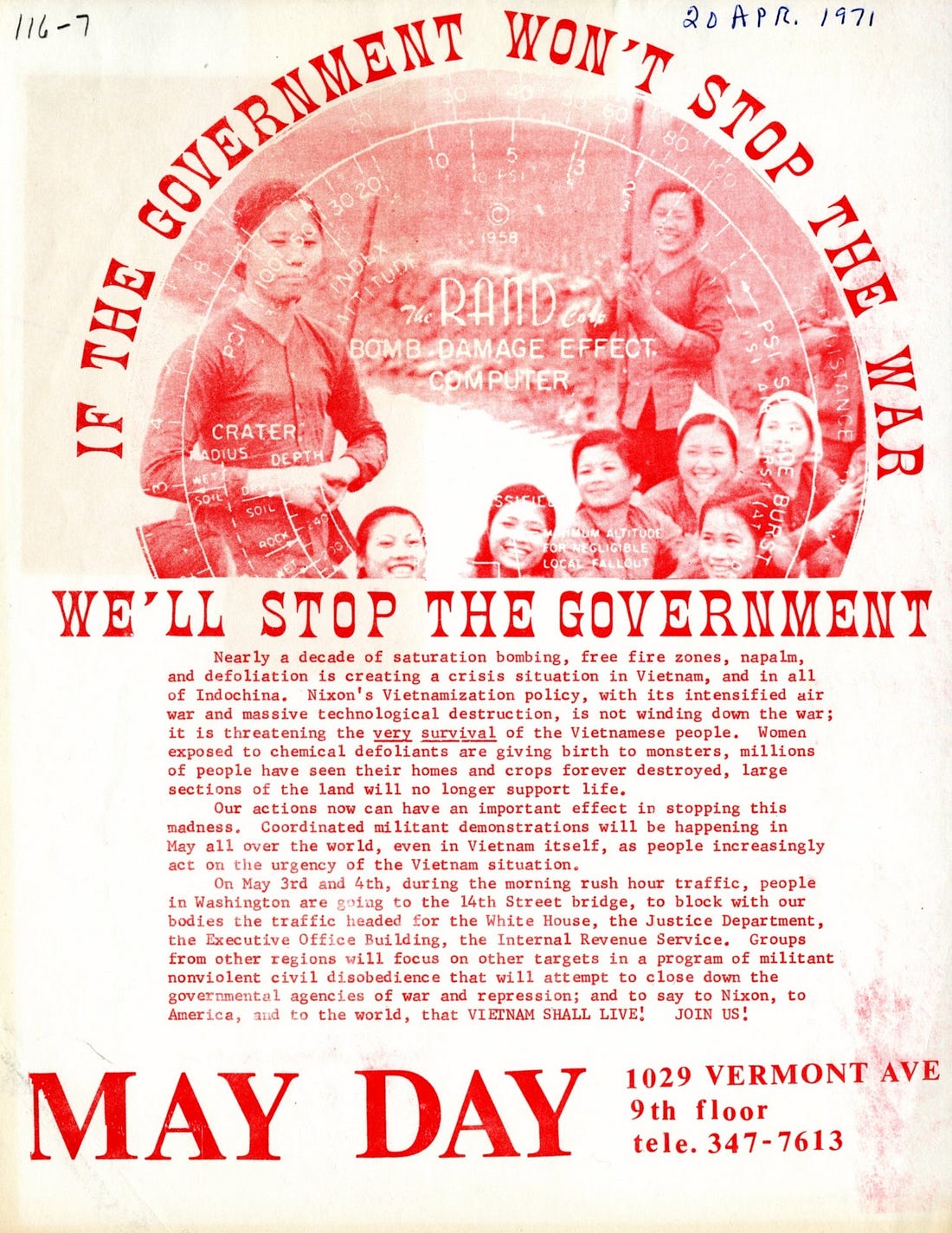
This will not be the first time Americans have engaged in mass protests on May Day. In 1971, tens of thousands of people took to the streets in Washington, D.C., to protest the Vietnam War. They began on May 3 and continued for two more days. By the time the protest ended, more than 12,000 protestors had been arrested. The protesters’ goal was to cause a traffic jam that would keep government employees from getting to work; their slogan was “If the government won’t stop the war, we’ll stop the government.”

Mass protests that are large and sustained have an impact on even an entrenched presidency. They did with Nixon. The White House Historical Association’s official version of events concludes that “the enormity of the protest pushed Nixon to accelerate the nation’s exit from Vietnam.” 

Even though it’s a different era, protests are bound to get to the thin-skinned president whose staffers, during his first term in office, had to prepare folders of positive stories about Trump for him to review twice each day. Imagine having thousands of people protesting within earshot of the White House. It must be even more galling because these protests are nonviolent and aim to support democracy through a legitimate exercise of First Amendment rights. They make a powerful statement, in contrast to a president who has abandoned the rule of law. 

In 1970, two-thirds of Americans had come to believe U.S. involvement in the Vietnam War was a mistake. We are not quite there yet when it comes to people’s view of the Trump administration. The most recent NBC News Stay Tuned Poll shows only 45% of Americans approve of the job Trump is doing. But, when asked about how strongly they hold their beliefs about the president, “the vehemence of the opposition outweighs the intensity of support from the president’s MAGA base.” Twenty-three percent of Americans said they were “furious” about what Trump is doing.

Thursday is also Law Day, an annual celebration of the rule of law. Although it has been in effect since 1958, it doesn’t usually receive much attention. This year, lawyers across the country have big plans for the day—make sure you look to see what’s going on in your area. President Dwight Eisenhower established Law Day as a day of national dedication to the principles of government under law. State Bar Associations hold essay competitions for school children, and there are state and national dinners most years. In 2025, Law Day takes on special significance as Americans’ concerns about due process come to the forefront. How fitting that the May Day protests sync with the Law Day commemoration. 

I’ve been doing a lot of research and writing about the origins of Law Day for my book (Giving Up Is Unforgivable, due out October 21), so I’ll leave that for another time, but I want to make sure everyone knows about Law Day. This year, many lawyers across the country will retake their oath to show their support for the rule of law. There is no reason the rest of the country can’t participate too!

The president issues a proclamation every year for Law Day. Trump did during his first term in office, too. In 2019, the proclamation began, “On Law Day, we renew our commitment to the rule of law and our Constitution. The rule of law requires that no one be above the obligations of the law or beneath its protections, and it stands as a bulwark against the arbitrary use of government power.” Unfortunately, he never lived up to those sentiments. On Thursday, we can look for the proclamation and point out the inconsistencies between what we expect from our presidents and how this one is behaving. The hypocrisy is always full force, and we shouldn’t shy away from pointing it out.

Due process is the sleeper issue of the second Trump presidency. No one really expected democracy issues, let alone concepts like the rule of law and due process to animate a country’s protests. But it’s increasingly clear that Americans are smart, and when we are well-informed, we have no difficulty assessing what matters and what is true. We see more and more of that as Americans carry signs that say “No Kings” and “Due Process” at local rallies. All of us can be advocates for democracy, not just the lawyers among us.

Here at Civil Discourse, we all understand the importance of this. We need to make sure the rest of the country does too. Until the Trump administration is over, it has to be Law Day every day. 

In 2024, the Law Day theme was “Voices of Democracy,” recognizing that the people are the rulers in a democracy. Americans express their views without fear of retribution because of the First Amendment and vote in elections to select their leaders. It’s up to us to make sure it stays that way.

This week will bring more briefings in the Abrego-Garcia case and others. There will be outrages, like the fact that Trump has a website hawking merchandise, literally selling the presidency. It’s not just the $50 price tag on the hat; there’s also the slogan, “Trump 2028,” a reference to Trump’s not-so-subtle hints that he’d like to serve a Constitution-busting third term in office. It’s not a joke. It never is with him.

So, make sure you take some time this week to celebrate Law Day. Invite people over. Go for a walk with friends or neighbors and share your views. Talk with your kids. Democracy is not automatic; it’s a participatory sport we must all play in together, one with critically important outcomes. Democracy is important. Let’s make sure we play for keeps.

We’re in this together,

Joyce

Thom Hartmann is a brilliant journalist who is fast to figure out the stories behind the headlines. Here, he explains why Attorney General Pam Bondi had Milwaukee County Jusge Hannah Dugan arrested and paraded her out of her courthouse in handcuffs. FBI Director Kash Patel tweeted pictures of the judge in handcuffs.

Hartmann writes that the goal was a warning to other judges:

The audience for Pam Bondi‘s performance yesterday — when federal agents swarm-raided a county judge — was not the general public. They don’t care if the story vanishes six or 12 or 24 hours into the news cycle, so long as vanishes. The real audience for their action was a very small number of people: the nation’s judges. They’ve pacified the Article I branch of government, Congress, and now they are in the process of pacifying the article III Judiciary branch. That will leave only the president in charge of the entire country under all circumstances in all ways. That is called dictatorship. Real dictatorship. Vladimir Putin style dictatorship. In fact it appears more and more every day that Putin is Trump’s mentor. If not his handler. And Trump is doing everything he can, with help from a South African billionaire, to destroy the traditional American infrastructure and nation and turn us into the newest member of the dictators club, joining Russia, China, Saudi Arabia, Belarus, Hungary, and the rest of the fascist and authoritarian world. And to get there, now that they have pacified Congress, they only have to seize control of the Judiciary and then nothing except we the people will stand in their way. And they know it. First, terrorize Congress. Second, terrorize the media. Third, terrorize the judges and lawyers. (the final step in that process for them will be the Supreme Court, and if they can first terrorize the entire federal judiciary it will be much easier to terrorize the Court). And finally begin terrorizing the individual citizens until the process is complete and we are fully Russia and all dissent is suppressed. And they know that time is running out because elections are coming and their popularity is already crashing. They are at maximum power right now and it is beginning to decline. This is another reason why they are pushing so hard to frighten judges. If Trump can do this as quickly as Hitler or Putin did, it could happen very quickly, possibly even in the next few weeks. Buckle up…

Hartmann also wrote about Trump’s habit of lying:

Busted: Trump stuns Time Magazine with outlandish lies to cover up his trade deal collapse. Donald Trump has lied his entire life, but China’s President Xi is committed to not letting him get away with lying about his trade negotiations with that country. On Tuesday, Trump sat down with two TIME Magazine reporters and repeatedly lied to them, saying that he was negotiating with China and that he’d already cut “over 200” deals with other nations to resolve the trade war he declared roughly a month ago. In fact, as the reporters pointed out, he’s not inked even one single deal so far and, to make things far worse for him, China is actively using social media to tell the world that they’re not even bothering to talk with his people, must less President Xi calling Trump himself. We’ve had some terrible presidents throughout our history and some have done some terrible things; John Adams imprisoning newspaper editors, Andrew Jackson and the Trail of Tears, both Richard Nixon and Ronald Reagan conspiring with foreign countries to steal American elections. But lying to the press and the people on such a routine basis — over 30,000 documented lies in his first term, and daily lies now — is something new in the American experience. Democracy can’t work when a nation can’t trust its leaders to tell them the truth on issues of consequence, which appears to be exactly Trump’s (and Putin’s) goal: the destruction of our republic from the inside, just as Khrushchev predicted.

Then Hartmann wondered why some of Trump’s Wall Street pals are getting stock tips:

Are Wall Street insiders getting stock tips from Trump? And why is Apple moving their production to India instead of the US? Fox’s senior business correspondent Charles Gasparino told his viewers on Thursday that “senior Wall Street execs with ties to the White House” had informed him that they were getting tips from the Trump administration on trade talks that could (and do) swing markets. When Gasparino approached Treasury Secretary and billionaire Scott Bessent’s press team, they refused to deny the reports. Remember when Martha Stewart went to prison for six months because a doctor friend told her about the results from clinical trials of a new drug and she passed that info along to her stockbroker? Hypocrisy doesn’t begin to describe the astonishing level of corruption across this administration. Of course, they have a hell of a role model to emulate in Donald Trump. Meanwhile, Apple reports they’re considering moving their iPhone production out of China in response to Trump’s tariff threats. But are they bringing it to Texas or Kentucky? Not a chance. India is the new destination, according to news reports. So much for Eisenhower’s “patriotic American companies”; that was so 1950s. The entire concept of doing good by the country that made you rich is long dead, the victim of the Reagan Revolution’s embrace of neoliberal free trade and doctrine of putting profits above people and patriotism.

As you read here, Michael Tomasky said that Trump was taking in millions from suckers by selling his meme coins, a for-profit deal that would have shocked the nation if it had been done by Biden or any other president.

Hartmann warns about the grifting, which the Mainstream Media doesn’t seem to care much about:

While America is burning (both economically and from climate change), professional grifter Trump is making out like a bandit. Are Americans paying attention yet? Can you imagine how Republicans would have responded if President Biden had announced that he and his son Hunter were going to start selling autographed pictures of himself for a few thousand dollars each and would be running the business out of the White House? And that the top purchasers — even if they were foreign nationals — would be having a private dinner with him and get a tour of the White House? They’d be fainting in the streets, screaming in front of the cameras, and convening investigations, grand juries, and criminal prosecutions faster than a weasel in a henhouse. But when Trump announced this week that he was selling his meme coins — which are just serial-numbered digital images of Trump or his wife with no intrinsic value — and the top 220 “investors” would have dinner with him, not even one elected Republican stood up to object. This is how far the party has fallen; they’re all in on the grift, and many are looking for ways to cash in on it as apparently Marjorie Taylor Greene did when it was reported it looked like she was buying and selling stocks based on insider information.