Archives for category: Texas

I am not sure that I agree with Steven Singer’s point here, that NAEP scores tell us nothing other than that students from affluent homes have higher test scores than students who live in poverty. 

His main point is undeniable. All standardized test scores are highly correlated with family income.

We could use income and poverty data to learn what the test scores tell us, without wasting billions on standardized tests and corrupting instruction.

But I think that NAEP does tell us something we need official confirmation for: the utter failure of Disruptive Corporate Reform.

The Disrupters have promised since No Child Left Behind was proposed in 2001 that they knew how to raise test scores and close achievement gaps: Test every child every year and hold schools accountable for rising or falling scores. That will do it, said George W. Bush, Margaret Spellings, Rod Paige and Sandy Kress. They rode the wave of the “Texas miracle,” which turned out to be non-existent. Texas in 2019 is stuck right in the middle of the distribution of states.

Then came Jeb Bush, with his fantastical claims of a “Florida miracle,” which are now repeated by Betsy DeVos. Look at the NAEP scores: Florida is right in the middle of the states. No miracle there.

Arne Duncan has been promoting Tennessee, which as one of the first Race to the Top states, which is also ensconced in the middle of the distribution.

Look for yourself.

Two states that were firmly under the control of Reform heroes, Louisiana and New Mexico, are at the tail end of the distribution.

What do the NAEP scores tell us?

Don’t look for miracles.

Don’t believe propaganda spun by snake-oil salesman.

Look to states and districts that are economically developed and that fund their schools adequately and fairly.

The scores in states may go up or down a few points, but the bottom line is that the basics matter most. That is, a state willing and able to support education and families able to support their children.


Jacob Carpenter, reporter for the Houston Chronicle, tweeted that the state education department plans to strip the Houston school board of its authority because of the persistently low scores of one school.

@ChronJacob

BREAKING: Texas Education Commissioner Mike Morath has notified Houston ISD that he plans to strip power from the district’s elected board and appoint a new governance team, the result of Wheatley High School’s chronically low performance and findings of trustee misconduct.

Morath previously served on the Dallas school board. He was a software developer, never an educator.


Tom Ultican has been writing a series of brilliant studies of cities where the Destroy Public Education Movement is busily undermining and privatizing its public schools, usually because of an unwarranted admiration for the efficiency of market forces. In their unalloyed love of the market, the DPE forces ignore the fact that markets never create equality; instead, they have a few winners and a lot of losers. They forget that the American education ideal is equality of educational opportunity, not a vast sorting machine that leaves most children behind.

In this post, he analyzes the city of Dallas, where business leaders, in league with the city’s leading newspaper, are determined to privatize public schools.

The business leaders think they are innovative, but in fact they echo the same stale cliches as corporate reformers in other cities. The slogan of the moment is that Dallas (and apparently all of Texas) wants “a system of great schools,” not “a great school system.” When I came across this chestnut in Ultican’s article, I nearly spit out my coffee because I had heard the same words uttered by Joel Klein in New York City in 2003.  Is there a Corporate Reformer hymnal where they learn all the same phrases, then pretend they made them up themselves?

Ultican’s history of Dallas education in the crosshairs of the Privatization Movement is richly detailed, too much to summarize briefly. It involves the brief tenure of a Broadie who arrived with great fanfare, then departed without having accomplished any of his grand goals.

It is safe to predict that nothing positive will come of the money lavished by elites to privatize the schools. It hasn’t succeeded anywhere else, and it won’t succeed in Dallas. When they finish playing with the lives of Other People’s Children, they should all be horsewhipped, an old Texas tradition. That would be real Accountability.


David Currie is a rancher, a pastor, and a member of the board of Pastors for Texas Children. He writes in this post about those who claim that the Bible gives them the right to discriminate against and hate others. He is chair of the Democratic Party in Tom Green County.

http://bit.ly/2ke3t2d

He begins:

“Most of you have probably never heard of Rachel Held Evans, but I want you to know about her. In May, at age 37, she died from severe swelling of the brain brought on by an allergic reaction to medication she was taking for an infection. She left behind a husband and two children — a boy age 3 and a girl just under a year old.

”She also left behind millions of us who admired her and were inspired by her grace and courage.

“I followed her writings on Twitter and simply loved the things she wrote. She was a Christian who struggled honestly with the questions of faith. She wrote four books about her faith, especially encouraging others who struggled with making sense of God, the Bible and living the Christian faith.

“She always wrote about God’s grace, and she was courageous in doing so. She challenged those who gave simplistic answers to life’s complex questions. I’ll share a few quotes that especially resonated with me.

“It’s a frightful thing – thinking you have to get God right in order to get God to love you, thinking you’re always one error away from damnation. … The very condition of humanity is to be wrong about God. The moment we figure God out, God ceases to be God. Maybe it’s time to embrace the mystery and let ourselves off the hook.”

“I’ve come to regard with some suspicion those who claim that the Bible never troubles them. I can only assume this means they haven’t actually read it….

“Writing about Rachel brings to my mind Charles Perry, our state senator, who sponsored SB 17, which I call the “permission to hate in the name of Jesus” bill. It allows people serving the public to refuse service to people whose lives or beliefs conflict with their own “sincerely held religious beliefs.” Of course, what Senator Perry aims to do, in proposing this bill, is to give people the right to discriminate against gay people, or Muslims, or … well, you get the idea. If you don’t like the way someone chooses to live their lives or the way they think, it’s OK to disrespect them and refuse to serve them. Personally, I can’t imagine Jesus being pleased. Seems to me Jesus didn’t treat people this way.

“Rachel wrote: “I thought God wanted to use me to show gay people how to be straight. Instead God used gay people to show me how to be Christian.” Same thing has happened to me. I finally figured out what Dr. Tracy tried to teach me at Howard Payne — that the love of God is unconditional and that my role as a follower of Christ is to love people, not judge them.

“Maybe you disagree with Rachel and me. The First Amendment to the U.S. Constitution gives you the right to believe as you see fit, but it does not give you the right to discriminate against those who disagree with you. You need to learn the difference between acceptance and approval. You don’t have to approve of the way that others use their freedom in living out their faith and their lives, but you do have to accept their right to do so. It’s the American way….

“During the Civil Rights movement of the 1960s, there were plenty of people who did not want to serve African-Americans in their restaurants, hotels, or other places of business because of their “sincerely held religious belief” that white people were superior to black people. Sadly, that appears to be the “sincerely held religious belief” of millions in America today who are encouraged by our president and his statements in support of white supremacy and racism.

“What most bothered me about Senator Perry’s bill was his statement about how the Bible doesn’t need interpreting … that it speaks for itself. That just blew my mind, but it is typical of the thinking of Religious Right fundamentalists.

”Take, for example, Psalm 137:9 (NIV): “Happy is the one who seizes your infants and dashes them against the rocks.” I kind of think that verse (and a few thousand more) might need some interpretation….

“But I am very concerned that many Christian leaders — for example, Franklin Graham, Robert Jeffress, and Jerry Falwell, Jr.; and political leaders — for example, President Trump, Gov. Abbott, Senator Ted Cruz, Lt. Governor Dan Patrick, and State Senator Charles Perry, are working to redefine religious liberty as the right of Christians to be mean and hateful in the name of Jesus.

“That is not the meaning of the First Amendment, which guarantees all people in America — not just Christians — the freedom to worship (or not) freely without interference. It does not guarantee them the right to use their “sincerely held religious beliefs” as an excuse for racist and bigoted — or downright evil — actions toward others…

“In 1791, Baptist preacher John Leland defined religious liberty as well as it will ever be defined: “Let every man speak freely without fear — maintain the principles he believes — worship according to his own faith, either one God, three Gods, no God or twenty Gods; and let the government protect him in so doing.” America was founded on this very sentiment…”


William J. Gumbert has been writing a series of articles about charter schools in Texas, which are undermining the state’s underfunded public schools and do not perform any better than public schools.

Texas Charter Schools – Perception May Not Be Reality

IDEA Public Schools: Remove the “Rose-Colored Glasses” and Many RED FLAGS Appear

By: William J. Gumbert

IDEA Public Schools (“IDEA”) is the fastest growing privately-operated charter school in Texas and its rapid expansion in local communities is funded and controlled by “special interests” that desire to “privatize” public education. With promotions of a “100% College Acceptance Rate” and students being “Accepted to the College or University of Their Choice”, a full-time staff is employed to advocate for IDEA in local communities and to aggressively recruit “economically-disadvantaged” parents dreaming of a better life for their children.

Ann Landers said: “Rose-colored glasses are never made in bifocals. Nobody wants to read the small print in dreams”. But with the education of children and millions of taxpayer dollars at stake, the small print is vitally important. Part 4 of this 5-part series removes the “rose-colored glasses” that are inherent in the promotions of IDEA Public Schools to provide parents, taxpayers and communities an opportunity to review the potential RED FLAGS that appear when the light is solely focused on the facts of the rapidly expanding, privately-operated charter school.

Overview, Growth, Taxpayer Funding and Financial Benefits: As a privately-operated charter, IDEA has been approved by the State to separately operate in community-based school districts with taxpayer funding. Since opening with 150 students in 2000, IDEA has been consistently focused on expanding its footprint. In this regard, IDEA strategic growth plan states it will serve 100,000 students by 2022 as new campuses are opened in Austin, El Paso, Houston, Midland/Odessa, Rio Grande Valley, San Antonio, Tarrant County, Louisiana and Florida. At 100,000 students, IDEA would be the 31st largest school system in the United States.

With an appointed board in the Rio Grande Valley, the expansion of IDEA is orchestrated without the involvement of local communities and taxpayers. IDEA’s growth is solely controlled by its appointed board, the State and its private donors. With the legislature supporting the expansion of privately-operated charter schools, the State recently approved IDEA to open 21 additional campuses across Texas.

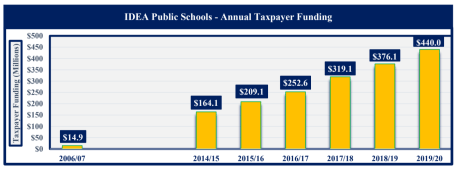
IDEA’s flexibility to expand has resulted in more and more taxpayer funding. Since its first graduating class of 25 students in 2007, IDEA’s taxpayer funding has increased from $14.9 million to approximately $440 million per year. This represents an increase in taxpayer funding of 2,853% in only 13 years.

Screen Shot 2019-09-14 at 10.14.11 PM

IDEA’s growth has also proven to be lucrative for its leadership team. As disclosed on its 2017 IRS Form 990, the Chief Executive Officer and Superintendent collectively received financial benefits totaling $968,208 in year 2017/18. In addition, 8 other IDEA administrators received financial benefits totaling between $219,070 – $466,006. On average, IDEA’s Central Office administrators have a salary of $200,249, while the statewide average salary for Central Office administrators in all Texas public schools is $102,300. 2

Other benefits for IDEA’s leadership team include free travel for family members to IDEA events and the potential use of IDEA’s private airplane secured through a long-term lease. That’s right, a taxpayer-funded “charter” school targeting underserved communities uses a private plane for “charter” flights.

Special Interests are Controlling and Directing IDEA’s Expansion – Not Communities and Taxpayers: As a privately-operated public school, IDEA’s expansion is not subject to the approval of local communities. Rather, IDEA’s expansion is controlled, directed and funded by “special interests” that desire to “privatize” public education. IDEA’s growth strategy proves this: “new regional expansions are the result of community supported education reform groups soliciting and inviting IDEA to open in their region and concurrently offering substantial startup and operational funding…”.

As shown below, IDEA has received financial commitments totaling over $150 million from private donors to expand in various regions of the State. It is important to emphasize that these financial commitments are contingent upon IDEA following the criteria specified by the donor (not parents, communities or taxpayers), which includes the opening of a specified number of new IDEA campuses in each region.

Private Donor

Commitment to IDEA

Expansion Region

Permian Strategic Partners

(Scharbauer and Abell-Hanger Foundations)

$ 55,000,000

Midland/Odessa

Charter School Growth Fund

(Gates and Walton Family Foundations)

$ 23,800,000

Rio Grande Valley

KLE Foundation

$ 23,558,800

Austin

CREEED Foundation (Hunt Family Foundation)

$ 17,000,000

El Paso

Laura and John Arnold Foundation

$ 9,500,000

Houston

Sid W. Richardson Foundation

$ 5,774,000

Tarrant County

Kleinheinz Family Foundation

$ 5,774,000

Tarrant County

Ewing Halsell Foundation

$ 5,500,000

San Antonio

Walton Family Foundation

$ 5,417,800

Tarrant County

Choose to Succeed and City Education Partners

(George W. Brackenridge Foundation)

$ 4,528,351

San Antonio


IDEA Reduces the Funding of Community-Based School Districts by an Estimated $350 Million Per Year: IDEA’s expansions are typically promoted with much publicity and fanfare. But such announcements routinely fail to mention the negative financial impact to local school districts that result from IDEA’s expansion. In this regard, Newton’s Third Law – “for every action, there is an equal and opposite reaction”, applies to education funding. In most cases, there is not any additional funding provided for IDEA to operate in communities as local public education funding is finite. As IDEA enters a community, the available funding must be divided amongst IDEA and the existing community-based school districts. In other words, the funding provided to IDEA will directly reduce the funding and ability of community-based school districts to simultaneously serve students. At this time, it is estimated that IDEA’s expansion in local communities has reduced the funding of community-based school districts by $350 million per year.

IDEA Has Lower Teacher and Principal Experience and Larger Class Sizes: Most parents likely prefer for their child to attend a school that deploys lower “student to teacher” ratios and smaller class sizes. Parents are also likely to prefer teachers and principals with more experience. But IDEA’s “education model” defies these logical preferences. According to Texas Academic Performance Reports (“TAPR”) published by the Texas Education Agency (“TEA”), IDEA’s average class size in the 3rd grade is 28.9 students or 9.9 more students than the statewide average. In addition, while IDEA publicly advertises that it has “Expert Teachers”, the average experience of IDEA’s teachers is only 1.9 years and 90.9% of IDEA’s teachers have 5 years of experience or less. In comparison, the average teacher experience for all Texas public schools is significantly higher at 10.9 years. Teacher turnover has also been historically high at IDEA with 22.1% of teachers leaving each year, which is 33.1% higher than statewide average. 3

Maybe IDEA has figured out how to achieve its promoted results with larger class sizes, lower experienced staff and higher teacher turnover. But if a child was needing to see a doctor, I think most parents would prefer a doctor with 10.9 years of experience, fewer patients and longevity within the community.

COMPARISON OF IDEA PUBLIC SCHOOLS AND STATE AVERAGE – TEXAS PUBLIC SCHOOLS

Teacher and Principal Experience, Class Size and Turnover

State Average – Texas Public Schools

Description

IDEA

Public

Schools

19.0 Students

CLASS SIZE – GRADE 3

28.9 Students

18.7

NUMBER OF STUDENTS PER TEACHER

15.1

10.9 Years

AVERAGE TEACHER EXPERIENCE

1.9 Years

37.3%

TEACHERS WITH 5 YEARS OF EXPERIENCE OR LESS

90.9%

6.3 Years

AVERAGE EXPERIENCE – SCHOOL PRINCIPALS

2.7 Years

16.6%

ANNUAL TEACHER TURNOVER

22.1%


COMPARISON OF IDEA PUBLIC SCHOOLS AND STATE AVERAGE – TEXAS PUBLIC SCHOOLS

Teacher and Principal Experience, Class Size and Turnover

IDEA’s Per Student Expenditures for Instruction and Student Services are Significantly Below Statewide Average: Like a household or a business, the expenditures of a public school can provide insight into the priorities of the school. Once again, IDEA’s unique model defies the norm. In comparison to all Texas public schools, IDEA spends:

  • 17.3% less per student on instruction;
  • 91.2% less per student on career and technical training;
  • 65.5% less per student on extra-curricular activities to supplement the education of students;
  • 43.6% less per student on students with disabilities; and
  • Zero dollars to educate students with a discipline history as such students are excluded from enrolling at IDEA.

However, IDEA does spend 99.7% more per student on “School Leadership/General Administration”. It is interesting to note that in comparison to the statewide per student average, the lower dollar amount that IDEA spends of “Instruction” is essentially equal to the higher dollar that IDEA spends on “School Leadership/General Administration”.

COMPARISON OF IDEA PUBLIC SCHOOLS AND STATE AVERAGE

Per Student Expenditures

State Average – Texas Public Schools

Description

IDEA

Public

Schools

$ 5,492

INSTRUCTION

$ 4,543

62.7%

INSTRUCTION EXPENDITURE RATIO

50.9%

$ 299

EXTRA-CURRICULAR ACTIVITIES

$ 103

$ 296

CAREER AND TECHNICAL TRAINING

$ 26

$ 75

ALTERNATIVE EDUCATION

$ 0

$ 908

SCHOOL LEADERSHIP/GENERAL ADMINISTRATION

$ 1,813

$ 174

SOCIAL WORK, HEALTH AND COMMUNITY SERVICES

$ 62

$ 1,157

STUDENTS WITH DISABILITIES

$ 652


IDEA Serves a Lower Percentage of “At Risk”, “Special Education” and “Disciplinary” Students: It is true that IDEA serves primarily “economically-disadvantaged” students. But every “economically-disadvantaged” student is unique; and some students require more attention and resources. These include students that are categorized by the State as “At Risk” of dropping-out, “Special Education” due to a physical or learning disability and those with a “Disciplinary” history.

While IDEA publicly promotes that it is “Open to All Students”, IDEA’s enrollment eligibility criteria states that it may “exclude” students with a “Disciplinary” history. In 2017/18, IDEA enrolled zero “Disciplinary” students and as such, IDEA is not really open to all students. In addition, data published by TEA demonstrates that IDEA serves a significantly lower percentage of “At Risk” and “Special Education” students than the community-based school districts from which they recruit students. While there could be many reasons for this, it may be that IDEA is designed to only appeal to a certain segment of students in the communities they operate within.

Student Description

Austin ISD

Cypress-Fairbanks

ISD

El Paso ISD

Fort Worth ISD

Ector County ISD

Northside ISD – (San Antonio)

IDEA Public Schools

At Risk

51.3%

44.7%

56.3%

77.8%

57.4%

47.0%

45.9%

Special Education

10.9%

8.0%

10.7%

8.3%

8.4%

11.6%

5.2%

Disciplinary Placement

1,140

1,131

1,049

674

555

1,374

0

IDEA Has a Small Number of Graduates and an Alarming High School Student Attrition Rate: While any high school graduate is to be celebrated, the actual number of IDEA graduates remains relatively small for a charter that has been approved by the State to expand to 83,000 students. Based upon information published by TEA, in years 2015-2017 IDEA only averaged 571 graduates, which is comparable to the number of graduates at Coronado High School in El Paso ISD.

Additionally, the high attrition rates of IDEA high school students indicate that its “educational model” may not be fulfilling the needs of all students. As shown below, 24.8% of students enrolled in an IDEA high school during years 2015-2017 did not make it to graduation. In each year, an average of 202 students left IDEA to attend another Texas public high school. In other words, only 3 of every 4 high school students graduate from IDEA as 1 of every 4 students leaves to enroll at a community-based school district or other Texas public high school.

Graduating

Class

Beginning 9th Graders

No. of Students – Transferring to Another Texas Public School

Actual Graduates

Change – 9th Graders Less Actual Graduates

Percentage Change – 9th Graders Less

Actual Graduates

2015

747

224

539

-208

-27.8%

2016

670

181

500

-170

-25.4%

2017

865

200

675

-190

-22.0%

3-Year Average

761

202

571

-189

-24.8%

IDEA Public Schools and Community-Based School Districts Targeted for Expansion

2017/18 Enollment Demographics

IDEA PUBLIC SCHOOLS

Graduation Summary and High School Student Attrition – Classes of 2015-2017

IDEA’S “100% College Acceptance Rate” is a False and Misleading Promotion: IDEA’s promoted legacy is that “100% of (Students/Seniors/Graduates) are Accepted to College” and they have even promoted in formal documents that “100% of Graduates are Accepted to the College or University of Their Choice”. But based upon the facts listed below, these promotions are simply not true and are “materially misleading” to prospective parents, many of which are “economically-disadvantaged”. 5

  • First, IDEA does not disclose that its college acceptance rate is artificially manipulated by its graduation requirements, which REQUIRES students to be accepted to a 4-year college/university in order to graduate.
  • Second, IDEA fails to disclose its high student attrition rate as 1 of every 4 students enrolled in an IDEA high school transfers to another Texas public high school prior to graduation.
  • Third, IDEA does not disclose that its number of graduates is relatively small, ranging from as few as 25 students to 571 students in 2017, and are not comparable to the community-based school districts it operates within. Statewide, over 300,000 students graduate from Texas high schools each year.
  • Third and most importantly, 125 IDEA graduates applied to a 4-year Texas college/university in years 2012-2016 and were not accepted according to latest data published by “tpeir-Texas Education Reports”,
  • Fourth, the misleading nature of the statement that “students are accepted to the college or university of their choice” speaks for itself and such a statement raises the question of IDEA’s real motivations.

IDEA Graduates Have a Lower College Graduation Rate: In recent years, IDEA has attempted to broaden its appeal by promoting its unique model and curriculum is preparing students for success in college. For example, IDEA’s Student Handbook and IMPACT Magazine that is prepared for students, parents and supporters includes the following statements:

  • “IDEA has focused on raising the achievement levels and expectations of students who are underserved so they have the opportunity to attend and succeed in college”;
  • “Since inception, IDEA has promised countless families that we will get their child to and through college”; and
  • Vision: To ensure the state of Texas reaches its fullest potential, IDEA will become the region’s largest creator of college graduates.

Despite these statements, the college graduation rate of IDEA students is significantly lower than college bound students graduating from community-based school districts in the geographic areas it serves. According to “tpeir – Texas Education Reports”, only 36.9% of IDEA’s 2012 class of 122 students that enrolled in a 4-year Texas college/university had graduated by 2017. In comparison, the college graduation rate for college-bound students in community-based school districts targeted by IDEA for expansion ranged from a minimum of 50.2% to a high of 84.1%.

Description

Austin ISD

Cypress-Fairbanks

ISD

El Paso ISD

Fort Worth ISD

Ector County ISD

Northside ISD (San Antonio)

IDEA Public Schools

Enrolled

872

1,409

1,129

525

190

1,120

122

Graduated

603

1,185

567

323

145

872

45

Graduation Percentage

69.1%

84.1%

50.2%

61.5%

76.3%

77.8%

36.9%

IDEA Public Schools and Community-Based School Districts Targeted for Expansion

Class of 2012 Enrolling and Graduating From 4-Year Texas College/University by 2017

IDEA Graduates Have Lower Success During Initial Year of Attending a 4-Year Texas College/University: There may be many contributing factors for the lower college graduation rate of IDEA students and unfortunately, poverty may be one. However, information published by the Texas Higher Education Coordinating Board indicates poverty is not the only one.

Of the 467 trackable graduates within IDEA’s class of 2018 that enrolled in a 4-year Texas public college/university, 37% had a GPA below 2.0 and an additional 21% had a GPA below 2.5 in their initial year. In other words, despite IDEA’s promoted focus on preparing students to succeed in college, 58% of IDEA’s 2018 graduates had a GPA below 2.49 in their initial year of attending a 4-year Texas public college/university. 6

Closing: As IDEA Public Schools expands in your community at the direction of privately funded “special interests” and your community relinquishes control of certain schools and taxpayer funding to the privately-operated charter, you deserve to know the facts.

To me, the facts do not support IDEA’s self-proclaimed success as many RED FLAGS appear when the “rose-colored glasses” are removed from IDEA’s promotions. In addition, the facts are very similar to the circumstances of previous attempts to “privatize” public services that failed to fulfill their promises. In this regard, the factual similarities include the promotion by “special interests”, lower expenditures to deliver public services, fewer public services, deployment of less experienced staff, higher administrative costs, employment of full-time promotional staffs and misleading advertisements, targeting of prospective customers, high turnover and the denial of service to certain customers.

But these are only my thoughts and with the future of children and communities at stake, I encourage you to do a little homework and form your own conclusions. Afterall, it’s your students, your schools, your tax dollars and your community.

DISCLOSURES: This material solely reflects the opinion of the author and the author has not been compensated in any manner for the preparation of this material. The author is a voluntary advocate for public education. The material is based upon various sources, including but not limited to, the Texas Education Agency, Texas Academic Performance Reports, tpeir-Texas Education Reports, Texas Higher Education Coordinating Board and other publicly available information. While the author believes these sources to be reliable, the author has not independently verified the information. All readers are encouraged to complete their own review of IDEA Public Schools, the material referenced herein and make their own independent conclusions.

Steve Miller writes in the Texas Monitor about the special protections provided by the law for charter schools. They claim to be public, they claim to be accountable, they claim to be transparent, but only when it suits their convenience.

Take the powerful IDEA chain, which has recently received over $200 million from Betsy DeVos’ personal slush fund called the federal “Charter Schools Program,” which currently spends $440 million of our taxpayer dollars to finance rapacious corporate charter chains.

IDEA has a private corporation that is neither accountable nor transparent.

IDEA Public Schools, for example, allows first class air travel for its employees and is looking into the lease of a private jet. But as long as it insists that the perks are being paid for with private funds, the expenditures are free from oversight, discovered only through deep dives into IDEA’s tax returns.
Charter schools and open records are “an enormous can of worms,” said Joe Larsen, a Houston public records lawyer. “It’s neither dog nor wolf — it’s kind of private and kind of public. The courts and the legislature keep grappling with it, as they want charters to have the advantage of a private entity to make more efficient choices.”
But, he said, the effort to allow charters the freedom to innovate also gives them more room to operate on the margins of transparency.
A public records dispute between a Pharr newspaper and IDEA, one of the state’s biggest charter operators, shows the divide.
In 2017, the Advance News Journal in Pharr asked for details of IPS Enterprises, a business created by IDEA. Charter officials refused to provide details and referred the request to the state attorney general’s office for a ruling. 
When that office said IDEA had to provide the records, the nonprofit sued AG Ken Paxton, citing a 2015 state Supreme Court ruling that found a nonprofit need only provide records related to businesses funded with public money.  And, IDEA said, IPS Enterprises is unrelated to the $400 million in public funding it receives.
IDEA won the lawsuit, and today no one knows much about IPS Enterprises, a for-profit entity that state records show is based at the same tax-exempt Weslaco address as IDEA. Records show IPS in 2017 received a $4.7 million contract from the U.S. Department of Education.
The newspaper never even considered suing IDEA for the records.
“We didn’t even get involved after they sued the AG,” said Advance Publishing publisher Gregg Wendorf. “They have way more money than us anyway.”

Steven Miller of the Texas Monitor reports on the perks for charter executives in Texas.

https://texasmonitor.org/charter-schools-fly-below-the-radar-on-spending-and-transparency-rules/

If you are a charter bigwig or spouse, you can fly first class, a privilege not available to public school employees.

Charter executives are exempt from the rules that apply to public schools. Yet they deign to call themselves “public schools” without surrendering their perks.

Miller writes:

“It’s a treat to fly at the front of the plane, where seats are bigger and fares are roughly double the cost of a coach seat. But for the state’s most prolific charter school operator, first-class air travel is allowed. In addition, the company will pay for the travel of employee spouses, family members and “companions” of executives as well.

“That’s just one of many illustrations of the different rules that apply to charter schools in Texas compared to public schools, where funding for even the most basic needs always seems in short supply.

“IDEA Public Schools, based in Weslaco, has allowed the first-class travel perk for six years. That includes footing the bill for the commute of chief financial officer Wyatt Truscheit, who moved from Mission, Texas, to the Los Angeles area in 2013 and comes to Texas every other week, according to tax records. IDEA also pays for Truscheit’s housing while he works in South Texas.

“IDEA received $319 million in state funding and $71 million in federal money in 2018 to operate its 61 campuses around the state. With its schools in Louisiana, IDEA runs 96 locations in all.

“As a 501c3 nonprofit corporation, IDEA is also allowed to make loans to employees and board members and to do business with relatives of employees.

“In 2015, IDEA bought property from board member and developer Mike Rhodes for $1.7 million. Board member David Earl also received money for serving as counsel for Rhodes in the land deal.”

The charters can engage in business with board members and their families. They do not have to hold open meetings. They are private schools that get public money but operate like private enterprises. Some gig.

Texas Commissioner of Education Mike Morath has threatened to take over the state’s largest school district—Houston Independent School District—because one high school has persistently received low test scores. That school—Wheatley High School—enrolls high proportions of students who are low-income (88%) and in need of special education (19%), but Morath doesn’t care.

Morath sent similar letters to three other districts.

This is nuts. Using its test-score based rating system, the state has rated Houston a B+ district. Yet the state commissioner wants to oust the elected board because one school has low scores!

Remember when Republicans were the champions of local control. Those days are gone. Republicans are now the champions of privatization and autocracy.

Morath is not an educator. He earned his undergraduate degree in business administration, then became a software developer, then a businessman and an investor. He was elected to the Dallas ISD school board, where he advocated turning the entire district into a”home-rule charter system,” a dream of privatizers like billionaire John Arnold.

How do Texans feel about Governor Gregg Abbott and Commissioner Morath taking control of any district that they target?

How do Texans feel about giving up their independence to state politicians and bureaucrats who don’t have a clue about how to improve schools?

Betsy DeVos has awarded more than $200 million to the IDEA charter chain to expand in Texas and beyond. IDEA plans to swamp San Antonio, El Paso, and other cities.

IDEA promises that all students will graduate and go to college, but it doesn’t promise that all students will make it to senior year, or that they will make it in college (earlier studies by Ed Fuller, then at the University of Texas, now at Penn State, found that IDEA graduates had high dropout rates from college).

Read this study of IDEA to learn more.


Texas Charter Schools – Perception May Not Be Real

IDEA Public Schools: Remove the “RoseColored Glasses and Many RED FLAGS Appear

By:  William J. Gumbert


IDEA Public Schools (“IDEA”) is the fastest growing privately-operated charter school in Texas and its rapid expansion in local communities is funded and controlled by “special interests” that desire to “privatize” public education.  With promotions of a “100% College Acceptance Rate” and students being “Accepted to the College or University of Their Choice”, a full-time staff is employed to advocate for IDEA in local communities and to aggressively recruit “economically-disadvantaged” parents dreaming of a better life for their children.

Ann Landers said: “Rose-colored glasses are never made in bifocals.  Nobody wants to read the small print in dreams”.But with the education of children and millions of taxpayer dollars at stake, the small print is vitally important. Part 4 of this 5part series removes the “rose-colored glasses” that are inherent in the promotions of IDEA Public Schools to provide parents, taxpayers and communities an opportunity to review the potential RED FLAGS that appear when the light is solely focused on the facts of the rapidly expanding, privately-operated charter school.

Overview, Growth, Taxpayer Funding and Financial Benefits: As a privately-operated charter, IDEA has been approved by the State to separately operate in community-based school districts with taxpayer funding.  Since opening with 150 students in 2000, IDEA has been consistentlyfocused on expanding its footprint. In this regard, IDEAstrategic growth plan states it will serve 100,000 students by 2022 as new campuses are opened in Austin, El Paso, Houston, Midland/Odessa, Rio Grande Valley, San Antonio, Tarrant County, Louisiana and Florida. At 100,000 students, IDEA would be the 31st largest school system in the United States.

With an appointed board in the Rio Grande Valley, the expansion of IDEA is orchestrated without the involvement of local communities and taxpayers.  IDEAs growth is solely controlled by its appointed board, the State and its private donors.  With the legislature supporting the expansion of privately-operated charter schools, the State recently approved IDEA to open 21 additional campuses across Texas.

IDEA Public Schools – Annual Taxpayer Funding

IDEA’s flexibility to expand has resulted in more and more taxpayer funding. Since its first graduating class of 25 students in 2007, IDEA’s taxpayer funding has increased from $14.9 million to approximately $440 million per year.  This represents an increase in taxpayer funding of 2,853% in only 13 years.  


IDEA’s growth has also proven to be lucrative for its leadership team.  As disclosed on its 2017 IRS Form 990, the Chief Executive Officer and Superintendent collectively received financial benefits totaling $968,208 in year 2017/18.  In addition, 8 other IDEA administrators received financial benefits totaling between $219,070 – $466,006.  On average, IDEA’s Central Office administrators have a salary of $200,249, while the statewide average salary for Central Office administrators in all Texas public schools is $102,300.

Other benefits for IDEA’s leadership team include free travel for family members to IDEA events and the potential use of IDEA’s private airplane secured through a long-term lease.  That’s right, a taxpayer-funded “charter” school targeting underserved communities uses a private plane for “charter” flights.

Special Interests are Controlling and Directing IDEA’s Expansion – Not Communities and Taxpayers: As a privately-operated public school, IDEA’s expansion is not subject to the approval of local communities. Rather, IDEA’s expansion is controlled, directed and funded by “special interests” that desire to “privatize” public education.  IDEA’s growth strategy proves this: “new regional expansions are the result of community supported education reform groups soliciting and inviting IDEA to open in their region and concurrently offering substantial startup and operational funding…”.  

As shown below, IDEA has received financial commitments totaling over $150 million from private donors to expand in various regions of the State. It is important to emphasize that these financial commitments are contingent upon IDEA following the criteria specified by the donor (not parents, communities or taxpayers), which includes the opening of a specified number of new IDEA campuses in each region.

Private Donor

Commitment to IDEA

Expansion Region

Permian Strategic Partners

(Scharbauer and Abell-Hanger Foundations)

$ 55,000,000

Midland/Odessa

Charter School Growth Fund

(Gates and Walton Family Foundations)

$  23,800,000

Rio Grande Valley

KLE Foundation

$  23,558,800

Austin

CREEED Foundation (Hunt Family Foundation)

$  17,000,000

El Paso

Laura and John Arnold Foundation

$    9,500,000

Houston

Sid W. Richardson Foundation

$    5,774,000

Tarrant County

Kleinheinz Family Foundation

$    5,774,000

Tarrant County

Ewing Halsell Foundation

$    5,500,000

San Antonio

Walton Family Foundation

$    5,417,800

Tarrant County

Choose to Succeed and City Education Partners

(George W. Brackenridge Foundation)

$   4,528,351

San Antonio


IDEA Reduces the Funding of Community-Based School Districts by an Estimated $350 Million Per Year:   IDEA’s expansions are typically promoted with much publicity and fanfare.  But such announcements routinely fail to mention the negative financial impact to local school districts that result from IDEA’s expansion. In this regard, Newton’s Third Law“for every action, there is an equal and opposite reaction”, applies to education funding. In most cases, there is not any additional funding provided for IDEA to operate in communities as local public education funding is finite. As IDEA enters a community, the available funding must be divided amongst IDEA and the existing community-based school districts.  In other words, the funding provided to IDEA will directly reduce the funding and ability of community-based school districts to simultaneously serve students. At this time, it is estimated that IDEA’s expansion in local communities has reduced the funding of community-based school districts by $350 million per year.

IDEA Has Lower Teacher and Principal Experience and Larger Class Sizes: Most parents likely prefer for their child to attend a school that deploys lower “student to teacher” ratios and smaller class sizes. Parents are also likely to prefer teachers and principals with more experience. But IDEA’s“education model defies these logical preferences. According to Texas Academic Performance Reports (“TAPR”) published by the Texas Education Agency (“TEA”), IDEA’s average class size in the 3rd grade is 28.9 students or 9.9 more students than the statewide average. In addition, while IDEA publicly advertises that it has “Expert Teachers”, the average experience of IDEA’s teachers is only 1.9 years and 90.9% of IDEA’s teachers have 5 years of experience or less.   In comparison, the average teacher experience for all Texas public schools is significantly higher at 10.9 years.  Teacher turnover has also been historically high at IDEA with 22.1% of teachers leaving each year, which is 33.1% higher than statewide average. 

Maybe IDEA has figured out how to achieve its promoted results with larger class sizes, lower experienced staff and higher teacher turnover.  But if a child was needing to see a doctor, I think most parents would prefer a doctor with 10.9 years of experience, fewer patients and longevity within the community.

COMPARISON OF IDEA PUBLIC SCHOOLS AND STATE AVERAGE – TEXAS PUBLIC SCHOOLS

Teacher and Principal Experience, Class Size and Turnover


State AverageTexas Public Schools

Description

IDEA

Public

Schools

19.0 Students

CLASS SIZE – GRADE 3

28.9 Students

18.7

NUMBER OF STUDENTS PER TEACHER

15.1

10.9 Years

AVERAGE TEACHER EXPERIENCE

1.9 Years

37.3%

TEACHERS WITH 5 YEARS OF EXPERIENCE OR LESS

90.9%

6.3 Years

AVERAGE EXPERIENCE – SCHOOL PRINCIPALS

2.7 Years

16.6%

ANNUAL TEACHER TURNOVER

22.1%


IDEA’s Per Student Expenditures for Instruction and Student Services are Significantly Below Statewide Average:  Like a household or a business, the expenditures of a public school can provide insight into the priorities of the school. Once again, IDEA’s unique model defies the norm. In comparison to all Texas public schools, IDEA spends:

17.3% less per student on instruction;
91.2% less per student on career and technical training;
65.5% less per student on extra-curricular activities to supplement the education of students;
43.6% less per student on students with disabilities; and
Zero dollars to educate students with a discipline history as such students are excluded from enrolling at IDEA.

COMPARISON OF IDEA PUBLIC SCHOOLS AND STATE AVERAGE

Per Student Expenditures


However, IDEA does spend 99.7% more per student on “School Leadership/General Administration”.  It is interesting to note that in comparison to the statewide per student average, the lower dollar amount that IDEA spends of “Instruction” is essentially equal to the higher dollar that IDEA spends on “School Leadership/General Administration”.

State AverageTexas Public Schools

Description

IDEA

Public

Schools

$ 5,492

INSTRUCTION

$ 4,543

 62.7%

INSTRUCTION EXPENDITURE RATIO

50.9% 

$    299

EXTRA-CURRICULAR ACTIVITIES

$    103

$    296

CAREER AND TECHNICAL TRAINING

$     26

$     75

ALTERNATIVE EDUCATION

$      0

$ 908

SCHOOL LEADERSHIP/GENERAL ADMINISTRATION

$ 1,813 

$ 174

SOCIAL WORK, HEALTH AND COMMUNITY SERVICES

$     62

$ 1,157

STUDENTS WITH DISABILITIES

$   652


IDEA Serves a Lower Percentage of “At Risk”, “Special Education” and “Disciplinary” Students: It is true that IDEA serves primarily “economically-disadvantaged” students.   But every “economically-disadvantaged” student is unique; and some students require more attention and resources. These include students that are categorized by the State as At Risk” of dropping-out, “Special Education” due to a physical or learning disability and those with a “Disciplinary” history.   

IDEA Public Schools and Community-Based School Districts Targeted for Expansion

2017/18 Enollment Demographics

While IDEA publicly promotes that it is “Open to All Students”, IDEA’s enrollment eligibility criteria states that it may “exclude” students with a “Disciplinary” history.  In 2017/18, IDEA enrolled zero “Disciplinary” students and as such, IDEA is not really open to all students. In addition, data published by TEA demonstrates that IDEA serves a significantly lower percentage of “At Risk” and “Special Education” students than the community-based school districts from which they recruit students.  While there could be many reasons for this, it may be that IDEA is designed to only appeal to a certain segment of students in the communities they operate within.

Student Description

Austin ISD

Cypress-Fairbanks

ISD

El Paso ISD

Fort Worth ISD

Ector County ISD

Northside ISD – (San Antonio)

IDEA Public Schools

At Risk

51.3%

44.7%

56.3%

77.8%

57.4%

47.0%

45.9%

Special Education

10.9%

8.0%

10.7%

8.3%

8.4%

11.6%

5.2%

Disciplinary Placement

1,140

1,131

1,049

674

555

1,374

0


IDEA Has a Small Number of Graduates and an Alarming High School Student Attrition Rate:  While any high school graduate is to be celebrated, the actual number of IDEA graduates remains relatively small for a charter that has been approved by the State to expand to 83,000 students.  Based upon information published by TEA, in years 2015-2017 IDEA only averaged 571 graduates, which is comparable to the number of graduates at Coronado High School in El Paso ISD.   

IDEA PUBLIC SCHOOLS

Graduation Summary and High School Student Attrition – Classes of 2015-2017


Additionally, the high attrition rates of IDEA high schoolstudents indicate that its “educational model” may not be fulfilling the needs of all students.  As shown below, 24.8% of students enrolled in an IDEA high school during years 2015-2017 did not make it to graduation.  In each year, an average of 202 students left IDEA to attend another Texas public high school. In other words, only 3 of every 4 high school students graduate from IDEA as 1 of every 4 students leaves to enroll at a community-based school district or other Texas public high school.

Graduating

Class

Beginning 9thGraders

No. of Students – Transferring to Another Texas Public School

Actual Graduates

Change – 9thGraders Less Actual Graduates

Percentage Change – 9thGraders Less

Actual Graduates 

2015

747

224

539

208

27.8%

2016

670

181

500

170

25.4%

2017

865

200

675

190

-22.0%

3-Year Average

761

202

571

189

-24.8%


IDEA’S “100% College Acceptance Rate” is a False and Misleading Promotion:   IDEA’s promoted legacy is that 100% of (Students/Seniors/Graduates) are Accepted to College and they have even promoted in formal documents that “100% of Graduates are Accepted to the College or University of Their Choice”.  But based upon the facts listed below, these promotions are simply not true and are “materially misleading” to prospective parents, many of which are “economically-disadvantaged”.

First, IDEA does not disclose that its college acceptance rate is artificially manipulated by its graduation requirements, which REQUIRES students to be accepted to a 4-year college/university in order to graduate.


Second, IDEA fails to disclose its high student attrition rate as 1 of every 4 students enrolled in an IDEA high school transfers to another Texas public high school prior to graduation.


Third, IDEA does not disclose that its number of graduatesis relatively small, ranging from as few as 25 students to 571 students in 2017, and are not comparable to the community-based school districts it operates within. Statewide, over 300,000 students graduate from Texas high schools each year.


Third and most importantly, 125 IDEA graduates applied to a 4-year Texas college/university in years 2012-2016and were not accepted according to latest data published by tpeir-Texas Education Reports”,


Fourth, the misleading nature of the statement that students are accepted to the college or university of their choice” speaks for itself and such a statement raises thequestion of IDEA’s real motivations.

IDEA Graduates Have a Lower College Graduation Rate: In recent years, IDEA has attempted to broaden its appeal by promoting its unique model and curriculum is preparing students for success in college.  For example, IDEA’s Student Handbook and IMPACT Magazine that is prepared for students, parents and supporters includes the following statements:

“IDEA has focused on raising the achievement levels and expectations of students who are underserved so they have the opportunity to attend and succeed in college”;


“Since inception, IDEA has promised countless families that we will get their child to and through college; and


Vision: To ensure the state of Texas reaches its fullest potential, IDEA will become the regions largest creator of college graduates.

Despite these statements, the college graduation rate of IDEA students is significantly lower than college bound students graduating from community-based school districts in the geographic areas it serves. According to “tpeir – Texas Education Reports”, only 36.9% of IDEA’s 2012 class of 122 students that enrolled in a 4-year Texas college/university had graduated by 2017.  In comparison, the college graduation rate for college-bound students in community-based school districts targeted by IDEA for expansion ranged from a minimum of 50.2% to a high of 84.1%.


IDEA Public Schools and Community-Based School Districts Targeted for Expansion

Class of 2012 Enrolling and Graduating From 4-Year Texas College/University by 2017


Description

Austin ISD

Cypress-Fairbanks

ISD

El Paso ISD

Fort Worth ISD

Ector CountyISD

Northside ISD (San Antonio)

IDEA Public Schools

Enrolled

872

1,409

1,129

525

190

1,120

122

Graduated

603

1,185

567

323

145

872

45

Graduation Percentage

69.1%

84.1%

50.2%

61.5%

76.3%

77.8%

36.9%


IDEA Graduates Have Lower Success During Initial Year of Attending a 4-Year Texas College/University:  There may be many contributing factors for the lower college graduation rate of IDEA students and unfortunately, poverty may be one.However, information published by the Texas Higher Education Coordinating Board indicates poverty is not the only one.

Of the 467 trackable graduates within IDEA’s class of 2018 that enrolled in a 4-year Texas public college/university, 37% had a GPA below 2.0 and an additional 21% had a GPA below 2.5 in their initial year.  In other words, despite IDEA’s promoted focus on preparing students to succeed in college, 58% of IDEA’s 2018 graduates had a GPA below 2.49 in their initial year of attending a 4-year Texas public college/university.


Closing: As IDEA Public Schools expands in your communityat the direction of privately funded “special interests” and your community relinquishes control of certain schools and taxpayer funding to the privately-operated charter, you deserve to know the facts.

To me, the facts do not support IDEA’s self-proclaimedsuccess as many RED FLAGS appear when the “rose-colored glasses” are removed from IDEA’s promotions.  In addition, the facts are very similar to the circumstances of previousattempts to “privatize” public services that failed to fulfill theirpromises.  In this regard, the factual similarities include the promotion by “special interests”, lower expenditures to deliver public services, fewer public services, deployment of lessexperienced staff, higher administrative costs, employment of full-time promotional staffs and misleading advertisements, targeting of prospective customers, high turnover and the denial of service to certain customers.  

But these are only my thoughts and with the future of children and communities at stake, I encourage you to do a little homework and form your own conclusions.  Afterall, it’s your students, your schools, your tax dollars and your community.

https://drive.google.com/file/d/0B8bMZiGFYbRFTjZfYm5ZVnZFVmlFZUw4ZWRhOFYyZWFXaENJ/view
A Message from our friends in Texas:


 “Little children, let us love, not in word or speech, but in truth and action.”
-1 John 3:18

Our Texas community is still reeling from the news of the recent shooting in El Paso. As faith leaders across our state, we are devastated by the violence and loss of life that has affected so many. 

Instead of our usual update this week, we wanted to offer you encouragement. In the wake of this violence, we encourage you to embody love, “in truth and in action,” in your community. Live love through acts of kindness, solidarity, and compassion. Live love by reaching out to those at the margins, to those who are different than you. Live love in a way that transforms our world. 

Scripture asks us to “weep with those who weep” and reminds us us time and time again that community is the most powerful response to tragedy. So, most importantly, we encourage you to live love by being there for those who are deeply impacted by this tragedy. 

Prayer vigils have already been planned across the state. Please consider finding one, attending, and being with your community in this time of mourning.

Copyright © 2019 Pastors for Texas Children, All rights reserved.
Our mailing address is:

Pastors for Texas Children

.