Archives for category: Testing

Mercedes Schneider pronounces an educational maxim to sum up the Rhee legacy in D.C.:

When the survival of a school system hinges upon test scores, that system will be driven toward corruption.

Case in point: DC public schools, beginning with the advent of mayoral control and the 2007 appointment of Michelle Rhee as DC chancellor under then-DC mayor, Adrian Fenty.

Mercedes says she wrote Amanda Ripley of TIME magazine to ask if she would rewrite the cover story about Rhee. Apparently not.

Andrew Boryga writes in the New Yorker about the changes that made New York City’s specialized, elite high schools more segregated than they used to be. One reason was budget cuts imposed by former Mayor Rudolph Giuliani.

“The city’s specialized public high schools weren’t always so segregated. In the nineteen-eighties, the three oldest and most prestigious specialized schools had sizable black and Latino populations. (In 1989, Brooklyn Tech, Bronx Science, and Stuyvesant were sixty-seven, twenty-two, and sixteen per cent black and Latino, respectively; today, those numbers have fallen to fourteen per cent, nine per cent, and three per cent.) Samuel Adewumi, a Brooklyn Tech alumnus who is now a teacher at the school, recalls that when he was growing up in the Bronx, in the late seventies, the borough had well-funded gifted-and-talented programs that served as pipelines for exceptional students. By the sixth grade, Adewumi said, he and his friends had their sights set on getting into a specialized high school. Most of their preparation for the test took place in school. “My teachers already knew what needed to happen for me to be prepared and worked it into the curriculum,” he said.

“Things began to change in the early nineties, when New York City eliminated many of its honors programs as “tracking”(separating students based on their abilities) fell out of favor. Then, under Mayor Rudy Giuliani, two billion dollars were cut from the city’s education system. Awilda Ruiz, who helped found the middle-school honors program that I attended, within an underperforming school in the South Bronx, and taught math in the program for nearly thirty years, said that during this period funding for test-prep in the program dried up. By the time I first became aware of the SHSAT, at the beginning of eighth grade, the only resource provided by my school was a thin packet of practice problems. I remember very little about sitting for the test that October, apart from feeling overwhelmed by the material, but I know that I wasn’t surprised or upset to learn that I didn’t score high enough to get into any specialized schools, in part because they never seemed meant for kids like me in the first place.

“Pedro Noguera, one of the country’s leading scholars of urban education, believes that the dismal diversity statistics in New York’s specialized high schools prove that the SHSAT is a flawed metric, and that the criteria for admission should be expanded. “There is no college in the country that admits students strictly on the basis of a test,” he told me. “The idea of using a single test is crazy and hard to justify—especially because we know grades are often better predictors of future success than test scores.” (Studies have shown that college students who are accepted to standardized-test-optional schools without submitting S.A.T. or A.C.T. scores perform around as well as those who do.) Noguera, who is a distinguished professor of education at U.C.L.A., and the author of a dozen books on urban education, is an Afro-Latino native of Brooklyn. He attended public schools in the borough and on Long Island, where his family moved when he was in the third grade, and he went on to attend Brown University, even though, as he’s put it, “most students that I went to school with did not go to college.” A big part of the problem with a school like Bronx Science, he said, is that it is overwhelmingly made up of students who don’t even live in the Bronx. “Either you open up Bronx Science to more kids,” he said, “or you create more Bronx Sciences in the Bronx.””

This is a big step forward. The union gained the right to block unnecessary tests. The ultimate goal must be to block all standardized tests because they are inherently designed to favor advantaged students over disadvantaged students.

Some network chiefs are trying to saddle students and teachers with useless and unnecessary tests. But we know what our students need – and we’re using powerful new language in our contract to reject these tests.

As part of our demand for respect for our professionalism and decision-making, we’ve fought against tests that are unduly burdensome and not useful. In the current Board-Union Agreement, we won the right to vote on ALL assessments that are not mandated by the State of Illinois, REACH, or particular programs like IB or bilingual education.

This is huge. This year, dozens of schools have held discussions in their PPCs, school communities and union meetings, and held votes where members have said “NO” to ‘optional’ assessments.

Some Network Chiefs are pushing back and trying to persuade members to add more tests – but members have held firm and confident in their judgement about the assessments their students need – or don’t need.

Cases which cannot be resolved at the school level will be brought to Strategic Bargaining for resolution. Our view is that the contract is clear and that teachers know their students’ needs.

If you’re having problems resolving testing issues at the school level, contact your field rep so this can be brought to strategic bargaining. And remember to email your plan and vote results to Vera Lindsay.

Both teachers and students have been victims of over-reliance on high-stakes testing for decades. Way too much teaching time has been taken up with prepping students for test-taking and administering numerous assessments — often, it seems, to profit big testing companies. A serious side effect: counselors are so busy with test prep duties on top of huge caseloads that they lack adequate time to counsel students who need the help they’ve been trained to provide.

But we know what our students need, and we’re using powerful new language in our contract to reject the time wasted on unnecessary and pointless tests — and take that time back for teaching.

Is it possible that a math test could be dangerous? This teacher educator, Kassia Omohundro Wedekind, says yes. She says the iReady Assessment is dangerous.

She explains:

This school year Fairfax County Public Schools, the 10th largest school division in the United States, adopted the iReady assessment as a universal screener across all of its elementary schools. Students in grades K-6 take these assessments individually on the computer three times per year, and the results are made available to both teachers and parents.

According to Curriculum Associates, the company that makes iReady, these assessments are an “adaptive Diagnostic for reading and mathematics [that] pinpoints student need down to the sub-skill level, and [provides] ongoing progress monitoring [to] show whether students are on track to achieve end-of-year targets.”

The Fairfax County Public Schools website further asserts that iReady is a “tool that has the potential to streamline Responsive Instruction processes, promote early identification and remediation of difficulties and improve student achievement.”

While I have found this assessment deeply troubling all year, it has taken me a while to be able to articulate exactly why I think this assessment is so dangerous, and why I think we need to use our voices as teachers, administrators and parents to speak out against it.*

So, let’s get back to the claim in the title of this blog post. iReady is dangerous. This might sound like hyperbole. After all, this is just a test, right? In this era of public schooling, children take many assessments, some more useful than others, so what’s the big deal with iReady?…

Based on the scores, iReady generates a report for each student for each of the domains. The report offers a bulleted list of what the student can do and next steps for instruction. However, if you take a look at the finer print you’ll learn that these reports are not generated from the specific questions that the child answered correctly or incorrectly, but rather are a generic list based on what iReady thinks that students who score in this same range in this domain likely need.

The teacher can never see the questions the child answered correctly or incorrectly, nor can she even access a description of the kinds of questions the child answered correctly or incorrectly. The most a teacher will ever know is that a child scored poorly, for example, in number and operations. Folks, that is a giant category, and far too broad to be actionable.

But above all else, the iReady Universal Screener is a dangerous assessment because it is a dehumanizing assessment. The test strips away all evidence of the students’ thinking, of her mathematical identity, and instead assigns broad and largely meaningless labels. The test boils down a student’s entire mathematical identity to a generic list of skills that “students like her” generally need, according to iReady. And yet despite its lumping of students into broad categories, iReady certainly doesn’t hesitate to offer very specific information about what a child likely can do and what next instructional steps should be.

Read on. See her examples. What do you think?

Last year, Julia Sass Rubin of Rutgers University devised a solution to Harvard’s admissions policy problem. Harvard is bow being sued by a group called Students for Fair Admissions, which claims to be supporting Asian-Americans, but is actually fronting for white conservatives who hate affirmative action.

She writes:

“Harvard actually accepts a disproportionately large percentage of Asian students, who make up approximately 6 percent of the U.S. population but will comprise more than 22 percent of Harvard’s incoming class. The claims of anti-Asian bias in Harvard admissions are based, in large part, on the number of Asian applicants with high standardized test scores relative to the number admitted.

“Ironically, Harvard has contributed to its current legal challenges by requiring standardized tests as part of its admission process. This helps legitimize standardized tests as an objective means of evaluating applicants. In reality, the tests favor students from families with greater wealth and educational attachment….

“Standardized test scores are also impacted by test preparation, and students who have taken the test previously score higher than those who are taking it for the first time. This further skews test results in favor of wealthier students, whose families can afford expensive test preparation services and multiple rounds of test taking.

“The strong correlation between income, education and race/ethnicity translates the economic and educational bias of standardized tests into a racial one, giving an advantage to Asians and whites. Although substantial poverty exists among both groups, on average, Asians and whites in the United States are much wealthier and have significantly higher educational attainment than blacks and Hispanics…

“A January 2016 report released by the Harvard Graduate School of Education and signed by more than 80 admissions officers, including those from all eight Ivy League schools, urged universities to move toward test-optional admission policies. To date, more than 950 universities and colleges have adopted such policies or eliminated standardized tests entirely from their admission process. Unfortunately, that group does not include a single Ivy League university.

“This is a missed opportunity. By eliminating the use of standardized tests, Harvard and the other Ivy League schools could help end the myth of test-based meritocracy and highlight that our country’s persistent and growing inequality of opportunity requires universities to consider applicants’ race, ethnicity, gender and family income if they hope to achieve meritocratic outcomes.”

A group called Students for Fair Admissions is suing Harvard University, claiming that it systematically discriminates against Asian-Americans in its admissions process. The group forced Harvard to release internal documents about its admissions decisions, which showed that Asian-American students were downgraded for personal characteristics even when their test scores and grades were perfect.

Two important principles are clashing in this dispute. On one hand, there is the principle of merit-based admissions. On the other is the practice of affirmative action, weighting the scales to give places to students who are black and Hispanic who might have lower scores but have the ability to succeed at Harvard.

Here are some statistics.

The U.S. population is about 6% Asian, African Americans are 13%, whites are 61%, Hispanics are 18%.

The Harvard class of 2021 is 22% Asian, 14.6% African American, 11.6% Latino, and 2.5% Native American or Pacific Islander.

The goal of Students for Fair Admissions is to eliminate affirmative action and to base admissions entirely on objective statistics. Conservatives have rallied to the cause because they oppose affirmative action.

The dilemma that Harvard and other elite institutions face is they they want to have a diverse student body. If they based admissions solely on tests and grades, their student body would have very few blacks or Hispanics, like New York City’s elite, exam-based high schools, where admission is determined solely by one test score, resulting in student bodies with few black or Hispanic students.

I hope that Harvard prevails, or racial segregation will intensify in executive suites and professions.

There is an emerging consensus among researchers that high school grade point average is a better predictor of success in college than scores on the SAT or ACT.

This appears to be the case for students transitioning directly from high school to college. For those who have delayed admission by a year or more, the tests have a slight advantage in math, not in English. The advantage is very small.

“Among students who delayed college entry, GPA didn’t consistently turn out to be more predictive than standardized exam scores. It depended on the subject and exam. Compared to SAT and ACT scores, GPA was a better predictor for success with college English. But compared to the ACCUPLACER scores, the percentage of the variance in college-level English grades explained by GPA was only one point greater. In math, the percentage of the variance in college-level math grades was just a point higher than the percentage explained by SAT scores. GPA was less predictive of college-level math grades than were ACT and ACCUPLACER scores.”

Given the predictive value of the GPA, there is no advantage for students or colleges in using standardized admissions tests.

Currently, in the competition to gain admission to highly selective colleges, parents spend large sums to pay for test prep. Some spend thousands of dollars. The top tutors command hundreds of dollars per hour, even $1,000 an hour.

To see how crazy this is, read this article by an SAT tutor who commands $1,000 an hour. At first, I thought he was jeopardizing his lucrative gig by this public confession, but by the time I finished reading, I realized he had transitioned into online tutoring, which apparently makes lots of dough and works as well as personal meetings. When confronting a mechanical test, a mechanical prep works well.

He writes:

“Nearly every student who came my way was, apparently, a “bad tester.”

“What do most parents mean when they refer to their children as bad testers?

Bad tester (n.): A student capable of keeping a 3.9 GPA at a competitive high school while participating in four extracurricular pursuits who is nonetheless incapable of learning the small set of math facts, grammar rules, and strategies necessary to get a high SAT score.

“How is it possible that a student who can ace his trigonometry tests and get an A+ in English can’t apply those same skills to the SAT? On the surface, it seems unlikely. But as I learned, parents and students around the country have been conned into thinking that it’s not only possible but standard.

“The first thing you need to know in order to understand the illegitimacy of this entire concept: The SAT isn’t particularly difficult.

“What do you need for a perfect SAT score? A thorough knowledge of around 110 math rules and 60 grammar rules, familiarity with the test’s format, and the consistent application of about 40 strategies that make each problem a bit easier to solve. If you can string together a coherent essay, that’s a plus…

“Kids are remarkable learners. If we give them the tools they need to study, the belief that they can learn on their own, and the gentle support necessary to encourage the process, they’ll accomplish remarkable things.

“On the other hand, if we put the power of education in the hands of figureheads, externalized structures, and programs that dictate what students are supposed to learn, when, where, and how, American students will continue to flounder.

“I’ve seen what students can do and learn on their own, and I’ve seen how students act when someone else is given the reins. I prefer the former.“

The author is explaining how to prep for the test.

Why take the test when your GPA matters more and shows your persistence over four years?

Even better for students would be to skip the test, save your parents’ money, go to school daily, do the work, and improve your GPA.

The North Carolina General Assembly believes that the only thing that matters in judging the quality of a school is its test scores. As teacher Justin Parmenter explains here, public schools are graded solely by their test scores. The grades accurately reflect the income level of the families enrolled. The state could save money by just checking family income instead of giving tests.

But wait! For voucher schools, test scores don’t matter. Voucher schools, most of which are evangelical, are not required to take the state tests.

Why? The General Assembly is afraid of seeing the results.

Maybe if the scores showed that the voucher schools are failing, they would have to send the kids back to public schools, where they would have certified teachers who have passed criminal background checks.

Hypocrites.

William Mathis is managing director of the National Education Policy Center and Vice-President of the Vermont State Board of Education. He sent this report to the blog exclusively. Hanushek is a strong believer in testing, accountability, and school choice, as well as annually firing the bottom 5% of teachers, as identified by their students’ test scores.

Dr. Hanushek Again Imagines Saving Trillions of Dollars

William J. Mathis

In a recent brief published by the American Enterprise Institute, economist Eric Hanushek announces that $76 trillion (that’s a “T”) dollars will be generated or saved by adopting unspecified educational reforms.[i] That’s almost a four-fold increase! The closest explanation of these mysterious school improvements is that they are “incentives” for “teachers and leaders.” In a longer technical version of the brief, the authors dismiss the need for more specifics stating “the precise source of the given improvements is not important.”[ii](p.466)


Hanushek is the Paul and Jean Hanna Senior Fellow at the conservative Hoover Institution of Stanford University, best known for his frequent testimony on behalf of defendants in school-funding litigation. But his work also includes analyses of teacher effectiveness, among other topics.


The argument made in the new AEI brief is one he and his colleagues have made repeatedly over the years. It goes like this: If we imagine that standardized test scores go up a certain amount, this will add trillions to the GDP. Alas, this argument is little more than a numerological exercise in assumptions, multiplication and extrapolation.  The astonishing increased dollar amounts are the result of “new estimates of … human capital stock” and assumptions about growth, which are then extrapolated to the nation. It assumes that NAEP test scores are a valid measure of workforce quality which will, in turn, drive the economic gains. As noted, this improved workforce is developed through unspecified “significant changes in school policies.”

The AEI brief does not present the actual methods or results, but some of these are found in the original technical paper, which itself circles back to the authors’ other work. In the end, the analyses fail in predictable ways:

  • They oversimplify the complex relationship between education and national wealth,
  • They are based on correlations which are interpreted as causal,
  • The statistical approach exaggerates the results, and
  • Workforce projections do not support this static scenario.


Oversimplifying – Education and wealth are certainly connected. But assuming education has this pervasive power over the economy ignores the complex set of interactive factors affecting the economy. This includes infrastructure, transportation, investments, political instability, climate, poverty, social changes and macroeconomic supports.[iii] In fact, two-thirds of the variance in test scores is attributable to outside of school influences.[iv]


Correlations are interpreted as causation – “Gains from school activities” certainly sounds causal. More specifically, the long paper flatly states the “… gains in annual GDP [are] due to educational reforms.” (p.470). But then, they back away and state causality is “challenging.” (p.479)

The core assumption of the piece is illustrated in a scatterplot of test scores and state economic growth (Figure 1, reproduced below). This includes an “estimated impact” of education on a state’s wealth. Little or no consideration is given to more important variables that might be the causes of the limited correlation.
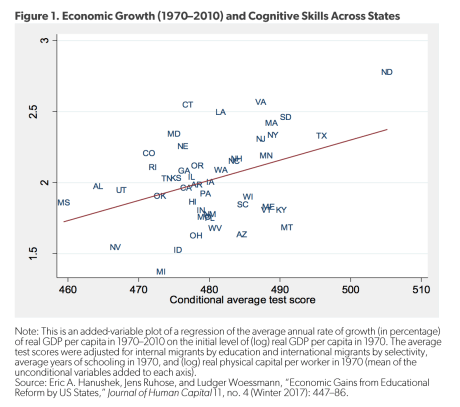
 

Screen Shot 2018-06-04 at 9.04.13 PM


Statistical Exaggerations – Although a best fit line (regression) is super-imposed on the scatterplot, the pattern is more suggestive of a shot-gun blast than an illustration of a strong relationship. Going back to the original study, we find that test scores explain a mere 23% of the variance in economic growth – and this may be largely due to the aforementioned “third variables.” This weak relationship is far from being as strong as touted. Furthermore, achievement test scores are collapsed into “state aggregate scores.” When scores are collapsed in this manner, the effect is to exaggerate a correlation.


Mystery Methods – Beyond one short note below the study’s Figure 1, the AEI paper does not share how these numbers were derived. How these were calculated for each state goes unexplained. Improving teaching and teacher leaders is put forth as the leading reform, but this also is not defended or explained. Neither socio-economic factors nor adequate funding are addressed, although a vast and relevant literature points to their importance. Yet, improvements are claimed to be “enormous” and states should be “willing to make substantial changes.” But how these strong but unknown recommendations are derived is not explained. However, the long paper does present a rich trove of irrelevant statistical exotica.


Workforce Extrapolations – The brief misses the mark with its implicit assumption that the work force and economic needs will remain static and can be easily extrapolated. In an age of emerging artificial intelligence and with virtually every job being transformed in the next half-century, it seems a long reach to assume that the form, function and role of education (and the economic drivers) will remain unchanged.

[1]  Hanushek, Eric A. (May 2018). Every State’s Economic Future Lies with School Reform. Washington, DC: American Enterprise Institute. Retrieved May 29, 2018 from https://www.aei.org/wp-content/uploads/2018/05/Every-States-Economic-Future-Lies-with-School-Reform.pdf? FRPc013V1FcL1JnZHg4V0Vsd253Z0kzUWsxVjc3dGhUSGVzRURhWUZORyttNDlQdWR2aVgifQ%3D%3D

[1] Eric A. Hanushek, Ruhose, J. & Woessmann, L. (Winter 2017) “Economic Gains from Educational Reform by US States,” Journal of Human Capital 11, no. 4 (447-86). Retrieved June 1, 2018 from http://hanushek.stanford.edu/sites/default/files/publications/Hanushek%2BRuhose%2BWoessmann%202017%20JHC%2011%284%29_0.pdf

[1] Sala-I-Marten, X., et al. (2014). The Global Competitiveness Index. Retrieved May 29, 2018 from http://www3.weforum.org/docs/GCR2014-15/GCR_Chapter1.1_2014-15.pdf

[1] Rothstein, R. (2016). In Mathis and Trujillo, Learning from the Federal Market Based Reforms. Charlotte, N.C. : Information Age Publishing. p. 432.

[1] Hanushek, E (Summer 2011), “Valuing Teachers; How much is a good teacher worth?” Education Next, 11(3). Retrieved May 29, 2018 from http://hanushek.stanford.edu/publications/valuing-teachers-how-much-good-teacher-worth


Mayor de Blasio wants to eliminate the exam that determines admission to three top-tier high schools and replace them with another formula that includes state test scores.

I have long been opposed to the dependence on one single standardized test for admission to these schools. No college uses such a narrow, archaic method of admitting students.

My view is that multiple measures make sense: the current test, an essay, teacher recommendations, rank in class, whatever.

Here is a brave article by a recent graduate of Stuyvesant who looked at the admission process for other elite high schools.

Danielle Eisenman, now a student at Harvard, writes:

“Let my people study.”

“A movement to keep the Specialized High School Standardized Admissions Test as the sole criterion for admission to specialized high schools appropriated the line, “Let my people go,” from the African American spiritual, “Go Down Moses.”

“The protesters — mostly low-income, first- and second-generation Asian immigrants — wish to prevent Mayor de Blasio from dismantling what they consider a meritocratic system. They blast de Blasio’s plan, which would instead admit a set percentage of the highest-performing students from each city middle school, as discriminatory; another popular sign says, “End racism.”

“As Kenneth Chiu, NYC Asian-American Democratic Club member, said in an interview on NY1, “They never had this problem when Stuyvesant was all white. Now, all of the sudden, they see one too many Chinese, and they say, ‘Hey, it’s not right.’” (Stuyvesant today is 74% Asian.)

“My mom, a Chinese immigrant, also supports the SHSAT. When I told her I was writing this article, she texted me, “Everyone I know will hate you,” telling me instead to write in support of the test.

“Though I sympathize with these concerns, the appropriation of “Let my people go” reveals how the campaign to keep the SHSAT reeks of irony and ignorance. De Blasio wishes to admit more black and Latino students, who, despite making up 67% of New York City’s public school system, represent just 10% of students offered enrollment in specialized high schools. Stuyvesant is only 0.69% black and 2.8% Latino. It’s hypocritical for protesters to invoke slavery, an experience that belongs to black Americans, when they’re advocating to keep in place a system that denies disadvantaged black Americans an opportunity for social mobility.

“Defenders of the current system, hailing the test as establishing a level playing field, argue that if more black and Latino students truly wanted to attend specialized high schools, they could just study harder. I have repeatedly heard my classmates champion this mindset, implying that black and Latino students are not as hardworking, and, even more disturbingly, not as smart as their Asian counterparts.

“The SHSAT, however, does not measure work ethic or intelligence, but a student’s ability to answer over 100 tedious multiple choice questions in under three hours. It tests for access to tutors and cram schools that teach students the skills they need to answer the questions without thinking.

“I flunked my first practice tests. After a prep class and some tutoring sessions, however, I knew all the tricks. If I hadn’t had access to that class, I likely would not have gotten into Stuy.

“The exam only tests for reading comprehension and math skills — no critical thinking, ambition, creativity or other qualities that predict success at specialized high schools….”

The legislature is unlikely to allow any change.