Archives for category: Testing


NYSUT, The New York State United Teachers, issued a blistering fact check of State Commissioner MaryEllen Elia’s claims about the state tests. 

You have to open it to get the full flavor because NYSUT, not normally outspoken, shreds Elia’s claims.

Elia writes in Orwellian Newspeak about value of the tests.

NYSUT response: Because of the lack of movement by SED on NYSUT’s suggested changes to the testing system, the current tests do not provide any useful information to parents or teachers or any real information on how a district is performing. The results do not accurately predict future student success. In fact, the tests mislabel more than half of the test takers as failing, while more than 80 percent of students go on to graduate from high school. The results of the current tests are not only useless, but also damaging to students.

There are several such exchanges.

Bear in mind that no one but the testing company is allowed to know student responses to questions. So teachers learn NOTHING about the strengths or weaknesses of their students. Teachers, students, and parents get a score but nothing of any diagnostic value.

All students in grades 3-8 should OPT OUT of these pointless tests.

A new study of the STAAR tests in Texas finds that the readability levels are far above the grade levels tested.

Professor Susan Szabo and Professor Becky Barton Sinclair of the Texas A&M at Commerce reviewed STAAR tests and report that readability levels were 1-3 years above the grade level tested.

Why is the state giving children tests that are above their grade levels?

Is it trying to fail children so that more public schools will be given low ratings and there will be more opportunities for privatization?

Or is it that the folks in charge of testing are not paying attention or don’t care?


If you liked the NPE report ASLEEP AT THE WHEEL, released today by the Network for Public Education, please consider joining. It is free. We rely on donations. We believe in the power of numbers, combined with a small but amazing staff. If you sign up, you will get alerts about what is happening in DC and in your own state, where your participation can make a difference. You will be asked to send emails to your representatives when important matters are being decided.

If you want to become more active in the fight for better public schools and against privatization and high-stakes testing, we can direct you to local groups in your state. We have toolkits for civic action.

Our affiliate (Network for Public Education Action) endorses candidates for local and state elections.

We believe that people power can beat money power, when we are informed and organize. We are many, they are few.

Go to this link to learn more about what you can do and how you can get involved. 

Our next national conference will be held in the spring of 2020 in Philadelphia. Stay tuned for details.

You can find “Asleep At the Wheel” here. 


Kevin Bosworth, a teacher at Olathe East High School in Olathe, Kansas, wrote to tell me about a class discussion of grades and tests. A student shared her poem with the class, and Kevin shared it with me. The reformers and disrupters now say they are intrigued with social and emotional learning. Let them read this and see what they have learned.


Hello my name is worthless

Name number and date

State your class and hour

Let the rubric pick your fate


Your value as a human

Can be measured by percent

All that matters is the value

That the numbers represent


We promise that you matter

You’re more than just a grade

But you better score one hundred

Or else you won’t get paid


They require our attendance

We’re brain dead taking notes

So we can barf back up the knowledge

That they shove down our throats


Each human life is precious

And every childhood has worth

But if you fill in the wrong bubbles

Then you don’t belong on earth


They question our depression

They wonder why we’re stressed

When our futures are decided

Doing better on a test


They tell me that I’m gifted

That there’s no need to despair

But if you only read the numbers

I’m a living waste of air


I might think I have talents

But there’s no worth in art

Because it can’t be measured

By a number on a chart


The people say I’m flying

The numbers say I’ll crash

My letter grades ‘ll prove it

I’m worthless human trash

They use standardized procedures

To find the worth of kids

But I don’t fit in boxes

Without spilling out the lids


Some kids don’t fit the system

But differences can’t stay

They put us in the garbage

And throw it all away


New York City has a peculiar high school admissions system. To gain admission to the city’s five most elite high schools, one must excel on a highly competitive examination called the Secondary High School Admissions Test. Nothing else counts but that one score on one test. I am not aware of any selective institution in the nation that relies on only one score for admission.

Every year, the media reports with shock how few Black and Hispanic students were admitted. This year may have been the worst yet. Only seven Black students were offered a place of 895 admitted to StuyvesantHigh School. Last year, it was 10. Valerie Strauss wrote about the results:  “For 2019, Stuyvesant offered admissions to 587 Asian students, 194 white students, 45 of unknown race or ethnicity, 33 Latino students, 20 multiracial students and nine Native Americans.”

At the meeting of the Jackson Heights Parents for Public Schools on March 16, the discussion of the specialized high schools became heated when a debate erupted between parents who said the exam was exclusionary and racist, and Asian parents who held up posters saying that criticism of the exam is racist. Asian students study hard for the test, do well, and don’t want it to change.

Jose Luis Vilson, who teaches middle school math, has no doubt that the exam is racist.

He writes:

“When news broke this week that only seven black students were accepted into New York City’s Stuyvesant High School, an elite public school that supposedly only takes the most advanced students in the city, I wasn’t surprised. In my 14-year career as a middle school math teacher in Manhattan with majority black or Latinx students, I’ve had thousands of kids who were rejected from magnet public schools like Stuyvesant. It breaks my heart every time.

“Every year, sometime in March, thousands of New York City adolescents receive a letter that tells them which high school selected them. That school day is always a tough one. Some students run up and down the halls, excitedly telling their friends about where they will be spending the next four years. Others, disappointed in their placement, sit solemnly or find a comforting shoulder to lean on.

“I’ve had to console far too many brilliant students who didn’t get chosen for the high school they wanted to go to. They checked off all the proverbial boxes: great attendance, high grades, strong work ethic, and had positive relationships with adults and peers. They studied hard for the Specialized High School Admission Test — an assessment given to eighth or ninth graders for entry into eight of the elite magnet public schools in New York City — for months. Because a student’s score on that test is the only criterion for high school admissions, the stressful three hours spent taking this exam could determine a student’s future.

“As a teacher, I try to assure my students that they will be fine regardless of which school they attend. But I often wonder if we educators are doing a disservice — and perpetuating the lie of meritocracy — by continuing to tell kids that if they work hard and excel then they can get what they want in life.

School segregation in New York City is reaching emergency levels

“Make no mistake: New York City is burning. But unlike the literal and metaphorical burning of the Bronx in the 1970s, the latest fire is happening in our education system as schools continue to segregate at alarming rates. Only 190 of the 4,798 slots, or 3 percent, in the eight major specialized high schools went to black students. This is in a city where a quarter of NYC’s public-school students are black.”

My view:

First, I think it is absurd to base admissions to any academic institution on a single test score. No Ivy League school does that. They ask for grades, essays, teachers’s recommendations, evidence of student interests and passions and service.

Second, when my next grandson applies for high school in New York City, I will actively discourage him from taking the exam or applying to one of the specialized schools. In my view, they are too large and they are academic pressure cookers. I hope he listens to me and applies to a school that has a balanced curriculum and gives him time to explore his interests. I also hope he goes to school with a diverse student body. Oneof thevaluesof public education is exposure to many kinds of people, with many kinds of talents, not just one dimension.


How great is a Charter School that is given permission by the state to offer a master’s degree in education?

I decided to check out the Learning Community Charter School in Central Falls, which just got the go-ahead and $500,000 to train teachers and award master’s degrees.

Surely this must be an extraordinary school, or you would expect the Providence Journal to let you know whether it’s up to the task.

Turns out it’s not extraordinary at all. 

Its scores are below the state average.

Way below the state average.

In the state, 26% were proficient in math, but only 15% at this charter.

In the state, 37% were proficient in English, but only 28% at this charter.

Disadvantaged students are falling behind, and achievement gaps are not narrowing.

Scores for low-income students are below state averages.

Question: What makes this charter school exactly the right place to train teachers and award master’s degrees?


The California Charter School Association recently held a rally in front of the State Capitol and declared that its motto was “Stand for All Children.” Only 10% of children in California are enrolled in charter schools.

Our blog poet, SomeDAM Poet, wrote a poem to go with the CCSA slogan:


“Stand for All (10% of) Students” (SAP)

Stand for ten percent
Stand for self-dealt rent
Stand for charter scam
Stand for Gulen man

Stand for puffing cheeks
Stand for quiet halls
Stand for hedge fund checks
Stand for Wall Street calls

Stand for standard test
Stand for testing prep
Stand for testing best
Stand for booting rest

Stand for cherry pick
Stand for hyped up claims
Stand for grad rate trick
Stand for PR games

Stand for wild west
Stand for lack of laws
Stand for what is Best
Stand for charter cause


Steven Singer has a straightforward and sensible proposition: accountability should begin with the people who make the rules and allocate resources.

Instead they have created a blame game for those who try to play by the rules they created, not matter how wrong those rules are.

Read the following and read his post to learn the Code of Conduct he has devised for those who make the rules.

He writes:


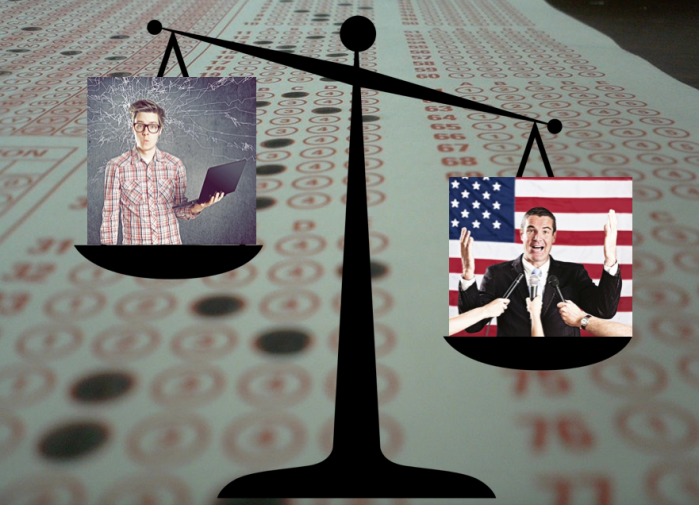
School Accountability Begins With the People Who Make the Rules: A Code of Conduct for Politicians and Test Makers

thumbnail_Screen Shot 2019-03-18 at 1.17.54 PM

Standardized testing is all about accountability.
 

We’ve got to keep schools accountable for teaching.
 

We’ve got to keep students accountable for learning.

 
It’s kind of a crazy idea when you stop to think about it – as if teachers wouldn’t teach and students wouldn’t learn unless someone was standing over them with a big stick. As if adults got into teaching because they didn’t want to educate kids or children went to school because they had no natural curiosity at all.
 

So we’ve got to threaten them into getting in line – students, teachers: march!

 
But that’s not even the strangest part. It’s this idea that that is where accountability stops.

 
No one has to keep the state or federal government accountable for providing the proper resources.

 
No one has to keep the testing companies accountable for creating fair and accurate assessments.

 
It’s just teachers and students.
 

So I thought I’d fix that with a “Code of Conduct for Politicians and Test Makers.”

 
After all, that’s what we do when we want to ensure someone is being responsible – we remind them of their responsibilities.
 

You see, the state and federal government are very concerned about cheating.

 
Not the kind of cheating where the super rich pay off lawmakers to rig an accountability system against the poor and minorities. No. Just the kind of cheating where teachers or students try to untie their hands from behind their backs.

 
They’re very concern about THAT.

 
When you threaten to take away a school’s funding and fire teachers based on test scores, you tend to create an environment that encourages rampant fraud and abuse.

 
So the government requires its public servants to take on-line courses in the ethics of giving standardized tests. We have to sit through canned demonstrations of what we’re allowed to do and what we aren’t allowed to do. And when it’s all over, we have to take a test certifying that we understand.
 

Then after we proctor an exam, we have to sign a statement swearing that we’re abiding by these rules to ensure “test security.”
 

This year, for the first time, I’m supposed to put my initials on the answer sheets of all of my students’ Pennsylvania System of School Assessment (PSSA) tests to prove….  I don’t know. That I was there and if anything went wrong, it’s my fault. Burn the witch. That sort of thing.

Even our students have to demonstrate that they’re abiding by the rules. Children as young as five have to mark a bubble on their test signifying that they’ve read and understood the Code of Conduct for Test Takers.
 

I still don’t understand how that’s Constitutional.

 
Forcing children to sign a legal document without representation or even without their parents or guardians present – it sure looks like a violation of their civil rights.
 

But that’s what accountability looks like when you only require certain people to be accountable.

 
So back to my crazy idea.
 

Perhaps the corporate flunkies actually designing and profiting off these tests should be held accountable, too. So should lawmakers requiring all this junk.
 

Maybe they should have to sign a “Code of Conduct for Politicians and Test Makers” modeled after the one the rest of us peons have to use to sign our lives away.


Read Steven’s “Code of Conduct for Politicians and Test Makers.”


As the tentacles of Ed Reform reachdown into the earliest years, forcing standardized tests on young children, Defending the Early Years is there to block the monster from strangling the children’s loveof learning.

In this short video, early childhood educator Kisha Reid explains what young children need most to thrive.

Play. When children play together, they collaborate. They solve problems. No one fails. They work and play together, as equals. Good practice for the real world.

Michael Elliott, professional videographer and ally of every New York parent group that opposes high-stakes testing, filmed the events on March 16, when AOC joined a community discussion in Jackson Heights, Queens, about public education. With the help of Kemala Karmen, he has broken up the day into segments that you can watch at your leisure. Each of them is short–mostly 3-5 minutes.


PUBLIC EDUCATION TOWN HALL

A BOLD NEW VISION FOR PUBLIC SCHOOL EQUITY & JUSTICE

Organized by Jackson Heights People for Public Schools

Recorded by @TurnOntheSound

New York City (Jackson Heights, Queens) | March 16, 2019

Part 1

TRANSFORMING THE CONVERSATION ON PUBLIC EDUCATION

Amanda Vender, Jackson Heights People for Public Schools

https://vimeo.com/325191468/3242902bd6

Opening remarks from lead organizer Amanda Vender (Jackson Heights People for Public Schools) kick off an inspiring convening of public school parents and community members; education activists; and local, state, and federal elected representatives.


Part 2

PARENT EMPOWERMENT AS RESISTANCE

Robert Jackson, NY State Senator

Johanna Garcia, NYC Opt Out & New York State Allies for Public Education

https://vimeo.com/325193259/8751a891eb

New York State Senator Robert Jackson and his chief of staff Johanna Garcia, both of whom started out as public school parent activists, encourage parents in the room to seize their power. Garcia, who has organized with both NYC Opt Out and NY State Allies for Public Education, ends with a rousing call for parents to opt out of state tests.

Part 3

MAKING SCHOOL SAFE & WELCOMING FOR CHILDREN OF COLOR

Maria Bautista, Alliance for Quality Education

https://vimeo.com/325195289/ebc805dc06

Maria Bautista, campaigns director for the Alliance for Quality Education, makes the case for bills NY state can pass to make schools culturally responsive to their populations and break the school to prison pipeline.


Part 4

CLASS SIZE & EQUITY

Leonie Haimson, Class Size Matters

https://vimeo.com/325194937/ebbfd1bf6c

Leonie Haimson of Class Size Matters on the myriad benefits of smaller class size, especially for children considered at risk; how class size has skyrocketed in NYC; and how a lawsuit, proposed legislation, and adequate funding could remedy this equity issue.

Part 5

THE IMPERATIVE OF BILINGUAL EDUCATION FOR OUR SCHOOLS

Kate Menken, New York State Association for Bilingual Education

https://vimeo.com/325194457/823d4ea9de

CUNY professor Kate Menken of New York State Association of Bilingual Education on the history and benefits of bilingual education, ways that federal and state law can be changed to bolster bilingual ed, and how high-stakes testing hurts language learners.


Part 6

WAR ON PUBLIC EDUCATION: CHARTERS & VOUCHERS

Carol Burris, Network for Public Education

https://vimeo.com/325191672/53caf8839e

Carol Burris talks about waste, fraud, and discrimination in voucher schools and the charter industry; discusses how pouring money into privately controlled vouchers and charters drains funding from public schools; and announces an upcoming report from the Network for Public Education.


Part 7

FIGHTING BACK: REFUSE STATE TESTS!

Diane Ravitch, Network for Public Education

https://vimeo.com/325192088/9f31ee23cd

Noted education historian and author Diane Ravitch on the undue influence of billionaires on education policy, why there is no such thing as a “public charter school,” and the separation of church and state. According to Ravitch, the whole shaky edifice of 20 years of failed federal educational policy rests on high-stakes tests and parents should wield test refusal as David would a slingshot.

Part 8a

NY STATE SENATOR JESSICA RAMOS RESPONDS

https://vimeo.com/325192892/188d2b41fd

In her response to the education advocates who preceded her at the town hall, NY State Senator Jessica Ramos, who ran on a platform that prioritized “real public schools,” touches on: testing and opt out, education that is responsive to our kids’ needs, charter schools’ lack of accountability, bilingual ed, more.

Part 8b

NY STATE SENATOR JOHN LIU RESPONDS

https://vimeo.com/325193891/f8f8c5a998

In his response to the education advocates who preceded him at the town hall, NY State Senator John Liu deems schools “the most important things in our lives,” and talks about school governance/accountability and his leadership of the new subcommittee on NYC Education.

Part 8c

CONGRESSWOMAN OCASIO-CORTEZ RESPONDS

https://vimeo.com/325190755/8e5d4deffb

In her response to the education advocates who preceded her at the town hall, US Congresswoman Alexandria Ocasio-Cortez speaks about her own experience as a bilingual student, decries the pernicious reach of Betsy DeVos, and calls for a national movement on the scale of the Green New Deal to solve the systemic and structural problems of our school system.


Part 9a

Q&A I: ESSA

https://vimeo.com/325195655/292bcdf611

Congresswoman Alexandria Ocasio-Cortez, State Senator Jessica Ramos, and education advocates* respond to questions from the audience. The questions in this segment were about the federal Every Student Succeeds Act (ESSA).

*Advocates (fr L to R): Kemala Karmen (NYC Opt Out/NY State Allies for Public Education), Kate Menken (NY State Association for Bilingual Education), Diane Ravitch (Network for Public Education), Carol Burris (Network for Public Education), Leonie Haimson (Class Size Matters), Maria Bautista (Alliance for Quality Education)
Part 9b

Q&A II: BILINGUAL EDUCATION

https://vimeo.com/325196134/b423807f1e

Congresswoman Alexandria Ocasio-Cortez, State Senator Jessica Ramos, and education advocates* respond to questions from the audience. The questions in this segment were about bilingual education.

*Advocates (fr L to R): Kemala Karmen (NYC Opt Out/NY State Allies for Public Education), Kate Menken (NY State Association for Bilingual Education), Diane Ravitch (Network for Public Education), Carol Burris (Network for Public Education), Leonie Haimson (Class Size Matters), Maria Bautista (Alliance for Quality Education)


Part 9c

Q&A III: “Diane Ravitch, what changed your mind?”

https://vimeo.com/325196402/3d6da0ca28

Congresswoman Alexandria Ocasio-Cortez, State Senator Jessica Ramos, and education advocates* respond to questions from the audience. The question in this segment was directed to Diane Ravitch re her metamorphosis from public education critic to champion.

*Advocates (fr L to R): Kemala Karmen (NYC Opt Out/NY State Allies for Public Education), Kate Menken (NY State Association for Bilingual Education), Diane Ravitch (Network for Public Education), Carol Burris (Network for Public Education), Leonie Haimson (Class Size Matters), Maria Bautista (Alliance for Quality Education)

Part 9d

Q&A IV: NYC’S SPECIALIZED HIGH SCHOOLS

https://vimeo.com/325196799/dd265c6fd2

Congresswoman Alexandria Ocasio-Cortez, State Senator Jessica Ramos, and education advocates* respond to questions from the audience. The questions in this part of the Q&A were about access to NYC’s test-in “specialized” high schools. Later in the program, local Assembly Member Catalina Cruz also addressed this issue. These 2 segments are combined here although they were not directly consecutive.

*Advocates (fr L to R): Kemala Karmen (NYC Opt Out/NY State Allies for Public Education), Kate Menken (NY State Association for Bilingual Education), Diane Ravitch (Network for Public Education), Carol Burris (Network for Public Education), Leonie Haimson (Class Size Matters), Maria Bautista (Alliance for Quality Education)

Part 9e

Q&A V: INFLUENTIAL EDUCATORS

https://vimeo.com/325197845/7c6bde519a

Congresswoman Alexandria Ocasio-Cortez, State Senator Jessica Ramos, and education advocates* respond to questions from the audience. The question in this segment was about how educators influenced the panelists/respondents.

*Advocates (fr L to R): Kemala Karmen (NYC Opt Out/NY State Allies for Public Education), Kate Menken (NY State Association for Bilingual Education), Diane Ravitch (Network for Public Education), Carol Burris (Network for Public Education), Leonie Haimson (Class Size Matters), Maria Bautista (Alliance for Quality Education)