Archives for category: Testing

Governor Mike DeWine acted decisively to close all schools in Ohio, starting at the end of the day Monday. Some schools will close sooner.

COLUMBUS, Ohio – Ohio Gov. Mike DeWine announced Thursday that all Ohio schools will have a three-week spring break – starting next week – as precaution against the spread of coronavirus.

Ohio K-12 schools will be closed from 3:30 p.m. Monday through at least April 3, DeWine said. The order applies to public, private and charter schools.

“We have to do this if we are going to slow this down,” DeWine said during his daily coronavirus update.

DeWine acknowledged that unless a child has a medical problem, the risk of death for a child from COVID-19 is not very high. But he noted that children can be carriers.

“We are announcing today that children in the state will have an extended spring date. The spring break will be the duration of three weeks and we will review it at the end of that,” DeWine said.

This action for K-12 schools is in addition to suspension of in-person classes announced earlier by colleges and universities….

DeWine said he understood there were many unanswered questions.

“We’re going to try to use common sense. We are all in this together. No one is going to impose a crazy regulation that doesn’t make sense,” the governor said. “This is a crisis.”

As for the details, such as normally mandated tests, DeWine said: “If we can’t have testing this year, we will not have testing this year. The world will not come to an end.”

I tweeted last night: “We need more coronavirus tests, and less standardized testing.” #priorities

Governor DeWine has his priorities right.

A reader made this sensible proposal. In the midst of a public health crisis, with various schools and districts closed, the state tests should be cancelled.

The writer says:

Here’s something else that must be cancelled: NYS 3-8 ELA and Math tests set to start in two weeks.

I called NYSED today to share my concern about testing amidst a health emergency. The kind gentleman on the phone said I should email him my concerns and he would pass them on.

I highly recommend everyone in New York State who cares about kids and teachers to do the same. Give NYSED a call at 518-474-3852 and follow the prompts. Or email your concerns to: emscassessinfo@nysed.gov

For now, forget everything else you dislike about testing. Let’s just focus on how terrible it is to further stress out both teachers and students on these tests at this time. We’re in the middle of an unprecedented health emergency. Schools are closing. Shows, conferences, and weddings are being cancelled. Our future is uncertain. State testing should not be a factor in how we survive this crisis.

Please call or email.

Thank you.

John Thompson is a historian and a retired teacher in Oklahoma. This article appeared originally in the Oklahoma Observer.

How the Billionaire Boys Club Ravaged America’s Public Schools

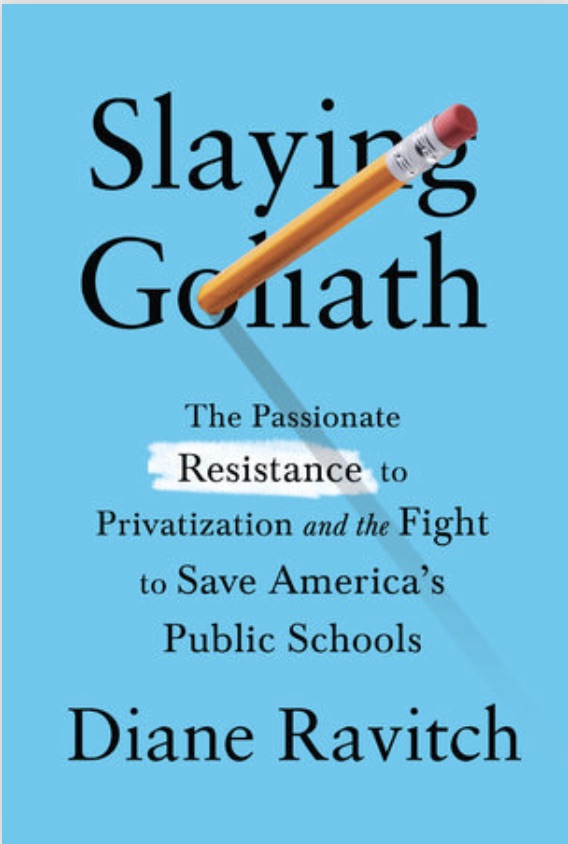
SLAYING GOLIATH The Passionate Resistance To Privatization And The Right to Save America’s Public Schools

Diane Ravitch started writing Slaying Goliath: The Passionate Resistance to Privatization and the Fight to Save America’s Public Schools in 2018 as teachers strikes erupted across the nation. These walkouts began in Red states where conservative legislatures drastically cut funding to under-resourced schools. Even in the places with the lowest salaries, like Oklahoma, educators were motivated by terrible working conditions that meant awful learning environments for students.

It wasn’t just the lack of money, and the resulting damage done by huge class sizes, a lack of textbooks, and neglected buildings, that motivated teachers. They also were resisting the disruption caused by corporate school reform, and the damage it had done to their kids. Teachers were sick of teach-to-the-test malpractice, reward and punish cultures and mandates that produce in-one-ear-out-the-other skin-deep instruction. The joy of teaching and learning was being undermined by the privatization of education. Many or most of these teachers put up with “reform” as long as they could before joining the “Resistance.”

Slaying Goliath is the third transformative book written by Ravitch after changing her mind on education policy. Although her academic histories of education had always been more balanced than progressives acknowledged, Ravitch had worked in the Education Department of President George H. W. Bush, and she had served on the board of the conservative Fordham Foundation. In 1992, she went to a briefing with David Kearns, the former Xerox CEO, where the Sandia Report’s findings were explained. Kearns and other reformers were outraged that scholars challenged the alarmism of “A Nation at Risk,” the infamous Reagan-sponsored indictment of public education. They refused to release the report which explained that American schools weren’t failing.

Ravitch recalls the way that education scholars were vilified for revealing that the so-called “crisis in education” was a “politically inspired hoax,” and a “manufactured crisis.” In a passage which exemplifies Ravitch’s candor, she writes about the late Gerald Bracey, “a prolific and outspoken education researcher” who challenged the conventional wisdom that she was then defending. Ravitch then writes, “I personally apologize to him.”

As the No Child Left Behind Act of 2002 started to undermine schooling, Ravitch joined progressive educator Deborah Meier in a dialogue which changed Ravitch and the struggle against data-driven, competition-driven reforms. In 2010, she released the Death and Life of the Great American School System and three years later, she published Reign of Error. Ravitch “renounced” her old views and exposed the “smear campaign” which she presciently described as “privatization.” They funded so-called “transformative” change, designed to drive “bad teachers,” protected by “bad unions,” out of schools.

Ravitch’s talent with words may have been as important as her evidence-based evaluation of the inherent flaws of the technocratic micromanaging known as “reform.” The initial political successes of the reformers where driven by the huge bank accounts funding savage attacks on teachers and school systems. During the height of corporate reform a decade ago, Ravitch’s ability to coin a phrase seemed to be educators’ only means of self-defense. She nailed the issue by identifying “the Billionaires Boys Club” as the sponsors of “corporate reform;” now Ravitch dubs their movement “Goliath.” Her use of the term “privatization” helped us understand that the neoliberal attack, funded by Silicon Valley and Hedge Fund elites, was interrelated with the overall privatization movement which intimidated so many Democrats into retreating from the War on Poverty and other social justice campaigns. (In doing so, she paved the way for excellent work such a OU’s Associate Dean Lawrence Baines’ Privatization of America’s Institutions.)

Now, Ravitch renames both sides of the education wars. The Billionaires tried to claim the word reform, but they never deserved that title. They are “Disrupters.” We who fought them off are the “Resistance.”

Slaying Goliath reviews the failure of NCLB, and how 1990s improvements in student performance as measured by the reliable NAEP assessment slowed and then stopped. Then, Obama era reforms put NCLB’s high stakes testing, cultures of competition, and corruption of test scores and education values on steroids. But most of the book describes the emergence, the struggles and victories of the grassroots Resistance.

During the first decade of the 21st century, the Disrupters won nearly all of their political battles as their micromanaging failed to improve schools. Their testing often turned modern classrooms into sped-up Model T assembly lines, as their behaviorism turned charter schools into weapons for undermining teacher autonomy, due process, and professionalism. During the last decade, Disrupters suffered political and educational defeats as they learned that it is easier to kick down a barn than rebuild it.

However, Ravitch reminds us that the Disrupters are still threatening. She compares today’s danger to that which faced a man who decapitated a rattlesnake but who nearly died after being bitten by the detached head.

Oklahomans should take special interest in the narratives where the snake’s head is still a threat to our schools.

Today, many or most of Goliath’s coalition have become disenchanted with standardized testing, but their Disruption model can’t function without it. Oklahomans should heed the wisdom of reform-minded Paymon Rouhanifard, the former Camden superintendent, who abolished report cards after listening to complaints, and eventually denounced standardized testing.

Rhode Island, where their state superintendent Deborah Gist tried to fire all of the teachers in Central Falls, was an example of students rising up. They staged a “Zombie March, “ and created “Take the Test” for 50 elected officials, architects, scientists, engineers, college professors, reporters, directors of nonprofit organizations, and reporters.” Even with such educated test takers, 60% didn’t score high enough to earn a diploma.

Gist called their protest “deeply irresponsible on the part of the adults” for sending the message that tests don’t matter.

Since philanthropists who still support Gist have also funded “portfolio management,” Oklahomans should read the evidence about that kinder and gentler-sounding recipe for permanent teach-to-the-test and conflict.

Oklahoma philanthropists seem to believe the spin claiming that the New Orleans portfolio model was a success, but even the researchers who support that all-charter district’s prohibitively expensive approach admit that its school quality peaked in 2013.

As Ravitch explains, “A portfolio district is one where the local board (or some entity operating in its stead) acts like a stockbrokerage, holding onto winners (schools with high test scores) and getting rid of losers (schools with low test scores), replacing them with charters.”

As she further explains, these failures are linked to the Disrupters’ infatuation with mass closures of schools. To take one example, Chicago, Ravitch explains how the Chicago Consortium on School Research (CCSR) found “few gains” due to closing schools but “a profound sense of loss: lost schools, lost communities, lost relationships. These were losses that the Disrupters never understood. Test scores were all that mattered to them.” Chicago lost over 200,000 black residents between 2000 and 2016. And the CCSR further explained how they “caused large disruptions without clear benefits for students.”

Whether in Chicago, Tulsa, or Oklahoma City, closures may produce little or no gains, but they will lead to a “period of mourning.” This is one of the many ways reason why Oklahomans should move on from the presumption that disruptive and transformative change made sense. That mindset is another legacy of not seeing “value in bonds among schools, families, and community.”

Whether you call it transformative change or disruption, this mentality was committed to “blind adherence” to the corporate demand for “outputs” that “don’t work for schools for the same reasons they don’t work for families, churches, and other institutions that function primarily on the basis of human interactions, not profits and losses.”
https://www.educationdive.com/news/is-edtpa-standing-in-the-way-of-getting-more-teachers-into-classrooms/572969/

Educators disagree about the value, validity, and reliability of the Pearson EdTPA, which is mandated in many states as the gateway to entering teaching.

Some states have lowered the passing score. Some are wondering whether to abandon it.

The debate occurs at a time when enrollments in teacher education programs have dropped by a third.

While many agree on the importance of high standards for new teachers, it’s by no means clear that the EdTPA encourages better teaching or merely rewards teachers who are good at the demands made by Pearson.

Audrey Watters asks the question that we should all be asking: is our democracy for sale to the candidate with the most billions? 

Apparently our schools sold out years ago when money was dabbled before them.

People who take money from that powerful education foundation — you know the one, the one that turns 20 years old this year — always insist to me that they’ve never been compelled to change their policies or practices. Of course, it doesn’t have to coerce its grantees to say and do things. People self-censor. They shape their initiatives to suit the foundation’s philosophy and its goals. They value the things the foundation says it values; they measure the way the foundation says it measures. Because if they rely on the foundation for funding, they know to fall in line. They needn’t be told. That’s how the power of philanthropy works. It sets the agenda. Personalized learning. The Common Core. Charter schools. Measures of Effective Teaching. It didn’t push for these ideas because that’s what people wanted. It helped convince politicians that these were the ideas that education needed. That is to say, education policy has not been shaped by democratic forces as much as it has been by philanthropic ones — by the billionaires who wield immense political power through their “charity.”

Actually, I don’t blame schools—few of whom had a say in decisions to follow the Gates money trail—so much as I blame the policy elites, who fell in love with the idea of sitting at the feet of billionaires and following their commands. The billionaires didn’t know what they were doing, but they were so confident in the virtues of testing, accountability, competition, choice. Who could resist?

Strange as it may seem, the best education reporter in New York City works for Rupert Murdoch’s New York Post. Her name is Susan Edelman, and she regularly reports on what is happening in the city’s schools without fear or favor. Unlike the New York Times, where reporters cycle in and out of the education beat, Sue has been writing on the subject for many years.

One of her best articles appeared in 2011, when she revealed the source of the non-existent “New York City Miracle.”

The title: “New York’s School Testing Con.”

Mayor Bloomberg trumpeted the 2009 scores as proof of the success of his mayoralty, as proof that the Legislature was wise to give him total control of the school system, and as reason #1 to re-elect him to a third term (which broke the City Constitution’s two-term limit).

Edelman began:

In a stunningly short time, from 2006 to 2009, New York schools celebrated what was presented as a tremendous turnaround. The number of city students passing statewide math tests in the third through eighth grades surged from 58% to 82%. At the same time, the Big Apple graduation rate rose from 49% to an all-time high of 63% last year.

The figures were miraculous.

They were also, for the most part, a lie.

While the scores have risen, real achievement has lagged. Behind the curtain, an erosion of standards has led to a generation of New Yorkers who have been handed high school diplomas but can’t handle the rigors of college or careers.

A new state report finds just 23% of city grads leave high school ready to succeed in college or the work world. About 75% who enrolled at CUNY community colleges flunked the entrance exam, and must take one or more remedial classes in math, reading and writing.

Many blamed State Commissioner Richard Mills, who set graduation standards so high that he had to lower the bar or face the possibility that most students would not get a diploma.

But others saw a coverup of huge proportions when the 2009 scores went through the roof. In response to the spectacular scores, Regent Betty Rosa asked,

 “Why are we celebrating these scores as a miracle, when there is no miracle?” Rosa said she asked.

Another insider said Big Apple officials were urged not to “exaggerate” the results. But Mayor Bloomberg hailed the increase in 2009 as an “enormous victory.” At the time, he had a lot riding on the scores — he was seeking a third term and pushing for legislation to extend mayoral control of the schools.

City officials “got very angry,” the insider said, when Regents Chancellor Merryl Tisch publicly downplayed the results, citing “troubling gaps” between the stellar state scores and lackluster outcomes on national exams.

Mills has maintained the scoring was backed by his panel of experts. But Rosa and other members of the Board of Regents say he kept them in the dark.

“I basically asked, ‘Who sets the cut scores? How is this determined?’ ” said Rosa, who joined the board in 2008. “There was no real explanation. I never got a straight answer.”

Mills and his testing chief, David Abrams, had rebuffed requests in 2008 to investigate the inflation. Faced with a lack of confidence, Mills was “encouraged” to leave in June 2009, insiders said. He declined to comment last week, saying, “I have nothing to add.”

Many city students soon discovered their Big Apple diploma was little more than a piece of paper.

Jasmine Gary, 18, a graduate of Port Richmond HS on Staten Island, was surprised when she scored a 70 on the Regents math exam.

“I don’t know how I passed, because I failed a lot of math classes,” she said.

She applied to CUNY but bombed on the entrance exam. Now she’s required to take a no-credit, $75 remedial class at Borough of Manhattan Community College, but is catching up. “I learn more here,” she said.

Rossie and Angely Torres, 18-year-old twins from The Bronx, earned 76 and 75 respectively on the math Regents at Philip Randolph HS in Harlem. They, too, take remedial classes at BMCC.

“In high school it was just people talking and the teacher would just give us an assignment. It was just to graduate. But here, people work hard and the teacher is more serious,” Rossie said.

Former Chancellor Joel Klein, who left office several months ago to join News Corp, which owns The Post, declined to be interviewed. But he defended his eight-year record via e-mail sent by a city DOE spokesman.

“We’ve long called for higher standards and . . . we still made real gains,” Klein said.

For instance, city fourth-graders have boosted their scores on national reading tests since 2003, though eighth-grade scores have remained flat.

And NYC has outpaced the state’s other big cities, Buffalo, Rochester, Syracuse and Yonkers, the DOE says. In 2002, New York City’s fourth-grade math results were 27% lower than the statewide average, while the other four cities showed a 31% gap. In 2008, New York City was just 8% behind the rest of the state, while the “big four” were 25% behind.

But the more spectacular results have vanished.

The Board of Regents commissioned a study, led by Harvard professor Daniel Koretz, which concluded in 2009 that the statewide grades three-eight tests had become too easy. Mills’ successor, David Steiner, recruited for his experience in teacher development as dean of Hunter College of Education, was charged with making the 2010 tests more comprehensive and less predictable. He also hoisted the cutoff points, requiring students to do more to pass.

Scores plunged. Just 54% of all city students in grades three-eight showed proficiency in math tests last year, compared with 82% in 2009. Reading proficiency citywide fell from 69% to a dismal 42%.

Even so, the tougher tests continued the practice of giving “partial credit” for wrong answers — or no answer at all — if the kids showed some understanding of the concept or did one step right.

On the fourth-grade test, for instance, a kid who answered that a 2-foot-long skateboard is 48 inches got half-credit for adding 24 and 24 instead of the correct 12 plus 12. “They were giving credit for blatantly wrong things,” said a teacher hired to score the tests.

A state report released this month delivered a new blow. It found that most kids who earn less than 75 on the state Regents English test or 80 on the math exam — 65 is passing for both — must take remedial classes before starting college.

That 65 score is misleading as well. It’s based on an adjustable scale — and the state has whittled down the points needed to pass. Back in 2003, students had to get 61.2% of math questions right for a 65 score, the minimum required for a Regents diploma, and 50.5% of questions right for a 55 score, enough for a “local diploma.” Today, students need just 30 points out of a maximum 87 — or 34.5% — to get a 65 score.

“When Johnny or Jenny comes home with a 65 or 70, their parents might think they’ve mastered about two-thirds of the material. In fact, it’s slightly more than a third,” said Steve Koss, a retired city math teacher who has railed against the bloated test scores. “Sadly, most parents don’t understand how the scoring works. If they knew the truth, many would be outraged at what amounts to a fraud perpetrated against them by state and local education officials.”

Last month, the state launched a shorter English Regents exam, cutting it from two days to one, six hours to three, and four essays to one. Instead of three other essays, kids have to write two “well-developed paragraphs.”

To bring matters to the present, the Regents are now debating whether to retain or discard their storied exams, which students must pass to graduate.

But that’s a topic for another post.

Heather Gautney and Eric Blanc warn in the Guardian the Michael Bloomberg’s ideas about education would be a disaster for the nation. He is the only candidate whose ideas about education are in synch with those of Donald Trump, Betsy DeVos, and Arne Duncan. The authors are both supporting Bernie Sanders.

Affer persuading the legislature to give him total control of the city’s 1.1 million public school students, he hired three non-educators as city Chancellor. One of them, a publisher out of her depth, lasted 95 days.

Like Trump and his inept Secretary of Education Betsy Devos, Bloomberg is a fervent backer of privatizing and dismantling public schools across the country. Education, in their view, should be run like a business.

While other establishment Democrats have begun changing their tune in response to the “Red for Ed” movement, Bloomberg’s campaign spokesman has made it clear that privatization will be a core message of his 2020 presidential run: “Mike has always supported charter schools, he opened a record number of charter schools as mayor of New York City, and he will champion the issue as president.”

Indeed, Bloomberg succeeded in massively expanding privately run but publicly funded charter schools during his term as mayor, increasing their number from 18 to 183. His controversial push to “increase school choice” closed over 100 schools in low-income communities and entrenched New York City’s education system as the most racially segregated in the country…

If anything, the main difference between Bloomberg and Trump is that the former has spent far more of his immense personal fortune to boost corporate “education reform” and local candidates driving this agenda. The New York Times reported last week that Bloomberg has spent millions to promote charters in the state of Louisiana alone. And this is just the tip of the iceberg: Bloomberg’s foundation in 2018 announced its plan to spend $375m to promote charters, merit pay, and the sacking of “failing” teachers, among other reforms.

Bloomberg is also an active promoter of high stakes testing. Despite abundant evidence that an excessive testing regime does little to improve real educational achievement, Bloomberg has vociferously sung the praises of this system in op-eds such as Demand Better Schools, Not Fewer Tests. Accordingly, as mayor he fought for a merit pay system through which teachers’ salaries would be pegged to student test scores.Like Trump and DeVos, Bloomberg has also viciously attacked teacher unions and scapegoated educators. He spent much of his mayoral tenure fighting with the powerful United Federation of Teachers (UFT), which he compared to the National Rifle Association. As he put it, “if the UFT wants it, it ain’t good”.

Actually, Bloomberg has poured money into charter school campaigns across the country, not just in Louisiana. He donated big money to school board races in Los Angeles and a charter referendum in Massachusetts, among many other state and local races.. His daughter Emma is one of three billionaire board members of TFA’s political action arm, called Leadership for Educational Equity.

Though his Republican roots are less evident on some other issues, Bloomberg’s personal and political similarity to Trump will make it very hard for him to win in a general election. Trump’s base remains solid – we need a candidate who can increase turnout by energizing the Democratic base and involving new voters in the political process.

That’s why having Bloomberg as the Democratic party’s standard bearer would make defeating Trump exceedingly difficult. At a moment when a wave of successful teachers’ strikes has captured the imagination of millions and changed the national discussion on education, a Bloomberg nomination would be a sure-fire recipe for demoralizing educators and teachers’ unions, an indispensable bastion of organized labor and the Democratic base.

They conclude:

You can’t win in November without teachers. And nobody should expect educators to be won over to a billionaire who has spent much of his career and fortune demonizing them. If you want to save public schools and defeat Trump, Bloomberg is no choice at all.

From Politico today:

Of all the Democratic candidates, Michael Bloomberg has the worst record on education. His education policies mirrored George W. Bush’s No Child Left Behind. He was fully invested in high-stakes testing, data-based decision-making, closing schools with low scores instead of helping them, opening new schools and then closing those schools, creating selective schools that chose students based on test scores, and opening scores of charter schools. He had sole control of the “Panel on Education Policy,” and warned its members that if they disagreed with him, they would be fired. When some disagreed about his blanket prohibition of “social promotion,” he summarily fired them. He hired three non-educators as chancellor to lead the system (one of them last 95 days). He tried and failed to hire business people and people from other other fields as principals. He stands for testing and privatization of public education. He has funded pro-privatization candidates in local and state school board races around the country.

SCOOP … MIKE BLOOMBERG is airing another national TV ad tying himself to closely BARACK OBAMA. This one is a 30-second spot entitled “Difference,” and it’s chock-full of imagery of BLOOMBERGand OBAMA. The timing of this ad is quite interesting, as it comes in the middle of a massive intraparty squabble between BLOOMBERGand Sen. BERNIE SANDERS (more about that in a second). BLOOMBERG has found plenty of ways to tie himself to OBAMA, the most popular Democrat in America. The 30-second ad

— SCRIPT: “[NARRATOR]: A great president and an effective mayor. Leadership that makes a difference. [OBAMA SPEAKING]: He’s been a leader throughout the country for the past 12 years, Mr. Michael Bloomberg is here. [NARRATOR]: Together they worked to combat gun violence, and again to improve education for every child. [OBAMA]: And I want to thank the mayor of this great city, Mayor Bloomberg, for his extraordinary leadership. And I share your determination to bring this country together to finally make progress for the American people.”

BLOOMBERG also has a new 30-second spot with Judge Judy. …

— LAT WITH THE NUMBERS: “Democratic presidential candidate Michael R. Bloomberg has spent more than $124 million on advertising in the 14 Super Tuesday states, well over 10 times what his top rivals have put into the contests that yield the biggest trove of delegates in a single day. The only other candidate to advertise across most of those states so far is Vermont Sen. Bernie Sanders, who has spent just under $10 million on ads for the March 3 primaries.”

NEWS: BLOOMBERG has qualified for the NBC/MSNBC/Nevada Independent debate Wednesday night in Las Vegas. He’s indicated that he’ll do it, and a brand-new poll suggests that his advertising and publicity blitz has vaulted him into second place nationally.

THE POLL: SANDERS, 31 … BLOOMBERG, 19 … JOE BIDEN, 15 … ELIZABETH WARREN, 12 … AMY KLOBUCHAR, 9 … PETE BUTTIGIEG, 8. NPR/PBS NewsHour/Marist Poll

— BLOOMBERG’S DEBATE PREP, via Chris Cadelago and Sally Goldenberg: “Howard Wolfson, the veteran Democratic strategist who joined Bloomberg’s orbit in 2009 after working on Hillary Clinton’s 2008 presidential race, is playing the role of Bernie Sanders; Julie Wood, Bloomberg’s national press secretary, is depicting Elizabeth Warren; and senior advisers Marc La Vorgna and Marcia Hale are stand-ins for Pete Buttigieg and Amy Klobuchar, respectively. …

“Bloomberg is trying to hone a crisp and energetic appeal to voters that will contrast with Biden — another white, male septuagenarian on stage, according to advisers.”

THE BRAWL right now between BLOOMBERG and SANDERS seems to be the rare internecine fight that benefits everyone involved. It goes something like this: BLOOMBERG whacks BERNIE, delighting the Democratic Party’s large anti-Bernie wing. BERNIE then blasts out a fundraising email to his list of millions. He reminds his supporters that BLOOMBERG is a billionaire who palled around with TRUMP,and the left goes wild, but so do BLOOMBERG supporters, who say only a deep-pocketed billionaire willing to punch can take on the president.

The munificently-funded Thomas B. Fordham Institute, based in D.C., controls Educatuon Policy, graduation requirements, curriculum, and testing in Ohio. Mr. Fordham, for whom the institute is named, had no known interest in education, but his namesake is part of the rightwing ALEC nexus, where contempt for public schools, hatred for unions, contempt for gun control and environmental regulation are reflexive.

Laura Chapman, who lives in Ohio, writes:


This numbers game is routinely pushed by the Ohio arm of Thomas B. Fordham Institute/Foundation. Oped’s written by employees at criticize the Fordham routinely criticize teacher unions for pointing out the debilitating affects of poverty on students. In a typical rhetorical move, the Fordham “expert” will find one exceptional school with an “A” rating of the state report card rigged to ensure few schools are rated A. Then when you read in detail, you will see that the most exceptional thing about this school is really rare. The same principal has been there for 18 years, lives in the community, and has an uncommon level of trust from her community, the teachers, and students. Test scores were a byproduct of that not the aim of her work as an educator.

In Ohio, the writer most responsible for this misleading journalism and “research” is Aaron Churchill, the Institute’s Ohio Research Director. The Institute says this: Since 2012, Aaron has worked on “strengthening” Ohio policy on standardized testing and accountability, school evaluation, school funding, educational markets, human-resource policies and charter school sponsorship. He writes for the Fordham’s blog, the Ohio Gadfly Daily and contributes op-eds to the Columbus Dispatch, Cleveland Plain-Dealer, Dayton Daily News, and Cincinnati Enquirer. Aaron previously worked for Junior Achievement.”

He has not an ounce of documented experience in teaching or studies of education as an undergraduate or graduate student. He gets a free pass on almost everything he submits to the Columbus Dispatch, Cleveland Plain-Dealer, Dayton Daily News, and Cincinnati Enquirer. These local newspapers are shrinking and have few if any staff available for questioning this “throughput” of misleading but ready to post news.

John Thompson, historian and retired teacher in Oklahoma, reviews SLAYING GOLIATH. This is the second part of his review.

This is an excerpt of a long and thoughtful review.

This second post will focus on Ravitch’s analysis of the research which predicted the defeat of accountability-driven, charter-driven policies. Perhaps the most striking pattern documented in Slaying Goliath is how they failed in the way that scholars and practitioners anticipated.

Decades of Disruption-driven reform began with the false claim “that American education was failing and the only way to fix it was with standards, tests, competition, and accountability.” As Arne Duncan’s public relations officer and Walton-funded reformer Peter Cunningham said, “We measure what we treasure.”

Ravitch’s response was, “I was taken aback because I could not imagine how to measure what I treasure: my family, my friends, my pets, my colleagues, my work, the art and books I have collected.” And that foreshadows the victory of the Resistance over Goliath. Most educators, patrons, and students agree that children are more than a test score.

No Child Left Behind and the Race to the Top set impossible test score targets. They were based in large part on the weird idea that “no-excuses” behaviorist pedagogies could be quickly “scaled up,” providing poor children of color a ladder to economic equality. Drawing on the tradition of Edward Thorndike and B.F. Skinner, reformers “rigidly prescribed conditioning via punishments and rewards.” Previewing their fatal flaw, Ravitch observes, “Behaviorists, and the Disrupters who mimic them today, lack appreciation for the value of divergent thinking, and the creative potential of variety. And they emphatically discount mere ‘feelings.’”

When educators resisted, corporate reformers became livid and doubled down on the punitive. Perhaps their worst debacle was using value-added teacher evaluations to hold each individual educator accountable for test score growth. It combined inappropriate test outputs with an unreliable and invalid algorithm, the VAM, as a club to enforce compliance. In the short run, it forced educators, who had previously tried to keep their heads down and “monkey wrench” testing mandates to join patrons and students in the Resistance. By 2018, however, pent up anger exploded as teacher strikes spread across the nation.

Today, many or most of Goliath’s coalition have become disenchanted with standardized testing, but their Disruption model can’t function without it. Few have gone as far as Paymon Rouhanifard, the former Camden superintendent who abolished report cards after listening to complaints, and denounced standardized testing as he left the job.

The more common path is to spin their punitive tests as “personalized” learning, and their incentives and disincentives as the “portfolio model.” As Ravitch explains, “A portfolio district is one where the local board (or some entity operating in its stead) acts like a stockbrokerage, holding onto winners (schools with high test scores) and getting rid of losers (schools with low test scores).”

As was also predicted by Campbell’s Law, test-driven accountability (made more intimidating by the dual threat of test-driven competition with charters) led to corruption. The cheating was far greater than just the scandals where adults erased and changed bubble-in answers. Graduation rates were easy to manipulate. For instance, NPR reported a “heartwarming story” in 2017 about a school with 100% graduation rate. A subsequent FBI investigation and a district audit found 1/3rd of the school’s graduates lacked credits and only 42% were on track to graduation.

And that leads to the corruption associated with school choice. Today’s Disrupters seem to be doubling down on charters to drive transformative change. As explained in a previous post, in 1988 Al Shanker saw charters as a path towards innovation. Within two years, however, the promise of win-win experimentation started to be undermined when conservative reformers Terry Moe and John Chubb claimed “choice is a panacea.”

In this case, it was choice-advocate Paul Peterson who predicted the political future. Charters didn’t take off because of the balanced approach of Shanker, but because reformers “radicalized” the concept. And, of course, there was plenty of big bucks available for pushing their radical but false narrative.

Within a decade, a shocking number of non-educators had been convinced by Goliath’s spinsters that the KIPP’s behaviorist model could be scaled up. As Slaying Goliath explains, “The biggest innovation in the charter sector was the invention of ‘no-excuses’ schools.” It took nearly another decade for policy makers to accept the fact that charters get average results except for those with high attrition.” And it took nearly as long to reveal the much greater down sides of charters…

Regardless of whether we’re discussing high-stakes testing, charter expansion, or the other pet theories, we should all heed Ravitch’s most important lesson of the past few decades is that “Reform doesn’t mean reform. It means mass demoralization, chaos, and turmoil. Disruption does not produce better education.”

Slaying Goliath celebrates a great victory for public education and democracy. However, Ravitch reminds us that the Disrupters are still threatening. She compares today’s danger to that which faced a man who decapitated a rattlesnake but who nearly died after being bitten by the detached head.

So, we can’t lower our guard until the principles that inspired the Resistance are safe in our schools.