Archives for category: Tennessee

North Carolina has been in the forefront of destructive education policies ever since the Tea Party won control of the state’s General Assembly (legislature) in 2010. Charters, vouchers, TFA, high-stakes testing, hostile indifference to teachers, etc.

But the rightwingers in NC wanted more. They wanted their own version of the Tennessee Achievement School District. They knew that Tennessee lawmakers had created a special district containing the state’s lowest-scoring schools; these schools would show dramatic improvement if handed over to charter operators.

The North Carolina legislators ignored the clear evidence that the Tennessee ASD was a failure, despite the state’s investment of $100 million from Race to the Top funding. Failure was no deterrent, no way to dissuade them from launching the magic elixir of privatization.

In 2016, the North Carolina General Assembly created its very own Achievement School District, which was soon renamed the Innovative School District. Now we know it too has failed. The General Assembly is defunding it.

The Innovative School District was supposed to contain five schools, but every time a school was designated, its district fought to keep the school. The ISD opened with only a single school, and that one school had a principal, a superintendent, and a charter management organization. An awful lot of administrators for one school.

Alex Granados wrote about the collapse of this bad idea in EdNC:

In an experiment, a hypothesis is tested. In the case of the Innovative School District(ISD), the hypothesis was that some of the state’s lowest-performing schools could be improved if they were grouped into one district, given charter school-like flexibility, and turned over to the management of alternative operators.

To judge by the biennium budget passed by the General Assembly in November 2021, North Carolina lawmakers must have concluded that the ISD experiment did not yield the result of improving schools, at least not in the way it was originally conceived. What other conclusion can be drawn from the fact that lawmakers put an end to the project in their two-year spending plan?

Background

The Achievement School District bill was passed during the 2016 General Assembly short session. At the heart of the legislation was the creation of a district that would eventually include five low-performing schools from around the state that could be turned over to charter school operators.

It was originally called the Achievement School District and its first superintendent, Eric Hall, said at the time that it was modeled after similar experiments from other states that had “mixed results.”

“We have an opportunity as a state to redefine what it means in North Carolina,” Hall told the State Board of Education in 2017. But that redefinition never quite came to be.

A single school

The initial plan was that all five schools in the ISD would be up and running by the 2018-19 school year. It is now the 2021-22 school year, and there is still only one school. That is thanks to, in large part, massive resistance from some of the districts approached by the state.

The single school that was taken over as part of the ISD was Southside-Ashpole Elementary School in Robeson County. And it’s been a tough journey both for the school and for the district — since its inception, the ISD has had four superintendents and the school has had three principals.

Current ISD Superintendent Ron Hargrave told the State Board of Education in December 2021 about visiting a kindergarten class at Southside-Ashpole on his first day. A teacher said to him: “‘Well, you’ll be number four,’ and she was talking about the number of superintendents who’ve come through there,” he said.

Hargrave replied, “I’m going to do everything in my power to make sure you don’t need a number five, because I’m here to stay.”

But turnover hasn’t been the only issue.

The nonprofit charter organization that was running the operation was ultimately relieved of its responsibilities by the State Board of Education. You can read about the difficulties with that organization, Achievement for All Children (AAC), in N.C. Policy Watch here and here.

‘No common ground’

Did Southside-Ashpole improve? According to data, no.

Trip Stallings, whose team conducted the external evaluation of the ISD when he was with the Friday Institute for Educational Innovation, said that a single school’s performance can’t really tell us anything about how well the ISD concept might work as a multi-school turnaround program.

“Because they only had one school in three years, you can’t really use that experience to validate or disprove the ISD approach,” he said. But there are a number of issues evident from even the experience of a single school that may have weakened the ISD structurally, according to Stallings.

One issue was that the legislation that created the ISD assumed there would be a wide variety of Charter Management Organizations (CMOs) vying to manage schools in the ISD. Instead, only three CMOs applied to manage Southside-Ashpole. The State Board of Education asked all three to resubmit their original proposals and, ultimately, the revised proposal from AAC was accepted.

“The real question is, ‘Why did other CMOs not apply?’” Stallings said.
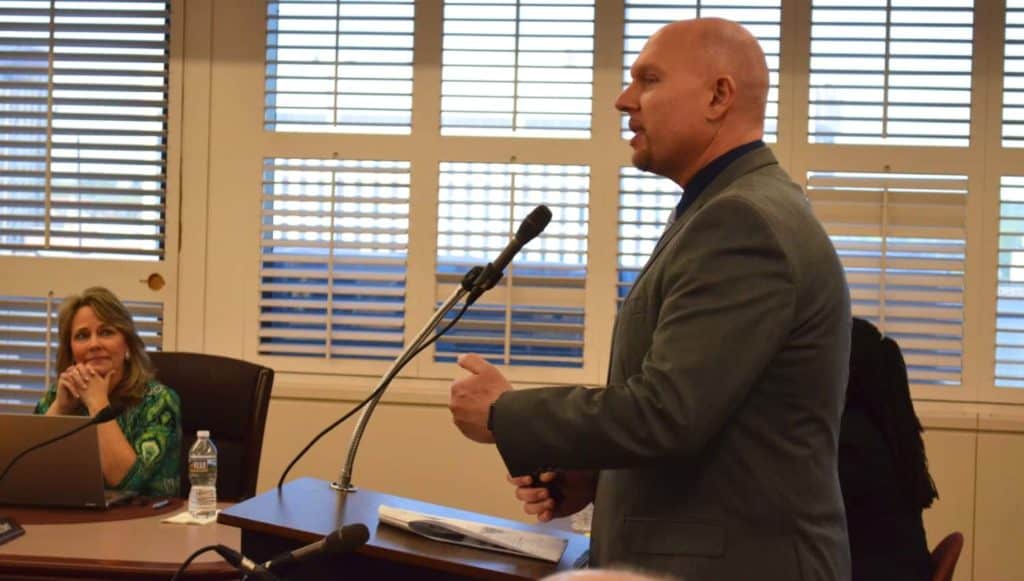
Former ISD Superintendent Eric Hall presents to the State Board of Education Thursday, April 5, 2018. Alex Granados/EducationNC

Another problem, according to Stallings, was the disconnect among the operator, the State Board of Education, and the state Department of Public Instruction (DPI) regarding how the ISD as a program should be implemented and managed.

“For example, none of the parties really reached agreement on the question of what this ‘charter-like flexibility’ means,” he said.

As a result, a superintendent, principal, and CMO leader all tried to assert separately how the single school in the district needed to operate. This led to confusion and dysfunction, he said.

Finally, Stallings said that the remote nature of the program was a “significant handicap.” DPI, AAC, and the school were all in separate locations and remote from each other not just geographically, but also culturally.

“They didn’t see many things in the same way,” he said. “For some issues, there was no common ground.”

According to the budget, Southside-Ashpole Elementary School will continue as part of the ISD until 2023-24 at the latest, when it will be returned to the Public Schools of Robeson County.

Craig Horn, a former Republican state representative from Union County, said this is terrible news. Not because he was a big fan of the ISD — he said he wasn’t — but because it is indicative of how the General Assembly operates.
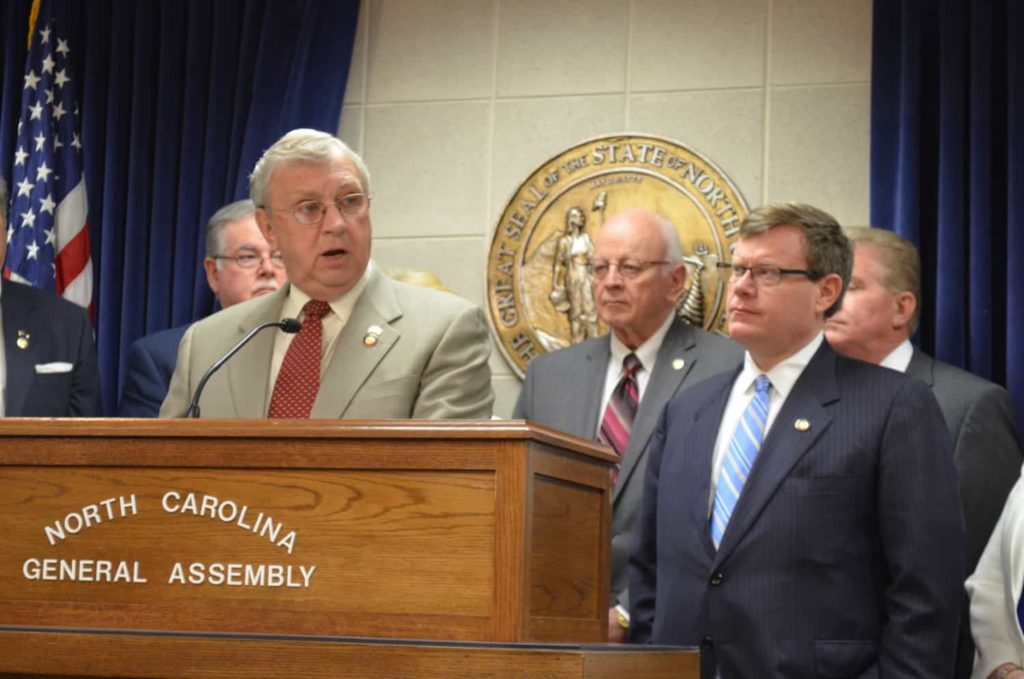
Rep. Craig Horn, R-Union, talking about the education portions of the budget at a 2017 press conference. Alex Granados/EducationNC

Horn, an influential legislator when it came to education, lost his seat when he ran for the state superintendent position and lost to Catherine Truitt in 2020. He was there for the inception of the ISD.

“I’m going to suggest that rather than sit down and work out the problems, it’s easier and faster to say, ‘Ok, we’re done. We’re not doing it,’” he said.

Horn had a lot of problems with the ISD program, but said that if it has failed, he hopes lawmakers have done their homework to understand why.

“If we can say that we did our homework, we actually talked to the people inside, we actually talked to parents and students, we actually made some adjustments and we’re still failing, OK, then we made an informed decision,” he said. “But my experience with the General Assembly is they don’t always make informed decisions.”

Preparing for transition

The State Board of Education heard from the current leaders of the ISD and Southside-Ashpole at the December 2021 meeting.

Derrick Jordan, associate superintendent of agency schools, told the Board that efforts to improve the school are still happening.

“There is absolutely still work to be done, but there is an unwavering commitment to improving outcomes for the students at Southside-Ashpole,” he said.

And Hargrave stressed to Board members that the students in that school are “full of potential.”

“It is a school full of children who desire to be loved and desire to be taught, and they have a hunger for learning,” he said.

Freddie Williamson, superintendent of the Public Schools of Robeson County, said the district is ready to have the school back and is already working with the school and the ISD to prepare for a “smooth, seamless transition.”

There isn’t yet a timeline for the transition, but when Southside-Ashpole does return back to the control of Robeson County schools, State Board of Education member Olivia Oxendine said she hopes it keeps innovation a priority. She said innovation takes a long time, and whatever the ISD, the new teachers, new principal, or the community have done, it should continue.

“Whatever is beginning to happen called innovation, let’s carry it forward,” she said.

Nothing on the record shows that there was either innovation or achievement at the one school in the experimental district. But whatever it is, says Ms. Oxendine, keep doing it, even though it yielded no improvement.

The full story of North Carolina’s failed experiment is fascinating. The bill to create the state’s Innovative School District was sponsored by Republican Rob Bryan. The money to promote the bill was supplied by an ultra-conservative businessman from Oregon named John Bryan (no relation to the legislator). After the bill passed, the state Board of Education selected Achievement for All Children (AAC) as the charter operator, although it had no experience turning around low-performing schools.

Here’s the context, which appeared in NC Policy Watch.

Mecklenburg County Republican Senator Rob Bryan sponsored the bill as a member of the House in 2016 that became law and created the ISD. That law specifies that the ISD can have up to five schools, selected from the lowest-performing in North Carolina.

Bryan argued at the time that the new district would provide much-needed reforms, but the following year, as Policy Watch reported, he received at least $5,000 as a “stipend” for his work with AAC.

Several other low-performing schools, including two in Durham, were targeted for state takeover in 2017, but resisted the move. Then-ISD Superintendent Eric Hall ended his pursuit of those schools.

That left Southside-Ashpole, which began operating as the state’s first and only school within the Innovative School District at the start of the 2018-19 school year. Southside-Ashpole has an enrollment of 270, 95% of whom are students of color: Black, Latinx and American Indian.

In its first year as an ISD school, there was a wholesale house cleaning at Southside-Ashpole: After Superintendent Allen abruptly left, the State Board of Education hired Ellerbe to replace her. School principal Bruce Major also suddenly resigned, and AAC then hired Bowen.

It remains unclear whether the changes were due to job performance.

Meanwhile, there has also been a major upheaval within AAC’s business partner, TeamCFA, a Charlotte-based nonprofit that provides financial, instructional and management support to more than a dozen schools in North Carolina and four in Arizona.

TeamCFA is AAC’s curriculum partner, according to the ISD website.

Tony Helton, one of the state’s most influential charter school leaders, resigned his $160,000-a-year post as southeastern regional director of TeamCFA last August. While holding that position, Helton also worked as chief operating office of AAC. He was replaced by Cotham.

TeamCFA was started by John Bryan (no relation to Rob Bryan), a retired Oregon businessman who has used his wealth to promote school choice causes.

John Bryan is also a major contributor to Republican lawmakers and was instrumental in helping to pass the North Carolina law that created the ISD. From 2013 to 2016, Rob Bryan’s campaign received more than $22,000 in contributions from John Bryan, state reports show. John Bryan also contributed to then-Gov. Pat McCrory, Lt. Gov. Dan Forest, NC House Speaker Tim Moore and Senate President Pro Tem Phil Berger.

Raleigh’s News & Observer reported in October that Bryan and the Challenge Foundation, which Bryan also formed, stopped funding TeamCFA. In his final founder’s letter, Bryan talked about passing on the responsibility to other private investors and philanthropists.

TeamCFA had received as much as 95% of its annual revenue from Bryan and the Challenge Foundation, the paper reported. TeamCFA also receives $510,000 annually from the Charles Koch Foundation.

The NC Republican leadership was heavily funded by John Bryan from Oregon. Bryan was the funder of TeamCFA. TeamCFA was the partner of the only charter operator that applied to manage the district that was created by legislation funded by John Bryan.

What happened to the 270 students in the one school in the Innovative school District? Well, they have had a constant turnover of principals and superintendents. They were Guinea pigs for legislators who don’t know them and apparently don’t care about them.

Gary Rubinstein has been following the sad career of Tennessee’s Achievement School District for a decade. The ASD was created with $100 million in Race to the Top funding, a portion of the $500 million won by the state in Arne Duncan’s competition.

The ASD was launched in 2012, when advocates of privatization earnestly believed that charter schools performed miracles. The mere act of turning a low-scoring public school over to a private operator would free the school from regulation and bad teachers and inevitably produce high test scores. Over the years, this assumption has been proven untrue, and the ASD is a leading example of great promises that produced failure.

Gary has tracked the failure of the ASD to transform low-scoring public schools into high-performing charter schools. The irony, as he notes in this overview, is that many states have copied the Tennessee ASD despite its failure to achieve its goals.

Gary writes:

The mission of the ASD was to take schools in the bottom 5% and within 5 years ‘catapult’ them into the top 25%. They started with six schools and over a period of about five years expanded into around 30 schools. The plan was to turn the schools over to charter operators and then after the schools had been successfully catapulted, they would return to the original school district.

After five years, it was clear that at least five of the original six school were still in the bottom 5%. The other one had maybe risen into the bottom 10%. Barbic resigned, Huffman resigned, the ASD changed their mission to something a lot more vague.

Now, ten years after the takeover of the original 6 schools, we learn from Chalkbeat, TN that some of those original 6 schools are returning to their district. I’ve been tracking those six schools for the past 10 years: Brick Church College Prep, Cornerstone Prep — Lester Campus, Corning Achievement Elementary School, Frayser Achievement Elementary School, Humes Preparatory Academy — Upper School, and Westside Achievement Middle School. Year after year, despite having been turned into charter schools, these schools barely budged in the rankings. One of the six, Humes, was already closed down and now, as reported by Chalkbeat, TN, two of them, Frayser and Corning are being returned to their districts even though they did not improve. Ironically, eight years ago Frayser was hailed as a miracle success story proving the effectiveness of the ASD.

There is no reason to celebrate the failure of a school, especially one enrolling vulnerable children. But there is every reason to point to the P.T. Barnum School of Charter School Propaganda. in did not achieve its goals. It disrupted the lives of children, parents, and teachers.

How shallow are the promoters of these grand plans that tear apart communities, then move on to another gig.

ProPublica and Nashville Public Radio investigated a case that happened in 2016, when the police arrested 11young children for a crime that doesn’t exist. What they found was not simply an outrageous miscarriage of justice, but a county whose juvenile justice system is run by tyrannical officials who like to punish children to “straighten them out.”

The initial arrests occurred after a scuffle among three boys. The boys who threw punches were not arrested, but the children watching the fight were. One was only eight years old. Some were handcuffed.

A few weeks before, a video had appeared on YouTube. It showed two small boys, 5 and 6 years old, throwing feeble punches at a larger boy as he walked away, while other kids tagged along, some yelling. The scuffle took place off school grounds, after a game of pickup basketball. One kid insulted another kid’s mother, is what started it all.

The police were at Hobgood [Elementary School] because of that video. But they hadn’t come for the boys who threw punches. They were here for the children who looked on. The police in Murfreesboro, a fast-growing city about 30 miles southeast of Nashville, had secured juvenile petitions for 10 children in all who were accused of failing to stop the fight. Officers were now rounding up kids, even though the department couldn’t identify a single one in the video, which was posted with a filter that made faces fuzzy. What was clear were the voices, including that of one girl trying to break up the fight, saying: “Stop, Tay-Tay. Stop, Tay-Tay. Stop, Tay-Tay.” She was a fourth grader at Hobgood. Her initials were E.J…

In Rutherford County, a juvenile court judge had been directing police on what she called “our process” for arresting children, and she appointed the jailer, who employed a “filter system” to determine which children to hold.

The judge was proud of what she had helped build, despite some alarming numbers buried in state reports.

Among cases referred to juvenile court, the statewide average for how often children were locked up was 5%.

In Rutherford County, it was 48%…

What happened on that Friday and in the days after, when police rounded up even more kids, would expose an ugly and unsettling culture in Rutherford County, one spanning decades. In the wake of these mass arrests, lawyers would see inside a secretive legal system that’s supposed to protect kids, but in this county did the opposite. Officials flouted the law by wrongfully arresting and jailing children. One of their worst practices was stopped following the events at Hobgood, but the conditions that allowed the lawlessness remain. The adults in charge failed. Yet they’re still in charge. Tennessee’s systems for protecting children failed. Yet they haven’t been fixed…

Eleven children in all were arrested over the video, including the 8-year-old taken in by mistake. Media picked up the story. Parents and community leaders condemned the actions of police. “Unimaginable, unfathomable,” a Nashville pastor said. “Unconscionable,” “inexcusable,” “insane,” three state legislators said. But Rutherford County’s juvenile court judge focused instead on the state of youth, telling a local TV station: “We are in a crisis with our children in Rutherford County. … I’ve never seen it this bad.”

Rutherford County established the position of elected juvenile court judge in 2000, and ever since, Donna Scott Davenport has been the job’s only holder. She sometimes calls herself the “mother of the county.”

Davenport runs the juvenile justice system, appointing magistrates, setting rules and presiding over cases that include everything from children accused of breaking the law to parents accused of neglecting their children. While the county’s mayor, sheriff and commissioners have turned over, she has stayed on, becoming a looming figure for thousands of families. “She’s been the judge ever since I was a kid,” said one mother whose own kids have cycled through Davenport’s courtroom. One man, now in his late 20s, said that when he was a kid in trouble, he would pray for a magistrate instead of Davenport: “If she’s having a bad day, most definitely, you’re going to have a bad day.”

While juvenile court is mostly private, Davenport keeps a highly public profile. For the past 10 years she’s had a monthly radio segment on WGNS, a local station where she talks about her work.

She sees a breakdown in morals. Children lack respect: “It’s worse now than I’ve ever seen it,” she said in 2012. Parents don’t parent: “It’s just the worst I’ve ever seen,” she said in 2017. On WGNS, Davenport reminisces with the show’s host about a time when families ate dinner together and parents always knew where their children were and what friends they were with because kids called home from a landline, not some could-be-anywhere cellphone. Video games, the internet, social media — it’s all poison for children, the judge says.

Davenport describes her work as a calling. “I’m here on a mission. It’s not a job. It’s God’s mission,” she told a local newspaper. The children in her courtroom aren’t hers, but she calls them hers. “I’m seeing a lot of aggression in my 9- and 10-year-olds,” she says in one radio segment…

Scrutinizing the inner workings of Tennessee’s juvenile courts can be difficult. Court files are mostly off-limits; proceedings can be closed at a judge’s discretion. But on the radio, Davenport provides listeners a glimpse of the court’s work. “I’ve locked up one 7-year-old in 13 years, and that was a heartbreak,” she said in 2012. “But 8- and 9-year-olds, and older, are very common now.”

The article is long and heartbreaking, to anyone with a heart. In the past five years, the county has been forced to pay out more than $11 million to the children and families who were mistreated. But Judge Davenport plans to run for another eight year term..

This is a case that should be viewed through the lens of critical race theory.

Dr. Michelle Fiscus, the top vaccination official in the Tennessee, was fired for encouraging teenagers to get vaccinated. She is a public health official who wants to save lives. Those who fired her thought she was alarmist, despite the deaths of 600,000 Americans who were infected with the coronavirus. Tennessee is a state with one of the lowest vaccination rates in the nation.

The now-former immunization director for the Tennessee Department of Health had been facing scrutiny from Republican state lawmakers over her department’s outreach efforts to promote COVID-19 vaccinations among teenagers.

“Now there is a fundamental lack of ability to discern credible information in the state of Tennessee amongst our leaders as well,” Fiscus told WKRN. “They don’t seem to be able to tell the difference between a Facebook meme and a peer-reviewed scientific journal publication.”

Dr. Fiscus told The Tennessean that she was fired Monday to appease lawmakers. She provided the newspaper with a copy of her termination letter, which does not explain the reasoning for her dismissal.

She also released a blistering statement accusing the “leaders” of the state of ignoring the dead and dying around them while turning their backs on doctors, scientists and other front line workers during the pandemic.

“I am ashamed of them,” she wrote. “I am afraid for my state. I am angry for the amazing people of the Tennessee Department of Health who have been mistreated by an uneducated public and leaders who have only their own interests in mind. And I am deeply saddened for the people of Tennessee, who will continue to become sick and die from this vaccine-preventable disease because they choose to listen to the nonsense spread by ignorant people.”

Dr. Fiscus told WKRN she was a scapegoat for a legislature bent on vaccine misinformation: “Our elected officials, many of them have really bought into this anti-vaccine propaganda that has been widely distributed, and they are not seeking the opinions of medical experts who understand these vaccines and understand this pandemic.”

August is National Immunization Awareness Month, but public health officials in Tennessee have been ordered not to acknowledge it.


Gary Rubenstein has been following the tale of the so-called Achievement School District in Tennessee for a decade. It was started with $100 million of the state’s $500 million from the Race to the Top (remember “Race to the Top”?). The ASD pledged to raise achievement dramatically in the state’s lowest performing schools, and it failed. Several other states were so impressed by the idea of the ASD that they created their own similar efforts. By the state’s own records, none of them was successful.

When Gary saw that veterans of the ASD were convening at a virtual conference to talk about the lessons learned, he decided to join the meeting. He couldn’t believe the claims that were made about the “success” of the failed program. When he finally decided to ask questions of the panelists, he was told that his questions were unacceptable and he was censored. He wondered why the Chalkbeat reporter wasn’t asking the same questions. All it takes is a review of the published stats.

“Reformers” continue to promote the same failed ideas, without concern for easily ascertainable facts.

The Tennessee legislature passed a voucher law. It was declared unconstitutional by lower courts.

However the State Supreme Court will revisit the issue. Voucher advocates are hopeful.

Think of all the low-cost, low-quality religious schools that will drain public dollars away from the state’s public schools.

Vouchers will not only take money away from the public schools, they will lower the overall quality of education in the state. Not a good way to build a better future.

In 2012, Tennessee created the “Achievement School District” (ASD) and promised that it would catapult the state’s lowest performing schools into high-performing schools. So confident were state leaders that they hired Chris Barbic, who ran a celebrated charter chain in Houston, and he was confident that the state’s weakest schools could be transformed within five years by handing them over to charter operators. Other states were excited by the idea and created their own state takeover districts.

The ASD failed, even though it was funded by $100 million in Race to the Top money. But Tennessee refuses to accept that taking over struggling schools and giving them to charter operators is a bad idea.

The North Carolina Policy Watch reported on Tennessee’s insistence on protecting failure. North Carolina created an “Innovative School District,” modeled on the ASD.

Greg Childress writes:

The state-run school district in Tennessee, the one on which this state’s Innovative School District (ISD) is modeled, has failed.

According to reports out of Tennessee, the Achievement School District (ASD), is working on a plan to return 30 ASD schools in Memphis and Nashville to their local districts by 2022.

State officials in Tennessee contend the district, which was established in 2012 to improve achievement in low-performing schools, “grew too quickly” and that “demand outpaced supply and capacity.”

Still, Tennessee officials aren’t giving up on the ASD. They’re billing the new proposal as a “reset” of the district, which has fallen short of its goals to move low-performing schools from the bottom 5 percent and into the top 25 percent.

Most ASD schools were handed over to charter school operators after being pulled from local districts.

“The Achievement School District remains a necessary intervention in Tennessee’s school framework when other local interventions have proven to be unsuccessful in improving outcomes for students,” officials said in a presentation obtained by Chalkbeat.

“The Commercial Appeal” in Memphis reports that most of the schools remain in the bottom 5 percent and that several have closed due to low enrollment. Teacher retention has also been a major challenge, the paper reports.

Tennessee school officials plan to stand by their Big Idea, even though its failure is clear even to them.

North Carolina’s “Innovative School District” has not fared any better. Although the state wanted the ISD to be a major reform effort, like the ASD, only one school entered the new district. NC had other low-performing schools, but whenever one was told to join the ISD, its leaders ran to their elected officials and got exempted.

To put it mildly, NC’s ISD has “struggled to get off the ground.”

Childress writes:

After only one year, state officials made wholesale leadership changes at ISD. The ISD got a new superintendent, the lone ISD school got a new principal and a new president was hired to lead the private firm that manages the school.

James Ellerbe, the ISD superintendent hired in July, reported this week that there are 69 schools on the state’s 2019 qualifying list, meaning the low-performing schools are at risk of being swept into the ISD.

The ISD will bring only one school into the state-run district next year. The school with the lowest performance score among Title I schools in the bottom 5 percent will be brought into the ISD.

The ISD was approved in 2016 by state lawmakers even though the ASD had showed little signs of success after being in business four years.

Not only is the NC ISD based on a failed model, its one school has both a principal and a superintendent!

All of which leaves unanswered question, why do failed reforms never die?


In a post from 2019, Mercedes Schneider reviewed the spectacular career of a TFA “reformer” who became a star in Nevada, briefly disappeared, then resurfaced with a cushy job in the booming IDEA charter chain in Houston (Betsy DeVos’s favorite).

Alison Serafin flourished in Nevada when there was a Republican Governor. She was vice-president of the state board. She launched a start-up called Opportunity 180 to foster charter schools. She resigned from the state board in December 2015 since her Organization was seeking state funding. In April 2016 her Opportunity 180 won a $10 million grant to being high-performing charters to Nevada.

Opportunity 180 was supposed to create the Nevada Achievement School District, modeled on Tennessee’s failed program.

By 2017, Serafin resigned, and her name was scrubbed from the website of the organization she founded.

Not to worry. Now Serafin works for IDEA in Houston, which has big plans for expansion.

Reformers fail upwards.

This is an excellent and comprehensive explanation of why Governor Bill Lee’s voucher plan has been rejected by two levels of the state judiciary. Lee is closely tied to Betsy DeVos, and he really wants vouchers but they are stalled. The legislature decided to put them only in Memphis and Nashville, against the will of the local governments. It seems there are some constitutional principles that matter more than the Governor’s wishes.

We hold that the ESA Act is local in effect and applicable to Davidson and Shelby counties in their governmental capacity,” the court wrote in its opinion.

As a result, the court found that the Legislature violated the Constitution by not allowing required referendums or votes of the county commissions when it approved the ESA program in 2019.

The court also found Metro Nashville and Shelby County had standing to file the lawsuit because county commissions are charged with funding local school systems.

The Legislature approved $25 million in this year’s budget for the program even though the governor decided to put it on hold after the Chancery Court found ESAs unconstitutional.

State Rep. Antonio Parkinson, a Memphis Democrat, said the Legislature needs to refund taxpayers for the voucher program and the Achievement School District, which has cost about $1 billion to run mostly charter schools in Memphis.

The state is likely to take the case to the Tennessee Supreme Court, but Parkinson said it is time to stop “wasting” money on the program.

The Attorney General’s Office said it is reviewing the ruling and consulting with the governor on its next steps.

“I think they should put this one to rest, go ahead and bury it and then bury the ASD right beside it and put up on the headstone: ‘We tried,’” Parkinson said.

The attorney for Nashville said the program not only violated home rule but would cost the district $111 million by year five.

Remember when Republicans supported local control?

The Tennessee Court of Appeals upheld a lower court decision that Governor Bill Lee’s voucher plan is unconstitutional.

The voucher plan was supposed to be installed only in Memphis and Nashville, over the objections of their representatives. The deciding vote was cast by a legislator from Knoxville, after he was promised that the voucher program would not include his district.

A victory for friends of public schools and communities in Tennessee!