Archives for category: Teachers and Teaching

Justin Parmenter is an English teacher in North Carolina and is nationally board certified. He recently was part of a professional conference where he was asked what advice he would give himself if he were a first year teacher. Be aware as you read that Justin teaches in a state that was once considered the leader in the South in education policy, in the number of NBCT teachers, and in teacher pay. Since 2010, when a hard-right Tea Party Group took control of the legislature and gerrymandered the state, many laws have been passed with the intent of reducing the professional status of teachers and privatizing public schools.

Justin writes about his first year teaching on an Apache reservation in Arizona.

“My first job in an American public school was teaching 6th grade Language Arts at Whiteriver Middle School. This school is located on the White Mountain Apache Reservation in the poorest county in Arizona. It was a very difficult place to be a teacher but an even harder place to be a child. Many of my students were chronically absent and exhibited serious behavior problems when they were at school. Some suffered from the effects of fetal alcohol syndrome. Some of them struggled to read at a first grade level. Parent support was spotty, as some of my students’ families maintained deep misgivings about public education–understandably so given the appalling recent history of American Indian boarding schools that used inhumane methods to forcibly assimilate Native children into European-American culture.

“I began my job in Whiteriver believing that I was going to transform every child. My fresh graduate school perspective, cutting edge pedagogy, and research-based literacy practices were going to bring all of my students up to reading on grade level in a hurry and change the way they felt about education forever. I was in for a rude awakening.

“Despite my best efforts at applying what I’d learned in grad school, my students’ reading proficiency levels remained relatively unchanged. School and district-level formative assessments yielded disastrous results. Our pass rates on Arizona’s standardized reading test hovered around 20-25%, where they remain today(the school has since been renamed Canyon Day Junior High). Every day, the outcomes I was getting reminded me that my students were failing and, by extension, I was failing them. I would sometimes wake up in the middle of the night and lie in bed wondering whether I was cut out for this work at all.”

He includes a graph showing the large attrition of teachers in their early years, which interestingly shows that most leave to teach in another state. This is not surprising given the legislature’s attacks on career teachers and its preference for TFA (the recently elected state superintendent is a TFA alum).

Initially, Justin blamed himself for his students’ poor scores. But over time, he realized the negative impact of poverty on school performance:

“While I was beating myself up about my inability to get my students to pass a test, I was unaware that our educational system’s data is more about measuring socioeconomic status than it is about measuring academic achievement. That was true in Whiteriver, Arizona two decades ago and it’s just as true in North Carolina today. Consider School Performance Grades, which routinely stigmatize entire schools as failures. The NC Department of Public Instruction’s most recent analysis of Performance and Growth of North Carolina Public Schools clearly shows that school report card grades and levels of poverty are inversely proportional to each other. As poverty goes up, school grades go down.”

Justin described the changes he made in his teaching so that students found the school work meaningful. The results did not necessarily show up in test scores, but he could see a difference in student work and engagement.

He writes:

“In an incredibly taxing profession that is chronically underpaid and under respected, our sense that our efforts are worth it is sometimes the only thing that keeps teachers going. Frequent turnover at our high poverty schools means those schools are more likely to house teachers who are just starting their careers, some of them probably believing they are going to transform every child and looking for evidence of their impact on their students. What we tell or don’t tell those teachers about that impact is critical. Our successes should not just be reflected in test scores and school letter grades which are often inextricably linked to our students’ backgrounds. As former Wake County Teacher of the Year Allison Reid puts it, we need to remember to focus on what is meaningful and not just what is measurable.”

There is a lot that Justin can teach new teachers.

There are many changes North Carolina could make if it valued teachers.

The Alliance for Quality Education, a civil rights group in New York, has threatened to sue if the State University of New York charter committee passes a regulation allowing certain charter schools to self-certify their teachers with lowered standards.

AQE maintains that the changes in the original proposal require new hearings and a new comment period.

The chair of the committee says he plans to call a vote.

The state Board of Regents, which is supposed to be the ultimate education authority in the state, has e pressed concern about this end run around the state’s high standards for teachers.

The SUNY committee will create teachers unqualified to teach in public schools. At the same time, it insults the teacher certification programs at SUNY campuses across the state.

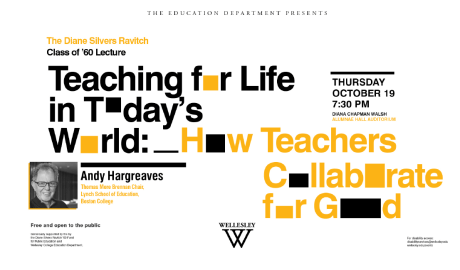
Linda Darling-Hammond fell ill over the weekend and had to cancel her appearance at the annual Ravitch Lecture at Wellesley College on October 19 at 7:30 pm at Alumnae Hall.

We were extremely fortunate to persuade one of the world’s most eminent authorities on the teaching profession to speak that night. Professor Andy Hargreaves will talk about the future of the teaching profession, drawing on examples of successful and powerful collaborations among teachers around the world.

Teaching for Life in Today’s World: How Teachers Collaborate for Good

Andy Hargreaves is Thomas More Brennan Chair, Lynch School of Education, Boston College. He is a renowned scholar of international education, teaching, and education reform who consults with organizations and governments all over the world, Andy Hargreaves is author or editor of over 30 books. He will describe what teaching for life, not just for tests, skills, careers, or individual gain looks like in different communities internationally where teachers work together to fight for dignity, peace, and democracy, even in the most difficult circumstances. Drawing on examples from around the world, he will discuss how we can help teachers in the United States work together to teach for good in their communities.

Andy Hargreaves received the Grawemeyer Award in 2015 with his co-author Michael Fullan for their work on the transformative power of teacher collaboration.

The State University of New York charter committee, which contains no educators, made a few tweaks to its plan to lower standards for new charter teachers and is forging ahead. Charter schools in New York have high teacher attrition and constant need to hire new teachers. The best way to help them is to lower standards for new teachers. Charter teachers with a fast-track license will not be qualified to teach in real public schools.

Whereas real teachers need to pass three tests to become certified, charter teachers will have to pass only one test.

When the Regents dropped the number of tests required for new teachers from four to three, “reformers” howled that the Regents were lowering standards. Now that charter teachers need pass only one test, the howls are not heard at all.

This means that students in charter schools will not have fully qualified teachers. It means that the charters are self-certifying their own teachers. Above all, it is a slap in the face to the teacher education programs at SUNY, which prepare teachers to meet all requirements to be professionals.

But charters in New York have a special status due to their relationship with Governor Andrew Cuomo. His campaign donors from the financial industry want more charters and don’t believe teachers need any professional education. Cuomo appoints all the members of the SUNY charter committee. The Board of Regents, supposedly the ultimate education authority in the state, cannot override decisions made by the businessmen and lawyers on the SUNY charter committee.

A sad state of affairs.

Tom Hobson teaches preschool in Seattle, Washington. He is also a blogger.

He wrote here about the machinations of the greedy profiteers who want children to be taught by machines. He will not permit it. The children are his friends. The profiteers don’t give a damn about the children he teaches.

He begins like this:

I typically wait by the door or gate to greet the children as they arrive, “Hi Sarah! I’m happy to see you!” I say it because it’s how I would like to be greeted. In a way, I guess, you could consider it my version of shouting, “Norm!” the way the Cheers regulars did each time their beloved friend walked through the door.

I also say it because it’s true. I am happy to see each child walk through the door. I’m grateful they’ve come back. I’m grateful that their parents continue to trust me with their baby. I’m grateful that we are going to now spend hours together, just farting around, making stuff, imagining stuff, thinking about stuff and generally just goofing off. I’m even grateful for the times we get sad or angry, because those conflicts are a part of our friendship.

And that’s the thing, that’s the part that people who don’t do this job will never understand: the friendship. These kids are my friends, especially those who are back for a second or third year with me. We’re not even two weeks into the new school year and we’re already finishing each other’s sentences and cracking inside jokes. This is what I will remember from the too short time we spend together. It is also what they will remember. And we’ve got nine months of that ahead of us. Norm!

He adds:

Are we that stupid. People need other people, not just for procreation or telling stories or being happy or forming a team, but also for learning anything worth learning. We will figure out how to read and write and cipher as we always have: virally, by hanging out with other people, which is a system that has worked for most people throughout history. It’s been a largely successful system so why the hell would we mess with it? And that’s also, not incidentally, how we learn everything else: virally, by hanging out with other people. And that requires friendship, deep down real friendship. That, ultimately, is the source of extraordinary motivation.

Read their own documents, and you’ll see that they are planning to turn live, face-to-face teaching into a “premium service.” . . . Meaning that they know face-to-face instruction is a better way to learn, and they have no intention of having their own children learn from machines.

I am not laughing about this academic’s predictions. I’m girding myself because billionaires are behind this and they, despite their philanthropic BS, care primarily about making a killing at the expense of our kids. I will not permit children, my friends, to be turned over to machines. I want them to come to a place where everybody knows their name and where they’re always glad they came.

Friends don’t turn their friends over to machines. People need other people. Children need humans, not machines, to teach them.

The charter committee of the State University of New York will decide whether to lower standards for charter teachers. They would be ineligible to teach in public schools because of their inferior credentials. Ironically, setting a lower standard for them is a slap in the face to the SUNY campuses, where fully qualified teachers are prepared.

This email was sent out by The chief of staff for NYC Assemblymenber Deborah Glick:

Standing Up for Teachers

The SUNY Charter School Institute is one of two agencies in New York State that grants and oversees charters at schools. Earlier this summer, the Institute proposed a change to regulations that would allow charter schools to self-certify teachers. It is shocking that a proposal has been presented to the Trustees from within SUNY to abrogate the high standards for some seeking to be teachers. These changes in regulations would undermine the teaching profession throughout New York State. All New York Students deserve a highly qualified and fully certified teacher.

Imagine that we were presented with a complaint that a health care network couldn’t find enough licensed doctors to hire for their urgent care centers. Its solution is to request authority to establish its own training program, which provides substantially less instruction time and dispenses with all the qualifying exams. This is the medical equivalent of the SUNY Charter Schools Institute proposal. It is deleterious, deeply flawed, and unacceptable.

I have been informed that the full SUNY Board of Trustees does not plan to vote on this item, but rather will defer to a vote by only the Charter School Committee. It is my understanding that the committee intends on hearing this item at their October meeting. The public notice and agenda have not yet been posted, but the meeting will be on October 11th, at SUNY Global Center, 116 East 55th Street. Meetings are generally in the morning. You can check on the SUNY Board of Trustees website for announcements, or contact my office next week. Please plan to attend to make it clear to the committee that all children deserve a fully and properly certified teacher. There will not be an opportunity for public speaking.

I have spoken out against this proposal since it was announced. I submitted comments to the SUNY Charter Institute and also wrote letters to each of the members of the Board of Trustees. Additionally, I discussed this issue on Capitol Pressroom with Susan Arbetter, which you can listen to herr.

http://www.wcny.org/september-21-2017-asm-deborah-glick/

Let me know if you have any questions.

Best,
Sarah

Sarah M Sanchala
Chief of Staff
Assemblymember Deborah J. Glick
853 Broadway, Suite 2007
New York, NY 10003
phone: 212-674-5153
fax: 212-674-5530
sanchalas@assembly.state.ny.us

Russ Walsh writes here about the difference between “belief” and “knowledge.”

He writes:

I imagine that most of those who read this blog accept climate change and the human impact on climate change as settled science. We’ve seen the evidence; we’ve heard from the experts and we have reached an informed conclusion. This is a good thing and one that most Americans not in the White House or in denial for economic and political reasons also accept. It is not a matter of believing or disbelieving climate science; it is a matter of rigorous academic inquiry.

Now I would ask all teachers and teacher leaders to apply the same academic rigor to instructional practice. That is we must make our instructional decisions on what we know works – based on research.

Unfortunately as I have talked to teachers over the years about instructional practice, I have heard a lot of faith-based language.

“I don’t believe in homework.”

“I believe in phonics.”

“I don’t believe in teaching to the test.”

“I believe in independent reading.”

“I believe in using round robin and popcorn reading.”

For about 2,000 years doctors “believed” that blood-letting was an effective treatment for a wide variety of ailments. Today, I would bet if you encountered a doctor who recommended blood-letting for your flu symptoms, you would run, not walk, out the office door screaming. Science, and mounting numbers of dead patients, caught up with blood-letting. So, as professionals, we need to hold ourselves to the same standards. We need to follow the science and stop talking about our beliefs and start talking about the scientific research behind our instructional decision making.

What do you do when the research is inconclusive or when research findings conflict?

Russ has some advice for you.

Bob Shepherd has a long and distinguished career as a teacher, curriculum developer, assessment developer, textbook writer, and more. He returned to teaching. He describes here what the state of Florida required him to do:

Years ago, I attended Indiana University, where I took a double major in English and Psychology and completed all the work required to receive what was called, then, a “lifetime certification” to teach high-school English, which I did for three years before taking a job in educational publishing so that I could actually support my family. For twenty-five years, I wrote and edited textbooks for use in K-college English classrooms. The list of my textbook publications (and online educational materials programs) runs to twenty-five pages, single spaced. At one time, it was difficult to find a K-12 English classroom in the United States where one or more of my textbooks was not being used—books on writing, literature, grammar, African-American studies, and much else.

The Hindus say that in the latter part of a life, one must quit the things of this world and devote one’s self to things of the spirit. I decided to do that. At the end of my career, I returned to my first love, teaching, which would give me an opportunity to apply in classrooms what I had learned from several decades of applying myself assiduously to learning how to teach English language arts. Teaching and nursing are the two holiest of professions.

In order to get a teaching job in Florida, I had to

–Pay for and take SEVEN tests prepared and administered by the Ed Deform simpletons at Pearson
–Complete a 20-page online application form
–Submit letters of recommendation, and
–Provide body fluids for drug testing

On the job as a teacher of English, Film, and Debate, I had to

–Prepare, in the first year, an 800-page binder documenting every aspect of my teaching
–Submit to three formal evaluations and countless informal ones every year
–Complete a yearly Individual Professional Development Plan
–Complete 300 hours of utterly useless online ESL training that seemed, from the factual inaccuracies and grammatical errors throughout the materials, to have been prepared for five-year-olds by people with severe cognitive deficits
–Fill out several thousand 504, IEP, ESL, and PMP (progress monitoring plan) updates
–Prepare Data Walls and materials for Data Chats—exercises in pseudoscientific numerology
–Attend a summer AP English institute
–Proctor absurdly designed, punitive, soul-destroying standardized pretests, benchmark tests, and test tests
–Serve as a crossing guard every morning and afternoon
–Attend parent-teacher conferences weekly, sometimes daily
–Deal with parents who wanted to sue me because I insisted that their 11th-graders put end marks at the ends of their sentences
–Attend ”trainings” (“roll over, sit up, good boy”) for people with IQs of 65 on gang violence, bullying, drugs in school, blood-borne illness, test data, test data, test data, test data, test data, and more test data
–Prepare, for each class, a two-page lesson plan form and have these in binders for review whenever an administrator entered my class
–Keep a log of every parent contact—emails, telephone calls, meetings
–Post my grades and attendance both in a paper book and online
–Coach extracurriculars (speech and debate, theatre)
–Chaperone dances and numerous other evening events
–Prepare materials for and be present at parent nights
–Prepare to teach 22 or 23 classes a week (one year, for FIVE separate preps)
–Print and post reports of my ongoing data stream, in particular formats, with charts and graphs
–Grade, grade, grade, and grade some more. If I assigned my 150 or so students a single paragraph to write, I would have a novella to read and respond to. All day and evening, every Saturday, spend doing this, and often on Sunday as well.

–And somehow find time actually to interact, one-on-one, with my unique students, each with their enormous, unique needs, proclivities, interests, and potentials

And that’s only a partial list. I worked FAR, FAR harder as a teacher of high-school English than I did as an Executive Vice President at a billion-dollar-a-year publishing company.

And all for a salary less than what a checkout person at the local grocery makes.

Who wouldn’t want to do this?

Do you think that Florida doesn’t want teachers?
Mercedes Schneider has listened to Betsy DeVos’s complaints about the public schools, the most common of which is that it is time to change. Big change. Real change.

DeVos recently complained that students were sitting around in desks, watching the teacher, and that is so old-timey. She wants something new, really new.

Of course, the classes in the religious schools she loves are also sitting at desks watching the teacher, but let’s put that aside.

Mercedes says she doesn’t mind the desks all that much.

She writes:

As DeVos continues, one senses that she believes desks in rows preclude education being “organized around the needs of students.” Of course, if rows of desks were the result of a pervasive voucher program, then they would be parent-empowered rows of desks, and that would surely vindicate that desk configuration.

I was in my desks-in-rows classroom today, even though it is a Saturday, because I needed to input grades in my computer in order to begin next week without being swamped. Last weekend, much of this past week, and some of this weekend I have spent and will spend time grading essays.

I teach English. Time-consuming essay grading is part of my responsibility to my students, just as it was 100 years ago. (I’m fairly certain that the computerized grading component emerged at least a decade or two later.)

I also spent hours meeting with each student individually to discuss each student’s grade on that essay assignment and to strategize improvements for the next essay, which will be even longer and more complex. I’m not sure if such consultation happened 100 years ago. I do know that my father (born 99 years ago) and my aunt (born 108 years ago) finished school at the eighth grade, which was common in the 1920s-1930s in New Orleans.

Indeed, the amount of time and effort it takes for me to grade a set of essays for my 141 high school seniors does have me siding with DeVos to rethink schools.

But now she is thinking that DeVos is on to something big with that desk issue.

Schneider wants a Harkness table in her classroom. She thinks there should be a Harness table in every high school classroom.

What is a Harkness table?

That is a table where a teacher sits with 12 students and discusses issues. This innovation began at the exclusive Exeter Academy, where Chester Finn Jr. was a student.

Schneider recalls a letter she wrote Finn in 2013:


Yes, Betsy, I would willingly surrender my 28 student desks for one Harkness table.

A wonderful byproduct of this desk-surrendering plan would be the reduced class size that would, in turn, cut my essay-grading burden by more than half.

We are on our way to solving multiple problems.

In my 2013 post, I called my plan the Exeter Plan, named for Finn’s multi-generational, exclusive private school alma mater, Phillips Exeter Academy, which started using the Harkness method in 1930.

(DeVos would surely forgive the multi-generational aspect of Finn attendance at a school with the same seating configuration across those generations since the school is a private school, which she prefers above all.)

Still, there are some complications, not the least of which is what would become of the students who don’t secure a seat at the table. That’s one of those old-fashioned hang-ups of traditional public schools: They have an obligation to educate all students– the public. They’ve been doing so for generations, just as private schools have been operating via selective admissions for generations.

So what if it is expensive? It would be a very productive change! Why should we teach 28 (or 35 or more) students in old-fashioned desks when it is so much more innovative to teach 12 students at one table?

Joanne Yatvin is now retired. She has been a teacher, principal, and superintendent, as well as President of the National Council of Teachers of English. She is a literacy specialist.

Allons Enfants de la Patrie

Arise Children of Our Country

During the last quarter of the 20th century powerful American politicians decided that human learning was a fixed process in which all healthy young people could and should acquire a specific body of knowledge, information, and skills over a fixed period of time. With that belief, the low scores of American students on international tests were a hard pill for politicians to swallow.

They concluded that those scores were the fault of our schools and their teachers, also parents who were shirking their responsibility to demand the best from their children. American students of all social backgrounds were growing up lazy, ignorant, and unprepared to be the competent adult workers, leaders, creators, and patriots they were meant to be.

Although there is no research evidence to confirm such beliefs about American students’ laziness or the ineffectiveness of our schools, public education has operated on those assumptions continually through the actions of Congress, the Department of Education, and state legislatures. Those bodies have also used public humiliation and punishment of students, teachers, school principals, unions and—indirectly—parents to prevent any resistance from gaining ground.

Thus far, all efforts to reverse the current concept of education and create a humane and reasonable foundation for our public schools have failed. Recently, we believed that the new federal law, ESSA, would return authority to states and their communities, but that belief was crushed by the Department of Education with its rejection of any state plans aimed to serve students’ needs and interests rather than raise test scores and improve graduation rates.

From my perspective, as the mother of four children who were public school students in far better times, and also as a teacher and school principal back then; there is only one possible solution. We must have a widespread public rebellion against the current system. Parents should refuse to have their children participate in high stakes testing and demand age-appropriate standards for all grades. Communities need to re-shape their public schools to fit the needs of their students; and state officials must fight any moves by the Federal government to punish schools for non-compliance.

We have wasted more than twenty years trying out the beliefs and programs ordered by powerful, but know-nothing politicians. For the sake of our children and our country we must take back public education and allow it to grow through wisdom and humanity.