Ron DeSantis, Governor of Florida, has pushed policies that are driving teachers out of their profession. He knows exactly what he is doing. He favors charter schools and voucher schools, where teachers have no job security, no pensions.
Teachers are leaving public schools. They are quitting. DeSantis is getting what he wants.
“From ’Don’t Say Gay’ to other bizarre positions,” said one teacher who asked not be identified, ”teaching is no longer teaching. It’s politics. Politics should have no place in the classroom, unless it’s actually a class about politics.”
“We have elementary school students who have same-sex parents,” said another teacher at a Palm Beach County elementary school. ”Are we really not allowed to acknowledge that? If we get fired, we lose benefits. If we resign now, we get what we have. This is why so many teachers are leaving. The Governor got it wrong.”
While the school district has been transmitting email blasts — and taking to social media — to promote job fairs and open positions, a check of the actual ”help wanted” website reveals just how dire the situation appears to be. As of noon on July 31st, 2022, a search of the word ”teacher” on the official Palm Beach County School District employment website yielded 1,784 jobs. While we did not review each and every listing, a spot check of several listings suggests that the openings are real. They range from full-time gifted to part-time continuing education. They range from Eagles Landing Middle School in Boca Raton to schools in all parts of the county.
It’s not just teachers. Transportation Services is also in need of bus drivers. The need is so great that the school district is offering a $1000 signing bonus to new transportation department employees.
Kathryn Joyce is an investigative reporter for Salon. In this article, she shows how the Republican leaders of Arizona have decided to end the teacher shortage by reducing standards for teachers. They have decided that teaching is not a profession. Anyone, they think, can do it.
She writes:
Last week, just days after the Arizona legislature passed the most expansive school voucher law anywhere in the nation, Gov. Doug Ducey signed into law another education measure decreeing that public school teachers are no longer required to have a college degree of any kind before being hired. Instead of requiring a masters degree — which has long been the norm in the profession — Arizona teachers will only have to be enrolled in college in order to begin teaching the state’s public school students.
The law, SB 1159, was pushed by conservatives on the grounds that Arizona has faced a severe teacher shortage for the last six years, which, by this winter, left 26% of teacher vacancies unfilled and nearly 2,000 classrooms without an official teacher of record. That shortage has led supporters of the bill, including business interests such as the Arizona Chamber of Commerce, to claim that loosening teacher credential requirements will help fill those staffing gaps. Opponents of the bill, however, point to the fact that Arizona has the lowest teacher salaries in the country, even while boasting a budget surplus of more than $5 billion.
“Arizona’s teacher shortage is beyond crisis levels,” tweeted Democratic state Rep. Kelli Butler this March. “Instead of offering real solutions (like increasing pay & reducing class sizes) the House Education Committee passed a bill to reduce the requirements to teach.”
“With Arizona trying to get education monies to parents directly to pay for schooling — including homeschooling — you see more evidence that the state doesn’t care who teaches its kids,” said David Berliner, an education psychologist at Arizona State University and former president of the American Educational Research Association. “Charters and private schools for years have not needed certified folks running schools or teaching kids — as long as the voucher for the kids shows up.” Combined with its new law creating a universal voucher system, Berliner added, “Arizona may now be the most radical state in terms of education policy.”
Please open the link and read the article in full.
In an effort to address teacher shortages in Arizona classrooms, the Arizona legislature passed a revised version of AZ SB 1159, which Arizona governor, Doug Ducey, signed into law on July 05, 2022.
This revision allows for Arizona school districts and charter schools to apply to the state to operate classroom-based, teacher-prep programs in which participants need only pass a background check and be enrolled in an accredited bachelors degree program before being allowed into the classroom– supervised, sort of maybe.
Just enrolled– meaning not even a single credit hour yet earned is acceptable, and in no particular field. Furthermore, the bill language is loose regarding who could be actually instructing the class, since the bill states that participants do not “regularly” instruct class unless a “full-time teacher, certificated teacher, instructional coach, or instructional mentor” is present.
What qualifies as “regularly”? Who knows? Is “regularly” different days of the week? Is “regularly” every day, with some mentor figure poking a head in the door on occasion to token-supervise, thereby CYA, so to speak, on countering “regularly” with a superificial, other-presence of sorts?
Those who teach with emergency certificates need only a high school diploma.
The best way to increase the supply of teachers is to raise salaries and reduce class sizes.
But doing the right thing costs money, and Arizona prefers to funnel money to charter operators and vouchers.
Arizona is doing its best to destroy public education while enriching charter entrepreneurs and the voucher industry.
The state is placing its bet on the assumption that anyone can teach.
Why don’t they try that for doctors? Drop the requirement of medical school and allow anyone to cut and sew. That would kill people. As for the future of their children? Doug Ducey and the legislature don’t care.
Mamie Krupczak Allegretti is a regular reader and commenter to the blog. She wrote the following comment, which is good advice from a veteran to new and experienced teachers.
Anytime a person is burned out, demoralized and ready to quit his/her job, something is wrong. It’s not just that something is wrong with the way the institution is run (which there are many), but there can also be something wrong with the way the person is approaching the job.
Many teachers have what I call “Mamma bird syndrome.” They spend they time driving themselves into the ground giving and giving until they are exhausted. People commend them for outstanding work but inside they are tired and resentful.
If you want to be a teacher, it doesn’t seem that the craziness of the institution is going to change anytime soon. So if you really want to teach, you have to find ways to protect yourself, conserve and pace your energy, and lead a balanced life.
There are 3 rules to live by:
1. let go,
2. learn to say “no,” and
3. prioritize what you value.
What I am really getting at here is learning to create boundaries for yourself. Let go of things and situations over which you have no control and are not in your job description. Sure, there are days when you may be able to do more, but monitor yourself and your energy. Learn the boundaries of your energy and then decide what you are willing to give.
Learn to say no to extra duties and requests. Prioritize what you value. If you value excellent lesson plans, put your energy into that. But know that if you try to do it all, something will give and it will most likely be your health – mental and/or physical.
Your school day ends at a certain time. Keep to that time. If you have to work at home, set a boundary of say 45 minutes. You need to remember that this is a job and you need to have a life outside of school.
It sounds hard-nosed to say that, but it is the truth. If they had their way, the school district would want you to work 24/7. So it’s up to you, the teacher, to set boundaries. Teacher duties have increased over time because teachers have accepted them.
But think about it. Would you ask your doctor or lawyer to do things that were outside his or her job? We now want teachers to be parents, friends, therapists, mentors, counselors, mental health experts, financial helpers, etc. to students.
So, I’m not saying that teachers should never go above and beyond at times but when fatigue, resentment and a desire to flee show up, something in yourself needs to change. I think these are the biggest lessons young teachers (and even old) have to learn.
Teachers are receiving apples, donuts, and lovely notes to thank them for their service. But that’s not enough. Many states are reporting severe shortages of teachers and support staff. This means larger class sizes and curtailed curricula. This means denial of a good education to millions of children.
A 2022 report reviews EPI research on teacher pay and presents the evidence showing that K–12 schools are facing a staffing crisis. The pandemic made clear that our economy cannot function if schools don’t have the staff they need to operate safely and effectively.
Policymakers need to invest in K–12 education now, the report’s authors emphasize. They can start by tapping into hundreds of billions of dollars of available federal COVID relief funds. Read the report.
Key takeaways
Since the beginning of the pandemic, state and local public education employment fell by nearly 5% overall, with much larger declines in some states, according to establishment data from the Bureau of Labor Statistics. Household survey data indicate that the number of employed public K–12 teachers fell by 6.8%, school bus drivers by 14.7%, school custodians by 6.0%, and teaching assistants by 2.6%.
COVID concerns are likely a factor in nonteacher staff shortages. Education support staff tend to be older—and thus more at risk of severe COVID—than the average U.S. worker. Less than a third (31.6%) of U.S. workers overall are age 50 or older, compared with 66.2% of bus drivers, 55.4% of custodians, and 50.4% of food service workers in the K–12 public education workforce.
Low pay is a long-standing issue for support staff. From 2014 to 2019, the median weekly wage (in 2020$) for food service workers in K–12 education was $331, while school bus drivers received $493 and teaching assistants $507. In contrast, the median U.S. worker earned $790 per week.
Inadequate pay is a long-standing issue for teachers. Past EPI research shows that public K–12 school teachers are paid 19.2% less than similar workers in other occupations.
Policymakers should tap into the hundreds of billions of dollars in federal COVID relief funds available now to raise pay for education staff, enact strong COVID protections, invest in teacher development programs, and experiment with ways to support part-time and part-year staff when school is not in session. They also need to plan for sustainable long-term investments in the K–12 public education workforce.
Teachers in New South Wales, Australia, plan to strike on May 4 to protest working conditions, especially understaffing and low salaries.
A letter to public school parents
Every day across NSW, children are missing out because of a lack of teachers.
It’s an unacceptable situation affecting public and private schools. Children can’t put their education on hold and wait for this to be fixed.
They have a right to be taught by a fully qualified teacher today and every day.
This is why teachers and principals have made the difficult decision to go on strike on Wednesday, May 4.
The teacher shortages are a growing problem caused by uncompetitive salaries and unsustainable workloads. COVID isn’t the cause. It’s just making a bad situation worse.
In February this year, there were vacant permanent teaching positions in more than half the schools in NSW. More than 95 per cent of teachers and principals say their school has difficulty finding casual teachers.
The Department of Education’s own research shows large and growing shortages of teachers in many subject areas, forcing almost a quarter of secondary teachers to teach outside their area of expertise.
How do we fix the teacher shortages and ensure no child misses out?
If we truly want every child to get a high-quality education, we need a qualified teacher in every classroom.
Significantly, increasing teacher salaries and giving them more time to prepare lessons is an investment in our future that will pay off for our kids and our country.
While the work of teachers has become far more complex and challenging, their salaries have fallen far behind other professions. The NSW Government’s wage offer of a 2.04 per cent annual increase won’t even keep pace with rising costs, with inflation now running at 5.1 per cent.
Workloads are also excessive, with NSW teachers now working an average of 60 hours a week.
For more than 18 months, we have tried to reach agreement with the NSW Government on a reset of teacher salaries to better reflect the value of the work teachers do and make the profession more attractive to high— achieving young people.
We have also sought an increase of two hours in the preparation time teachers have each week. (The current two-hour entitlement for primary teachers has not changed since the 1980s. Preparation time for secondary teachers hasn’t changed since the 1950s.)
Unfortunately, the NSW Government is refusing to make this investment that will help retain our dedicated teachers and attract the ones we need to stop the shortages.
What will happen on Wednesday May 4?
You will need to make alternative plans for your child on this day because teachers will not be at the school.
We understand this is not ideal. But if we do not take action now, the teacher shortages will only grow and more children will miss out.
If you would like more information or to show your support for teachers, you can do so at
A state with one of the lowest investments in public education in the country now has a record budget surplus. This, of course, means Tennessee could make great strides in shoring up an education budget that can best be described as severely lacking without raising taxes one dime. In fact, investing in schools with new state money would also have the added benefit of keeping local property taxes low. It’s a policymaker’s dream.
That’s why Gov. Bill Lee has announced his definitive TISA plan – Tennessee Investment in Student Achievement.
Apparently, a key element of that plan was just announced today:
While we’re on the subject, let’s examine the reality of Lee’s TISA school funding plan:
Sure, that really has nothing to do with student achievement or funding schools or anything at all related to education. It does, however, continue a trend of placing just about everything else above public schools when it comes to Lee’s priorities.
First, it does nothing to shore up the shortage of teachers needed to adequately support students now. That is, according to both TACIR and the Comptroller, Tennessee districts hire MORE teachers (11,000 more, to be exact) than the current formula funds. Guess what? TISA does nothing to change that. There is no indication that the weights will mean more teachers hired and supported by state funding.
Next, TISA does nothing to boost overall teacher pay. Sure, TISA “allows” lawmakers to earmark certain funds to give raises to “existing” teachers, but that doesn’t mean they will. Nor does it mean those raises will be significant. This year’s $125 million set aside for teacher compensation will mean what is effectively a 2-3% raise for most teachers. Based on current inflation rates and rising insurance premiums, this essentially amounts to a pay cut.
While the plan doesn’t address the shortage of teachers or teacher compensation or local costs for hiring/retaining teachers, it does raise local property taxes.
Open the link and read how Governor Lee will ingeniously raise property taxes, build a shiny new domed football stadium, and shortchange the school children of Tennessee. All while sitting on a huge surplus.
What can you say when a state decides to adopt a policy that has failed again and again and has been conclusively discredited? I call such proposals “zombie policies,” because they fail and fail but never die.
Justin Parmenter, a National Board Certified Teacher in North Carolina, writes here about a plan in his state to eliminate experienced-based pay and replace it with the obsolete practice of tying teacher pay to student test scores. The leaders in North Carolina call it ”merit pay.” It is also called value-added evaluation and test-based compensation.
Whatever it is called, it is ineffective and demoralizing to tie teacher pay to test scores. Those who teach in affluent districts will be paid more than those who teach in low-income schools or who teach students with disabilities. Presumably, the folks in North Carolina never heard of the POINT study in Nashville, Tennessee, a three-year study of whether teachers would produce higher test scores if offered a big bonus. The conclusion was that the bonus (merit pay) did not make a difference.
The final evaluation concluded:
While the general trend in middle school mathematics performance was upward over the period of the project, students of teachers ran- domly assigned to the treatment group (eligible for bonuses) did not outperform students whose teachers were assigned to the control group (not eligible for bonuses). The brightest spot was a positive effect of incentives detected in fifth grade during the second and third years of the experi- ment. This finding, which is robust to a variety of alternative estimation methods, is nonetheless of limited policy significance, for this effect does not appear to persist after students leave fifth grade. Students whose fifth grade teacher was in the treatment group performed no better by the end of sixth grade than did sixth graders whose teacher the year before was in the control group.
Have the North Carolina policymakers heard about the Gates-funded program to evaluate and pay teachers based on test scores and peer evaluations, which was tried in seven sites, including Hillsborough County, Florida, Memphis, Pittsburgh, and four charter chains? The program cost hundreds of millions of dollars, and it was evaluated by the RAND Corporation and AIR. The cost of the program was shared between Gates and the local districts.
The evaluation report of the Gates program was released in 2018. It concluded that the program did not improve student achievement, did not raise graduation rates or dropout rates, and did not change the quality of teachers. In some sites, teacher turnover increased. The neediest students did not get the best teachers because teachers angled to get students who would produce higher test scores. The program planners expected that as many as 20% of the site’s teachers would be fired but only 1% were.
Furthermore, in 2017, a federal judge in Houston threw out precisely the same evaluation system that North Carolina plans to use because teachers were judged by a “secret algorithm” and had “no meaningful way” to ensure that their scores were correctly calculated. The judge wrote: “The [teacher’s] score might be erroneously calculated for any number of reasons, ranging from data-entry mistakes to glitches in the computer code itself. Algorithms are human creations, and subject to error like any other human endeavor.”
Parmenter writes:
A draft proposal coming before the State Board of Education next week (April 6) would transition all North Carolina teachers to a system of “merit pay” as soon as 2023.
The proposed change would make North Carolina the first state in the country to stop paying teachers on an experience-based scale that, at least in theory, rewards long-term commitment to a career in education and recognizes the importance of veteran educators (if adequately funded by the state–but that’s a topic for another post).
Instead, compensation would be based largely on teacher effectiveness as determined by EVAAS, a computer algorithm developed by the SAS corporation which analyzes standardized test scores. Teachers who do not have EVAAS scores would receive salaries based on principal observations, observations by colleagues, and student surveys.
This plan is problematic in a number of ways. It would increase “teaching to the test” by offering a handful of larger salaries to those educators whose students do well on tests. Competition over a limited number of larger salaries would lead to teachers working in silos rather than collaborating and sharing best practices as cohesive teams. Teachers of subjects with no standardized tests are raising concerns that observations and student surveys are highly subjective, and basing salaries on them would be unfair.
Dr. Tom Tomberlin, who serves as the North Carolina Department of Public Instruction’s Director of Educator Recruitment and Support, has justified moving away from an experience-based pay scale by claiming that teacher effectiveness plateaus after the first few years in the classroom.
It’s an argument which shows a major disconnect between DPI and those of us who actually work in schools and experience first hand how important veteran teachers are to overall school operations.
Veteran teachers often work as mentors, run athletic departments, coach sports and deliver professional development for peers.
They have long-standing relationships with school families and community members that position them to be excellent advocates for the needs of their schools.
None of that value is reflected in a veteran teacher’s EVAAS score.
Brenda Berg, CEO of pro-business education reform organization Best NC, has been a vocal proponent of scrapping the experience-based pay scale. Berg, who serves on the compensation subcommittee that helped develop the plan, said this week that it’s clear our current system isn’t working and it’s time to be “bold” about change even if it’s “scary.”
I’d like to note that anyone who claims educator pushback to this plan is centered in fear of change is completely out of touch with what it’s like to be a professional educator. We are the most flexible and resilient people on the planet, and the last two years have illustrated that fact like never before. We also know what it means to be treated fairly.
It’s true that North Carolina is facing a major pipeline crisis, with enrollment in UNC education programs down drastically over the past several years. It’s true that if we aren’t bold about change we will soon have nobody left who’s willing to work in our schools.
But we also need to be bold about acknowledging the reason for this crisis. It isn’t because the licensure process is too cumbersome. It isn’t because veteran teachers are ineffective and making too much money. It isn’t because our teachers lack accountability.
The reason North Carolina’s schools are suffering from a lack of qualified educators is because for the last 12 years our legislature’s policies have made it deeply unappealing to be a teacher in this state. Those policies include cutting master’s pay and longevity pay, taking away teacher assistants, eliminating retiree health benefits and many, many others.
The solution to North Carolina’s teacher pipeline crisis isn’t a system of merit pay which devalues long term commitment to public schools and ties salaries to standardized tests and subjective measures.
The solution to the problem is comprehensive policy change that makes a teaching career in North Carolina an attractive proposition. That’s the kind of change that will allow us to put an excellent teacher in every classroom.
This proposal ain’t it.
You can share feedback on the proposal with Dr. Thomas Tomberlin here: Thomas.Tomberlin@dpi.nc.gov
State Board of Education members will hear Dr. Tomberlin’s presentation at the April 6 board meeting. Their email addresses are:
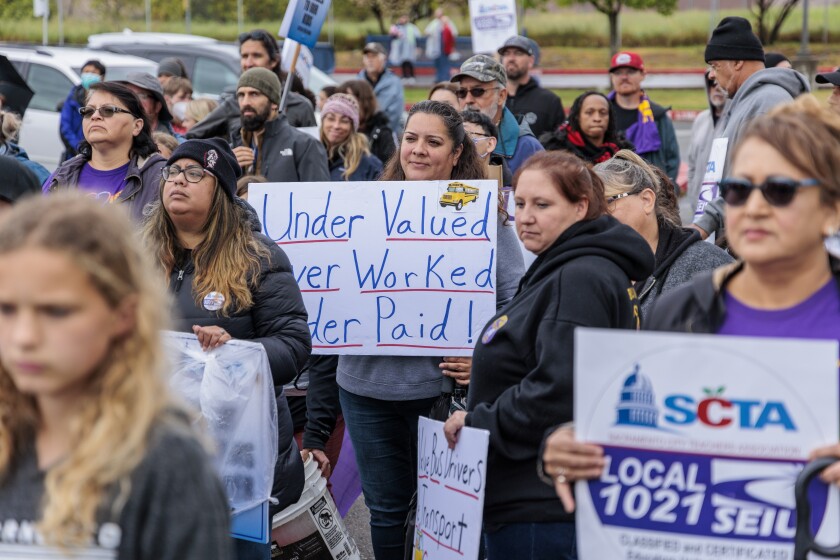
Sacramento City Unified School District teachers, school staff and supporters take part in a rally at Rosemont High School on March 28 as they have been gone on strike due to the staffing crisis in the district . All SCUSD schools shut down and will remain closed for the duration of the strike.
I have read many articles about the shortage of teachers and school staff. I have read many that were laden with statistics. This is one of the best. It appeared in the Los Angeles Times.
A few weeks ago, Sacramento teacher Kacie Go had 56 kids for second period.
That day, there were 109 students at her eighth- through 12th-grade school who were without an instructor because of staff shortages. So she crammed the students into her room and made it work, but “it’s not sustainable,” she said.
No kidding.
Go told me the story standing with hundreds of other teachers and support staff Tuesday morning in the parking lot of an empty high school, as “We’re Not Gonna Take It” blared from speakers and the mostly female workers gathered for day five of a strike that has closed down schools in the Capitol City.
Like Go, these teachers, cafeteria workers, bus drivers and instructional aides are fed up with being asked to do more with less. It’s a problem that goes beyond the Sacramento City Unified School District, with 48,000 students in 81 schools. Frustration among teachers and school workers is rampant across California — pushed to a breaking point by the pandemic and a shortage of more than 11,000 credentialed teachers and thousands of support staff as the state tries to expand pre-kindergarten and bring 10,000 mental health counselors on campuses.
From school closure protests in Oakland to Sacramento’s all-in strike, those who work in our schools are telling us they cannot do this job under the conditions we are imposing. These include mediocre pay, sometimes vicious political blowback from COVID-19 safety measures, a witch-hunt-like scrutiny around hot-button topics, a mental health crisis, the reality of too few people doing the work, and the general disrespect of a society that swears it loves teachers and values education but does little to invest in it. Worrying about school shooters, once an urgent concern of educators and parents, doesn’t even make the top three problems anymore.
It’s the same story playing out in hundreds of other districts not just in California but across the country. Minneapolis teachers just ended a 14-day strike that shared some of the same issues of pay and support, underscored by the same teacher chagrin that we talk a good game about supporting public education but don’t always come through with actions. Minneapolis Federation of Teachers Chapter President Greta Callahan summed it up, sounding like she could be standing in Sacramento.
“We shouldn’t have had to [have] gone on strike to win any of these things, any of these critical supports for our students, but we did,” she said.
Go, who has been a teacher for 20 years and earned a master’s degree along the way — bringing her to the top of the district’s salary scale at just more than $100,000 a year — estimates she’s losing about $500 a day during the walkout.
But she’s more worried about support staff such as Katie Santora, a cafeteria worker who was also on the picket line.
Santora is the lead nutrition services worker at a high school, expected to churn out 1,500 meals a day between breakfast and lunch — with a staff of nine people (though they started the year with only five). Most are part-timers because the district doesn’t want to pay them benefits, and they make about minimum wage.
Santora, with 13 years at the district, makes $18.98 an hour for what is essentially a management role. She’s in charge of ordering, planning, receiving and keeping the joint running.
On the last day before the strike, that included making popcorn chicken bowls for lunch. What does that look like? Five 30-pound cases of chicken, oven-baked, 22 bags of potatoes, boiled and mashed, corn and gravy — all assembled after her staff finished making steak breakfast burritos and scrambled egg bowls. Did I mention every student is required to take a piece of fruit, which means washing somewhere along the lines of 1,700 apples?
Santora says high schoolers are the “most misunderstood” people on the planet, teetering between child and adult. Their well-being, she says, depends on being fed so “their bellies aren’t rumbling in class” and seeing a friendly face when they walk in her cafeteria. She loves delivering both.
“When they come through the line, I like to say, ‘Thank you for having lunch with me,’” she says.
But the money isn’t enough to pay her bills. Four or five nights a week, she gets about an hour at home before she heads to her second job loading grocery bags for delivery drivers at Whole Foods. She’s working two jobs just to pay for the privilege of doing the one she likes.
Go, the teacher, feels the hardships in other ways. One of her twin daughters recently had a “pretty severe concussion,” she said, but Go felt like she couldn’t stay home with her. If she did, one of her co-workers would likely be stuck with a jampacked classroom — and all the other unofficial jobs she has to do on a daily basis, from fill-in parent to police officer to relationship advisor when her teenage students’ hormones go into overdrive. Substitutes are hard to come by, she thinks, because the pay — $224 a day — isn’t competitive compared with other jobs with less stress.
“Subs don’t have an easy life,” Go said. “Why would you want to do that when you could go to In-N-Out and worry about if it’s animal-style or not for the same amount of money?”
The unions involved in the Sacramento strike contend that there are hundreds of open positions in the district in virtually every job. Nikki Milevsky, a school psychologist and vice president of the teachers union, puts it at 250 vacancies for teachers and 400 for classified staff — in a district with 2,069 teachers and 1,656 classified staff. That classified staff and teachers walked out together shows the depth of problems in Sacramento — it’s unusual for both to strike at the same time, and it has forced schools to shut down because there was no one left but administrators to watch kids.
Chris McCarthy, a first grade teacher in the Sacramento Unified School District, joined other teachers, parents, students and supporters, in the rain at a rally in support of their strike against the school district at Rosemont High School in Sacramento.
The teachers union says that 10,000 students lack a permanent instructor, and on some days, up to 3,000 don’t even have a substitute. About 547 kids who signed up for independent study haven’t been given a teacher yet, meaning they are learning nothing.
The district says it’s down 127 certificated staff and 293 classified positions. Take the difference as you will, but the district doesn’t dispute it’s in a staffing crisis.
Sacramento teachers want a pay raise to make the district more competitive in hiring. Right now, some surrounding districts pay more but have lesser benefit packages. (Please don’t make me tell you that healthcare is a right, not a privilege.) The teachers want the district to back off of a proposal to make current and retired teachers pay hundreds more to keep a non-HMO health plan. The district says it has made an offer of a pay increase and recruitment bonus and a one-year stipend to offset the health plan issue.
From there it turns contentious. Teachers reject the district’s offer as lowball and assert there is money available to do better, just not the will to invest it in staff. The district says the teachers need to compromise because it can’t afford all of their asks.
For days, there were no negotiations. State Supt. of Public Instruction Tony Thurmond tried to bring everyone to the table, only to be rebuffed by the district. Back home again instead of in the classroom, my eighth grader, a student in Sacramento schools, ate lots of chocolate chip pancakes and watched “Turning Red” on repeat.
There is no end in sight. Though negotiations with both unions have resumed, the shutdown is another blow to parents and families already anxious and stressed out. The last time my daughter had a normal school year, she was in fifth grade. So I understand the frustration, and even anger, of parents that schools are once again closed — and the resentment of parents across the state who are sick and tired of problems with schools, many of which predate the pandemic.
But I went to the strike line three times and I can tell you this — it’s not about the money for these teachers. You can roll your eyes at the unions all you want, but these teachers and support staff want their schools to work, for their students, for themselves, and for our collective future. Because democracy depends on an educated populace and education is a right. And because they are educators, and they’re invested in our kids.
Go doesn’t want to do anything else but teach, even if it means 56 kids sometimes. Even if it means losing $500 a day and striking. Even if it means making some people mad to make schools better.
Jennifer Berkshire, expert education journalist and co-author of A Wolf at the Schoolhouse Door, writes in The Nation about the forces driving teachers out of the schools.
She interviewed many teachers who explained why they were leaving. Some cited ”the bad teacher” narrative promulgated by Arne Duncan and his insistence that teachers be evaluated, based on their students’ test scores, which is both ineffective and inaccurate. His and Obama’s “Race to the Top” was deeply demoralizing to teachers, and it accomplished nothing positive.
She begins:
Neal Patel survived teaching in the pandemic. It was the culture wars that did him in.
In the fall of 2020, Patel added two flags to the wall of his science classroom in Johnston, Iowa. Now, alongside images of energy waves and the electromagnetic spectrum were the Gay Pride rainbow flag and a proclamation that Black Lives Matter. The flags, says Patel, represented the kind of inclusive space he was committed to creating, sending a signal to all students that even in this conservative suburb of Des Moines, there was a place for them.
School administrators supported him—on one condition. “They’re just there as decoration,” Patel says. “The only time I discuss the flags is when a student asks me about them.”
Patel assumes it was a student who snapped a picture of the display. Somehow it ended up on the Facebook page of a conservative state legislator. Representative Steve Holt, who lives 100 miles from Johnston, pointed to the flags as evidence of creeping left-wing indoctrination in Iowa’s schools and encouraged his constituents to take a stand. Patel says he was shocked by the attention, then upset: “Holt thinks it’s a political issue to try to create an inclusive environment, and he’s using that to try to further divide our community.”Johnston has grown only more divided since Patel became Facebook fodder. At a school board meeting last fall, members debated whether to ban two books on race, including one by the Native American writer Sherman Alexie, after parents complained. The president of the Iowa State Senate, who represents a neighboring county, took the mic during the public comment period, calling for teachers who assigned “obscene” material to be prosecuted. Patel was in the crowd that night, to lend support to minority and LGBTQ students who’d come to speak out against banning the books. And he had an announcement of his own to make: This year would be his last as a teacher in Johnston.
The Obama administration made matters much worse for teachers when it imposed test-based evaluation as the heart of its “reforms.”
The thinking went something like this: Make teacher evaluations tougher, and teaching would get better, which would mean higher student achievement, more students graduating from college, and ultimately a country better able to outsmart China et al. “Tougher” meant holding teachers accountable for how their students fared on standardized tests…
In 2010, Colorado became one of the first states to enact a high-stakes teacher evaluation law; by 2017, nearly every state had one on the books. While the pandemic may have disrupted everything about schooling, policies like Colorado’s Senate Bill 10, with its 18-page evaluation rubric and 345-page user guide aimed at weeding out bad teachers, remain in place.
For Shannon Peterson, an English language acquisition teacher in Aurora, that meant leading her students through a writing exercise last fall as her principal observed. Peterson’s students, many of them immigrants who live in poverty, bore the pandemic heavily, she says: “The kids are stressed, all of their writing is about anxiety, and attendance is way down.”
To her delight, the students responded enthusiastically to the writing prompt she’d come up with: comparing and contrasting the Harlem Renaissance and Black Lives Matter, and how the entertainment industries in their respective eras related to both. In a year of stress and struggle for teachers and students alike, here was something to celebrate. “Excellent writing came out of this,” Peterson says.
Her principal wasn’t convinced. Peterson, he felt, hadn’t done enough actual teaching during the observation. “I just don’t feel comfortable checking off these boxes,” he told her.
The previous year, when the cash-strapped school district had offered teachers buyouts to leave, Peterson turned it down: “I felt an enormous obligation to go back for the kids and my colleagues.” After her evaluation, though, Peterson had reached a breaking point. She quit a week later, walking away from a career that spanned 23 years, 18½ of them in Aurora. “I’m not a box,” Peterson says.
Two weeks after Peterson resigned, a major study came out: The decade-long push to weed out bad teachers had come to naught. The billions of dollars spent, the wars with teachers’ unions, and the collapse in teacher morale had produced “null effects” on student test scores and educational attainment.
Please open the link and read the study. Billions of dollars wasted on ineffective and demoralizing teacher evaluations that produced tons of data but nothing else.

 Diane Ravitch's blog