Archives for category: Supporting public schools

Carol Burris, veteran educator and executive director of the Network for Public Education, writes here about what the new Trump administration plans to do to American education. She foresees that President Obama’s “Race to the Top” will turn into President Trump’s “Race to the Bank,” as for-profit entrepreneurs find ways to cash in on the education industry. The ultimate goal is the elimination of public schools, which are a cornerstone of a democratic society.

She writes:

The elimination of democratically governed schools is the true agenda of those who embrace choice. The talk of “civil rights” is smoke and mirrors to distract.

The plan on the Trump-Pence website promotes redirecting $20 billion in federal funds from local school districts and instead having those dollars follow the child to the school of their choice — private, charter or public. States that have laws promoting vouchers and charters would be “favored” in the distribution of grants. Like Obama’s Race the Top, the competition for federal funds that states could enter by promising to follow Obama-preferred reforms, a Trump plan could use financial incentives to impose a federal vision on states.

The idea is not novel. Market-based reformers have referred to this for years as “Pell Grants for kids,” or portability of funding.

Portability, vouchers and charter schools have been hallmarks of Pence’s education policy as governor of Indiana. Unlike the Trump-Pence website, which frames choice as a “civil rights” initiative, Governor Pence did not limit vouchers to low-income families. He expanded it to middle-income families and removed the cap on the number of students who can apply.

Pence attacked the funding and status of public education with gusto as governor, following the lead of his predecessor Mitch Daniels:

It was promised that vouchers would result in savings, which then would be redistributed to public schools. What resulted, however, was an unfunded mandate. The voucher program produced huge school spending deficits for the state — a $53 million funding hole during the 2015-16 school year alone. That deficit continues to grow.

The “money follows the student” policy has not only hurt Indiana’s public urban schools, it has also devastated community public schools in rural areas — 63 districts in the Small and Rural Schools Association of Indiana have seen funding reduced, resulting in the possible shutdown of some, even after services to kids are cut to the bone.

In contrast, charters have thrived in Indiana with Pence’s initiatives of taxpayer-funded, low-interest loan, and per-pupil funding for nonacademic expenses. For-profit, not-for-profit and virtual schools are allowed. Scams, cheating scandals and political payback have thrived, as well. Former Indiana education commissioner Tony Bennett was forced to resign as the commissioner of Florida[1] after it was discovered that he had manipulated school rating standards to save an Indiana charter school operated by a big Republican donor who gave generously to Bennett’s campaign.

Burris shows how this kind of untrammeled school choice affected the schools of Chile and Sweden, where the far-right imposed Milton Friedman’s school choice theories. In Chile, the result was hyper segregation of all kinds; in Sweden, rankings on international exams fell. What was left of public schools were filled with the children of the poor.

Burris asks important questions:

Do we want our schools to be governed by our neighbors whom we elect to school boards, or do we want our children’s education governed by corporations that have no real accountability to the families they serve?

Do we to want to build our communities, or fracture them, as neighborhood kids get on different buses to attend voucher schools, or are forced to go to charters because their community public school is now the place that only those without options go?

Do we believe in a community of learners in which kids learn from and with others of different backgrounds, or do we want American schools to become further segregated by race, income and religion?

The most shocking instances of charter school scandal and fraud consistently appear in states that have embraced the choice “market” philosophy. Are we willing to watch our tax dollars wasted, as scam artists and profiteers cash in?

Public schools are not a partisan issue. People of all political parties serve on local school boards.

Trump’s plan is a radical plan, not a conservative plan. Conservatives don’t blow up traditional institutions. Conservatives conserve.

Now is the time for people of good will to stand together on behalf of public schools, democratic governance, and schools that serve the community.

I am posting this again because I left out the link last time to Sarah’s story. I hope you will read it in full.

Sarah Mondale directed a wonderful new film called A BACKPACK FULL OF CASH, narrated by Matt Damon.

Ten years ago, Sarah and her partners Sarah Patton and Vera Aronow made a four-part series called SCHOOL, a history of the American public school; it was shown on PBS and won rave reviews.

Why did the team reassemble now to tell a new story about our public schools?

Sarah Mondale explains in her post why she cares so passionately about public schools.

She writes:

“My dad, Pete Mondale, was a lifelong teacher who spent most of his career as a professor of American Studies. His mother was a music teacher who taught for a while in a one-room schoolhouse. He went to public schools in the tiny farming town of Elmore, Minnesota, and thanks to the government-funded GI Bill, he was able to go to college. He later earned his doctorate at the University of Minnesota, a great public institution. He reached the pinnacle of his career in the 1960s when he founded the Department of American Studies at the University of Alabama in Tuscaloosa where he inspired a very special group of students. He also made a difference in the lives of students at George Washington University where he taught for many years. A number of them became family friends, and growing up, I saw how much they respected him. After he retired, his Alabama students invited him back for a celebration in his honor. They came from all over the country to tell him how he had changed their lives, a type of recognition that is rare in the life of a teacher.”

Her father taught her that the public schools were the bedrock of our democracy.

“My dad would often talk about how his parents’ generation, the sons and daughters of poor immigrants, got their start in this country thanks to public schools. His father-in-law, my grandfather, came to America from Italy as a teenager, and talked about public schools as one of the greatest institutions this country had to offer. My mother, became a teacher of English to adult immigrants in the public schools of Washington, DC.”

When Sarah discovered a few years ago that our public schools and their teachers were under assault by powerful forces, she knew she had to do something. She was teaching high school at the time. She thought about what she could do. And she decided to tell the story in a way that a large public would understand. A film.

I have seen it. It is gripping. It should be shown in every community across the nation. Now, more than ever, we need this film to inform the American public about the unconscionable effort to turn our public schools over to private control. We need the people to understand the theft of their public property, the stealth attack on the commons, the harm that occurs when public schools are defended and closed to underwrite privately managed charters.

Please read her story.

Arthur Camins writes that in the wake of the election, with a public deeply divided, it is time to unify and organize around our public schools. Although the future of K-12 education was not part of the national election, it appeared on many state ballots, where significant majorities rejected privatization and voted to support their public schools.

He writes:

For many of us, our hopes and dreams are bound up with our expectations for our children. For that reason, it is ripe with potential for organizing to pressure our government to be more responsive to the needs of folks without privilege and to regain social trust.

Take a deep breath because now it is the time for a protracted struggle to revitalize the struggle for democratic, equitable education. Now is the time to reassert an ethos of citizen’s responsibility for one another in education policy and practice. Now is the time to reassert an ethos of improvement for all over the restrictive idea of improvement for a few. Now is the time to utilize the revitalizing power of collaboration instead of the divisiveness of competition as the primary lever to advance the academic, social and emotional learning of all students. Now is the time to advance the broad promises of education to prepare every student for life, work, and citizenship.

Several decades of a myopic bipartisan focus on the imposition of test-based accountability and punishment systems has failed to significantly narrow race and class-based opportunity and achievement gaps. Several decades of effort to create privately-controlled, but taxpayer-funded, charter schools and to provide tuition vouchers for private schools to compete with democratically funded public schools have increased segregation without achieving widespread improvement. Several decades of purposeful ideological propaganda and on-the-cheap silver-bullet solutions have undermined public confidence in democratic government as a problem-solving mechanism.

Public education remains as a commitment to the commons. Obviously, most of what we do is outside the commons. But the commons must be strengthened, preserved, transformed to represent the community’s commitment to its children, all of them.

Last week’s election was both a victory and a defeat for corporate education reform. On one hand, Donald Trump won with a strong commitment to school choice and privatization, which is the highest goal of corporate reformers. He will very likely appoint a Supreme Court justice (or justices) hostile to unions, another priority of the so-called reformers. Maybe now, they can give up their pretense of being Democrats and hail the new regime in D.C.

On the other hand, voters in two very different states–Massachusetts and Georgia–were asked if they wanted to “improve” their schools by turning them over to the charter industry, and both states answered with a resounding NO.

In Georgia, despite a deceptively worded constitutional amendment, a bipartisan majority voted 60-40 against allowing the governor to create a special district where low-scoring schools could be converted to charters.

In Massachusetts, the corporate financiers bundled $26 million, mostly from out of state donors, to promote Question 2, which would add 12 new charters every year. The advertising campaign tried to sell Question 2 as a civil rights issue. They promised it would not defund public schools. They swore it was only “for the kids.” Question 2 lost overwhelmingly by 68-32%. Two-thirds of the voters did not believe the promises.

Here is the big news: The largest vote against charters in the Massachusetts vote came in communities that already had charters. The voters knew that charters were taking money from their public schools. They didn’t like what charters were doing to their communities.

“Almost all of the fiercest Question 2 opponents were cities and towns whose public schools are losing money to charter schools.

“Easthampton topped all Massachusetts municipalities in the strength of its opposition — 76.2 percent voted ” No,” or 7,324 against 2,290 “Yes” votes — and that city will lose $940,000 to its charter school, Hilltown Cooperative Charter Public School, in fiscal 2016.

“It comes right off the top,” Easthampton Mayor Karen Cadieux said Thursday. “If you’re saying it doesn’t cost us anything, then you need to explain why I’m $940,000 short.”

“Hadley and South Hadley also followed the pattern, voting “no” to the tune of 73.7 and 68.9 percent. South Hadley contains Pioneer Valley Performing Arts Charter Public School and Hadley houses Pioneer Valley Chinese Immersion Charter School.

“Despite being located in Eastern Massachusetts, where opposition to Question 2 was not as high as in the rest of the state, Somerville also voted strongly against Question 2, with 71.2 percent of voters opposed. The city houses Prospect Hill Academy Charter School.

“Greenfield, where Four Rivers Charter Public School makes its home, voted against Question 2 by 71 percent. In Holyoke, which contains Paulo Freire Social Justice Charter School, 66 percent opposed.”

Despite the millions of dollars in Dark Money, despite the big buy on television, despite the civil rights rhetoric, Question 2 was rejected.

The best part of this election, other than the victory of public education, was that opponents of Question 2 were fully informed about the threat that privatization posed to public education in General and to their public schools in particular. Only a handful of affluent districts supported the measure. The rest understood that they were repelling an existential threat to a democratic institution that belongs to their community: their public schools.

Jeff Bryant, a wise observer of politics and education, offers solace at a time when supporters of public education fear the ascendancy of a Republican President and Congress devoted to privatization of schools.

He reviews the electoral victories for public schools.

Chief among them, of course, were the overwhelming defeat of charter school measures in Massachusetts and Georgia.

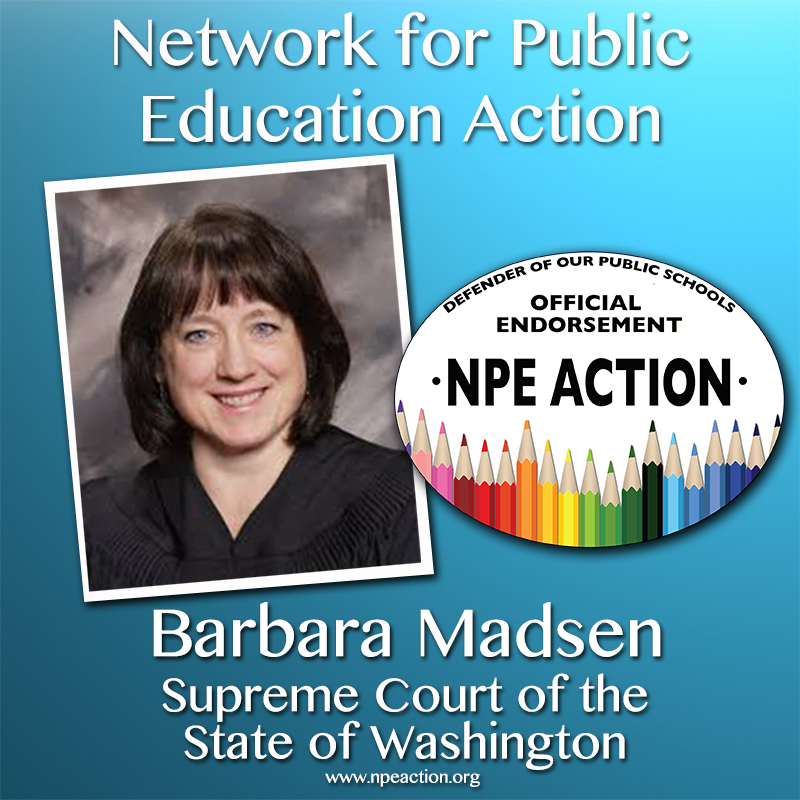
Another victory occurred in Washington State, where Bill Gates spent $500,000 into an effort to unseat Supreme Court justices who ruled that charter schools are not public schools. The Justice who wrote that decision, Barbara Madsen, was re-elected with 64% of the vote. Two other incumbents were re-elected.

Montana Governor Steve Bullock, a strong supporter of public schools, was re-elected, running against an advocate of school choice.

California voters passed measures to assure school funding.

One other piece of good news–and these days, any piece of good news is welcome–is that Maine voters narrowly agreed to raise taxes by 3% on upper-income taxpayers, to increase education funding.

A reader writes:

In Minneapolis, Minnesota all four pro public education, teacher endorsed school board candidates won, beating out two incumbents! The first Somali running for state office in the US won election to the MN State House. And the school referendum renewal passed by over 80%.

Voters in Massachusetts rejected Question 2, which would have authorized a dozen new charter schools every year. The margin, at last word, was 62-38%.

Voters in Georgia rejected Amendment 1, which would have allowed the Governor to take over low-scoring schools and put them in an “Opportunity School District,” a district of charter schools, whether for-profit or non-profit. Georgians apparently didn’t like the idea of abolishing local control of their schools. The vote was similar to Massachusetts, 60-40%. Voters were not fooled by the deceptive language.

Voters in Washington State re-elected the Supreme Court judges who declared that charter schools are not public schools, rejecting the judges supported by Bill Gates.

Our fight for public education continues. Now, with Donald Trump as President, the Every Student Succeeds Act (ESSA) works in our favor. He will turn over federal funds to the states without strings, and we will fight in every state to make sure that those funds are allocated to provide a better education for all children. From the results in Massachusetts and Georgia, we know that the majority is on the side of public schools.

We will win some, we will lose some, but we won’t give up. We will do what is right for children. We will defend teachers and the teaching profession. We will defend democratically-controlled public education. We will protect the public good.

Do not despair. Join the Network for Public Education. Plan to join us next October in Oakland, California, and help us plan for the future.

*PS: Wendy Lecker, civil rights lawyer, points out in the comments that voters in Kansas retained all the judges who ruled in favor of full funding for public schools, rebuffing Governor Brownback.
http://kcur.org/post/all-kansas-supreme-court-justices-retained

The Network for Public Education Action Fund is a c(4) political action group, approved by the Internal Revenue Service to make political endorsements. Unlike most other PACs, however, we have no funding to offer those we endorse. All we can give is our public support to help voters know which candidates and which resolutions are in the best interest of public education.

Our endorsements are made after candidates request an endorsement and fill out a questionnaire. They are vetted by our members in the locality or state. A committee of the board reviews the documentation and recommends whether to endorse.

Before you head to the polls on November 8th, we wanted to tell you about the pro-public education candidates we have endorsed in national, state, and local elections.

NPE Action has also taken positions on three ballot initiatives. If you live in these ballot initiative states, make sure to participate in these important votes.

Ballot Initiatives

vote-yes-on-1-npe-action


From Yes on 51:

Prop 51 is a state bond to address the multi-billion backlog of school construction projects.

It provides funding to repair schools, upgrade classrooms and train veterans. It is a fiscally responsible way to fix schools, with tough taxpayer accountability.

vote-no-on-1-768x768


From Keep Georgia Schools Local:

On November 8, 2016, Georgia voters will be faced with a deceptive ballot question: “Shall the Constitution of Georgia be amended to allow the state to intervene in chronically failing public schools in order to improve student performance?”

The right answer is NO.

Join parents, teachers, and communities across the state working to Keep Georgia Schools Local.

no-on-2-768x768

no-on-2

From Save Our Public Schools MA:

Ballot Question 2 proposes to lift the charter school cap in Massachusetts.

Under the proposed ballot question, 12 new charter schools enrolling up to 1 percent of the school-age population could be approved every year, forever, with no limit. These charters could open anywhere in the state, and there are no restrictions on how many charter schools could be opened in a single community or how much money any one district could lose to these new charter schools. Vote no.


Presidential Endorsement

The Network for Public Education Action (NPE Action) endorses Hillary Rodham Clinton for President of the United States. NPE Action is not aligned with Ms. Clinton on all educational issues, however, all members of the NPE Action Board strongly agree that the election of Donald Trump would have disastrous consequences for public education.

Read the full endorsement here.


Statewide Endorsements

The Network for Public Education Action is proud to announce its support for Barbara A. Madsen for the Supreme Court of the State of Washington.

According to NPE Action Board President, Diane Ravitch, “Madsen is a judge of great integrity who cares deeply about justice and equity. As an organization devoted to strengthening and improving our nation’s public schools, we are grateful for Judge Madsen’s defense of the right of every child in Washington to an ample public education.”

Learn more about Judge Madsen here.

We support Glenda Ritz for State Superintendent of Public Instruction of Indiana. A former library media specialist in an Indianapolis School, Glenda understands the importance of educating the whole child. She knows that the purpose of reading is not just to pass a test.
She is opposed to the reform agenda in a state controlled by those who would privatize Indiana schools.
We believe that Glenda deserves our support in her bid for re-election.
Learn more about Glenda here.

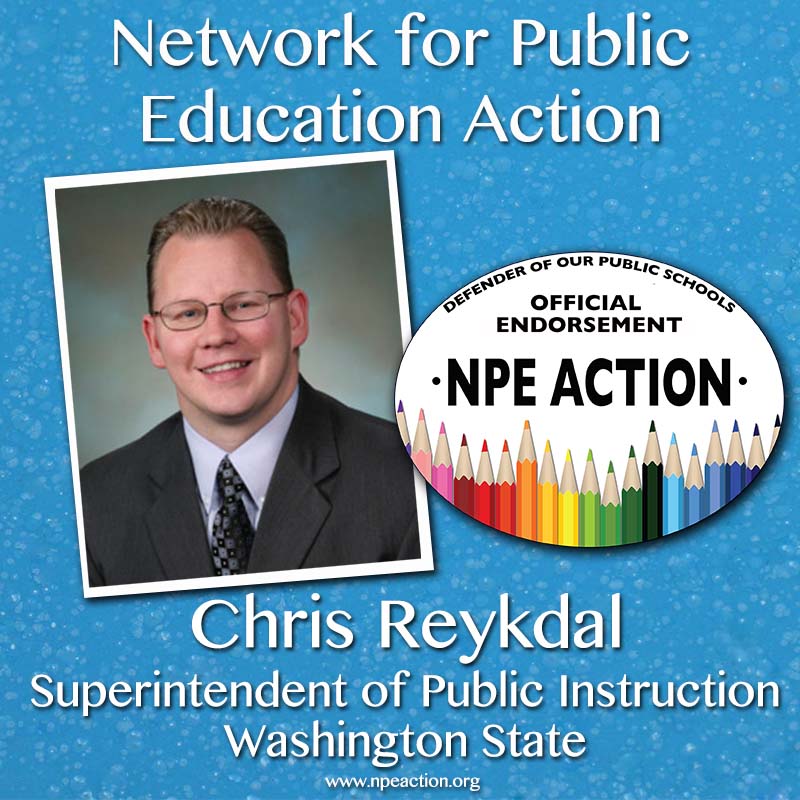
The Network for Public Education Action also gives its endorsement to Chris Reykdal, in the race for Washington State Superintendent of Public Instruction.

Here is what Chris told us about why he is running – “Washington State is under court order to fund PUBLIC schools even while education “reformers” are pushing more aggressively for new charter schools. I am running to support, defend, and improve our public schools! I am incredibly passionate about this work and always have been.”

Learn more about Chris here.

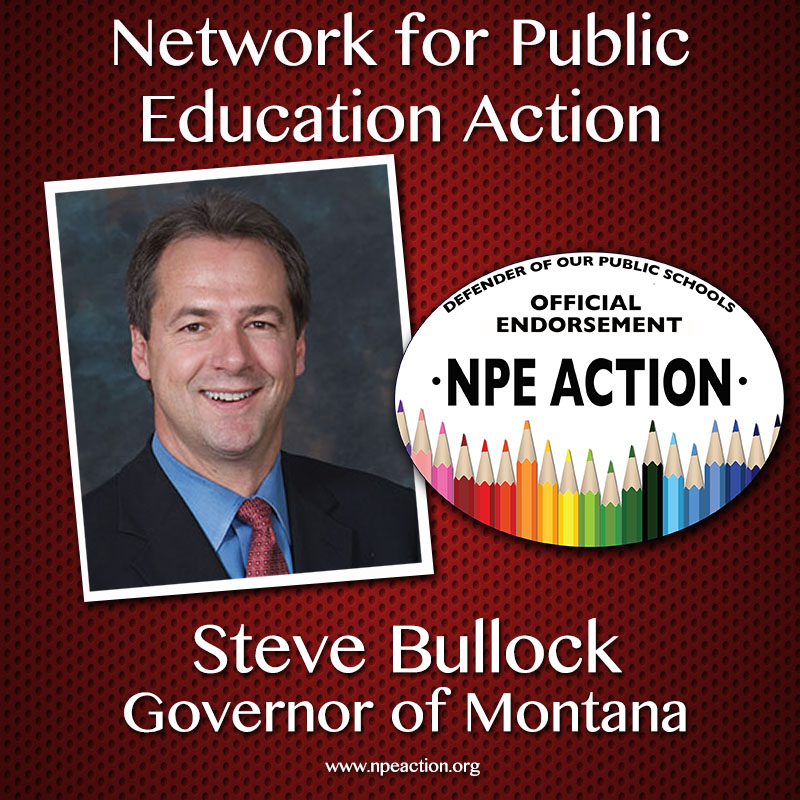
The Network for Public Education Action gives our unqualified support to Steven Bullock, for Governor of the State of Montana.

Governor Bullocks’ strong, support for public education and democratically governed schools is well known throughout his state. In 2016, The Network for Public Education’s State Report Card ranked Montana 4th in the nation. Under Governor Bullock’s leadership, the state received a rating of “A” for its resistance to privatization and for its resistance to high-stakes testing.

Learn more about Governor Bullock here.


State Endorsements

The Network for Public Education Action gives its unqualified endorsement to Zephyr Teachout to represent New York’s 19th Congressional District.

Zephyr’s strong, progressive support for public education is well known throughout New York State. During her Democratic primary bid for New York Governor, her support for democratically-governed public education was a prominent part of her platform.

Learn more about Zephyr here.

NPE Action is proud to endorse Renitta Shannon for the Georgia House of Representatives, District 84.

Ms. Shannon tells us, “I am running because Georgia is facing a school takeover plan similar to what Michigan has been through, and the Democrat incumbent has been voting and advocating for school vouchers, and school privatization. I believe we need to fully fund public education.”

Learn more about Renitta here.

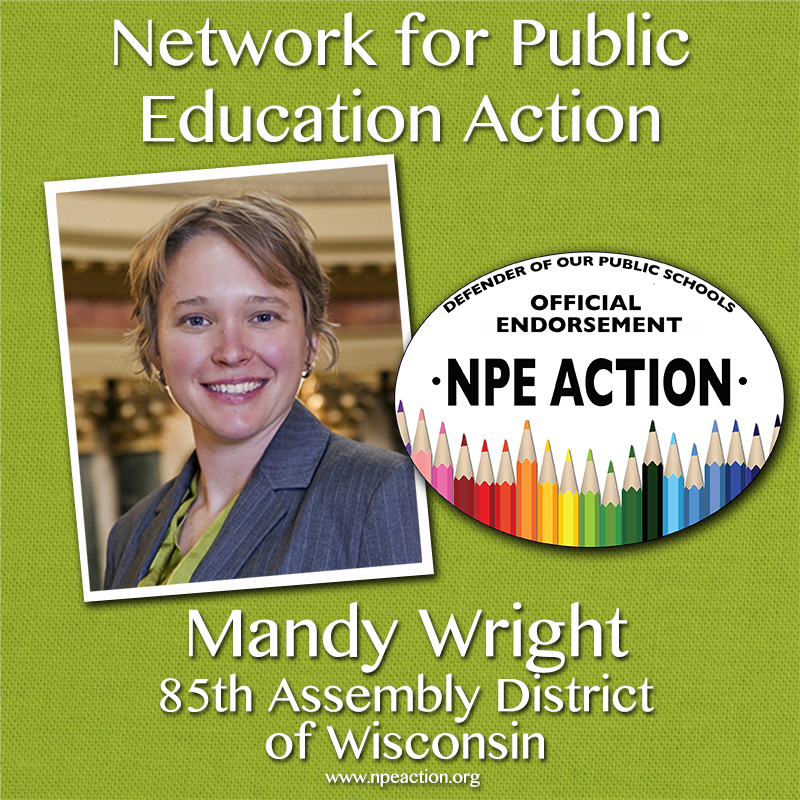
Mandy Wright is a public school teacher who believes in investing in community schools. She supports the Fair Funding initiative of the governor, which will provide stability to school funding in the state. She also believes in investments in teacher training programs, loan forgiveness, and reinstating of collective bargaining.

Learn more about Mandy here.

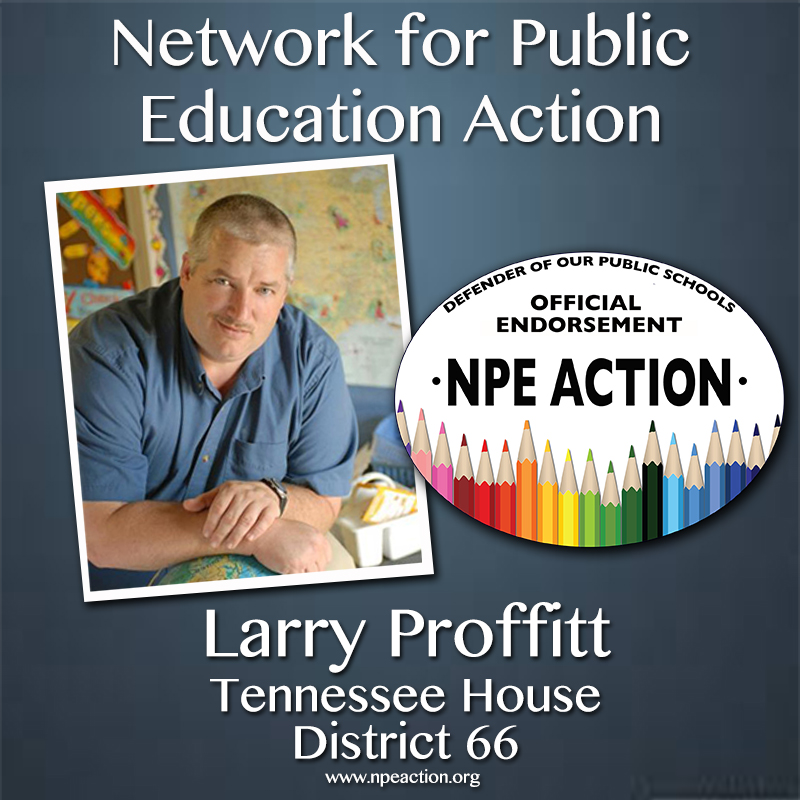
NPE Action proudly endorses Larry Proffitt in his bid for a seat in the Tennessee House of Representatives, representing District 66, Robertson County. Larry, a public school teacher, told us why he wants to serve – “Politicians have had their turn. It’s time to put an educator into the legislature to help improve jobs, education and health-care.”

Learn more about Larry here.

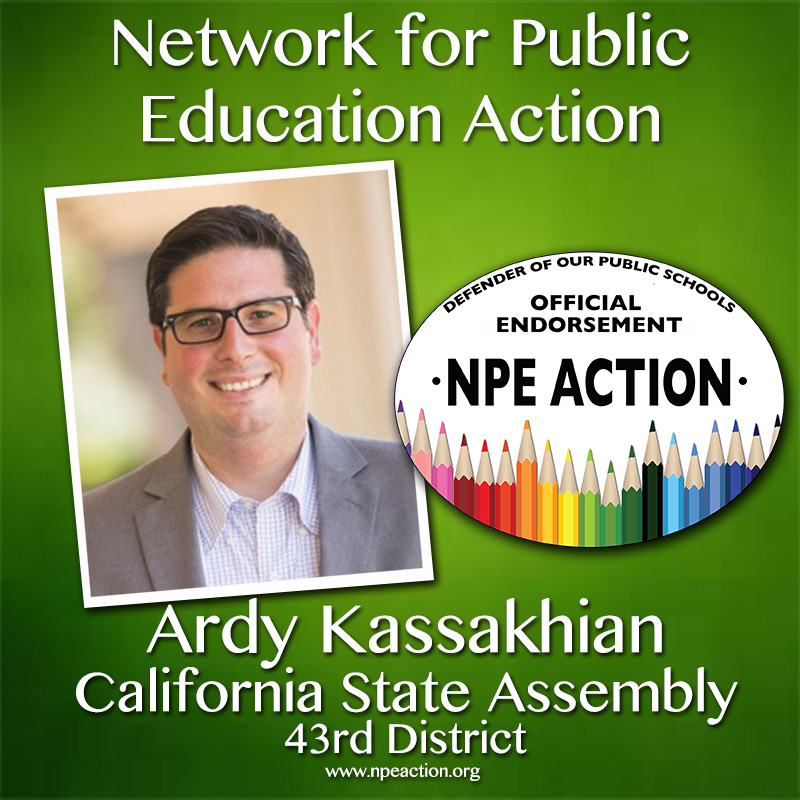
NPE Action is proud to endorse Ardashes “Ardy” Kassakhian for the California State Assembly, 43rd District.

We believe that Ardy, who is a pro-public school candidate, deserves the vote of NPE supporters. According to NPE Action President, Diane Ravitch, “We need a champion in the California legislature. It would be wonderful if Ardy can show that the powerful charter lobby can be beaten in November.”

Learn more about Ardy here.


Local School Board and City Council Endorsements

Kwame, who is a teacher of mathematics and science, told NPEAction that, “We should be using testing to guide curriculum and instruction and help create student improvement plans. We don’t need more tests–students are more than test scores. We need to stop the practice of using test scores to determine school, student or teachers value.”Learn more about Kwame here.

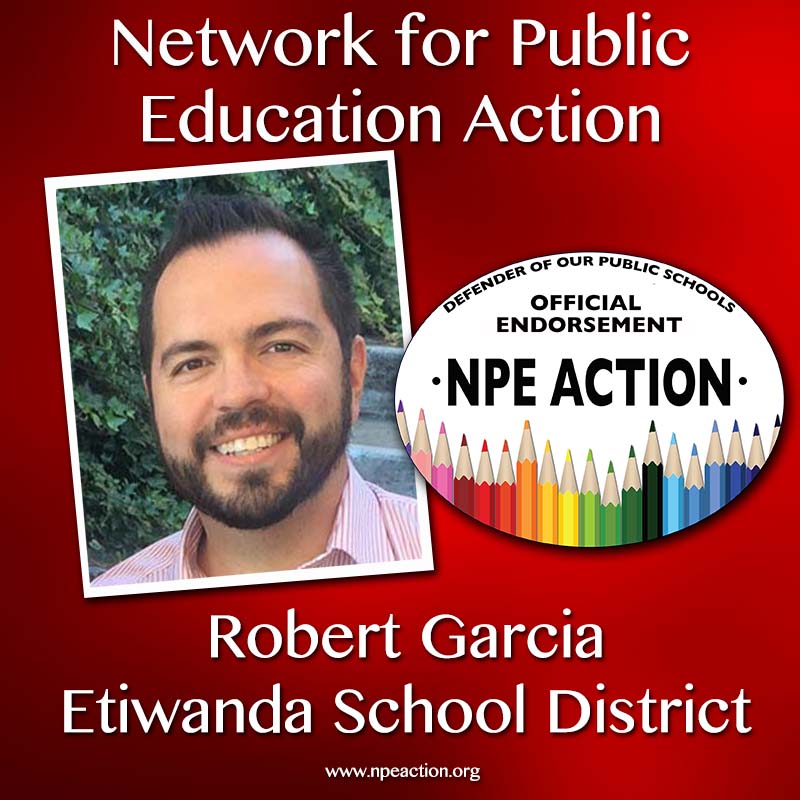
NPE Action proudly endorses Robert Garcia for the School Board of the Etiwanda School District in San Bernardino County, California.


Robert was a teacher for 12 years, and he is in his second year as an administrator. Robert taught in a charter school for a short while, and helped unionize its teachers.

Robert supports smaller class sizes, opposes vouchers, and wants to make schools more equitable for all students.

Learn more about Robert here.

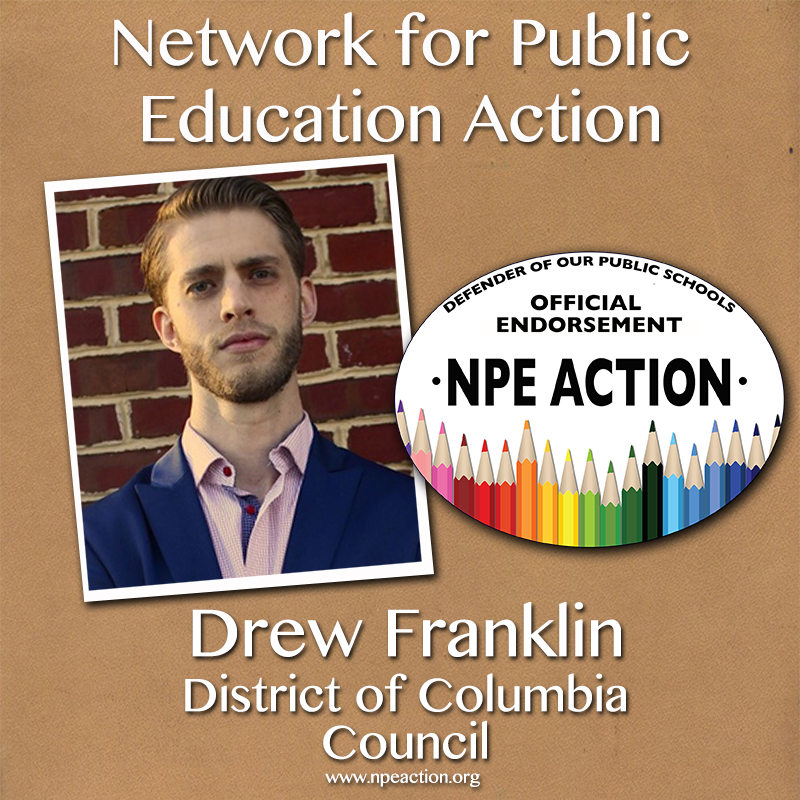
NPE Action is proud to endorse Drew Franklin for an At-Large Member seat of the Council of the District of Columbia (DC Council At-Large). Franklin, a writer and Occupy Wall Street activist, explains his support for education – “I am committed to community control of public schools in DC, which is home to some of the country’s most extreme racial inequities in education…corporate reform has only made the situation worse.

Learn more about Drew here.


If you live in Northeast Wisconsin, I urge you to support Tom Nelson for Congress.

He has never accepted money from DFER or any other privatizers.

He has fought Scott Walker over Walker’s full-blown efforts to privatize public funding for public schools.

He has served in the state legislature and as a county executive.

Elect a friend of public education to Congress!

In the annual fight in Texas over school vouchers, one of the strongest, most consistent defenders of public schools is an influential group known as zpastors for Texas Children. They believe in the importance of public education as a democratic right and they strongly support the separation of church and state.

At recent legislative hearings in Austin, their executive director Charles Foster Johnson testified against a voucher bill that was passed in the State Senate. This battle occurs every year. Thus far, a coalition of rural Republicans and urban Democrats has managed to defeat vouchers in the House. Pastor Johnson and his colleagues have been a powerful group in staving off privatization.

[If you want to watch Pastor Johnson’s testimony, which was “from the heart,” and diverged from his written statement, watch here:

[Start the video at the 3:50 mark– that’s 3 HOURS and 50 MINUTES– move the cursor just shy of the left side of the middle. http://tlchouse.granicus.com/MediaPlayer.php?view_id=37&clip_id=12360 ]

Testimony Before House Public Education Committee

By Charles Foster Johnson of Pastors for Texas Children

October 17, 2016

Chairman Aycock, thank you for the opportunity to testify before you and your committee today about what we have witnessed in our fine neighborhood and community public schools throughout our great State. My name is Charles Johnson, pastor of Bread Fellowship, Fort Worth. I am also executive director of Pastors for Texas Children, a statewide organization mobilizing the faith community for public education support and advocacy. We do two things: we minister to children in our local schools and we advocate for just policy for our children with our legislators. We were birthed out of the Baptist General Convention of Texas three years ago and now have over 1900 faith leaders of all denominations in churches all across Texas.

We are in our schools every day and see children from every ethnicity, every socio-economic background, and all walks of life succeeding beautifully on their path to productive citizenship in our society. We see children discovering their God-given talent and giftedness at the hands of dedicated teachers answering the call of God to pursue careers as educators. We witness daily the sheer moral power of public education as a building block of our society. This is why we are compelled to deliver the message to whoever will listen that universal public education is God’s will for all people—not a “choice” accorded to a few through a school choice voucher. I’d like to share several reasons why:

Public education is a moral duty. Education is a gift of God for all people. Just like the first human did in the Bible story so long ago, every person gets to name God’s world. Just as God brought all the creatures to the human to see what he would name them, so classroom teachers in schools all across our land teach our children to name God’s world. It’s the only way we can fulfill the first commandment of God to “be fruitful and multiply, replenish the earth and subdue it.” Education is a core component of the public interest. It is God’s common good for all God’s children—not just for those who are smart and stable and economically secure enough to pay for it with a school choice voucher.

Public education is a democratic duty. The founders of this nation determined at the outset of our Republic that in order to have a democratic society, we must educate all our children—not just a few children from families affluent enough to pay for it. Public education is a cornerstone of our American way of life. It is what has made America great. Our neighborhood and community schools are the places where our American history is taught, where our children learn basic civics, where the Pledge of Allegiance is said every day, where citizens are made. In America, citizenship is for all people—not just those few fortunate enough to be chosen by a school choice voucher.

Public education is a societal duty. It is incorrect for some of our friends to say that the money should follow the child because it is “my money.” With all due respect, it is not “my money” in a just society. We have a responsibility to participate in the well-being of all people. Do I get to have my own private security guard subsidized by the public through a “safety choice voucher?” Do I get to have my private swimming pool underwritten by the people of Texas because I don’t use the public pool? In a just and equal society, do I get a “transportation voucher” because I walk or ride a bicycle? The love of neighbor has founded our social order in these United States. We practice that love of neighbor through our taxation to support investments in that societal infrastructure.

Public education is a constitutional duty. The Constitution of the State of Texas says this in Article 7, Section 1: “A general diffusion of knowledge being essential to the preservation of the liberties and rights of the people, it shall be the duty of the Legislature of the State to establish and make suitable provision for the support and maintenance of an efficient system of public free schools.” The members of this legislative body swore a Bible oath to uphold that provision. There is zero authorization for this body to do anything with private schools.

Public education is a spiritual duty. We believe wholeheartedly in religious liberty as a gift of God from all people. Thomas Jefferson and James Madison did not make it up. It is the principle upon which our nation is founded. So, we affirm that no overt religious instruction or activity should be advanced or established with tax dollars in our public schools. All faith is voluntary. It belongs in the home and the church—not in our public institutions. This government has no authority to advance religion in our public schools. Nor, on the other hand, does this government have any authority to meddle in our private and home schools through a school choice voucher. Any money that is diverted from the public trust to a private entity will be publically accounted for, thus inserting and intruding government into the voluntary associations of religious schools. God does not need Caesar’s money to do the Lord’s work. Never has. Never will.

But, faithful teachers take the love of God with them into our classrooms each and every day, ministering long hours at low pay while serving the poorest children in our midst. They instill moral character. They teach respect across the wide diversity of our population. They show unconditional love to all kids. They do this because they are called before God. This is why the dynamics that govern our capitalistic system do not operate in an educational environment. Market forces such as competition and cost benefit analysis simply do not apply in the formation of a human being. A classroom is a holy place of learning—not a marketplace of financial gain. To make commodities of our kids and markets of our classrooms is to misunderstand—and profane—the spirituality of education.

PO Box 471155 – Fort Worth, Texas 76147
http://www.pastorsfortexaschildren.com