Archives for category: Supporting public schools

North Carolina is one of the states where the legislature has been working overtime to pass programs to harm public schools. Charters, vouchers, cybercharters, Teach for America, and regular assaults on the teaching profession.

That context makes it especially surprising and gratifying to see that the editorial board of the News-Observer wrote a strong critique of the GOP Tax Plan because it hurts public education.

This is a fantastic editorial:

There’s no doubt that tax-cut proposals in the House and Senate will increase income inequality today, but provisions in the bills could also weaken the earning power of many in the future by eroding the quality and the diversity of public schools.

One change that as approved by the Senate and also found in the House bill extends a tax benefit for college savings accounts to cover tuition for private elementary and secondary education. The change means that those who can afford to save money for non-public school tuition will be able to see that money grow tax-free.

Extending the tax break won’t mean much for families of modest incomes since they can’t afford to save large amounts for pre-college schooling, but it will have the effect of making high-priced private schools less costly to the wealthy. The Senate version of the change offered by Republican Sen. Ted Cruz of Texas even allows those who home school to draw up to $10,000 annually out of the tax-favored accounts to cover loosely defined school expenses. In the end, the change reduces tax revenue to give the wealthy a break on private education costs.

This relatively narrow adjustment will be joined by sweeping proposals in both the House and Senate tax bills that limit federal deductions for state and local taxes. Those changes will make it harder for local and state governments to raise taxes to support public schools. Together, the changes will lighten the tuition bill at private schools while adding to the tax burden that supports public schools.

Of course, higher education is also threatened by provisions in the tax plans that would include levies on endowments and on tuition benefits provided to graduate students and children of college employees. But the plans’ broader threats are to public schools, which are already being undermined by Republican-backed efforts to increase the number of charter schools – publicly funded but privately run – and to expand the use of tax funds for private schools through voucher programs. Now that “school choice” movement has gained support at the federal level with the appointment of Betsy DeVos – a charter and private school advocate – as the U.S. education secretary.

Fueling re-segregation

As Republicans cut away at the financial foundation of public schools they are also accelerating the re-segregation of all schools at the elementary and secondary levels. Adding charters and using tax dollars to subsidize private and sectarian school tuition is leading to a great sorting by race. And that, rather than enhancing education, deprives children of learning through exposure to classmates of different racial groups and economic backgrounds.

In a recent report on charter schools, The Associated Press found the number of charter schools has tripled over the last decade and racial isolation has grown with them. Charters tend to be overwhelmingly white, or overwhelming one minority. The AP reported: “While 4 percent of traditional public schools are 99 percent minority, the figure is 17 percent for charters. In cities, where most charters are located, 25 percent of charters are over 99 percent nonwhite, compared to 10 percent for traditional schools.”

The trend worries even some charter school advocates. Pascual Rodriguez, principal of a Milwaukee charter where nearly all the students are Hispanic, told the AP: “The beauty of our school is we’re 97 percent Latino. The drawback is we’re 97 percent Latino … Well, what happens when they go off into the real world where you may be part of an institution that’s not 97 percent Latino?”

The AP report mirrors what an October News & Observer report found about racial segregation in North Carolina charter schools. The report found that the schools are more segregated and have more affluent students than traditional public schools.

Christine Kushner, a member of the Wake County Board of Education and a former chair of the panel, said that despite efforts to foster diversity in the Wake County school system, the state’s largest, minorities are the majority, largely because of an increase in Hispanic students and more white students enrolling in schools outside of the system. She said Wake schools remain strong, but their reduced diversity both in race and income is a setback.

“It’s troubling to me that we are going backward because I think diverse schools are what’s best for all children and economics and history affirm that,” she said. School choice is fine, she said, but public schools need to have the resources “to be the first choice for all parents.”

Good public schools and strong support through taxes are inseparable. But the tax bills in Congress are adding to the forces that are splitting that bond and jeopardizing public education.

Read more here: http://www.newsobserver.com/opinion/editorials/article188972429.html#storylink=cpy
Please watch this two-minute video of John Kuhn, Texas Superintendent, who tells the story of two adjacent school districts, one rich, one poor. He explains with eloquence and passion why schools should be equitably funded and how unjust it is to fund schools differently and expect to get the same results.

This video is part of a series of short videos produced by Michael Elliott for the Network for Public Education.

Please watch it, tweet it, share it on your Facebook page, and wherever else you reach your friends and acquaintances. Send it to everyone you know.

Kuhn is powerful and eloquent on behalf of children, communities, public schools, justice, and equity.

Join the Network for Public Education Action Fund in protest against public funding of private schools. Open the link. When you sign in, you can automatically send letters to your senators and members of Congress. You can write your own letter or send one that NPE Action has written. We make it easy for you to fight for public schools!

Please join us and speak up.

A regular reader who identifies himself as GregB has sound advice about how to advocate for your schools. His advice is similar to what is suggested by the Indivisibles. I would add that you can amplify your voice by joining the Network for Public Education. We exist to connect people to other activists in their community and state. Be informed. Participate. Work with allies.

GregB writes:

“For whatever its worth, I’ve worked as a legislative staffer, have organized and implemented grassroots advocacy campaigns in education, medical research, and health regulatory issues and Lloyd is far closer to the truth than Ed will ever be.

“First, phone calls are generally useless. Your call goes to young staffer–an intern or someone who has their first job–who literally take calls on every issue under the sun. They have no clue what people are calling about, take for/against tallies that few people pay attention to, and generally will answer you with something to the effect of: “I’ll be sure to pass your views on the senator/congressman.” The exception to the rule is when an issue becomes so big that it clogs up the phone lines, something like a Supreme Court nomination or a big issue that dominates the headlines and evening news. But it is aggregate numbers that matter, not individual messages. If you think your calls are being taken seriously, then you may as well agree with the argument that Hillary Clinton only won the popular vote because of widespread voter fraud.

“Second, emails are generally the same as phone calls, the only difference being that the computer algorithms generate pre-approved responses (if you are for the issue, you get one response, if you are against it, you get another). Occasionally when there are more than one issue addressed or nuances that don’t fit the algorithms, the message goes to a legislative correspondent who then patches together pre-approved language into “personal response.”

“Third, snail mail letters are effective if the stars line up such as: the arguments in the letter are personal with relevant examples and emotion and it reaches the eyes of a sympathetic staffer. While that is sometimes effective, more often than not, you will get an equivocal response that ends with “your views will be important to me should this issue ever be considered on the floor of the Senate/House.” In other words, nothing.

“If you do not know the names of: a local staffer who deals with constituents on the issue areas you care about, a DC legislative assistant and the legislative correspondent who supports him or her, and, if you are lucky, the local staff director and DC legislative director or chief of staff, then you are not doing effective citizen lobbying. You must contact one in the local and one in the DC staff a minimum of twice a year. You must be specific about your issue and remind them of what you contacted them about previously. And to be very effective, you should coordinate with other constituents who are like minded. You should share your correspondence to the boss with them.

“You should also know what committee/subcommittee memberships your senator/congressman has. If education is your issues and your senator/representative is not on the authorizing or appropriating committee on the issues you care about, then it is very unlikely that your views will ever reach the level of the boss. If it does, the best you can hope for is for that senator/representative to sign on to “Dear Colleague” letters about specific issue, i.e., they become lobbyists of a sort who try to influence the committees of jurisdiction. And if you are a real effective citizen lobbyist, you should find out about those “Dear Colleague” letters and make the staffers aware of them. If they are on the right committees, the tips below are even more important.

“If you can’t get to DC, you should try to schedule visits with local staffers (so that they become your lobbyists to their DC counterparts) once or twice a year and also request visits with their bosses during congressional recess periods. Town hall meetings used to be incredibly effective when only a dozen or so people showed up. That dynamic has changed dramatically since polarization has set in.

“Letters to the editor are more effective than phone calls or letters. They are more effective if you’ve done relationship building with staffers; you can make them aware of the letters. I have often received notes from my reps responding to letters I’ve written.

“One last tip. Should you get paper responses from your senators/representatives with signatures, know that signature machines are used. They have separate templates with full signatures and first names, the latter to make it more “personal.” But know that the boss has never touched that letter. When you get short, hand-written notes, then you know you’ve actually reached your senator/representative.

“But please don’t be deluded into thinking that your occasional call or email is actually accomplishing somethings. If you’re not willing to do your homework, build relationships, and keep it up since there is regular staff turnover (meaning you have to start the process all over again) you’re not engaging in effective advocacy.”

Texas Pastor Charles Foster Johnson has a great idea. If the people who work in schools were to all vote, they could vote out the cold-hearted politicians who are attacking public schools and the children who attend them. Rev. Johnson is leader of Pastors for Texas Kids.

What a simple and radical idea.

If every single school district employee were to register and vote, it would reshape politics in Texas.

“A top leader of the movement in support of public education is a charismatic pastor, the Rev. Charles Foster Johnson of Fort Worth. I heard him speak about the coming battle at the Texas Association of School Boards convention in Dallas last month.

“The title of the session at which Johnson spoke was provocative: “You can’t fix stupid but you can vote it out.”
His audience was a room filled with school board members and superintendents from across the state.
The session description promised to teach “a successful turn-out-the-vote effort” and how school board members can build “a culture of voting in the schools and the community…”

“I’ll tell you a dirty little secret,” Johnson told the standing-room-only crowd. “Nobody holding office wants you to vote. …

“We’ve got a Senate in the state of Texas — and I hope there’s somebody here who will quote me — that does not believe in public education for all children. It needs to stop right now.”

The math is there. Voter turnout is close to worst in the nation. Johnson estimates that there are maybe 700,000 school district employees. If they all vote, everything changes.

“We will get a different Senate, y’all. It’s as simple as that,” the pastor told educators…

“Plano ISD trustee Yoram Solomon shows The Watchdog how much this matters. Of 190,000 potential voters, about 10,000 voted in a school board election. A winner only needed 3,800 votes.

“Plano ISD has 6,700 employees. “They could have swung any race they wanted, if they were influenced to do so,” Solomon says.

“Plano ISD Trustee Yoram Solomon, at his home in Plano, is raising ethical questions about a statewide movement to get school district employees to vote out conservative lawmakers.

“Plano ISD Trustee Yoram Solomon, at his home in Plano, is raising ethical questions about a statewide movement to get school district employees to vote out conservative lawmakers.

“A draft resolution supporting a “culture of voting” is on the agenda in hundreds of state school districts. In Plano this week, Solomon raised enough questions to get it postponed.

“The resolution urges districts to offer employees a voter pledge or oath (“I am a Texas educator and I commit to vote in the March primary and the November general election. I will vote in support of public education in the interest of the more than 5 million Texas schoolchildren.”)

“The resolution also urges time off for early voting for employees and allows for school buses to take employees to the polls.

“Plano trustees will edit the template (good for them!) and add new language to the resolution “that will assure that there will be absolutely no influence on our employees, and that their votes will be confidential,” Solomon says.”

Great line!

YOU CANT FIX STUPID, BUT YOU CAN VOTE IT OUT!

Watch Rev. Johnson at the NPE Conference in Oakland and be inspired.

Carol Burris and Darcie Cimarusti of the Network for Public Education argue here that the candidates who forcefully stand up for public schools and speak out against privatization will win in November 2018.

Their evidence is the Elections of 2017.

Start with the remarkable results in Virginia.

“The most important race of 2017 was the hotly contested race for the governor of Virginia, in which a strong public education advocate, Democrat Ralph Northam, faced off against Republican Ed Gillespie. Gillespie fully embraced the entire DeVos agenda — charter expansion, online virtual schools, home schools, and vouchers in the form of tax credits and education savings accounts. There was not an inch of policy daylight between Gillespie and DeVos.

“This should come as no surprise. Gillespie received over $100,000 in campaign contributions from the DeVos family, including a donation from the Secretary’s husband, Dick DeVos. Americans for Prosperity, which is controlled by the Koch brothers, launched a digital video in which a charter school leader criticized Northam for being the vote that stopped the neo-voucher “educational savings accounts.”

“Northam, who was supported by the teachers union, has been a strong and consistent supporter of public education. As stated on his website, “Ralph took tie-breaking votes to protect Virginia’s public education from being raided with unconstitutional private school vouchers and to keep decisions about public charter schools in the hands of local school boards.”

“The election of Gillespie would have been a game changer for public education in the Commonwealth. Virginia is one of a handful of states that allow charter schools to only be authorized by local school boards. In Virginia, charters are subject to the same transparency guidelines as public schools in the state. There are only eight charter schools in Virginia, much to the chagrin of charter advocates.”

Northam, who calls himself a “friend of public schools,” will keep privatization out of the state and instead work to strengthen and improve Virginia’s public schools.”

Friends of public schools will win. Democrats who abandon public schools will not be able to take advantage of “The DeVos Effect.”

I forgot to include the link on this post, so I am reposting.

This was one of the best keynote speeches from the fourth annual conference of the Network for Public Education in Oakland. They were moving, inspiring, powerful.

Please watch Dr. Charles Foster Johnson of Pastors for Texas Kids explain how he got involved in the fight for public education and why men and women of faith communities must support public schools and protect separation of church and state.

Charlie Johnson is a wonderful speaker. He is working with his peers in other states, including Oklahoma, Arkansas, Arizona, and Indiana. When he finished talking, he was swarmed by people from the South and Midwest, seeking his help and advice.

You will enjoy and learn from his presentation.

Stuart Egan, NBCT High School Teacher in North Carolina, writes here about the lessons learned from a TV series set in the 1980s called “Stranger Things.” Remember the 1980s? There were no charter schools, no voucher schools. Public were and still are the heart of their communities. But some communities have been ripped asunder by false notions of choice and competition, whose main goal seems to be to sow division and break community spirit.

“The fictional town of Hawkins, Indiana became the epicenter of a lot of “binge-watching” in the last month as the second season of the hit series Stranger Things was released in nine episodes.

“Following the trials and tribulations of these school-age kids and their families is rather surreal; the music, the fashion, and the hair styles are as authentically presented now as they were actually in the 1980’s, especially if you are a middle-aged public school teacher who listens to The Clash like he did growing up in a small rural town in Georgia where he rode his bike everywhere without a digital link to everything else in the world.

“He just had to be home by dinner.

“While the kids and adults in this fictional town battle forces from the “upside down” amidst a government cover-up during the Cold War, it is easy to get lost in the sci-fi aspects of this well-written show. And it is very well-written and produced. But there is one non-human entity that is foundational and serves as the cornerstone to those people in a small section of Indiana: Hawkins Middle School, Home of the Tiger Cubs…

“If there ever was a cornerstone for the characters in Hawkins, IN, then it is the public school. It serves as the greatest foundation of that community.

“The AV Room. Heathkit. School assemblies. The gymnasium. Science class. Mr. Clarke. Eleven channeling Will. Makeshift isolation tank. Portal to the Upside Down. The Snow Ball. Parents were students there. Ghostbusters suits.

“Those are tied to Hawkins Middle School.

“So is growing up, coming of age, hallway conversations, epiphanies, learning about others, following curiosities, finding answers to questions you learned to ask.

“Those are also tied to Hawkins Middle School.”

The question that we should all try to answer is how “conservatives” became devoted to the idea of destroying community institutions.conservatives used to serve on the school board and lead the PTA. When did it become conservative doctrine to oppose public schools?

Brian Malone, videographer, produced a film called “Education, Inc.” in which he portrayed the intrusion of Dark Money into School Board Elections, with the goal of privatization and destruction of public schools. He focused on Dougco in Colorado, where Voucher forces used big money to take control of the local school board.

On Tuesday night, organized parents and teachers elected their slate of public school supporters.

Brian Malone was there to film it, and he says he will change the ending of “Education, Inc.”

Share the joy by watching a few minutes.

For now, public education is back in Douglas County!

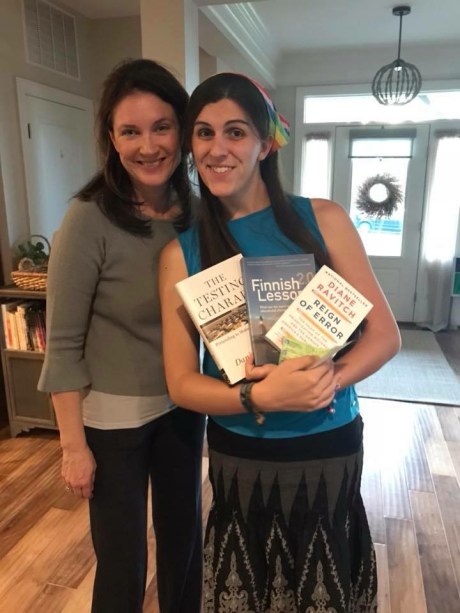
Our reader and commenter, known to you are Virginia Parent, is Michele Boyd. She worked very hard to elect pro-public education candidates in Virginia. In this photograph, taken before the election, she gives Danica Roem some good reading on education issues. Danica was one of the people I endorsed for election to the House of Delegates, on the recommendation of Michele, Rachel Levy, and others on the ground. She is one of the brave Democrats who has come close to taking a majority of seats in a legislature that was gerrymandered to maintain Republican control. Danica knocked out one of the most reactionary members of the House of Delegates.

In case you can’t read the print, Michele gave Danica the following: Daniel Koretz, “The Testing Charade”; Pasi Sahlberg, “Finnish Lessons”; and my last book “Reign of Error.” Can’t go wrong with those three.

Congratulations to all of those and who fought to stop Trumpism in Virginia.

You sent a message to the Nation and gave hope to people who had lost it.

IMG_3450