Archives for category: Stupid

Trump’s campaign may have launched the “October Surprise”–the game-changing event in the last days of the campaign–as a boomerang. The political columns, like Politico, are filled with reactions to the comedian’s line about Puerto Rico being “an island of garbage.” The outrage is loud and bipartisan, since Republicans realize the “joke” offended an important voting bloc.

The Archbishop of San Juan demanded a personal apology from Trump.

JD Vance said at a rally that people should not be so easily offended by a joke. But they are. Calling the island garbage means calling the people on it garbage. Why shouldn’t they be offended? Would Vance be so complacent if someone called Ohio “a garbage state?”

And the controversy revived memories of Trump throwing paper towels to people in Puerto Rico after a devastating hurricane, as well as Trump’s indifference to the island:

On the NBC website was news about the joke:

Apart from Bad Bunny, the Puerto Rican singer Marc Anthony slammed Trump for his actions during Hurricane Maria as he endorsed Harris, posting on Instagram: “I remember after Hurricane Maria devastated our island… Trump blocked billions in relief … while thousands died. I remember that when our families lacked clean water and electricity, Trump threw paper towels and called Puerto Rico ‘dirty’ and ‘poor.’” He added he was not “surprised,” because Trump “launched his campaign by calling Latinos criminals and rapists.”

After the 2017 hurricane, Trump repeatedly opposed disaster funding for Puerto Rico as he disputed and failed to acknowledge Maria’s death toll — almost 3,000 people in the U.S. territory, making it the deadliest hurricane in the U.S. in 100 years. Trump also drew attention for disparaging statements about Puerto Rico after Maria, including “they want everything to be done for them,” and for tossing paper towels in a visit to the island after the deadly hurricane.

During his presidency, Congress approved a total of $20 billion in federal housing funds for Puerto Rico’s post-hurricane reconstruction, a historic amount. But the Trump administration blocked Puerto Rico from receiving such funds and obstructed a government probe looking into officials who withheld the aid, according to a Department of Housing and Urban Development Office of Inspector General report.

All good news for Kamala, who had just released her plans to help Puerto Rico’s economy.

On the same day that the Washington Post announced that it would not endorse a Presidential candidate, the following article appeared, written by Isaac Arnsdorf and Josh Dawsey. Actually, I saw the article on the Post website Friday morning but by Friday night it had disappeared from the website. I searched for it at 1 am early Saturday morning and could not find it. It was posted again this morning with yesterday’s date. It’s a long article, but well worth the read.

It reads like a rebuttal to Jeff Bezos’ decision not to endorse a candidate, not to choose between an experienced, sensible woman of color and a nutty, egotistical ex-President who thinks he won the last election.

The article appeared before the editorial decision. It reads like a rebuttal.

It begins:

Donald Trump debuted a name for his idiosyncratic, digressive speaking style this summer: “the weave.”

The Republican presidential nominee, now 78, was frustrated with news coverage describing his speeches as rambling and speculating about cognitive decline, according to people who have talked with him, who like others spoke on the condition of anonymity to discuss private conversations.

Trump decided to brand his habit of going off on wide-ranging tangents as the mark of a vibrant and sophisticated mind, they said — trying to turn what many voters, and some of his advisers, saw as a weakness into a strength.

I call it ‘the weave.’ And some people think it’s so genius. But the bad people, what they say is, ‘You know, he was rambling.’ That’s not a ramble. There’s no rambling. This is a weave. I call it the weave. You need an extraordinary memory because you have to come back to where you started.
Oct. 9 interview with Andrew Schulz on the “Flagrant” podcast

Trump’s recent public appearances have been strikingly erratic, coarse and often confusing, even for a politician with a history of ad-libbing in three consecutive presidential runs, a Washington Post review of dozens of speeches, interviews and other public appearances shows. His speeches have gotten longer and more repetitive compared with those of past campaigns. He promotes falsehoods and theories that are so far removed from reality or appear wholly made up that they are often baffling to anyone not steeped in MAGA media or internet memes.

He jumps more abruptly between subjects and from his script to improvising, sometimes offering what sound like non sequiturs. He occasionally mixes up words or names, and some of his sentences are meaningless or nonsensical. As he has delivered more speeches in October, he has made multiple slip-ups per day. He has become more profane in public.

Many of Trump’s supporters say they enjoy his off-the-cuff commentary, favorably contrasting his speeches with what they usually hear from politicians.

“Just because you don’t like how somebody talks doesn’t mean that you don’t listen to what’s in their head,” said Deanna Borracci, 52, who wore a hat reading “Re-elect that motherf—er” to Trump’s rally in Juneau, Wisconsin, on Oct. 6.
“It doesn’t bother me,” she said of his long speeches and off-the-cuff remarks. “He’s being himself.”

With less than two weeks of campaigning left, Vice President Kamala Harris is increasingly trying to use Trump’s words against him. At rallies, she has started playing clips of him speaking and calling him “unstable and unhinged.”

“He has called it ‘the weave,’” Harris said at a rally on Oct. 19. “But I think we here will call it nonsense.”

Trump’s unusual delivery has inspired comedy routines and armchair diagnoses for years. Long, meandering stemwinders, provocations, brazen falsehoods and blunt language, jokes and insults have distinguished his speeches since he launched his candidacy in 2015 calling Mexican immigrants “rapists.” He has frequently posted all-caps outbursts on social media in the middle of the night, critiqued live television, picked fights with celebrities, and veered off poll-tested political messages in favor of petty, personal grievances. His unscripted appearances generate widespread attention, accomplishing his goal of dominating headlines.

The Republican nominee has scoffed at questions about his age and fitness and challenged Harris’s intelligence.

“I have no cognitive,” he said at a town hall in Lancaster, Pennsylvania, on Oct. 20. “She may have a cognitive problem, but, but there’s no cognitive problem.”

He has regularly mocked Harris for meandering answers she has sometimes given and questioned her intelligence in sometimes sexist ways, people who have been with him privately say. He also accused the press of cherry-picking occasional slip-ups.

For weeks and weeks, I’m up here ranting and raving. Last night, 100,000 people, flawless. Ranting and raving. I’m ranting and raving. Not a mistake. And then I’ll be at a little thing, and I’ll say something, a little bit like ‘the,’ I’ll say, ‘dah,’ they’ll say, ‘He’s cognitively impaired.’ No. I’ll let you know when I will be. I will be someday. We all will be someday, but I’ll be the first to let you know.
Oct. 13 rally in Prescott Valley, Arizona


Trump’s Truth Social posts don’t have anywhere near the reach he once got on Twitter and his rallies are not covered wall-to-wall on live TV, meaning his comments don’t get the traction they once might have. Privately, some of his advisers see this as a positive development. Harris, for her part, has urged people to watch Trump’s rallies for themselves.

Trump would be the oldest person ever elected president. He has never released his medical records or submitted to independent evaluation. The most detailed account of his health came in a January 2019 briefing from White House physician Ronny Jackson, who later resigned under allegations he drank on the job and mistreated subordinates; he now represents a Texas district in Congress. His successor, Sean Conley, gave public accounts of Trump’s health that were rosier than reality when the then-president contracted covid-19 shortly before the 2020 election.

Fifty-one percent of Americans said Trump was too old to work in government in a September Reuters-Ipsos national poll, an identical number as in the same survey in July.

Trump’s advisers reject the notion that Trump has lost a step. He has dramatically increased the pace of campaigning since Labor Day, with multiple events on some days, leaving him appearing more tired and irritable. He has had to suspend his usual golf routine both because of the demands of the campaign and because of security concerns from two assassination attempts and ongoing threats from Iran, according to advisers. He has shown flashes of frustration with those dangers, as well as with his busy schedule, and with having to run against Harris after an aging President Joe Biden withdrew from the race.

Some of his puzzling statements arise from how he gets his own information. In the years since leaving the White House, Trump’s sources of news have grown increasingly insular and self-reinforcing, according to people who talk with him. He both validates and thrives on an alternative ecosystem that selects and amplifies stories to suit him, and he summarily dismisses any other reports as fake. Aides who contradict him or bring him bad news quickly lose his favor and access. Much of the information he gets these days comes from Natalie Harp, a junior but highly influential aide who often trails Trump no matter where he is, printing out supportive articles and social media posts for his review, according to advisers.

For several weeks this fall, campaign advisers tried to persuade him to shorten his speeches. Talk about the economy. Don’t attack people. People would stop leaving, they argued, if his speeches were shorter.

“Going down the stretch, a little discipline would help,” one adviser said.

Trump has dismissed the advice. “People want a show,” he said in Pennsylvania in August, according to a person who heard his comments.
Trump spokesman Steven Cheung in an email praised the Republican nominee’s rhetoric: “President Trump is the greatest orator in political history and his patented Weave is a brilliant method to convey important stories and explain policies that will help everyday Americans turn the page from the last four years of Kamala Harris’s failures. The media is too stupid and ignorant to understand or comprehend what is happening in the country and, therefore, is unable to accurately report on President Trump’s achievements while in office and the pro-America agenda he will implement in his second term.”

He repeats falsehoods that are far removed from reality

And then they have the apps, right? How about the apps? Where they have an app so that the gangs, the people, the cartels, the heads of ’em, they can call the app. They call the second-most resettled population. Nobody’s ever seen. They call up the app and they ask, ‘Where do we drop the illegals?’ And people are on the other side, and they left that. She actually created an app, a phone system, where they can call up. I mean, she’s a criminal. She’s a criminal. She really is. If you think about it.
Oct. 11 rally in Aurora, Colorado

Trump’s tendency to boast and exaggerate is well documented, including in more than 30,000 false claims during his presidency, tallied by The Washington Post’s Fact Checker. Typical fact checks compare the data Trump is referencing with his characterization. But some of his falsehoods are so fantastical it can be hard to tell what he is referring to.

He accused Harris of speaking “about teddy bears,” which have never come up in any of her interviews. He claimed she was known as “the tax queen” as San Francisco district attorney even though prosecutors have no power over taxation. He falsely claims banning cows and windows are part of Democrats’ plans to reduce greenhouse gas emissions, even accusing them of trying to raze Manhattan. He sometimes vividly describes nonexistent crime sprees.

You go to a lot of cities and they rob a department store and guys are walking out with refrigerators. They have it on their back with two front and air conditioning and everything, and they literally are stripping. And the police are standing outside and they’re shaking out of anger because they really want to do something, but they’re told to stand down, stand down, and they’re watching these criminals walk out.
Oct. 20 town hall in Lancaster, Pennsylvania


Trump’s riffs about Hannibal Lecter roughly coincided with false right-wing internet rumors about cannibals from Haiti. He and his campaign have never provided any basis for Trump’s frequent claim that foreign countries are emptying their prisons and mental institutions to send people to the United States.

As Trump emphasizes immigration in the closing stretch of the campaign, his speeches routinely feature the false allegation that Harris created a phone app for cartels to coordinate human smuggling at the U.S.-Mexico border. The false claim stems from a mobile application developed and released by Customs and Border Protection during the Trump administration to facilitate trade. In 2023, the agency expanded the app to add appointment scheduling for asylum applications.

Most prominently, Trump promoted unfounded, racist allegations against Haitian refugees settled in Springfield, Ohio, during the Sept. 10 debate with Harris. False internet rumors accused people of eating geese and cats, and Trump, without any basis, added dogs.

He occasionally mixes up words and names

In June, Trump accidentally called his former doctor, Ronny Jackson, Ronny Johnson — ironically in the same breath that he was attacking Biden’s cognitive health and boasting about his own.

At an Oct. 1 news conference in Milwaukee, Trump complained that the Secret Service was busy protecting the U.N. General Assembly, including “the president of North Korea, who’s basically trying to kill me,” apparently meaning Iran.

At the same appearance, Trump mistook Afghan attacks on coalition forces, known in NATO as “green on blue,” for “blue on brown and brown on blue.”

At a rally in Prescott Valley, Arizona, on Oct. 13, Trump struggled to pronounce the word “Assyrians,” sounding like “Azurasians.”
At an Oct. 5 rally in Butler, Pennsylvania, Trump appeared to struggle to summon the name of Harris’s running mate, Minnesota Gov. Tim Walz, while also falsely claiming that Harris helped start the “defund the police” movement.


She was one of the founders of ‘defund the police.’ And she still believes that. By the way, I don’t know how anybody could, but she still believes that. And if she ever had a chance, there’s a good possibility you should go back to it. Can you imagine, somebody’s robbing our house? ‘Well, there’s nothing we can do about it.’ That’s what they had. They say, there’s not — you know, they tried it. And you know where they tried it? In Minnesota, with our … vice president. And it wasn’t working out too well. It was working out very well for the robbers and the criminals. That’s the only one it was working out well for.
Oct. 5 rally in Butler, Pennsylvania

This isn’t like Elon with his rocket ships that land within 12 inches on the moon where they want it to land or he gets the engines back. That was the first I really saw. I said, ‘Who the hell did that?’ I saw engines about three or four years ago. These things were coming. Cylinders, no wings, no nothing, and they’re coming down very slowly, landing on a raft in the middle of the ocean, someplace with a circle. Boom. Reminded me of the Biden circles that he used to have, right? He’d have eight circles and he couldn’t fill them up. But then I heard he beat us with the popular vote. I don’t know, I don’t know, couldn’t fill up the circles. I always loved those circles. They were so beautiful. That was so beautiful to look at. In fact, the person that did them, that was the best thing about his — the level of that circle was great. But they couldn’t get people, so they used to have the press stand in those circles because they couldn’t get the people. Then I heard we lost. ‘Oh, we lost.’ No, we’re never going to let that happen again. But we’ve been abused by other countries. We’ve been abused by our own politicians, really, more than other countries. I can’t blame them. We’ve been abused by people that represent us in this country, some of them stupid, some of them naive, and some of them crooked, frankly.
Oct. 10 speech to the Detroit Economic Club

In an Oct. 7 interview with radio host Hugh Hewitt, Trump claimed he had visited Gaza. There is no evidence he has ever been to the territory, and a campaign official later clarified he was referring to Israel, which does not encompass Gaza.

During a town hall in Oaks, Pennsylvania, on Oct. 14, Trump incorrectly named Election Day as Jan. 5 instead of Nov. 5. (Back in February, he misstated the date of Michigan’s primary as Nov. 27 instead of Feb. 27.) The Oaks town hall ended with 39 minutes of Trump swaying and dancing to music after two people fainted and he decided to stop taking questions.

In an Oct. 21 news conference in Asheville, North Carolina, Trump answered a question about climate change using the French term “double entendre,” which means a phrase with a second meaning, usually sexual. He appeared to mean “double standard.”

We weren’t losing jobs. We weren’t in terms of climate change. Because when you look at the rest of the world and you look at China and you look at the fact that they spent no money on climate change — I mean, John Kerry goes over and speaks to President Xi and they say ‘yes’ and ‘yes’ him. And they laugh at him as he leaves and they do what they’re doing. We spend a lot of money in this country. You know, we have a — it’s a double, it’s a double entendre.
Oct. 21 news conference in Asheville, North Carolina

Trump’s rallies often include a shout-out to the superfans who frequently camp out to be first in line for his rallies, known as the “Front Row Joes.” On Oct. 22 in Greensboro, North Carolina, Trump mistakenly called them the “Front Row Jacks.” He repeated “Front Row Jacks,” then seemed to catch himself by adding, “and Joes.”
Trump repeatedly interrupted that speech to point to someone in the crowd, asking if he was someone he had met yesterday. The man shouted back, “No, you haven’t met me, but I LOVE you, man!”

Almost two hours into the Greensboro rally, Trump struggled to summon the word “fryer” two days after visiting a McDonald’s restaurant in Pennsylvania.

“Those french fries were good,” he said. “They were good. They were right out of the uh, they were right out of whatever the hell they make them out of.”

He transitions abruptly, verging on non sequiturs

During an Oct. 10 speech at the Detroit Economic Club, Trump described watching a SpaceX landing and said it reminded him of “the Biden circles that he used to have.” Trump was alluding to small-scale campaign events that Biden held during the pandemic to accommodate social distancing, with people seated in spaced-out circles painted on a parking lot — claiming that was evidence that Biden could not have beaten him in the election. The reference would not be obvious based on Trump’s description alone, without already being familiar with the image from four years ago.

Trump often delivers speeches in conversation with his own text, ad-libbing asides and reacting in real time to his own statements as he reads them. Sometimes he switches back and forth between improvising and reading the script or teleprompter without warning, leading to abrupt or jarring transitions.

At an Oct. 1 news conference in Milwaukee billed as a speech about education policy, Trump jumped off from that topic to compare the United States’ performance to other countries, compare states, complain about transgender athletes and immigration, return to other countries and states, attack California Gov. Gavin Newsom (D), misrepresent a California law preventing localities from imposing stricter voter ID requirements than the state, and accuse Democrats without evidence of cheating in elections. He then returned to his script about schools without any verbal signal or change in his affect.
Five days later, in Juneau, Wisconsin, Trump swerved off topic based on two distinct meanings of the word “mandate.”

The only way to avoid this miserable fate for America is if Wisconsin and the entire Midwest turn, and I mean turn out in record numbers. We need — and I hate to use this word, ’cause they should have never done it with respect to covid, they should have never done it. But for this, we need a mandate. They shouldn’t have done it with covid. Everybody that did it should be ashamed of themselves what they did. But we need a mandate in the vote, and we’re going to get it.
Oct. 6 rally in Juneau, Wisconsin

In an Oct. 15 Bloomberg News interview, editor John Micklethwait asked whether the Justice Department should break up Google as a monopoly. Trump, appearing to react to the mention of the Justice Department, responded by complaining about a new lawsuit to prevent systematic voting roll purges within 90 days of an election.
“The question is about Google, President Trump,” Micklethwait said.
That night, at a rally in Atlanta, Trump dwelled on the word “kickback” to toggle between making fun of Harris for reading a teleprompter and accusing the administration of corruption. (A week later, at a rally in Greensboro, Trump called the same phenomenon with teleprompters a “snap back.”)

She was talking about 32 days, Mr. Congressman. 32. She goes, ‘And the election will be in 32 days. Thirty-two days.’ The teleprompter crashed. Thirty-two — she kept going. I would have loved to — you know, it kicked back in. It’s called a kickback. Like some people know a lot about a kickback. It’s called a kickback. They know in this administration. But no, it’s a kickback, it kicks back in. And it did kick back in just in time because she was about ready to eat the guy.
Oct. 15 rally in Atlanta

He has started routinely comparing his various tax proposals to the invention of the paper clip. During an Oct. 21 rally, he made the comparison while talking about exempting car loan interest from taxes.

Sounds simple, right? But it’s not so simple. I always say it’s like the paper clip. You know, some guy 129 years ago, he came up, he took a little piece of stuff, and he went like all of a sudden, the paper clip. He made a fortune. People look at it, they say, ‘Why didn’t I think of that?’ This is the same thing.
Oct. 21 rally in Greenville, North Carolina

Some of Trump’s speeches can be hard to follow for anyone not already familiar with listening to him, because he uses shorthand for topics as he rapidly jumps through them rather than fully explaining his references. In one answer at the Lancaster town hall, he said “what happened in Afghanistan” to mean the killing of 13 U.S. service members in a suicide bombing at the Kabul airport in 2021, and “Russia Russia Russia” to mean special counsel Robert S. Mueller III’s investigation into Russian interference in the 2016 election.

Our country is really, it’s a failing nation. I don’t care what you say. I mean, we’re not — we’re laughed at all over the world by other leaders four years ago. We were respected by everybody. China, Russia. Russia would have never gone into Ukraine. Israel would have never been attacked on October 7th. We would have never had the most embarrassing moment in the history of our country, which is you saw what happened in Afghanistan, the Taliban. We would have never had — think of it. We would have never had Afghanistan. We were getting out, but we were going to get out with dignity and strength, and we were going to keep the big air base, Bagram, because it’s one hour away, spent billions and billions of dollars, just about the biggest, most powerful, longest runways in the world. We gave it to China. They gave it to China. The Chinese now operate it. We were one hour away from where China makes its nuclear weapons. We gave it up. Would have never happened. All of these things. We wouldn’t have had inflation because our energy was so good. Energy caused inflation. What they did with energy. But I said to myself, you know, sometimes I think I see, you know, I get hit with all these lunatics that we have with the radical left lunatics where they make up stories about Russia, Russia, Russia. In the end, I wouldn’t change what we’ve done for anything. We’re going to make America great again, greater than ever before.
Oct. 20 town hall in Lancaster, Pennsylvania

Some phrases and answers are nonsensical

I think when you talk about the kind of numbers that I’m talking about, that — because child care is child care. It’s — couldn’t — you know, it’s something — you have to have it. In this country, you have to have it. But when you talk about those numbers compared to the kind of numbers that I’m talking about by taxing foreign nations at levels that they’re not used to, but they’ll get used to it very quickly. And it’s not going to stop them from doing business with us, but they’ll have a very substantial tax when they send product into our country. And those numbers are so much bigger than any numbers that we’re talking about, including child care, that it’s going to take care. We’re going to have — I look forward to having no deficits within a fairly short period of time, coupled with the reductions that I told you about on waste and fraud and all of the other things that are going on in our country, because I have to stay with child care. I want to stay with child care.
Sept. 5 speech at the Economic Club of New York

Some of Trump’s answers in recent interviews and town halls have been particularly obscure. A discussion of his plan for child care included phrases such as “child care is child care,” and there was little more clarity to be found in the answer taken as a whole.
His intent was similarly unclear when he jumped from discussing the border to his support among women during an Oct. 9 rally in Scranton, Pennsylvania.

Four years ago, we had the best border in our country’s history, and that included human trafficking, mostly in women, by the way. That includes — so, when women say, ‘Oh, I don’t know if I like Trump. I was the one — that is the most heinous thing. Human trafficking, mostly in women. Gee, I wonder what that’s all about, right? And then they say, ‘Oh, I don’t know, I’m going to’ — Kamala is not going to protect anyone. They’ve allowed this country to be poisoned at our border. And, you know, a lot of people say — and this is not part of the deal, but I’d like to go off the teleprompter, if you don’t mind. I actually haven’t — I don’t think I’ve been on it, shit. I haven’t — they’re waiting for me.
Oct. 9 rally in Scranton, Pennsylvania

At a rally in Latrobe, Pennsylvania, on Oct. 19, Trump said Chinese factories in Mexico would sell cars to the U.S. by going “around the little horn.”

Asked on Oct. 7 how he would advise Israeli Prime Minister Benjamin Netanyahu on Iran, Trump repeatedly interrupted himself without finishing or explaining his thoughts. He also referred ambiguously to “the nuclear people.”

No, I said don’t hit the nuclear. Did you ever hear of anyone say don’t hit, he says don’t hit the nuclear. They asked him the other day would you hit, well, I don’t think you should hit the nuclear. I thought it was the opposite, okay? I sort of thought it was the opposite. The nuclear is the biggest single problem the world has. Not global warming, where the ocean will rise one-eighth of an inch in the next 500 years. You know, these people are crazy. The biggest problem we have is nuclear warming, not global warming. And the nuclear people can’t have the nuclear. The nuclear is the power.


Oct. 7 interview with Hugh Hewitt
Sabrina Rodriguez, Marianne LeVine and Hannah Knowles contributed to this report.
David Dayen, executive editor of The American Prospect, explains how little Trump understands economics or industrial policy. Strange that a graduate of the University of Pennsylvania’s Wharton School of Finance would be economically illiterate. Maybe he was a DEI admit.

Dayen writes:

When Donald Trump is in the room, the truth takes a night off.

Only in this Republican Party can stories about Haitians eating pets leap from 4chan to the presidential debate stage in two days. As Rick Perlstein noted today, when you have religious conviction animating your movement, trivialities like verifying claims are sidelined. As long as something fits into the worldview, it doesn’t need to be true. For all the talk about the damage of young girls being addicted to their cellphones and steps needing to be taken to wean them off, nights like Tuesday remind us that the real damage of internet addiction is occurring among old right-wing men who believe everything put in front of them.

About Kamala Harris’s strategy: The expression du jour is that Harris “baited” Trump into looking insane in front of the public, but I don’t think there was a chance that she would throw out the bait and not reel anything in. This wasn’t a fair fight. This was like the late 19th century, when the servants of some industrialist would stock the lake with hungry fish. The Harris campaign ran an ad on Fox News making fun of Trump about crowd sizes, did everything but fly a giant banner over Trump’s car reading, “We’re going to make fun of you about crowd sizes,” then made fun of him about crowd sizes, and Trump still got angry. Yes, the debate team knew who they’re dealing with, because the subject in question has the emotional self-control of a toddler.

What’s more interesting to me is the cul-de-sac that Trump has stumbled into on tariffs, which now comprise his entire economic policy. It’s indicative of this wall that has been built, not to keep out migrants from Mexico, but to keep out reality.

In 2016, Trump had a rationale for imposing tariffs. He thought cheap Chinese goods entering the country unmolested was hurting the industrial base and causing factories to close. He imposed them to revitalize those left-behind areas, rebuild those factories, lower the trade deficit, and make America great again. And they were not placed across the board outside of China; the tariffs other countries felt were sector-specific.

Somewhere along the way, an aide must have idly read half a page to Trump from Karl Rove’s book about William McKinley, and now tariffs are to him what tax cuts are to every other Republican: a cure for every ailment. (It’s a floor wax and a dessert topping.) Trump’s incoherent-sounding answer at the Economic Club of New York last week about child care was merely Trump seeing tariffs as bringing in enough cash to handle the problem. The way he thinks about this is the way a gangster used to think about protection money: Trump will get rich (oh, and sure, the country will too) by sticking up other countries.

There’s been a lot of dumb talk about tariffs lately, but they aren’t totally outlandish. That’s why, as Trump said in his only somewhat accurate comeback, Biden has kept a lot of the Chinese tariffs on. Lori Wallach and the Rethink Trade crew have a good primer on the purpose of tariffs. They are a trade enforcement tool for critical industries where countries have an economic and national-security imperative to compete. They are attempts to induce that competition fairly. And they are completely justified along those lines.

But that’s only if you combine them with other tools to allow for industrial expansion, like investing in manufacturing sectors or using export controls on certain technologies. The Biden administration has done this, and even added new, targeted tariffs on the same sectors where manufacturing is being encouraged. Because they are using tariffs in the manner in which they should be used, manufacturing construction in critical industries is soaring faster than any time in the last 30 years, private investment has been leveraged manyfold, clean-energy jobs in the U.S. are rising at twice the rate of other jobs, and the expected market share for U.S. semiconductors is now expected to grow after decades in the wilderness.

You’d have to know about this going in, but Harris actually alluded to it a bit when she talked about Trump “selling American chips to China to help them improve and modernize their military.” That was a reversal of Trump’s initial flirtation with export controls. She also highlighted the increase of 800,000 manufacturing jobs, which is frankly a low number, since practically all the factories boosted by the Inflation Reduction Act are still being completed and have yet to bring on production workers.

(I would add that the one area where the Biden administration eased up on including trade enforcement tariffs in its strategy, by delaying for two years solar component penalties, is an area where Chinese dominance is continuing. The suspension of a silicon cell factory in Colorado is the direct result of this failure to use the entire toolbox. The cross-pressure from the solar installation lobby, a trade group that includes the very Chinese companies dominating production, has been very damaging for administration strategy.)

Tariffs are imposed on wholesale prices, becoming part of the input cost. They are not a direct tax added to retail prices, and they are often absorbed into profit margins. But if you’re setting tariffs on everything, from every nation, including goods that have no substitute production in the U.S., then you are likely to get higher prices as a result, because there’s nothing stopping the retailer from passing on that input cost. You can use across-the-board tariffs as a trade enforcement tool to win policy concessions from other countries, but only if you’re willing to take them off if the concessions are won.

None of this is even reckoned with by Trump anymore. If it were, he’d have to admit that his tariffs failed to bring back industrial capacity. So instead, he’s gone deep into his mind and decided that tariffs are just a cheat code that allows you to cut other taxes and fund every need the government has. That means you can’t ever take them off, if they’re your main revenue source.

Thinking about tariffs as revenue is innumerate. Trump had to pay back out almost as much additional tariff revenue that he brought in to help struggling exporters, particularly in agriculture, caught up in his trade war. Tariffs cannot replace the income tax, and fund child care and other priorities, as a mathematical matter. But worse than that, the revenue on across-the-board tariffs, where no industry will rise to pick up the production and higher prices will result, will simply come from working families. Like any sales tax, it’s going to be regressive on those who spend a higher proportion of their income on basic necessities.

By contrast, the Biden strategy shows that industrial expansion and targeted tariffs can coexist with stable inflation, which as of today is down to 2.5 percent over the last year.

The Trump position on tariffs is indicative of the brain-poisoning of an entire party that has left policy construction behind in favor of Reddit rumors. In a fact-free zone, words are mashed together to the point of incoherence, and promises can be big and bold without a thought of whether they’re true and correct.

Do debates matter? They were enough to push one old politician out of the race a couple of months ago. Today, the Republican Party, which once called itself “the party of personal responsibility” is touting internet polls that their minions stormed, and blaming debate moderators for jumping in to say there’s no evidence of Haitians eating cats and dogs in Springfield, Ohio. Republicans have gone beyond any of the rational thoughts that would involve reassessing any of their choices over the last decade.

Whether debates matter for the purposes of collecting votes will not be revealed until November. What I know is that Donald Trump’s success depends entirely on whether he’s convinced enough Americans in swing states to be as ignorant as he is.

Michael Hiltzik is the Pulititzer Prize-winning business columnist for The Los Angeles Times. In this column, he explained that Trump and Vance are wrong to claim that tariffs will produce vast new revenues for the U.S. Treasury. Hiltzik shows that Trump doesn’t know what he’s talking about.

He writes:

Despite strong evidence that the average voter in the presidential election doesn’t care a hoot about international trade policy, Donald Trump and his running mate JD Vance have been promising to step up Trump’s tariff war with China.

As usual, they’re backing their promise with lies and other humbug.

“A tariff is a tax on a foreign country,” Trump asserted at an Aug. 19 rally in Wilkes-Barre, Pa., for example. “That’s the way it is, whether you like it or not. A lot of people like to say it’s a tax on us. No, no, no. It’s a tax on a foreign country.”

Questioned during an appearance on NBC’s “Meet the Press” on Aug. 25 about the effect of Trump’s tariffs on ordinary households — and economists’ conclusion that consumers pay the price — Vance asserted that “economists really disagree about the effects of tariffs.”

They’re wrong on both counts.

In truth, there’s no detectable disagreement among economists. In two polls conducted by the Booth School of Business at the University of Chicago, panels of economists unanimously agreed that American households would pay the price for Trump’s tariffs.

Those opinions held in a March 2018 poll and a May 2019 poll of panels of 43 leading academic economists. (The panels weren’t identical but did overlap; three respondents in the first poll didn’t provide answers and 11 didn’t answer or were “uncertain” in the second.)


The Harris campaign is more forthright about the cost of tariffs to the average consumer, although its specific estimates about the magnitude of the cost of tariffs Trump has proposed for the future — almost $4,000 a year on middle class households — can be questioned.

It’s proper to note, moreover, that although Harris has called the Trump tariffs a “Trump sales tax,” she doesn’t mention that the Biden administration has kept many of Trump’s tariffs in place and has moved to increase some of them.
It’s safe to say that the entire topic of tariffs is fraught with confusion and uncertainty. Here’s what you need to know.


First, the background. Trump launched a trade war, principally with China, in 2018 with a tariff of up to 25% on $50 billion worth of Chinese products. He stepped up the war later in the year with 10% tariffs on $200 billion in goods, and added tariffs of 10% on an additional $112 billion of Chinese imports. Trump also imposed tariffs on aluminum and steel imports from numerous trade partners.


These levies amounted to a tax of some $80 billion a year on American consumers, the nonpartisan Tax Foundation recently calculated. That was tantamount to “one of the largest tax increases in decades,” the foundation said, blaming the tariffs for the loss of the equivalent of 142,000 jobs. The average household paid a price of nearly $300 a year.


Biden kept in place many of the levies on Chinese products and added some of his own, including a 100% tariff on Chinese-manufactured electric vehicles. He replaced the aluminum and steel tariffs on imports from Britain, the European Union and Japan with a tariff quota, meaning that imports up to a certain level are exempt but tariffs remain in place for higher import volumes.

Tariffs are designed to fall on finished exported goods, but those goods often aren’t what consumers buy directly. Aluminum and steel, obviously, are raw materials used by manufacturers in the importing country. Other products subjected to the Trump tariffs are parts that go into American-made cars or other finished products.


The household-level effect of tariffs also depends on what a consumer buys. Consider the effect of tariffs on washing machines imposed by Trump (and allowed to expire by Biden) and the 100% tariff on Chinese-made electric vehicles Biden announced in May.


The EV tariffs will have no effect on American buyers, in the view of economist and economic blogger Noah Smith. That’s because Chinese EVs aren’t a factor in the U.S. market: “If you’re an American, you weren’t buying a Chinese EV yesterday, and now you’re not going to buy one tomorrow either. Nothing will change for you,” Smith observes.

You might, however, be able to buy one at some point in the future. Chinese EV makers including BYD are planning to build factories in Mexico, which would allow them to circumvent the Biden tariff even if the Mexican-made vehicles are bristling with Chinese parts. Some companies may even open factories in the U.S., as BMW, Honda, Toyota and other foreign carmakers have done.

The Trump tariff on washing machines had a measurable effect on the American market, however. Chinese-made machines commanded 80% of the U.S. market in 2018. That January, Trump imposed a 20% tariff on the first 1.2 million imported washing machines per year, and 50% on the excess imports.

Economists at the Federal Reserve and University of Chicago calculated that as a result, the price of washing machines rose by about 11%, or an average of $86.

As it happens, the price of clothes dryers, which weren’t subject to a tariff, also rose, by $92. The reason evidently is that washers and dryers are generally bought as a pair; washer makers taking advantage of the reduction in foreign competition to raise prices on that appliance simply jacked up prices on the package.

Overall, manufacturers passed through more than 100% of the tariff cost to consumers, thanks to the lack of competition and the price increase on dryers. American consumers lost about $1.55 billion because of the washing machine tariffs, the authors found.

The researchers did acknowledge that manufacturing employment in the washing machine sector increased by about 1,200 in the wake of the tariff. But that worked out to a cost of about $815,000 per new job — borne, again, by consumers.

That underscores the fakery purveyed by Trump and Vance about the purported virtues of tariffs. During his “Meet the Press” appearance, Vance claimed that tariff critics overlooked the “dynamic effect when more jobs come into the country. Anything that you lose on the tariff from the perspective of the consumer, you gain in higher wages.”

But there’s scant evidence for Vance’s claim that the tariffs pay for themselves. Certainly the economists polled by the University of Chicago didn’t think so, and the Tax Foundation found that, on balance, the Trump tariffs cost jobs.
The same conclusion was reached by economists at UCLA, UC Berkeley, Yale and Columbia, who found “large consumer losses from the trade war” Trump instigated. They added together the cost of the U.S. tariffs and those of retaliatory tariffs imposed by target countries, especially China.

That leaves the question of the role tariffs should play in overall industrial policy. They’re a tool that can be useful or warranted in specific contexts, but only if they’re carefully calibrated with other measures. Biden accompanied his continuation of Trump’s tariffs on Chinese semiconductor products, for instance, with the 2022 CHIPS and Science Act, which provides for about $280 billion in government funding for semiconductor research and development, including $40 billion in subsidies for chip factories in the U.S.

Viewed in isolation, tariffs are disdained by liberal and conservative economists alike. David Dollar and Zhi Wang of the liberal Brookings Institution warned in 2018 that of the costs of Trump’s trade war, “some … will be borne by American consumers; [and] some by American firms that either produce in China or use intermediate products from China.”

Their conclusions were confirmed by the libertarian Cato Institute, which asserted last month that “Americans bore the brunt” of Trump’s tariffs. Among the drawbacks were “higher tax burdens and prices, loss in wages and employment, reduced consumption, decreased investment, a decline in exports, and overall aggregate welfare.”

History offers its own warnings. During an interview on “Fox News Sunday,” Trump praised the tariffs proposed by William McKinley (R-Ohio) as a member of Congress in 1888. “If you look at McKinley,” Trump told his interviewer, Mark Levin, “he was a great president. He made the country rich.”

During the years following the enactment of the “McKinley Tariff” in 1890, the U.S. suffered four recessions or “panics,” in 1890-91, 1893, 1896 and 1899-1900.

McKinley became president in 1897. By then the McKinley Tariff had been shown to be a political disaster, leading to landslide losses of 83 House seats in the midterm election of 1890 and the loss of the White House in 1892, placing both chambers of Congress and the presidency in Democratic hands.


In other words, if Trump knew history, he would abandon all this tariff talk. But he doesn’t, and he hasn’t.

To anyone who wonders if there is a difference between the two parties, here’s a big one: gun control. A Trump-appointed federal judge in Kansas struck down a ban on machine guns. He was following the advice of Justice Thomas, who made the wacky argument that if something was okay when the Constitution was written, then it’s okay now. The Founding Fathers did not ban machine guns: why should we?

Politico wrote:

Up next in the arms of school shooters: fully automatic machine guns. Trump appointee U.S. District Judge John Broomes (Kansas) ruled that the ban on owning fully-automatic machine guns that’s been part of American law since the 1930s is unconstitutional. Citing Clarence Thomas’ argument that if something wasn’t illegal at the time the Constitution was written it shouldn’t be illegal now, Broomes has set up a new case that’ll almost certainly end up before the six rightwing cranks on the US Supreme Court.

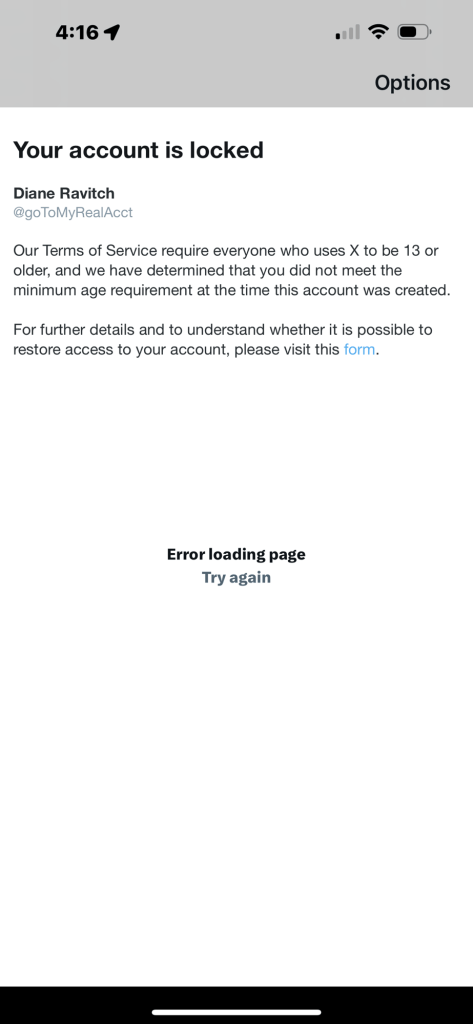
For three weeks, I was locked out of Twitter because of a snafu that’s not worth recounting. Every time I tried to log on, I received a notice saying I was underage and not allowed to engage on Twitter. I have been on Twitter since 2009. So, even though I have been an active participant on Twitter for 15 years, Twitter concluded I had not yet passed my 13th birthday!

I have been active on Twitter for 15 years, but the great X decided I was not yet 13. Should I feel complimented or insulted?

Anyway, I didn’t watch or listen when Elon Musk held a conversation with Trump last night. I did notice, however, that the topic “slurring” was trending, and I discovered hundreds of comments about Trump slurring his language in the conversation, which led to comments about weird things Trump said: congratulating Musk for firing workers who dared to strike; brushing off climate change and rising seas, instead saying that he would get “more oceanfront property” and that our real worry should be “nuclear warming.” Many more non sequiturs.

Rex Huppke of USA Today wrote about the Musk-Trump show and summed it up well: it was a disaster. Worse, it was boring.

It started 40-45 minutes late, due to technical problems.

It was downhill from there.

For a fascism-curious billionaire who loves cuddling up to right-wing loons, Elon Musk sure is good at making right-wing politicians look stupid.

Former President Donald Trump had loudly trumpeted a planned Monday night interview with Musk that would stream on X. But much like the disastrous X-platformed launch of Florida Gov. Ron DeSantis’ presidential campaign, the Musk/Trump interview failed to launch, leaving social media users laughing at the collective incompetence.

Since Vice President Kamala Harris rose to the top of the Democratic presidential ticket last month, Trump’s reelection campaign has been flailing. His childish attacks against her aren’t working. His racist comments about her mixed-race heritage have repelled all but his most loyal supporters. His vice presidential pick, JD Vance, becomes less likable every time he speaks.

So his answer, weirdly, was to sit down with Musk and talk to what would undoubtedly be a very online audience that doesn’t represent the broader electorate. Had the conversation gone off without a hitch, it still would have been odd and largely useless for Trump’s effort to halt Harris’ momentum….

Forget the glitches, Trump’s X interview got worse when he started talking

Of course, things didn’t get better for Trump once the interview was able to proceed. …

He was rambling, babbling on about crowd sizes and immigration and President Joe Biden and whatever else seemed to pass through his mind. He was also badly slurring his words, raising questions about his health, and doing nothing to knock down rising concerns about his age and well-being.

He sounded like a disoriented, racist Daffy Duck…

I’m not going to quote anything Trump said in the interview because it was either too stupid to merit transcription or a mere repetition of the nonsense he spouts at every rally he holds.

A big part of Trump’s problem right now is he has become almost unbearably boring. Build a wall. Drill, baby, drill. Marxist, socialist something-something. Harris only recently became Black. Blah, blah, blah.

So for Trump, sitting down with a rich weirdo few people like and slurring his way through an interview that failed to launch was, in the words of one Donald J. Trump, “a DISASTER!”

Musk, with his social-media ineptness and unmerited sense of self-importance, made DeSantis look like a fool. And now he’s done the same to Trump.

Ben Meidas, a creator of The Meidas Touch blog, demonstrates Trump’s state of mind by reproducing some of his recent posts on “Truth Social,” the media site Trump launched after he was banned by Twitter for inciting violence.

The first question that occurs is: Is it normal for a 78-year-old man to refer to his political opponents by calling them derogatory names? Isn’t that what you might hear on a playground from little children? Doesn’t it seem as though he is the playground bully? Was his mental and emotional development stunted at the age of 7?

Trump has said repeatedly that he will defund schools that mandate vaccines. Every state requires vaccinations before enrolling students. I may be mistaken but I think every state requires children to be vaccinated for a long list of diseases. So, he is threatening to defund every public school in the nation.

Dr. Paul Offit, a specialist in infectious diseases, explains what a dangerous idea this is. Vaccines work. Vaccines save lives. Trump is pandering to the anti-vaccine people. They are wrong and so is he. Children will die if Trump gets elected and follows through on this vile promise.

Dr. Offit writes:

At a campaign rally on June 22, 2024, former president Donald Trump told a crowd of cheering fans, “I will not give one penny to any school that has a vaccine mandate.” Given that every public school in the United States has vaccine mandates, this would mean eliminating all federal funding for public schools. Will Trump’s statement pressure schools to eliminate mandates? More to the point, why are school vaccine mandates important?

The best way to understand school vaccine mandates is through the lens of measles virus, the most contagious vaccine-preventable disease. Measles vaccine first became available in 1963. At that time, every year in the United States, 3-4 million people would be infected with measles, 48,000 would be hospitalized, and 500 would die. Deaths were primarily caused by pneumonia, severe dehydration, and encephalitis (inflammation of the brain). By the late 1960s, measles vaccination led to a 95 percent drop in the incidence of the disease. By the early 1970s, however, immunization rates had become stagnant. Measles cases increased. In 1971, about 150,000 cases were reported. Although the number of states requiring vaccines for school entry increased from 25 in 1968 to 40 in 1974, health officials hadn’t enforced them.

By 1981, all 50 states had school immunization requirements. By 2000, because school mandates were enforced, measles was eliminated from the United States. However, 45 of 50 states now allow philosophical or religious exemptions to vaccination. Because a critical percentage of parents have now chosen these exemptions, measles is coming back.  At the end of December 2022, schools and daycare centers in Columbus, Ohio, reported 85 cases of measles; 32 children were hospitalized; all were unvaccinated. During the past four years, 338 cases of measles have been reported. This year, 188 cases of measles were reported in the United States, triple the number of cases seen in 2023. If Donald Trump were to pressure schools to eliminate mandates, hundreds of cases of measles will become thousands of cases. The case-fatality rate for measles is about 1 in 1,000. If return to a time when measles infects thousands of people, children will once again die from a disease that is entirely preventable.

The notion that Donald Trump would withhold federal funding for schools is highly unlikely. But there is another way that Trump could weaken vaccine rates—eliminate the Vaccines for Children Program (VFC), which launched in 1994 and provides vaccines for all children who are uninsured or underinsured. The program is estimated to prevent about 30 million hospitalizations a year. Were the Trump Administration to eliminate the VFC, we could expect to retreat to a time, not that long ago, where every year polio paralyzed as many as 30,000 children and killed 1,500, rubella (German measles) caused 20,000 cases of birth defects, diphtheria was the most common killer of teenagers, and bacteria like Haemophilus influenzae type b (Hib) caused 25,000 cases of meningitis and bloodstream infections.

Although Donald Trump may have found an applause line at his campaign rallies, if his disdain for vaccine mandates translates into public policy, children who needlessly suffer preventable illnesses won’t be applauding.

The state of Florida—Ron DeSantis and his dumdum legislature—has decided that climate change doesn’t exist, but climate change doesn’t care. The Miami Herald reported that the last of a rare species in the Florida Keys has died—because of rising seas. The children of Florida won’t understand any of this because the State Department of Education will not buy textbooks that explain climate change. They think—I suppose—that if you don’t learn about it, it will go away.

Key Largo has a new, disturbing and first-of-its-kind graveyard. There are no headstones, no burial markers, no names, no bodies. 

It’s the last place an incredibly rare species of tree called the Key Largo tree cactus was seen alive, back in 2023. The killer? All the clues point to climate change. 

At least, that’s what a newly published paper suggests. Scientists have been watching this particular stand of cacti — known for their height (up to 20 feet) and brown hairlike puffball they grow around their flowers — since the 1990s.

At the time, researchers determined that a two-acre patch in John Pennekamp State Park was the only population in the U.S. of Pilosocereus millspaughii, an offshoot from the larger Caribbean population of the cactus. But as of last year, the very last of the bunch is gone. And researchers believe sea level rise was the main culprit — rising tides and groundwater turning the soil too salty for the plant to survive. It appears this local extinction (also known as extirpation) could be the first climate-driven demise of a species in the United States.

“As far as we know, from any published research we can find, this is the first case we can find,” same James Lange, lead botanist with Fairchild Tropical Botanical Gardens and co-author of the study, which was published Tuesday in the Journal of the Botanical Research Institute of Texas. “It was tragic to see as we monitored this over the years,” he said. “It was a big, old beautiful plant, one of the things that makes the Keys unique. And we’ve lost it.”

Read more at: https://www.miamiherald.com/news/local/environment/climate-change/article289915489.html#storylink=cpy

Leslie Postal of the Orlando Sentinel reports that Florida’s Department of Education has warned textbook authors to delete references to climate change, although some apparently are getting through. This is especially egregious since Florida is one of the states most threatened by climate change.

She writes:

Textbook authors were told last month that some references to “climate change” must be removed from science books before they could be accepted for use in Florida’s public schools, according to two of those authors.

A high school biology book also had to add citations to back up statements that “human activity” caused climate change and cut a “political statement” urging governments to take action to stop climate change, said Ken Miller, the co-author of that textbook and a professor emeritus of biology at Brown University.

Both Miller and a second author who asked not to be identified told the Orlando Sentinel they learned of the state-directed changes from their publishers, who received phone calls in June from state officials.

Miller, also president of the board of the National Center for Science Education, said the phrase “climate change” was not removed from his high school biology text, which he assumed happened because climate change is mentioned in Florida’s academic standards for biology courses. [Note: The state standards for science were adopted in 2008, before DeSantis was elected Governor.]

But according to his publisher, a 90-page section on climate change was removed from its high school chemistry textbook and the phrase was removed from middle school science books, he said.

The other author said he was told Florida wanted publishers to remove “extraneous information” not listed in state standards. “They asked to take out phrases such as climate change,” he added.

The actions seemed to echo Florida’s previous rejection of math and social studies textbooks that state officials claimed include passages of “indoctrination” and “ideological rhetoric.” And they fall in line with the views of many GOP leaders, who question both the existence of climate change and the contributions of human activities to the problem, despite a broad scientific consensus that human-caused climate change is transforming the earth’s environment.

In May, Gov. Ron DeSantis signed a bill that stripped the phrase “climate change” from much of Florida law, reversing 16 years of state policy and, critics said, undermining Florida’s support of renewable and clean energy…

But there are no textbooks for high school environmental science classes on the approved list, though three companies submitted bids to supply books for that class, according to documents on the department’s website. Course material for that subject typically includes significant discussion of climate change.

“How do you write an environmental science book to appease people who are opposed to climate change?” asked a school district science supervisor, who is involved in science textbook adoption for her district. She asked not to be identified for fear of job repercussions.

She and other educators, the textbook authors and science advocates said the state’s actions will rob students of a deeper understanding of global warming even as it impacts their state and communities through longer and hotter heat waves, more ferocious storms and sea level rise.

Florida had already earned a D — and was among the five lowest-ranked states in the country — in a 2020 study that graded the states on how their public school science standards addressed climate change, said Glenn Branch, deputy director of the center for science education, which was a partner in the study.

Is there a grade lower than F? F-?