Archives for category: Standardized Testing

Rhode Island State Commissioner Ken Wagner says that the state will drop the unpopular Common Core exam PARCC and adopt instead the Massachusetts test called MCAS. After all, if Massachusetts is the highest-achieving state in the nation, it must be because they have the best tests! So soon, you can expect Rhode Island to be up at the top of NAEP alongside Massachusetts because testing must be the key to their success, especially since Massachusetts has used more or less the same tests for two decades. Stability and the same test. Magic!

Now if every state adopted MCAS, then every state would be at the top!

People who came into education have a strange penchant to work for ultra-conservative politicians, like John White in Louisiana, Kevin Huffman in Tennessee, and Eric Guckian, who was education advisor to the far-right North Carolina Governor Pat McCrory.

Now comes this news via Politico Pro. I can’t give you a link because I don’t have a subscription (they told me it costs $3,500 and I run a very low-cost shop here):

A senior Trump administration education adviser is expected to move into a new role at the Education Department, according to multiple sources familiar with the shift who asked to remain anonymous because they were not authorized to speak about personnel issues.

Jason Botel, the former executive director of the Maryland education advocacy group, MarylandCAN, joined the Trump administration in January as senior White House adviser for education.

One source said he is being considered for a deputy assistant secretary position at the agency’s Office of Elementary and Secondary Education, which serves as a key partner to states and school districts in matters spanning pre-K through high school. The position is politically appointed but isn’t Senate-confirmable.

Neither Botel, nor an Education Department spokesman responded to requests for comment.

In recent months, Botel had helped an understaffed Education Department in various roles.

Botel shocked some of his colleagues by joining the Trump administration earlier this year. He had donated $400 to former President Barack Obama’s presidential bid in 2008. Those who know him say he’s passionate about strong accountability standards, and racial and social justice issues — priorities embraced by the Obama administration. Botel joined Teach for America out of college, teaching in Baltimore public schools, and later brought the charter school network, KIPP, to Baltimore.

You will note that Botel worked for Maryland CAN, which exists to encourage privatization via charter schools. After he left Governor McCrory’s office, he worked at TFA’s Leadership for Educational Excellence, which trains ex-TFA to run for office. Acquaintances believe that his appointment suggests a renewed emphasis on standards, testing, and accountability. Interesting that someone would feel equally comfortable working for Obama and then Trump. A flexible mind.

Georg Lind is a retired psychologist.

“As a psychologist I recommend to abandon all tests based on Classical and Modern “test theories.” But I am not sure whether my colleagues at APA and AERA will agree with me. They make a living on applying traditional tests. Even those who critically examine test usage do not question their validity and their use in principle. They have not only vested interests but have not heard of possible alternatives to which they could switch. Critical scholars like Alan Schoenfeld, professor of math didactics and former president of APA, warn us of the use of psychometric methods but all they suggest is a moratorium of tests. I think we can do better.

“I am a retired German professor of psychology, having specialized in experimental and psychometric methods, besides my involvement in the study of moral-democratic competence and its application in education. Already during my study at university I developed some suspicion against Classical Test Theory and its modern variations (IRT, Rasch-scaling), on which nearly all tests are based. The better I understood these “theories” the more I discovered that they have nothing to do with scientific psychology. Prevailing test theories are a modern form of Vodooism with sacred rituals which are to make the people believe that our sorting and evaluating of people is something rational, scientific. It is not.

“Prevailing test theories fail an important standard of sound science: they cannot be falsified by data, they are immune against reality. If a test yields some anomalies, its items are replaced until the data fit the statistical dogma of reliability – regardless of the damage this “item analysis” does to the overall validity of the test. Because test makers have no real understanding of what they measure they cannot answer the basis question of validity: Does the test really measure what we intent to measure? Instead they invent all kinds of “validities” in order to save their assumptions.

“No wonder that these tests have all failed. They have little, if any, “prognostic validity”. Even much criticized teacher grading is a better predictor of college success. Moreover, no support can be found for the allegation that their use would improve teaching and learning. I have analyzed many studies of the effects of the high-stakes-testing which began with the Head Start program in 1965, the year when I was exchange student in the US. I could not find any support for this allegation. Some small, short-term increases of test scores occurred but they could be fully explained by growing test-wiseness and cheating. Therefore, tests have to be replaced by new versions at an ever faster rate.

“Then it was the first time I had to take a test as a school student. In Germany we had no multiple choice tests in school until PISA started. I was surprised how easy it was to get an A. To answer a 90-minute test, it took me just ten minutes. I did not know many of the answers, I just made guesses. Only much later I understood why my school-mates worked harder but got lower test scores. It was BECAUSE they worked harder. For me tests were just fun like cross-word puzzles. I was not obliged to get credits. For them tests were high-stakes. They scared the hell out of them and confused them. Peter Sacks has shown how test anxiety, students’ background and test scores are connected. Tests cannot compensate for student poverty, bad teacher-education and poor curriculum. On the contrary, they even seem to deepen these disadvantages.

“But, if tests are based on well-elaborated teaching goals and on sound psychology, and if they are used anonymously, they can be a great help for improving curriculum and teaching methods. If tests are not used for evaluating people (which I believe is a human rights issue), but for evaluating teaching method and content, and for improving teacher education programs, they can be a real blessing. I have shown how a valid test can help to multiply the effect size of methods for teaching moral competence. Just google for the experimentally designed Moral Competence Test. Its construction principle, Experimental Questionnaire, can be easily adapted for other fields of teaching.”

Fred Smith is a testing expert who worked for the New York City Board of Education for many years. In retirement, he volunteers for parent groups fighting to stop excessive and pointless standardized testing. The testing starts tomorrow across the state, and the State Education Department is pulling out all the stops to hinder, deter, and block the opt-out movement.

The New York State Education Department (SED) has been campaigning to dissuade more parents from abandoning the annual testing program.

Last year the parents and guardians of 220,000 children opted out of the English Language Arts (ELA) and math exams. They are given to 1.2 million children annually in grades 3 through 8. Their administration becomes the center of attention for six school days. They are due to begin on Tuesday.

The effort to keep parents onboard this year depends on repeating the same misleading information the state provided in 2016. It must be challenged. There are also important test-related matters SED fails to advise parents about.

Seeking to turn back the opt-out movement, misinformation about testing has been reduced to a few scripted points to help SED and education administrators convey the idea that the testing program has improved: The number of questions on the exams has been reduced; more teachers have been involved in developing them; and the tests are untimed.

On the surface these seem attractive. But, fewer items make less reliable tests. The teachers who were involved reviewed but didn’t write the questions, which were developed by test publisher Pearson. And the removal of time limits means the tests are no longer being conducted under standard conditions, thereby nullifying attempts to measure growth.

Effectively, the results of the 2017 exams cannot be used to make meaningful comparisons over time. This should end their already shaky use to assess student progress, or be factored into value-added formulas to judge teacher effectiveness, or enter into the evaluation of school performance. Ipso facto, the inability to make year-to-year comparisons of achievement is a sufficient reason for opting out.

Another selling point the state makes is that, while the tests will continue to be given, no teachers or principals will be affected by the results. This may lull people concerned about the misuse of the tests into accepting their administration because negative consequences have diminished.

My experience tells me something different. Whenever there is an investment in testing, a use for the scores will be found to justify the cost and to shield decision makers, who lean on the results, from taking direct responsibility for their actions.

There is a darker side to the propaganda. In announcing the improvements, an SED spokesperson said, “It’s up to parents to decide if their children should take the tests and we want them to have all the facts so they can make an informed decision.”

Then why does State Education Commissioner Elia withhold information on a parent’s right to opt out of the exams? And why has the state continued since 2012 to keep parents in the dark about the field testing of questions that allow publishers to develop future exams for free by trying out test questions on children?

Both omissions are most notable in a one-page document posted on SED’s Engageny , titled The 2017 Grades 3-8 New York State Assessments: What Parents Need to Know. Evidently, they must know the tests are untimed, shortened, reflective of teacher involvement and the fact that some districts will give them on computers. The ultimate goal is a transition to universal computer-based testing. No reason they should know about opting out or about the field tests.

This is pure arrogance. Presenting information in a need-to-know manner implies that parents are like soldiers told only those things that are essential to the discharge of their duties—in this case, an obligation to take the tests. This is how we “enage” parents?!

Here are some more facts about 2017’s field testing that parents don’t need to know:

There are two approaches publishers follow to develop questions and determine which should be kept for subsequent exams. The preferred way is to embed try-out material (reading passages and associated questions) in the test booklets that students are striving to complete. In theory, students can’t tell which questions are experimental and do not count in scoring their tests from the operational ones that count. Thus, they should be motivated to do well on the trial items.

This year, 22% of the ELA multiple-choice items that appear in Test Book 1 (March 28) are being field tested. In grade 3, 25% of the items are being tried out. That is, one reading passage and six out of the 24 items are developmental. They don’t count, but they require time and energy to complete and their inclusion on the tests can have an impact on the results.

In math, embedded items will make up 14% of the tests, interspersed among the operational items. They are contained in Test Books 1 and 2 (May 2 and 3). Statewide, 1.2 million children have been volunteered to participate. Parents haven’t been asked for their consent.

The less preferred way to try out items, known as stand-alone field testing, has also been taken by SED, because embedding has not yielded enough items to build new tests. So, separate field tests are used to generate sufficient material for the next round.

Here too, parents are not told about these tests. The state has targeted 3,073 schools for ELA or math stand-alone field testing on one grade level any day between May 22 and June 9. 973 of them are being tapped to participate in the computer-based testing part of this experiment.

What makes stand-alone field testing weak is that students are not motivated to do well on tests that are given late in the year consisting entirely of questions they know don’t count. Therefore, the information obtained about how the try-out items functioned is tenuous when publishers must choose which ones will become operational.

Stand-alone field testing has been discredited and criticized as contributing to poorly constructed Common Core exams. There are no negative consequences for rejecting this shoddy approach.

Clearly, not leveling with parents shows contempt. It is part of SED’s conspiracy of silence designed to keep mass testing in place. Parents and their children, the lifeblood of the public schools, should strongly consider opting out of the 2017 exams.

Sarah Blaine, a lawyer and parent in New Jersey, calls on the legislature to block the use of PARCC as a graduation requirement for students in the state.

As she notes in this article, the New Jersey Assembly voted overwhelmingly to block the State Board of Education from imposing this nutty requirement.

The bill now moves to the State Senate, and she urges senators to vote for the bill.

She writes:

On March 16, the New Jersey Assembly overwhelmingly passed ACR-215, which is a resolution declaring that the state Board of Education’s new regulations requiring students to pass the PARCC Algebra 1 and the 10th grade PARCC English Language Arts tests to graduate from high school are “inconsistent with legislative intent.”

The existing law requires a comprehensive 11th grade test (which these two PARCC tests, neither of which is generally administered in 11th grade, are not). The resolution will not stop New Jersey’s schools from having to offer PARCC each year, but if adopted by the state Senate as well, it is a step toward ensuring that students will not have to pass PARCC to graduate from high school.

With this resolution, the Assembly took the first step in one process by which our New Jersey legislators can check the authority of our governor and his appointees (in this case, the state Board of Education): invalidating regulations that our Legislature determines are “inconsistent with legislative intent.” In English, that means that if the Legislature passes a law, and the executive branch decides to ignore the law and do something different, the Legislature can tell the executive branch: “No, you’re wrong, please go back to the drawing board.” Because this is a check on the executive branch’s authority, the governor’s signature is not required.

As at least 180,000 New Jersey students demonstrated by refusing to take PARCC tests in 2015 and 2016, opposition to PARCC testing is widespread. But leaving the substantive issues surrounding the PARCC test aside, important as they are, ACR-215 and its senate companion resolution, SCR-132, are about governance. That is, in considering these resolutions, the key question our legislators must decide is whether they are willing to allow Gov. Chris Christie and the Christie-appointed Board of Education to openly ignore New Jersey law.

Blaine writes about the issue as an open conflict between the executive and the legislative branches.

But the substantive issues are worth reviewing.

The PARCC test was created by Pearson as a test of the Common Core standards in grades 3-8.

PARCC was never intended to be a graduation test. Most states that signed up to use it as a test of annual student performance in grades 3-8 have dropped it. New Jersey is one of the very few states that still require this test.

No standardized test should be used as a high school graduation test. Standardized tests are normed on a bell curve, and they are designed to differentiate from best to worst scores. They are designed to have a certain proportion of students who will fail, no matter how hard they try.

The state of New Jersey should not substitute the SAT or the ACT or any other standardized test for PARCC, because they all suffer the same fatal flaw.

There are many ways to set graduation requirements and make them rigorous for some, but reasonable for all. It is not reasonable to establish a high bar that some students will clear, but most will not, or that a substantial minority will not. There must be a reasonable path towards winning a diploma, especially for students with cognitive disabilities, and students who for other reasons will never ever pass the PARCC.

It is a basic rule of psychometrics (the study of testing) that tests should be used only for the purpose for which they were designed.

The legislature should force the governor and the state board to drop PARCC as a graduation requirement and give thought to reasonable standards that match the diverse needs of the state’s students.

If the state keeps

I have earlier reported studies showing that students post higher scores when they take tests with pencil and paper, rather than on computers. Some children do not have keyboard skills, some get confused by scrolling up and down in search of the right text. Yet state officials demand that students take tests online. This is especially pernicious for the youngest children, who are least likely to have the computer skills needed for the testing. This parents asks why.

Open Letter to
Kimberley Harrington,
Acting Commissioner of Education
State of New Jersey

March 10, 2017

Dear Ms. Harrington,

You are making nearly all third graders in the state of New Jersey take the PARCC test on a computer knowing scores would measure more accurately, and very likely be substantially higher if the test were administered with pencil and paper. Many reputable articles in professional publications substantiate this. My son is in third grade. I am both a concerned father and an educator. Why would you not want New Jersey students to achieve the highest scores possible? PARCC assessment tests the knowledge students acquire from their teacher, not adeptness using a computer – or am I missing something? Your insistence the PARCC be administered on a computer not only likely negatively impacts scores, but also potentially reflects negatively on a teacher’s evaluation as 30% is based on PARCC scores.
I would like to understand more about your logic behind this mandate. Schools unfortunately have cast aside handwriting instruction and other important developmental skills to make room for PARCC. Why then insist the PARCC be administered on computer?

Many parents across New Jersey are anxious to hear your detailed reasoning on this matter.

David Di Gregorio
Father, Englewood Cliffs

Donald Trump’s selection of Betsy DeVos to be Secretary of Education set off a seismic reaction among parents, educators, and other concerned citizens across the nation. Never, in recent memory, has a Cabinet selection inspired so much opposition. The phone lines of Senators were jammed. People who never gave much thought to what happens in Washington suddenly got angry. Snippets of her Senate confirmation hearings appeared again and again on newscasts. It was widely known that she was a billionaire who has spent most of her adult life fighting public education and advocating for privatization via charter schools and vouchers for religious schools.

She is Secretary and has pledged that her hope is to open more charters, funnel more money to cybercharters, encourage more homeschooling, and encourage state programs for vouchers, much like the Florida tax-credit program that has funneled $1 billion to organizations that pay for students to attend mostly religious schools.

There have been many state referenda on vouchers. The public has rejected every one of them, including the one funded by Betsy DeVos in Michigan in 2000 and by Jeb Bush in Florida in 2012.

Citizens must work together to block every federal or state effort to defund public schools.

There are two ways to stop DeVos.

One, join local and state organizations that are fighting privatization. Contact and join the Network for Public Education to get the names of organizations in your state.

Two, opt out of federally mandated tests. That sends a loud and clear message that you will not allow your child to participate in federal efforts to micromanage your school. Whatever you want to know about your state’s test scores can be learned by reviewing its scores on the National Assessment of Educational Progress. For example, we know that Michigan students have declined significantly on tests of reading and math–especially in fourth grade–since the DeVos family decided to control education policy in their home state.

The state tests are a sham. Students learn nothing from them, since they are not allowed to discuss the questions or answers. They never learn which questions they got wrong. Teachers learn nothing from them. The scores come back too late to inform instruction, and the contents are shrouded in secrecy. The tests are a waste of valuable instructional time and scarce resources. They teach conformity. They do not recognize or reward creativity or wit. They reward testing corporations.

Say no to DeVos by opting out. Send a message to Congress that its mandate for annual testing is wrong. Revolt against it. Teach your children the value of civil disobedience and critical thinking. Defend authentic education. Resist! Opt out.

Community Voices for Public Education is grassroots group in Houston that is a leader in the fight against high stakes testing and test prep mania. It is holding a rally tomorrow to protest DeVos and to share some good news about HISD.

4:30 pm

HISD Hattie Mae White Educational Support Center

The good news:

*Students do not need to take or pass the STAAR test this year to be promoted

*HISD school board will pass a resolution supporting immigrant families

*HISD board will not use student test scores as part of teacher evaluations this year

John Kuhn was the superintendent of the small Perrin-Whitt school district in Texas and was recently named superintendent of schools in Mineral Wells, Texas. He is also one of the best informed, most eloquent critics of corporate reform in the nation. He was a lead speaker at the 2011 Save Our Schools March on Washington, where he electrified the crowd. He has recently published two books: Fear and Learning in America and Test and Punish: How the Texas Education Model Gave America Accountability Without Equity. Kuhn says that the Texas A-F school grading system sets up schools that enroll poor kids to fail; A stands for “Affluent.”


Kuhn writes:


Texas Education Agency Releases A-F Grades for School Districts the Same Day It Dismisses Its Own A-F Grade on the National “Quality Counts” Report Card


On January 5, the Austin American-Statesman published the Texas Education Agency’s A-F grades for Texas school districts and campuses. The law establishing this system called for official A-F grades to come out in 2018, so these are “what if” grades, intended to provide to legislators a preview of what the “real” grading system will look like when grades come out officially. In a statement, TEA commissioner Mike Morath cautioned that no “inferences about official district or campus performance in the 2015– 16 school year should be drawn from these ratings.” That didn’t keep public school critics from immediately proclaiming that the A-F grades “transparently and comprehensively represent the performance of districts and campuses statewide.” No surprise there; A-F is seen by many as a tool designed specifically to give anti-public education forces ammunition to aim at the public school system.


In releasing the “work-in-progress” A-F grades to the public (as they were obligated to do), TEA officials ensured that these unofficial scores will become the de facto rating system for Texas schools for the remainder of the year, even though an actual rating system is already in place. This is despite commissioner Morath stating clearly and repeatedly that the grade report “is very much a work-in progress,” that the bases and assumptions behind the grades may change, and that the TEA didn’t take into account local community ratings of districts (statute requires that this local stakeholder input be included as 10% of schools’ final A-F grades). We now have a confusing situation in which the TEA homepage notes in a headline article that 94% of Texas school districts “Met Standard” while public school critics giddily point to another article on the same homepage announcing the release of A-F grades that often label formerly successful schools as sudden failures. In fact, several high-performing schools around the state received D’s and F’s. The Dallas Morning News listed 11 local school districts that received F’s but that were only recently considered as having “Met Standard.” “That’s amazing
when you consider that they all met the standard two weeks ago and the scores, the data, haven’t changed,” Mesquite Superintendent David Vroonland said.


School district officials have called the new A-F system “a big mistake,” “NOT an accurate reflection of quality education,” and “an unfair game,” and have noted that a similar A-F system was rescinded in Virginia after failing spectacularly, and that, since an A-F rollout in Oklahoma, student performance has declined significantly–despite the fact that A-F systems are sold to legislators as a means to improve student performance by holding districts accountable. It is difficult not to conclude that this system is for the most part arbitrary and capricious. In one respect it is very reliable, as it actually very consistently punishes those Texas schools that serve the most economically- and socially-challenged families and students. District A-F grades appear to align exceptionally closely with the percentage of economically-disadvantaged students on school district rosters, a factor that is obviously outside the ability of schools to affect.


As a means of assessing the impact of non-school factors on districts’ A-F grades, I sorted every school district in the state by the percentage of their student bodies made up of economically disadvantaged students, and then I listed their A-F grades out to the side. I took the ten districts with the lowest percentage of economically disadvantaged students that received grades in all four categories and compared them to the ten districts with the highest percentage of economically disadvantaged students. Here are the results:


The 10 Schools Serving the Lowest Proportions of Poor Kids in Texas

A – 20

B – 7

C – 9

D – 2

F – 2

Overall average – B

On the other hand:


The 10 Schools Serving the Greatest Proportions of Poor Kids in Texas:

A – 6

B – 8

C – 11

D – 6

F – 9

Overall average – D+


As you can see, there is a strong and verifiable correlation between districts’ A-F grades and the prevalence of poverty among their students. Meanwhile, there is no verifiable correlation between districts’ A-F grades and the quality of their teachers, which is supposed to be the purpose behind A-F grades even existing. They are supposed communicate to the public which schools are better, not which schools are poorer. We don’t need a measure that communicates which schools have the greatest concentrations of poor kids—we already have that measure (the economically disadvantaged numbers). The A-F system exists to differentiate good schools from bad, not poor schools from rich, and it can’t do it! Major fail.


That latter assertion—that A-F can tell us which schools are better and which schools are worse—was never really anything more than a blind assumption built on ideology and political posturing, rather than on science. This A-F system, despite what the anti-public education lobby will say, is not in the least transparent, not in the least fair, not in the least accurate, and does not serve the need of Texas parents and taxpayers to be informed about the quality of teachers and schools. In fact, if anything, it misinforms them. It amounts to fake news. These are fake grades, non-representative of what they purport to reflect. If your passing school in Texas is suddenly failing today, it’s probably because it educates the wrong kinds of kids: poor ones. The A-F system is carefully-crafted disinformation likely to adversely effect on public support for public education.


If I had time, I would do a similar bit of sorting of districts by residential home values, ratios of students served in special education, ratios of students with limited English, ratios of at-risk students, average teacher salary levels, and school finance revenue levels (because, in case you don’t know, Texas schools are funded at wildly different levels). I predict that each of those exercises would result in a strong correlation with these A-F grades (that, again, purportedly reflect teaching quality and supposedly do NOT merely reflect non-school factors outside the control of the educators being smeared by these grades). I challenge any statisticians worth their salt to examine this system in an independent review and let Texas education stakeholders know what these grades really show.


Commissioner Morath had to release these grades by law, so I don’t blame him for releasing it. However, he badly let down local teachers and administrators by over-promising transparency in the lead-up to A-F and under-delivering with its rollout. In a meeting of school leaders from the Dallas-Fort Worth area in December, Mr. Morath confidently assured school leaders that, out of a sense of fairness, since schools in Texas are funded so inequitably, he would ensure that anywhere the TEA published A-F ratings for schools, the Agency would also publish information related to each school’s relative funding level—so that users of the information would have the full picture, as it is unfair to expect schools with fewer resources to outperform schools that are funded more generously. Having promised that, however, Mr. Morath somehow failed to ensure that the information published by the Austin newspaper included the funding-levels context. As of this writing, I haven’t seen the promised relative funding levels information published anywhere by TEA. As many of us feared, the assurance that appropriate context would be included alongside the published results of the A-F accountability system appears to have been little more than a bait-and-switch. As with every school accountability system in the history of the state of Texas, this system purports to communicate to Texas parents that it represents a fair ranking of schools that are competing on an even playing field. In reality once again, by funding some schools at double and triple the level of others and keeping hush-hush about which schools are flush and which are kept on a shoestring budget, Texas is picking winners and losers and concealing the fact in school accountability system after school accountability system. This A-F system, like all the others, occludes more than it reveals.


In the end, A-F appears to exist primarily as a political tool, designed not to inform but to misinform parents and taxpayers across Texas. The A-F rating system has not been independently assessed for validity. No third party has done an in-depth analysis to establish whether A-F grades for schools tend to significantly correlate with factors outside of schools’ control, such as poverty levels of students, discrepant funding levels, and the like. Until it is established that the system accurately reflects educational quality more than it reflects social realities that schools operate within and cannot control, the system should be considered incapable of serving its stated purpose. No educational quality conclusions should be drawn absent this independent validation.


One last sidebar:


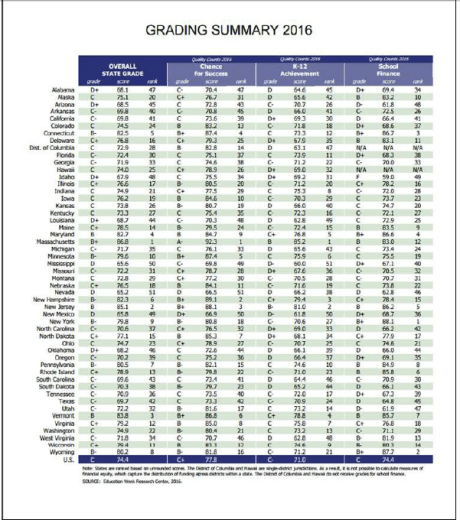
Ironically, on the same day that the TEA released grades for local campuses, it received its own A-F grade from Education Week’s “Quality Counts” report on the education systems in all 50 states and the District of Columbia. The Texas Education Agency received an overall grade of C- on the national report and wasn’t happy. TEA immediately dismissed the validity of the report, stating that it is “difficult to effectively evaluate the state’s performance from a national report where no state made the highest grade, no state made the lowest grade, and the majority of states were all lumped into the same grade category.”


On the chart below (from www.edweek.org/media/qualitycounts2016_release.pdf), you will see that on the “Quality Counts” ranking, Texas ranked 45th in the nation in school finance. In other words, Texas schools are low-funded compared to other states. However, on the achievement of students, Texas was ranked 24th. To this educator, that means Texas teachers are picking up the slack that lawmakers are leaving. Additionally, on a third measure called “Chance of Success”—which includes circumstances faced by students including family income, parent education, parent employment, steady employment, etc.—Texas ranked 42nd. So, despite long odds and little meaningful help from policymakers, Texas teachers are doing an outstanding job overcoming obstacles placed in front of them and helping our students to learn.
screen-shot-2017-01-08-at-9-45-25-am

Despite the systemic obstacles like inadequate school funding and insufficient outside-of-school supports available to Texas children, the TEA nonetheless released this grading report labeling 30% or so of Texas schools—as demanded by the bell curve they built the system on—as “D” and “F” schools. Perhaps most incredible of all is the fact that these grades are based almost exclusively on STAAR standardized test results, an exam fraught with problems, about which the Texas Lieutenant Governor Dan Patrick once said “we don’t trust this test.”


Despite misgivings about the quality and ability of the test to reflect student learning, and despite the TEA’s own tepid reaction to its A-F grade from Education Week, and despite the prior existence of a school accountability system proclaiming 94% of Texas schools to be satisfactory performers, and despite the fact that the A-F system reflects poverty better than it reflects teaching quality, ultimately, when it comes to A-F grades, the Texas Education Agency apparently believes it is better to give than to receive.


Note:  Spreadsheets with the Texas data can be found here and here.


Bruce Baker of Rutgers University is frustrated. He and colleagues have published study after study about the uses and misuses of standardized test scores to measure teachers and schools.The evidence is clear, he writes. Yet states remain devoted to failed, erroneous methods that pack any evidence!


“It blows my mind, however, that states and local school districts continue to use the most absurdly inappropriate measures to determine which schools stay open, or close, and as a result which school employees are targeted for dismissal/replacement or at the very least disruption and displacement. Policymakers continue to use measures, indicators, matrices, and other total bu!!$#!+ distortions of measures they don’t comprehend, to disproportionately disrupt the schools and lives of low income and minority children, and the disproportionately minority teachers who serve those children. THIS HAS TO STOP!”