Archives for category: Standardized Testing

Dr. Michael J. Hynes is superintendent of the Port Washington school district on Long Island in New York. He previously posted here his proposal for a new vision of education.

He writes here about the College Board, which has become the gatekeeper whose tests decide which students go to which colleges.

He writes:

The College Board Monster and Why It’s Time to $lay the Dragon (at least during a pandemic)

Michael J. Hynes, Ed.D.

Reader beware. I wrote a scathing diatribe about the College Board a few years ago. I have since updated it as we enter testing season this spring.

Before you read my thoughts about the educational sacred cow and standardized testing machine known as the College Board, you should know up front that I am no fan of the College Board CEO/President David Coleman who years ago was the architect of Common Core. I felt this way before the pandemic and feel even more strongly about it now.

Most of us in the educational world know of the Common Core State Standards and the “test focused education reform movement” that accompanied it as a fiasco that plagued American schools.

Mr. Coleman was on the English Language Arts writing team and his good friend and eventual partner at Student Achievement Partners (SAP) Jason Zimba was a leader on the Common Core Mathematics team. Student Achievement Partners is a non-profit organization that researches and develops achievement based assessment standards.

Interesting enough, it was funded in large part by Bill Gates. The final nail in the coffin for me was when I realized Mr. Coleman, his former assistant and Mr. Zimba were founding board members for Michelle Rhee’s StudentsFirst, an organization that lobbies for standards driven educational reform.

Do you see a pattern?

Years later Mr. Coleman still leads the College Board money-making machine and this educational monolith is the church where most public schools worship several times a year.

For the reader who doesn’t know what The College Board is: it is the ultimate gatekeeper and judge-jury-executioner for millions of students each year who dream to enter college and it literally is a hardship for many families due to the test taking expense.

Schools and families have no other choice because there is no other game in town, aside from a student taking the ACT exam.

The College Board claims to be a non-profit organization, but it’s hard to take that claim seriously when its exam fees for the Scholastic Aptitude Test (SAT), Advanced Placement test (AP), services for late registration, score verification services and a multitude of other related fees are costing families and schools millions of dollars each year.

Eleven years ago this “non-profit” made a profit of $55 million and paid nineteen College Board Executives’ salaries that ranged from three hundred thousand dollars to over one million dollars a year.

That trend continues today.

Cost aside, it is hard to fathom and understand how the College Board has claimed a monopoly-like status over our public school system.

Over the years it has literally convinced school administrators, school board trustees, teachers, parents and students they can’t live without what they sell. They sell classes and tests to schools like Big Pharma sells pills to consumers.

They sell as much as they can and jack up the prices just enough where most people won’t complain. They have convinced my beloved public education system, the university system and pretty much the solar system that if students don’t take the PSAT, the SAT and now multiple Advanced Placement tests during a child’s tenure in high school, then those students won’t be competitive and have the same opportunities to be successful in life as the ones who drink the College Board Kool-Aide.

I fear too many of us have bought this story hook, line and sinker without many of us asking the question…why and how did we let this get so out of control?

We now know there are over 800 colleges (and counting) that are SAT optional or flexible. We also know that AP classes and tests have doubled over the past ten+ years. Over four million tests are administered each year.

If you do the simple math (4 million tests x $94.00 a test = over $376 million a year). And that’s just the AP exam…the money from the AP exams go to the College Board and a students’ score is sent to the student but they never know what questions they got right or wrong, they just receive a score of 1-5. The reality is many schools get great marks for enrolling more AP students and the College Board makes a ton of money off this arrangement.

What a sham.

The problem I have with College Board is the effect and infection it’s created on the climate within school systems and their respective communities. We have reached a crescendo of students and families believing that “more is more” when it comes to prepping for the PSAT/SAT tests.

The SAT (with the optional essay) can be taken several times throughout a student’s high school career. If you do the simple math (1.7 million tests x $64.50 a test = $109 million a year). This does not include the other fees attached to the SAT test or the prep books or courses a student may take. If your child is applying to many colleges, you will pay for each score sent to them. 

Here is an example of how much it costs for SAT prep courses:

There are some SAT prep centers that cost upwards of $1800 per in-person course to online courses that cost up to $1400 per course. One-on-One tutoring can cost up to $200 an hour. This all adds up very fast. More important, how is this not seen as an equity concern? Many families can’t afford this type of assistance and since so much is at stake for successful college acceptance, it’s criminal unless the system truly changes. 

As a school superintendent I see and hear about many families hiring tutors for PSAT tests (sometimes starting in eighth grade) and many young men and women taking AP classes because they are “weighted” which bolsters their academic transcript and grade point average.

Most troublesome to me is when I’m told by families that enroll their children in multiple AP classes each year; taking so many AP classes provides a “badge of honor” for both the family and student. In some school districts you have communities that have bred and unleashed a “Keep up with the Joneses” phenomenon. All at the expense for what?

If this is true, what are the unintended consequences? Mental health has never been more important. When students take multiple AP classes and have four hours of homework and skip lunch every day, who suffers in the end? When a student feels like they have to take multiple AP classes to keep their class ranking high and take as many classes as possible to receive college credit so they potentially save money when they go to college, what are they losing in the present moment when they are still in high school?

I believe we have more stressed out and anxious children in our high schools than ever before.

This is a big reason why.

I offer some sincere observations sprinkled in with some facts…

1. AP classes have a lot of material with not much time to teach and truly understand it. Don’t get me wrong, many of the courses are wonderful and stretch our student’s worldview and cognitive abilities, but the courses end in early May. They don’t have the same amount of time as other students who take courses throughout the year. IN NY they have almost two months of school left!

2.  Students are over burdening themselves with the belief that 8-10 AP courses guarantees them access to a high performing university or academic scholarships. I don’t believe that’s true.

One thing I can guarantee this type of course load will provide is 4 hours or more of homework every night and not enough time for students to take electives they will enjoy.

Also, a friend of mine and I agree that the college acceptance process is so badly and deeply damaged, that kids should know that lots of AP classes will not help them as much as they think.

3.  If schools had the courageous conversation to eliminate class ranking, eliminate the weighting of AP classes and mandate lunch for every student, I believe we will have healthier and happier kids. U.S. News and World Report must stop using AP courses as part of their criteria in ranking the top high schools in America.

If they care about college readiness so much, how about looking at more important factors for success such as a student’s emotional, social and physical growth.

It would paint a much more effective predictor of college readiness and future success.

4. Schools must do a better job of promoting predictors of success that are not affiliated with the College Board. Universities want to see that students are more than AP test taking machines:1. GPA (grade point average) is a much better predictor of college success2. Rich and eclectic electives – take risks and explore new opportunities3. Play a sport – physical growth is just as important as academic growth4. Join clubs – a great way for students to get their social and emotional needs met5. Join outside school organizations in the community – fosters empathy6. Work after school part time – teaches responsibility

A few years ago, Mr. David Coleman once said, “Never give someone only one chance to be great.”

I couldn’t agree more but we know the College Board stands to make millions of dollars off of a child’s second chance by taking the SAT or AP test(s) multiple times a year.

If the College Board is really looking to provide better opportunities for students, why not make the test fee reasonable? I know they offer reduced pricing for some hardships but why not make a flat fee for all students? I thought the purpose of a non-profit was to not make a profit…especially off of children.

Finally, if information needs to be sent from the College Board to anywhere the family needs, make it a free service.

I have a problem when non-educators make decisions in my educational arena.

David Coleman and the College Board are not educators, they are business-people. As a parent, would you bring your child to a businessperson instead of a pediatrician if your child was sick? Would you find it odd that your child’s teacher or principal was a businessperson and not an educator?

So the obvious next question is. why is it widely accepted that we have business-people who run an educational institution that has such a significant influence over our children’s futures, a families’ pocketbook and total domination over the last two-three years of your child’s high school experience?

Mr. Coleman, please help me understand how these tests have not been placed on hold during this pandemic. Students are fighting for their lives. They are living in incredibly difficult times where the importance of mental health is at an all-time high but our children’s mental health is at an all-time low. 

The College Board has fleeced us all and its time we fight back against our over reliance on this monopoly.
The mainstream media are filled with warnings about “learning loss” and how we must measure it and why students should go to summer school to make up for what they have “lost.” If we can’t quantify it, they say, how can we know which students are behind? This is silly. There was no “pre-test,” so there can’t be a “post-test.” A test that students take this spring can’t possibly demonstrate “learning loss,” since they can’t be compared to anything else. If you want to know where students are in their learning, ask their teacher.

Here are some good readings on “learning loss.”

Peter Greene gathered some and calls his post a “learning loss debunkery reader.” And don’t miss Peter’s personal tale of his own “learning loss.” It began right after high school graduation, when he realized he had forgotten algebra!

Russ on Reading turned “learning loss” into a Henny Penny fable, in which the wolves are trying to get into the henhouse.

“Wait a minute. Are we sure our children have lost their learning? I know a year away from the schoolhouse is concerning. And I know the online learning is not as good as beak to beak learning, but just what are we worried about here. Our children are learning lots of things. They have learned how to make the best of a bad situation. They have learned how we all need to pitch in to help each other. They have learned to wear masks in public. They have learned a lot about communicable diseases. They may have different learning this year, but is that the same as losing learning?  Before we let the foxes into the hen house, we better be sure there is a big problem.”

The Zoom meeting went silent. Goosey Loosey shut down Foxy Loxy’s Zoom feed. She said, “You know maybe we have bigger things to worry about than learning loss. I am going to go read my chicks a book.”

Pay attention to whatever Yong Zhao writes. He is among the very top tier of educational thinkers in the world. I always learn when I read his work.

This post warns parents, teachers, and policy makers to beware the “learning loss” rhetoric. It is a trap, he says.

He writes:


A dangerous trap exists for educators and education policy makers: the learning loss. This trap comes with a large amount of data and with sophisticated projection methods. It presents a stunningly grim picture for education and it invites educators and policy makers to make wrong decisions and invest in wrong things. The article identifies a number of undesirable outcomes that their concerns could lead to. It also suggests several productive actions when the pandemic is controlled and schools reopen.

The trap is the so-called learning losses during the Covid-19 pandemic. A number of organizations and individuals have put out various estimates about what students have lost due to school closures and remote learning during the pandemic. For example, the global consulting firm McKinsey produced two reports about these learning losses. As late as December 8, 2020, McKinsey said, “Students, on average, started school about three months behind where we would expect them to be in mathematics” and “Students of color were about three to five months behind in learning; white students were about one to three months behind” (Dorn et al. 2020). The Center for Research on Educational Outcomes (CREDO 2020) at Stanford University issued a press release stating that “the average estimates of how much students lost in the Spring of 2020 ranged from 57 to 183 days of learning in Reading and from 136 to 232 days of learning in Math” (para. 2). Other organizations, such as the assessment company NWEA (Kuhfeld and Tarasawa 2020) and the Annenberg Institute at Brown University (Santibanez and Guarino 2020), have also published reports about learning losses. The Organization for Economic Cooperation and Development (OECD) published a projection for the economic losses due to learning losses as $14 trillion over the next 80 years (Hanushek and Woessmann 2020).

These estimates have caught the attention of policy makers and educators. Governments, school leaders, and teachers are all concerned about the learning loss students may experience due to the Covid-19 pandemic. After all, schools have been seriously disrupted, as have students and their families. The pandemic has, in more ways than one, significantly affected learning and school operations. It seems only natural to want to know the extent of the learning loss students have experienced and then take actions to hopefully make up for the losses.

Possible mistakes

This is wherein the trap lies. There is nothing wrong with making estimates about learning losses, but the possible actions these projections can induce are worrisome because they can, at best, waste resources and, at worst, lead post-pandemic education in the wrong direction. The concerns of educators and policy makers are to be expected, but these policy makers could end up investing in unproductive educational efforts. Below are a number of undesirable outcomes that their concerns could lead to.

Governments may decide to launch standardized assessments to track students’ learning losses. It is possible that educational policy makers may be so interested in learning the extent of loss experienced by students that they will use standardized testing to assess all students. The desire to know the overall extent of loss and what achievement gaps may exist between different groups of students is completely understandable, but standardized testing can be the worst way to collect such data for two major reasons.

First, any standardized testing given to all students will have a typically limited scope, with a focus on math and reading. In other words, what will be measured is not the entirety of students’ learning but a small piece of their overall education. Even assuming that the assessments are highly accurate (which they are not), they would miss other equally and perhaps more important aspects of learning, such as confidence, self-determination, creativity, entrepreneurial thinking, and other subjects.

Education has many desirable outcomes (Zhao 2017, 2018b). These outcomes can be short term or long term, cognitive and non-cognitive, and instructional and educational. Short-term, cognitive, and instructional outcomes do not necessarily translate directly into long-term, non-cognitive, and educational outcomes. For example, test scores have often been found to have a negative correlation with students’ confidence and well-being (Loveless 2006; OECD 2019; Zhao 2018b). Test scores have also been found to have a negative correlation with economic development and entrepreneurial confidence and activities across (Baker 2007; Tienken 2008; Zhao 2012). Test scores do not predict the future of an individual’s success very well, and non-cognitive skills may play a bigger role than cognitive skills play (Brunello and Schlotter 2010; Levin 2012). Some assessments show successes that are only productive in the short term, while failures may actually be more productive in the long term (Dean and Kuhn 2007; Kapur 2014, 2016).

That’s the beginning. Read it all.


Scores of education deans signed a letter to Rep. Bobby Scott (D-VA), chair of the House Education Committee, in opposition to the recent announcement by the Biden administration that it would not grant waivers to states from the annual testing mandate in the Every Student Succeeds Act, which originated as part of the No Child Left Behind Act of 2002. The letter was written before the confirmation of Secretary of Education Miguel Cardona. The signatures were gathered by Kevin Kumashiro as spokesman for the group.

Dear Chairman Scott,

I am writing as a leader of Education Deans for Justice and Equity (https://educationdeans.org), an alliance of hundreds of education deans across the country with expertise in educational equity and civil rights.

We, in EDJE, are deeply concerned by the recent announcement by the U.S. Department of Education that it will not grant state waivers of ESSA mandates for 2021 student testing, as it did in 2020. Two weeks ago, we sent the attached letter to Secretary-Designate Miguel Cardona, signed by over 200 deans and other leaders, that outlines what we believe the research makes clear, namely, that there are fundamental problems with these tests, that the administration and use of these tests widen (not remediate) inequities, and that these problems are exacerbated in the midst of the pandemic.

We agree that we need data to make informed decisions and to address long-standing and emergent challenges, but to do so, we describe the different types of data that are needed and the assessments–other than state testing–that are more appropriate for such purposes. We urge you and Congress to act quickly and forcefully to insist that the Department waive mandates for 2021 student testing, and we are available to work and meet with you in support of this change.

The letter, included in the link below, begins:

As the nation struggles to address the impact of the pandemic on public schools, we urge the U.S. Department of Education to waive federal ESSA student-testing requirements for all states for 2020-2021 (as was done for 2019-2020).
We, Education Deans for Justice and Equity (EDJE), are an alliance of hundreds of deans of schools and colleges of education across the country who draw on our expertise as researchers and leaders to highlight three research findings to support our request.


First, ​problems abound with high-stakes standardized testing of students, particularly regarding validity, reliability, fairness, bias, and cost​. National research centers and organizations have synthesized these findings about standardized testing, including the ​National Educational Policy Center​ and ​FairTest​. For example, some of the ​harmful impacts​ of high-stakes testing include: distorted and less rigorous curriculum; the misuse of test scores, including grade retention, tracking, and teacher evaluation; deficit framing (blaming) of students and their families and ineffective remedial interventions, particularly for communities of color and communities in poverty; and heightened anxiety and shame for teachers and students. Researchers have also spoken specifically about annual state testing, like in ​California​ and Texas​, arguing that such assessments should not be administered, much less be the basis for high-stakes decision making.


Second, ​these problems are amplified during the pandemic.​ The research brief, ​The Shift to Online Education During and Beyond the Pandemic​, describes the “law of amplification” and ways that the shift to online education widens long-standing inequities and injustices in education, particularly for groups already disadvantaged in schools. These challenges with technology, logistics, and safety would unquestionably apply to testing, whether in-person or online. For example, districts that administer computer-based tests in-person are now trying to determine how to recall computers that were loaned to students in order to have enough computers in school, which in effect, means that those students will not have computers for remote learning for weeks. In fact, with the vast changes and differences in curriculum and instruction that resulted from the shift to online education over the past year—that is, the reduction in opportunities to learn, particularly in schools that were already under-resourced—the content validity of the tests is almost certainly compromised, as described by the ​National Education Policy Center​. Furthermore, with so much trauma in the lives of students and families, schools need to invest all they can into quality time with students, supplemental tutoring, and enrichment and wellness programs, not stress-inducing, time-consuming tests that provide narrow data of limited use.

Many people use the terms “test” and “assessment” interchangeably, but this is a mistake. In education, a test usually refers to a multiple-choice standardized test, while an assessment reflects a different way to evaluate what students know and can do. The SAT, which once was officially the Scholastic Aptitude Test, changed its name to the Scholastic Assessment Test, when it was a test, not an assessment. Finally it renamed its tests the SAT, which stands for nothing.

In this article, Arthur Camins calls on policy makers to abandon their obsession with standardized tests, which are not useful, and turn instead to a variety of assessments that help teachers and students understand whether the student has learned what was taught.

Rep. Jamaal Bowman is leading the fight in Congress to reverse the Biden decision to require standardized testing this spring. Randi Weingarten is president of the AFT. Jamaal was a middle school principal in the Bronx before he was elected to Congress. He was a leader in the opt-out of testing movement.

Together they wrote an article posted by NBC News about why the spring tests should be canceled.

A great way to inform the public.

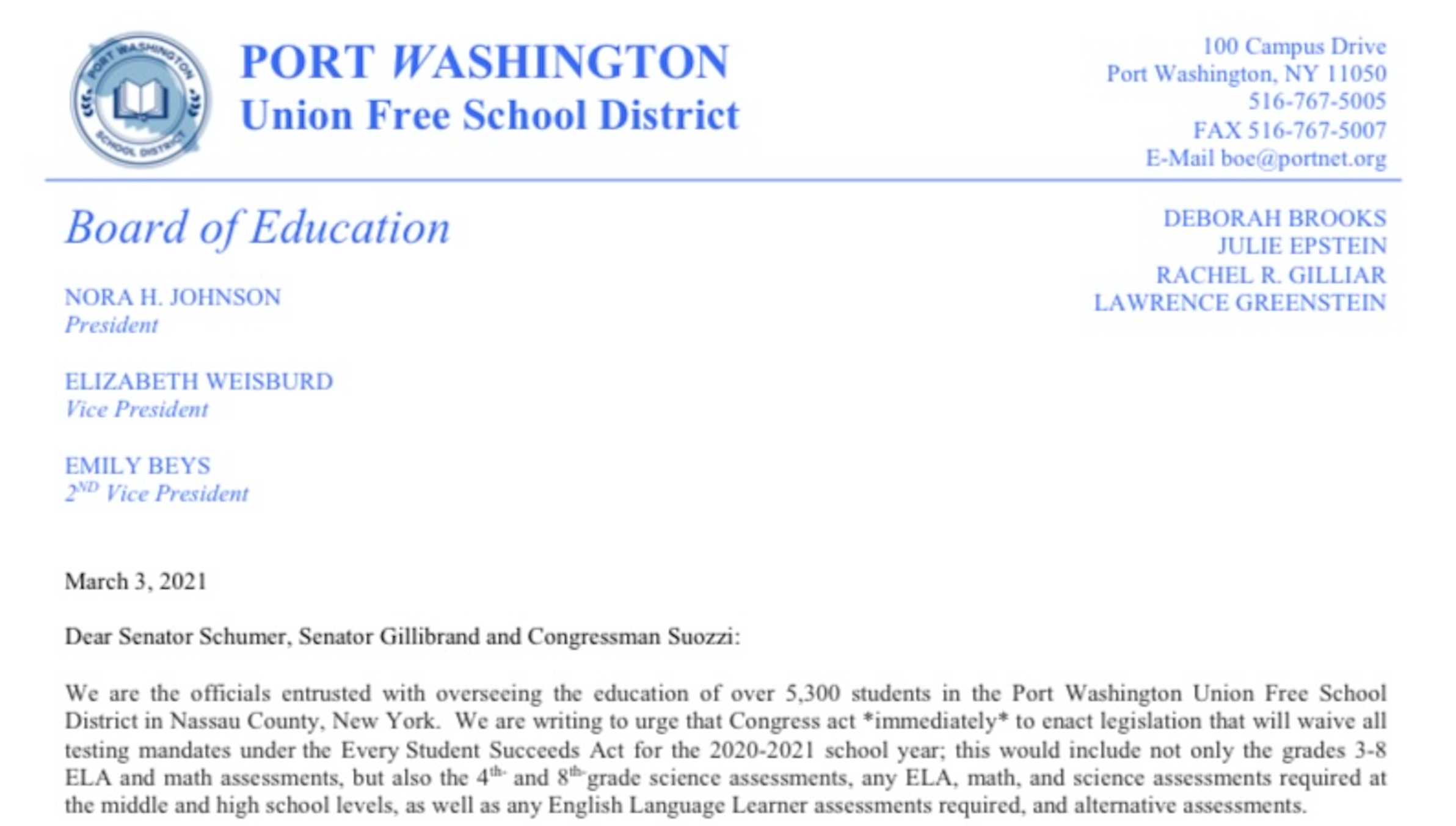
The Port Washington Union Free School District on Long Island in New York wrote an excellent letter to their representatives in Congress. It is a model letter that should inspire other local and state school boards.

We are the officials entrusted with overseeing the education of over 5.300 students in the Port Washington Union Free School District in Nassau County, New York. We arc writing to urge that Congress act ‘immediately’ to enact legislation that will waive all testing mandates under the Every Child Succeeds Act for the 2020-2021 school year. This would include not only the grades 3-8 ELA and math assessments, but also the 4th and 8th grade science assessments, any ELA, math, and science assessments required at the middle and high school levels, as well as any English Language Learner assessments required, and alternative assessments.

The pandemic has caused our country’s children immense psychological harm and stress. Children arc best served by face-to-face interactions and connections with teachers. staff. and know students, in a school building setting. Our school buildings arc our children’s ccosystem, and for many, it’s their primary source of emotional and social sup, (not to mention food and nutrition and sometimes even clothing). Last March. all of that was taken from them. literally overnight. Sadly. to this very day. many schoolchildren nationwide. including in Ncw York Statc, have yet to rctum to in-person instruction, and even for those who have rcturned. in-person instruction is often not full time and is plagued by constant quarantines of both students and staff.

Safely reopening our schools during this pandemic and creating a fully virtual K-5 school required spending to the mine of over S3.7 million – a staggering amount for any local school district. Yet. even with this immense expenditure. only our elementary school kids arc attending school in person full time, and our secondary students arc still in a hybrid cnvironmcnt that is less than ideal. Additionally. we have the constant quarantines of classes and teachers that further stalls Teaming.

These federally-mandated tests constitute an unfunded mandate. Many districts, such as Port Washington, have already dipped into reserve funds in order to safely reopen our schools. Administering the ESSA assessments is an incredibly wasteful endeavor, and a breach of our fiduciary duty to our taxpayers. Every moment that a teacher has with our nation’s children should and must be spent on substantive learning while focusing on their social and emotional well-being. Our students arc living in crisis. The very last thing these children need is to be subjected to assessments. Congress must act now to enact legislation that will waive all testing mandates under the Every Student Succeeds Act for the 2020-2021 school year.

Before he became a member of Congress, Jamaal Bowman was principal of a middle school in the Bronx. He knows what kids need: more support, not more testing. He is now vice chair of the House Education Committee. In New York, before entering Congress, he was an active member of the opt-out of testing movement. He is now spearheading an effort to roll back the Biden administration’s refusal to grant waivers to states from the mandated federal testing.

He wrote a letter to Secretary Miguel Cardona and gathered signatures from other members of Congress. What is remarkable is how few members signed his letter.

Bowman said that requiring testing this year would add stress to kids who are already traumatized and divert school administrators’ resources and attention away from reopening safely. 

“We absolutely should not be doing this now in the middle of a pandemic,” he said in an interview, adding that it would be “too much of a heavy lift” for states.

“We already know where the gaps are because we’ve been testing for 20 years,” Bowman said, adding that the federal government should engage with teachers and principals to determine where resources need to be targeted as a result of the pandemic.

The letter to Cardona, shared with POLITICO, was also signed by Reps. Ilhan Omar (D-Minn.), Tom Suozzi (D-N.Y.) and Mark Takano (D-Calif.) as well as Sens. Ed Markey (D-Mass.) and Kirsten Gillibrand (D-N.Y.)...

The new testing guidance was unveiled by the Education Department on Feb. 22, before Cardona was confirmed by the Senate. The guidance was signed by Ian Rosenblum, former executive director of The Education Trust-New York, who is the acting assistant Education secretary for elementary and secondary education. 

“Mr. Rosenblum, with all due respect, has never been a teacher or school administrator in his life, and it’s important that our parents and educators know that these decisions are being made by people who do not have the experience to make those decisions,” Bowman said. “That’s unacceptable in and of itself.”

The resumption of testing is supported by the chairs of the House and Senate education committees, Rep. Bobby Scott of Virginia and Senator Patty Murray of Washington State. They imagine that the standardized tests will somehow promote equity and measure “learning loss.” It will do neither.

“We must do everything in our power to make up for lost learning time and address achievement gaps that have been exacerbated by the pandemic — and that starts by understanding the scope of the problem,” Scott and Murray said in a joint statement last month.

They should listen to Jamaal Bowman, who knows what he is talking about.

And they should read this article, which explains why standardized testing does not close achievement gaps and does not promote equity and will not measure “learning loss.”

Please call or write your members of Congress to register your views about the resumption of standardized testing as we are still in the pandemic, following a year of disrupted schooling, in which educational opportunity was unevenly available. If you want to know how your kids are doing, ask their teachers.

As readers are well aware, the federal law called the Every Student Succeeds Act continued the mandated annual testing of students in grades 3-8 in reading and math (as well as one high school test) that was the heart of George W. Bush’s No Child Left Behind law, enacted in 2002. The Secretary of Education is allowed to grant waivers to states that ask not to give the tests. Last year, as the pandemic closed most schools, Secretary Betsy DeVos offered a blanket waiver to all states. She vowed not to do it again.

During the campaign of 2020, candidate Joe Biden publicly and unequivocally pledged to abandon the tests. He seemed to understand that they were not producing useful information and were squeezing out valuable instruction and subjects that are not tested.

Education Trust, led by John King, who was Obama’s Secretary of Education in his last year in office, created a campaign to demand that the Biden administration refuse all waiver requests and demand that everyone be tested, despite the pandemic. Education Trust, and most of the organizations that signed its two letters, are heavily funded by the Gates and Walton foundations.

The decision not to allow waivers, bowing to the EdTrust campaign, was announced by Ian Rosenblum, a low-level political appointee who previously worked for Education Trust New York and was an advocate for high-stakes testing. His boss was John King, who sent the pro-testing letters. The decision was made before Secretary Cardinal was confirmed. My guess is that the decision was made by Carmel Martin, who was an influential testing advocate in the Obama administration, then worked for the neoliberal Center for American Progress. She now works in the Biden White House as a member of the Domestic Policy Council. If I am wrong, I hope she corrects me.

Laura Chapman reviews the chronology here.

Thank you for all who helped to produce this rapid response and effective use of only two of the many databases for tracking the role of money in shaping policy.

I think it may be useful to put a timeline around some these flows of money and federal policies.

MAY 2020. Guidance for ESEA section 8401(b)(3)(A) testing waivers were published in May 2020 and almost every state or comparable jurisdiction requested and received these waivers for the 2019-2020 school year, well before the full force of the pandemic required large scale changes in schools. https://www.federalregister.gov/documents/2020/05/19/2020-10740/notice-of-waivers-granted-under-section-8401-of-the-elementary-and-secondary-education-act-of-1965.

FEBRUARY 3, 2021. The Education Trust sent a letter to Dr. Miguel Cardona. This was after his nomination but before his confirmation on March 1. This letter was signed by 18 organizations in addition to the Education Trust. Find the letter here. https://edtrust.org/wp-content/uploads/2014/09/Joint-Letter-to-Dr.-Miguel-Cardona-Urging-Rejection-of-Waivers-to-Annual-State-Wide-Assessment-Requirements-for-the-2020-21-School-Year-February-3-2021.pdf

The February 3 letter ends with two footnotes. The first is for McKinsey & Co.’s data about achievement before schools closed and the transition to remote learning began. This analysis includes “epidemiological scenarios” for learning loss (in months) for students who are white, black, and Hispanic. As usual, Mc Kinsey & Co. cares about the economic value of test scores “We estimate that the average K–12 student in the United States could lose $61,000 to $82,000 in lifetime earnings (in constant 2020 dollars), or the equivalent of a year of full-time work, solely as a result of COVID-19–related learning losses…. This translates into an estimated impact of $110 billion annual earnings across the entire current K–12 cohort.” https://www.mckinsey.com/industries/public-and-social-sector/our-insights/covid-19-and-student-learning-in-the-united-states-the-hurt-could-last-a-lifetime

The second footnote refers to a Bellwether Education report justifying their use of “crisis” rhetoric about school attendance data. The report estimates that about three million school-age children had difficulty engaging in or accessing education in the spring and fall 2020. That estimate was based on data from multiple sources, including media reports.

I hope Dr. Cordona understands that McKinsey & Co and Bellwether Education are not great sources of trustworthy information about public schools. https://bellwethereducation.org/publication/missing-margins-estimating-scale-covid-19-attendance-crisis.

FEBRUARY 22. On this date Ian Rosenblum, “Delegated the Authority to Perform the Functions and Duties of the Assistant Secretary of Elementary Education” announced “guidance for state testing” with particular attention to the conditions required if waivers of any find were requested. Note that Dr, Cardona has not yet been confirmed as Secretary of Education. I have yet to discover how he was granted authority (or grabbed it) to assert national policy on testing for the 2020-2021 school year. It is worth noting that Rosenblum’s prior employer had been The Education Trust, (New York). Here is the Guidance letter.https://www2.ed.gov/policy/elsec/guid/stateletters/dcl-assessments-and-acct-022221.pdf

FEBRUARY 23. In no time flat, The Education Trust sent this second letter to the U.S. Department of Education, titled “Response From Civil Rights, Social Justice, Disability Rights, Immigration Policy, Business, and Education Organizations to the U.S. Department of Education’s Updated Guidance on Key ESSA Provisions in 2020–21.” This letter was signed by 30 organizations in addition to the Education Trust. This letter emphasized that local assessments were not suitable for accountability:
…
”We want to be clear: The Department must not, as part of its promised state-by-state “flexibility,” grant waivers to states that would allow them to substitute local assessments in place of statewide assessments or to only assess a subset of students. By design, these local assessments do not hold all students to the same standards and expectations. They do not offer appropriate accommodations for students with disabilities or English learners, as required under federal law for statewide assessments; they are not peer reviewed to ensure quality and prevent bias; and the results of these assessments will not be comparable from district to district.”

In effect, the only accountability measures that matter to The Education Trust and those who signed on to these letters are features of a factory model of education. Standardization is the ultimate criterion for data entering into decisions about federal policy. This factory model is also positioned as if the primary way to address equity and civils rights. We must “hold all students to the same standards and expectations.”

The February 23 letter also articulates a clear distain for assessments most likely to be meaningful to teachers, students, and parent caregivers; namely teacher and district developed evaluations of learning with these judgements student-specific, curriculum relevant, informed by face-to=face conversations and providing a meaningful pathway for guiding students.


Education Trust, led by former Secretary of Education John King, sent two letters to the Biden administration, urging the administration not to allow states to receive waivers from the mandated federal testing. The signers of the letters were not the same. As State Commissioner in New York, King was a fierce advocate for Common Core and standardized testing.

Leonie Haimson, leader of Class Size Matters, the Parent Coalition for Student Privacy, and board member of the Network for Public Education, wrote this about the pro-testing coalition assembled by King:

I asked my assistant Michael Horwitz to figure out which organizations were on the first Ed Trust letter pushing against state testing waivers, but not the letter that just came out, advocating against allowing flexibility by using local assessments instead.  National PTA, NAN (Al Sharpton’s group), LULAC, KIPP and a few others did drop off the list. 

I then asked Leonie if she could add the amounts of funding to these organizations by the Gates Foundation and the Walton Foundation and she replied:

The largest beneficiary of their joint funding among these organizations has been KIPP at over $97M, then Ed Trust at nearly $58 million, who spearheaded both letters. Also TNTP at $54M, NACSA at $44M, Jeb Bush’s FEE at nearly $32 M and 50Can at $29M. [TNTP used to be called “The New Teachers Project,” and was created by Michelle Rhee.] Michael Horwitz did the research.

Signers on the first letter:

The following orgs were on the second letter, but not the first: many more obviously pro-charter, right-wing and more local organizations:

Leonie Haimson 
leoniehaimson@gmail.com

Follow on twitter @leoniehaimson 

Host of “Talk out of School” WBAI radio show and podcast at https://talk-out-of-school.simplecast.com/