Archives for category: Science

The New York Times published this excellent article by Jeneen Interlandi about the Trump administration’s mad effort to defund and distort science. Our nation’s leadership in science has been extraordinary. Our scientists have led the world in discovering cures for diseases, extending the human life span, exploring space and the oceans, and extending the bounds of knowledge. This is a gift article, meaning you can open it without a subscription. You should open it to see the many photographs and illustrations.

Interlandi writes:

Thirteen months into the second Trump administration, science, medicine and public health have been hijacked by a cadre of grifters and ideologues and by the politicians in obvious thrall to both. Federal institutions have been all but dismantled. Researchers have been defunded en masse and the universities that support them deliberately destabilized. Discourse on crucial scientific questions and key public health challenges has been stifled. And along the way, trust has been broken between scientists and the nation’s leaders — and the people that both are supposed to serve.

It’s tempting to view this undoing as temporary. Americans love science and revere innovation, almost as a rule, and politicians of every stripe have spent the better part of a century promoting and protecting both. However imperfect the resulting system was, hardly a modern convenience exists that can’t be traced back to it — central air-conditioning, the internet and ChatGPT; polio vaccines, statins and weight-loss drugs; the human genome sequence and CRISPR gene editing. The National Institutes of Health alone generates about $2.50 in economic returns for every dollar of investment. It’s also the largest government-funded biomedical research agency in the world and until recently was the envy of scientists across the globe.

The president’s attacks on this legacy have been relentless and all encompassing. He has turned the federal health department over to Robert F. Kennedy Jr., the nation’s most prominent anti-vaxxer. For months, President Trump’s Office of Management and Budget all but froze operations at the National Science Foundation and the National Institutes of Health. His newly established so-called Department of Government Efficiency, or DOGE, fired thousands of civil servants from the Food and Drug Administration and the Centers for Disease Control and Prevention, in a process that was wildly disorganized, frequently unlawful and needlessly cruel. Global health initiatives were also eviscerated.

Stacked against these measures, the administration’s explanations — which focus on cutting waste and eliminating so-called woke politics from science — have been inadequate and disingenuous.

It can be difficult to imagine a future in which American science does not prevail. But, as the president’s many critics have warned, institutions like the C.D.C., F.D.A. and N.I.H. will be far more difficult to rebuild than they have been to destroy — especially if their intended beneficiaries lose all faith in them or forget why they existed in the first place.

The current administration seems to understand as much. Top officials have taken pains to describe the nation’s scientific bodies as corrupt and ineffective and the nation’s scientists as elitist and excessively woke. “Science and public health have achieved much more than current leaders seem to recognize,” said Tom Frieden, the author of “The Formula for Better Health” and president of the public health nonprofit Resolve to Save Lives. “We actually know a lot about how to make America healthier. But very little of that knowledge is in line with what the current administration has done so far.”

Nowhere is this disconnect on fuller display than in the long war against H.I.V. Forty years ago, the infection was a mystery and a death sentence. Today, thanks to a combination of biomedical breakthroughs and diligent, boots-on-the-ground public health (testing, education, robust social safety nets), it is a chronic but manageable condition that really flourishes only among society’s most marginalized groups.

The first Trump administration vowed to finally end the American H.I.V. epidemic no later than 2030 by doubling down on prevention efforts in the hardest-hit communities. The resulting initiative has clearly paid off: Transmission rates are down in the targeted ZIP codes, according to the National Minority AIDS Council, a nonprofit devoted to stopping the virus’s spread. Racial health gaps are narrowing as a result, and because prevention is cheaper than treatment, money is being saved.

The second Trump administration seems determined to reverse course anyway.

On March 20 of last year, Kathryn Macapagal, a clinical psychologist and a faculty researcher at Northwestern University’s Feinberg School of Medicine, was sitting at her in-laws’ dining room table when her phone and laptop began pinging and ringing furiously.

Ping. The Adolescent Trials Network, a huge research apparatus focused on treating and preventing H.I.V. infection in teenagers and young adults, was abruptly closed. The network was responsible for several studies that Macapagal and her colleagues were collaborating on.

Ping. A close colleague’s 10-year study on H.I.V. and substance use in L.G.B.T.Q. teenagers and young adults was suspended. So was another project on reducing H.I.V. risk in relationship.

Ring. Another of her projects, on how to improve the measurement of sexual orientation and gender identity in federal surveys, was also done for. So were at least two fellowship programs for early-career scientists who wanted to specialize, as she did, in L.G.B.T.Q. health and dozens of other projects affecting just about everyone she worked with or knew professionally.

Her husband, Dan Fridberg (also a scientist, also reliant on N.I.H. funding), paced frantically behind her as she announced each new bit of carnage. “At this rate, you’ll be out of a job by dinnertime,” he said. “Oh, my God. What are we going to do?”

“I cannot go there right now,” she replied. She was determined to remain calm. She was also too stunned to panic, although in truth, she was not surprised. Her research sat in just about every one of the administration’s cross hairs: All of her projects included the new red-flag terms, and most of the researchers on her staff fell into at least one disfavored category. All of their salaries (including hers) were reliant on N.I.H. funding, and all of their jobs were now gravely imperiled.

And not just theirs: Federal grants were the lifeblood of academic research. They supported scientists and students, institutes and administrators. They covered overhead costs. It was not uncommon for one person to be funded by several grants, nor was it rare for professors like Macapagal, working at elite universities like Northwestern, to be wholly dependent on grants that had to be renewed every few years. It was a deeply precarious arrangement, sustained for decades by the certainty that, come what may, the federal government would honor its commitments.

When the dust finally settled, four of Macapagal’s grants had been terminated, nearly a quarter of her salary was gone, and a project she had spent many months developing was on seemingly permanent hold. As they struggled to make sense of what was happening, she and her colleagues found themselves drawing grim battlefield analogies: It was as if a bomb had gone off and some of them were dead on the field and others, like her, were maimed. “One colleague who lost everything told me that he thought I actually had it worse,” she said. “Because, you know, if you’re going to die, it’s probably better to do it quickly.”

Of the 1.2 million people living with H.I.V. in the United States, more than 60 percent are Black or Latino. Transgender women, gay and bisexual men and teenagers and young adults of color face the greatest overall risk of contracting the virus in any given year.

Those inequities are no mystery: less access to health care, more social stigma and a negative feedback loop, wherein a higher prevalence of the virus in certain communities begets a higher prevalence of the virus in certain communities. But resolving them is no small feat.

In the years leading up to 2025, as she tried to do exactly that, Macapagal was consumed by several thorny challenges. A troubling dichotomy had emerged since the medication that prevents H.I.V. transmission (known as pre-exposure prophylaxis, or PrEP) first became widely available. Within the gay community, middle-aged white professionals had embraced the treatment as an ordinary component of overall health and wellness. But younger adults, immigrants and racial and ethnic minorities still had not.

“It’s not unlike birth control when it was first introduced,” said Jim Pickett, a board member of TaskForce, an L.G.B.T.Q. youth center on Chicago’s West Side and a collaborator of Macapagal’s. “It’s pretty straightforward as a treatment, but it’s attached to all of this cultural baggage that makes it challenging to get across.”

In 2018, when PrEP was approved for adolescent use, Pickett and Macapagal began searching for ways to overcome these challenges. They knew teens would be an especially tough sell. Health care systems intimidated the boldest of them, sexual identities were still developing at that age, and this particular form of protection could easily become a source of embarrassment or even shame.

They enlisted, among others, Skai Underwood, TaskForce’s dance instructor and youth engagement specialist, in their quest.

Underwood, who was assigned male at birth, knew by the age of 5 that she was a girl but did not medically transition until her early 20s. She was intimately familiar with the shame and isolation that gay and transgender people often faced — how even friends and family would signal their rejection when you declared yourself, how that rejection could lead you to retreat inward. Her goal was to help TaskForce teens resist that impulse, so that instead of hiding, they might thrive.

To her, the solution to Macapagal’s public health conundrum was clear: If you wanted to teach teenagers — or anyone else — to take safe sex seriously, you had to convince them that there was something to protect in the first place. “What it really comes down to is self-love,” she told me when I visited TaskForce in November.

With that in mind, she, Macapagal and Pickett created a two-pronged public health initiative called PrEP-4-Teens. The first prong involved a media campaign linking safe sex to empowerment and joy. The second wove an L.G.B.T.Q. sexual education curriculum into a suite of community-building activities. “They basically come together to dance and make art,” Underwood said. “We celebrate queer identity, and then in between all of the fun, we teach them how to protect themselves.”

The program’s early results were promising: Among other things, participants came away with an understanding of PrEP and a sense that it was no more shameful to use than condoms or birth control. But before they could scale it up or study it in greater depth, a new administration began.

On his first days in office, the president issued a flurry of executive orders rolling back transgender rights and bringing federal diversity, equity and inclusion initiatives to an abrupt end. By many accounts, the DOGE officials tasked with carrying out those orders had little to no understanding of the projects they were supposed to evaluate. “They seem to have confused D.E.I., which is about diversifying the work force, with health equity, which is about reducing health disparities in marginalized communities,” Amy Knopf, a professor at Indiana University’s School of Nursing, told me. “They’re making it so that you can’t study certain groups without violating these edicts. But you can’t really tackle H.I.V., or any number of other conditions, without looking at those exact groups.”

In the weeks after the March 20 Massacre (as some of them had taken to calling it), Macapagal and her colleagues began working furiously to cover as much and as many of their salaries as they could. The main conference space morphed into a war room of sorts, as her boss, Brian Mustanski, tried to match any open position or bit of unused grant money he heard of with whichever recently defunded staff member who was qualified.

Macapagal’s job was saved by one colleague who stepped up without even being asked. “We have some money that we’re not using yet and some work that you could definitely do,” the woman explained. “Let me add you to that project.” Macapagal accepted and for many months afterward would tear up just recalling the kindness.

In April the federal government froze some $790 million in funding for Northwestern, without notice or explanation. The university was apparently being accused of antisemitism and racism over its diversity initiatives, but it was unclear whether the freeze was related to those charges, and no one seemed to know when or whether or how the funds would be restored. Researchers would have to tighten their belts as much as possible, university officials explained, while they tried to sort out the situation.

Among other things, the new strictures meant that Macapagal would not be able to pay Pickett for all the work he had done on her projects. He had presided for decades over a community center that prided itself on perseverance, and he took the news in stride. “Don’t worry,” he said. “We’ll make do.” But she felt awful.

Nobody outside the scientific community seemed to realize what was happening. Friends and family had all tried to reassure her that everything would be fine in the long run, that she just needed to hang in there until the midterms or the next presidential election. She found it exhausting to explain how irreversible the damage was. They had lost years of research in a matter of weeks. Whole labs had been closed, and successful, decades-long careers ended — and none of it appeared to have anything to do with the quality or import of the research itself. The decisions were political and ideological. They were also arbitrary and needlessly cruel.

Trust had been broken as a result, at just about every level of the scientific enterprise (between study participants and scientists, between scientists and universities and between universities and the federal government). Whatever came next, it seemed extremely unlikely to her that any of them, let alone all of them together, would be able to just pick up where they had left off.

In the meantime, those who were left — the maimed but still breathing — leaned on one another. When they were advised to pre-emptively change the language in their public-facing documents, Macapagal and her colleagues did the edits together, grousing in unison over the aggravation of revising terms like “inclusion criteria” and the moral grossness of erasing the word “transgender” from their work.

It was not the first time their field had been forced to make such compromises; the eldest among them remembered culling words like “gay” and “sex” back in the early 1990s. But this was different. In the past, even if they had to change a word or two, they still got to do their research. Now Macapagal found herself contorting a study on H.I.V. vaccine misinformation (her attempt to get ahead of the hesitancy that had plagued Covid vaccines) into something else entirely.

She found herself making other changes, too, including dyeing her pink hair back to a soft brown. “It might be safer for me to not be so out there with how I look,” she said. Some of her friends and colleagues were taking similar precautions. They were losing facial piercings and gay pride stickers. They were also changing slide deck images to include more white people, even when the conditions they studied did not, for the most part, affect white people. It felt gross because it was gross, but what else could they do? They had families and mortgages and work that they still wanted to complete. They knew people who had been doxxed and threatened — and worse — just for studying gender-affirming care. And they were anxious and, in some cases, afraid.

As spring bled into summer and the university explained that it could no longer provide offices with free coffee or free tissues, Macapagal turned a worried eye to her lab and began doing what she could to help people secure other jobs. It was a risky gamble: If they left and her funding was then restored, she’d be hamstrung. But she thought of the group as a kind of family, and she wanted to protect whomever she could.

Her lab manager, Andrés Alvarado Avila, was here on an H-1B visa, and if his funding was cut, he would have just 60 days to find another job, secure an exception or return to Mexico. Her project coordinator, Zach Buehler, was only a few years out of college. She found herself wondering if it was fair or right to encourage him down a career path whose future looked so bleak. Like many of her lab members, Alvarado Avila and Buehler were gay men. As anachronistic as it sounded, she could not help but worry about what that might mean for their futures, in an America that was less recognizable by the day and that seemed to be coming for them all.

In the past year or so, scientists funded through the National Institutes of Health have developed potential treatments for pancreatic cancer, broken the logjam on Huntington’s disease, shepherded a male birth control pill through clinical trials and saved a baby’s life with the first personalized gene editing procedure. In a different time and place, any one of those breakthroughs would have been hailed as the triumph of an epoch and might have lured a new generation of talent to the cause of scientific research.

Instead, six years after the pandemic began and one year into the second Trump administration, we have the opposite: seasoned scientists fleeing the profession (or the country) and younger prospects deciding not to pursue it at all. It’s impossible to say what new medicines those minds might have developed or what wicked problems their efforts might have solved.

What seems clear is that Americans have entered a grim new era, one in which science itself is a political weapon, rather than a tool for the collective good. It would be simplistic to argue that the two — science and politics — should be wholly disentangled. (As a human endeavor that involves trade-offs and requires public support, science is inherently political.) But real data and hard, neutral facts still drive the work that most scientists do, and the best of that work should still frame public discourse and, ideally, inform public policy. And right now, it does not.

Last June the F.D.A. approved the latest version of PrEP: an injection that patients would need to receive only twice a year and that appeared to work even better than its predecessors at preventing infection. In July the N.I.H. director, Dr. Jay Bhattacharya, laid out yet another strategy for eliminating H.I.V. in the United States. Rather than pour limited resources into more basic research, his agency would simply deploy existing PrEP medications. “Why is there any reason to wait?” he asked on his podcast. “Why don’t we just really commit to ending the H.I.V. epidemic, actually doing it with the tool kit we have now?”

The director’s epiphany frustrated H.I.V. specialists. He was right about the import of using existing tools more effectively. But many of them, including Macapagal, had been working on exactly that challenge when Bhattacharya’s agency cut their funding back in March. What’s more, almost all of the current administration’s stances — not only on science but also on health care and public health, immigration and social safety nets — were anathema to his stated goals.

If health officials really wanted to extirpate H.I.V. from the United States, they would increase access to health care, ramp up testing and education and fortify the social safety net.

At every turn, Trump and his deputies did the exact opposite. They tried to eliminate hundreds of millions of dollars in funding for H.I.V. testing, treatment and prevention services. They cut Medicaid by hundreds of billions of dollars and played chicken with Democrats over Affordable Care Act subsidies. They also weakened the social safety net, sowed terror in immigrant communities and upended public health programs just about everywhere.

If those policies persisted, even as the newest PrEP medication was made commercially available, H.I.V. would continue to linger. “Most of what we’ve done to beat back AIDS comes down to this extremely fragile safety net that is right now being destroyed,” Dr. Jon Mannheim, a pediatric H.I.V. specialist who sometimes collaborates with Macapagal, told me when I visited Chicago in November. Illinois was facing one of the largest Medicaid cuts in the nation, and his clinic was already bracing for impact. Among other things, he worried that fewer social workers would be hired for even less pay than before.

Without them, he said, the whole system might collapse. Patients who lost health insurance would have a harder time getting into the fail-safe programs meant to keep them on PrEP (and to keep AIDS at bay). The pregnant women he treated would lose their main point of contact for a whole suite of stabilizing services. “I don’t know how many babies would have to be born with H.I.V. for the federal government to care,” he said. “But I guess we’ll find out.”

In the meantime, his Latin American patients were still avoiding the clinic altogether, months after ICE had descended on the city. He had lost several of them to follow-up care over the summer. The one that troubled him most was a 10-year-old girl from Venezuela who lived in a car with her mother and whose H.I.V. infection might have already progressed to AIDS. “I have not seen her in months,” he said. “She could be dead by now.”

A few miles away in Chicago, the TaskForce community center was facing similar challenges. It had lost some $500,000 in anticipated funding, thanks not only to state and federal budget cuts but also to a new reluctance among donors. “We heard a lot of, ‘Hey, these dollars that we thought that we could give you we actually can’t now, because you’re L.G.B.T.Q., which is a no, and BIPOC, which is also a big no,’” said the center’s director, Chris Balthazar, using an acronym for “Black, Indigenous and people of color.”

It was getting by, but the strain of moving through the world with so many targets on its back was starting to show. One of its regulars, a 15-year-old Haitian boy, had nearly taken his own life after his parents were abruptly deported. And Underwood had detected a new reluctance in some of her L.G.B.T.Q. students. They were not expressing themselves as freely as they did before, she thought. Some mentioned creeping anxieties, when she asked. Others talked about fear.

She wanted to prevent those feelings from dimming the light she saw in each of them, but it was complicated. Self-expression and personal safety could cut brutally against each other for a gay or transgender teen, and a lot of her TaskForce students had bigger worries, in any case. They did not always have enough food to eat or safe places to stay; winter was coming, and they needed warm coats. “It’s OK,” was sometimes all she could think to tell them. “This is nothing new. We’re just going to keep on jumping these hurdles, one at a time, until we’re free and clear.”

By the start of 2026, Macapagal and her colleagues had settled into an uncertain quiet. The university’s funding was unfrozen in December, and thanks to a couple of lawsuits, most of the grants that her group had lost were in the process of being restored. But confusion still reigned: When would that money be disbursed? Would researchers be given additional time to complete their work? What would happen when those grants came up for renewal in the coming year?

No one seemed to know, but the N.I.H. was still expecting annual progress reports from all its grantees in the meantime. “We are supposed to tell them what we did with the money they gave us and what progress we’ve made in our research,” Alvarado Avila explained. “But they did not really give us the money, and our biggest barrier to progress has been them. How do you say that in a way that’s diplomatic?” The institute where Macapagal worked had 30 fewer staff members now and lots of empty offices and cubicles. One conference room had become a storage facility for the H.I.V. and sexually transmitted infection test kits that they had planned to send to study participants.

“These are supplies that your tax dollars paid for, to get people tested for H.I.V. and S.T.I.s in the context of a research study,” Macapagal said. “And now they’re just sitting there, and like any medical kit, they will eventually expire.” She was torn about the future. On the one hand, she could not help but hope. State officials had expressed interest in partnering with her and TaskForce to expand the Prep-4-Teens program, and she had just applied for yet another N.I.H. grant based on the agency’s stated interest in using implementation science to conquer H.I.V.

On the other hand, hope seemed a delusional response to the events of the past year. Word was that new grant applications would ultimately be decided on not by fellow scientists, as had always been the case, but by political appointees who had apparently effectively taken over the N.I.H. Macapagal had spent nearly all of her adult life cultivating expertise in behavioral health and disease prevention and then training the next generation to do the same. She could not help but wonder now what the point of any of that had been.

She still wanted to show up for her team. She believed that the work was important, and she knew that Alvarado Avila, Buehler and their peers were its future. But truth be told, she was also thinking about going into private practice.

Alvarado Avila was holding off on applying to graduate programs for now, in part because prospects were skimpy for noncitizen scientists who wanted to stay in the United States and also because he had watched ICE agents descend on Chicago and raid the communities around him. He had also watched them kill an unarmed woman in Minnesota — who was a mother and a poet and a white U.S. citizen and who happened to be a lesbian — and his heart was sick and he was angry.

“They say that by focusing on marginalized groups, we are discriminating against everyone else,” he said. “But those are the communities most impacted by these issues. They say visa holders like me are stealing jobs from Americans. I don’t think they understand that, one, for a specialty visa, you have to prove to the government that you can do the work and, two, we contribute to a tax system that we have no assurance that we will get back from.”

More and more, he wondered what fighting back looked like and whether it was incompatible with a career that forced you to erase whole categories of people from your work or treat words like “diversity,” “equity” and “inclusion” as toxins instead of virtues. More and more he wondered if America, where he had lived, studied and worked for most of his life, was still the place for him.

Buehler, for his part, had applied to more than a dozen Ph.D. programs, almost all of them focused on exactly the kind of research he was doing in Macapagal’s lab. “I love this work,” he told me. “I really want to create the kind of programs that I wish I’d had when I was coming up.” He knew the risks, knew that he was probably consigning himself to a path marked by deep uncertainty and that he would find neither glory nor gratitude on the other side of that struggle. But he also knew that perseverance was the key to progress. And the way he saw it, resilience could be an identity, too.

John Thompson, historian and retired teacher in Oklahoma, explains how distrust of science has colored every important issue and is deployed by big money donors. Every important debate these days is undermined by propaganda and suspicion of science.

He writes:

Science Under Siege: How to Fight the Five Most Powerful Forces that Threaten Our World, by Michael Mann and Peter Hotez, starts with two of the three biggest threats to humanity – the climate crisis and pandemics.  Then they describe the “third leg to that tripod,” a network of anti-science institutions which is on the way to bringing “the collapse of civilization as we know it.” 

That may sound extreme but both have a sterling record in the fields, despite being attacked by rightwingers; Mann is an environmental scientist and Hotez is an expert in pandemics. 

Mann and Hotez describe the five “P’s” that are undermining our future.  The first two Ps, plutocrats and petrostates, were the original founders, funded by fossil fuel elites, like the Koch brothers, to protect their profits from government regulations. 

I should have known better, but it wasn’t until I read Science Under Siege that I realized how and why the plutocrats also “had a huge financial stake in fighting medical science during the pandemic.” I had long known about their attacks on clean air and drinking water, in addition to fending off the victims of the pollution. But, I was unaware about how these were interconnected. 

Mann and Hotez then document the roles of international petrostates, as well as the Texas petrostate. They estimate that around 40,000 Texans died because they believed the petrostates’ propaganda and refused Covid vaccines. 

Mann and Hotez then explained how elites promoted the “pros,” now known as rightwing media “influencers;” the propagandists, the think tanks that make up falsehoods that they present in papers that look like scientific research; and the fake news press. 

They also criticize a number of mainstream  journalists and commentators in newspapers like Washington Post and New York Times, explaining that they “often fall victim to [a] sort of false framing, what we call performative neutrality, where anti-science will be placed on an equal footing with the consensus of the world scientists.” 

They conclude with the history of why 75% of Americans cannot name a living scientist. 

Science Under Siege follows the same dynamics I’ve seen since the 1990s when social and cognitive science came under siege.  At first, I assumed that we could bring data-driven researchers, funded by the “Billionaires Boys Club,” and traditional  education scholars together. 

I repeatedly and unsuccessfully tried to explain to smart data-driven researchers, who didn’t know what they didn’t know about public education, why their methodologies for real world policy issues was inappropriate. The issue wasn’t what data-driven approaches “can” do, but what they likely “will” do. The most common reply was that isn’t what I was hired to do. 

Worse, the big money donors also hired skilled propaganda providers, who demonized teachers. Having previously been a lobbyist for Planned Parenthood, I saw them borrow the “pro-Life” approach of slandering  the supposed type of women who would seek an abortion. They applied it to teachers who supposedly didn’t care enough to hold students to “High Expectations” and “No Excuses.” 

Even worse, “astro-turf” think tanks, funded by foundations like the Koch brothers, spread this PR campaign in order to push privatization. 

To take a recent example, advocates for the “Mississippi Miracle” push the Big Lie that Proficient NAEP test scores are “grade level.” Actually “Basic” is closest to grade level. But privatizers send the false message that up to 90% of urban school students score below grade level, meaning those schools were irreparable broken. 

That led to the claim that reward-and-punish accountability is the only path to literacy, even though so many social and cognitive scientists had long predicted that that learning culture would more likely to undermine reading for comprehension. 

Worse still, you can’t improve the highest-challenge schools, like those I taught in, without building a team effort. 

And guess what? 

Similar attacks are being launched against our team players, such as medical and mental health providers, housing advocates, and higher education, etc. They are being targeted by Trumpists,  the Koch brothers, Project 2025, etc. in the same way public and higher education is being assaulted by privatizers.

Similarly, I love the NYTimes, but I was especially upset by commentaries during the COVID pandemic, often written by people who I highly respect but who didn’t know squat about school cultures and who, for instance, would proclaim: When Trump was Right and Many Democrats were Wrong. with the subtitle, “Children have suffered because many mayors and governors were too willing to close public schools.” 

As Mann and Hotez explain, “It took centuries to build the leading scientific infrastructure in the world here in the United States. And it’ll only take years to destroy it. And once you destroy it, you’re not going to rebuild it.’ 

They call for “urgency” and “agency.” Today, Science under Siege makes an urgent call for a fight against  disinformation that is “infecting” our public schools. They call for investments in media training for young people so they do not succumb to fake news. 

And, if we cannot protect the culture of agency that protects higher education, scholars will be driven out of science for generations to come. 

In other words, if we cannot come together to defeat the tripod of disinformation by those seeking an “anti-science empire,” humanity will undergo extreme suffering which could be extremely long-lasting.

New Hampshire is an unusual state. It is a magnet for libertarians. A significant number of them have been elected to the legislature, where they use their clout to “free” people from government.

Their current goal is to eliminate all vaccine requirements. Diseases that were long ago eliminated will come roaring back. People will die of diseases that could have been avoided. But they won’t be subject to government mandates.

At the same time, with no sense of irony, Some New Hampshire legislstors are demanding greater state control over what is taught in the classroom.

Garry Rayno of InDepthNH reports:

Two bills coming before the House this week are indicative of the New Hampshire Legislature: where it is heading and where it has been for the last three terms.

It is not a pretty picture unless you want to end government as we know it, or you want to use the sledgehammer of government to force everyone to believe what you do.

HB 1811 would repeal the immunization requirements for children in state statutes. All of them.

They include, diphtheria, tetanus, pertussis (whooping cough), polio, measles, mumps, rubella, chickenpox, and Hepatitis B.

Last week the House passed a bill to remove the Hepatitis b vaccine from the list.

The “compromise” position, said the prime sponsor of the bill, Rep. Matt Drew, R-Manchester, is to retain the polio vaccine requirements.

House Bill 1792 or the “Charlie Kirk Act,” which would fittingly prohibit public schools from teaching critical race theory, LGBTQ+ ideologies and other alleged Marxist derived educational theories.

The bill also gives those who believe the law was breached, the right to bring a civil suit against the school and educators as well as code of conduct allegations against the teacher which could result in loss of license.

Over the last several years, the US District Court has struck down laws passed by this legislature on critical race theory or divisive concepts, and outlawing diversity, equality and inclusion programs calling them overly vague putting educators in harm’s way.

It is hard to imagine this law would pass muster either.

In the broader picture, most of the childhood diseases that plagued school children 60 or 70 years ago have been, if not eliminated, made negligible.

But measles is making a comeback in the last few years as is whooping cough because the vaccination rates in children have been trending down as parents seek to opt them out for religious or medical reasons.

In the past, immunizations were not an issue. People had their children vaccinated to protect them from the ravages of the diseases and ultimately to protect the population in general from the newborns to the elderly.

It was the responsible thing to do.

People like Health and Human Services secretary Robert Kennedy Jr. have long disparaged vaccines, as he and others gaslighted many into believing they cause autism.

The vaccination question found a red hot burner with the new COVID 19 shots when the decade began.

It didn’t matter that the protesters were never going to get the COVID vaccine, they wanted to block the state’s most vulnerable to the disease from having a jab.

Two years ago, lawmakers passed a bill that would have taken away the Department of Health and Human Services’ authority to determine what vaccines children need, and would have had the legislature set the list, but it failed to become law.

These same folks also wanted to eliminate the state’s free vaccination program in conjunction with insurance companies, but had to settle for a study committee instead.

The prime sponsor of House Bill 1792, Rep. Mike Belcher, at the public hearing on the bill alleged a straight-line connection between Karl Marx’s theories and ideologies to the education system that fosters concepts like critical race theory, the oppressor and the oppressed models, LGBTQ+ ideologies, identity based ideologies and systemic inequity based on identity groups, or anti-constitutional narratives.

He claimed these ideologies undermine learning and unity, and the right of parents to direct their children’s upbringing.

He claimed these worldviews are responsible for the divisions in this country and have fostered the view that white Americans are inherently racists.

Belcher claimed his bill does not infringe on a teacher’s free speech, noting a teacher has no right to say anything he wants to children who are captive.

Legislation reaching down into classroom curriculum, which always has been the responsibility of local school boards and administrations, has been a recent trend with book and material bans, anti-abortion requirements and just plain interference and requirements meant to disrupt the system while many public schools struggle to provide a quality education under the burden of high property taxes, while the state fails to meets its constitutional obligation to fund an adequate education.

Before these attempts, bills targeting public education had always been quickly dismissed, but that was before there was an organized effort to end public education.

The chair of the Education Policy and Administration Committee Kristin Noble, R-Bedford, is a co-sponsor, as is Majority Leader Jason Osborne, R-Auburn.

Noble recently posted on social media that schools should be segregated to separate Republicans from Democrats and called public schools Marxist indoctrination centers, while Osborne called them black boxes where children go in, but you don’t know what comes out.

Not that long ago, people followed the concept of the public good, or the long established “Social Contract” espoused by philosopher Jean-Jacques Rousseau.

The concept is that people surrender some of their freedoms in exchange for protection of their remaining rights, security and social stability, with the sovereign power residing in the people as a whole.

Under that concept, the industrialized world has been able to eliminate polio and other deadly diseases to benefit society as a whole.

But that concept has been eroding along with what was once considered the moral responsibility to look after your neighbors and the most vulnerable as well as yourself. Now it’s just yourself.

The idea of individual rights overriding the greater good is not new, but the founding fathers sought to protect against the tyranny of the majority overriding the rights of the minority.

What we have today is a tyranny of the majority in the legislature driven by Free Staters and Libertarians who want to impose their will on the people of New Hampshire in education, medicine, local planning and zoning, religion and social services. It is tyranny of the minority of New Hampshire residents.

One Republican representative, Travis Corcoran of Weare said in a social media post: “The point of Republican legislation is not just to change the laws, it’s to demoralize the left . . . and encourage them to leave.”

He is a co-sponsor of the Charlie Kirk Act.

If you are passing laws for reasons like that you do not belong in New Hampshire which has always been a welcoming state with a live and let live attitude.

Maybe we should have been more discerning about people moving here who claim to be for freedom, while they trample the freedoms of those who disagree with them.

That is the definition of hypocrisy.

And voters need to be more discerning about who they send to Concord.

Yesterday, the New Hampshire legislature voted on the bill to ban all vaccine mandates: it was defeated, 192-155.

However, the bill to prohibit “woke” curriculum passed by 184-164 and now goes to the State Senate. The bill is called the Charlie Kirk Act, after the founder of the rightwing Turning Points America, who was assassinated last year.

The bill prohibits the teaching of critical race theory, LGBT ideology, or other allegedly Marxist materials. Citizens can file civil suits against teachers found teaching prohibited ideas, and teachers might ultimately lose their license.

A similar law was previously struck down by the federal district court on grounds of vagueness.

Just when you thought that you had heard “the worst decision” by the Trump regime, the one that will hurt people the most, along comes another. Trump is well known for denying climate change. Just days ago, his Environmental Protection Agency announced that it would no longer regulate the discharge of deadly gases. Perhaps it should change its name to the Environmental Pollution Agency.

But here comes another scientific reverse, possibly tied not to ideology, but to politics.

CNN reported:

A leading American research lab is slated to lose its critical supercomputing facility, according to a letter released Thursday by the National Science Foundation.

The move is part of the Trump administration’s effort to disassemble the National Center for Atmospheric Research in Boulder, one of the world’s top weather and climate research centers, which the admin views as a source of climate change alarmism.

The computing center, which is slated to be turned over to an unspecified third party, runs weather and climate research models and is used by about 1,500 researchers from over 500 universities around the country. The work done on this supercomputer benefits the American people by leading to more accurate forecasts of extreme weather and climate events, aircraft turbulence and more.

The problem with spinning off the computing center away from the research center is that it could disrupt access to high performance computing. Much as with AI, high power computing is essential for simulating weather and climate and for evaluating the accuracy of new forecast models, which eventually end up contributing to what Americans see in the weather apps each day…

Some Colorado officials view the move as part of a retribution campaign being waged by the White House that is designed to pressure Colorado Governor Jared Polis, a Democrat, into granting clemency to Tina Peters, a former county election clerk who was convicted in a 2020 election-related data breach scheme. Peters is a prominent 2020 election denier.

Annie Andrews is a pediatrician in South Carolina. She is running against Senator Lindsey Graham in the November election.

She wrote:

I’ve been a pediatrician for 20 years. When I learned how to take a pediatric patient’s history, I was taught to ask parents: “Are your child’s immunizations up to date?” At the beginning of my career I’d already be writing down the answer “yes,” without hesitation or uncertainty. Now when I ask that question, I brace myself.

Right now, a measles outbreak is surging in my home state of South Carolina, where there are already more than 900 confirmed cases, most of them unvaccinated children, with hundreds in quarantine and more exposures being reported daily.

That’s hundreds of parents missing work. Kids missing weeks of school. Newborns, seniors and the immunocompromised being forced to gamble their health on their neighbors’ choices. Hospitals and health centers bracing for what comes next.

This was all preventable, and we need to be honest about how we got here.

We have an incredibly safe and effective vaccine for measles. One of the reasons scientists worked with urgency to develop the measles vaccine was because of how contagious the virus is, far more contagious than the flu or Covid-19. Every person with measles infects 20 other people, on average. Someone with measles can walk into a room, cough and leave, and the virus can still be alive in that room for hours. This is why measles doesn’t “fade out” on its own. It spreads like wildfire when community immunity drops.

So no, measles doesn’t spread like this just because a virus is good at its job. It spreads when the systems meant to protect families get replaced with noise, doubt, lies and deliberate confusion.

At the highest levels of our federal government, we have watched medical expertise get shoved aside while conspiracy theories get promoted. The message Americans keep getting is that expertise is suspect, that doubt is bravery and that your Facebook feed is just as good as your doctor’s advice. When the people at the top signal that science is subjective, confusion becomes contagious.

That message has consequences. It becomes the air people breathe. It shapes what a parent believes about vaccinations as they scroll their social media feed in the preschool pickup line. It erodes trust in medicine and threatens the fabric of our nation’s public health system.

The outbreak isn’t the fault of Health and Human Services Secretary Robert F. Kennedy  Jr. alone, but we’re kidding ourselves if we pretend leadership doesn’t matter. 

Kennedy has been a leading voice in the anti-vaccine movement for decades, which has led communities across the country to slip below the herd immunity threshold for the prevention of outbreaks of infections like measles. Even if you replaced the name on the door at HHS tomorrow (which a responsible Congress would do), trust doesn’t snap back like a rubber band. It takes years to build and minutes to burn.

And the burn is not theoretical. Just this month, the United States withdrew from the World Health Organization, stepping away from the very kind of coordination that helps countries spot outbreaks early and stop them before they spread. Meanwhile, the world is looking back at us: a nation on the brink of losing elimination status for measles, a disease we fully eliminated in 2000.

We are flirting with the return of an old killer, not because the science changed, not because the virus itself changed, but because our politics did.

I didn’t set out to become a politician. I’m a pediatrician and mom of three, which means I understand deeply what it feels like to be responsible for a tiny human you’d do anything to protect. I know how heavy it is to make decisions in a world that feels more chaotic and less trustworthy by the day. And I understand that when politics is injected into public health, parents’ jobs get harder and children suffer. That is why I stepped up to fight on behalf of America’s children and the families who love them.

So here’s my plea, doctor to country, mother to community.

Stop letting politicians play games with public health. Put scientific expertise back where it belongs: in government, in policy and in the language we use when the stakes are life and death.

If you want to stop measles, you should get vaccinated.

If you want to stop the next iteration of this, you stop rewarding people who profit from confusion. You stop letting unserious leaders turn public health into a culture war. You put serious, qualified people back in the rooms where decisions are made.

Measles doesn’t care who you voted for. It cares whether we protect each other. And we still can.

Annie Andrews

Scientific American reviewed Robert F. Kennedy Jr.’s record since he became Secretary of Health and Human Services a year ago. Contrary to his explicit promises at his confirmation hearing, he has cast doubt on the efficacy of vaccines. Not coincidentally, South Carolina is experiencing an outbreak of measles, with nearly 1,000 people, mostly children, affected.

Dan Vergano of Scientific American began with a summary of RFK’s promises:

“At his confirmation hearing weeks earlier, Kennedy made a number of pledges under oath to those U.S. senators:

“I will commit to not firing anybody who’s doing their job.”

“I support vaccines. I support the childhood schedule.”

“My approach to HHS, as I said before…, is radical transparency.”

“I’m pro-good science.”

Health experts say Kennedy has made sweeping reversals on these statements. His HHS tenure has seen the U.S. childhood vaccine program reduce the number of recommended shots to protect against 11 diseases instead of 17, thousands of public servants (many of them scientists) have been fired, standard-setting scientific practices at the Centers for Disease Control and Prevention, Food and Drug Administration and National Institutes of Health have been replaced with “gold-standard” dictates that scientists call dishonest, and judges have blocked funding cuts as illegal. Kennedy and HHS officials did not respond to requests for comment.…”

The secretary has spoken broadly about his goals this year to Congress and the public. In September, before a Senate panel, he described his “big-picture” mission as “enacting a once-in-a-generation shift from a sick care system to a true health care system that tackles the root causes of chronic disease.” His “Make America Healthy Again” (MAHA) agenda, now wedded to President Donald Trump’s “Make America Great Again” movement, puts Kennedy atop a new, unorthodox American political coalition. It unites a partisan distrust of science with a deep-rooted skepticism of medicine and the food industry. Roughly four in 10 parents are supporters of the MAHA movement, according to a KFF survey.

“Who can argue with the foundational goal of ‘Making America Healthier Again’? We want parents to want healthier lives for their children,” says Washington University in St. Louis School of Public Health dean Sandro Galea, author of the book Within Reason: A Liberal Public Health for an Illiberal Time. Many of the goals of the MAHA movement—including increasing stalled U.S. life expectancies, bettering childhood health and addressing overmedicalization—are shared by public health experts.

“It would be great to see MAHA be a force for good,” Galea says. “But some of its ideas, frankly, will end up hurting people.” Notably, Kennedy’s decisions on vaccines will inevitably lead to outbreaks, Galea says, and the return of preventable infectious diseases such as measles. “We really haven’t seen an HHS tenure like this in our lifetimes.”

HHS is largely the national social insurance arm of the U.S., with a sideline in medical research and public health. It oversees the massive Social Security, Medicare and Medicaid programs, as well as the FDA, CDC and NIH. In many ways, the colossal agency today continues to function as normal: Social Security checks, Supplemental Security Income or both still lands in nearly 75 million mailboxes every month, one in five Americans receives Medicaid coverage, and the Affordable Care Act that the department administers still covers more than 24 million people nationwide despite Trump administration cuts to health insurance and food assistance. On February 2 Kennedy announced a $100 million pilot program to fund outreach, medical treatment and other support for homeless people and those with substance use disorders in eight cities—in the kind of bipartisan response to the overdose crisis long sought in the public health world.

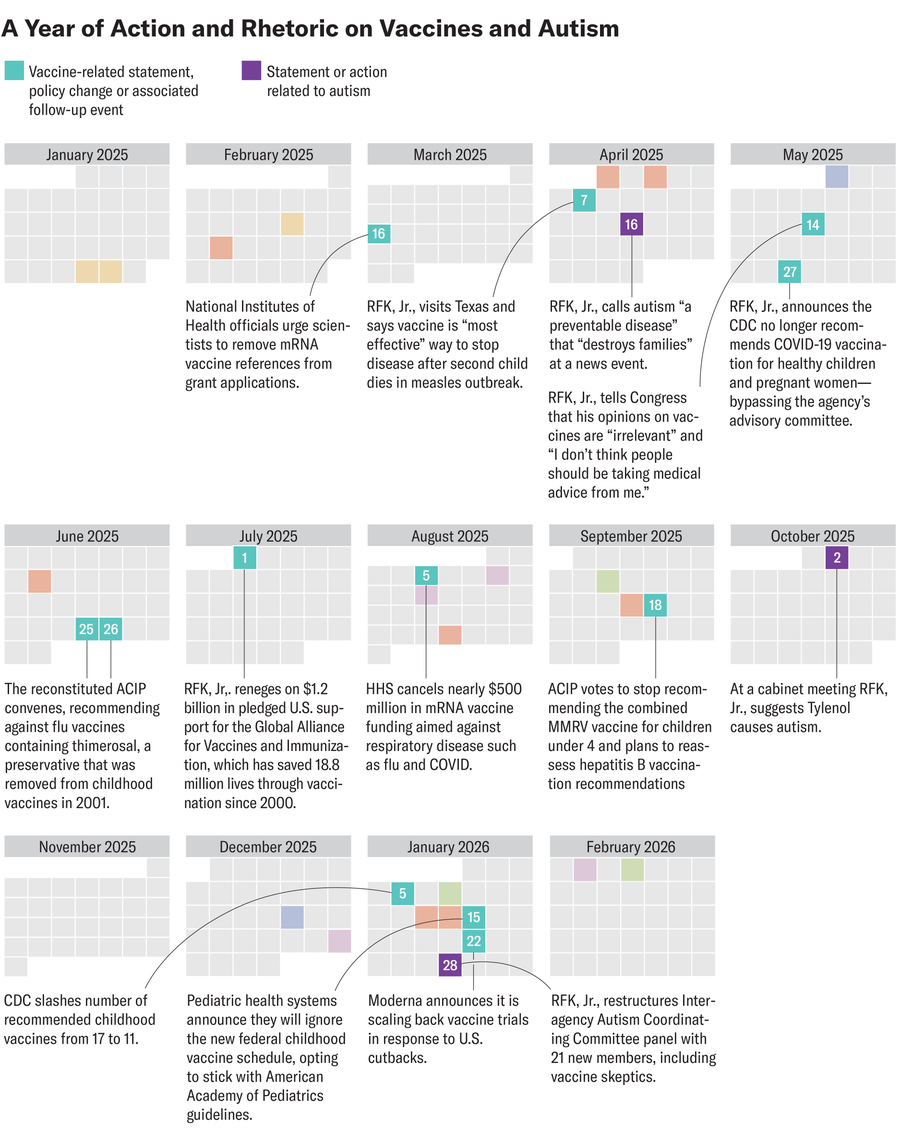
Graphic shows a series of monthly calendar grids from January 2025 to February 2026 with turquoise squares highlighting vaccine-related statements, policy changes and associated events and purple squares highlighting statements or actions related to autism. Each square is labeled with the date and annotated with a description of the associated event.
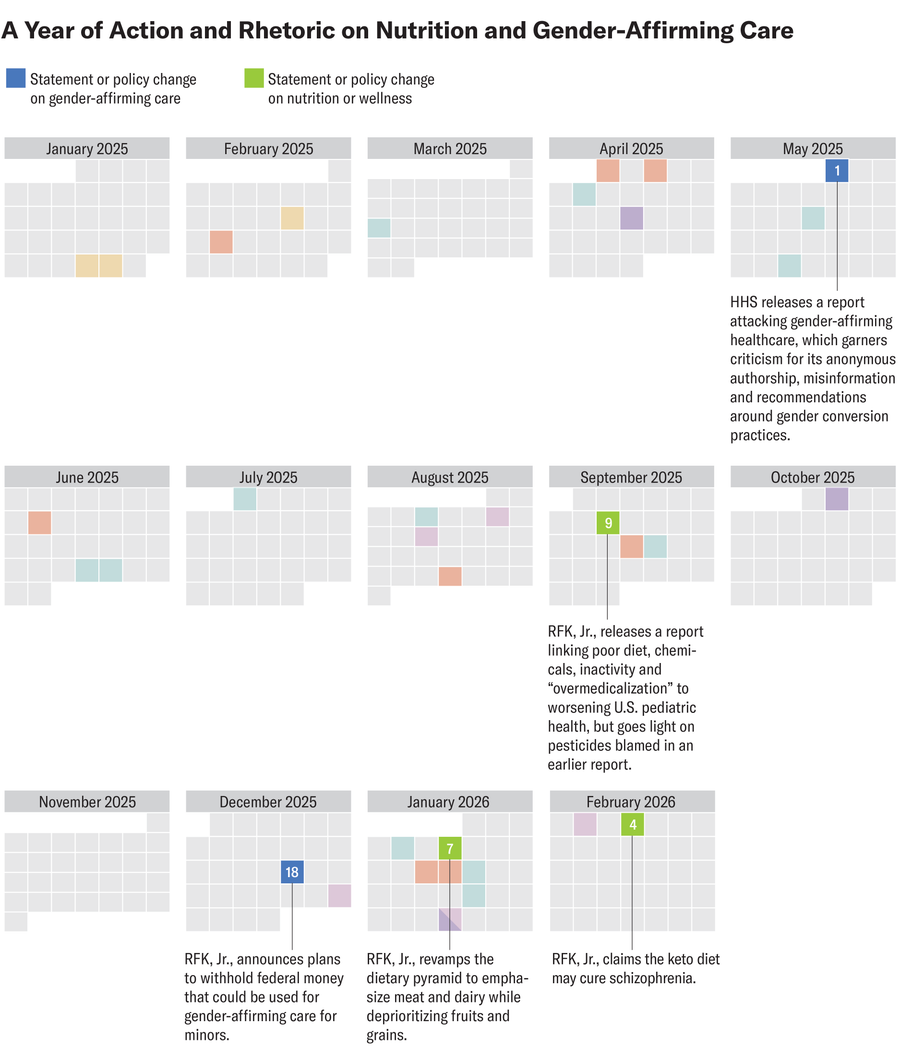
Graphic shows a series of monthly calendar grids from January 2025 to February 2026 with blue squares highlighting statements and policy changes on gender-affirming care and green squares highlighting statements and policy changes on nutrition or wellness. Each square is labeled with the date and annotated with a description of the associated event.
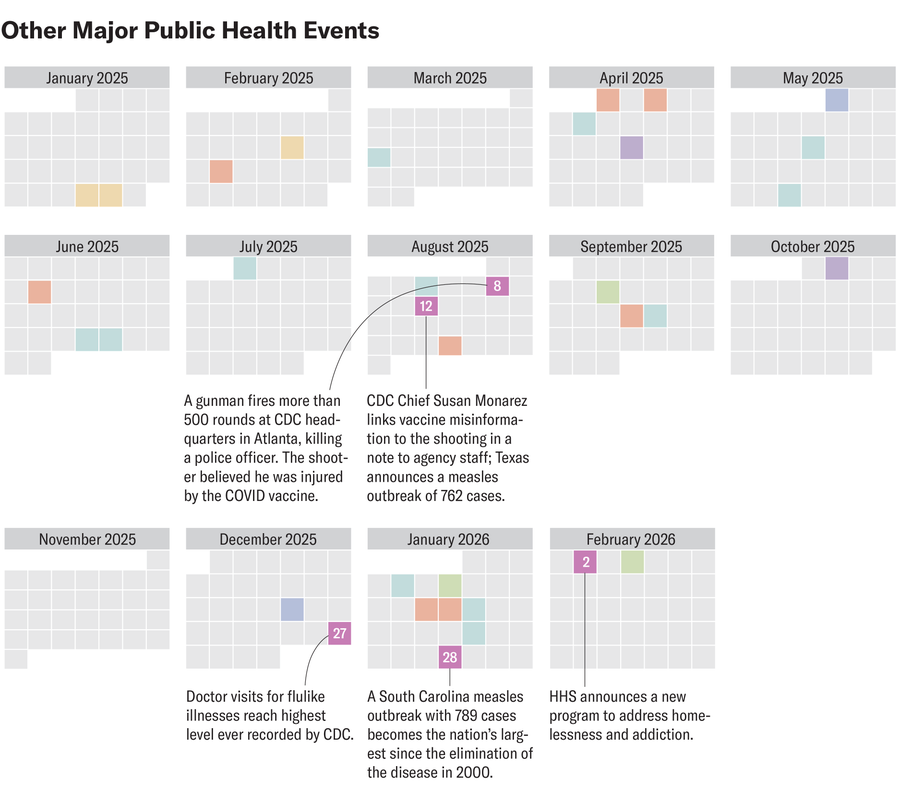
Graphic shows a series of monthly calendar grids from January 2025 to February 2026 with lavender squares highlighting other major public health events. Each square is labeled with the date and annotated with a description of the associated event.

The move, however, came after layoffs at HHS’s Substance Abuse and Mental Health Services Administration and the whipsaw cancellation and restoration of $2 billion in funding for its programs in January.

This kind of tumult is now standard fare at HHS. In his first year, Kennedy fired his own handpicked CDC chief, linked Tylenol to autism with little evidence and urged farmers to let bird flu “run through” their flocks (an idea that could blow chicken prices skyward and spur spread of the virus, experts say). All told, the agency lost more than 17,000 civil servants through firings and resignations in 2025—including many scientific leaders at the FDACDC and NIH. An HHS spokesperson defended Kennedy’s cuts to “bloated bureaucracies that were long overdue” to ProPublica in August.

In the September Senate hearing, Kennedy accused one critical lawmaker of “crazy talk” and took out his phone and began scrolling through it while another spoke. “We’re denying people vaccine,” said senator Bill Cassidy of Louisiana, the physician chair of the Senate health committee. “You’re wrong,” Kennedy replied to Cassidy, who provided a crucial Republican vote last February for Kennedy’s confirmation.

Kennedy “comes across as a privileged rich guy with an air of entitlement,” says American Public Health Association executive director Georges Benjamin, whose organization called for Kennedy to resign in April after the mass layoffs at the CDC, FDA and other health agencies. “He’s completely in over his head at this job, has no experience, no training in areas of health he’s affecting and is causing a lot of harm.”

VACCINES

Kennedy has a long history of vaccine opposition. He joined the board of the antivaccine nonprofit Children’s Health Defense in 2015, when it was known as the World Mercury Project (and resigned from his position as chairman in 2024); the organization led numerous lawsuits against vaccine makers. The move from environmental lawyer to antivaccine activist turned out to be well timed for postpandemic politics; attacking COVID vaccines wooed Republican voters. At his confirmation hearing, Kennedy refused to disavow links between vaccines and autism, a favorite theory of outfits spurring vaccine hesitancy among parents, though numerous studies have found no connection. “News reports have claimed that I am antivaccine or anti-industry,” Kennedy said at his confirmation hearing. “I am neither; I am pro-safety.” What Kennedy meant then by safety has since become clear, Benjamin says: his own judgment.

The FDA’s top vaccine official, Peter Marks, resigned in March, writing of Kennedy, “truth and transparency are not desired by the secretary, but rather he wishes subservient confirmation of his misinformation and lies.” During the pandemic, Marks had famously withstood political pressure to approve COVID shots without safety testing. Now he is out. An HHS official told NPR that Marks “has no place at FDA” because of his opposition to the secretary “restoring science to its golden standard and promoting radical transparency” at the agency.

In May Kennedy removed COVID vaccines from the list of shots recommended for healthy pregnant adults and children without consulting with CDC safety panel experts. In June he fired those experts and replaced them with people scientists have called unqualified, unvetted vaccine opponents. He next pulled $500 million in funding away from research into mRNA vaccines to combat diseases such as COVID and the flu, falsely claiming they had stopped working as the viruses evolved. He followed that move by firing then CDC chief Susan Monarez, a microbiologist, who wouldn’t rubber-stamp the votes of the panel she called “newly filled with people who have publicly expressed antivaccine rhetoric” in a Wall Street Journal op-ed.

Kennedy later claimed Monarez had told him she wasn’t “trustworthy”; in Senate testimony, she denied doing so. “The question before us is whether we will keep faith with our children and grandchildren—ensuring they remain safe from the diseases we fought so hard to defeat: polio, measles, diphtheria, whooping cough and many others,” Monarez said at the September 17 Senate hearing. “Undoing that progress would not only be reckless—it would betray every family that trusts us to protect their health.”

In December Kennedy’s reconstituted vaccine panel voted to stop recommending that all newborns be vaccinated for hepatitis B, a disease that contributed to the deaths of 1.1 million people worldwide in 2022. HHS next reduced the number of U.S. childhood vaccine shots so that they protected against 11 diseases instead of 17, basing the decision on the rules of Denmark, a country with a relatively small and homogenous population and publicly funded health care for all. Most recently, the chair of the vaccine panel, a cardiologist, told POLITICO that its focus this year will be on examining vaccine side effects rather than on its longstanding mission of gauging vaccine effectiveness.

WELLNESS

“I walk through the airports today…, and I see these kids that are just overburdened with mitochondrial challenges,” Kennedy said in August at a Texas “Make America Healthy Again” state-law-signing ceremony. Ashish Jha, formerly the Biden administration’s pandemic response czar, called this airport diagnosis “wacky, flat-earth voodoo stuff” on X (formerly Twitter).

But for Kennedy’s MAHA followers, it probably sounded familiar. Concern over mitochondria has moved from a nascent area of medical research to staple of the trillion-dollar wellness industry. Alongside exercise and vitamins, the industry embraces the medical “freedom” movement opposed to conventional medicineincluding vaccines. The movement’s rhetoric echoes many of RFK, Jr.’s MAHA claims, says Richard Pan, a California physician and former lawmaker, who clashed with Kennedy’s fight against California vaccine laws in 2019. Numerous corners of the wellness world embrace odd longevity curesunpasteurized milk, unfluoridated waterdubious nutritional supplements and the assertions of influencers such as Casey Means, Trump’s nominee for surgeon general, who argues that many chronic diseases such as diabetes, cancer and Alzheimer’s originate via “mitochondrial dysfunction.” This dysfunction, she claims, is driven by poor sleep, bad food and inactivity. These are all real problems, but they’re ones with uncertain links to sleepy kids in airports.

“I think what we’re seeing is a mutual partnership between RFK, Jr., and what he says he values and the existing MAHA values and ideals,” says Mariah L Wellman of Michigan State University, a wellness industry scholar. Kennedy’s rhetoric reflects a common ground with influencers like Means, she adds. “I absolutely think there are deep ties between how the wellness industry exists [and] is talked about on social media right now and RFK, Jr.’s beliefs.”

In May, at a Senate Finance Committee hearing, Kennedy called for an end to genetic research on the causes of autism, instead suggesting that “environmental toxins” were the source. Kennedy often claims there that there is an autism “epidemic,” but improved diagnosis largely explains the recent rise in cases.

A MAHA commission report released by HHS in September reflected the movement’s signature mixture of concern over real problems, such as rising childhood obesity and illness, with Kennedy’s “pet peeves and half-baked science that doesn’t really get at the root causes of poor health in children,” says Peter Lurie of the Center for Science in the Public Interest. Alongside calls for research on cell-phone-signaleffects on health and vaccine injuries, the report went light on investigating pesticides and the food industry, disappointing some environmental figures.

In September Kennedy joined Trump in suggesting that Tylenol use during pregnancy causes autism—another belief taken up by the wellness industry—based on weak evidence. Scientists, however, say that if the medicine is linked with autism—a connection that’s not yet clear—it could be the fevers and infections the Tylenol was meant to address, and not the pills themselves, that drives increased autism risk. Nevertheless, HHS started the process for an FDA warning to be added to the pain reliever’s label.

January’s reset of U.S. nutrition guidelines from HHS also borrowed some wellness ideas, calling for people to eat “real food” such as beets, strawberries and beans (foods endorsed by wellness nutritionists as well as, apparently, Mike Tyson, the boxer notorious for biting one of his opponents’ ears, who espoused eating real food in a Super Bowl commercial promoting the changes). The guidelines embrace whole milk and red meat despite more than six decades of research that have found that saturated fat is linked to heart disease.

The recommendations fit a pattern of Kennedy’s, Benjamin says. “I see him as a sort of environmental purist of sorts,” he says, rejecting medicine just as he once opposed pollution as an environmental lawyer. Fatty “real” foods, even if they are linked to heart disease, look less threatening to a worldview shaped by fears of something “artificial” causing harm, even if (unnatural) prescription drugs such as statins actually reduce the risk of heart disease. “He is an advocate, and he sees the world as a place for advocacy, not [for] the balanced perspective of a scientist or physician,” Benjamin says.

Antidepressants and heart disease medications are now in MAHA’s sights. Kennedy has claimed that medications such as these are overprescribed as a result of what he says is corruption that has affected medical studies—a charge that echoes his environmental movement rhetoric.

POLITICS

“Don’t you want a president that is going to make America healthy again?” Kennedy said at an August 23, 2024, campaign rally in Glendale, Ariz., in which he endorsed Trump. At the event, as Trump was introducing Kennedy to his supporters, he announced his intention to release the assassination files of Kennedy’s uncle John F. Kennedy…

“RFK, Jr., certainly has his own goals and ideology that overlap with Trump’s and are also distinct,” says Pamela Herd of the University of Michigan’s Gerald R. Ford School of Public Policy. “But at the end of the day, it is the Trump administration, and he will be limited to what it is, or isn’t, comfortable with.”

In other words, Kennedy is just one more politician heading a federal agency in the Trump era. In March he kept silent as the EPA rolled back mercury pollution rules, as well as others, despite railing against their proposed cancelation in 2017. (He had also pledged during his campaign to remove toxic chemicals from food.) He has also bent to the administration’s industry alliesby going light on pesticide makers and backing away from initial calls to regulate ultraprocessed foods.

And Kennedy’s big picture goal of reversing chronic disease keeps butting against the current political calculusAxios noted in April. By taking the axe to research on illness among minorities and the disadvantaged, he cut off help to those most affected by diabetes, heart disease, cancer and COVID. In April Kennedy told ABC News that administration funding cuts at federal agencies were “not affecting science”, but in 2025 more than 3,800 grants ended up killed or frozen at NIH and the National Science Foundation.

At a December campaign rally-style briefing from the first-floor stage of HHS’s headquarters at the Hubert H. Humphrey Building in Washington, D.C., Kennedy announced sweeping plans to restrict gender-affirming care for U.S. minors. Kennedy recognized political activists and conservative politicians in his opening remarks. Gender-affirming care has not been a historical preoccupation of Kennedy or the wellness industry but rather one “where the [Republican] party sees an advantage,” POLITICO observed.

“I think the MAHA and MAGA [movements] are intersecting circles in a Venn Diagram,” says political scientist David Lewis of Vanderbilt University. Right now, the two movements form a political coalition held together by Trump, he says.

Overall, the most significant effect of Kennedy’s tenure at HHS, Herd says, is his firing of scientific leaders and replacing expertise with political activism, most notably in upending the childhood vaccine schedule. The politicization genie won’t easily go back in the bottle, she says. “I think this this is a much more kind of radical change and one that’s difficult to pull back.”

MAHA and MAGA are now inextricably linked. In February Kennedy spoke at the right-wing Heritage Foundation’s event “One Year of Making America Healthy Again,” attended by political activists and Senator Tommy Tuberville. There Tony Lyons, president of the political group MAHA Action, described the group’s commitment to backing Republican candidates endorsed by Trump, a sign that the political coalition forged in the 2024 election will hold into the midterms. “It’s a joy to work for [Trump],” Kennedy said onstage. “He lets me do stuff that I don’t think anybody else would ever let me do.”

DAN VERGANO is senior editor, Washington, D.C., at Scientific American. He has previously written for Grid News, BuzzFeed News, National Geographic and USA Today. He ischair of the New Horizons committee for the Council for the Advancement of Science Writing and a journalism award judge for both the American Association for the Advancement of Science and the U.S. National Academies of Sciences, Engineering, and Medicine.

It’s Time to Stand Up for Science

If you enjoyed this article, I’d like to ask for your support. Scientific American has served as an advocate for science and industry for 180 years, and right now may be the most critical moment in that two-century history.

I’ve been a Scientific American subscriber since I was 12 years old, and it helped shape the way I look at the world. SciAm always educates and delights me, and inspires a sense of awe for our vast, beautiful universe. I hope it does that for you, too.

If you subscribe to Scientific American, you help ensure that our coverage is centered on meaningful research and discovery; that we have the resources to report on the decisions that threaten labs across the U.S.; and that we support both budding and working scientists at a time when the value of science itself too often goes unrecognized.

In return, you get essential news, captivating podcasts, brilliant infographics, can’t-miss newsletters, must-watch videos, challenging games, and the science world’s best writing and reporting. You can even gift someone a subscription.

There has never been a more important time for us to stand up and show why science matters. I hope you’ll support us in that mission.

Thank you,

David M. Ewalt, Editor in Chief, Scientific American

Subscribe Subscribe to Scientific American to learn and share the most exciting discoveries, innovations and ideas shaping our world today.

We have long known that Donald Trump despises science. We also know that he refuses to accept the science concerning climate change. Yesterday, Trump accepted an award as the “Champion of Coal.” He wants to turn the clock back a century. He will go down in history for his willful ignorance and for the harm he has unleashed on the public.

The Los Angeles Times reports:

*The Trump administration has repealed the 2009 endangerment finding on greenhouse gases, eliminating the foundation of much of U.S. climate policy.

*The decision reverses decades of environmental progress despite overwhelming scientific evidence and opposition from health experts, environmental groups, 50 cities and 17 states.

*Experts warn the repeal will increase pollution, respiratory disease and planet-warming emissions over the coming decades.

The Trump administration on Thursday reversed the U.S. government’s longstanding scientific assertion that planet-heating pollution seriously threatens Americans, erasing a foundational piece of the country’s efforts to address climate change.

The repeal of the 2009 endangerment finding — a conclusion based on decades of science that carbon dioxide and other greenhouse gases endanger public health and welfare — represents one of the biggest environmental rollbacks in U.S. history, and the latest in a series of actions by President Trump to scrap policies and regulations designed to curb the use of fossil fuels and accelerate the transition to clean energy.

The administration on Thursday also repealed all federal regulations governing vehicle emissions.

Experts and scientists condemned the action. The Environmental Protection Network — a bipartisan group of more than 700 former staff and appointees at the Environmental Protection Agency — described it as “unprecedented and dangerous.”

“This move is a fundamental betrayal of EPA’s responsibility to protect human health,” said Joseph Goffman, former assistant administrator of the EPA Office of Air and Radiation. “It is legally indefensible, morally bankrupt and completely untethered from the scientific record.”

Independent researchers around the world have long concluded that greenhouse gases released by the burning of gasoline, diesel and other fossil fuels are warming the planet and worsening weather disasters.

In the year 2000, health officials declared that measles had been eliminated in the United States, thanks to a successful program to vaccinate all children against the disease.

But, thanks to Robert F. Kennedy Jr, who is now Secretary of Health and Human Services, measles is back.

RFK Jr. is often described as a “vaccine skeptic.” He would be more accurately described as a fierce opponent of vaccines.

South Carolina reported nearly 800 cases last Tuesday, and the number is likely to grow.

CNN reported:

With 789 cases reported as of Tuesday, the South Carolina outbreak surpassed a massive outbreak in Texas, which reached 762 cases before it ended in August last year. Two children died during the outbreak in Texas…

“It breaks my heart to see that my state is the number one outbreak currently in the United States since the 1990s,” Dr. Anna Kathryn Rye Burch, a pediatric infectious diseases physician with Prisma Health in South Carolina, told CNN Wednesday. “We have this amazing vaccine that would help protect us all from getting the measles, and we are just seeing that people aren’t as excited about getting that vaccine anymore. This is why we’re seeing measles come back into the United States…”

Measles was declared eliminated in the US in 2000, meaning there has not been continuous transmission for more than a year at a time.

Before 2025, there were an average of about 180 measles cases reported each year since elimination, according to US Centers for Disease Control and Prevention data. The US reported more than 2,200 confirmed measles cases in 2025 — significantly more than there have been in any year since 2000.

https://www.cnn.com/2026/01/27/health/largest-us-measles-outbreak-south-carolina?utm_source=cnn_Evening+Newsletter+-+Thursday%2C+January+29%2C+2026&utm_medium=email&bt_ee=gvqCy2mCVeUEqO7zOX61HyRkKAF7F461fS0rgklCK%2Bs9goDd85EFJdHLZMXX1kfC&bt_ts=1769725134216

Every year, Science magazine highlights the most innovative development of the year. While the United States retreats from efforts to protect the environment, China surges ahead with the use of American technology.

Here is its selection for 2025:

BREAKTHROUGH OF THE YEAR

The rise of renewables

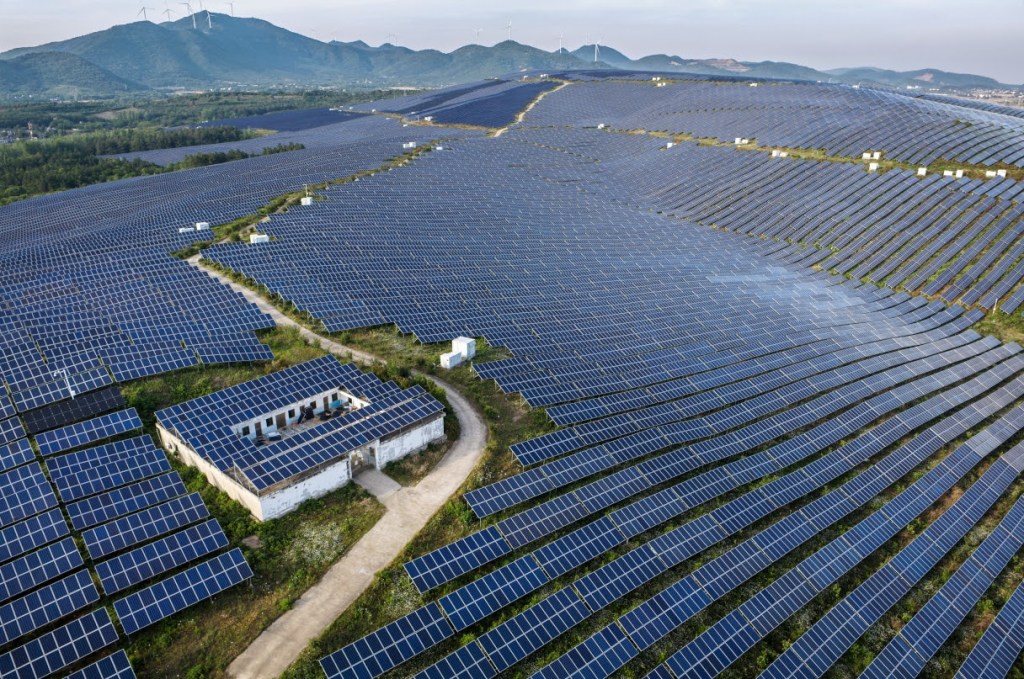
Solar panels armor a hillside in China’s Anhui province, parting only for an access road. Distant ridges host wind turbines, another fast-growing component of an energy revolution that has helped ease air pollution and slow the growth of China’s carbon emissions.  GEORGE STEINMETZ

This year—for the first time—the world produced more energy via renewable sources than with coal. The meteoric rise of these greener energy technologies, particularly in China, has brought us tantalizingly close to the turning point where annual global carbon emissions plateau and even decline. “To many, the continued growth of renewables now seems unstoppable,” wrote Science News Editor Tim Appenzeller—“a prospect that has led Science to name the renewable energy surge its 2025 Breakthrough of the Year.”

While renewable technologies were pioneered in the U.S., it was China’s industrious production of them that changed the game. The country now makes 80% of the world’s solar cells, 70% of its wind turbines, and 70% of its lithium batteries. Increased production led to lower prices and increased demand, which in turn fueled even more production and even lower prices. As a result, “wind and solar became the cheapest energy in much of the world,” Appenzeller noted. Instead of investing in renewables because they are environmentally friendly, countries—and individuals—started buying them up because they were more affordable. “That change in motivation may be the most important breakthrough of all, ensuring that this year’s inflection points are just the beginning,” he concluded.

But there is one notable exception: the United States. “The U.S. is now squandering an opportunity to reap the benefits of its own technology, ceding the income and the geopolitical power to a nation that repeatedly puts technological prowess above politics,” wrote Science Editor-in-Chief Holden Thorp in an accompanying editorial. While much of the world continues to increase its renewable energy capacity, “the U.S. marches boldly backward toward the past,” Thorp wrote.


The Trump administration is engaged in a war against science and medicine. It has eliminated funding in many crucial areas of research conducted by universities and by the National Institutes of Health. Incalculable damage has been done to set back the search for cures for cancer, Alzheimer’s, heart disease, infectious diseases, HIV, respiratory diseases, and pediatric cancer. People will die because of the ignorance of those who close down ongoing, vital research.

Trump has consistently claimed that “climate change” is a hoax. He has said that the term “climate change” refers to the weather. He hates wind farms and has cut federal funding for them. He has hated wind farms since wind turbines were built near his Trump International Golf Links in Scotland. He sued to block them but repeatedly lost.

Now he is closing down a major hub of climate research.

The New York Times reported:

The Trump administration said it will be dismantling the National Center for Atmospheric Research in Colorado, one of the world’s leading Earth science research institutions.

The center, founded in 1960, is responsible for many of the biggest scientific advances in humanity’s understanding of weather and climate. Its research aircraft and sophisticated computer models of the Earth’s atmosphere and oceans are widely used in forecasting weather events and disasters around the country, and its scientists study a broad range of topics, including air pollution, ocean currents and global warming.

But in a social media post announcing the move late on Tuesday, Russell Vought, the director of the Office of Management and Budget, called the center “one of the largest sources of climate alarmism in the country” and said that the federal government would be “breaking up” the institution.

Mr. Vought wrote that a “comprehensive review is underway” and that “any vital activities such as weather research will be moved to another entity or location.”

USA Today first reported on the White House plans.

Scientists, meteorologists and lawmakers said the move was an attack on critical scientific research and would harm the United States.

The National Center for Atmospheric Research was originally founded to provide scientists studying Earth’s atmosphere with cutting-edge resources, such as supercomputers, that individual universities could not afford on their own. It is now widely considered a global leader in both weather and climate change research, with programs aimed at tracking severe weather events, modeling floods and understanding how solar activity affects the Earth’s atmosphere.

The center’s research has often proved useful in unexpected places, such as when its studies of downdrafts in the lower atmosphere in the 1970s and 1980s led to development of wind shear detection systems around airports that helped address the cause of hundreds of aviation accidents during that era.