Archives for category: Privatization

Journalist Jennifer Berkshire and historian Jack Schneider wrote a warning in the New York Times to the Democratic Party about education. Democrats, they say, used to have a big advantage over Republicans on the education issue, but that advantage has almost disappeared. They say that Democrats have erred in celebrating education as the most important, if not the only, route to economic success. Meanwhile, they ignored trade unions, which dwindled under red state assaults and corporate attacks, and tax policy, which favored the rich.

While I don’t disagree with their analysis, I have a different take on why Democrats lost the education issue. Not only did they ignore growing economic inequality, but Democrats abandoned their historic devotion to public schools (attended by 90% of American students) and adopted the Republicans’ long-standing belief in choice, competition, testing, and accountability.

Thirty years later, it is indisputably clear that those policies do not improve education, do not increase opportunity for those who are at the bottom, and do not reduce economic inequality.

Under Bill Clinton in the early 1990s, the Democratic platform sounded remarkably like the Republican Party on education. Clinton and Gore pledged to create a national system of standards and tests. Their Goals 2000 legislation of 1994 laid the groundwork for George W. Bush’s No Child Left Behind, which had bipartisan support. The Clinton administration created the federal Charter Schools Program in 1994, which allocated a few million dollars to help start new charters; it has now grown into a charter slush fund of $440 million annually, which is strongly supported by Republicans and for which there is no need, given the many billionaires who subsidize charters.

Race to the Top was the culmination of the Democrats’ complete merger with Republicans on education policy.

The Democrats lost their primacy as the party of public schools because they embraced Republican ideology, and they ignored the causes of economic inequality, which testing, standards, and choice could not fix.

Berkshire and Schneider write:

The warning signs are everywhere. For 30 years, polls showed that Americans trusted Democrats over Republicans to invest in public education and strengthen schools. Within the past year, however, Republicans have closed the gap; a recent poll shows the two parties separated on the issue by less than the margin of error.

Since the Republican Glenn Youngkin scored an upset win in Virginia’s race for governor by making education a central campaign issue, Republicans in state after state have capitalized on anger over mask mandates, parental rights and teaching about race, and their strategy seems to be working. The culture wars now threatening to consume American schools have produced an unlikely coalition — one that includes populists on the right and a growing number of affluent, educated white parents on the left. Both groups are increasingly at odds with the Democratic Party.

For the party leaders tasked with crafting a midterm strategy, this development should set off alarms. Voters who feel looked down on by elites are now finding common cause with those elites, forming an alliance that could not only cost the Democrats the midterm elections but also fundamentally realign American politics.

The Democrats know they have a problem. One recent analysis conducted by the Democratic Governors Association put it bluntly: “We need to retake education as a winning issue.” But reclaiming their trustworthiness on education will require more than just savvier messaging. Democrats are going to need to rethink a core assumption: that education is the key to addressing economic inequality.

The party’s current education problem reflects a misguided policy shift made decades ago. Eager to reclaim the political center, Democratic politicians increasingly framed education, rather than labor unions or a progressive tax code, as the answer to many of our economic problems, embracing what Barack Obama would later call “ladders of opportunity,” such as “good” public schools and college degrees, which would offer a “hand up” rather than a handout. Bill Clinton famously pronounced, “What you earn depends on what you learn.”

But this message has proved to be deeply alienating to the people who once made up the core of the party. As the philosopher Michael Sandel wrote in his recent book “The Tyranny of Merit,” Democrats often seemed to imply that people whose living standards were declining had only themselves to blame. Meanwhile, more affluent voters were congratulated for their smarts and hard work. Tired of being told to pick themselves up and go to college, working people increasingly turned against the Democrats.

Today, as the middle class falls further behind the wealthy, the belief in education as the sole remedy for economic inequality appears more and more misguided. And yet, because Democrats have spent the past 30 years framing schooling as the surest route to the good life, any attempt to make our education system fairer is met with fierce resistance from affluent liberals worried that Democratic reforms might threaten their carefully laid plans to help their children get ahead.

Please read the rest of their article.
Sara Roos, a blogger who writes under the name “Red Queen in LA,” reports on a dangerous development in California. Charter school insiders took charge of writing the California Democratic Party’s education platform and made changes that undercut longstanding Democratic Party opposition to charter schools. Suddenly, charter schools are referred to not as privatization but as “public charter schools,” the preferred language of the charter lobby. The new language dropped the Democratic Party’s insistence that the boards of charter schools must be elected and replaced it with the requirement only that they be authorized by local school boards. A big change, among others that put the Democratic Party platform in the pocket of the charter billionaires.

Roos wrote:

What actually happened with the CA Democratic Party’s (CADEM) platform adopted Sunday (3/6/22) at its convention?

At the eleventh hour, following an eleven-hour meeting finalizing draft proposalsfor updating the 2022 CADEM platform, it came to light that one of its 23 platform “planks”, that of Education, had been tampered with by charter school (CS) industry insiders.

As a consequence, CADEM delegate and California Federation of Teachers legislative advocate, Tristan Brown, urged from the floor that fellow delegates vote “no” on the entirety of the proposed platform changes, since the rules forbade focusing on specifics to excise.

It was argued that the new language altered the hard-won, former mandate that charter school boards must be elected, because democracy demands public, elected accountability. The platform’s new language morphed this fundamental demand, requiring instead that charter schools simply be authorized and monitored by a school board. The language of conditional support was removed altogether.

On the strength of the Union recommendation by the statewide federation of teachers, and the leadership of several key caucus chairs and leaders, the final floor vote passing the platform was far shy of consensus at 57% aye (691 votes), 43% nay (510 votes). [The absolute numbers are extracted from the meeting transcript and are a little different from the poll result percentages shown to delegates via zoom].

From a convention of 3,037 elected delegates + 80 proxies, that translates to passage by just 22% (=691/3117) of total eligible voters at the convention. But the total number of delegates voting for the platform was not presented. If quorum were just reached for the vote with its 1559 members, then a bare minimum of 358, or nearly one-quarter of delegates (23% of the eligible quorum (=358/1559)), abstained from the platform vote altogether. The sum total of those failing to vote for the platform {“nay”+abstain} far outstrips those who did.

As it happens, the reality of the platform language change is far worse than what was hastily presented on the floor. And befitting their shepherding by charter school operators (including the board chair of the charter school lobbying association), these changes do very much advantage charter school operations.

The former language of bullet 23 in the K-12 Education plank conditioned circumstances for the Party’s support of charter schools on five contingencies [emphasis mine]:

  • Support only those charter schools that are managed by public and elected boards, not-for-profit, and transparent in governance; have equitable admissions; adopt fair labor practices and respect labor neutrality; and, supplement rather than supplant public education programs.

The draft language posted in advance of the convention eliminates rules for conditional support altogether. Instead conditions are replaced by definitions. The term “charter school” is redefined through use of the modifying adjective, “public”. A list of characteristics is simply inserted, absent any conditioning on support. And the long-standing federal exhortation acknowledging and specifying the fungibility of money to ‘supplement not supplant’ (ie, do not rob Peter to pay Paul), is lost:

  • Support public charter schools that are governed by not-for-profit, elected, public boards with transparent governance, have equitable admissions, adopt fair labor practices, respect labor neutrality, and supplement public education programs for students in historically low performing subgroups such as low income, English learners, Black, American Indian, and Alaskan Native students, foster children and students with disabilities

The real problem came from a change inserted after the posted draft platform. Support is urged for these entities now defined not by their governance but by the circumstance of their chartering: authorization and monitoring [emphasis mine]:

  • Support public charter schools that are authorized and monitored by public and elected boards, not-for-profit, and transparent in governance; have equitable admissions; adopt fair labor practices and respect labor neutrality; and, supplement public education programs for students in historically low performing subgroups such as low income, English learners, Black or African American, American Indian, and Alaskan Native students, foster children and students with disabilities

The change amounts to saying “I exist therefore I am”. It asserts support of charter schools no matter what, and defines them as “public”, a characteristic denied by the courts. Reversing the stringent conditional acceptance terms delineated formerly, this incarnation accepts charter schools as the choice of the Democratic Party.

Another change instigated by the charter school lobbyist who volunteered their services to the platform committee, softens the field for two competing ballot initiatives to privatize our public schools through the use of vouchers.

Under cover of redundancy, bullet 14 that unequivocally and expressly “opposes voucher systems for schools,” is eliminated. Its declaration is diluted by sending it lower in the long list of bullet points, and combining it with Education Savings Accounts. The real problem comes in conditioning this opposition to their effect. Since charter schools are defined in the platform now as “public”, vouchers would not be found to “take away from public school funding”.

  • Oppose K-12 Education Savings Accounts, school vouchers, or any programs that would take away from public school funding;

This change was not a mere correction of duplication, it substantively prepares the field for a statewide fight about “school choice,” launched and led from the left. The platform now states that because we define charter schools as “public”, vouchers are a system we no longer oppose because they do not take money away from the public-charter entity. Just as this new platform accepts charter schools de facto, we also now fail to oppose voucher systems.

Trickiness gonna be tricky. Voters gotta be vigilant. Special, monied-interests are persistent and focused; the rest of us are harried volunteers.

Angie Sullivan teaches in a Title 1 elementary school in Las Vegas, Nevada (Clark County). She frequently sends letters to every legislator in the state about the need to fund schools like hers adequately and the dismal failure of charter schools.

She responded to a post that featured an interview with Jennifer Berkshire, who predicted that some states would phase out public schools in the next few years.

Sullivan responded:

There would have been a time I would have said this will never happen. Public Schools are such an American Insitution. They are protected by laws.

Now I know charter schools are built to go around the laws. Our Nevada Constitution states one district one county. But charters claim they are not a district. And when necessary they are not even a school. The beauty of the EMO/CMO makes them slippery too. They are often a combination for-profit/non-profit. What law can apply to all of the above: a non-profit education.business, managed by a for-profit management corporation which can then also take advantage of all public school resources and tax advantages, while also applying for all the small business grants and money.

Nevada never got the immediate overnight conversion Elaine Wynn and her reformers wanted. That was too quick and shocking. The ASD grabbing 30 schools at a time did not work. [Elaine Wynn is chair of the state Board of Education and wife of a major casino owner.]

So neoliberals have settled for a slow and steady 5 or 6 charters a year. Along with adding to charter chains by grade level every year – 100 students here and 100 students there.

Jana Wilcox-Lavin uses the $22 million in grant money to grease wheels and find favor. Rebecca Feiden is one of the most powerful women in the state. She grants charters; She refuses charters. Rebecca gives some chance after chance after chance to start their charter business. Others, she stops dead in their tracks. They both inherited a dysfunctional and failing charter business. The Charter Authority is still mired in failing charters – failing financially, failing academically, and failing to enroll diversity. Charters in Nevada are obvious segregation and white flight. There is limited appetite to serve poor students.

Mayors in Clark County seem to think running a school is easy. The pandemic allowed them to use education money to offer micro-charters. This seems to have whet some appetites to own a district of their own.

Mayor Goodman of the City of Las Vegas wants a charter. For some unknown reason she paired up with the EMO TNTP (Michelle Rhee’s Group). She signed on the who’s who of education reform. The City of Las Vegas is now in the school business. Interestingly enough Mayor Goodman was successful at running an expensive private school. She does know education. She has zero experience running a school for diverse poor students. She is about to get a wake-up call. Cedric Creer was only voice of reason when this was discussed. He has the failing Agassi, Rainbow, and 100 Academies in his area – he warned the City Council not to go into the school business. Those charters have had few successes and much more failure. Turnover is constant both teachers and students. Mayor Goodman is about to learn that loads of donations and cash from the City of Las Vegas will not be enough if you let Michelle Rhee’s teaching hating group abuse labor. Interestingly enough, Goodman will retire and the City Council will then run this charter school.

Things I did not think were possible.

Are happening.

I thought our straight forward laws would prevent the Mayors from owning a district through their City Councils.. But charters are not in “districts”. Nor are they schools. Nor are they businesses. They become whatever they need to be to skirt the rules the rest of us live by daily. They claim it is “innovation”. Grifters do it everyday. I do not find it new.

I watched Rebecca Feiden define EMO/CMO very differently to the Nevada Legislature the other day – than she has ever defined it is a Charter Authority Meeting. Perhaps she does not even know or want to know. She was certainly snippy like legislators should already know.

I think this year, The Nevada State Public Charter School Authority will become the second largest district (yes, I know they claim they are not one, but they act like one) in Nevada. It is the size of the Reno/Washoe School District almost. And it serves mainly rich white students inside the middle of Clark County. Yes I know it has a hand full of diverse charters – those are not the norm. Yes I know there are charters in other counties. The bulk of the Nevada charters are serving rich white students inside CCSD. Creating a systematic segregation in Clark County. White Flight is obvious.

Charters segregate by religion, race, and money. They are actually tracking special education, language learning, and free and reduce lunch because those categories earn businesses more pupil center funding dollars. This tracking does not help with Mormon charters, all black or all white charters, and charter locations which are obviously limiting access.

Rebecca Feiden is focused on trying to get more free and reduced lunch children into charters. The Charter Authority is sending the charters a letter, inviting them to participate in “Weighted Lotteries” to help correct their diversity issues. All the charters are getting a “Weighted Lottery” and the Charter Authority is claiming this is a tool to diversify. Weighted Lotteries do not help at all. Especially with new charter enrollment which required diversity by law. Weighted Lotteries only go into affect if charters are full. Technically if a charter has even one spot open – the lottery is not triggered.

The irony of all this is not lost on me. CCSD is one of the most diverse districts in the United States. Yet our Nevada Charters which are predominantly EMO’d For-Profit Academica – serve the rich and white. Now Nevada Charters are spending money to attract diversity to their charters – advertising, flyers, walking door-to-door, or so they claim they tried to find a diverse child to enroll. The Tax Payer has to pay these businesses to admit a few IEP, language learners or poor children. For some perspective, my public school is 100% diverse on every and all levels – we do not try at all to add diversity. In fact

Nevada never closes a failing charter. Even charters that cannot fill out the application or meet the requirements just sue until they are finally allowed to do whatever they want. There is not remedy to stop this. $950 million in Nevada Charters and not a single soul can tell you where it is or what it was spent on.

This is why I think Jennifer Berkshire is correct. Eventually, there will be no place called public schools. There will be a selection list and rich people will be able to pay to have a teacher and school. Others will accept cash and their children will not receive anything and that will be fine because it is their “choice”. And most will meet in a charter warehouse somewhere to sit in front of a device with software teaching them. The poor will be used to privatized and receive the lesser quality of the lists.

It will be slow. CCSD has a parasite. At this rate, the Charter Authority will just keep growing and making more messes which use up more education dollars. It takes from some to give to others. And folx are just fine with allowing a corporation take everything from the disadvantaged so their own children can get ahead. The so called “progressives” are leading the charge.

It is wrong and I hope we fight it. I believe in our imperfect public schools. I see nothing the charters offer that is new. I do not see them being a remedy at all. There is some limited liability advantages for businesses – is that good use of tax dollars?

I hope I am wrong.

Logically I am just afraid Jennifer Berkshire is right.

She followed up with another comment:

Sadly CCSD and Nevada “Leadership” are TFA. They are here to stay. Having catapaulted themselves above everyone.

An example is the very powerful Rebecca Feiden who control $950 million in Nevada Education Dollars which go to Nevada Charters.

Another is Jana Wilcox-Lavin in Opportunity 180 which spreads charters and gives “grants” to them.

No one wants to be a teacher – seems there will always be an appetite to make six figures and control everyone and everything for an eduphilantrophist like Elaine Wynn.

Craig Harris of USA Today wrote a blistering expose of the money grab by charter schools for federal COVID funds. Harris was previously a reporter for the Arizona Republic who often covered charter school scandals in that state where deregulation has enabled grifters to get rich by opening charter schools. This story is a national scandal. Unfortunately, it is behind a paywall, so I urge you to run out and buy the Sunday March 20 USA Today.

The story begins:

America’s charter schools received at least a $1 billion windfall during the pandemic, an unneeded cash infusion for most from a federal program intended to bail out struggling small businesses, USA TODAY has found. 

More than 1,000 of the publicly funded but privately operated schools that educate a fraction of U.S. children jumped at the chance to collect forgivable loans up to $10 million after Congress created the Paycheck Protection Program in March 2020.

The hastily launched program was designed to save small businesses during the pandemic by helping them cover employee salaries and other costs.

While more than 90% of all eligible businesses across the country took the roughly $800 billion inloan allocations, charter schools were among the first to get the money — ahead of mom-and-pop shops and minority-owned companies — during the early days of the crisis when the economy was cratering and many business owners scrambled to get a financial lifeline.

And charter schools were uniquely positioned to get the loans — even though they continually received funding from taxes, just like traditional public schools. But unlike those schools, which educate the vast majority of American children, charters qualified for what would eventually become pots of free money because they are considered a business. 

A USA TODAY investigation, based on public records,found 93%of the charter schools may not have needed the money because they were in states that continued to fund them at the same level as before the pandemic, or at even higher levels in some cases. These schools also had access to federal COVID grants. 

Records show some of the private companies that operate the charter schools used the money to pad savings accounts or, in one case, hand millions of dollars to an investor.

USA TODAY’s investigation is based on publicly available documents from 1,139 charter schools, as well as federal and state agencies, including 37 departments of education that oversee local funding for charter schools.

“It makes me furious because there was absolutely no reason for those (charter) schools to get that money and take it from small businesses,” said Carol Corbett Burris, a critic of charter schools and executive director of the Network for Public Education Foundation, an advocacy group in New York City. “They successfully double-dipped….”

Charter school advocates said operators were entitled to the loans, which ranged from $150,746 to $9.8 million,because they are technically private businesses

“Funding is always difficult to secure but was even more challenging during the pandemic,”  said Nina Rees, president and CEO of the National Alliance for Public Charter Schools.

Rees added that charter schools typically receive less public funding than traditional school districts and Congress intended for them to get the money because of “the special nature of these unique public schools.”

Critics have a different view. 

A congresswoman who has monitored the program said that while the schools may have done nothing legally wrong, their decisions to take the money were “terrible.” And one superintendent who leads an inner-city San Diego charter operation said that despite the legality, the behavior was unethical because financially strong charter businesses took money from those truly in need. 

“At the time PPP became available, we had not suffered financially,” said David Sciarretta, superintendent of the Albert Einstein Academies, which has 1,450 students from kindergarten to eighth grade at two San Diego campuses. “I saw PPP as a way to help small businesses, especially those in the service sector…There is a fiscal way to look at it, and there’s a moral and ethical way to look at it.”

While Sciarretta declined to call out specifics schools, USA TODAY found, for example, that at least 14 affiliates of the California-based charter chainKnowledge Is Power Program (KIPP) took a collective $28.4 million in loans and had them forgiven at locations around the U.S.

Its national headquarters in San Francisco, meanwhile, saw its bottom line swell 56% to $75 million during the first year of the pandemic….

The concerns about charter schools have spurred critics to pressure the federal Small Business Administration, which is in charge of forgiving the loans if companies used them to save jobs and cover COVID-related expenses, to claw back the money.

The SBA declined repeated requests for interviews in response to questions about financially solid charter schools having their loans forgiven. 

The agency in a late December email told USA TODAY it was committed to helping businesses reopen and that it had removed hindrances for small businesses to have their loans forgiven.

SBA two months later, following additional questions from USA TODAY, blamed the Trump administration for issues of “fraud, waste and abuse” in the program. Yet, nearly all of the loan forgiveness has happened at SBA during the Biden administration.

California Congresswoman Judy Chu is a member of the House Small Business Committee, and she has sought answers about where the money went and which businesses received loan forgiveness. Shamed by media attention in the early days of the pandemic, the Los Angeles Lakers and the national chain Shake Shack returned their multi-million dollar PPP loans.

Congresswoman Chu said:

It was never the intent of Congress to forgive loans to companies, such as charter schools, that experienced no economic loss.

“It’s terrible,” Chu said about the charter schools. “But nonetheless, it is in the realm of what is permissible.”

Permissible, but not ethical. Charter schools got their ”loans” early on because of their relationships with their banks, but minority-owned businesses waited for months.

The PPP program was a boon to the charter industry, which never lost its state funding, but it was ineffective. Harris quotes a study by the National Bureau of Educational Research which found that the program “the program kept up to three million workers employed an additional year at a cost of up to $258,000 per job retained.

This is a very powerful, well researched article that raises important questions. if charter schools are “businesses,” how can they call themselves ”public schools?” Public schools were not eligible for PPP funds because they are not businesses. Charter schools qualified for public school funding and for PPP funding. They are both fish and fowl. They did not lose money, like the mom-and -pop stores that had to close their doors. But they eagerly took the money that was supposed to save the jobs of people who lost them and save the businesses on the edge of bankruptcy.

Permissible? Perhaps. Ethical? No.


Jill Lepore is a historian at Harvard University and a writer for The New Yorker. In this recent article, she reviews a history of attacks on one of our nation’s most important democratic institutions: our public schools. To read the complete article, subscribe to The New Yorker. It is a wonderful magazine.

She begins:

In 1925, Lela V. Scopes, twenty-eight, was turned down for a job teaching mathematics at a high school in Paducah, Kentucky, her home town. She had taught in the Paducah schools before going to Lexington to finish college at the University of Kentucky. But that summer her younger brother, John T. Scopes, was set to be tried for the crime of teaching evolution in a high-school biology class in Dayton, Tennessee, in violation of state law, and Lela Scopes had refused to denounce either her kin or Charles Darwin. It didn’t matter that evolution doesn’t ordinarily come up in an algebra class. And it didn’t matter that Kentucky’s own anti-evolution law had been defeated. “Miss Scopes loses her post because she is in sympathy with her brother’s stand,” the Times reported.

In the nineteen-twenties, legislatures in twenty states, most of them in the South, considered thirty-seven anti-evolution measures. Kentucky’s bill, proposed in 1922, had been the first. It banned teaching, or countenancing the teaching of, “Darwinism, atheism, agnosticism, or the theory of evolution in so far as it pertains to the origin of man.” The bill failed to pass the House by a single vote. Tennessee’s law, passed in 1925, made it a crime for teachers in publicly funded schools “to teach any theory that denies the story of the Divine Creation of man as taught in the Bible, and to teach instead that man has descended from a lower order of animals.” Scopes challenged the law deliberately, as part of an effort by the A.C.L.U. to bring a test case to court. His trial, billed as the trial of the century, was the first to be broadcast live on the radio. It went out across the country, to a nation, rapt.

A century later, the battle over public education that afflicted the nineteen-twenties has started up again, this time over the teaching of American history. Since 2020, with the murder of George Floyd and the advance of the Black Lives Matter movement, seventeen states have made efforts to expand the teaching of one sort of history, sometimes called anti-racist history, while thirty-six states have made efforts to restrict that very same kind of instruction. In 2020, Connecticut became the first state to require African American and Latino American history. Last year, Maine passed “An Act to Integrate African American Studies into American History Education,” and Illinois added a requirement mandating a unit on Asian American history.

On the blackboard on the other side of the classroom are scrawled what might be called anti-anti-racism measures. Some ban the Times’ 1619 Project, or ethnic studies, or training in diversity, inclusion, and belonging, or the bugbear known as critical race theory. Most, like a bill recently introduced in West Virginia, prohibit “race or sex stereotyping,” “race or sex scapegoating,” and the teaching of “divisive concepts”—for instance, the idea that “the United States is fundamentally racist or sexist,” or that “an individual, by virtue of his or her race or sex, is inherently racist, sexist or oppressive, whether consciously or unconsciously.”

While all this has been happening, I’ve been working on a U.S.-history textbook, so it’s been weird to watch lawmakers try their hands at writing American history, and horrible to see what the ferment is doing to public-school teachers. In Virginia, Governor Glenn Youngkin set up an e-mail tip line “for parents to send us any instances where they feel that their fundamental rights are being violated . . . or where there are inherently divisive practices in their schools.” There and elsewhere, parents are harassing school boards and reporting on teachers, at a time when teachers, who earn too little and are asked to do too much, are already exhausted by battles over remote instruction and mask and vaccine mandates and, not least, by witnessing, without being able to repair, the damage the pandemic has inflicted on their students. Kids carry the burdens of loss, uncertainty, and shaken faith on their narrow shoulders, tucked inside their backpacks. Now, with schools open and masks coming off, teachers are left trying to figure out not only how to care for them but also what to teach, and how to teach it, without losing their jobs owing to complaints filed by parents.

There’s a rock, and a hard place, and then there’s a classroom. Consider the dilemma of teachers in New Mexico. In January, the month before the state’s Public Education Department finalized a new social-studies curriculum that includes a unit on inequality and justice in which students are asked to “explore inequity throughout the history of the United States and its connection to conflict that arises today,” Republican lawmakers proposed a ban on teaching “the idea that social problems are created by racist or patriarchal societal structures and systems.” The law, if passed, would make the state’s own curriculum a crime.

Evolution is a theory of change. But in February—a hundred years, nearly to the day, after the Kentucky legislature debated the nation’s first anti-evolution bill—Republicans in Kentucky introduced a bill that mandates the teaching of twenty-four historical documents, beginning with the 1620 Mayflower Compact and ending with Ronald Reagan’s 1964 speech “A Time for Choosing.” My own account of American history ends with the 2020 insurrection at the Capitol, and “The Hill We Climb,” the poem that Amanda Gorman recited at the 2021 Inauguration. “Let the globe, if nothing else, say this is true: / That even as we grieved, we grew.”

Did we, though? In the nineteen-twenties, the curriculum in question was biology; in the twenty-twenties, it’s history. Both conflicts followed a global pandemic and fights over public education that pitted the rights of parents against the power of the state. It’s not clear who’ll win this time. It’s not even clear who won last time. But the distinction between these two moments is less than it seems: what was once contested as a matter of biology—can people change?—has come to be contested as a matter of history. Still, this fight isn’t really about history. It’s about political power. Conservatives believe they can win midterm elections, and maybe even the Presidency, by whipping up a frenzy about “parents’ rights,” and many are also in it for another long game, a hundred years’ war: the campaign against public education.

Please subscribe and finish reading.

The latest from Michigan, where Betsy DeVos is leading a campaign for vouchers:

FOR IMMEDIATE RELEASE

News from For MI Kids, For Our Schools

***MEDIA ADVISORY***

March 15, 2022

Contact: Sam Inglot, 616-916-0574, sam@progressmichigan.org

New Coalition Forms to Stop DeVos Voucher Proposal

For MI Kids, For Our Schools launches campaign to oppose DeVos voucher effort to take hundreds of millions of dollars away from public schools

MICHIGAN – On Wednesday, March 16 at 1 p.m. EST, a coalition of organizations will announce the launch of the For MI Kids, For Our Schools ballot question committee (For MI Kids, for short) during a Zoom press call. For MI Kids is focused on defeating the DeVos-backed “Let MI Kids Learn” voucher proposal that would rip hundreds of millions of dollars away from public schools across Michigan. 

The coalition that makes up For MI Kids includes: 482Forward, American Federation of Teachers Michigan, K-12 Alliance of Michigan, Michigan Association of School Boards, Michigan Association of Superintendents & Administrators, Michigan Education Association, Michigan Education Justice Coalition, Michigan Parent Teacher Association, and the Middle Cities Education Association.

WHO: For MI Kids, For Our Schools

Casandra Ulbrich, PhD, who serves as the president of the State Board of Education

Andrew Brodie, Superintendent, Flat Rock Community Schools and MASA Board President

Arlyssa Heard, a Detroit schools special education parent, 482Forward education organizer

Twanda Bailey, a retired educator from Detroit with 30 years of teaching experience

Owen Goslin, a Cheboygan schools parent

Rick Catherman, a retired educator from South Haven with 30 years of teaching experience

WHAT: Zoom Press Call

Members of the media are asked to RSVP in advance. Contact sam@progressmichigan.org if you run into any issues.

WHEN: Wednesday, March 16 @ 1 p.m. EST

WHY: For MI Kids, For Our Schools is a ballot committee opposing the Let MI Kids Learn voucher proposal because it would take hundreds of millions of dollars away from public schools, hurting every public school across Michigan during a historic teacher shortage. The coalition is made up of parents, educators, support staff, administrators, and community-minded folks who love our public schools and want to see them improve and thrive so every student can get a great education.

###

Andy Spears is the publisher of the Tennessee Education Report. He writes in the current issue of The Progressive about the well-funded effort to privatize education funding in Tennessee. Republican Governor Bill Lee and the legislature are determined to gut local control and to outsource taxpayer dollars to out-of-state organizations to open charter schools. This drive for privatization ignores the abject failure of the Tennessee Educational Achievement Authority, which burned through $100 million without achieving anything.

Spears writes:

If you are wondering what it looks like when school privatizers are close to total victory, Tennessee is a prime example. Here, the forces that want to take public money and hand it over to private entities are on the verge of completing their conquest.

Tennessee’s current legislative session features a range of attacks on public schools. Some of these would have immediate impacts, while others take a longer-term approach to fully privatizing K-12 education in the state.

First, it is important to understand that groups backing privatization in the form of charter schools and vouchers are among the top spenders when it comes to lobbying state legislators. For example, the American Federation for Children—an organization founded and previously led by the family of Betsy DeVos, a school privatization advocate and former President Donald Trump’s Secretary of Education—spent $887,500. Another big spender, the Tennessee Charter School Center, spent $732,500.

Based on this year’s full-frontal assault, these investments appear to be paying off. There are three key issues that currently pose the most significant threat to Tennessee’s public schools. They include: a partnership with Hillsdale College, a private fundamentalist Christian college in Michigan, to run fifty or more charter schools; legislation that would create a charter school real estate grab; and school funding reforms that set the stage for a statewide voucher program.

In his State of the State address, Governor Bill Lee restated his commitment to set aside $32 million to help launch new charters in Tennessee and announced the Hillsdale College partnership, which could bring close to fifty Hillsdale-run charter schools into the state.

Beyond the use of public funds to open schools run by a private, Christian college, there is reason to be concerned about the nature of the Hillsdale curriculum. As educator and blogger Peter Greene explained, “[Hillsdale President Larry] Arnn has been a Trump supporter, and the college has fallen right into MAGAland as well. . . . The college uses Trump mailing lists to raise money. They used to sponsor Rush Limbaugh’s show. They get grads placed on the staff of legislators such as Jim Jordan and Kevin McCarthy.”

Over the past decade, I have consistently referred to charters as part of the privatization movement, a first decisive step towards vouchers. Charter advocates have frequently written to insist that charter schools are “public schools.” They are, because the state law (drafter by charter lobbyists) calls them “public schools.”

But the Tennessee push for charter schools makes clear that they have become a Trojan horse for privatization. Governor Lee is rewriting the school funding formula so “the money follows the child,” a back door path to vouchers, which a state court ruled unconstitutional.

Spears writes:

Potentially millions of dollars worth of real estate assets in local districts across Tennessee could soon be up for grabs at prices below market value. No wonder privatizers tied to the charter industry have spent $8 million lobbying the legislature.

The final element in the push for privatization is being billed as a “reform” of the state’s school funding formula. Governor Lee recently released his plan to revamp how the state directs money to local school districts for public schools. The bottom line, according to Lee, is that the approach is “student-centered” and that funds “follow the child” no matter what. This plan is based on model legislation from the rightwing American Legislative Exchange Council (ALEC).

This statement, first of all, creates the erroneous impression that charter schools operate as “public” schools. Although called public schools under Tennessee law (as in most states), these schools function with less government oversight and an array of private operations, from real estate management to the sourcing of substitute teachers to overall school management.

Lee has been fighting to redirect public money to private schools since before he was elected governor.

Second, the proposed change to school funding is quite simply the gateway to a full-on voucher scheme. As Tennessee teacher Mike Stein wrote on his personal blog, the final form of funding reform is a workaround for a school voucher law that Lee enacted and was ruled unconstitutional.

Can the privatizers be stopped? Will charters pave the way for vouchers? Will Governor Lee succeed in destroying local control of public schools?

Stay tuned.

By now, we have observed that the Koch-Walton-DeVos oligarchs take every opportunity to undermine public confidence in public schools. Wherever there is an organized attack on public schools and their teachers, it’s a safe bet that there’s dark money from libertarian billionaires.

John Merrow wrote recently about the new “parents rights” groups that have led the fight against public schools. His post was condensed by the blog of the Network for Public Education. Read the full post here on John Merrow’s blog..

Opportunistic politicians are also attempting to limit classroom discussion of other controversial topics. In late February Florida’s House of Representatives passed a bill to ban “classroom discussion about sexual orientation or gender identity” in the state’s primary schools. Governor DeSantis has indicated that he will sign the bill if the Senate passes it. [The legislature passed the bill and DeSantis will sign it.]

Of course, the GOP maintains that it’s doing this for parents “Speaking to legislators on the House floor, Rep. Joe Harding, the Republican who introduced the bill, said the measure is about “empowering parents” and improving the quality of life for the state’s children.” Florida isn’t alone. According to the highly regarded publication Chalkbeat, at least 36 states have adopted or introduced laws or policies that restrict teaching about race and racism.

As New York Times columnist Jamelle Bouie wrote recently, “Defenders of this push for censorship say they are simply working to protect the nation’s children from prejudice, psychological distress and inappropriate material. ‘To say there were slaves is one thing, but to talk in detail about how slaves were treated, and with photos, is another,’ said Tina Descovich, a leader of (a Florida chapter of) Moms for Liberty, a conservative group that seeks to enshrine ‘parental rights’ into law.”

Ms. Descovich, who lost her seat on a local school board in 2020, is a parent, but many of the adults who have been disrupting local school board meetings not only do not have children enrolled in those schools; they are classic outside agitators, perhaps even from neighboring states.

Simply reviewing curricula and banning discussion aren’t enough for some. Legislators in Florida, Iowa, and Mississippi want cameras installed in classrooms so parents can watch what’s going on. “The Iowa bill, H.F. 2177, would require that cameras be placed in every public school classroom in the state, except for physical education and special education classes. The cameras would feed to livestreams that could be viewed on the internet by parents, guardians and others.” Educators who fail to keep the cameras operational would lose 5% of their salary, per infraction. The bill died in Committee, but its supporters haven’t given up.

The pandemic has created opportunities for opponents of public education. Twenty-two states created or enlarged school voucher programs in 2021, and more are in the offing. “School voucher proponents in statehouses across the country have spent much of the past year working to pass legislation that transfers critical public school funding to the private sector. Framing these debates around education “reform” and the inauthentic culture wars surrounding public schools, voucher proponents have been steadily working to undermine public education on the state level.” That’s from the publication of the National Education Association, which explains the loaded language.

But the NEA numbers are correct, as others have reported. ”Nearly half of all state legislatures last year increased funding for school choice programs in their state budgets or passed laws to expand or create new Education Savings Accounts or scholarship programs. They also notably expanded eligibility requirements to include home-schooling, charter schools and private schools. Four states created entirely new programs; three created new and expanded programs, and Ohio created the most improved programs of them all, according to the analysis. The majority, 14, either expanded or improved their existing school choice programs.”

While this isn’t the time or place to debate vouchers, let’s stipulate that money dedicated to vouchers would otherwise have gone to public schools.

COVID and the ensuing closure of most public schools frustrated many parents, some of whom felt that teachers cared more about their own health than their students’ learning. Teacher unions, a favorite whipping boy of the right, may have hurt their own cause by defending members who did not want to risk contracting COVID–but defending their members is what unions are supposed to do.

But what’s happening now has very little to do with education and far more to do with politics. Republicans feel that being ‘pro-parent’ is a winning position, even though barely 20% of households have school age children. I don’t think most Republican politicians really care whether parents dig deeply into curriculum. What they hope is that the other 80%–those without children–will be outraged at the idea of meddling teachers indoctrinating America’s children. Their goal is for the other 80% to go to the polls and vote Republican.

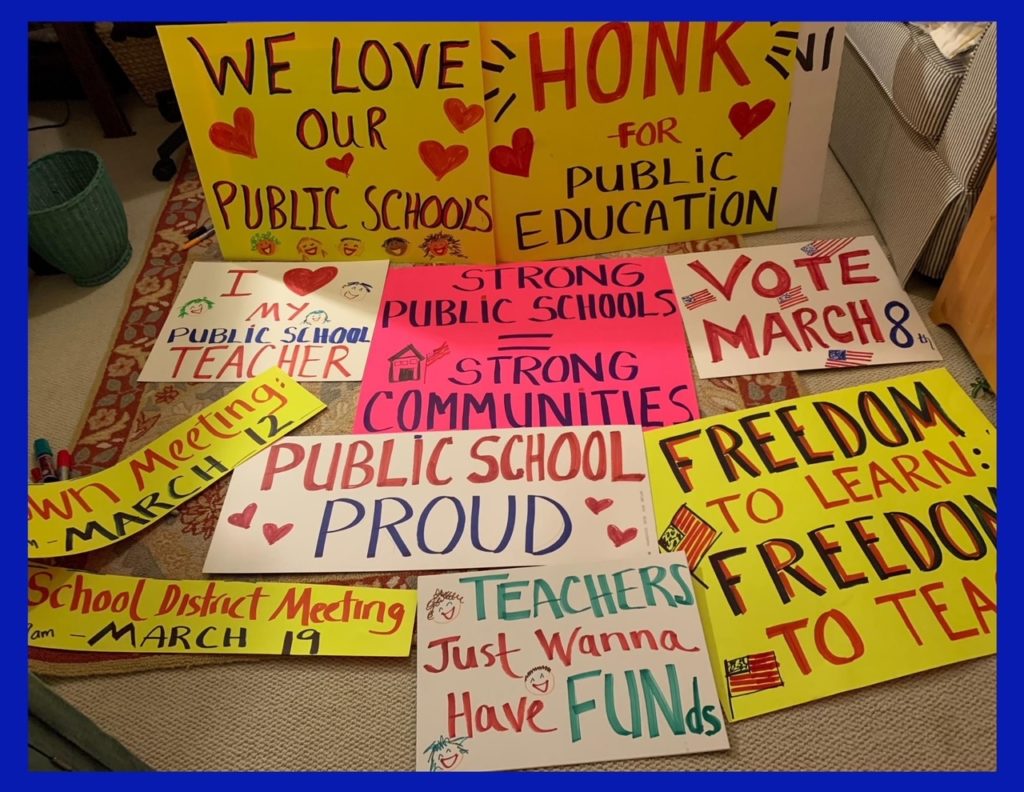
Tuesday’s school board election in New Hampshire was a triumph for parents and citizens who love their public schools!

This must have shocked Republican Governor Chris Sununu, the Republican-controlled legislature, and State Commissioner Frank Edelblut, who home-schooled his own children and is pushing a sweeping voucher plan for the state.

AfterGlenn Youngkin was elected Governor of Virginia by pandering to parents angry about “critical race theory,” mask mandates, and eager to control what children learned and what books they read, the media bombarded us with stories predicting that Republicans would win next November by running against public schools.

New Hampshire families and citizens said on Election Day, “Not so fast! We love our public schools.”

I Love Public Education Sign Visibility

In first town elections since onslaught of attacks on public education and a honest, accurate education, voters send clear message that they support strong public schools and a honest, accurate education

CONCORD, NH – In race after race across New Hampshire on Town Meeting Day, concerned parents and community members in communities large and small successfully organized to elect pro-public education candidates and reject those seeking to dismantle public education and censor history.

“These results should raise serious doubts about any Republican 2022 election strategy that is built around pitting parents against local public schools and educators,” said Zandra Rice Hawkins, Executive Director of Granite State Progress. “In nearly every school board race, Granite State voters chose out-spoken champions for public education and an honest, accurate, inclusive education. This is a big win for public schools and for our future. These leaders are committed to keeping our public schools strong and making sure every student’s history and experience is valued.”

The results from the election are all the more astounding for record-shattering voter turnout, and for the blatant differences between the candidates on everything from public education, COVID public health measures, and attempts to whitewash American history and censor educators. A priority list of school board results can be found here.

Key examples from around the state:

  • Merrimack Valley School District, home to some of the state’s most vocal anti-vaccine, anti-mask, and classroom censorship activists, experienced a 56% increase in voter turnout from 2019, and supported public education candidates while also defeating a classroom censorship/anti-equity warrant resolution.
  • Bedford experienced a 36% increase in voter turnout and elected pro-public education candidate and teacher Andrea Campbell with 2832 votes, compared to 1293 votes for Sean Monroe, a candidate supported by right-wing organization Defend Our Kids, and 856 for incumbent John Schneller; both of whom supported efforts to censor teachers and ban conversations about race and racism in public schools.
  • Londonderry elected pro-public education candidates Amanda Butcher and Kevin Gray, defeating vocal anti-masker Rachel Killian (seen here harassing school board members during a public meeting). Voters also rejected a warrant resolution to make masks completely optional and the sole decision of parents instead of school leaders and public health experts; a significant decision given Gov. Sununu’s recent decision to ban schools from enacting COVID public health measures like masks.
  • Governor Wentworth School District elected Republican State Rep. Brodie Deschaies over far-right activist Jessica Williams, who believes public schools are indoctrinating students and was arrested at a GWSD school board meeting on September 13, 2021.
  • Weare elected pro-public education candidates William “Bill” Politt and Alyssa Small, and passed full-day kindergarten; and Hollis elected pro-public education candidates Carryl Roy, Krista Whalan, and Holly Babcock.
  • Exeter and SAU 16 elected a full slate of pro-public education and honest education candidates, despite a nearly $20,000 effort by the opposition and months of voter mailings from those who oppose diversity, equity, and inclusion justice efforts in the school districts.

“We are in awe of how our communities have come together to protect and support public education,” said Sarah Robinson, Education Justice Campaign Director for Granite State Progress. “Parents, students, educators, and community leaders have been working for months to organize, recruit strong candidates, and support pro-public education campaigns. Watching the results come in and knowing that so many public education champions are going to be serving in these roles gives us all hope. Our schools have been under constant attack from privatization schemes, neo-Nazi’s, and of course Governor Sununu’s statewide ban on a honest education. We all know that serving on a school board right now is challenging, and we thank these leaders for stepping up for our students. We hope the folks at the State House are paying attention, because this showdown will play out again in November unless they stop the attacks on our public schools.”

The St. Louis Post-Dispatch published a front-page story about the financial shenanigans associated with a charter school founded by two TFA teachers (one of whom was the son of the former mayor). The school has a large number of uncertified teachers and an uncertified high school principal and boasts of its staff’s lack of credentials. Its teachers have a high attrition rate. And its academic performance is mediocre. The school handbook says that staff must keep all financial records confidential. Nonetheless, the school Hoovers up millions of taxpayer dollars from local, state and federal governments and claims it wants to “proselytize” about its “method.” Whether they mean to spread their “method” of sucking up public funds or producing unimpressive academic results is not clear.

Despite stories like this one, the Republican-led legislature wants to authorize more charters.

ST. LOUIS — The sponsor of Kairos Academies, a charter school in the Marine Villa neighborhood, has raised red flags over the school’s financial and leadership practices involving a shadow group that employs nearly two-thirds of the staff.

The school’s founders created Kairos Academies Vanguard for “charitable and educational purposes” before the school opened three years ago, according to records with the Missouri Secretary of State. The nonprofit has since grown to employ 36 staff members out of 56 who work at the school, including 10 teachers and all administrators.

Kairos has funneled millions of taxpayer dollars to Vanguard for bookkeeping, human resources, student recruitment, special education and other services, all without a contract. While Vanguard staff members work full time at Kairos, are listed in the school directory and share a staff handbook, school leaders say they are exempt from state laws requiring the release of financial information and participation in an educators’ pension fund.

Vanguard qualifies as a quasi-governmental body subject to Missouri Sunshine Law because its primary purpose is to contract with a taxpayer-funded school, said St. Louis lawyer Elad Gross.

“Schemes like this one to spin off a nonprofit organization are trying to do what a lot of corporations do,” Gross said. “Folks are using those same Wall Street-type practices to avoid liability and public transparency.”

In a “letter of concern” sent this month, the Missouri Charter Public School Commission that sponsors Kairos outlined a 13-point correction plan for the school to complete by March 31. The plan calls for an approved contract with Vanguard, separate audits of the school and the nonprofit, and legal oversight and training on open records laws.

Kairos violated Missouri regulations by not following policies regarding its relationship with Vanguard including approval from its sponsor, according to Robbyn Wahby, the charter school commission’s executive director.

“These requirements exist to ensure that public funds for the education of Missouri students are managed transparently and appropriately,” Wahby wrote in the Feb. 4 letter.

After receiving Wahby’s letter, Kairos set up a mailbox for Vanguard at a coworking space across the street from the school on south Jefferson Avenue. The Kairos board held a special meeting Wednesday to approve a temporary contract through March that pays Vanguard $282,480 per month. Clayton lawyer Hugh Eastwood serves as president of the board of both organizations.

The charter commission “is demanding that the school have a detailed contract with Vanguard so that the commission and taxpayers will know how public funds are used” by the March 31 deadline, Wahby said. “We are pleased that Kairos Academies’ board agrees with our findings and is working to put in place the remedies we are requiring of them.”

$3.3 million

Kairos Academies opened in fall of 2019 led by CEO Gavin Schiffres and chief strategy officer Jack Krewson, son of then-mayor Lyda Krewson. The founders were both 25 at the time and graduates of the two-year Teach for America program. The education reform group Opportunity Trust contributed more than $300,000 in startup costs and continues to provide annual grants.

Kairos now enrolls about 400 students in fifth through eighth grades and will start a high school with ninth graders in the fall. Last spring, 35% of students tested proficient in English and 33% in math on state standardized tests. Only eight current staff members, including Krewson and Schiffres, were with the school when it opened in fall of 2019, according to the school directory.

Schiffres said Vanguard was formed with the “idea of creating a vehicle where we could take what we learned and potentially bring it to other regions, take the Kairos method and proselytize that.”

Charter schools are publicly funded and independently operated. Under Missouri law, charter school employees are required to participate in the Public School Retirement System of the City of St. Louis. Kairos pays 15% of the salaries of 20 teachers into the retirement fund, according to an audit of fiscal year 2021 by St. Louis accounting firm KEB.

The school’s administrators, plus Spanish, art and special education teachers, the principal and head of athletics and secretarial staff are considered contractors who are exempt from the fund. Those 36 employees can receive up to a 3% match for a separate retirement fund, according to the Kairos staff handbook.

The audit of Kairos included Vanguard as an affiliate because “the entities are commonly managed.” It shows the two organizations combined received $3.3 million in local, state and federal tax revenue in fiscal 2021.

No certification

A review of state and school records shows other examples of Kairos operating like a private organization:

• Eight teachers including three English teachers have no Missouri teaching certificates. An additional seven have substitute certificates, according to the Missouri Department of Elementary and Secondary Education. Nilesh Patel, who is slated to lead Kairos’ high school this fall, has no state certification. The Kairos community handbook reads, “Please assume that your child’s teachers are not certified to teach in their assigned grade level or subject. Although most are, Kairos takes cues from the best private schools around the country and recruits talent with diverse, real-world experience.”

• Like traditional public schools, charter schools are not allowed to discriminate in admissions. The Kairos staff handbook suggests that family income can play a role. “Enrolling another low-income student will make it harder to get the high academic results my team is striving for … disadvantaged students tend to come in below grade level,” the handbook describes as a hypothetical admissions decision. “On the other hand, our Finance Team understands the economic value associated with any student: they’re ‘customers’ the state pays us to educate.”

• Kairos received $163,000 in 2020 through the U.S. Small Business Administration’s Paycheck Protection Program. The school also anticipates receiving about $2 million in coronavirus relief for public schools from the U.S. Department of Education, according to its records.

• The Kairos handbook says staff must keep financial information, vendor contracts and curriculum confidential.

Do it the Kairos way!