Archives for category: Privatization


Stephen Dyer says there is now little or no question that crimes were committed by ECOT (the late, unlamented Electronic Classroom of Tomorrow).

Someone knowingly inflated enrollment to collect millions from the state.

Who done it?

“Because it now appears that we have a smoking gun indicating that officials at the Electronic Classroom of Tomorrow formed the necessary mens rea to be charged with crimes.

“According to an Associated Press story today (which ran all over the place, but I’ll link to my former employer’s version), people at ECOT — at one point the largest single school in the nation — were ordered to deliberately inflate enrollment so the school could keep getting paid $100 million plus to “educate” children, even if those children weren’t actually at ECOT.

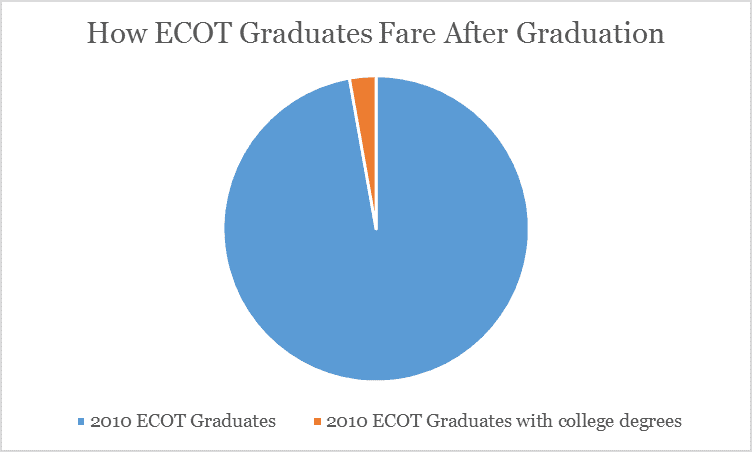
“ECOT infamously did a remarkably poor job of educating those who were, by the way. How poor? Only 109 of 3,794 ECOT graduates from 2010 earned a college degree within 6 years of graduating.”

B

The highest court in Massachusetts ruled unanimously that the cap on charter schools is constitutional. 

It tossed out an effort by charter advocates to win in the judicial system what they lost at the polls in a state referendum in 2016, when the public voted against expanding the number of charter schools.

In an opinion issued Tuesday, Massachusetts’ Supreme Judicial Court dismissed a complaint that the cap on the number of charter schools allowed to operate in state violates students’ rights under the state’s constitution.

The unanimous opinion, authored by Justice Kimberly Budd, affirmed a lower-court decision made in October 2016. It holds that even when public schools under-serve their students, that doesn’t mean state actors are failing in their constitutional duties — or that opening more charter schools is the only way to make it right.

The decision represents a third and possibly decisive setback for the proposal to lift the longstanding cap. In 2015, legislators decided against advancing Gov. Charlie Baker’s bill for more charter schools, instead leaving the choice to voters — who then voted it down by a 24-point margin in 2016.

It’s cause for disappointment and frustration among supporters of those schools, and for students and families who hoped to get in off their wait lists.

“Watching your own children have to suffer in a school that’s underperforming — and knowing that it’s the result of a political turf war… it’s crushing. It’s devastating.”

Keri Rodrigues

 Keri Rodrigues is one of those people. She’s an education activist who supported Question 2 in 2016. Now, she runs Massachusetts Parents United — an advocacy group supported in part by the pro-charter Walton Foundation. She has two sons who have tried and failed to get seats in a charter school. “Watching your own children have to suffer in a school that’s underperforming — and knowing that it’s the result of a political turf war… it’s crushing. It’s devastating…”

The plaintiffs argued that missed opportunity amounted to a violation of their shared right to an adequate public education, or to equal protection under the laws, as laid out in the state constitution.

The SJC opinion accepts the plaintiffs’ arguments that, under Massachusetts’ constitution, state leaders must provide all students with an “adequate education,” and that “the education provided at their schools is, at the moment, inadequate” based on testing data.

But the court rejected the plaintiffs’ conclusions. The opinion holds that state officials and lawmakers must be allowed to work to improve poorly-performing schools, and that the plaintiffs failed to demonstrate that the state’s current approach — including oversight and takeover of chronically underperforming schools — couldn’t jump-start progress “over a reasonable period of time.”

Rodrigues wasn’t persuaded. “Over what period of time are we talking about? Because parents get roughly 12 years to get their kids an adequate education,” she said. “So are we just supposed to roll the dice and hope the commonwealth is able to figure this out?”

But the SJC opinion goes further. It argues that even if students’ constitutional rights were definitively being violated, it still wouldn’t mean the charter program must be expanded. The opinion states, “There is no constitutional entitlement to attend charter school,” and further, that the court is barred from enforcing any “fundamentally political” remedy of that kind.

The decision, in short, says that the state has an affirmative duty to improve low-performing schools, not an affirmative duty to open privately managed charter schools.

Rodrigues was state director for the now-defunct Families for Excellent Schools (also Walton-funded), which bundled millions of dollars for the failed “Yes on 2” charter expansion referendum; she is now executive director of Massachusetts Parents United, another astroturf group created by Walton and other charter advocacy organizations.

Unlike most parent organizations, Massachusetts Parents United started its life with $1.5 million in projected income and more on the way from the Waltons and other friends. 

The decision affirmed that the charter advocacy groups cannot rely upon the judicial system to overturn the 2016 referendum that said NO to more charter schools.

toñ hhc

We always knew that Campbell Brown’s anti-union, anti-teacher news site (The 74) would find a way to blame the growing wave of teachers’ strikes on those”evil unions.”

Peter Greene finds the quintessential non sequitur article on The 74, written by a choice zealot.

Teachers are walking out in “right to work” states, it seems, because they are robots who do what their unions order them to do. Teachers never think for themselves.

Lest we forget, the 74 is funded in part by Betsy DeVos.

Critical thinking is not the selling point of The 74. Propaganda is.


Teachers who worked at Chicago’s leading charter chain spoke out to NPR and described their discomfort with the strict disciplinary code. Some called it “dehumanizing.” 

“The trend toward school choice has educators across the country looking at Chicago’s Noble Charter Schools — an award-winning network of mostly high schools that specializes in helping inner-city kids achieve the kind of SAT scores that propel them into four-year universities. But despite its prestigious reputation, Noble has a peculiarly high teacher turnover rate.

“And some of those teachers are speaking up about policies they describe as “dehumanizing.”

“Noble’s handbook lists more than 20 behaviors that can elicit demerits. The dress code, for example, requires students to wear light khakis, plain black leather belts,

“Kerease Epps, who taught at Noble’s Hansberry College Prep, made sure to arrive by seven o’clock every day to help students with curved lines in their hair avoid punishment.

”“Every morning, I would color in two of my boys’ parts,” she says. ”I had a hefty amount of eyeliner at my desk, so I’d just color in with black or brown eyeliner.”

“Ann Baltzer taught chemistry at Hansberry. When one of her female students showed up with braids that included strands of maroon — the school color — the girl was told she couldn’t attend class. So she asked Baltzer to use a black marker to obliterate the maroon in each braid. The teacher looks back on that as not only unnecessary, but racist.

“To have a system that results in a white woman having to color on a black woman’s hair, and if I don’t, she’s excluded from education, there’s something wrong with that,” Baltzer says…”

Some teachers like the strict discipline and the culture change it promotes.

But turnover among teachers is high, in part because of the culture of the schools.

“It’s a completely dehumanizing system, both for teachers and students,” Baltzer says.

“One of the policies that made her most uncomfortable was demanding “level zero,” or complete silence, in the hallways during passing period, which she says teachers could activate by yelling “hands up.”

“Teachers were applauded if you had the ability to shut down the hallway,” Baltzer says. “We had no awareness that it would be inappropriate to shout ‘hands up’ at a hallway full of black children. And so we had white teachers shouting ‘Hands up’ and kids putting their hands up and going silent. That is insane.”


Now, here is a startling and welcome development. Dennis Kucinich, who is running for Governor of Ohio, has proposed a complete ban on campaign contributions by charter operators. If charter operators couldn’t give campaign contributions, they would not be able to buy legislators or other state officials. Since public schools can’t make campaign contributions, that would level the playing field.

Are the voters of Ohio sick of charter corruption yet?

Charter school officials would be banned from making campaign contributions under a sweeping plan unveiled today by Democratic gubernatorial candidate Dennis Kucinich.

The former congressman and Cleveland mayor also wants a statewide vote on a constitutional amendment that would allow local school boards to decide whether they even want charter schools, which are privately operated but funded with taxpayer dollars.

“Ohio public educational funding has been subverted by special interest groups and for-profit charter school management companies, who through campaign contributions have, in the past decade, normalized the privatization of public education funding, creating an often substandard, for-profit system ‘education’ system, using and misusing billions of dollars in public funds,” Kucinich said.

“The normalization of what is essentially a wholly corrupt system constitutes one of the greatest scandals in the history of the state of Ohio because billions of public funds have been diverted away from public education and have enriched private, for-profit enterprises.”

He pointed to the founder of ECOT, the online charter school forced to close last month, who gave hundreds of thousands of dollars to state lawmakers who enabled lax oversight and the diversion of money from local school districts to charter schools.

“Any local school board member, member of the General Assembly, or employee of the Ohio Department of Education who accepts any payment, gratuity, or campaign contribution with a value of more than one dollar, or any pecuniary benefit in excess of one dollar from the operator of a charter school or on behalf of such entities will be subject to forfeiting any state benefit, including salary and pension,” Kucinich said.

He said he will ask the legislature to return to the public election of all members of the state school board, which was the case from 1956 to 1996, when governors were given the power to appoint several board members. Ironically, just two days ago Gov. John Kasich pushed to allow the governor to choose the entire board, because voters have no idea of for whom they are voting.

Kucinich pledged to “shine a light on the corrupt system that allows millions of taxpayer dollars to flow into the pockets of profiteering private charter operators, and then, into the political campaign coffers of politicians, all at the expense of local taxpayers, Ohio’s children, and quality public education.”

His running mate, Akron City Councilwoman Tara Samples, worked as a paralegal and board liaison for White Hat Management, long one of the state’s leading charter-school operators under Akron industrialist and major Republican campaign donor David Brennan.

Jullian Vasquez Heilig got the right terminology: The Texas Education Agency has pulled a “gangster move” on black and brown children in Houston public schools. TEA has warned the Houston Independent School Board that it must privatize the 10 lowest performing schools or face a state takeover.

Guess what? Every district has a bottom 1%, a bottom 5%, a bottom 10.

But only gangsters would threaten to shut down and takeover the whole district if the bottom 10 were not handed over for privatization.

Mike Morath, the state commissioner, failed to turn Dallas into an all-charter district, and now he is plotting to put more charters wherever he wants, whenever he wants.

Morath is a software developer who served on the Dallas school board, then was appointed state commissioner. He is not an educator. He is a vandal. He has no ideas about improving schools. His only ideas are how to privatize them and hand them off to the corporate sector that is hungry for more taxpayer dollars.


A whistleblower informed state education officials that ECOT (the Electronic Classroom of Tomorrow) had used software that inflated its enroll,wants and its state reimbursements. He filed his complaint in early August but state officials ignored it until December.  

ECOT’s lobbyist disagreed.

“COLUMBUS, Ohio — Education regulators are reviewing a whistleblower’s claim that Ohio’s then-largest online charter school intentionally inflated attendance figures tied to its state funding using software it purchased after previous allegations of attendance inflation, The Associated Press has learned.

“A former technology employee of the now-shuttered Electronic Classroom of Tomorrow said he told the Ohio Department of Education last year that school officials ordered staff to manipulate student data with software obtained following the state’s demand that it return $60 million in overpayments for the 2015-2016 school year. He also took his claims to Republican Ohio Auditor Dave Yost, whose office said they were incorporated into a financial audit being prepared for release.

“The employee spoke to the AP on condition of anonymity for fear of professional repercussions for speaking out. His concerns were first raised in an Aug. 3 email to the state a month before it released its 2017 attendance review of ECOT.

“The state challenged ECOT over how it claimed student time using the new software, called ActivTrak, after finding that it duplicated learning hours, according to Education Department spokeswoman Brittany Halpin.”

ProgressOhio reported:

Columbus – Yesterday, the Associated Press reported that the Ohio Department of Education is reviewing allegations that the Electronic Classroom of Tomorrow (ECOT) deliberately inflated attendance records in order to get more money from the state. Though a whistleblower initially contacted the Department in August 2017, officials did not interview him until December.

“Manipulating attendance records is the cherry on top of ECOT’s cake of fraud that it keeps trying to serve Ohio taxpayers,” said ProgressOhio’s Monica Moran. “While taxpayers are happy to see that these claims are being looked at, it seems that once again the state is slow-walking the investigation. Ohio regulators cannot put their heads in the sand like they did for years while ECOT was still operating.”

From the report:

“A former technology employee of the now-shuttered Electronic Classroom of Tomorrow said he told the Ohio Department of Education last year that school officials ordered staff to manipulate student data with software obtained following the state’s demand that it return $60 million in overpayments for the 2015-2016 school year…

The whistleblower told the AP that the first run on the new software returned results showing students with just more than half the hours needed to justify ECOT’s full reported enrollment — and, with that, its full state payment. He shared his assessment with the Education Department’s top lawyer, Diane Lease, in an Aug. 3 email.”

Another perspective, taken from a personal email to me from a parent in Ohio, including the whistleblower’s letter:

”http://www.wlns.com/ap-top-news/whistleblower-school-used-software-to-get-more-state-money/1135319359

In an Aug. 3, 2017, email, a whistle-blower who calls himself ECOT Voice sent explosive information to ODE Legal Counsel Diane Lease. He said ECOT implemented a new system to intentionally inflate its attendance and warned ODE to get back-up documentation of the attendance padding. Instead, ODE took ECOT’s word for the higher enrollment.

ECOT Voice urged the state to “demand clear documentation of the role of the ActivTrak software, how the data aggregation process distinguishes academic work from other use of the student computers, how much idle-time is allowed between verified student interactions, and how that data is used in relation to the other verified academic sources (the iQity Learning Management System, the Blackboard Collaborate online sessions, and other imported sources).

I have met with, and spoken to, ECOT Voice multiple times and verified his employment with ECOT. He said ECOT purchased new software from ActivTrak that allows the school count as classroom time anytime a window is opened on a student’s laptop. The whistleblower estimated that the new software allows ECOT to improperly collect an additional $10-20 million per school year.

It appears as if the “clear documentation” he urged Lease to obtain is readily available. I telephoned ActivTrack and spoke with both the salesman who handles the ECOT account and the CEO. They said ECOT purchased 20,000 copies of ActivTrak and provides ODE with two sets of reports: One that shows ALL time on the computer, another provides very detailed breakdowns of student activity.

We know that ECOT Voice’s warning was ignored because a Nov. 19, 2017, report in the Columbus Dispatch, states that ODE relied on ECOT’s attendance figures, clearly showing that the agency did not take ECOT Voice’s suggestion to “demand clear documentation of the role of the ActivTrak software….’’

From the Dispatch:

When the Ohio Department of Education audited ECOT’s attendance for a second school year last summer, the embattled online charter’s verified attendance went up more than 80 percent, and the amount it was forced to repay was $19.2 million, down from $60 million the previous year.

But documents show that the state used different methods during the second audit completed over the summer, as the two sides bickered over how to handle it. Instead of figuring out the attendance itself, as it had done in the previous year, the department asked the Electronic Classroom of Tomorrow on July 31 to compile computer records showing how many hours a year students performed classwork.

The process did not go smoothly. By mid-August, according to correspondence between the charter school and the department, the department was complaining to ECOT that “the manner in which the data was provided did not allow the department to validate the summary data” with ECOT’s underlying daily attendance records.

On Aug. 30, ECOT submitted yet more data that the state used “as the basis for the final determination.” In the end, the department signed off on the much-higher attendance number, but with the following caveat: “This final determination was based on the records provided by ECOT to the department,” Aaron Rausch, the department’s director of budget and school funding, wrote ECOT on Sept. 28.

Exactly what all this means about the independence of the latest audit is unclear. Neither Rausch nor department spokeswoman Brittany Halpin would answer questions about the most recent review, which ECOT will begin challenging before an arbitrator next month.

Here is the full email that warned of attendance padding:


From: ECOT Voice <ecotvoice@gmail.com>
Date: Thu, Aug 3, 2017 at 4:24 PM
Subject: ECOT Related Inquiry
To: Diane.Lease@education.ohio.gov

Ms. Lease,


I am a former ECOT employee who was referred to you by Tess Elshoff.  She declined to accept my approaching her due to pending litigation with ECOT.


As ODE is in the midst of evaluating the accuracy of reported engagement data from ECOT, I believe it to be an opportune time to express my concerns over the funding claims based upon that data. I am not an endorser of the change in how ODE is evaluating the services rendered and the resulting funding model change; nevertheless, I am also not supportive of claiming funds based upon suspect data.


While employed by ECOT (until July of this year) I had occasion to be present when strategies for calculating the per-pupil “educational opportunity” were considered, including various models tested by ECOT prior to submission.  The primary concern I would raise relates to how statistics were gathered that may not have sufficiently distinguished between non-academic and academic usage of systems, as well as the methods used to assess whether students were active or idle while logged on may have been overly generous in allocating classroom time during inactivity.


As I understand, the typical audit of selected students is unlikely to delve into the original source data used to determine the duration of student work sessions and the assumptions that may have been encoded in the processing of the raw data.  I would strongly advise that the audit process demand clear documentation of the role of the ActivTrak software, how the data aggregation process distinguishes academic work from other use of the student computers, how much idle-time is allowed between verified student interactions, and how that data is used in relation to the other verified academic sources (the iQity Learning Management System, the Blackboard Collaborate online sessions, and other imported sources).


While recent news reports indicate that a modest percentage of the audited students may have raised concern and identified need for further research, I am concerned that the scope of questionable data might be much larger.  Internal opinion at the time of my departure was that actual verifiable academic engagement is not likely to be much greater than 50% of the enrolled FTEs (a bit better than the 41% of last year) but that submitted data will represent a much higher funding rate than that — even on the order of 80% or higher.  A level many find difficult to believe.


Please consider this as a communication from a concerned citizen of the State of Ohio and forward its content as you deem appropriate for the purposes of completing an trustworthy audit of the public interest in charter school funding.


Regards,


E


Matt Barnum of Chalkbeat obtained additional portions of the postmortem analysis of why the corporate reformers lost in a state referendum to expand charter schools in Massachusetts (here is his first report). It makes for fascinating reading, both his summary and the original document itself. The Walton family and their allies invested millions in the referendum, hoping to increase the number of privately-managed charter schools in the Bay State. The Walton Education Coalition funded the postmortem, hoping to learn from the resounding defeat of the “Yes on 2” campaign.

The referendum was held in November 2016. “Yes on 2” advocated for expanding the number of charters in the state by 12 per year, anywhere in the state, indefinitely. “No on 2” warned that charters took funding away from local public schools. The YES campaign was funded by the Waltons, out-of-state financiers and corporate interests, and the New York City-based Families for Excellent Schools (FES). The NO campaign was funded mostly by the unions (including the National AFT and NEA) and small individual contributions. The YES campaign spent about $25 Million, the NO campaign spent about $15 Million. The successful message of the NO campaign boiled down to: “Do you support public schools or school privatization?”

If you read the original memo, you will see that the consulting firm really doesn’t understand why voters supported their local public schools and trusted teachers rather than the governor. Massachusetts public schools are the best in the nation, which raises the question of why the Waltons and FES decided this state was ready for privatization. Maybe they thought that if they could win in Massachusetts, they could win anywhere.

The second memo paints Massachusetts Teachers Association President Barbara Madeloni as a radical villain, because she outsmarted the charter lobbyists. She mobilized teachers and parents and did not compromise, and her side won. The consultants don’t understand or sympathize with her point of view, so they call her an “ideologue,” who “vowed to stop the corporate takeover of the public schools.” She beat the privatizers, and she rallied the public to save their public schools. I’d call her a successful strategist.

Their recommendation to the Waltons and other charter friendly groups is that in the next battle, they must activate charter teachers to sell their message, to counter the messaging of public school teachers. In liberal states, they said, the charter advocates must pretend to be liberals:

” Consider specific Democratic messages, or at least targeted messages, particularly in liberal states. Advocates should test owning the progressive mantle on education reform and charters: this is about social justice, civil rights, and giving kids a chance. While this is a problematic frame for the electorate as a whole, it may speak to the values of a Democratic electorate. The initial message recommendations to refrain from splintering the electorate was not wrong; this messaging discussing achievement gaps or inequality have sunk in other case studies. However, it could be the right approach for liberals in this new Administration.”

There is something inherently ironic—if not comical—about the notion of the far-right anti-union Walton Family donning the garb of “social justice” and “civil rights” to sell their non-union charter chains.

After the Question 2 referendum was defeated by a large margin, the Massachusetts campaign finance board fined Families for Excellent Schools $426,000 dollars for failing to reveal the names of its donors (“Dark Money”) and banned it from operating in Massachusetts for five years. Soon after, FES closed its doors in reaction to a #MeToo scandal involving its CEO.

Supporters of public schools can learn about the thinking of the charter lobbyists by reading these memos and preparing for the battles ahead, if the charter lobbyists ever again dare to compete in a referendum instead of their customary practice of giving campaign contributions to legislators and governors.

Maurice Cunningham, the University of Massachusetts political science professor who tracks Dark Money, said this on Twitter about the secret memo:

“My initial reading reaction. 1. Without Walton and Strategic Grant Partners money, there is no Q2. 2. Voters hate Walton money and corporate education interests – the whole Financial Privatization Cabal. 3. @bmadeloni was absolutely right. #MaEdu #mapoli #bospoli”


Guy Brandenburg is a retired teacher of mathematics who taught in the D.C. public schools. He was very likely the first person to publicly explode the myth of Michelle Rhee, having pursued her initial claims about miraculously raising the scores of the students she taught as a new TFA teacher from the 13th percentile to the 90th percentile.

He continues to watch the D.C. schools, and he recently attended the public unveiling of NAEP scores for 2017. He was reviewing them in separate posts, and I invited him to combine them into a single post. He generously agreed to do so.

For his diligence and persistence as a researcher and whistle-blower, I name Guy Brandenburg to the honor roll of this blog.

He writes:

NATIONAL TEST SCORES IN DC WERE RISING FASTER UNDER THE ELECTED SCHOOL BOARD THAN THEY HAVE BEEN DOING UNDER THE APPOINTED CHANCELLORS

By Guy Brandenburg

Add one more to the long list of recent DC public education scandals* in the era of education ‘reform’:

DC’s NAEP** test scores are increasing at a lower rate now (after the elected school board was abolished in 2007) than they were in the decade before that.

This is true in every single subgroup I looked at: Blacks, Hispanics, Whites, 4th graders, 8th graders, in reading, and in math.

Forget what you’ve heard about DC being the fastest-growing school district. Our NAEP scores were going up faster before our first Chancellor, Michelle Rhee, was appointed than they have been doing since that date.

Last week, the 2017 NAEP results were announced at the National Press Club building here on 14th Street NW, and I went in person to see and compare the results of 10 years of education ‘reform’ after 2007 with the previous decade. When I and others used the NAEP database and separated out average scale scores for black, Hispanic, and white students in DC, at the 4th and 8th grade levels, in both reading and math, even I was shocked:

In every single one of these twelve sub-groups, the rate of change in scores was WORSE (i.e., lower) after 2007 (when the chancellors took over) than it was before that date (when we still had an elected school board).
I published the raw data, taken from the NAEP database, as well as graphs and short analyses, on my blog, (gfbrandenburg.wordpress.com) which you can inspect if you like.

I will give you two examples:

• Black 4th grade students in DC in math (see https://bit.ly/2JbORad ):

o In the year 2000, the first year for which I had comparable data, that group got an average scale score of 188 (on a scale of 0 – 500). In the year 2007, the last year under the elected school board, their average scale score was 209, which is an increase of 21 points in 7 years, for an average increase of 3.0 points per year, pre-‘reform’.

o After a decade of ‘reform’ DC’s black fourth grade students ended up earning an average scale score of 224, which is an increase of 15 points over 10 years. That works out to an average growth of 1.5 points per year, under direct mayoral control.

o So, in other words, Hispanic fourth graders in DC made twice the rate of progress on the math NAEP under the elected school board than they did under Chancellors Rhee, Henderson, and Wilson.

• Hispanic 8th grade students in DC in reading (see: https://bit.ly/2HhSP0z )

o In 1998, the first year for which I had data, Hispanic 8th graders in DC got an average scale score of 246 (again on a scale of 0-500). In 2007, which is the last year under the elected board of education, they earned an average scale score of 249, which is an increase of only 3 points.

o However, in 2017, their counterparts received an average scale score of 242. Yes, the score went DOWN by 7 points.

o So, under the elected board of education, the scores for 8th grade Latinx students went up a little bit. But under direct mayoral control and education ‘reform’, their scores actually dropped.

That’s only two examples. There are actually twelve such subgroups (3 ethnicities, times 2 grade levels, times 2 subjects), and in every single case progress was worse after 2007 than it was beforehand.

Not a single exception.

You can see my last blog post on this, with links to other ones, here:

https://gfbrandenburg.wordpress.com/2018/04/20/progress-or-not-for-dcs-8th-graders-on-the-math-naep/ or https://bit.ly/2K3UyZ1 .

Amazing.

Why isn’t there more outrage?

*For many years, DC officials and the editorial board of the Washington Post have been bragging that the educational ‘reforms’ enacted under Chancellor Michelle Rhee and her successors have made DCPS the fastest-improving school district in the entire nation. (See https://wapo.st/2qPRSGw or https://wapo.st/2qJn7Dh for just two examples.)

It didn’t matter how many lies Chancellor Rhee told about her own mythical successes in a privately run school in Baltimore (see https://wapo.st/2K28Vgy ). She also got away with falsehoods about the necessity of firing hundreds of teachers mid-year for allegedly being sexual predators or abusers of children (see https://wapo.st/2qNGxqB ); there were always acolytes like Richard Whitmire willing to cheer her on publicly (see https://wapo.st/2HC0zOj ), even though the charges were false.

A lot of stories about widespread fraud in the District of Columbia public school system have hit the front pages recently. Examples:

• Teachers and administrators were pressured to give passing grades and diplomas to students who missed so much school (and did so little work) that they were ineligible to pass – roughly one-third of last year’s graduating class. (see https://bit.ly/2ngmemi ) You may recall that the rising official (but fake) high school graduation rate in Washington was a used as a sign that the reforms under direct mayoral control of education had led to dramatic improvements in education here.

• Schools pretended that their out-of-school suspension rates had been dropping, when in actual fact, they simply were suspending students without recording those actions in the system. (see https://wapo.st/2HhbARS )

• Less than half of the 2018 senior class is on track to graduate because of truancy, failed classes, and the like. (see https://bit.ly/2K5DFx9 )

• High-ranking city officials, up to and including the Chancellor himself, cheated the system by having their own children bypass long waiting lists and get admitted to favored schools. (see https://wapo.st/2Hk3HLi )

• A major scandal in 2011 about adults erasing and changing student answer sheets on the DC-CAS test at many schools in DC in order to earn bonuses and promotions was unfortunately swept under the rug. (see https://bit.ly/2HR4c0q )

• About those “public” charter schools that were going to do such a miraculous job in educating low-income black or brown children that DCPS teachers supposedly refused to teach? Well, at least forty-six of those charter schools (yes, 46!) have been closed down so far, either for theft, poor performance on tests, low enrollment, or other problems. (see https://bit.ly/2JcxIx9 ).

**Data notes:

A. NAEP, or the National Assessment of Educational Progress, is given about every two years to a carefully chosen representative sample of students all over the USA. It has a searchable database that anybody with a little bit of persistence can learn to use: https://bit.ly/2F5LHlS .

B. I did not do any comparable measurements for Asian-Americans or Native Americans or other such ethnic/racial groups because their populations in DC are so small that in most years, NAEP doesn’t report any data at all for them.

C. In the past, I did not find big differences between the scores of boys and girls, so I didn’t bother looking this time.

D. Other categories I could have looked at, but didn’t, include: special education students; students whose first language isn’t English; economically disadvantaged students; the various percentiles; and those just in DCPS versus all students in DC versus charter school students. Feel free to do so, and report what you find!

E. My reason for not including figures separated out for only DCPS, and only DC Charter Schools, is that NAEP didn’t provide that data before about 2011. I also figured that the charter schools and the regular public schools, together, are in fact the de-facto public education system that has grown under both the formerly elected school board and the current mayoral system, so it was best to combine the two together.

F. I would like to thank Mary Levy for compiling lots of data about education in DC, and Matthew Frumin for pointing out these trends. I would also like to thank many DC students, parents, and teachers (current or otherwise) who have told me their stories.
 

Have you been missing Campbell Brown? There was a long period when she stepped forth to position herself as the symbol of the corporate reform movement, warning the world to be wary of public schools loaded with pedophile teachers who were protected by unions and tenure. As Michelle Rhee faded away, Campbell Brown’s star rose in the corporate reform firmament.

Her Partnership for Educational Justice launched lawsuits against tenure, none of which have been successful. She garnered millions from the usual billionaires to start a news site called The 74 Million, to sing the praises of charter schools and privatization.  She served on the board of Betsy DeVos’s American Federation for Children, which handed out millions of dollars to fund candidates who support charters and vouchers. Betsy, in turn, funded The 74 Million.

But now she has left us! She has joined the messaging team at Facebook, where she is smoothing ruffled feathers and soothing angry critics. In this long profile in the New York Times, Campbell’s role as the dragon slayer of public schools gets only a few paragraphs.

Here is what the New York Times says about Campbell’s foray into education as the new Michelle Rhee:

“But after leaving CNN, Ms. Brown did shed her journalistic skin, and turned herself into a political animal.

“Ms. Brown became an activist focused on education. She fought teachers’ unions, a tactic some friends think was meant to position her for a run for office. A New York Magazine profile once posed the question, “How did an ex-news anchor become the most controversial woman in school reform?”

“She was a celebrity in ed reform,” said Eva Moskowitz, the founder and chief executive of the Success Academy Charter Schools, where Ms. Brown is a board member. “We just didn’t have people of her prominence before.”

“Ms. Brown also started an education news site called The 74 Million, which often reports on issues around teachers’ unions, and an advocacy group called The Partnership for Educational Justice, which funded a lawsuit against teacher tenure. She served on the board of Betsy DeVos’s American Federation for Children. (Ms. Devos has funded The 74 Million.) When President Trump nominated Ms. DeVos to be Secretary of Education last year, Ms. Brown wrote an op-ed in her defense, calling Ms. DeVos a “friend.”

“By then, Facebook was in crisis mode over how it handled news.”

Her career as the nation’s leader in the fight to crush teachers, unions, and public schools has receded into the background, perhaps ended.

Who will be the new face of corporate reform? Who will be the next bold reformer to grace the cover of TIME magazine, broom in hand, as Rhee once did?

Campbell Brown, we hardly knew ye.