Archives for category: Privatization

John Thompson is a historian and a retired teacher, who blogs often, here and on other blogs. He has keen insight into what’s happening in Oklahoma.

He writes:

Since 2015, the Tulsa Public Schools have cut $22 million from its budget, even dipping into its reserve fund to balance the books. Now it must cut another $20 million.

Given the huge support for the TPS by local and national edu-philanthropists, patrons should ask why it faces such a crisis, even after the state has started to restore funding. Despite the assistance of the outcome-driven Billionaires Boys Club, the TPS has lost 5,000 students, especially to the suburbs and online charters. But that raises the question of why Chief for Change Superintendent Deborah Gist and her staff of Broad Academy administrators have produced such awful outcomes.

https://www.gkff.org/what-we-do/parent-engagement-early-education/prek-12-education/

After a series of community meeting, Gist recommended school closures designed to save $2 to 3 million. Gist also seeks $3 million in saving by increasing class sizes. Then, Gist proposed $13 to 14 million in cuts to district office administrators.

It’s great that most of the burden will be carried by the central office. But that raises the question why the district has such a well-funded administration.

Even though the Oklahoma press wouldn’t dare ask what the corporate reform-subsidized administration has accomplished, Tulsans should ask why the district in near the nation’s bottom in student performance from 3rd to 8th grades. Why does it have more emergency certified and inexperienced teachers than other districts after being awarded Gates Foundation “teacher quality” grants?

https://www.tulsaworld.com/news/local/education/tulsa-public-schools-patrons-weigh-in-on-million-budget-cut/article_fecdcb9d-f914-578c-913a-433ecb90d7b7.html

Participants in the recent community engagement process “were most willing to make budget reductions related to student transportation and bell times, teacher leadership opportunities, building utilization and district office services.” Perhaps as a repudiation of the Gates Foundation’s experiment, cutting teacher coaches was the recommendation that received the most votes. Tulsans were most protective of teacher pay, class sizes, and social-emotional learning and behavioral supports.

The fear is that closures and increased class sizes will result in more patrons leaving the district. Community participants also expressed concerns that closures will lead to more charter schools. The Tulsa World’s report on community meetings noted the worries of a parent, Wanda Coggburn:

Many shared Coggburn’s suspicion of a charter school taking over Jones or the other targeted elementary school buildings. But Gist said the needs of the six TPS-sponsored charter schools did not factor into the recommendation to close the schools.

The World also reported the fears of parents with disabilities. The parents of a child who has cerebral palsy and a developmental delay that causes behavioral issues say he was moved from a special education to a general education class against their wishes, and “they worry that adding more students would hinder his progress even further.”

Betty Casey of TulsaKids also describes the protests of parents whose deaf children attend Wright Elementary, which the superintendent wants to close. She talked with a mom who said of Wright:

She fears that it will be given to Collegiate Hall Academy, a charter school which currently shares space with Marshall Elementary. She wants her child to continue at Wright, not a charter school. She pointed out that Marshall has two gyms and a swimming pool currently not being used that could be put to use by public school students. Why not close College Bound Academy and put those students in Wright and Marshall? Closing a small charter school without a building would be much less disruptive.

https://www.tulsaworld.com/news/local/education/tulsa-s-jones-elementary-school-was-closed-once-before-and/article_2a08579f-2236-5bb8-b2a5-feb9db156682.html
https://www.tulsakids.com/where-does-tps-find-20-million/

Why would patrons have such fears? Maybe it’s because Gist responded to a question about a closed building saying “she’s confident the growing TPS-sponsored charter schools are interested in the potential space and are closely watching this process.”

I previously said that the traditional press hasn’t dared to investigate the results of corporate reform in Tulsa. However, Ms. Casey’s TulsaKids is a parents’ magazine that asks the questions that journalists have ducked. She recently wrote:

Why is it that when public schools are starved, and resources are stretched to the breaking point, that TPS is supporting a parallel school system of charters that drain more resources from the public schools? … The savings in closing schools is a drop in the bucket, but once the school is closed, it’s very difficult to go backward. Didn’t the superintendent say she was going to try to draw families back to TPS? Where will those returning families put their children? If Wright becomes a College Bound Charter, the families who wish to remain at a neighborhood school will have only one “choice” of a charter school.

Casey further explains:

I’m glad that Superintendent Gist has vowed to interview all the families leaving TPS. But, it seems a little late to wonder why people are leaving as they walk out the door. Why not work to create public schools that families love right now? …

Maybe it’s time to look at the “reforms” being implemented by the superintendent, and prior to that, Dr. Ballard’s acceptance of Gate’s Foundation money (MAP testing), and admit that those changes aren’t working for our kids, and families are leaving as a result.

https://www.tulsakids.com/where-does-tps-find-20-million/

Angie Sullivan teaches in a Title 1 elementary school in Carson County, Nevada. She teaches the children who were left behind.

She sent this post to every legislator in Nevada:

A small group of vocal teachers, parents, and activists have been publicly concerned about national public school privatization for two decades.  
 
Diane Ravitch is the leader of that pack.  
 
Her new book is coming out soon.  
 
Her last books included characters who are national culprits in destroying American Public Schools.  Some have come from my state of Nevada.  
 
Reform was meant to change a system of education that needed to change.  Still needs change. Admittedly we need to improve.  No one argues against that.  Teachers have always been willing to improve.  
 
This reform was not ever meant to improve.  
 
Change came.   The wrong kind.  
 
Big bad horrific and public school destroying change came.   
 
It was bad change bought by corporations who do not love children, will not love children, and seek money even if harm comes to children. 
 
Wrecking ball.  
 
National level well funded and crushing. 
 
Reformers will not use the data – they supposedly worshipped – to admit – they were wrong. 
 
Devastatingly wrong. 
 
Wrong in ways that were really destructive over two generations.   Destroying the central fabric of America – attacking our local public schools.  Kids were warehoused in experiments.  Kids without teachers.   Kids hooked up to innovations that made money but did not educated.  
Billions spent on reforms:  disruption, return on investment, testing, take over, turnaround, triggering, attacking teachers, standardization, score chasing has barely moved American Students on the NAEP Assessments.  
 
The data is back. 
Business reformers failed.   Return on investment was zero.  
 
Reform has been successful at systematically privatizing huge amounts of education cash.  It has segregated.  It has devastated.  It has destroyed public school communities.  And disenfranchised students are further behind than ever before. 
 
The teachers were crushed and millions left. 
 
This expensive business-type reform did not improve education.  
 
Unfortunately, the folks driving reform were not teachers – nor were they interested in authentic education.   Billionaires who were successful in business took over.  They bought the top levels of government and spread cash from the top down.  Both parties.   Anyone with power.   And policy makers and leadership sold out hard. Money taken from public schools to be spent on scams and fads. 
Billions wasted.   
 
Money and people who chase dollars should never be in charge of education policy.  Neoliberals and corporations who hide from liability will never create the synergy, caring, and community building that teachers can do in a school building. 
 
Now the billionaires know – public school teachers will fight.  Activists will engage.  Those who love children will activate. 
 
Take that Goliath.
 
A band of loud people who care – will fight with any small stone we can find. 
We are not scared – because we are right.  
 
Time for policy makers and leadership to buy a book.  
 
O God hear the words of my mouth – hold us in Your Hand because we are small against those seeking to harm kids.  
 
The Teacher,
Angie Sullivan. 


The Network for Public Education has issued two reports documenting waste, fraud, and lack of oversight in the federal Charter Schools Program. The CSP was created by the Clinton administration in 1994 at a time when there were few charters; it was intended to give aid to start-ups. Over the years it has evolved into a slush fund for rapacious corporate charter chains and for the advocacy groups that lobby for more charter funding.

In response to the NPE reports, the charter industry attacked them as cherry-picking, inaccurate, and union-funded, none of which is true.

Recently Betsy DeVos attacked NPE and its critique of the $440 million CSP program that is in her sole control.

NPE executive director Carol Burris responded to the critics by using the data offered by DeVos herself. DeVos’s numbers demonstrate that the NPE reports underestimated the number of charter schools that never opened (“ghost schools”) or that closed not long after opening.

She further showed that the charter lobby (which has received millions from the CSP program) has an obvious self-interest in keeping their federal money flowing and that their critiques of the NPE reports are inaccurate and riddled with error.

The worst thing that the industry and DeVos can say about NPE is that we support American public education and oppose privatization. This is true. We do. That doesn’t make NPE “biased.” It makes us good citizens.

Burris’s response is brilliant and well worth your time to read as an example of clear thinking and clear writing, supported by the evidence provided by DeVos herself.

Jennifer Berkshire writes in The Nation about the quandary of Democratic candidates. For years, charter schools had bipartisan support. Clinton and Obama both supported charter schools, and joined with Republicans to expand the federal Charter Schools Program, which is now the single biggest source of funding for charter schools at $440 million annually (the second biggest source is the Walton Family Foundation).

Then came the Trump administration and Betsy DeVos, with their full-throated advocacy for school choice, including vouchers. In red states like Ohio, voucher programs are exploding, and Democrats are pushing back against school choice. They are also pushing back against charter schools, as we saw in Kentucky and Virginia, where pro-public education governors were elected.

Meanwhile, the current crop of Democratic candidates are weaving and bobbing. Sanders and Warren have come out against charter schools and privatization. Other candidates are trying to thread the needle, not fully rejecting charter schools, but opposing “for-profit” charter schools (which are legal only in Arizona, but are found in almost every state with charters that are managed by for-profit EMO managers).

Berkshire begins:

When seven of the Democratic presidential candidates descended on Pittsburgh recently for a day-long forum on public education, one of Pennsylvania’s unlikeliest new political stars was on hand to greet them. Working Families Party candidate Kendra Brooks, a black single mom from North Philly, won an at-large seat on the Philadelphia City Council this fall, stunning the political establishment. At the heart of Brooks’s insurgent campaign was her resistance to Philadelphia’s two-decade-long experiment with school privatization, including the explosion of charter schools and the mass closure of neighborhood schools. “If we as community members don’t commit to this public institution that we fought so hard for generations ago, we’re going to lose control of it,” says Brooks.

Her message resonated with Philly’s voters, and thrilled the audience of teachers and activists who were on hand in Pittsburgh to hear a long list of presidential hopefuls weigh in on the future of the country’s schools. But just outside of the convention center, on a rain-slicked plaza, the resistance to the Democrats’ leftward swing on education was on vivid display. Over 100 charter school parents, part of the same school choice network that disrupted an Elizabeth Warren campaign event last month, came armed with a message of their own: Black Democrats support charter schools.

Welcome to the Democrats’ school choice wars. For the last three decades, charter schools have attracted bipartisan love, amassing an unlikely—and unwieldy—amalgam of supporters along the way: GOP free marketeers, civil rights advocates, ‘third way’ Democrats, and hedge fund billionaires. But in an era of fierce political partisanship, that coalition is now unraveling.

Progressive Democrats recognize that charters are a step towards vouchers and are fully a part of the DeVos crusade to eliminate public schools. We will watch to see what happens to the other candidates.

And we will also watch as DeVos hands out yet another $440 million to corporate charter chains, charter advocacy organizations, and even to states that don’t want the money (see New Hampshire and Michigan, both of which said they did not want more money for charter schools).

We now know that the core constituency for charters and vouchers are Wall Street financiers, hedge fund managers, billionaires, libertarians, right-wingers, ALEC, and the far-right. Where do Democrats fit into this coalition?


Perhaps you have been confused by the proliferation of organizations that claim to be all about fixing schools and teachers. Perhaps you can’t figure out who is who in the galaxy of billionaire-funded world of fake reformers.

Buy this reference book! It names names! It is the glossary you have been waiting for!

EDSPEAK AND DOUBLETALK: A Glossary to Decipher Hypocrisy and Save Public Schooling.

It was written by Nancy Bailey and me. It is published by Teachers College Press. Not only does it have a definitive deconstruction of reform blarney and baloney, but it will be continuously updated online as the billionaires spin out new AstroTurf groups and impose new fads and terrible ideas on the schools and the teaching profession.

Confession: Nancy and I have never met face to face. We met by reading each other’s commentaries about the fraudulent language now current in education. We emailed. I invited her to help me rewrite “Edspeak,” a now dated and obsolete glossary that I had published in 2006. She threw herself and her deep classroom experience into the task. I was the beneficiary of her wisdom and her keen eye for phoniness.

All of the royalties from the sale of the book will be donated to the Network for Public Education. Nancy and I look forward to meeting at the NPE conference in Philadelphia in late March.

Thomas Ultican, retired teacher of advanced mathematics and physics in California, has written the first review of my new book SLAYING GOLIATH: THE PASSIONATE RESISTANCE TO PRIVATIZATION AND THE FIGHT TO SAVE AMERICA’S SCHOOLS.

He liked it!

He calls it “spiritually uplifting” and describes it (accurately) as a “fight to save the commons.”

Enjoy!

The Education Law Center is one of the nation’s pre-eminent civil rights organizations committed to improving equality of educational opportunity. It points out in the following release that the charter schools have never signed the legally required contracts to participate in court-ordered universal pre-school programs in the state’s poorest districts, the “Abbott Districts.”


December 9, 2019
ELC CALLS FOR END TO SEPARATE CHARTER SCHOOL PRE-K PROGRAMS IN ABBOTT DISTRICTS
Education Law Center is calling for the NJ Department of Education (NJDOE) to immediately end the unauthorized practice of allowing charter schools in poor urban Abbott districts to operate separate preschool programs outside the districts’ universal “Abbott Preschool Program.”
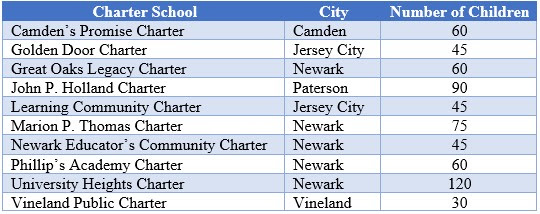
The administration of former Governor Chris Christie allowed 10 charter schools in five Abbott districts to operate their own preschool programs, despite not having a contract from the districts to participate in the districts’ universal program, as required by the landmark Abbott v. Burke rulings. In 2019-20, the 10 charter preschool programs enrolled 630 three- and four-year-olds, funded by over $8 million in state preschool aid.
ELC’s December 2019 letter to the NJDOE emphasizes that, under the NJ Supreme Court’s detailed Abbott preschool mandates, only Abbott districts are authorized to offer high quality preschool to all resident three- and four-year-olds through an NJDOE-approved universal enrollment program. While community providers and Head Start are eligible to operate preschool classrooms in Abbott districts, they can only do so under a contract with the districts. The district contract requires strict adherence to teacher quality, class size, and other Abbott preschool standards, as well as enrollment through the district’s universal outreach and recruitment process.
As the Supreme Court has made clear, these requirements are essential elements of the constitutional obligation imposed on Abbott districts to provide high quality preschool to all eligible three- and four-year old children residing in their communities. The districts are mandated to enroll at least 90 percent of the universe of those children. The requirement for community-based providers to operate only under district contracts ensures that only those providers capable of and willing to deliver high quality preschool through district coordination, support and supervision, can participate in the Abbott program.
The NJDOE’s decision to allow the 10 charter schools to operate separate preschool programs not only violates the Abbott rulings and the agency’s own regulations, but also undermines the cornerstone of the nationally-recognized success of the Abbott Preschool Program: a district-supervised, mixed delivery system of early education unifying community-based providers and district classrooms under a common set of high quality standards, backed by adequate funding. This well-established legal and policy framework does not permit any entity, including charter schools, to provide preschool wholly outside of the district-run, universal Abbott program.
“The NJDOE has no authority to permit a charter school to run a parallel preschool program that competes with the district’s Abbott program for students and funding,” said David Sciarra, ELC Executive Director and lead counsel in the Abbott litigation. “Charter schools in Abbott districts cannot operate preschool classrooms unless they enter into a contract with the district, as is required of every community-based provider and Head Start program participating in Abbott preschool.”
In 2019-20, the following charter schools are providing preschool without obtaining the legally required contract to participate in the Abbott district program:
In addition to calling for an end to the unauthorized practice of allowing charter schools to operate their own preschool programs, ELC is also demanding the NJDOE immediately notify the 10 charter schools that to continue to provide preschool in the 2020-21 school year, they must secure a contract with their district to participate in the district-wide Abbott preschool program.
Press Contact:
Sharon Krengel
Policy and Outreach Director
Education Law Center
60 Park Place, Suite 300
Newark, NJ 07102
973-624-1815, ext. 24

Kentucky passed a law authorizing charters but never provided funding for them. The new governor of Kentucky, Democrat Andy Beshears, was elected in part because of his strong support by teachers and his commitment to public schools.

First charter school application in Kentucky rejected

NEWPORT, Ky. (AP) — The first charter school application filed in Kentucky has been unanimously denied. News outlets report Newport Independent Schools rejected the application Thursday night. The superintendent says the documents submitted by the proposed River Cities Academy lacked planning in multiple areas. A review committee says there was significant plagiarism in the application process. The committee also found a lack of authentic community support for the school. River Cities Academy can appeal the decision to the state board of education. The state approved charter schools in 2017 but a funding source for the schools hasn’t been provided

Among rightwing think tanks, none has more intellectual firepower than the Thomas B. Fordham Institute, due to its leading thinker Chester E. Finn Jr., who has an Ed.D. from Harvard Graduate School of Education and worked in the administrations of Reagan and Nixon, as well as working for Daniel Patrick Moynihan and Lamar Alexander.

The Institute, formerly a foundation, is based in Washington, D.C., where it has a large voice in Republican politics, but its actual (if not physical) home is Ohio, because the money came from a Mr. Thomas B. Fordham, who lived in Ohio.

TBF is very influential in Ohio, where it recently wrote the state’s academic standards. TBF has been a loud cheerleader for the Common Core standards, having received millions from the Gates Foundation both to evaluate them and advocate for them.

Fordham looms large as an advocate for charters, vouchers, high-stakes testing, and punitive policies towards teachers and principals. I was an original member of the TBF board, when it was launched, and resigned in 2009, when I realized that my views were no longer aligned with those of TBF. One of the projects I disliked intensely was a “manifesto” funded by Eli Broad, which argued that one did not need to be an educator to be a school principal. I disagreed. I also disagreed with the TBF decision to accept Gates’ funding, since it would hamstring TBF’s role as an independent think tank and put it in the debt of Gates. It was also unnecessary, since TBF had $40 million in the assets at the time. Since I left TBF, it has accepted many, many millions from Gates, Broad, Walton and other external funders.

Who was Thomas B. Fordham? How did his fortune become the founder of a rightwing think tank?

Mercedes Schneider here reviews an analysis of the origins of the Thomas B. Fordham Institute, based on a paper by Richard Phelps. 

As I have often stated, I was an original member of the board of the Thomas B. Fordham Foundation. I objected to two major policy positions: one, the decision to become an authorizer of charter schools in Ohio, which I believed was not the role of an independent think tank. I lost that vote. As I recall, almost every one of the charters authorized by TBF either closed or failed or both. I also objected to accepting money from the Gates Foundation, as it would impair our independence and make it impossible to criticize Gates when it was wrong. And TBF didn’t need the money, it had assets of $40 million. I lost that vote too. I left the board in 2009, since I no longer supported either choice or the TBF vision of accountability. I later heard that “my seat” (the girl) was awarded to the CEO of a Gulen charter chain in Los Angeles. So there.

The distinguished education researcher Gene Glass reads this blog and occasionally comments. Yesterday I quoted a short statement by Margaret Raymond, director of CREDO, the Walton-funded evaluator of charter schools, who stated publicly that markets don’t work well in schooling. We can speculate on why markets don’t work: parents don’t have enough information, information is distorted by marketing and propaganda, test scores are the wrong information, etc. If you believe that society has a fundamental obligation to provide good schools for all children, the market is the worst delivery mechanism because it exacerbates inequity. The one thing the market can never do is produce equality of educational opportunity.

Gene Glass responded to the post with this comment:

Wikipedia describes Kenneth Ewart Boulding as “… an economist, educator, peace activist, poet, religious mystic, devoted Quaker, systems scientist, and interdisciplinary philosopher. “ Indeed, Ken Boulding was all of those things and many more. At the University of Michigan in the 1950-60s, he founded the General Systems society with Ludwig von Bertalanffy. Born in Liverpool in 1910, he was educated at Oxford (Masters degree).

His textbook, Economic Analysis (1941) was virtually the introduction to Keynesianism to American academics. He never obtained a doctorate, though surely he never felt the want of one due to the many honorary doctorates he received. In his long career, he served as president of the Amer. Econ. Assoc. and the AAAS, among other organizations. He died in Boulder in 1993.

I was very lucky to be situated at the University of Colorado when Boulding left Michigan in 1967 to join the Economic Department at Boulder. I had joined the faculty there in 1966. Within a few years the word spread that this new fellow in Economics was someone to listen to. Twice, in the early 1970s, I sat through his undergraduate course in General Systems. The undergraduates had no idea how lucky they were; I was enthralled. Boulding was a Liverpudlian, and that coupled with a pronounced stammer made listening to him lecture extremely demanding. But somehow the effort produced greater concentration. I can recall so many of the things he said though more than 40 years have passed. “”The invention of the correlation coefficient was the greatest disaster of the 19th century, for it permitted the subtitution of arithmetic for thinking.”

From 1969 through 1971, I was editing the Review of Educational Research for the American Educational Research Association (AERA). In the office, I enjoyed a few small privileges in connection with the 1971 Annual Meeting. For one, I could invite a speaker to address the assembled conventioneers. I invited Boulding. An expanded version of his talk was published in the Review of Educational Research (Vol. 42, No. 1, 1972, pp. 129-143). I have never read anything else by an economist addressing schooling that equals it.

Here is the merest sampling of what he wrote:

Schools may be financed directly out of school taxes, in which case the school system itself is the taxing authority and there is no intermediary, or they may be financed by grants from other taxing authorities, such as states or cities. In any case, the persons who receive the product-whether this is knowledge, skill, custodial care, or certification-are not the people who pay for it. This divorce between the recipient of the product and the payer of the bills is perhaps the major element in the peculiar situation of the industry that may lead to pathological results. (pp. 134-135)

Boulding originated the notion of the “grants economy” in which A grants a payment to B who delivers a service or product to C. Of course, this turned on its head the paradigm used by most economists, who imagine C paying B for services or products. When Boulding referred to this grants economy underlying schooling as leading to “pathological results,” he was referring to the fact that the schooling industry is “not normal,” i.e. does not follow the course of classical economic models. In the years ensuing since Boulding’s early forays into this notion, the grants economy has become increasingly important to understanding a nation’s economy.

Boulding was considered a bit of a rebel. David Latzko wrote of Boulding that “The narrow bounds of the economics discipline could not contain his interests and talents.” Perhaps this accounts for why many traditional economists have not followed him where reality leads. Perhaps this is why Dr. Margaret Raymond could pronounce so recently that “And it’s the only industry/sector [schooling]where the market mechanism just doesn’t work.” In fact, the “market mechanism” fails to work in many sectors.

But back to Dr. Raymond. Margaret Raymond is the head of the Hoover Institution’s Center for Research on Educational Outcomes. As key researcher in charge of the first big CREDO study of charter schools that dropped on the charter school lobby with a big thud: charter schools no better than old fashion public schools, some good, some really bad. And then more recently, CREDO under Raymond’s direction conducted a study of charter schools in Ohio, a locale that has known its problems attempting to keep charter schools out of the newspapers and their operators out of jail. What did this second CREDO charter school study find? Charter schools in Ohio are a mess.

All of this bad news for the charter school folks caused Dr. Raymond to go before the Cleveland Club and confess thusly:

“This is one of the big insights for me. I actually am kind of a pro-market kinda girl. But it doesn’t seem to work in a choice environment for education. I’ve studied competitive markets for much of my career. That’s my academic focus for my work. And it’s the only industry/sector [schooling] where the market mechanism just doesn’t work.”

Of course, it is positively absurd to think that schooling is the only “industry” in which free markets just don’t work. And Dr. Raymond didn’t give up entirely on the free market ideology for education — she would probably have to find a professional home outside the Hoover Institution if she did. She went on to tell the Cleveland Club that more transparency and information for parents will probably do the trick.

Frankly parents have not been really well educated in the mechanisms of choice.… I think the policy environment really needs to focus on creating much more information and transparency about performance than we’ve had for the 20 years of the charter school movement.

So parents just aren’t smart enough to be trusted to make choices in a free market of schooling, and they need more information, like test scores, I presume. I’ll leave Dr. Raymond at this point, and recommend that she and her associates at the Hoover Institution spend a little more time with Kenneth Boulding’s writings.