Archives for category: Pennsylvania

Peter Greene has read the legislative language of SB 2 in the Pennsylvania State Senate so we don’t have to, and he spells out what is in it. You can be sure that there is nothing good for public schools.

An astonishing 15% of the lowest scoring schools are eligible, which is way larger than most states. As Peter points out, even if every school were doing a good or great or awesome job, there will always be a bottom 15% to thrown into the pool of eligible-for-a-voucher.

He writes:

What’s Super-Duper About It?

Vouchers are a policy idea that will not die; let’s just give every student a check and let them enroll at whatever school they want to (and let’s not talk about the fact that they don’t really get to decide because top private schools are expensive and all private schools are free to accept students or not for whatever reason).

But many reformsters see another end game. Why bother with school at all? Let students purchase an English class from one vendor and a math class from another. Get history lessons on line paid for by your educational voucher card account.

ESAs make that splintered version of “education” possible. Instead of saying, “Here’s a tuition voucher to pay your way to the school of your choice,” the state says, “Here’s a card pre-loaded with your education account money. Spend your special edu-bucks however you want to.”

Do you think that legislators in Pennsylvania care that voucher studies for the past few years have consistently shown that kids do worse than the ones who stayed behind in public schools?

Guess not.

Pennsylvania loves cybercharters even though study after study shows that they get terrible results.

The Keystone State Coalition points out in its latest newsletter that state records demonstrate that none of the state’s 18 cybercharters meets state academic standards.

Do taxpayers care?

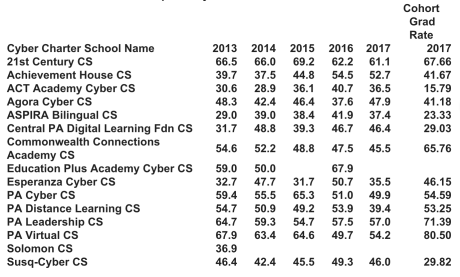
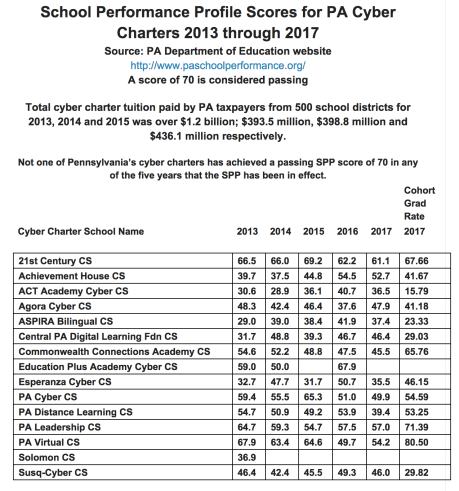
Not one of Pennsylvania’s cyber charters has achieved a passing SPP score of 70 in any of the five years that the SPP has been in effect. All 500 school districts are required to send taxpayer dollars to these cyber charters, even though none of them voted to authorize cyber charter schools and most districts have their own inhouse cyber or blended learning programs.
School Performance Profile Scores for PA Cyber Charters 2013-2017
Source: PA Department of Education website

http://www.paschoolperformance.org/

A score of 70 is considered passing.

Total cyber charter tuition paid by PA taxpayers from 500 school districts for 2013, 2014 and 2015 was over $1.2 billion; $393.5 million, $398.8 million and $436.1 million respectively.

Screen Shot 2018-05-23 at 9.09.06 PM


Lisa Haver and Deborah Grill pose this question in an incisive article in the Philadelphia Inquirer. 

There was a national media flap when billionaire investor Stephen Schwarzman offered his alma mater in Abington, Pennsylvania, $25 million in exchange for renaming the school, putting his name over six entrances, and changing the curriculum to meet his demands. Ultimately, the board refused some but not all of his requirements.

Haver and Grill worked in the Philadelphia public schools. They say, “Welcome to our world,” where the Uber-rich have owned the public schools for years and run them into the ground.

”In November 2011, the state-imposed School Reform Commission (SRC), absent any public deliberation, approved a multimillion-dollar grant from the Bill and Melinda Gates Foundation. In return, the SRC agreed to several conditions, including yearly charter expansion, implementation of Common Core standards, more school “choice” and testing, and permanent school closures. No one elected Bill Gates, typically portrayed in the media as just a very generous rich guy, to make decisions about Philadelphia’s public schools. But his mandates have had devastating and lasting effects on the district, much more than renaming one school.”

No one elected Bill Gates. An unelected board outsourced control of the Philadelphia public schools to an unaccountable billionaire. Why? Money. No evidence. No research. No wisdom. Just money. Goal: Privatization. Means: Silence the public.

“Here in Philadelphia, the Gates Compact conferred authority upon the Philadelphia School Partnership (PSP) “to provide funding …to low-performing or developing schools.” PSP has since raised tens of millions from a stable of wealthy donors; most has gone to charter schools, in keeping with Gates’ pro-privatization ideology. PSP’s influence has grown in the last seven years: the group now funds and operates teacher and principal training programs, oversees a website rating all Philadelphia schools, and holds the district’s yearly high school fair. PSP’s money, like Schwarzman’s, always comes with strings attached, whether that means changing a school’s curriculum or a complete overhaul of faculty and staff, as its 2014 grant to two North Philadelphia schools mandated.”

The PSP meetings are closed to the public. Its board members are wealthy suburbanites.

There is something to be said for democracy. Why has Philadelphia prevented its citizens from having any role in the o ersight of the public schools? Could those who have a genuine stake in them do worse than the rich dilettantes who control them now?


Nick Trombetta, founder of the nation’s first cybercharter, will be sentenced on July 10.

He admitted stealing $8 million in public funds intended for his school.

The long-delayed sentencing hearing of former Pennsylvania Cyber Charter School CEO Nick Trombetta on charges of tax fraud and conspiracy is set for July, according to information filed Wednesday in U.S. District Court.

The July 10 sentencing will come nearly five years after Trombetta, 62, was indicted by a grand jury on 11 counts of tax fraud and conspiracy in August 2013. He pleaded guilty to conspiring to defraud the IRS in August 2016.

He faces up to five years in federal prison.

Trombetta siphoned $8 million from the Midland-based public school and used the money to stockpile retirement money and buy personal luxury goods for himself, his girlfriend and his family — including multiple homes and a twin-engine airplane.

The conspiracy involved Trombetta and several others – including his accountant, Neal Prence – moving the money to other companies created or controlled by Trombetta and filing false tax returns.

He had this great idea. Give a computer and distance instruction to students who enrolled. Collect full state tuition. He collected $10,000 per student and had 10,000 students. He was rolling in dough. $100 million. It is easy to let that kind of money go to your head or your bank account.

There are virtual charter schools operating across the country that are raking in lots of money that they don’t need or deserve. What should they do with it?

If every charter operator who used his school’s credit card as his personal piggy bank were put into jail, the jails would be overcrowded. If they happened to be privatized prisons, the charter industry would turn against privatization and demand decent public prisons.

The Philadelphia Inquirer posted an editorial saying it is time to revise the charter school law, written 20 years ago.

The charter-school law, over 20 years old, has never been revised to improve accountability or performance.

Charters were intended to create and spread innovations into traditional public schools, but the evidence they have done so is scarce, and study after study has found charters trailing traditional public schools in key areas of performance.

The latest of those studies, from Philadelphia Citizens for Children and Youth, calls for stricter accountability measures for charters’ performance and renewals.

Last year alone, public school districts paid $1.5 billion for students attending a charter – out of their full budgets. And every action the state has taken – taking away reimbursements to the districts for those costs, being less than rigorous in oversight, and pushing an approval process that would take further control out of the districts – has created two separate education systems that too often work against each other.

In the bizarro world of charters in Pennsylvania, the receiver of a bankrupt district (Chester Upland) granted a nine-year renewal to a low-performing charter school (The Chester Community Charter School), pushing millions towards its sponsor.

The charter enrolls 70% of the primary school students in the district. It has been the prime mover in bankrupting the district, drawing away resources and students. In exchange for not opening a high school (which it did not plan to do), the receiver gave it another nine more years.

What is behind this sweet deal?

The owner of the school was one of the biggest contributors to former Republican Governor Tom Corbett and a member of his transition team.

He has profited handsomely by supplying goods and services to his Chester Community Charter School.

CSMI’s founder and CEO is Vahan H. Gureghian of Gladwyne, a lawyer, entrepreneur and major Republican donor –the largest individual contributor to former Gov. Tom Corbett. And though CSMI’s books are not public – the for-profit firm has never disclosed its profits and won’t discuss its management fee – running the school appears to be a lucrative business. State records show that Gureghian’s company collected nearly $17 million in taxpayer funds just in 2014-15, when only 2,900 students were enrolled.

The receiver is a Republican accountant who served as treasurer of Corbett’s campaign.

State Auditor General Eugene DePasquale, whose office has scrutinized the Chester school’s finances in the past and who has often called the state’s charter law “the worst in the country,” was unaware of the renewal until he was told this month by the Inquirer and Daily News.

DePasquale, a Democrat, said he had never heard of such a lengthy charter school renewal, and questioned whether the move limited the district’s authority to demand improvements, especially at a school where test scores are so low.

Things are going well on the financial side for the charter company, but not so well on the academic front. Its schools have shown very low performance. But poor academic performance is no deterrent to its longevity or its profitability!

CSMI, its parent company, has long been a prominent player in the charter world – and not just in Chester. The company runs a school in Atlantic County, N.J., and until last year had another in Camden – New Jersey denied its renewal because of low academic performance.

Chester Community has also struggled to succeed. The Pennsylvania System of School Assessment (PSSA) exams released in September showed that Chester Community had some of the lowest scores among charter schools in the region: Less than 16 percent of students passed PSSA reading tests in the last school year; 6 percent passed math.

The scores were lower than all but one of the four Chester Upland district schools that have K-8 students.

When the State Education Department tried to remove the receiver of the district, who has the same powers as a superintendent, Chester Community Charter School defended him, and he held on to his position.

Two weeks after the receiver was reappointed, the charter school filed its request for a nine-year extension and the receiver agreed.

By the way, the charter founder-owner has dropped the price of his Palm Beach mansion to only $64.9 million. It is a steal It is almost a $20 million drop from the original asking price.

The owners of a never-occupied, eight-bedroom mansion in Palm Beach cut their asking price by $5 million to $64.9 million.

The new $64.9 million asking price for the French Chateau-style mansion is almost $20 million below the original asking price when it was listed for sale more than two years ago.

The 35,993-square-foot residence at 1071 North Ocean Boulevard is still the most expensive home listed in the Palm Beach Board of Realtors Multiple Listing Service…

The owner is a trust linked to Philadelphia-area lawyers Vahan and Danielle Gureghian, who initially planned to occupy the custom-built home.

The Gureghians’ Palm Beach residence features a bowling alley, home theater, pub room and library, plus dual ocean balconies and an eight-car garage.
This article was published a year ago. It remains timely. It tells the story of the charter schools (one in particular) that bankrupted one of Pennsylvania’s poorest school districts.

While the public schools have been bankrupted and taken over by a receiver, the owner of the biggest charter became very rich selling goods and services to his charter corporation. He is active in Republican politics. He was on Governor Tom Corbett’s transition team for education. Governor Wolf has approached him with care. His charter has fattened on special education payments, which were $40,000 per student, even for those with the mildest speech disabilities, leaving the most disabled students to the bankrupt public schools.

Governor Wolf was able to negotiate a lowering of the special education payment to $27,000.

To put some noteworthy flaws of Pennsylvania’s charter law in stark relief, one need look no further than the Chester-Upland School District, a desperately poor enclave in generally well-off Delaware County.

As the state’s most distressed district, it is so unable to meet its students’ needs that it is under the control of a receiver.

Nearly half of the students in Chester Upland attend charter schools, and 46 percent of its budget goes to charter payments. Most charter students there are enrolled in the Chester Community Charter School (CCCS). The K-8 school has 2,900 students, nearly as many as the 3,300 K-12 students in the district. The state’s largest brick-and-mortar charter by far, CCCS was founded and is operated for profit by a company owned by businessman Vahan Gureghian, a major supporter of former Gov. Tom Corbett and other Republican candidates and causes.

CCCS and its management company, Charter School Management Inc., have built a reputation for taking maximum advantage of the financial opportunities built into the charter school law, while strenuously resisting any public scrutiny about where that money goes.

Until court-sanctioned action that lowered payments this year, the state’s special-education funding formula required Chester-Upland to send its charters more than $40,000 for every special education student. How much of that actually went to student services is not known, in part because the charter law does not require CCCS or any other charter to make that information public.

What is known, however, is that CCCS spends a healthy chunk of its budget on fees paid to Gureghian’s management company. Gureghian won’t open his books, but about 10 years ago, the school spent an estimated 40 percent of its revenue on management, as opposed to the state average for charters of about 16 percent.

What is also known is that the Chester Upland district’s payments to CCCS for special education have a profound effect on the district’s budget. “Unfair and excessive special education payments are bankrupting the District,” wrote Chester Upland officials in their recent recovery plan. Last summer, Gov. Wolf asked a judge to intervene and bring special education payments more in line with special education expenses.

A hallmark of the CCCS approach is that the school identifies large numbers of students as needing special education, usually in relatively low-cost categories.

For instance, in the 2014-15 school year, more than 27 percent of the special education students were classified as having a “speech and language impairment,” the least expensive classification of disability, which generally requires speech therapy once or twice a week. That is close to twice the state rate of 15.4 percent and more than 11 times the Chester Upland district rate of 2.4 percent for that category.

When the state tried to adjust the formula for special education reimbursements to reflect the level of student needs, charter lobbyists descended to fight it. And nothing changed.

By the way, the owner of the Chester Community Charter School has his mansion in Palm Beach for sale. He dropped the price last May by $5 million. You can pick it up for a mere $64.9 million. Quite the steal, never lived in.

For some reason, the Chester Community Charter School has a high rate of “safety incidents” and suspensions, more than any other school in Delaware County.

Senator Pat Toomey of Pennsylvania sponsored an amendment to the GOP tax bill that would exempt small Hillsdale College in Michigan from a tax that would apply to other colleges with a sizable endowment. This exemption is worth $700,000 a year to Hillsdale College.

Why did he care so much about a college that is not even in his home state?

Hillsdale is an unusual college. It is one of the very few in the nation that refuses any federal funds, even for student aid, so that it is exempt from any federal regulations, like civil rights.

It is also a special object of the affection of the DeVos family. The DeVos family gave Pat Toomey $60,000 in his close 2016 election. He won’t face the voters again until 2022. Hillsdale College is also a favorite of the Koch brothers, who also supported Toomey’s re-election campaign.

Columnist Will Bunch explains Toomey’s peculiar affection for a super-conservative college not in his own state:

If you’ve never heard of a small institution of higher learning called Hillsdale College, here are a few things you should know about it. The school decided after a 1980s Supreme Court ruling to forego all federal funds, which means it doesn’t need to follow the Title IX rules aimed at reducing campus sexual assault, let alone any guidelines on affirmative action. The college is thus mostly white — and its longtime president once referred to non-white students at a legislative hearing as “dark ones.” It also has a reputation as an unfriendly place for LGBTQ students — which was driven home when the school’s chaplain called for prayer against “evil” gay marriage.

And there’s also this: Hillsdale College is located in southern Michigan, some 280 miles west of the commonwealth of Pennsylvania.

All in all, to paraphrase the cliché of the moment, this was a bizarre Hillsdale that one of Pennsylvania’s U.S. senators, Pat Toomey, chose to die on.

OK, maybe “die” isn’t the right word, but the state’s junior senator did reveal a lot about himself on the wee wee hours on Friday when — in a strange 11-minute debate amid the dead-of-night push for the GOP’s $1 trillion millionaire tax giveaway — Toomey tried to defend his amendment that would mean a $700,000 annual tax break for the conservative-oriented Hillsdale by exempting it from a levy on endowments that would hammer the University of Pennsylvania and several other schools in the state Toomey supposedly represents.

Thanks to a few wayward Republicans, the special carveout for Hillsdale College was deleted, but later recouped by adding a few more colleges to the mix:

And it was all for a murky outcome — Toomey’s amendment was voted down (even some of his fellow Republicans thought this a bridge too far), although a later, broader amendment removed not just Hillsdale but also many more traditional universities from the endowment tax.

The universities and colleges that will pay a tax on their endowments will have less money for scholarships for needy students. But that is of no concern to Pat Toomey, or Betsy DeVos, or the Koch brothers.

For the fifth year in a row, not one cybercharter in Pennsylvania achieved a passing school performance score of 70. When will these scams be held accountable for their poor performance? When will the State close down these failing schools? These “schools” drain hundreds of millions of dollars away from real schools and get poor results, year after year. Two different cybercharter operators were indicted for stealing millions from state taxpayers. One was convicted, the other was tried but the trial ended in a hung jury.

Screen Shot 2017-11-02 at 9.44.37 PM

Oklahoma has an online charter school that is growing “at breakneck speed,” but producing pathetic results for students. This is not unusual. It is typical for online charter schools to recruit students, experience high attrition, and produce crummy results.

Oklahoma’s largest online charter school is on a track of explosive growth, nearly tripling its enrollment over three years, to almost 8,500.

That pursuit of lightning growth by Epic Charter Schools – a goal affirmed by its co-founder – shows no signs of letting up. Epic officials predict enrollment will near 10,000 by mid-school year.

But the trend is raising concerns from one top online charter-school regulator about whether there is too much turnover of students. And at least one national report warns that rapid expansion at virtual charter schools can compromise academic achievement.

Epic’s unconventional efforts to drive enrollment also have raised eyebrows. Among other tactics, it gives out concert tickets, vacations and other prizes to students’ families as rewards for referrals of students. The school also spurs referrals by depositing bonus money into “learning fund” accounts that families can use to buy their curriculum or computers or defray fees for extracurricular activities such as dancing or club sports. Epic told state officials the rewards are not paid for with state funds.

Epic administrators say their system is growing rapidly because parents and students love it. Parents of some students applaud the program, saying it gives them the freedom of home-schooling with some of the benefits of a public school.

“Clearly, we’re providing a quality of service and education that families are enjoying and appreciate, or we wouldn’t be continuing to grow year after year,” said Superintendent David Chaney.

But Epic’s academic performance is average or low, as measured by the state’s standard assessment tools. Just over a quarter of Epic’s students last year graduated within four years, compared with 82 percent statewide. Its elementary, middle and high schools received a C-, D and C on the state A-F report cards.

Those marks contrast with Epic’s posting a 100 percent attendance rate for the 2015-2016 school year, achieved by only one other school in the state – ABLE Charter School, a virtual school the state is trying to close.

“There is a good place for virtual charter schools,” said Rebecca Wilkinson, executive director of the Statewide Virtual Charter School Board, which oversees all of the state’s online schools. “I’ve got lots of stories from individual families and students that it’s the right choice for. But more than anything, these large numbers of kids coming in – it’s disturbing, and overshadows the good it (Epic) can do.”

Epic co-founder Ben Harris said the school is working on improving its graduation rates and A-F letter grades. He added the number that matters most to him is enrollment.

Yes, indeed! Enrollment translates into dollars! For every dollar spent by an ineffective online school, there is a dollar less for a real public school.

Study after study has shown that virtual schools are not good schools. Kids may turn on the computer–or not. They may turn on the computer and learn nothing. The bad results are consistent.

Betsy DeVos doesn’t care about results. She loves online charter schools (like her mentor, Jeb Bush, co-author of that classic Digital Education NOW!, which urged expansion of digital classes and schools with no accountability whatever). In Pennsylvania, which is overrun with virtual charter schools, the graduation rate is 48%. That’s high compared to the graduation rate at ECOT in Ohio, which hovers around 20%. The founder of Pennsylvania’s biggest virtual charter school pleaded guilty to tax fraud and is awaiting sentencing, having been convicted of siphoning off millions of dollars. The founder of another virtual charter skimmed $6.5 million dollars for herself but was not charged with a crime because of her age.

Education Week investigated the online charter industry and reported numerous cases of fraud. It is a fraudulent industry. Why do we need more of it?