Archives for category: Pennsylvania

I remember back in the late 1980s and early 1990s when charter schools were first invented. Advocates (then including me) said they would be more accountable than public schools, because if they didn’t get academic results they promised, they would close. They would also save money because they would cost less than real public schools. Turns out none of this is true. Charter schools fight for equal funding with public schools, and now we know they fight against any accountability. Even failing charter schools get renewed.

When charters close because of financial scandal or academic failure, they are typically replaced by another charter.

When a charter school fails to meet its goals, its charter should be revoked and it should be returned to the public schools to be run by professionals, not amateurs.

Greg Windle writes in The Notebook about the decision by the Philadelphia school board to renew a failing charter school. Parents thought the bad old days of the state-dominated School Reform Commission were over. SRC thought that charters were always the answer to every problem.

He writes:

After the Board of Education meeting Thursday night, many longtime activists in the audience felt as if they had returned to the days of the board’s predecessor, the School Reform Commission. The most controversial vote reversed the SRC’s 2017 decision to close Richard Allen Preparatory Charter School for years of poor and declining academics, instead granting it a one-year extension.

This charter had gotten an extension in 2017 despite poor performance. The school met no standards in any of the three categories—academic, organizational, or financial.The SRC voted not to renew on October 4, 2017:

From the 2017 Renewal Report:

https://drive.google.com/file/d/0B9x1ev_U2NtlN29hQ3Z4cVNraFk/view

RENEWAL RECOMMENDATION: REVOCATION AND NON-RENEWAL
Richard Allen Preparatory Charter School was part of the 2014-15 renewal cohort. In spring of 2015, the CSO recommended the Charter School for a one-year renewal with conditions due to declining academic performance in years 3 and 4 of the charter term. The SRC did not take action on the 2014-15 renewal recommendation because the CSO and the Charter School did not reach agreement on the terms of a renewal charter agreement. During the 2016-17 school year, the CSO supplemented the 2014-15 comprehensive renewal evaluation with data and information from the years since the 2014-15 evaluation was conducted; primarily the 2014-15 and 2015-16 school years for academic success and financial health and sustainability and through the current school year, 2016-17, for organizational compliance and viability. The Charter School’s performance in the most recent years reflects continued declines in academic success and financial health and sustainability performance and sustained non-compliance for organizational requirements. The Charter School has not demonstrated an improvement in academic performance; proficiency scores are below comparison groups in both 2014-15 and 2015-16 and proficiency rates declined in English Language Arts (ELA) and Science in 2015-16.Furthermore, the Charter School did not meet the growth standard in any subject in both 2014-15 and 2015-16. The Charter School continued to not meet the standard for organizational viability and compliance and now only approaches the standard for financial health and sustainability in 2016-17 due to related party, inaccurate attendance reporting and financial transaction concerns. Based on the aggregate review of performance in the three domains, the Charter School is recommended for revocation.
The Philadelphia School Reform Commission (now the Board of Educatuon) ordered the closure of Eastern Academy Charter School because of its poor academic performance, but the charter has vowed to fight the closure, a process that could drag on for years due to Pennsylvania’s charter-friendly law. The charter school even challenges the school district’s power to hold it accountable. It feels it is entitled to public money without any accountability for academic quality.

“Eastern is appealing on several grounds. For one thing, it contends that the Charter Schools Office unfairly assessed its academic record by including two special admission schools in one comparison group. For another, it says that two Charter Schools Office staffers who participated in the review were inexperienced.

“Susan DeJarnatt, a professor of legal research at Temple University and a critic of the charter school industry, said that Eastern’s arguments essentially object “to any kind of oversight.”

“The heart of the argument seems to be an idea that many charter proponents have advanced recently — that no charter school should be closed so long as any District schools that underperform the charter school in any way are operating, regardless of the charter’s academic performance or compliance with the law…

“In its appeal, Eastern included a speech by its CEO, Omar Barlow, in which he referred to neighborhood schools where many of his students might otherwise attend as “cesspools” to justify his own school remaining open. In the speech, he made no attempt to refute the charter office’s findings of poor academic performance and violations of state and federal laws.

“DeJarnatt said Eastern’s strongest argument is the one that questions the decision of the charter office to include two special admission schools in a group to which Eastern was compared. But she said that the school presented no evidence of how it would have fared if those magnet schools were removed. Still, she doesn’t see that argument as likely to void the SRC’s decision.

“The school was founded in 2009 with support from Eastern University, though the university has not continued to support the school. David Bromley, executive director of Big Picture Philadelphia, was also a member of the founding coalition. Although Eastern’s website contends that it is a Big Picture School, the only Big Picture Schools in Pennsylvania are El Centro and Vaux.

“By any standard, the school’s academic performance has been low. On the latest round of PSSAs, 20 percent of students in the school’s middle grades scored proficient in English and 1 percent were deemed proficient in math. The high school had poor scores in math and science on the Keystone exams. The school serves 349 students in grades 7-12.”

Twenty percent proficient in English! One percent prominent in math!

This is a failing school.

Why is this school still open?

You know the story about zombies. They are the walking dead. They can’t be killed.

Crack reporter Greg Windle has discovered a zombie charter school in Philadelphia.

It has been warned and warned and threatened with death, but it fails and appeals and fails and never dies.

I remember the early days of the charter movement, the late 1980s, early 1990s. Charter enthusiasts said that the great thing about charters was that they would always be accountable for results. If they didn’t keep their promise, they would promptly be closed.

How did that work out?

This zombie charter plans to fail forever and live forever. No accountability!

We now know that the charter lobbyists have made it extremely difficult to close a failing charter school. Zombies!

It takes a long time to close a charter school, and the process includes many opportunities to delay closure for years. Khepera Charter School has exhausted all but its final chance and is now appealing to the state’s Charter Appeals Board to overturn the School Reform Commission’s decision to close the school.

Khepera is a K-8 school with 450 students located in Hunting Park. It was awarded its first charter in 2004, which was renewed in 2009. After academic results declined, the charter was renewed in 2014 with explicit conditions, along with the proviso that failure to meet these conditions would lead to the closure of the school.

Many of the conditions were never met; beyond that, the school continued to violate the state charter law. Since signing the 2014 charter, the school failed to hire enough certified teachers. Growth on the PSSAs largely reversed as scores began to plummet. The school promised to revise its discipline policy and reduce student suspensions, but instead, suspensions increased, even among kindergarten students. Board members didn’t file the required conflict of interest forms. Nor did the school submit the required financial reports and independent audits.

In 2015, the SRC’s Charter Schools Office first warned Khepera that it was failing to meet the conditions. Yet the school has been operating ever since and, by all indications, plans to open for the 2018-19 school year.

Khepera’s appeal to the state essentially seeks to dismiss all charges for a variety of reasons. Its lawyers argue, for instance, that a lack of certification paperwork for a given teacher doesn’t prove that the teacher isn’t certified.

The school ignored the first “notice of deficiency” from the Charter Schools Office, sent in October 2015. The charter office sent another notice in May 2016, another in August 2016, and yet another in May 2017.

Khepera did not respond to these notices. So in June 2017, the SRC voted to begin conducting public hearings to determine whether it should revoke the school’s charter — fully two years after the school failed to meet multiple terms of its signed contract. Hearings began Aug. 10, 2017, and ended Sept. 12, for a total of seven sessions.

Then in December 2017, the School Reform Commission voted to close the charter. Case ended? No! The charter appealed to the state Charter Appeals Board, which could keep the charter open for years.

Zombie!

But that’s not all:

After the SRC voted to revoke the charter of Walter Palmer Leadership Learning Partners Charter School in the spring of 2014, the school filed an appeal to the state so that it could open its doors in September for the next school year.

But when it could not pay employees, Palmer abruptly shut its doors in December 2014, stranding students mid-year and forcing the District to scramble to find places for them.

This cut short the hearings before the state Charter Appeals Board, at which administrators for the charter school had invoked their Fifth Amendment right against self-incrimination 77 times.

After closing the charter, Palmer, a longtime civil rights leader in Philadelphia who founded and ran his namesake school, became a consultant to Khepera, where he initially helped with recruitment. At the end of 2016, he was hired to be CEO.

Khepera’s website gives every indication that it intends to operate throughout the 2018-19 school year and is continuing to recruit and enroll new students.

Zombie walks, talks, and enrolls students even though it is a failing school.

Every failing charter in Pennsylvania can find inspiration in the story of this failing charter:

The longest charter revocation process in state history was for Pocono Mountain Charter School. It lasted six years from the initial revocation hearings to the date the school finally closed. The charter revocation hearings ran for two years, starting in 2008, and appealing to the state’s Charter Appeals Board allowed the school to remain open for three more years. Then the school appealed the state board’s decision twice to higher courts, and only closed in 2014 after it declined to file a third appeal.

Toward the end of the process, Pocono Mountain’s CEO was convicted of using the school to funnel more than $1.5 million in tax dollars to himself, his family, and his businesses. He was sentenced to 10 months in prison.

But taxpayers can take solace knowing that the charter revocation process ended after six years and the CEO was convicted. Justice is slow but sometimes happens.

I have been waiting for the sentencing of Nicholas Trombetta for years, ever since he was arrested for tax evasion after not reporting the millions of dollars he stole from his cyber charter, the first such in the state of Pennsylvania.

Steven Singer reports the sentencing here, and he is outraged that Trombetta got a slap on the wrist, as compared to the long jail sentences meted out to Atlanta teachers who changed test scores.

What Steven doesn’t understand is that Trombetta was sentenced for tax evasion, not for embezzlement of millions of dollars. Embezzlement of public funds was not an issue, although it should have been. Apparently it is okay to steal from the state as long as you report it on your tax returns. Some of the embezzlement occurred by setting up shell companies with which Trombetta did business with himself, using public money. Watch for the “related companies” when following the money.

Steven writes:

Nick Trombetta stole millions of dollars from Pennsylvania’s children.

And he cheated the federal government out of hundreds of thousands in taxes.

Yet at Tuesday’s sentencing, he got little more than a slap on the wrist – a handful of years in jail and a few fines.

He’ll serve 20 months in prison, be on supervised release for three years, and payback the tax money he concealed.

As CEO and founder of PA Cyber, the biggest virtual charter school network in the state, he funneled $8 million into his own pocket.

Instead of that money going to educate kids, he used it to buy a Florida condominium, sprawling real estate and even a private jet.

He already took home between $127,000 and $141,000 a year in salary.

But it wasn’t enough.

He needed to support his extravagant lifestyle, buy a $933,000 condo in the Sunshine State, score a $300,000 twin jet plane, purchase $180,000 houses for his mother and girlfriend in Ohio, and horde a pile of cash.

What does a man like that deserve for stealing from the most vulnerable among us – kids just asking for an education?

At very least, you’d think the judge would throw the book at him.

But no.

A former certified public accountant who helped hide the tax evasion by the leader of Pennsylvania’s first cyber charter was sentenced to prison for a year and a day.

The founder of the Pennsylvania Cyber Charter School, Nicholas Trombetta, will be sentenced later this month.

Trombetta scammed $8 million and didn’t pay taxes. By some fluke in the law, he was not charged with theft of public’s money, but only with failing to pay taxes on the money he stole.

The school was the state’s first cyber charter. It had 10,000 students, each producing a revenue of $10,000 to the school. That’s $100 million, just lying around. What was Trombetta to do with all that dough?

Don’t you think the legislature might reconsider the need for regulation and oversight of these sweet deals? No accountability, no transparency, no supervision. Just lots of money.

Pennsylvania has many cyber charters. They are all failing schools. The legislature doesn’t care. Two cyber charter operators were arrested and convicted for stealing millions of dollars. One of them–Nicholas Trombetta– is awaiting sentencing for tax evasion on the $8 million he stole from the cyber charter he founded (Pennsylvania Cyber Charter School), the other–June Brown, founder of two cyber charters–was convicted but not sent to jail because the judge accepted her plea that she was too old and frail to be incarcerated (she is younger than me). Trombetta committed a crime by evading taxes, but stealing $8 million from his cyber charter was not a crime under lax Pennsylvania law, according to the article cited here.

Greg Windle writes here about the failure of the Legislature to reign in cyber charter corruption, fraud, waste, and abuse of taxpayers’ dollars.

Even choice advocates are embarrassed by cyber charters, but they keep on going, collecting tax dollars for rotten services.

No cyber charter school in Pennsylvania have ever received a passing academic score from the state, and very few have come close, according to information recently highlighted in a report from the office of Democratic State Rep. James Roebuck of Philadelphia.

Roebuck and other House Democrats have assembled a package of bills that would further regulate charters by reforming how they use reserve funds, rules for leasing buildings, special education payments, contracting, the teacher evaluation system, disclosure in advertising, school building closures, and the transfer of school records. The package would not single out cybers, but other legislation has been introduced that would reduce their per-student reimbursement.

Pennsylvania has 13 cyber charters enrolling more than 34,000 students, or 10 percent of all the cyber students in the country.

These schools are authorized not by local districts, but by the Pennsylvania Department of Education. But districts must send per-pupil payments to cyber charters for each local student they enroll, and the payments are the same as for brick-and-mortar charters, even though cybers have fewer expenses.

This has proven frustrating not only to the districts and other proponents of traditional public schools, but to several groups that favor school choice and charters…

No cyber charter school in Pennsylvania have ever received a passing academic score from the state, and very few have come close, according to information recently highlighted in a report from the office of Democratic State Rep. James Roebuck of Philadelphia.

Roebuck and other House Democrats have assembled a package of bills that would further regulate charters by reforming how they use reserve funds, rules for leasing buildings, special education payments, contracting, the teacher evaluation system, disclosure in advertising, school building closures, and the transfer of school records. The package would not single out cybers, but other legislation has been introduced that would reduce their per-student reimbursement.

Pennsylvania has 13 cyber charters enrolling more than 34,000 students, or 10 percent of all the cyber students in the country.

These schools are authorized not by local districts, but by the Pennsylvania Department of Education. But districts must send per-pupil payments to cyber charters for each local student they enroll, and the payments are the same as for brick-and-mortar charters, even though cybers have fewer expenses.

This has proven frustrating not only to the districts and other proponents of traditional public schools, but to several groups that favor school choice and charters…

It’s been a difficult school year for many U.S. cybers. Ohio’s largest chain was forced to close mid-year, and others closed down in Georgia, Indiana, Nevada, and New Mexico. In the past, it has been rare for states to close cyber charters despite low achievement across the sector and several financial scandals…

Of the 43 states that allow charter schools, only 35 allow cyber charters. The eight that do not are Delaware, Maryland, Massachusetts, New Jersey, New York, Rhode Island, Tennessee, and Virginia. Only 23 of the states that allow cybers have actually authorized any, according to the report from the National Association of Charter School Authorizers. Those states plus Washington D.C. have a total of 135 full-time cyber charter schools.

Cybers make up just 2 percent of all charters in the country.

At its peak, Pennsylvania had 14 cyber charters, more than 10 percent of the nation’s total. However, Education Plus Cyber closed in December 2015 during the state budget crisis after its bank pulled the school’s line of credit. Some staff also alleged financial mismanagement…

Out of the 13 full-time cyber charters in Pennsylvania, educating over 34,000 students, only four have come close to receiving a passing grade of 70. The rest have received the lowest rating on the state’s academic rubric every year….

Larry Feinberg has his own frustrations with cyber charters and gw attributes them to a poorly written charter school law. Feinberg has been a school board member in Haverford Township for over 20 years, is on the board of the Pennsylvania School Board Association, and co-founded the Keystone State Education Coalition — a group that advocates for traditional public education, including stronger regulations on charters.

“Every month in school board meetings, I have to approve payments to cyber charters,” Feinberg said. “Our test scores are 30, 40, 50 points higher than theirs. We never authorized any of them. … They are all authorized by the Pennsylvania Department of Education. That allows them to reach in and take our tax dollars.

“There’s just no way it can cost as much money to educate them without a building and full-time staff. So there’s huge profits to be made.”

Pennsylvania bowed to pressure from religious schools that are beneficiaries of public funding via tax credit programs and removed language from the state law that bars discrimination.

Should private schools that benefit from Pennsylvania’s tax credit programs adhere to the rules of the public system?

That debate often revolves around school accountability because the state does not require private schools to administer and publish the results of standardized tests.
But the question has also cropped up in recent weeks around an entirely different issue — employee discrimination.

In May, Governor Tom Wolf’s administration removed nondiscrimination language from guidelines governing private schools that receive money through state tax credits.

The removal came soon after a coalition of private schools and lawmakers complained the language violated state law, prompting administration officials to acknowledge that the clause was inserted by accident.

The eliminated language would have barred private schools that benefit from the Educational Improvement Tax Credit (EITC) and the Opportunity Scholarship Tax Credit (OSTC) from discriminating against their employees on the basis of “gender, creed, color, sexual orientation, gender identity or expression.”

The inclusion of “sexual orientation, gender identity or expression” irked several religiously-affiliated private schools around the state. One school, Dayspring Christian Academy in Lancaster County, called the language a “direct violation of our Christian conscience,” and encouraged parents to contact their legislators.

This skirmish highlights, for some, a lack of state oversight for religious and private schools that benefit from state policy. With some lawmakers pushing to create new avenues for private schools to receive state funds, that tension will likely grow.

Religious schools receiving public money through these programs will not be required to report standardized test scores and will be permitted to discriminate against students and staff on grounds that would not be permissible in public schools.

This is a terrible precedent. Where public money goes, so must public laws and accountability. Why should the public subsidize discrimination?

This will likely be a template for DeVos’s voucher plans at the federal level.

Peter Greene has read the legislative language of SB 2 in the Pennsylvania State Senate so we don’t have to, and he spells out what is in it. You can be sure that there is nothing good for public schools.

An astonishing 15% of the lowest scoring schools are eligible, which is way larger than most states. As Peter points out, even if every school were doing a good or great or awesome job, there will always be a bottom 15% to thrown into the pool of eligible-for-a-voucher.

He writes:

What’s Super-Duper About It?

Vouchers are a policy idea that will not die; let’s just give every student a check and let them enroll at whatever school they want to (and let’s not talk about the fact that they don’t really get to decide because top private schools are expensive and all private schools are free to accept students or not for whatever reason).

But many reformsters see another end game. Why bother with school at all? Let students purchase an English class from one vendor and a math class from another. Get history lessons on line paid for by your educational voucher card account.

ESAs make that splintered version of “education” possible. Instead of saying, “Here’s a tuition voucher to pay your way to the school of your choice,” the state says, “Here’s a card pre-loaded with your education account money. Spend your special edu-bucks however you want to.”

Do you think that legislators in Pennsylvania care that voucher studies for the past few years have consistently shown that kids do worse than the ones who stayed behind in public schools?

Guess not.

Pennsylvania loves cybercharters even though study after study shows that they get terrible results.

The Keystone State Coalition points out in its latest newsletter that state records demonstrate that none of the state’s 18 cybercharters meets state academic standards.

Do taxpayers care?

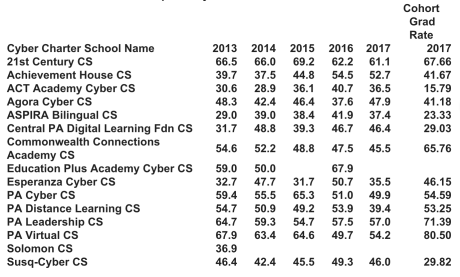
Not one of Pennsylvania’s cyber charters has achieved a passing SPP score of 70 in any of the five years that the SPP has been in effect. All 500 school districts are required to send taxpayer dollars to these cyber charters, even though none of them voted to authorize cyber charter schools and most districts have their own inhouse cyber or blended learning programs.
School Performance Profile Scores for PA Cyber Charters 2013-2017
Source: PA Department of Education website

http://www.paschoolperformance.org/

A score of 70 is considered passing.

Total cyber charter tuition paid by PA taxpayers from 500 school districts for 2013, 2014 and 2015 was over $1.2 billion; $393.5 million, $398.8 million and $436.1 million respectively.

Screen Shot 2018-05-23 at 9.09.06 PM


Lisa Haver and Deborah Grill pose this question in an incisive article in the Philadelphia Inquirer. 

There was a national media flap when billionaire investor Stephen Schwarzman offered his alma mater in Abington, Pennsylvania, $25 million in exchange for renaming the school, putting his name over six entrances, and changing the curriculum to meet his demands. Ultimately, the board refused some but not all of his requirements.

Haver and Grill worked in the Philadelphia public schools. They say, “Welcome to our world,” where the Uber-rich have owned the public schools for years and run them into the ground.

”In November 2011, the state-imposed School Reform Commission (SRC), absent any public deliberation, approved a multimillion-dollar grant from the Bill and Melinda Gates Foundation. In return, the SRC agreed to several conditions, including yearly charter expansion, implementation of Common Core standards, more school “choice” and testing, and permanent school closures. No one elected Bill Gates, typically portrayed in the media as just a very generous rich guy, to make decisions about Philadelphia’s public schools. But his mandates have had devastating and lasting effects on the district, much more than renaming one school.”

No one elected Bill Gates. An unelected board outsourced control of the Philadelphia public schools to an unaccountable billionaire. Why? Money. No evidence. No research. No wisdom. Just money. Goal: Privatization. Means: Silence the public.

“Here in Philadelphia, the Gates Compact conferred authority upon the Philadelphia School Partnership (PSP) “to provide funding …to low-performing or developing schools.” PSP has since raised tens of millions from a stable of wealthy donors; most has gone to charter schools, in keeping with Gates’ pro-privatization ideology. PSP’s influence has grown in the last seven years: the group now funds and operates teacher and principal training programs, oversees a website rating all Philadelphia schools, and holds the district’s yearly high school fair. PSP’s money, like Schwarzman’s, always comes with strings attached, whether that means changing a school’s curriculum or a complete overhaul of faculty and staff, as its 2014 grant to two North Philadelphia schools mandated.”

The PSP meetings are closed to the public. Its board members are wealthy suburbanites.

There is something to be said for democracy. Why has Philadelphia prevented its citizens from having any role in the o ersight of the public schools? Could those who have a genuine stake in them do worse than the rich dilettantes who control them now?