Archives for category: Online Education

I earlier posted Rep. Rosa DeLauro’s outspoken criticism of Secretary DeVos for diverting CARES (coronavirus relief) funds to her pet projects (anything but public schools). DeVos wants to liberate America’s students from public schools, despite the fact that the legislation does not authorize her to follow her own wishes. DeVos has this wacky idea that learning online is “student-centered,” when it is not. We already know from experience and research that virtual charter schools are typically the worst schools in every state that has them.I should have first posted the DeVos announcement:

FOR IMMEDIATE RELEASE
April 27, 2020
Contact: Press Office
(202) 401-1576 or press@ed.gov

Secretary DeVos Launches New Grant Competition to Spark Student-Centered, Agile Learning Opportunities to Support Recovery from National Emergency

States can compete for more than $300 million to rethink education by creating flexible K-12 models, developing postsecondary tools that aid economic recovery

WASHINGTON — U.S. Secretary of Education Betsy DeVos announced today more than $300 million in discretionary grant funds will be available for states to use to create adaptable, innovative learning opportunities for K-12 and postsecondary learners in response to the COVID-19 national emergency. The grants will be funded through the Education Stabilization Fund (ESF), authorized by the Coronavirus Aid, Relief, and Economic Security (CARES) Act, signed into law by President Donald J. Trump.

“If our ability to educate is limited to what takes place in any given physical building, we are never going to meet the unique needs of every student,” said Secretary DeVos. “The current disruption to the normal model is reaffirming something I have said for years: we must rethink education to better match the realities of the 21st century. This is the time for local education leaders to unleash their creativity and ingenuity, and I’m looking forward to seeing what they do to provide education freedom and economic opportunity for America’s students.”

The CARES Act provides $307.5 million for these discretionary grants, which the Department will divide between two competitions: $180 million for the Rethink K-12 School Models Grant and $127.5 million for the Reimagining Workforce Preparation Grant.

The Rethink K-12 School Models Grant is aimed at opening new, innovative ways for students to access K-12 education with an emphasis on meeting students’ needs during the coronavirus national emergency. The competition is open to state educational agencies which can apply for funds in one of the three categories:

Microgrants for families, so that states can ensure they have access to the technology and educational services they need to advance their learning
Statewide virtual learning and course access programs, so that students will always be able to access a full range of subjects, even those not taught in the traditional or assigned setting
New, field-initiated models for providing remote education not yet imagined, to ensure that every child is learning and preparing for successful careers and lives
The full Notice Inviting Applications (NIA) will be available online today.

The Reimagining Workforce Preparation Grants are designed to expand short-term postsecondary programs and work-based learning programs in order to get Americans back to work and help small businesses return to being our country’s engines for economic growth. The full NIA for this competition will be issued later this week.

Secretary DeVos continued, “Current students and displaced workers will be navigating a very different job market and economy once America reopens. This competition is a tremendous opportunity for states to think creatively and strategically about what their workforce needs will be and how to support entrepreneurs and small business in order to get the economic engines in their states firing on all cylinders again.”

Application packages for these competitions will be available within two weeks. Applicants will then have 60 days to apply. As with most of the Department of Education’s discretionary grant competitions, applications will be evaluated by a panel of independent peer reviewers, and the highest-scoring applications will be funded. For additional information about how to apply, please visit https://oese.ed.gov/offices/education-stabilization-fund/states-highest-coronavirus-burden/.

The Department continues to update http://www.ed.gov/coronavirus with information on COVID-19 for students, parents, educators and local leaders.

For more information about COVID-19, please visit the following websites: coronavirus.gov, cdc.gov/coronavirus/2019-ncov/index.html, and usa.gov/coronavirus.

Talk about taking advantage of a crisis!

The rightwing extremist Heritage Foundation has issued its own report on how to recover from the pandemic. They cover it with patriotic glitz to make it appear like a government report, which it is not. It calls itself the “National Coronavirus Recovery Commission. But it is just a self-aggrandizing report from a rightwing think tank funded by the usual suspects.

The Task Force consists of people who share the Heritage view that government is evil, as are public schools.

Tucked into its recommendations is this: eliminate public schools and certified teachers.

That will help America sink back at least a century in educating its children, perhaps even two centuries.

Perhaps you will not be surprised to learn that the lead person on education was Kevin P. Chavous, CEO of the notorious for-profit K-12 Inc. online charter chain, noted for high attrition, low graduation rates, and low test scores–and above all, high profits! In 2019, Chavous’s total compensation was $4.3 million for his estimable services. But in the nature of for-profit enterprises, there are always new worlds to conquer, new markets to open up.

On page 5:

The Commission recommends that states help families return to work with access to K–12 education by making existing education funding student-centered and portable. Many parents and guardians who now find themselves in charge of teaching and monitoring their children’s educations are unable to access the public schools they pay for through their taxes and are looking for continuity in their children’s education. States should immediately restructure per-pupil K–12 education funding to provide education savings ac- counts (ESAs) to families, enabling them to access their child’s share of state per-pupil funding to pay for online courses, online tutors, curriculum, and textbooks so that their children can continue learning. Students are currently unable to enter the K–12 public schools their parents’ taxes support. They should be able to access a portion of those funds for the remainder of the school year in the form of an ESA. Parents would receive a por- tion of their child’s per-pupil public school funding in a restricted-use account that they could then can use to pay for any education-related service, product, or provider of choice. Additionally, state restrictions on teacher certification should be lifted immediately to free the supply of online teachers and tutors, allowing anyone with a bachelor’s degree to provide K–12 in- struction online. Research suggests that there is little if any difference in student academic outcomes between teachers who are traditionally certified, alternative- ly certified, or not certified at all. States should work with school districts to reopen districts based on data about where the disease is prevalent or waning. Deci- sions about whether to keep schools closed should be medically determined by zip code, tied to districts. Dis- tricts that have low incident rates should begin plans to
reopen, and all school districts should have emergency response plans (including quick transitions to online learning) if they are forced to close again.

The Commission recommends that states remove occupational licensing requirements. States have im- posed numerous occupational licensing requirements that in many instances are simply artificial barriers to entry that can inhibit individuals’ ability to pursue en- trepreneurial work. These should be eliminated. Simi- larly, states should extend reciprocity so that licensed individuals in one state are not subject to additional requirements in the new state. Eliminating or signifi- cantly reducing occupational licensing requirements can help to get people back to work and can also provide a state with access to individuals with high-demand skills. For example, Massachusetts created a one-day approval process to license doctors with out-of-state licenses as a means to expand access to medical care in response to the virus.

Peter Greene also saw this phony “commission report” that pretends to be an official document but is just another anti-government, anti-public school self-aggrandizing piece of propaganda.

He writes:

While Trump has announced a variety of groups he wants to gather together to charter a pandemic recovery for the nation, there’s one group that is already on the job– and their plans for public education suck.

The National Coronavirus Recovery Commission– doesn’t that sound grand? It sounds like a real official government thing, only it isn’t, exactly. It’s the project of the Heritage Foundation, a right-tilted thinky tank that has been a major policy player in DC since the days of Ronald Reagan.

He notes the presence of one Kevin P. Chavous, who has made good money by running with the rightwing crowd, a sector not known for their devotion to racial equality and civil rights.

Well, look. It’s Kevin Chavous, the big cheese at K12, the 800 pound gorilla of the cyber school world, the one funded by junk bond king Michael Milken and founded by a McKinsey alum (anoter early investor– Dick DeVos). They’ve had more than their share of messes (like the time the NCAA decided K12 credits don’t count). But the Trump administration has been good times for them. And Chavous used to help run the American Federation for Children, Betsy DeVos’s dark money ed reform group, from which he called for the privatization of post-Katrina New Orleans education. Do I need to add that he has no actual education background?

Want a reason to vote for Joe Biden? Read the Heritage Foundation report with their plans for a dark future.

A wise reader, who is anonymous, posted this comment a few days ago. I thought it was wise because we hear so many Disrupters cheering about “the end of schooling as we know it” when the reality is that most parents and students can’t wait for real school to start again. You don’t hear those same voices saying that no one will ever work in an office again; no one will every go to a concert or a play; no one will ever go to a physical store. They clearly have an agenda, and their predictions are their wishes, but they fly in the face of reality. Life goes on. It is never the same after an earth-shattering event such as a pandemic. But many things will not change. Who knows? Schools may even change for the better as parents show their gratitude to teachers and their public schools, and as the backlash against distance learning grows stronger, based on experience.

He or she wrote:

No one is calling for the end of grocery stores for Instacart, restaurants for takeout, church buildings for live streaming, physical stores for their online versions, theatre/sports/concerts for streaming, conventions for talking heads on video, clubs for solo dance parties on Zoom, renting office space for work at home, theme parks for Virtual Reality machines, etc. in the advent of COVID-19. But, so many think that this is a “great opportunity” to shift students away from school buildings.

“But education is broken.” Talk to people in any other industry, and they’ll tell you about the broken parts of those too. But they aren’t using COVID as a means to COMPLETELY change it. Yes, there will be a permanent uptick in grocery delivery, online shopping, a day or two a week to work from home, and videoconferencing as some people fall in love with the platforms and get used to them. There may even be a parent in a two-parent household where one was laid off, and they figured out that they could live on one income by getting rid of one of their car payments and so they decide to do virtual school.

BUT, society will be itching to get back into going to concerts, stores, conventions, theme parks, airplanes, sitting inside of restaurants, church, to the office, and SCHOOL!

David Deming, director of the Malcolm Wiener Center for Social Policy at the Kennedy School at Harvard, warns about the possibility of substituting online learning for real teachers.

He writes in the New York Times:

As the coronavirus pandemic forces schools and college campuses to go online, the delivery model of education — largely unchanged for centuries — has suddenly been disrupted.

This may seem like the acceleration of a permanent shift toward online learning, but I have my doubts. In fact, economics tells us that technology will make in-person education more valuable than ever.

At the moment, teachers from kindergarten through graduate school are struggling to take their classes online, and the initial results are, understandably, spotty. But the longer this mass experiment continues, the more familiar remote learning will become. And, has been predicted for many years, online performances by superstars are increasingly likely to replace more pedestrian in-person lectures.

This can go only so far, because other important aspects of education are best done by teachers in more intimate settings. Educators will increasingly be tutors, mentors and role models, and economics also tells us that these features of a great education will not scale up.

Therefore, I worry not about the future of teachers but of students. I fear that on-campus learning will become an increasingly important quality differentiator, a luxury good that only students with means can afford.

Consider that online education has been around a lot longer than Covid-19. According to the latest estimates from the Department of Education, 35 percent of college students took at least one course online before the pandemic, and this share has been growing steadily for more than a decade.

This spring, schools and universities had to move courses online with only a few weeks’ notice, and the results have often been ugly. Students face significant challenges, such as spotty access to the internet or an unstable living environment.

Yet the long-term prospects for online learning are good — up to a point. Many universities already offered high-quality lectures online before this crisis, sometimes through partnerships with organization like edX and Coursera. Khan Academy has offered free courses for younger learners. The increased flexibility of online learning has been especially important when students need to balance burdens like jobs or, right now, to care for themselves or relatives who have fallen ill.

After this crisis ends, online lectures will still be increasingly valuable, because they are known in economics as “nonrival goods,” meaning they are not used up as more and more people view them. For this reason, the very best lecturers can teach everyone at the same time. This could make lesser lecturers obsolete and should, at least to some degree, generate much-needed productivity growth in education.

This seems grim for teachers, but I don’t think it will make us obsolete, for two reasons.

First, demand for education is a moving target, and as people become more prosperous they typically want better education, not worse.

So while cost is important, it’s not everything. Bending the higher-education cost curve through online lectures may seem appealing, but the point isn’t to enable everyone to learn on the cheap. Rather, people will want better education for the money, and online lectures alone won’t do it.

This explains why massive open online courses, known as MOOCs, have largely failed to disrupt traditional education despite the hype. Lectures are part of education, but they are not the best part.

Second, as online lectures become better and cheaper, the other essential components of education will take more time and energy.

Within economics this is known as unbalanced growth: the tendency for resources to shift toward parts of the economy where productivity growth is lowest. It is partly why the bulk of U.S. employment has moved away from manufacturing and into the service sector and, in education, why tuition and salaries keep rising. Precisely because they are personal, services are hard to scale up — few people are interested in mass-produced child care, for example.

The personal services provided by educators include tutoring, individualized feedback and mentoring, and numerous studies, as well as countless individual experiences, show that such services are essential for learning.

Good teachers work with students individually or in small groups to diagnose and remedy specific learning gaps. A survey of nearly 200 educational experiments found that “high dosage” tutoring — defined as groups of no more than six students meeting at least four times per week — was one of the most effective ways to improve learning. High-frequency individual feedback also greatly improves student performance.

Teachers are critically important as mentors and role models as well, the studies show. Students are more likely to complete a college degree when teachers have high expectations of them. A female instructor greatly increases the performance of women in math and science courses and their subsequent interest in STEM (science, technology, engineering and mathematics) careers.

Furthermore, racial gaps in course performance are smaller in classes taught by professors from underrepresented groups. Yet the implications of this research extend even beyond race and gender. Mentors matter for everyone, and they can have a powerful impact on students’ life choices and career success. There is simply no technological substitute for these aspects of great teaching.

Because of unbalanced growth, efficiency gains in online instruction will cause educators to shift toward more personal forms of education. Moreover, what economists call “cost disease” tells us that the price of tutoring, mentoring and direct personal intervention will rise, even as lectures are provided more efficiently online.

If these trends continue unchecked, on-campus learning and intensive interaction between teachers and students may eventually become unaffordable for all but the wealthiest institutions and, probably, the wealthiest families.

Two changes are necessary to avoid this tragedy.

First, we must broaden access to institutions that can afford a high-quality on-campus experience. Second, universities under budgetary pressure should resist the temptation to think of online learning technology only as a means of cost reduction.

It is wonderful that technology has enabled millions of students to keep learning even when direct contact is impossible. But once this crisis ends, we will be better off if technology frees up precious class time so that educators and students can engage deeply with each other and build personal connections that will last a lifetime.

During her tenure as Secretary of Education, Betsy DeVos has taught the public many lessons, most of which she did not intend. Her radical agenda educated the public about the privatization movement and its ambition to cripple public schools. She taught us that there really are people who put the profits of for-profit colleges above the students who were defrauded by them.

PeterGreene says she taught us why the Secretary of Education should be an educator.

He quotes a recent conference call that’s head with reporters. One thing is clear: she has no empathy or understanding of those who work in the schools. She is utterly indifferent to their knowledge and experience.

He writes:

Meanwhile, privatizers are chomping at the virtual bit to get students shoved into more profitable avenues of education-flavored products, like her old friends at the Heritage Foundation who are cheering her on to keep pushing the product because this is ed tech’s Katrina and by God they are going to cash in or know the reason why.

The Koch-funded Mercatus Center has more of the same. “Leverage the near-ubiquity of cellphones and internet to deliver instruction online,” but near-ubiquity is a lame measure, indeed. I imagine that none of these deep thinkers would like to be shot into space in a rocket that contains a near-ubiquity of oxygen tanks nor live in a home with a near-ubiquity of food. Worried about students with special needs? Senior policy analyst Johnathan Butcher reads the fed instructions as saying, “Give it a shot, but hey, if you have to leave them, leave them with our blessing.” Butcher adds “Parents, taxpayers, and policymakers should not allow traditional schools to claim they do not have the resources or expertise to deliver instruction online” based on God only knows what. And he touts the Florida Virtual School, Florida’s experiment in cyber-schooling that just keeps failing upward because Florida’s political leaders would rather finance a profitable turd than support public education.

In short, the amateurs are out in force, yammering about how schools should now see things their way, even though they don’t know what the hell they’re talking about.

It would be great, in the midst of all this, to be able to turn to a secretary of education who actually knew something–anything– about the inside of a classroom, who actually had a grasp of the many issues involved in the current crisis. I don’t mean to pick on DeVos, who is basically the Herbert Hoover of education right now– I can’t think of any secretary of education, not Arne “Katrina is super-duper” Duncan, not John King, not Rod Paige, not any of them, who would be worth a spoonful of rat spit right now.

But we could really use someone who knows what they’re talking about and isn’t just salivating at the chance to push some more anti-public ed policies. Of course, what any classroom teacher would know includes this– that when times get tough and crisis rear their heads, you can absolutely depend on the government bureaucrats to be largely useless, and you’d better figure out how to navigate this on your own. Which sucks, but it’s one of the many “hard things” that teachers already do, all the time.

We have known for a long while that the worst scandals in the charter sector are intertwined with online learning and cyber charters. Consider the bankruptcy last year of ECOT (the Electronic Classroom of Tomorrow) in Ohio, whose owner collected $1 billion from the state over nearly 20 years, but declared bankruptcy rather than pay the state $60 million for inflated enrollments.

Then there is the infamous A-1 scandal in California, where the owners and several cooperating school districts were indicted in San Diego nearly a year ago for the theft of $50 million from the state, a scheme that involved phantom students.

Yet here we are in the midst of a pandemic and most schools have been shutdown to protect students and staff from exposure to the coronavirus. Almost overnight, millions of students were required to continue learning by going online. The platforms are different, but tens of millions of students are engaged in distance learning.

Kathleen Porter-Magee of the Thomas B. Fordham Institute sees this asa fortuitous moment, an opportunity to revolutionize education. She calls it “A Revolution in Education, Born of a Necessity.”

She says, seize the moment.

She writes:

Said more simply: Those working “in the arena” to run great schools and support great teachers are charging full steam ahead to make the most of this period of remote learning. Those who have been quick to dismiss distance learning as “ineffective” are looking in the rearview mirror and imagining a world where past must be prologue, rather than embracing the innovation that this moment may well have sparked.

You will not be surprised to learn that I disagree. From what I see and read and hear, I believe that parents want to get back to their own work. They don’t want their children home all the time, learning at a screen. Those who want to home school are already doing it. More important, I think that students must miss their friends, their teachers, their social life, their teams and activities. Home Alone is a drag.

And then there is the inconvenient CREDO study of 2015, which found that students in virtual charter schools fell behind their peers in brick-and-mortar public schools. In a school year of 180 days, the online students lost 44 days in reading and 180 days in math.

If you want our whole society to go backwards, distance learning and cyber schooling will do it.

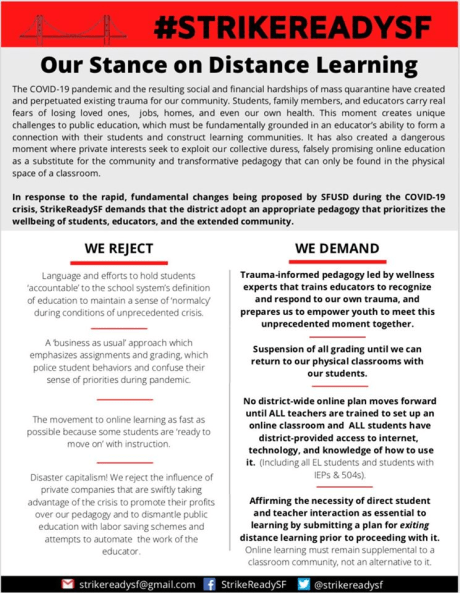
Parents, educators, and community activists in San Francisco formed an organization to protest the inequities in over reliance on distance learning. They call themselves StrikeReadySF. This is their manifesto.

distancelearning

We have been told that technology can’t be stopped and that we are heading for a jobless economy. We have been told that anyone who disagrees is an old fogey standing in the way of progress.

Peter Greene says “nonsense.”

Do you remember the predictions about 15 years ago that MOOCS would drive most institutions of higher education out of existence. Didn’t happen. Except for job-oriented and/or highly motivated persons, online instruction is boring except in small doses, monitored by a teacher.

Greene writes that venture capitalists have lost patience with self-driving trucks and cars.

As millions of parents have become involuntary home-schoolers, they see the limits of online instruction. Boredom sets in.

The Texas-based IDEA charter chain, along with the Noble Network in Chicago and the Match charter school in Boston, is trying to boost its college graduation rates by encouraging its former students who dropped out of college to enlist in an online college program where requirements are minimal. 

By partnering with Southern New Hampshire University, which enrolls tens of thousands of students from across the country in its low-cost online college programs, the charter operators are coaching students through college. The university provides the coursework and confers degrees, while an arm or affiliate of the charter networks recruits and mentors students.

The Noble charter network in Chicago launched its partnership last year, following the IDEA network in Texas and Match Charter School in Boston. Together, the three programs now enroll nearly 1,000 students, and other charter operators say they’re watching closely.

It’s a notable extension of those networks’ mission, which for years has been to send their mostly low-income students of color to college. More recently, though, it’s become harder to ignore the reality that many of their alumni are leaving higher education without degrees

If successful, these programs will provide students another chance to earn a degree that could bolster their financial futures, while also boosting the charter networks’ college completion rates…

So far, though, students in the programs have earned only a few dozen bachelor’s degrees. And the expansion of these programs worries some observers, who question whether students are getting a high-quality college experience — and whether the degrees students do earn will pay off in the job market.

IDEA launched IDEA-U in 2017 with around 40 students, including Chapa. Now, the program has around 400 students from across Texas enrolled, about half of whom are IDEA graduates.

Around 95 students are enrolled in Noble’s program, known as Noble Forward, which launched last year. Nearly all are graduates of a Noble school in Chicago.

Match’s program, initially called Match Beyond, began in 2013 by enrolling mostly Match alumni, but was spun off as a nonprofit called Duet in 2018. It now serves around 500 students who graduated from high schools across the Boston area.

The programs differ slightly, but the academics work the same way. Students enroll in one of a handful of “competency-based” degree programs offered by Southern New Hampshire University and progress by completing projects designed to show they’ve mastered key skills.

There are no lectures, professors, or class discussions, but students are assigned readings and videos. Students work at their own pace — instead of on a set academic calendar — re-submitting projects as many times as they need, though the university says students average around two tries. Their projects are evaluated by a university “reviewer” with at least a master’s degree.

Underlying question: Is the goal of this program to provide a valuable education to students or to improve the data of the sponsors?


Mr. and Mrs. Bill Gates apparently feel they are not winning enough battles in the court of public opinion, so they have created a lobbying organization to promote their ideas in Congress and state legislatures. 

Will the Gates lobby push for Common Core? For more high-stakes testing? For more federal funding for charter schools? For evaluating teachers by the test scores of their students? For more technology in the classroom?

These are but a few of Bill Gates’ failed education initiatives. Has he learned from failure or will he use his C4 lobby to push his failed ideas even more?

Bill and Melinda Gates have launched a lobbying organization to advocate for issues in health, education, and poverty, The Hill reported on Thursday.

The Gates Policy Initiative, which was announced on Thursday, will work with lawmakers on issues such as global health, global development, moving people from poverty to employment, and education for black, Latino, and rural students. The initiative, which will be a 501(c)(4) organization under the US tax code, is independent from the Bill and Melinda Gates Foundation, the billionaire couple’s philanthropic organization.

Rob Nabors, the director of the Bill and Melinda Gates Foundation and the former White House director of legislative affairs during the Obama administration, told The Hill that the Gates Policy Initiative would work in a bipartisan way.

In an article in The Hill, Rob Nabors said the new lobbying organization would reflect the work of the foundation.

Much of what they’ve learned running their foundation will help them through the process of establishing a lobbying shop.

“Probably the most important point for us is similar to the way Bill and Melinda have approached their philanthropic giving and other things that they do. They are interested in learning what works and what doesn’t work,” Nabors said.

He said that if they are not successful in a couple of years, they will “shutter the shop and figure out what else could potentially be done.”

“I think that experimental type of approach, that innovative type of approach, is both relatively unique in this space and embedded into the DNA that Bill and Melinda bring with them,” he said.

Nabors said that when he worked in the Obama White House, his job was often described as the White House chief lobbyist.

“I’m excited to get back into the mix of talking to people specifically about the work that they are doing every day, trying to put bills together that will make people’s lives better,” he said.

He added that Bill and Melinda Gates also bring a unique lens to a lobbying shop.

“They are very data-focused so a number of the types of issues that we will be exploring and the solutions that we are exploring are based on data that we collected from programs that we funded,” he added.