Archives for category: North Carolina

Public Schools First North Carolina posted the following critique of the state’s newly expanded voucher program. Before it passed, the parent-led group projected that costs would soar to $550,000,000 annually, as a result of removing income limits. Instead of “saving poor kids from failing schools,” vouchers have become a way to subsidize the tuition of students from middle-income and upper-income families who never attended any public school.

Should teachers have some type of educational background or teaching license?

Should schools that receive public dollars provide transparency for how those dollars are spent?

Should North Carolinians expect to know how well students in schools funded by tax dollars are learning?

Should we have some assurance that our tax dollars are not being used to discriminate against groups of students and/or parents?

Should the governing body (i.e. school board) of each district be elected to represent the community it serves and held accountable by voters/taxpayers?

Whether your answer to these questions is yes or no, the degree to which schools actually have policies in place or are regulated in a way to address these questions depends entirely on whether they are traditional public schools, charter schools or private schools, even though all of them may be funded by our tax dollars.

With a massive NC private school voucher program expansion in the proposed House and Senate budgets, it is worth examining which policies apply to which schools and how much the public knows about the schools they’re funding. Although more than 70% of the U.S. population lives in households without a school-aged child, having a well-educated citizenry affects everyone, so accounting for how tax dollars are spent is important.

The NC Department of Administration Division of Non-Public Education registers and monitors both conventional private schools and homeschools. Each year, the division publishes a report containing the publicly available information on private schools. It’s a thin, three page report with minimal information: number of students by school, county, and year, number and percentage of school by type (i.e. independent or religious), and number and percentage of students by sex (i.e. male or female). Taxpayers funding school vouchers see no budget on how their money is being spent and there are no public meetings or ways to the public to give input on schools procedures or policies.

No information is provided by these private schools about student achievement or population subgroups such as special education, English learner, race, ethnicity, or family income status. Lacking any such data, it’s difficult for the public to know whether students are learning or if schools are discriminating against students or families.

In fact, although voucher-accepting private schools are required to administer an achievement test each year, they are allowed to select the test, be in charge of how it is administered and the results are not made publicly available. So the public is left with no objective measure of whether students are learning anything at all.

Traditional public schools and charter schools are required to follow the state standard course of study and show the assessment results, but voucher-receiving private schools have no curriculum guidelines at all. In fact, they could even operate under an “unschooling” philosophy while accepting public tax dollars.

In traditional public schools, 100% of the teaching staff must have a license or be working toward one to provide instruction to our children. In charter schools, the requirement if that just 50% of the teacher must be certified, and in private schools the requirement drops to 0%. Teachers do not to be certified nor do they have to even have a college degree.

Traditional public schools and charter schools must also provide a minimum of 185 days (or 1,025 hours) of instruction across at least nine months. Private schools have no minimum days or hours of instruction. They are simply required to provide some instruction across nine months in a given year. Private schools are also allowed to determine their own policies and procedures for handling excessive student absences, including the maximum number of days a student may be absent and remain enrolled. Compare this to the requirement we place on public schools for students attendance and related retention policies.

Although state law does prohibit private schools from discriminating on the basis of race, color, or national origin, with no tracking mechanism in place to show that they comply or not making it a toothless requirement. And to date, state law does not require voucher-receiving private schools to follow other federal non-discrimination laws such as the Americans with Disabilities Act or Title IX. (See our report for more information), yet they would receive public tax dollars.

In contrast to the absence of private school data, the NC Department of Public Instruction makes extensive and detailed data available about student achievement, demographics, and school finances for traditional public schools and some data about charter schools. The public can find out how many students achieved a passing score on state tests, what a school or district’s demographic make-up looks like and how it has changed over time, whether students fall into special needs categories, how many disciplinary actions occurred in a given year, how much money was spent on teachers and textbooks versus facilities, and answers to just about any other question one can ask about schools. There is full transparency for tax dollars at work with public schools. Annual public audits of the financial books is required by state law and available to the public.

Traditional public school leadership is also open to public scrutiny, as the past few years have highlighted. Traditional school boards must conduct some public meetings and provide an opportunity for public comment. Not so for charter and private schools – there is no public input required or allowed.

In addition, all traditional public school board members must live within their school district and have to be elected by registered voters. These elected board members represent the communities they serve where all citizens, whether parents or not, can vote in school board elections. However, only 50% of charter school board members must reside in North Carolina and elections are not required. There are no residency or election requirements for private school board members along with no requirement that their governing boards even be shown publicly.

All North Carolinians deserve to know whether their tax dollars are being spent responsibly to create a better community for everyone. Comparing requirements between traditional public schools and private schools reveals stark differences. When tax dollars are being spent to support private schools, the public needs accountability to prevent financial fraud and poor student outcomes.

More transparency for how voucher-receiving private schools use their public funds would also help legislators make more-informed budget and policy decisions and evaluate the value of the money spent. Transparency and meaningful data are important requirements when hard-earned public tax dollars are funneled to unaccountable private schools, the same information we expect from publicly funded public schools.

Isn’t it curious that many of the same people who demanded strict accountability for public schools insist on no accountability for voucher schools?

Two Democratic legislators from Wisconsin joined the hard-right American Legislative Exchange Council (ALEC) to keep track of what their opponents were planning. They recently attended the 50th annual ALEC convention in Orlando, Florida.

ALEC has about 2,000 state legislators as members. ALEC writes model legislation on the environment, education, gun rights, and every other topic likely to be considered by state legislatures. The members take the model legislation back to their home state and introduce it after writing in the name of their state. ALEC is against gun control, against public schools, against environmental protections, etc. ALEC is funded by major corporations and acts as a voice for corporations that want no government regulation.

Erik Gunn is the deputy editor of the Wisconsin examiner, which first published this report.

Wisconsin State Reps. Francesca Hong and Kristina Shelton aren’t exactly the typical lawmakers to belong to the American Legislative Exchange Council — ALEC for short.

Hong, of Madison, and Shelton, of Green Bay, are staunch Democrats who have consistently voted against bills advancing the policies of the sort ALEC promotes. While the organization is legally nonpartisan and a tax-exempt nonprofit, it has become widely known as the birthplace of right-wing legislative proposals that find a home mainly with Republican state lawmakers around the country.

Last week, however, the two second-term Assembly members were in Orlando for ALEC’s annual meeting. It was Shelton’s second visit and Hong’s third. When they posted about their participation on social media, some followers wondered what they were doing in a crowd so ideologically at odds with their own political stances.

“I think it’s important to understand the agenda of the opposition,” Hong says. “And our current political reality requires us to know what the motivation is of our colleagues and where they’re getting model legislation from [along with] talking points, candidate training. These are all things that are available at ALEC.”

“It gives us an understanding of what’s to come,” adds Shelton — in the form of future legislation that members of the Republican majority might introduce. “And it helps us prepare as Democrats, organizing our own legislation and messaging. There’s no better way to prepare than to hear it directly from the folks on the other side….”

Hong and Shelton view themselves as carrying on a tradition among progressive Wisconsin lawmakers in joining ALEC, attending its events and going back home to report what they see and hear. Their predecessors are former state Rep. Mark Pocan, now a member of Congress, and former state Rep. Chris Taylor, now an appeals court judge.

Their name tags for the ALEC event simply identify them as Wisconsin state representatives, and Hong and Shelton say they don’t go out of their way to out themselves as Democrats — but they aren’t undercover, either…

As paying ALEC members (dues are $200 a year; conference fees are $750), they can’t be excluded on ideological grounds because of the group’s nonpartisan legal status, says Hong, who adds she has asked ALEC for its guest list “multiple times” but never received it.

Membership includes the opportunity to join two subject-matter task forces. Hong chose energy and environment as well as taxation and federalism. Shelton’s two were health and human development and education and workforce. Those sessions are where the details of proposed model legislation from the organization are outlined. They are also where the role of big business is most evident in helping to shape the organization’s proposals….

On education, Shelton says, the organization has heavily promoted school privatization proposals, including education savings accounts and universal private school vouchers, such as were included in a sweeping education bill in Arkansas, the LEARNS Act, enacted earlier this year.

“They’re no longer interested in sort of nibbling around the edges on school vouchers,” Shelton says. “They’re going all in — removing the income limits, moving to those education savings accounts, wildly expanding public investment for religious schools … [and] dismantling any sort of bureaucratic accountability measures.”

Hong says the education proposals have also been made with reference to the difficulties that employers have had filling job openings.

“The framing of it didn’t come off as full, ‘We’re attacking public schools,’” Hong says. “This is how we’re going to get more workers is to essentially make schooling and education’s sole purpose is to be producing workers.”

On economic and social policy, a persistent talking point was “about making poor people rich, not rich people poor,” she adds, while government assistance is “dragging down the economy” and “morally wrong.”

“They’re really digging into that narrative and saying that growing government to help those people is going to be the end of time,” Hong says.

To be sure, ALEC is just one of many organizations, from the AFL-CIO to the Sierra Club, that pursue policy change, sometimes constructing model legislation for that purpose. The difference, Shelton says, is that the group’s agenda doesn’t appear to her to be about policy so much as about political power.

“I think what’s different here is a sort of militant approach by those on the conservative right to not be as interested in actually solving the problems in the critical issues of working people,” she says, “but rather creating legislation to drive issues that they see as winning at the ballot box.”

Even so, a prevailing theme was diminishing the role of government and freeing corporations and business, the two Wisconsin Democrats say.

Last April, newly elected Democrat Tricia Cotham announced that she was switching from the Democratic Party to the Republican Party. This was after she had campaigned as a supporter of abortion rights, an opponent of school vouchers, and a loyal Democrat. Her betrayal of voters in her blue district shook up the state’s politics, because it meant that the hard-right Republicans in the state legislature (the General Assembly) could override the vetoes of Democratic Governor Roy Cooper.

Everyone who saw the damage wrought by Cotham wondered why she did it. She claimed that Democrats didn’t appreciate her enough. That’s a strange reason to flip positions on big issues.

The New York Times reporters Kate Kelly and David Perlmutt found out why she switched: she was wooed by powerful Republicans, encouraged to run, and flipped knowing full well that she lied to her voters.

When Tricia Cotham, a former Democratic lawmaker, was considering another run for the North Carolina House of Representatives, she turned to a powerful party leader for advice. Then, when she jumped into the Democratic primary, she was encouraged by still other formidable allies.

She won the primary in a redrawn district near Charlotte, and then triumphed in the November general election by 18 percentage points, a victory that helped Democrats lock in enough seats to prevent, by a single vote, a Republican supermajority in the state House.

Except what was unusual — and not publicly known at the time — was that the influential people who had privately encouraged Ms. Cotham to run were Republicans, not Democrats. One was Tim Moore, the redoubtable Republican speaker of the state House. Another was John Bell, the Republican majority leader…

Three months after Ms. Cotham took office in January, she delivered a mortal shock to Democrats and to abortion rights supporters: She switched parties, and then cast a decisive vote on May 3 to override a veto by the state’s Democratic governor and enact a 12-week limit on most abortions— North Carolina’s most restrictive abortion policy in 50 years…

More perplexing to many Democrats was why she did it. Ms. Cotham came from a family with strong ties to the Democratic Party, campaigned as a progressive on social issues and had even co-sponsored a bill to codify a version of Roe v. Wade into North Carolina law…

Late in March, just a few days before switching parties, she skipped a pivotal gun-control vote, helping Republicans loosen gun restrictions in the state. After she became a Republican, she sponsored a bill to expand student eligibility for private-school vouchers, voted to ban gender-affirming care for minors and voted to outlaw discussions of race or gender in state job interviews.

“This switch has been absolutely devastating,” said state Representative Pricey Harrison, a Democrat from Greensboro.

Ms. Cotham received a standing ovation at North Carolina’s state Republican convention in June. She was invited to meet privately there with Gov. Ron DeSantis of Florida and former Vice President Mike Pence.

“She’s a rock star among the Republican Party activists and voter base,” said U.S. Representative Dan Bishop, a Republican who said he encouraged Ms. Cotham to join his party and who stood behind her when she announced the decision.

There were clues that should have raised suspicions. In an earlier stint in the legislature, Cotham was loud in demanding greater accountability for charter schools. After she left the legislature, she was a lobbyist for the charter school industry. When she returned this year and flipped parties, she led the Republican demand to transfer control of charters from the State Board of Education to the General Assembly.

The move would, at first, shift independent oversight of charter schools from a board largely appointed by the governor to a board largely appointed by the General Assembly….

Cotham, a former teacher, has been a supporter of school choice. She was the president of a corporation that ran charter schools. Cotham is one of three chairs of the House Education Committee, a role she’s held since the start of the session when she was a Democrat, a rare position for a Democrat in the GOP-controlled chamber.

Real Democrats support public schools, not corporate charter chains or vouchers.

Republicans in North Carolina hold a supermajority in the state’s General Assembly after a renegade Democrat announced she was switching parties. That legislator, Tricia Cotham, betrayed the people who voted for her, thinking she supported abortion rights and opposed vouchers. After switching sides, she voted to ban abortion and to support vouchers. With a supermajority, Republicans can and do override Democratic Governor Roy Cooper’s vetoes.

In their hatred for everything public, the Republicans voted to fund capital expenses of charter schools (even though they also are passing legislation by declaring that charter schools are not public schools). Notably, they also voted to allow low-performing charters to expand! Nothing equals funding failure!! Republicans want more kids in failing charters!

Democratic North Carolina Gov. Roy Cooper on Friday vetoed a Republican-backed bill that seeks to enable big changes to the state’s charter school system, likely setting up another override battle with the GOP-led General Assembly.

House Bill 219, the “Charter Schools Omnibus,” would remove a cap on enrollment growth at low-performing charter schools and allow charter schools to automatically add enrollment and grade levels over time without state approval.

It would also allow the schools to give preference to students in certain preschools. The law currently requires admissions to be done by lottery, not by preference. And it would allow charters to enroll and charge tuition for out-of-state and foreign exchange students.

The biggest change in the bill would allow charter schools to seek taxpayer money for capital expenses, such as construction, renovation or building purchases.

Currently, charter schools must secure and finance their own buildings. State and local taxes pay for the operating costs of charters, but not for their capital needs.

Counties would be authorized to raise taxes to generate the needed funds for charters but wouldn’t be required to do so.

Supporters of the bill say it would even the playing field between charters and traditional public schools, which are already fully funded by taxpayers.

But critics say there’s not enough funding available for traditional public school capital needs as it stands.

“This bill allowing more students to attend failing charter schools risks their education and their future,” Cooper said in a statement Friday.

He said the State Board of Education should maintain oversight of charter schools’ enrollment growth.

“Diverting local resources to build charter schools without clear authority on who owns them risks financial loss to county taxpayers who have no recourse,” Cooper said.

The measure passed both General Assembly chambers with full Republican support and at least one Democratic vote, so it’s a likely candidate for a veto override when lawmakers return to business in Raleigh on Aug. 7, along with five other veto overrides on their calendars.

It’s the 14th veto of the year for Cooper. Six are awaiting override votes. The previous eight have been overridden already.

Republican legislators don’t give a hoot about students or education. They keep their eyes on what matters: profit.

A North Carolina charter school has a rule requiring girls to wear skirts, as they did in the good old days. The courts said that if they are a public school, they can’t impose such a discriminatory rule. The school insisted it was “not a state actor” and not public. As matters stand, the school can’t force girls to wear skirts.

This is a dilemma. The national charter lobby has made a point of claiming that charters are public schools and are entitled to full public funding. They call themselves “public charter schools” to make the point. I have maintained for years that charter schools are not public schools because they don’t have an elected board, they are not accountable to anyone, they make up their own rules about admissions and discipline, etc.

But North Carolina legislators want to pass a law saying that charter schools are not public schools because the owner of the charter in question is a member of the rightwing elite. If he wants girls to wear skirts, they should wear skirts.

The Fayetteville (NC) Observer reported:

The courts told a charter school near Wilmington it is a public school, and it is unconstitutional for its dress code to make girls wear skirts instead of pants.

In short: If boys can wear pants, so can girls.

In response, North Carolina legislators are trying to pass a law that says taxpayer-funded charter schools are not “state actors” — and not subject to obeying the Constitution.

Following a court ruling that said it is unconstitutional for North Carolina’s taxpayer-funded charter schools to make girls wear skirts in school instead of pants, some North Carolina lawmakers want to exempt charter schools from respecting the Constitutional rights of their students.

They seek to pass a law that says, “Actions of a charter school shall be considered as actions of private nonprofit and not of a state actor.” This is despite laws and policies that since the 1990s have said charter schools are public schools.

The legislators’ effort follows court decisions in 2022 and 2023 in Peltier v. Charter Day School, Inc., a case from the Wilmington area that made international headlines. Judges said Charter Day School’s skirts-for-girls, pants-for-boys dress code violated the female students’ Constitutional right under the 14th Amendment to be treated the same as the male students.

Justin Parmenter, a National Board Certified Teacher in North Carolina, is concerned that vouchers in his state will go to private and religious schools that discriminate when they choose their students. Republicans in the Legislature have a super-majority since a teacher elected as a Democrat—Tricia Cotham—betrayed her voters and flipped parties. Republicans ca pass whatever they want without fear of a veto. Would you want your tax money to fund a school that would not accept your own child or one where teachers speak in tongues?

He wrote recently:

As this year’s legislative session hits the homestretch, public education advocates are waiting to see whether proposed changes to North Carolina’s school voucher system become law.

On the House side, brand new Republican Rep. Tricia Cotham sponsored House Bill 823, a bill which would expand funding for vouchers by hundreds of millions of dollars a year until the annual amount going to school vouchers eclipses $500 million in school year 2032-33 and every year thereafter.

In addition to massively increasing funding for vouchers, the proposed legislation eliminates income eligibility requirements so that any student in the state–regardless of financial need–may use public money to attend private schools. That means North Carolina taxpayers will be subsidizing the tuition of wealthy families whose students already attend private schools.

A parallel bill has been filed in the Senate.

Advocates are concerned about the proposed legislation for a variety of reasons. Among them are the continued depletion of resources available to public schools; the relative lack of accountability charter and private schools have, which mean no real way to track return on investment, and; the use of public dollars to support institutions which are legally able to discriminate against children.

Federal civil rights law prohibits discrimination on a variety of grounds for institutions that receive federal funds, among them religion, sex (including sexual orientation and gender identity) and disability.

In most cases, those prohibitions do not extend to religious private schools which take in more than 90% of North Carolina’s voucher students. Many of those schools accept public tax dollars via the Opportunity Scholarship voucher program and deny admissions to LGBTQ students, students whose families practice the “wrong” religion, and students who have special needs such as learning disabilities. And many of the schools come right out and advertise their discriminatory practices in official school documents.

Here are a few examples:

Students with special needs:

Alamance Christian Academy in Graham, NC, assesses students based on their “emotional readiness,” as well as academic and behavioral histories as justification to refuse admission to students with “deficiencies.”

Southeastern Christian Academy in Shallotte, NC says “A student may be ineligible for enrollment based on achievement and/or individual learning styles. Because SCA is a private school, compliance with IEPs [Individualized Education Programs] issued by the public school system is not required.”

North Raleigh Christian Academy also discriminates against children with special needs. The school’s admissions policy states that NCRA only accepts students who score on grade level and will not admit anyone with an IQ of 90 or below. IEPs are not available at NCRA.

LGBTQ students:

Many of North Carolina’s private schools that receive millions in taxpayer funding via vouchers specifically deny admissions to LGBTQ students or vow to expel any student who is discovered to be LGBTQ after enrolling.

For example, Wesleyan Christian Academy does not accept students who are discovered to be “participating in, supporting, or condoning sexual immorality, homosexual orientation, homosexual activity, or bisexual activity; promoting such practices; or being unable to support the moral principles of the school.”

Wesleyan’s promise to exclude those students appears on the same handbook page where the school claims to seek students who are “reflective of the global community in which we live.”

Fayetteville Christian School similarly bars LGBTQ students, labeling them “deviate [sic] and perverted.”

High Point Christian Academy also accepts public funding through Opportunity Scholarship vouchers. This institution makes it clear that attendance is “a privilege and not a right,” and explains that when conduct within a student’s home diverges from “the biblical lifestyle the school teaches,” the school may refuse admission or discontinue enrollment.

Students with religious differences:

More than 90% of the students claiming public voucher dollars attend religious private schools, and the vast majority of those schools are Christian schools. While some are tolerant of religious diversity, many of them will not accept students unless they are Christian.

Freedom Christian Academy in Fayetteville only accepts students “whose home life is led by parents who have a vibrant relationship with Jesus Christ.” The student’s spiritual life must demonstrate “a relationship with Jesus Christ resulting in age-appropriate virtue and high moral character.”

Fayetteville Christian Academy, previously mentioned above for denying admissions to LGBTQ students, specifically states in its admissions requirements that it will “not admit families that belong to or express faith in non-Christian religions such as, but not limited to: Mormons (LDS Church), Jehovah’s Witnesses, Muslims (Islam), non-Messianic Jews, Hindus, Buddhists, etc.”

Research clearly shows that the most important factor in student learning outcomes is access to excellent teachers. North Carolina requires public school teachers to be licensed in order to demonstrate they have the necessary skills for the job.

Mount Zion Christian Academy in Durham does not require teachers to be licensed, but this voucher-receiving organization is proud of the fact that the school’s entire staff has demonstrated being filled with the Holy Spirit by speaking in tongues.

Public schools are proud to welcome, accept and support our students exactly as they are. It’s disappointing that North Carolina’s state legislature and “school choice” proponents are moving in the opposite direction by exponentially increasing public funding for schools that deny learning opportunities to specific students.

If you object to your public tax dollars funding institutions that discriminate in this way, please contact your state legislator and urge them to oppose expansion of the Opportunity Scholarship voucher program.

Justin Parmenter, NBCT teacher in North Carolina tweeted that the the state is funding Christian fundamentalist schools with vouchers. He identified on Christian school is not academics but devotion to the words of the Bible.

He tweeted:

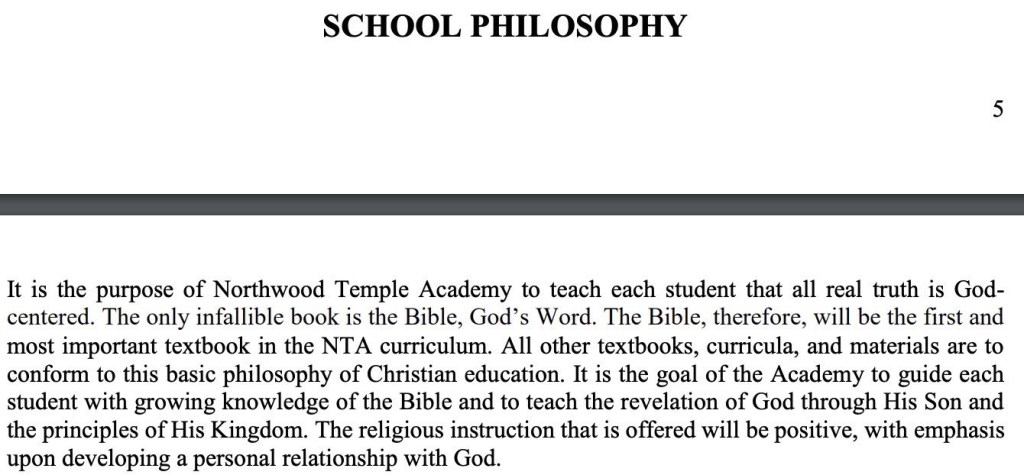
Northwood Temple Academy in Fayetteville got more than $1.1 million in NC taxpayer voucher funds this year.

Their school philosophy is “The Bible, therefore, will be the first and most important textbook in the NTA curriculum.”

They should not get public $ #nced #ncga

Matt Barnum, writing in Chalkbeat, reports that the U.S. Supreme Court declined today to rule on whether charter schools are public or private.

The case at hand was a charter school in North Carolina that required girls to wear certain types of clothing. If the school were deemed “public,” its rule would be considered discriminatory. If it were deemed “private,” the school could write its own rules about student dress.

So the question remains open, and the Court of Appeals ruling that the school could not discriminate remains in place.

The U.S. Supreme Court declined Monday to hear a case that hinged on whether charter schools are considered public or private.

The decision to punt indicates the highest court won’t offer an early hint on the validity of religious charter schools. It also leaves in place a patchwork of rulings on whether charter schools are considered private or public for legal purposes.

But the legal debates are not over.

“The issue will percolate and the Supreme Court will eventually hear a case,” predicted Preston Green, a professor of educational leadership and law at the University of Connecticut.

The case, Charter Day School. v. Peltier, focused on a dispute over a charter school’s dress code. The “classical” school in southeastern North Carolina had barred girls from wearing pants, as a part of an effort to promote “chivalry,” according to its founder.

Backed by the American Civil Liberties Union, some parents sued over this policy. They argued that the dress code amounted to sex-based discrimination and is illegal under the 14th Amendment to the U.S. Constitution. The school countered that it is not a government-run institution so is not bound by the Constitution, which does not apply to private organizations. (Charter Day also maintains that the dress code is not sexist.)

Last year, a divided circuit court sided with the parents. The majority ruled that charter schools, at least in North Carolina, are bound by the Constitution and that the dress code amounted to illegal discrimination.

The charter school appealed to the Supreme Court. Attorneys for the Biden administration argued that the lower court decision was correct and urged the court to accept that ruling. A string of conservative writers and groups had urged the court to take on the case.

On Monday, though, the Supreme Court declined to grant a hearing, leaving the circuit court decision in place. This indicates that there were not four justices who wanted to take on the case. As is typical, the court did not issue any further comment.

The case turned on whether Charter Day School is a private entity or a public “state actor.” This issue is also crucial for the brewing legal dispute over religious charter schools. If charter schools are state actors then they likely cannot be religious. If they are private, though, religious entities would have a stronger case for running charter schools. These debates will likely be tested in Oklahoma, which recently approved what could be the country’s first religious charter school. Ultimately, this may end up being sorted out via years of litigation — which could end up back at the Supreme Court.

Meanwhile, the court’s decision to pass on the case is a win for the parents who sought to change the North Carolina charter school’s dress codes.

A two-year-old boy in North Carolina found his parents’ gun and played with it while his mother was doing laundry. The gun went off, striking her in the back. She was able to call her husband and the police. She was 33 weeks pregnant. She died, as did the child she was carrying.

Republicans should really decide whether they are pro-life or pro-death.

Kris Nordstrom of the North Carolina Justice Center reports on a shocking study of the state’s voucher program. It found that a significant number of voucher schools receive more vouchers than they have students. Most of those profiting by the state’s negligence are religious schools.

Will anyone care?

He wrote:

This session, General Assembly leaders have placed a massive expansion of the state’s voucher program at the top of their education agenda. Legislative leaders in both the House and the Senate want to triple the program’s size by opening it to wealthy families who have already enrolled their children in private schools. But new data shows that the existing program lacks adequate oversight and is potentially riven with fraud.

Data from the two agencies charged with overseeing private schools and North Carolina’s Opportunity Scholarship voucher program show several cases where schools have received more vouchers than they have students. Several other private schools have received voucher payments from the state after they have apparently closed.

The Department of Administration’s Division of Non-Public Education (DNPE) compiles annual directories of active private schools. The North Carolina State Education Assistance Authority (SEAA) publishes data showing the number of voucher recipients at each private school.

An analysis of this data shows 62 times where a school received more vouchers than they had students.

For example, Mitchener University Academy in Johnston County reported a total enrollment of 72 students in 2022. That same year, the state sent them vouchers for 149 students. Based on this data, either every student received two vouchers, or the school pocketed about $230,000 of state money for students that never existed….

The actual number could be higher. Since 2015, 449 vouchers have been awarded to schools that failed to report their enrollment to DNPE.

In addition, 23 schools continued to receive vouchers after they stopped reporting to DNPE altogether. It’s unclear whether these schools were operating in the years they received vouchers. For example, Crossroads Christian School of Statesville submitted reports to DNPE from 2009 through 2019. They stopped reporting to DNPE in 2020. Yet that same year, the school received $57,300 for 15 voucher students, even though it’s unclear whether the school was operating for the entire school year.

These data discrepancies should represent a major red flag for lawmakers pushing voucher expansion. These discrepancies could represent innocent mistakes, or they could represent massive fraud. Unfortunately, lawmakers have failed to equip either DNPE or SEAA with the staff or authority to determine the reason for the discrepancies.