Archives for category: New York

Todd Kaminsky, a Democratic Assemblyman from Long Island, stated his unequivocal opposition to Governor Cuomo’s tax credit proposal–a thinly veiled voucher that will benefit children who attend religious schools. However, the election is over, and now Assemblymember Kaminsky thinks that vouchers are a swell idea.

Maybe he thought that local parents are so busy fighting high-stakes testing that they wouldn’t notice that he wants to take money from their schools and send it to yeshivas, parochial schools, and madrasahs.

During the campaign, he was a vocal opponent of vouchers and received the endorsement of the teachers’ union. He said:

““It’s something that’s not going to happen,” Kaminsky said at the time. “Last year, it did not come up for a vote in the Assembly. I don’t know if it will again, but I can tell you it’s not something I favor.”

Now the election is over and the fickle Mr. Kaminsky says, “there’s a difference between campaigning and governing….”

“Nassau County’s Five Towns area, which Kaminsky represents, has a strong and growing Orthodox Jewish community. During our conversation, the assemblyman noted the tendency of Orthodox families to have many children, which puts a strain on their education budgets.”

In response to the news that teachers in Buffalo and Cooperstown support opt out, the media has been silent, according to this comment:

“It is troubling that this news has received no coverage through Western New York’s corporate media outlets. Also noted that the only place I was informed about the Rochester Teacher Association resolution (last week) concerning parental opt out was Diane Ravitch’s blog. We will need to be creative and use digital media to get the word out to build momentum promoting OPT OUT. Help spread the word–this needs to go viral! Don’t feed the Tisch/Cuomo/King testing agenda!”

Teacher and blogger Ralph Ratto says that New Yorkers must rally to support public education:


“All across the Empire State thousands upon thousands of parents, students, business leaders, and teachers are standing up and speaking out for public education. The message is clear. We will not let Governor Cuomo destroy public education in New York.9/11 Memorial Run/Wall in Manhattan


“Andrew Cuomo, our ‘self-proclaimed student advocate’, is holding school funding hostage in his maniacal quest to sell off public education to the highest bidder. An integral part of his plan is to falsely proclaim our schools and teachers as failures.


“We have all witnessed Cuomo do the following;


“shift needed funding towards the private sector.


hand over public schools buildings room by room to privately own charter schools.


wrenched local control away from communities.


demanded unfunded mandates that are driving public school districts into fiscal distress.


destroyed teacher preparation programs.


whittled away at teacher education centers.


demanded standards that are not age appropriate for students.


forced children to undergo hours and hours of abusive high stakes tests.


labeled public sector unions as an evil force.


Let’s not forget, Cuomo was not endorsed by the New York state AFL-CIO and NYSUT. There is a reason this Democrat was shunned by labor. His agenda is anti-labor and is driven by his hedge fund millionaire campaign donors. That’s why he lost just about every county and every region in the state except for where his hedge fund millionaires poured in tons of cash.


His agenda is quite clear, he has a vendetta against those who turned their backs on him and squashed his presidential aspirations. He is willing to sacrifice the futures of the children, of the Empire State, all the while handing parts of a multi-billion dollar public asset to privateers.


As evident in his decisions to end any oversight on ethics he has ordered all of his administrations e-mail and correspondence to be purged on a regular basis. Cuomo is counting on a world of darkness and despair as he slams the door on open government. We are on to him, and he won’t get away with this.


Cuomo wants us to believe the sun in New York State Seal is setting on the era of public education and open government. It is time to stand up and speak out and tell the governor that the citizens of the Empire State will not allow that sun to set on our most important assets, our children and our public schools.Seal_of_New_York.svg


Stand Up, Speak out for public education. Let the sun shine as we share the successes of public education in New York. Nassau County’s forum- “Stand Up and Speak Out for Public Education” is on March 12 at Westbury High School.


More information can be found at https://www.facebook.com/StandUp4PublicEducation. #allkids need you to be there.

George Joseph in The Nation has written a sharply researched article about the nine billionaires who have been planning to impose their ideas on New York state since at least 2010.


They are, as you might expect, hedge fund billionaires. They have given millions of dollars to Andrew Cuomo in both his election campaigns. They have also given millions to a group called New Yorkers for a Balanced Albany that campaigned to maintain Republican control of the State Senate. Their handiwork can be seen in organizations such as Families for Excellent Schools (no, these are not families of children in the public schools, they are the families of hedge-fund billionaires), StudentsFirst, Education Reform Now, and Democrats for Education Reform. Their goal: More privately-managed charter schools.


Joseph has done a stunning job of connecting the dots, showing the collaboration among the billionaires, Joel Klein (then chancellor of the New York City public schools), and John White (then an employee of New York City public schools, now state superintendent of Louisiana).


Why do they want more charter schools? Well, you could say, as some do, that they care deeply about the poor children of New York City and want each and every one of them to be in an excellent charter school (although most charters are not willing to take certain children, like those with severe disabilities, those who don’t read and speak English, and those with behavioral problems).


But Joseph thinks there is another reason for Wall Street’s passion for charter schools. They claim that charter schools are the best way to end poverty. It is certainly cheaper to open more charter schools with state money than to pay the billions that the state owes to New York City as a result of a court decision in a case called the Campaign for Fiscal Equity.


Cuomo has said that he is tired of spending more money on the schools. We tried that, he says, and it didn’t work. But a parent advocate does not agree: “Zakiyah Ansari, a parent and public schools advocate with the labor-backed Alliance for Quality Education, called such reasoning shameful, “Why do Cuomo and these hedge funders say money doesn’t matter? I’m sure it matters in Scarsdale. I’m sure it matters where the Waltons send their kids. They don’t send their kids to schools with overcrowded classrooms, over-testing, no art, no music, no sports programs, etc. Does money only ‘not matter’ when it comes to black and brown kids?”


Joseph explores the question of why the New York hedge fund leaders are passionate about charter schools, test-based teacher evaluation, and ending teacher tenure.


He writes:


Their policy prescriptions—basing 50 percent of teacher evaluations on student test scores, for instance—are not in any way grounded in mainstream education research.


“The problem is that Cuomo’s backers aren’t paying much attention to the people who actually understand how Value-Added Modeling works,” explains Professor Julian Vasquez Heilig, an education policy researcher at California State University. “Education statisticians have come out many times saying these models are being used inappropriately and are unstable because other things happen in students’ lives outside of the teachers they encounter. When a kids’ parents in a high needs district are deported, and their achievement plummets, this actually has nothing to do with the teacher.”


Vasquez Heilig added that the reform proposals seem founded on a desire to destroy the development of long-term professional educators, rather than any empirical analysis: “We know 70 percent of teachers will bounce between high performing and low performing from year to year. So this is creating an impossible high stakes testing gauntlet between a young excited teacher and their path to quality, veteran expertise. If you’re looking for a cheap churn-and-burn teaching force, this is your policy, but if you want experienced, qualified teachers, committed to a schools’ long-term success, this is a disaster.”


From a purely business standpoint, however, such cost-effective education reform proposals do make sense for the hedge-fund community, especially given the alternative education reform option: the legally required equitable funding of New York public schools, as mandated by the state’s highest court in 2007. Low-income New York school districts haven’t received their legally mandated funding since 2009 and the state owes its schools a whopping $5.9 billion, according to a recent study by the labor-backed group Alliance for Quality Education. Yet somehow in this prolonged period of economic necessity, billionaire hedge-fund managers continue to enjoy lower tax rates than the bottom 20 percent of taxpayers.


As a recent Hedge Clippers report pointed out, the hedge-fund community has achieved these gains over the last decade and a half by buying political influence and carving out absurd breaks and loopholes in the New York state tax code. Since 2000, 570 hedge fund managers and top executives have poured $39.6 million into the campaign coffers of New York state politicians. Thus, despite New York’s progressive reputation, its school-district funding-distribution system is actually one of the most regressive nationwide, similar to that of states like Texas, North Carolina and Missouri.


According to Michael Kink, an advocate of fair share taxes with the labor-backed Strong Economy For All Coalition, “We could fund the court order completely with fair share taxes.” This would include closing the carried interest loophole that allows hedge funds to pay a smaller share of their income in taxes than, according to Hedge Clippers, “their limousine drivers, dry cleaners, servants, helicopter pilots, and doormen.” Taxing hedge fund fees and profits fairly would bring New York hundreds of millions of dollars that could go straight to local schools. A recent Hedge Clippers analysis found that fair-share taxes and fees targeting hedge funds, billionaires, high-income LLCs and major corporations could raise between $3.1 and $4.2 billion dollars per year—well over the annual minimum required by state law’s school funding formula. But Cuomo’s hedge fund–backed proposals fail to even approach these standards, instead parroting the convenient logic of corporate education reformers that the problem is not the lack of school funding, but the way in which it is spent.


“It was outrageous when the governor said the lack of school funding was not an issue,” explains New York State Senator Liz Krueger (D). “And it’s consistent with his attempts to fail to make good on the CFE lawsuit commitment, somehow ignoring the fact that the poorest-achieving schools are also the most underfunded.” Commenting on the hedge fund forces backing such proposals, Krueger continued, “I can never know what people’s actual intentions are. But it does seem that there is a pattern of spending enormous lobbying money in lobbying and attempting to influence campaigns…. Hedge funds seem in particular to have made a fine art of not paying their taxes, allowing fundamental public services to be inadequately funded.”


Putting it more explicitly, Jonathan Westin of the labor-backed New York Communities for Change, argues the main point of the hedge fund–backed education reform push is thus “about shaping and controlling the public school system so that they will continue to get away with not paying hundreds of millions in taxes.”


In this light, the hedge-fund community’s fervent advocacy of the charter-school movement reflects its neoliberal social vision for the state and society. Charter schools are imagined as institutions where students can be reshaped to prevail against structural barriers like racism and poverty. As hedge-fund billionaire Paul Tudor Jones II claimed, contrary to decades of empirical evidence, “We proved with the charter school that the achievement gap was a myth, that with the right schools, kids from the poorest neighborhoods could do every bit as well as kids from the richest ones.”


To “make up for” pervasive inequality, in lieu of correcting it, hedge-fund billionaires like Daniel Loeb of Success Academy and Larry Robbins of KIPP have promoted charter schools that envelop students in hyper-disciplined and surveilled school environments in which their every decision, down to their most minute physical movement, can be measured, assessed and addressed. This “no excuses” pedagogical approach signals to students that the only barrier to their success is their character. In other words, as Cuomo put in his the State of the State address, students under the charter school paradigm should understand their educational opportunity as “the great equalizer.”


Read the article to see the links. Everything is carefully researched and sourced. It confirms what many of us have long known about the role of Wall Street in financing privatization and other policies that hurt teachers and public schools. And it is still scary. And anti-democratic.


This resolution should be a model for the AFT and the NEA and for their affiliates. Teachers do not oppose testing; they oppose the misuse of testing. Teachers do not oppose accountability; they oppose accountability that is contrary to research and experience, whose purpose is not to improve instruction but to punish teachers for low scores.

The Rochester (NY) Teachers Association adopted the following resolution, unanimously:

RESOLUTION OF RTA REPRESENTATIVE ASSEMBLY

WHEREAS, the volume of mandated summative standardized testing to which students are subjected in the Rochester City School District (“RCSD”) has increased many times over in recent years, and

WHEREAS, a very large amount of learning time is lost through the administration of such tests, while the results of such tests cannot be used for diagnostics or remediation or other educational purposes, and

WHEREAS, such testing generates results that are used for high-stakes decision-making regarding both students (e.g., grade promotion and graduation) and their teachers (e.g., evaluation scores, tenure, retention), and

WHEREAS, the attachment of high stakes to test results necessarily makes such tests the focus of classes in schools, and

WHEREAS, such tests fail to measure the most important qualities schools should seek to develop in students, such as relationship, character, ethical development, critical thinking, persistence, imagination, insight, and collaboration, amongst others, and

WHEREAS, as a result, many students who in fact develop these valued but unmeasured qualities, but who have extreme difficulty with standardized and other paper-and-pencil tests, experience these tests as stressful to the point of abuse, and

WHEREAS, the increasing focus on such testing thus causes severe distortions of schooling, both inflicting trauma on many students and changing schools into test-prep factories that prepare students for little but further testing and lives of resigned obedience, and

WHEREAS, the commitment of substantial resources to testing and evaluation diverts those same resources from the educational needs of students, including the arts, music, other non-tested subjects, the challenges of special needs students and English language learners, moral and ethical development, social and emotional development, internships, practical and workplace skills, project-based, authentic learning opportunities, attention to contemporary cultural and social concerns, deep exploration of subject matters, and many others, and

WHEREAS, such commitment of resources also diverts resources from the professional development needs of teachers, who wish to align their skills to the real needs of students, and

WHEREAS, parents and guardians frequently express dismay that students are subjected to so much testing, and they express confusion about the rights and obligations of children and families
with respect to such testing, as well as about the rationales for the various tests, and

WHEREAS, parents, students, families, teachers, and some districts throughout the state have expressed forceful opposition to the current testing regime, and

WHEREAS, the Rochester Teachers Association (“RTA”) wishes to clarify its stance on the various issues involved with the current testing regime,

NOW, THEREFORE, BE IT
RESOLVED, that the Rochester Teachers Association declares its opposition to the use of state- or federal-mandated standardized tests for the purposes of making grade promotion, graduation, or other high-stakes decisions regarding students or teachers, and

RESOLVED, that RTA supports the right of parents and guardians to choose to absent their children from any or all state- or federal-mandated testing, and supports the right of teachers to discuss freely with parents and guardians their rights and responsibilities with respect to such testing, all without any negative consequences from RCSD, and

RESOLVED, that RTA will, to the best of its ability, support and protect members and others who may suffer any negative consequences as a result of speaking about their views of such testing or about the rights and obligations of parents and guardians with respect to such testing, and

RESOLVED, that RTA calls upon the RCSD Board of Education to direct RCSD administration to provide parents and guardians, in a timely manner, with an explanation of the rationale, intended use, and costs associated with any state- or federal-mandated tests intended to be administered to students, and to provide an explanation, in a timely manner, of the steps parents and guardians would need to take should they choose to absent their children from such testing, and

RESOLVED, that RTA calls upon the RCSD Board of Education to make a determination as to whether such testing operates in the best interests of RCSD students, and, if they conclude that it does not, to give serious consideration to deciding not to administer any or all such tests, in consultation and alliance with other districts throughout Monroe County and the State of New York, and

RESOLVED, that RTA declares its support for the professional freedom of teachers to design, administer, score and use such testing as they deem necessary or appropriate for students in their classes, in their sole professional judgment, and

RESOLVED, that RTA appoint an Ad Hoc Committee to develop proposals for new, research-based, educationally sound measures to be used for accountability purposes, that will support, rather than undermine, the RCSD’s educational mission, and that such committee shall be free to work independently or in collaboration with RCSD to such ends, and

RESOLVED, that RTA, through its officers and staff, communicate these resolutions to anyone to whom they deem it fit and proper.

Adopted unanimously on March 17, 2015 by RTA Representative Assembly
Fred Smith, a testing expert who worked for the NYC Board of Education for many years, poses an interesting question: why were three test questions quietly removed from the Pearson tests?

He writes:

“One wonders why SED [New York State Education Department] might have killed the item. Might there be no answer? Could there be more than one correct answer? Perhaps, a higher percentage of students selected one or two confusing distractors than chose the answer SED deemed to be right? Maybe the item is biased against a certain group of students. Any of the above would give it a failing grade.”

And he raises other questions:

“So, students, what do we draw from these revelations?

A) Clearly items that Pearson claimed were vetted by review panels and experts were unrefined and no better than field test items that somehow passed muster only to flop in prime time.

B) SED’s dirty secret is out of the bag: Its performance-defining cutoff scores are set after tests are given—in this case, after the raw score distribution had been studied and truncated.

C) SED plays fast and loose with data at its disposal, withholding information from the public that paid for it.

D) Efforts to classify students and evaluate teachers that rest on such shaky grounds are indefensible and unsustainable.

E) All of the above.

“E” certainly seems like the smart choice. But we can’t know for sure until an outside investigation is conducted into how SED and Pearson have run the testing program. Parents should hold their children out of all statewide tests until SED comes clean by providing complete and timely item analysis data and is able to demonstrate that the test results are relevant to the purposes they are being bent to serve—in other words, until there are meaningful alternative assessment programs in place.

“Transparency in all matters concerning educational testing is a moral imperative. We must demand passage of revised Truth-in-Testing legislation, opening the testing process to sunshine and scrutiny, restoring its balance and something immeasurable—a level of trust in educational leadership that’s been missing too long.”

* * * *

* * * *

Fred Smith, a testing specialist and consultant, was an administrative analyst for the New York City public schools. He’s a member of Change the Stakes, a parent advocacy group.

There was an enthusiastic and energetic audience of about 1,500 parents and educators at the Tilles Center for the Performing Arts on Long Island, Néw York, on March 9. Long Island is the epicenter of the Opt Out movement, which is supported by many of its superintendents.

This is the best, most factual account I have seen of that great evening. It was written by Jaime Franchi, the best education writer on Long Island and one of the best in the state.

It begins:

“Critics of the controversial education reform Common Core rallied at Long Island University Post Campus Monday in the first such organized protest on Long Island this year against the Obama administration initiative and the latest in what has been a consistent and relentless campaign among opponents to halt the contentious standardized testing examinations.

Titled “Standing Together to Save Public Education: A Call to Action,” the gathering drew more than 1,000 parents, teachers, school administrators and anti-Common Core activists, including New York Gov. Andrew Cuomo’s former gubernatorial primary challenger Zephyr Teachout, and was keynoted by renowned education policy analyst, historian and New York University professor Diane Ravitch.

Joining her onstage was a panel of distinguished educators including: South Side High School in Rockville Centre Principal Carol Burris, Comsewogue School District science teacher and Port Jefferson Station Teachers Association President Beth Dimino, Comsewogue Superintendent Dr. Joe Rella, New York State Allies for Public Education (NYSAPE) cofounder and Long Island Opt-Out Facebook administrator Jeanette Deutermann, and education advocacy group Lace to the Top cofounder Kevin Glynn, a teacher at Brookhaven Elementary School in South Country School District.

Each spoke about how the Common Core tests are damaging to children and echoed the need for attendees to “Refuse The Tests.” With more than 30,000 students across Long Island “opting out” and forgoing taking the exams last year—and with that number expected to increase significantly during the next scheduled round of exams this April—panelists found a welcoming and charged audience quick to respond with resounding applause and cheers. [Read About How Thousands Of Long Island Students Opted-Out Of Common Core Here]

“We are in the midst of a vast social experiment on the children of the nation and it is all tied to the standardized test,” Ravitch told the electrified crowd, many of whom held homemade posters and signs decrying the Common Core program.”

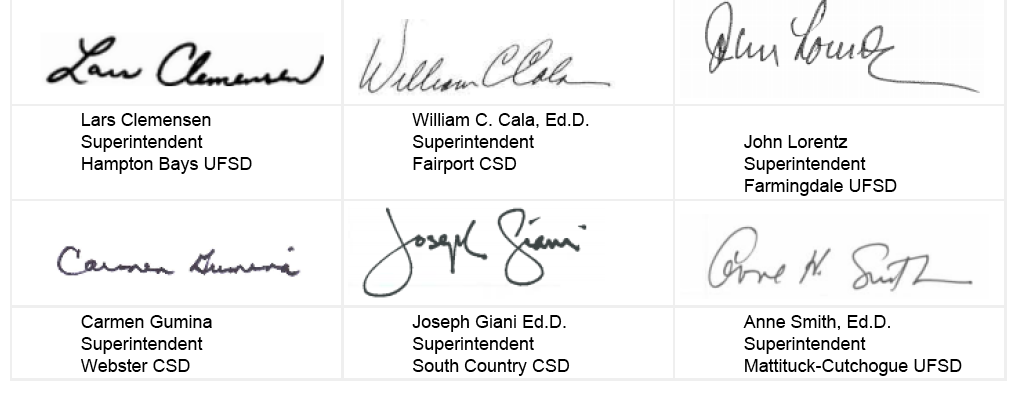
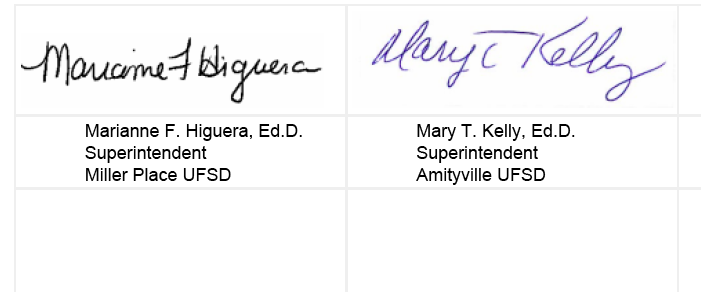
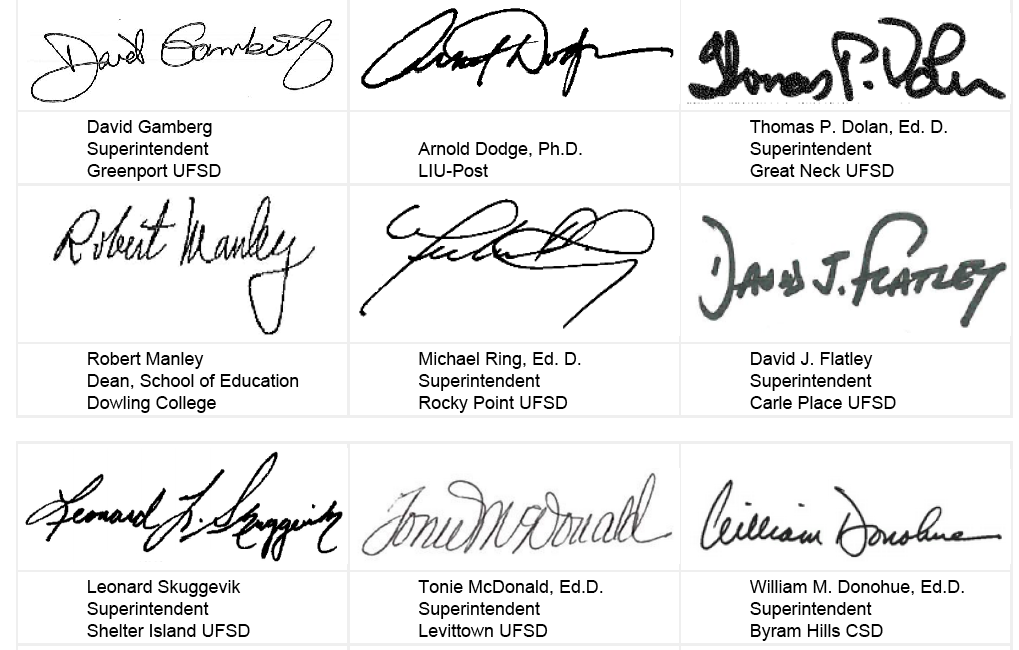
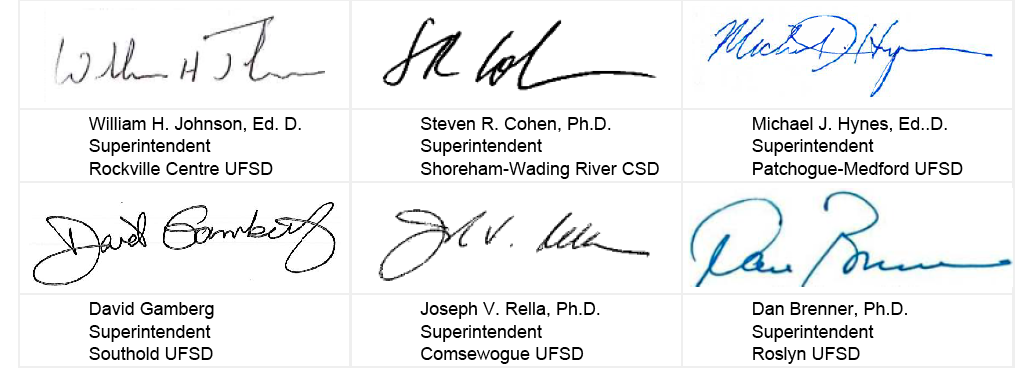
A group of school superintendents in New York banded together in late February to form The Alliance to Save Public Education.  They currently number 30 superintendents from Nassau County, Suffolk County, Westchester County, and Monroe County. They invite other superintendents from across the state to join them in signing their Declaration below. They welcome the signatures of school board presidents and leaders of parent associations as well.


Please contact your Superintendent, Board President, or PTA President to sign:


Print it, then sign the printout with a dark flair-type pen in a blank spot 


Scan & email it (or fax it) back to dgamberg@southoldufsd.com

You can download the letter to print here.


Here is the text of the letter:


March X, 2015


Dear Lawmaker:


Every day, nearly three million children and adolescents attend New York State’s public schools:  upstate and downstate, rural, urban and suburban, small, medium and large.  The variety is immense.  It may be painfully true that 109,000 students attend failing schools in New York State, but it also means that between 2.8 and 2.9 million students are attending successful schools.  Even in successful schools, we are familiar with a certain percentage of our children who fail.  We are constantly looking for ways within those systems to discover new and better methods to teach those struggling students and eliminate failure from the landscape of our public schools.  However, we must continue to support the segments of our systems that can create success.  In fact, they should be celebrated and replicated where possible.  The current effort at State reform, rather than focusing on our success and supporting what works effectively, appears to focus only on the State’s failures.  Failures can never be ignored, and do in fact need to be fixed, but not at the expense of damaging what creates our successful schools.


The Governor’s agenda is connecting the politics of State aid to education policy … AT WHAT COST?


The Governor’s agenda is removing control of our schools from our local communities … AT WHAT COST?


At what cost do we over test our students?  It must not be at the cost of our children, and our communities.


New York’s public schools include many that sustain student learning at high levels, and also some schools that fall below everyone’s expectations.  We believe the best use of our resources allows schools that work to continue to do so, and, at the same time, to support schools that need help to engage their students at the level we expect for all children.  In a state as varied as New York, a one-size-fits-all approach to school improvement is bound to damage schools that already engender students success, while dissipating the focused support that failing school require, to meet the needs of their students.


We urge the legislature to refrain from enacting the Governor’s proposals without a thoughtful debate.


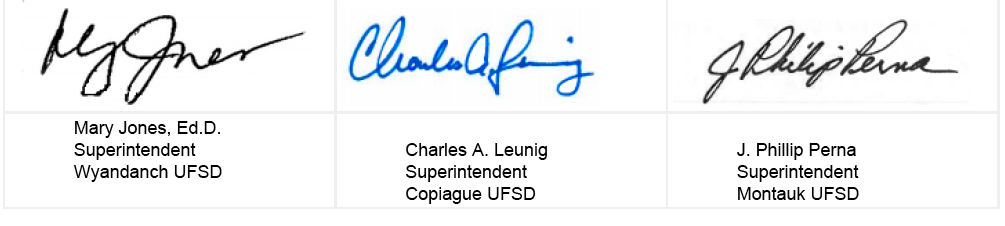
Sincerely,


Screen shot 2015-03-11 at 8.43.08 PMScreen shot 2015-03-11 at 8.43.18 PMScreen shot 2015-03-11 at 8.43.28 PMScreen shot 2015-03-11 at 8.42.50 PMScreen shot 2015-03-11 at 8.42.20 PM

There is this really cool feature about democracy. From time to time, people who have to win election to their seats in the Legislature or Congress actually pay attention to their constituents. That is happening in New York state right now. Governor Cuomo presented some truly bad ideas about how to evaluate teachers (as if he knows how to evaluate teachers), introducing tax credits for private and religious schools (aka vouchers), and expanding charters. He told parents and educators that he would not increase education aid unless his boneheaded plan was endorsed. But fortunately, we still live in a democracy, and the Legislature has made clear in recent days that they will not tie state aid to Andrew’s bad ideas. The gossip is that they will increase charters (too much money behind them to be ignored), but they will not tie state aid to acceptance of the Governor’s agenda.


See here and here. 

It is hard to laugh about Governor Cuomo’s nonsensical proposal to demoralize teachers and destabilize public schools. He wants to change teacher evaluation so that 50% of their rating is based on their students’ test scores (he doesn’t realize that most teachers don’t teach reading and math in elementary schools); he wants 35% of their evaluation to be based on the drive-by evaluation of an independent person who doesn’t work in the school; and he wants the judgment of the principal, who sees the teachers regularly, to count for only 15%. He wants more charter schools and vouchers (he calls them “tax credits”) even though neither produces better results than public schools. It makes no sense but he won’t release funds due to public schools unless the Legislature passes his harmful proposals.


Cynthia Wachtell, a scholar at Yeshiva University, is a public school parent. She has written a hilarious analysis of Governor Cuomo’s plan. Among his other ill-informed ideas is a proposal to close down the schools whose test scores place them in the bottom 5% so their students don’t have to go to failing schools anymore. She gently offers a math lesson. Sorry, Governor, there will always be a 5%.


Therein lies the math problem. If a “school is designated as ‘falling’ if it’s in the bottom 5% of schools across the state,” then, by definition, Cuomo’s goal of “no longer … condemning our children to failing schools” is impossible. The children in the bottom 5% of NYS schools will always be in ‘failing’ schools. Math will be math. And that’s just how percentages work.


She tells Governor Cuomo what his state’s public schools and students really need:


Clearly we need to improve the education received by all of “our” children. And unlike the Governor, I actually have two children in NYS public schools. The way to help my sons and other NYS students is to reduce class size; shift away from high stakes testing; offer a well-rounded curriculum rich in the sciences, technology, physical education, and the arts; and evaluate teachers in a way that takes into consideration the unique challenges of each of their classrooms. I once sat as a parent visitor in a classroom of thirty-plus sixth graders working through an ELA test prep workbook. And, sorry Andrew, it did not make me happy.